SOLVE THE CHALLENGECARD PROBLEMS TOGETHER
USING YOUR KNOWLEDGE OF PERCENTAGES.
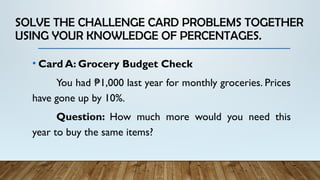
• Card A: Grocery Budget Check
You had 1,000 last year for monthly groceries. Prices
₱
have gone up by 10%.
Question: How much more would you need this
year to buy the same items?
4.
SOLVE THE CHALLENGECARD PROBLEMS TOGETHER
USING YOUR KNOWLEDGE OF PERCENTAGES.
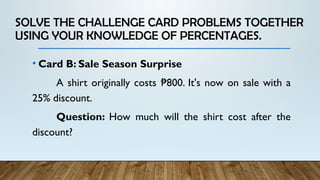
• Card B: Sale Season Surprise
A shirt originally costs 800. It's now on sale with a
₱
25% discount.
Question: How much will the shirt cost after the
discount?
5.
SOLVE THE CHALLENGECARD PROBLEMS TOGETHER
USING YOUR KNOWLEDGE OF PERCENTAGES.
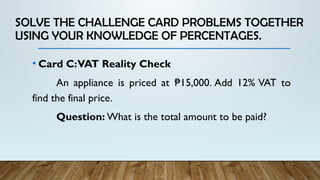
• Card C:VAT Reality Check
An appliance is priced at 15,000. Add 12% VAT to
₱
find the final price.
Question: What is the total amount to be paid?
6.
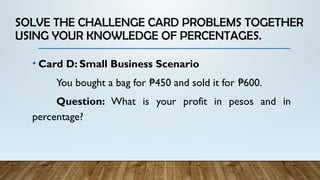
SOLVE THE CHALLENGECARD PROBLEMS TOGETHER
USING YOUR KNOWLEDGE OF PERCENTAGES.
• Card D: Small Business Scenario
You bought a bag for 450 and sold it for 600.
₱ ₱
Question: What is your profit in pesos and in
percentage?
7.
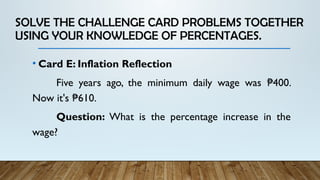
SOLVE THE CHALLENGECARD PROBLEMS TOGETHER
USING YOUR KNOWLEDGE OF PERCENTAGES.
• Card E: Inflation Reflection
Five years ago, the minimum daily wage was 400.
₱
Now it's 610.
₱
Question: What is the percentage increase in the
wage?
8.
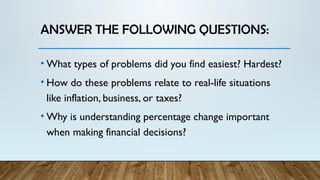
ANSWER THE FOLLOWINGQUESTIONS:
• What types of problems did you find easiest? Hardest?
• How do these problems relate to real-life situations
like inflation, business, or taxes?
• Why is understanding percentage change important
when making financial decisions?
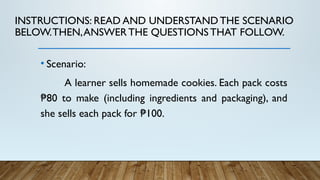
INSTRUCTIONS: READ ANDUNDERSTANDTHE SCENARIO
BELOW.THEN,ANSWERTHE QUESTIONS THAT FOLLOW.
• Scenario:
A learner sells homemade cookies. Each pack costs
80 to make (including ingredients and packaging), and
₱
she sells each pack for 100.
₱
11.
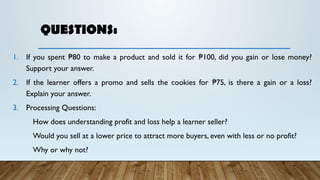
QUESTIONS:
1. If youspent 80 to make a product and sold it for 100, did you gain or lose money?
₱ ₱
Support your answer.
2. If the learner offers a promo and sells the cookies for 75, is there a gain or a loss?
₱
Explain your answer.
3. Processing Questions:
How does understanding profit and loss help a learner seller?
Would you sell at a lower price to attract more buyers, even with less or no profit?
Why or why not?
1. UNDERSTANDING PERCENTAGECHANGE
a. Introduction to Percentage Increase and Decrease
Percentage change indicates the extent to which
a quantity has increased or decreased in relation to its
original value. It is often utilized in finance, sales,
budgeting, and data analysis.
14.
1. UNDERSTANDING PERCENTAGECHANGE
b. Formula for Calculating Percentage Change
• If the result is positive, it indicates a percentage increase.
• If the result is negative, it indicates a percentage decrease.
15.
1. UNDERSTANDING PERCENTAGECHANGE
c. Interpreting Positive and Negative Percentages
• +15%: The value increased by 15% from the
original.
• -10%: The value decreased by 10% from the
original.
16.
EXAMPLES:
• Old Price:600, New Price: 650 Increase of 8.33%
₱ ₱ →
• Enrollment: 500 last year, 550 this year Increase of 10%
→
• Stock value: 120 down to 90 Decrease of 25%
₱ ₱ →
• Rent: 15,000 to 16,500 Increase of 10%
₱ ₱ →
• Savings: 8,000 to 7,200 Decrease of 10%
₱ ₱ →
17.
2. INFLATION ANDITS EFFECTS
a. What is Inflation?
Inflation is the general increase in prices of goods and services
over time, resulting in decreased purchasing power.
b. How Inflation Affects the Cost of Goods
When inflation occurs, everyday items like rice, bread, or
gasoline become more expensive, meaning your money buys less.
18.
2. INFLATION ANDITS EFFECTS
c. Adjusting Wages for Inflation
To maintain the same standard of living, wages need
to increase at a rate like inflation. If wages stay the same
while prices rise, people effectively earn less.
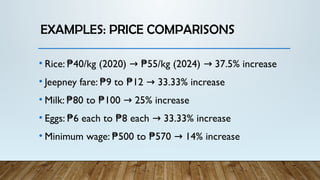
EXAMPLES: PRICE COMPARISONS
•Rice: 40/kg (2020) 55/kg (2024) 37.5% increase
₱ → ₱ →
• Jeepney fare: 9 to 12 33.33% increase
₱ ₱ →
• Milk: 80 to 100 25% increase
₱ ₱ →
• Eggs: 6 each to 8 each 33.33% increase
₱ ₱ →
• Minimum wage: 500 to 570 14% increase
₱ ₱ →
21.
3. MARK-UPS ANDDISCOUNTS IN BUSINESS
a. Difference Between Cost Price and Selling Price
Cost Price (CP): Original price paid to acquire
or produce a product
Selling Price (SP): Price at which the product is
sold to customers
22.
3. MARK-UPS ANDDISCOUNTS IN BUSINESS
b. Computing Mark-up Percentage
23.
3. MARK-UPS ANDDISCOUNTS IN BUSINESS
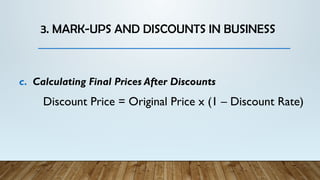
c. Calculating Final Prices After Discounts
Discount Price = Original Price x (1 – Discount Rate)
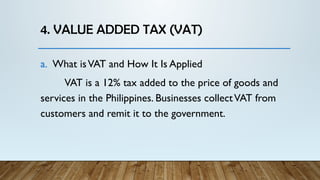
4. VALUE ADDEDTAX (VAT)
a. What isVAT and How It Is Applied
VAT is a 12% tax added to the price of goods and
services in the Philippines. Businesses collectVAT from
customers and remit it to the government.
26.
4. VALUE ADDEDTAX (VAT)
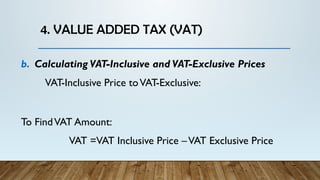
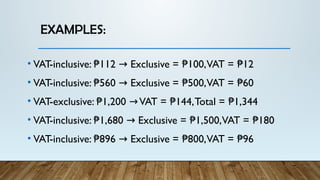
b. Calculating VAT-Inclusive and VAT-Exclusive Prices
VAT-Inclusive Price toVAT-Exclusive:
To FindVAT Amount:
VAT =VAT Inclusive Price –VAT Exclusive Price
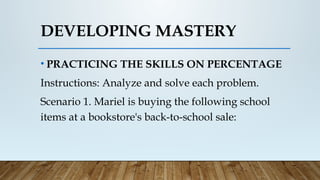
DEVELOPING MASTERY
• PRACTICINGTHE SKILLS ON PERCENTAGE
Instructions: Analyze and solve each problem.
Scenario 1. Mariel is buying the following school
items at a bookstore's back-to-school sale:
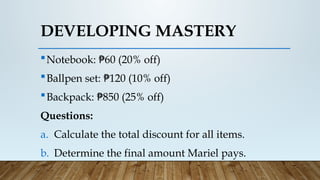
29.
Notebook: 60 (20%off)
₱
Ballpen set: 120 (10% off)
₱
Backpack: 850 (25% off)
₱
Questions:
a. Calculate the total discount for all items.
b. Determine the final amount Mariel pays.
DEVELOPING MASTERY
30.
Solution:
a. Total Discount
Notebook:60 × 20% = 12
₱ ₱
Ballpen set: 120 × 10% = 12
₱ ₱
Backpack: 850 × 25% = 212.50
₱ ₱
Total Discount = 12 + 12 + 212.50 =
₱ ₱ ₱ 236.50
₱
b. Final Amount Paid
Original total = 60 + 120 + 850 = 1,030
₱ ₱ ₱ ₱
₱1,030 − 236.50 =
₱ 793.50
₱
DEVELOPING MASTERY

 Most read