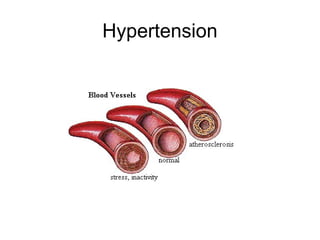
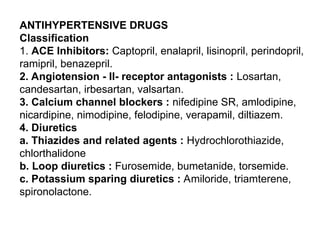
• Hypertension
• Hypertensionis the most common
cardiovascular condition.
• A persistent and sustained high blood
pressure has damaging effects on the
heart, brain, kidneys and eyes.
4.
Hypertension is generallyclassified into two
types
1. Primary or essential hypertension : In
more than 95% of cases, there is no specific
underlying cause.These patients are said to
have essential hypertension.
2. Secondary hypertension : It is seen in
about 5% of cases. It can be due to a specific
disease or drug.
5.
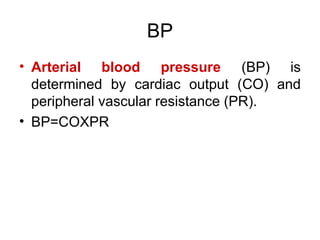
BP
• Arterial bloodpressure (BP) is
determined by cardiac output (CO) and
peripheral vascular resistance (PR).
• BP=COXPR
6.
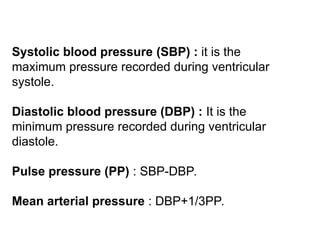
Systolic blood pressure(SBP) : it is the
maximum pressure recorded during ventricular
systole.
Diastolic blood pressure (DBP) : It is the
minimum pressure recorded during ventricular
diastole.
Pulse pressure (PP) : SBP-DBP.
Mean arterial pressure : DBP+1/3PP.
7.
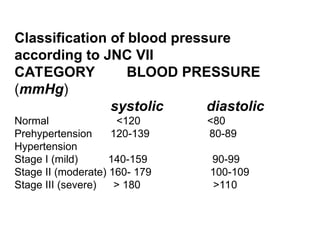
Classification of bloodpressure
according to JNC VII
CATEGORY BLOOD PRESSURE
(mmHg)
systolic diastolic
Normal <120 <80
Prehypertension 120-139 80-89
Hypertension
Stage I (mild) 140-159 90-99
Stage II (moderate) 160- 179 100-109
Stage III (severe) > 180 >110
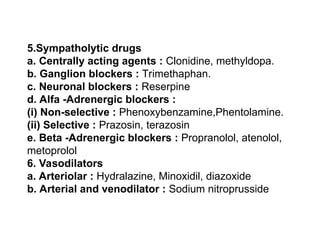
5.Sympatholytic drugs
a. Centrallyacting agents : Clonidine, methyldopa.
b. Ganglion blockers : Trimethaphan.
c. Neuronal blockers : Reserpine
d. Alfa -Adrenergic blockers :
(i) Non-selective : Phenoxybenzamine,Phentolamine.
(ii) Selective : Prazosin, terazosin
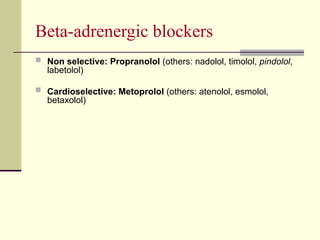
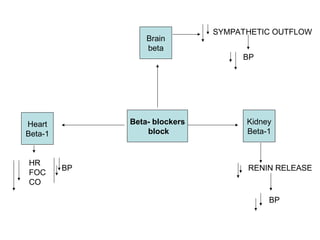
e. Beta -Adrenergic blockers : Propranolol, atenolol,
metoprolol
6. Vasodilators
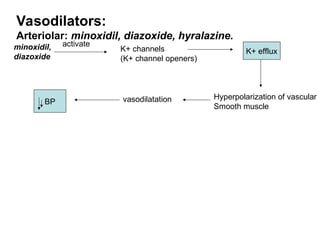
a. Arteriolar : Hydralazine, Minoxidil, diazoxide
b. Arterial and venodilator : Sodium nitroprusside
11.
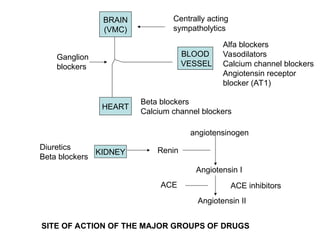
BRAIN
(VMC)
HEART
BLOOD
VESSEL
KIDNEY
Beta blockers
Calcium channelblockers
Centrally acting
sympatholytics
Ganglion
blockers
Alfa blockers
Vasodilators
Calcium channel blockers
Angiotensin receptor
blocker (AT1)
Diuretics
Beta blockers
Renin
ACE
angiotensinogen
Angiotensin I
Angiotensin II
ACE inhibitors
SITE OF ACTION OF THE MAJOR GROUPS OF DRUGS
12.
ANGIOTENSIN-CONVERTING ENZYME
INHIBITORS
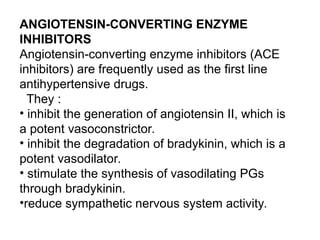
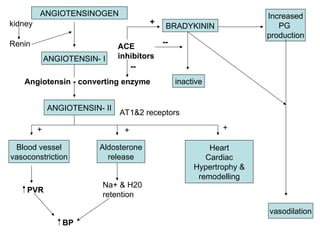
Angiotensin-converting enzymeinhibitors (ACE
inhibitors) are frequently used as the first line
antihypertensive drugs.
They :
• inhibit the generation of angiotensin II, which is
a potent vasoconstrictor.
• inhibit the degradation of bradykinin, which is a
potent vasodilator.
• stimulate the synthesis of vasodilating PGs
through bradykinin.
•reduce sympathetic nervous system activity.
13.
• ACE inhibitorsare preferred antihypertensive
agents in the younger age group.
• They are used in all forms of hypertension,
especially in patients with diabetes and CHF.
• They are preferred in patients with diabetes
because they delay or prevent the
progression of renal complications.
14.
Mechanism of action(ANGIOTENSIN-
CONVERTING ENZYME INHIBITORS )
•ACE inhibitors also reduce aldosterone
production hence reduce sodium and water
retention.
•All these actions contribute to their
antihypertensive effect.
•They dilate both arteries as well as veins,
hence they reduce afterload and prelolad.
Pharmacokinetics
•ACE inhibitors areusually given orally.
•In emergency, enalapril can be given
intravenously.
•Food reduces the absorption of captopril
hence it should be given 1 hour before meals.
•They poorly cross the BBB; metabolized in the
liver and excreted in urine
17.
Adverse effects
Cough (dryCough) is due to increased bradykinin
levels. Appearance of intractable cough is an
indication to stop the drug.
Angioedema, Proteinuria,Taste alteration
Teratogenic effect (growth retardation and
neonatal death) - hence contraindicated in
pregnancy.
Severe hypotension may occur 1-2 hours after
taking the first dose. Hence, ACE inhibitors should
be started with a small dose and then gradually
increased.
18.
Proteinuria, Rashes, Itching,Loss of
appetite, Nausea, vomiting and
diarrhoea
Hyperkalaemia may be seen in patients
with renal insufficiency and when combined
with K+ sparing diuretics.
19.
Therapeutic uses ofACE inhibitors
1.Hypertension :
•Use of ACE inhibitors reduces the incidence of heart disease
in hypertensive patients.
•ACE inhibitors are useful in all grades of hypertension.
•They prevent or retard myocardial hypertrophy and
remodeling.
2. CCF : ACE inhibitors should be prescribed to all patients
with impaired left ventricular function.
3. MI:
•ACE inhibitors should be started within 24 hours in patients
with MI.
•They have shown both short-term and long-term improvement
in survival.
20.
4. Diabetic nephropathy:
•ACE inhibitors and angiotensin-II-receptor blockers
(ARBs) are preferred drugs in diabetic nephropathy as
they control both systemic hypertension and
intraglomerular pressure.
•Therefore, ACE inhibitors are the preferred
antihypertensive in diabetics.
21.
5. Scleroderma renalcrisis :
• ACE inhibitors produce dramatic
improvement in patients with renal crisis and
accelerated by hypertension.
22.
ANGIOTENSIN II-RECEPTOR BLOCKERSOR
ANGIOTENSION-RECEPTOR ANTAGONISTS
•The two types of angiotensin II-receptors are AT1
and AT2.
•Most of the effects of angiotensin II are mediated by
AT1-receptors.
•They are: vasoconstriction, aldosterone secretion
and the release of noradrenaline from sympathetic
nerve endings.
23.
• The roleof AT2-receptors is not known. ARBs
competitively inhibit the binding of angiotension II
to AT1-receptor subtype.
• ARB’s produce effects similar to those of ACE
inhibitors.
• The efficacy and tolerability are also similar to
ACE inhibitors.
24.
• Losartan isless potent than ACE inhibitors,
whereas the ARBs, candesartan,valsartan
are equipotent to ACE inhibitors.
• ARBs do not affect bardykinin production.
25.
SIDE EFFECTS
•ARB’s arebetter tolerated as compared to ACE
inhibitors.
•They cause headache,hypotension,weakness,
rashes,nausea,vomiting and teratogenic effects.
•They may cause hyperkalaemia in patients with
renal failure or in patients on K+ sparing diuretics.
•They are less likely to produce cough or
angioedema.
•ARBs are used in hypertension,congestive
cardiac failure (CCF) and diabetic nephropathy.
26.
• The efficacyand tolerability of ARBs are similar to
those of ACE inhibitors.
• ARBs are mainly indicated in patients who develop
cough with ACE inhibitors.
• ARBs also reduce the progression of nephropathy in
patients with diabetes.
27.
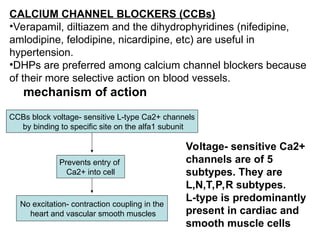
CALCIUM CHANNEL BLOCKERS(CCBs)
•Verapamil, diltiazem and the dihydrophyridines (nifedipine,
amlodipine, felodipine, nicardipine, etc) are useful in
hypertension.
•DHPs are preferred among calcium channel blockers because
of their more selective action on blood vessels.
mechanism of action
CCBs block voltage- sensitive L-type Ca2+ channels
by binding to specific site on the alfa1 subunit
Prevents entry of
Ca2+ into cell
No excitation- contraction coupling in the
heart and vascular smooth muscles
Voltage- sensitive Ca2+
channels are of 5
subtypes. They are
L,N,T,P,R subtypes.
L-type is predominantly
present in cardiac and
smooth muscle cells
28.
• The antihypertensiveeffect of DHPs is mainly
due to the reduction of total peripheral resistance.
• It causes headache, flushing, palpitation, reflex
tachycardia and even may precipitate angina or
arrhythmia.
• The use of sustained release preparations reduce
the incidence of side effects.
29.
• B-Blockers canbe used with nifedipine to
counteract the reflex tachycardia.
• Veapamil and diltiazem do not cause reflex
tachyardia because of their greater cardiac
depressant effect.
• CCBs are particularly useful in elderly patients and
also in patients with angina, asthma, peripheral
vascular disease, migraine, hyperlipidaemia,
diabetes and renal dysfunction.
Thiazide diuretics
•These areused in uncomplicated mild to moderate
hypertension and have a long duration of action.
•Potassium sparing diuretics are usually given with
thiazides to counteract the K+ loss.
32.
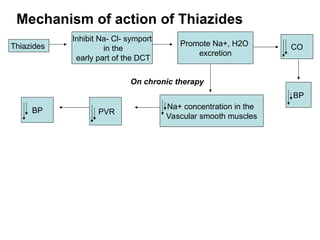
Mechanism of actionof Thiazides
Thiazides
Inhibit Na- Cl- symport
in the
early part of the DCT
CO
Promote Na+, H2O
excretion
BP
Na+ concentration in the
Vascular smooth muscles
PVR
BP
On chronic therapy
33.
Adverse effects
Hypokalaemia, hyperglycaemia,hyperuricaemia,
hyperlipidaemia, hypercalcaemia, impotence and decreased
libido.
Advantages
1. Have long duration of action
2. Thiazide diuretics are cheaper.
3. They are well tolerated even in elderly patients.
4. They decrease the incidence of fracture in elderly patients
by reducing urinary Ca2+ excretion.
Loop diuretics
These have shorter duration of action, therefore, are not used
in hypertension except in the present of renal or cardiac failure.
34.
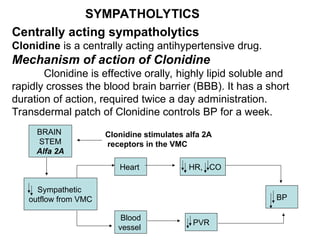
SYMPATHOLYTICS
Centrally acting sympatholytics
Clonidineis a centrally acting antihypertensive drug.
Mechanism of action of Clonidine
Clonidine is effective orally, highly lipid soluble and
rapidly crosses the blood brain barrier (BBB). It has a short
duration of action, required twice a day administration.
Transdermal patch of Clonidine controls BP for a week.
BRAIN
STEM
Alfa 2A
Clonidine stimulates alfa 2A
receptors in the VMC
Sympathetic
outflow from VMC
Heart
Blood
vessel
HR, CO
PVR
BP
35.
Adverse effects
•Dryness ofmouth and eyes, sedation, depression,
bradycardia, impotence, nausea, dizziness, parotid
gland swelling and pain are the adverse effects of
clonidine.
•Sudden stoppage of Clonidine after prolonged use
may causes withdrawal syndrome headache,
nervousness, tachycardia, sweating, tremors,
palpitation and rebound hypertension.
36.
Uses
Clonidine is used:
1.In hypertension.
2.To treat withdrawal symptoms in Opioids and
alcohol addicts.
3.As pre-anaesthetic agent.
4.To reduce postmenopausal hot flushes
5.Glaucoma
6.Prophylaxis of migraine
37.
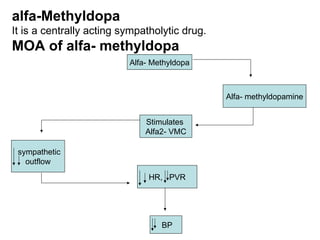
alfa-Methyldopa
It is acentrally acting sympatholytic drug.
MOA of alfa- methyldopa
Alfa- Methyldopa
Alfa- methyldopamine
Stimulates
Alfa2- VMC
sympathetic
outflow
HR, PVR
BP
38.
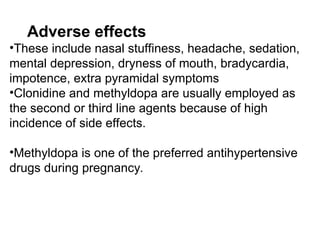
Adverse effects
•These includenasal stuffiness, headache, sedation,
mental depression, dryness of mouth, bradycardia,
impotence, extra pyramidal symptoms
•Clonidine and methyldopa are usually employed as
the second or third line agents because of high
incidence of side effects.
•Methyldopa is one of the preferred antihypertensive
drugs during pregnancy.
39.
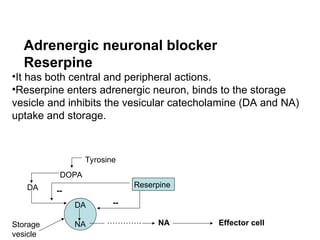
Adrenergic neuronal blocker
Reserpine
•Ithas both central and peripheral actions.
•Reserpine enters adrenergic neuron, binds to the storage
vesicle and inhibits the vesicular catecholamine (DA and NA)
uptake and storage.
Tyrosine
DOPA
DA
DA
NA
Storage
vesicle
Reserpine
--
--
Effector cell
NA
………….
40.
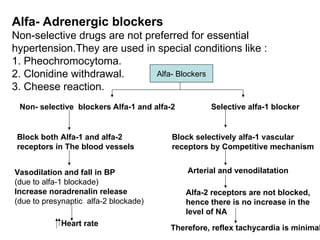
Alfa- Adrenergic blockers
Non-selectivedrugs are not preferred for essential
hypertension.They are used in special conditions like :
1. Pheochromocytoma.
2. Clonidine withdrawal.
3. Cheese reaction.
Alfa- Blockers
Non- selective blockers Alfa-1 and alfa-2 Selective alfa-1 blocker
Block both Alfa-1 and alfa-2
receptors in The blood vessels
Vasodilation and fall in BP
(due to alfa-1 blockade)
Increase noradrenalin release
(due to presynaptic alfa-2 blockade)
Heart rate
Block selectively alfa-1 vascular
receptors by Competitive mechanism
Arterial and venodilatation
Alfa-2 receptors are not blocked,
hence there is no increase in the
level of NA
Therefore, reflex tachycardia is minimal
41.
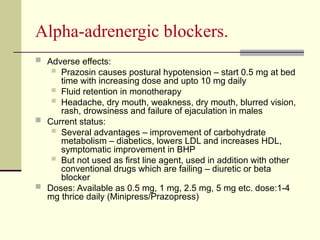
Αlpha-adrenergic blockers.
Adverseeffects:
Prazosin causes postural hypotension – start 0.5 mg at bed
time with increasing dose and upto 10 mg daily
Fluid retention in monotherapy
Headache, dry mouth, weakness, dry mouth, blurred vision,
rash, drowsiness and failure of ejaculation in males
Current status:
Several advantages – improvement of carbohydrate
metabolism – diabetics, lowers LDL and increases HDL,
symptomatic improvement in BHP
But not used as first line agent, used in addition with other
conventional drugs which are failing – diuretic or beta
blocker
Doses: Available as 0.5 mg, 1 mg, 2.5 mg, 5 mg etc. dose:1-4
mg thrice daily (Minipress/Prazopress)
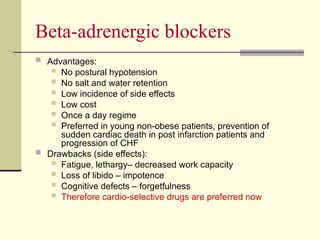
Beta-adrenergic blockers
Advantages:
No postural hypotension
No salt and water retention
Low incidence of side effects
Low cost
Once a day regime
Preferred in young non-obese patients, prevention of
sudden cardiac death in post infarction patients and
progression of CHF
Drawbacks (side effects):
Fatigue, lethargy– decreased work capacity
Loss of libido – impotence
Cognitive defects – forgetfulness
Therefore cardio-selective drugs are preferred now
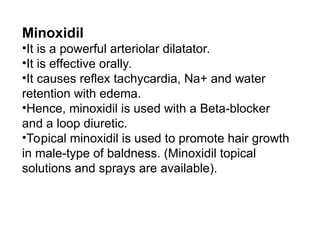
Minoxidil
•It is apowerful arteriolar dilatator.
•It is effective orally.
•It causes reflex tachycardia, Na+ and water
retention with edema.
•Hence, minoxidil is used with a Beta-blocker
and a loop diuretic.
•Topical minoxidil is used to promote hair growth
in male-type of baldness. (Minoxidil topical
solutions and sprays are available).
47.
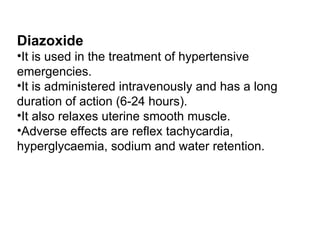
Diazoxide
•It is usedin the treatment of hypertensive
emergencies.
•It is administered intravenously and has a long
duration of action (6-24 hours).
•It also relaxes uterine smooth muscle.
•Adverse effects are reflex tachycardia,
hyperglycaemia, sodium and water retention.
48.
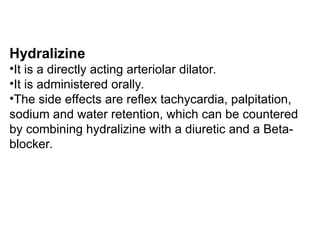
Hydralizine
•It is adirectly acting arteriolar dilator.
•It is administered orally.
•The side effects are reflex tachycardia, palpitation,
sodium and water retention, which can be countered
by combining hydralizine with a diuretic and a Beta-
blocker.
49.
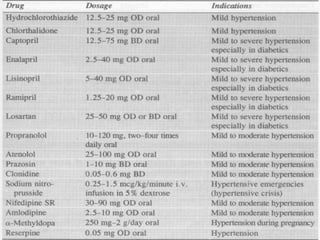
Sodium nitroprusside
•It isa powerful arteriolar and venodilator.
• It has a rapid onset and short duration of action
hence administered by i.v. infusion.
•Sodium nitroprusside is a drug of choice for
hypertensive crisis but can also be used to improve
cardiac output in CCF
50.
• Nitroprusside cancause severe hypotension,
hence close monitoring of BP is required.
• Prolonged administration may cause anorexia,
nausea and vomiting, fatigue, disorientation,
toxic psychosis due to accumulation of
cyanide, which in turn may lead to severe lactic
acidosis.
51.
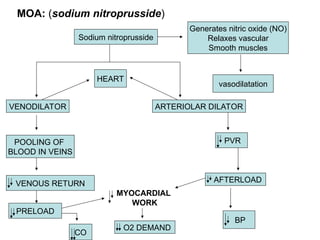
MOA: (sodium nitroprusside)
Sodiumnitroprusside
Generates nitric oxide (NO)
Relaxes vascular
Smooth muscles
vasodilatation
HEART
VENODILATOR ARTERIOLAR DILATOR
POOLING OF
BLOOD IN VEINS
VENOUS RETURN
PRELOAD
CO
MYOCARDIAL
WORK
PVR
AFTERLOAD
BP
O2 DEMAND
52.
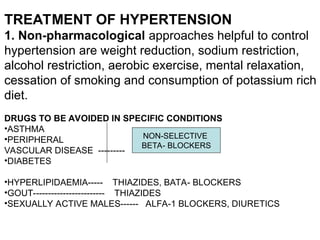
TREATMENT OF HYPERTENSION
1.Non-pharmacological approaches helpful to control
hypertension are weight reduction, sodium restriction,
alcohol restriction, aerobic exercise, mental relaxation,
cessation of smoking and consumption of potassium rich
diet.
DRUGS TO BE AVOIDED IN SPECIFIC CONDITIONS
•ASTHMA
•PERIPHERAL
VASCULAR DISEASE ---------
•DIABETES
•HYPERLIPIDAEMIA----- THIAZIDES, BATA- BLOCKERS
•GOUT------------------------ THIAZIDES
•SEXUALLY ACTIVE MALES------ ALFA-1 BLOCKERS, DIURETICS
NON-SELECTIVE
BETA- BLOCKERS
53.
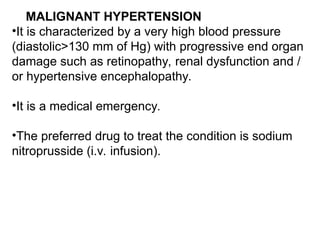
MALIGNANT HYPERTENSION
•It ischaracterized by a very high blood pressure
(diastolic>130 mm of Hg) with progressive end organ
damage such as retinopathy, renal dysfunction and /
or hypertensive encephalopathy.
•It is a medical emergency.
•The preferred drug to treat the condition is sodium
nitroprusside (i.v. infusion).
55.
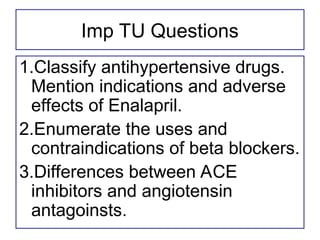
Imp TU Questions
1.Classifyantihypertensive drugs.
Mention indications and adverse
effects of Enalapril.
2.Enumerate the uses and
contraindications of beta blockers.
3.Differences between ACE
inhibitors and angiotensin
antagoinsts.
56.
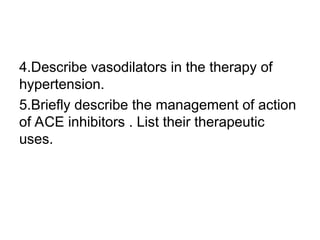
4.Describe vasodilators inthe therapy of
hypertension.
5.Briefly describe the management of action
of ACE inhibitors . List their therapeutic
uses.
Editor's Notes
#2 Hypertension means high blood pressure. High blood pressure is an increased pressure in your blood vessels, and therefore there is less space for your blood to travel through
It can be caused by many factors such as stress, high cholesterol, and inactivity.
Two classes of of hypertension. In 90-95% of patients presenting with hypertension, the cause is unknown. This condition is called primary (or essential) hypertension. The remaining 5-10% of hypertensive patients have hypertension that results secondarily from renal disease, endocrine disorders, or other identifiable causes. This form of hypertension is called secondary hypertension.
#14 Preload refers to the initial stretching of cardiac muscle cells (cardiomyocytes) at the end of diastole. Afterload is the pressure or resistance the heart ventricles must overcome to eject blood into the aorta (left ventricle) or pulmonary artery (right ventricle) during systole.
#17 Proteinuria abnormal quantities of protein in the urine, which may indicate damage to the kidneys.
#18 Proteinuria is the presence of excess protein (specifically albumin) in the urine
#20 Diabetic nephropathy is a serious, progressive kidney disease caused by type 1 or 2 diabetes, leading to kidney failure if untreated
#21 Scleroderma renal crisis (SRC) is a rare, life-threatening complication
#39 extra pyramidal symptoms;
lead to involuntary muscle movements, rigidity, tremor, and restlessness
#42 Benign Prostatic Hyperplasia (BPH), or enlarged prostate