This documents will provide a brief explaination of anti-asthamatic drugs with the classification,
after that in this presentation you will find the mechanism of action uses adverse effects of drugs.
this presentation will be helpfull for the B Pharma students.or any other competative exams.
Asthma
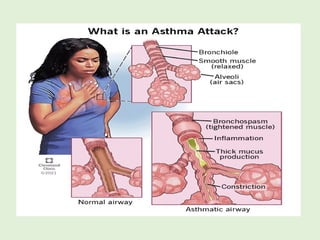
• Asthma isa chronic inflammatory disease of the airway
characterized by hyper responsiveness of trachea-bronchial
smooth muscle to variety of stimuli.
• Result into Dyspnoea ,wheezing, cough, Bronchospasm.
• Triggering factors: Infection, irritant, pollutant, cold air etc.
4.
Pathophysiology of asthma
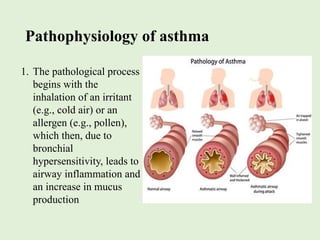
1.The pathological process
begins with the
inhalation of an irritant
(e.g., cold air) or an
allergen (e.g., pollen),
which then, due to
bronchial
hypersensitivity, leads to
airway inflammation and
an increase in mucus
production
5.
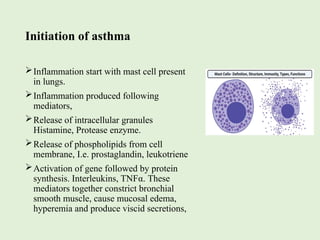
Initiation of asthma
Inflammationstart with mast cell present
in lungs.
Inflammation produced following
mediators,
Release of intracellular granules
Histamine, Protease enzyme.
Release of phospholipids from cell
membrane, I.e. prostaglandin, leukotriene
Activation of gene followed by protein
synthesis. Interleukins, TNFα. These
mediators together constrict bronchial
smooth muscle, cause mucosal edema,
hyperemia and produce viscid secretions,
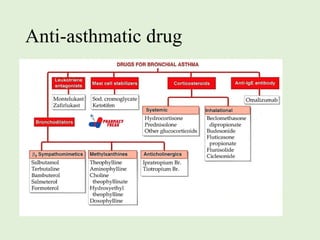
β Sympathomimetic Drug:MOA
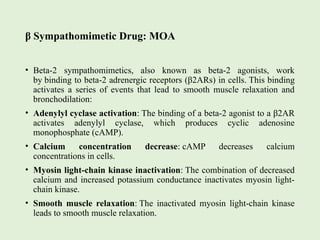
• Beta-2 sympathomimetics, also known as beta-2 agonists, work
by binding to beta-2 adrenergic receptors (β2ARs) in cells. This binding
activates a series of events that lead to smooth muscle relaxation and
bronchodilation:
• Adenylyl cyclase activation: The binding of a beta-2 agonist to a β2AR
activates adenylyl cyclase, which produces cyclic adenosine
monophosphate (cAMP).
• Calcium concentration decrease: cAMP decreases calcium
concentrations in cells.
• Myosin light-chain kinase inactivation: The combination of decreased
calcium and increased potassium conductance inactivates myosin light-
chain kinase.
• Smooth muscle relaxation: The inactivated myosin light-chain kinase
leads to smooth muscle relaxation.
8.
Bronchodilators:MOA
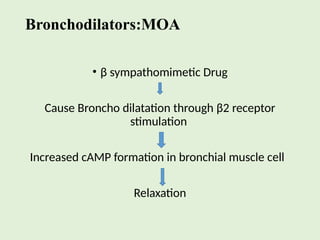
• β sympathomimeticDrug
Cause Broncho dilatation through β2 receptor
stimulation
Increased cAMP formation in bronchial muscle cell
Relaxation
9.
Salbutamol (Albuterol)
• Ahighly selective β2 agonist,
• cardiac side effects are less prominent.
• Selectivity is further increased by inhaling the drug. Inhaled
salbutamol delivered mostly from pressurized metered dose
inhaler (pMDI) produces bronchodilatation within 5 min and
the action lasts for 2–4 hours.
• It is, therefore, used to abort and terminate attacks of
asthma,
10.
Pharmacokinetics
• Oralbioavailability is 50%. Oral salbutamol acts for 4–6
hours, is longer acting and safer than isoprenaline, but not
superior in bronchodilator efficacy. Salbutamol undergoes
presystemic metabolism in the gut wall,
Side effects
• Muscle tremors are the dose related side effect.
• Palpitation,
• restlessness,
• nervousness,
• throat irritation and ankle edema can also occur.
Hypokalaemia is a possible complication.
11.
Uses
• Salbutamol isused to relieve symptoms of asthma and
chronic obstructive pulmonary disease (COPD) such as
coughing,
• wheezing and
• feeling breathless.
• It works by relaxing the muscles of the airways into the
lungs, which makes it easier to breathe.
12.
METHYL XANTHINES
• Theophyllineand its compounds have been extensively used
in asthma, but are not considered first line drugs any more.
• They are used more often in COPD.
• Theophylline is one of the three naturally occurring
methylated xanthine alkaloids caffeine, theophylline and
theobromine.
13.
Pharmacological actions
• CNS: Caffeine and theophylline are CNS stimulants, primarily affect
the higher centres. Caffeine 150–250 mg produces a sense of wellbeing,
alertness, beats boredom, allays fatigue, thinking becomes clearer even
when dullness has tended to prevail after a sustained intellectual effort.
• CVS: Methylxanthines directly stimulate the heart and increase force of
myocardial contractions.
• They tend to increase heart rate by cardiac action,
• Smooth muscles: All smooth muscles are relaxed, most prominent effect
is exerted on bronchi, especially in asthmatics. Theophylline is more
potent than caffeine. Slow and sustained dose-related bronchodilatation
is produced, but the effect is much less marked compared to inhaled β2
agonists.
14.
Mechanism of action
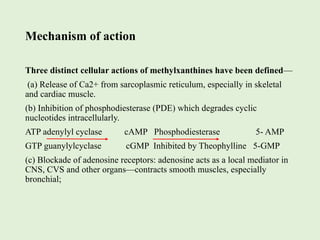
Threedistinct cellular actions of methylxanthines have been defined—
(a) Release of Ca2+ from sarcoplasmic reticulum, especially in skeletal
and cardiac muscle.
(b) Inhibition of phosphodiesterase (PDE) which degrades cyclic
nucleotides intracellularly.
ATP adenylyl cyclase cAMP Phosphodiesterase 5- AMP
GTP guanylylcyclase cGMP Inhibited by Theophylline 5-GMP
(c) Blockade of adenosine receptors: adenosine acts as a local mediator in
CNS, CVS and other organs—contracts smooth muscles, especially
bronchial;
15.
Theophylline
• Pharmacokinetics: Theophyllineis well absorbed orally; rectal absorption from
suppositories is erratic. It is distributed in all tissues—crosses placenta and is secreted
in milk,
• 50% plasma protein bound and extensively metabolized in liver
• t½ in adults is 7–12 hours. Children eliminate it much faster (t½ 3–5 hours)
• Adverse effects :
• Theophylline has a narrow margin of safety.
• Dose-dependent toxicity starts from the upper part of therapeutic concentration
range.
• Adverse effects are primarily referable to the g.i.t.,
• CNS and CVS.
• Headache, nervousness and nausea are early symptoms.
• Children are more liable to develop CNS toxicity
16.
Uses
• Theophylline isused together with other medicines to treat the
symptoms of asthma, bronchitis,
• emphysema,
• And other lung diseases.
17.
Leukotrienes antagonist
• Cystenylleukotrienes (LT-C4/D4) are important mediators of bronchial
asthma, Two cysLT1 receptor antagonists montelukast and zafirlukast
are available.
• Montelukast and Zafirlukast Both have similar actions and clinical
utility.
• They competitively antagonize cysLT1 receptor mediated
bronchoconstriction, airway mucus secretion, increased vascular
permeability.
• Bronchodilatation, reduced sputum eosinophil count, suppression of
bronchial inflammation, mucus and hyperreactivity are noted in asthma
patients
18.
Pharmacokinetics
• They arewell absorbed orally, highly plasma protein bound
and metabolized by CYP2C9 (montelukast by CYP3A4 as
well).
• The plasma t½ of montelukast is 3–6 hours, while that of
zafirlukast is 8–12 hours
• Side effects
• like headache and rashes.
• Eosinophilia and neuropathy are infrequent.
• Few cases of Churg-Strauss syndrome (vasculitis with
eosinophilia) have been reported.
19.
MAST CELL STABILIZERS
Sodiumcromoglycate
• It is a synthetic chromone derivative which inhibits
degranulation of mast cells trigger stimuli.
• Release of mediators of asthma like histamine, LTs,
PAF, interleukins, etc. is restricted.
• The basis of this effect is not well understood, but may
involve a delayed Cl¯ channel in the membrane of these
cells.
• Bronchospasm induced by allergens, irritants, cold air
and exercise may be decrease.
20.
Pharmacokinetics
• Sod. cromoglycateis not absorbed orally.
• It is administered as an aerosol through metered dose inhaler delivering
1 mg per dose:
• 2 puffs 4 times a day.
• Only a small fraction of the inhaled drug is absorbed systemically
Uses
1. Bronchial asthma:
2. Allergic rhinitis:
3. Allergic conjunctivitis:
21.
Corticosteroids
• The adrenalcortex secretes steroidal hormones which have
glucocorticoid, mineralocorticoid and weakly androgenic
activities.
• Glucocorticoids are not bronchodilators.
• They benefit by reducing bronchial hyper reactivity, mucosal
edema and by suppressing inflammatory response to AG:AB
reaction or other trigger stimuli
22.
Hydrocortisone (cortisol)
• Actsrapidly but has short duration of action.
• In addition to primary glucocorticoid, it has significant
mineralocorticoid activity as well.
• Used for: Replacement therapy—20 mg morning + 10 mg afternoon
orally.
• Shock, status asthmaticus, acute adrenal insufficiency—100 mg i.v.
bolus + 100 mg 8 hourly i.v. infusion.
• Topically and as suspension for enema in ulcerative colitis
23.
INHALED STEROIDS
• Theseare glucocorticoids with high topical and low
systemic activity (due to poor absorption and/ or marked
first pass metabolism).
• Beclomethasone dipropionate, Budesonide and Fluticasone
have similar properties.
• Inhaled steroids suppress bronchial inflammation, increase
peak expiratory flow rate, reduce need for rescue β2-agonist
inhalations and prevent episodes of acute asthma.
24.
• Peak effectis seen after 4–7 days of instituting inhaled
steroids and benefit persists for a few weeks after
discontinuation.
25.
ANTI-IgE ANTIBODY
• Omalizumab
•It is a humanized monoclonal antibody against IgE.
Administered s.c.,
• it neutralizes free IgE in circulation without activating mast
cells and other inflammatory cells.
• On antigen challenge, little IgE is available bound to the
mast cell surface receptors (FcεR1) to trigger mediator
release and cause bronchoconstriction.
• In severe extrinsic asthma, omalizumab has been found to
reduce exacerbations and steroid requirement.
• No benefit has been noted in nonallergic asthma. It is very
expensive.
26.
use
• Used inresistant asthma patients with positive skin tests or
raised IgE levels who require frequent hospitalization.
• It is being tried in other allergic reaction.
 Most read