Antianginal drug
Prof.S.A.Bhagat
Assistant professor
DRGIOP,Amravati
Angina pectoris
• Angina pectoris is a symptom of ischaemic heart disease.
• It is due to an imbalance between oxygen supply and oxygen
demand of the myocardium.
• Angina pectoris is characterized by sudden severe chest pain
or heaviness radiating to the neck, jaw and arm.
There are three types of Angina :
1. Stable Angina
2. Unstable Angina
3. variant angina
Stable Angina
• Attacks are predictably provoked by exercise, emotion etc.
• It lasts for several seconds and subsides on rest.
“Stable” indicates the reproducible nature of the angina; the
same activity at the same intensity faithfully produces
symptoms.
Unstable Angina
• The unstable angina is characterized by recurrent attacks of
angina.
• It occurs with minimal exertion.
It is precipitated due to combination of athero scleroti-
plaque, platelet aggregation at ruptured plaque and vasospasm.
Variant Angina
• This is a relatively uncommon pattern of myocardial ischemia
usually occurring at rest or during sleep and often in young
individuals.
• It is induced by coronary artery vasospasm, it generally
responds promptly to vasodilators.
Pathophysiology
• O supply increases due to
₂
• ↑ Heart rate
• ↑ Ventricular contractility
• ↑ Ventricular wall tension
• O supply decrease due to
₂
Coronary atherosclerosis
Coronary vasospasm Coronary
thrombosis
Treatment strategies
• Decrease O demand
₂
• By decreasing workload
on heart
• By decreasing preload –
nitrates
• By decreasing afterload -
CCBs, K+ channel opens
• By decreasing best rate
and contractibility of beta
blockers
• Increase O supply
₂ Restore
coronary blood flow
• Relieves the vasospasm by
drugs CCB/nitrates
• Break the thrombi using
thrombolytic agents -
Streptokinase, Urokinase
• Prevent thrombus formation
by using - antiplatelet drugs.
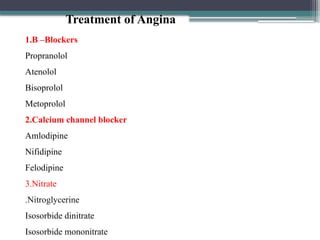
1.B –Blockers
Propranolol
Atenolol
Bisoprolol
Metoprolol
2.Calcium channel blocker
Amlodipine
Nifidipine
Felodipine
3.Nitrate
.Nitroglycerine
Isosorbide dinitrate
Isosorbide mononitrate
Treatment of Angina
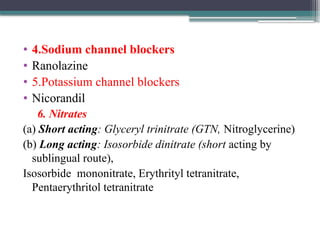
• 4.Sodium channel blockers
• Ranolazine
• 5.Potassium channel blockers
• Nicorandil
6. Nitrates
(a) Short acting: Glyceryl trinitrate (GTN, Nitroglycerine)
(b) Long acting: Isosorbide dinitrate (short acting by
sublingual route),
Isosorbide mononitrate, Erythrityl tetranitrate,
Pentaerythritol tetranitrate
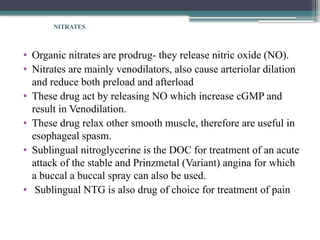
NITRATES
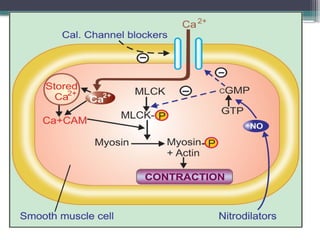
• Organic nitrates are prodrug- they release nitric oxide (NO).
• Nitrates are mainly venodilators, also cause arteriolar dilation
and reduce both preload and afterload
• These drug act by releasing NO which increase cGMP and
result in Venodilation.
• These drug relax other smooth muscle, therefore are useful in
esophageal spasm.
• Sublingual nitroglycerine is the DOC for treatment of an acute
attack of the stable and Prinzmetal (Variant) angina for which
a buccal a buccal spray can also be used.
• Sublingual NTG is also drug of choice for treatment of pain
• Preload reduction: Nitrates dilate vein more than arteries → peripheral
pooling of blood decrease venous return i.e. preload on heart is reduced end
diastolic size and pressure are reduced.
• Afterload reduction: Nitrates also produce some arteriolar dilation → slightly
decrease total peripheral resistance (TPR) or afterload on heart.
• Mechanism of relief of angina The relaxant effect on larger coronary vessels
is the principal action of nitrates benefiting variant angina by
counteracting coronary spasm.
• Heart and peripheral blood flow Nitrates have no direct stimulant or
depressant action on the heart. They dilate cutaneous and meningeal vessels
causing headache. renal blood flow decreases to compensate for
vasodilatation in other areas.
• Other smooth muscles Bronchi, biliary tract and esophagus are mildly
relaxed. Effect on intestine, uterus is variable and insignificant.
Pharmacological action of nitrate
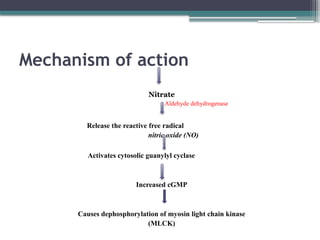
Mechanism of action
Nitrate
Aldehyde dehydrogenase
Release the reactive free radical
nitric oxide (NO)
Activates cytosolic guanylyl cyclase
Increased cGMP
Causes dephosphorylation of myosin light chain kinase
(MLCK)
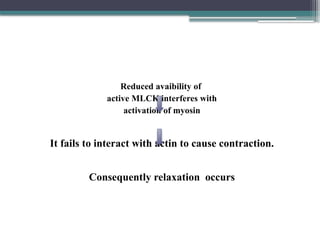
Reduced avaibility of
active MLCK interferes with
activation of myosin
It fails to interact with actin to cause contraction.
Consequently relaxation occurs
Pharmacokinetics
• Organic nitrates are lipid soluble
• well absorbed from buccal mucosa, intestines
• and skin. all are Ingested orally,
• except isosorbide mononitrate undergo extensive and variable
first pass metabolism in liver.
Adverse effects
 headache
 Flushing,
 weakness,
 sweating,
 palpitation,
 dizziness
 Methemoglobinemia
 anaemia,
 Rashes
INTERACTION
• Nitrate x Sildenafil → Serve hypotension
• Nitrate x Alcohol → Serve hypotension
Therapeutic uses of nitrates
• Tightness or pain in chest
• Angina pectoris
• Myocardial infarction
• Congestive heart failure
• Biliary colic and esophageal spasm
• Acute coronary syndrome
β BLOCKERS
• -blockers have slow onset of action and are useful in angina
ẞ
prophylaxis.
• They act by decrease cardiac work & 02 consumption.
• They decrease total coronary blood flow (due to blockage of
dilator B, receptor).
PHARMACOKINETICS
 Propranolol is well absorbed after oral administration, but has
low bioavailability due to high first pass metabolism in liver
 Metabolism of propranolol is dependent on hepatic blood
flow.
 Bioavailability of propranolol is higher when it is taken with
meals because food decreases its first pass metabolism.
PHARMACOLOGICAL ACTIONS
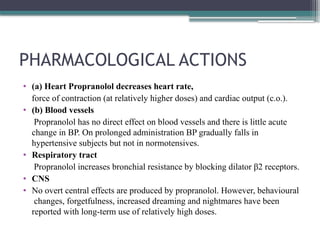
• (a) Heart Propranolol decreases heart rate,
force of contraction (at relatively higher doses) and cardiac output (c.o.).
• (b) Blood vessels
Propranolol has no direct effect on blood vessels and there is little acute
change in BP. On prolonged administration BP gradually falls in
hypertensive subjects but not in normotensives.
• Respiratory tract
Propranolol increases bronchial resistance by blocking dilator β2 receptors.
• CNS
• No overt central effects are produced by propranolol. However, behavioural
changes, forgetfulness, increased dreaming and nightmares have been
reported with long-term use of relatively high doses.
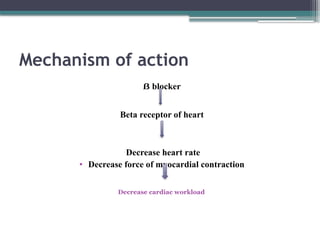
Mechanism of action
blocker
ẞ
Beta receptor of heart
Decrease heart rate
• Decrease force of myocardial contraction
Decrease cardiac workload
ADVERSE EFFECTS
• Bradycardia
• CHF/edema
• Cold hands and feet,
• g.i.t. upset,
• nightmares,
• forgetfulness,
• rarely hallucinations
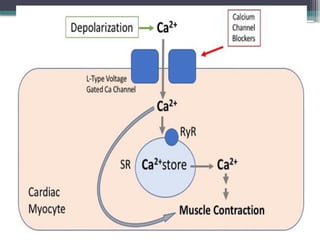
CALCIUM CHANNEL BLOCKER
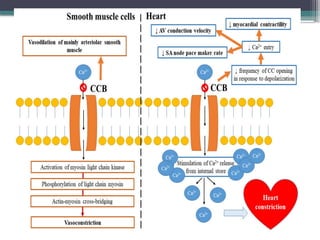
The property of CCBs is to inhibit Ca2+ mediated slow
channel component of action potential (AP) in smooth/
cardiac muscle cell. The two most important
Actions of CCBs are:
(i) Smooth muscle (especially vascular) relaxation.
(ii) Negative chronotropic, inotropic effect on heart.
PHARMACOKINETICS
All are 90–100% absorbed orally, peak occurring
at 1–3 hr (except amlodipine 6–9 hr).
The oral bioavailability of Ca2+ channel blockers is
incomplete with marked inter- and intra-individual
variations.
This is due to high first pass metabolism
All are highly plasma protein bound (min.: diltiazem
80%, max.: felodipine 99%).
USES
Angina pectoris All CCBs are effective in reducing frequency
and severity of classical as
well as variant angina.
Hypertension All DHPs, diltiazem and verapamil are among the
first line drugs for
hypertension
Cardiac arrhythmias Verapamil and diltiazem
are highly effective in supraventricular arrhythmias
Hypertrophic cardiomyopathy
Other uses Nifedipine is an alternative drug
for premature labour
POTASSIUM CHANNEL OPENERS
• Minoxidil and diazoxide are K+ channel openers
• which were used earlier in severe hypertension
and hypertensive emergencies.
• Novel K+ channel openers like nicorandil
Nicorandil
This dual mechanism antianginal
drug activates ATP sensitive K+ channels (KATP)
thereby hyperpolarizing vascular smooth muscle.
The vasodilator action is partly antagonized by
K+ channel blocker. Like nitrates
it also acts as a NO donor—relaxes blood vessels
by increasing cGMP. Thus, arterial dilatation is
coupled with venodilatation.
Mechanism of action
•
• Pottasium channel opener
Open K ATP
Enhance K + Efflux
Membrane hyperpolarization
Reduce Ca+ entry
Reduced intracellular calcium & caused
Muscle relaxation
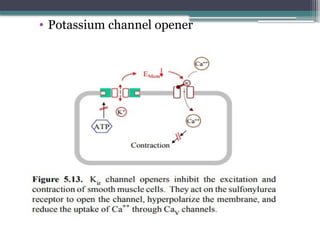
• Potassium channel opener
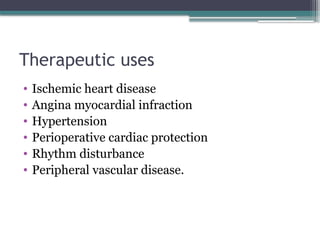
Therapeutic uses
• Ischemic heart disease
• Angina myocardial infraction
• Hypertension
• Perioperative cardiac protection
• Rhythm disturbance
• Peripheral vascular disease.
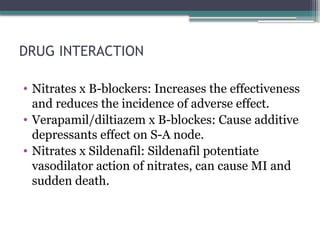
DRUG INTERACTION
• Nitrates x B-blockers: Increases the effectiveness
and reduces the incidence of adverse effect.
• Verapamil/diltiazem x B-blockes: Cause additive
depressants effect on S-A node.
• Nitrates x Sildenafil: Sildenafil potentiate
vasodilator action of nitrates, can cause MI and
sudden death.
Anti anginal drugs with there classifications.pptx