I
nria was foundedin 1967 by
General De Gaulle in order to
guarantee France’s sovereignty
in a domain then in its infancy:
information technologies.
60 years later, after successive
revolutions ushered in by the internet,
the world wide web, the spread of
digital modelling to all areas of
science, the smart phone and,
more recently, artificial intelligence,
revolutions in which Inria has played
a role, digital technology is everywhere.
Working at the intersection of so many
national, European and international
priorities, our mission remains the
same as ever, as reaffirmed in the
strategic plans co-signed with the
French government since 2018: to
strengthen France's digital sovereignty
through world- leading research and
innovation.
2025 opened and closed with two
major international events devoted
to AI and the challenges of digital
resilience - the AI Action Summit and
Adopt AI - both of which drew leading
public and private sector decision-
makers to Paris. As the driving force
behind the French government's
national AI research strategy since
2018, Inria has been leading efforts to
keep France at the forefront of science
and innovation, launching brand new
initiatives such as “AI Pioneers” in
partnership with Bpifrance as part
of the France 2030 plan.
Inria is a national research institute,
and in 2025 we continued to live up to
our reputation with research projects
of international importance, across
a diverse array of domains.
Nurturing new startups in the Inria
Startup Studio (which has put Inria
top of the table of institutions
supporting winners of the i-PhD
competition), and developing
strategic industrial partnerships with
businesses from France's rich talent
pool, for example in the fast-rising
field of quantum computing, has
enabled us to amplify our impact.
In the field of defence and security,
we have reinforced our collaborations
with the Armed Forces Ministry,
overseen by Inria Defence Security.
The National Institute for AI
Evaluation and Safety (INESIA)
continues to go from strength to
strength in fields of essential
importance to our digital sovereignty,
allowing us to form closer ties with
the SGDSN, in addition to our ongoing
partnerships with ANSSI and VIGINUM
to combat the manipulation of
information by malicious
foreign actors.
All of these subjects, which form part
of our public policy support efforts,
require research at the vanguard of
contemporary science, dealing with
topics which are rapidly evolving,
much like our work in the regulatory
field supporting the CNIL, another
partnership which has been expanded
this year.
In 2025, we also ramped up our
commitment to integrating
humanities and the social sciences
(HSS) into our scientific strategy.
New projects have been launched
exploring the societal ramifications of
digital development, and for the first
time Inria has recruited permanent
faculty members working in these
fields.
2025 was also the user in which our
organisational transformations and
repositioning work reached maturity.
The dynamism of Inria's University
Centres has allowed us to reap the
rewards of aligning our priorities
and actions with our 14 partner
universities, at the heart of our
research, innovation and higher
education system.
First proposed by Inria in 2021,
the Programmes Agency is now a fully
operational reality, the cornerstone of
a new approach to our missions. Its
eight thematic programmes and two
inter-disciplinary programmes (PIQ
and Apollo) bring together the whole
digital ecosystem in order to
strengthen public-private
partnerships and maximise our
collective impact. The Apollo
programme in particular continues
to go from strength to strength,
developing software infrastructure to
support public policy, allowing us to
reinforce our ties with the “Trusted
Software and Digital Solutions”
strategic committee.
These developments, which have
drawn plaudits from HCERES and the
Cour des Comptes, are helping us to
maintain the ambitious trajectory
plotted out in our Objectives and
Performance Contract for the period
2024-2028. In a complex, fast-moving
international environment, and as
France grapples with serious
difficulties affecting the public
finances, Inria continues to fulfil
its mission with dedication and
determination, rising to the
challenges of the age.
This annual report is testament not
only to the motivation demonstrated
by the men and women of Inria, but
also to the commitment shown by our
public and private sector partners.
I would like to take this opportunity
to thank them.
Enjoy the report!
Editorial Bruno Sportisse, CEO of Inria
3 / ANNUAL REPORT 2025
4.
INRIA, DRIVING NATIONALSTRATEGIES
Digital Programmes Agency:
from construction to action
— Two years after officially becoming a Digital
Programmes Agency, Inria passed a decisive
milestone in 2025 as the programme entered
its fully operational phase. Summing up
Building on the initiatives launched in
2024, the Digital Programmes Agency
has strengthened its planning role
with a series of strategic road maps,
aligned with the National Strategic
Review and co-constructed with
scientific communities and the Inria
ecosystem. This approach is in line
with the Objectives and Performance
Contract, which requires an annual
strategic vision update. Furthermore,
a demonstrator model for a new tool
designed to map research dynamics
and skills has already been developed.
2025 was also marked by the French
Prime Minister's decision to
greenlight France 2030 funding for
four new items, submitted by the
Agency in 2024. Three of these
items are associated with the
AI programme, and are now in
preparation in order to equip the
scientific community with tools at the
cutting edge of AI research and
technology, enabling them to develop
modular components for AI
acceleration along with a software
environment (jointly developed with
the ASIC programmes agency led by
the CEA) and, finally, in collaboration
with the National Institute for
AI Evaluation Safety (INESIA),
a programme which will provide
France with a benchmark ecosystem
for rigorous evaluation of the
performance and risks associated
with AI systems.
The fourth item is associated with the
“Systems, networks and cloud” and
“Virtual worlds” programmes, and is
devoted to the creation of digital
twins. The goal is to make digital
twins a force for sovereignty through
innovation, operating at the forefront
of science and technology, with the
potential to positively influence any
and all economic and industrial
sectors. All of these items will get
under way in early 2026, along
with the PEPR programme on
Environmentally-Responsible Digital
Tech. These programmes are fine
examples of our systemic approach,
integrating scientific production,
training and innovation while
working closely with Inria’s partner
universities and industrial ecosystem
(not least through the “Trusted
Software and Digital Solutions”
strategic committee).
In the meantime, our eight existing
thematic programmes have
continued their operational
deployment, while our close working
partnerships with the CEA-led ASIC
programmes agency and the INSERM-
led health research programmes
agency have gone from strength to
strength. The PIQ programme for
supporting high risk research has
continued to expand and develop,
with 27 active projects. The Apollo
programme has also structured its
public policy support activities,
launching work with multiple
partners to ascertain and clarify
their needs.
At the European level, the
Quantum and Scientific Calculation
programmes have joined forces
with CSA (Coordinated and Support
Actions) partners to map out future
road maps for their fields which will
be aligned with the existing national
road maps. The “Systems, networks
and cloud” programme was a major
contributor to the EURO-3C (cognitive
collaborative computing) project,
in line with our digital continuum
policy. International actions,
particularly under the aegis of the AI
and Cybersecurity programmes, have
helped to establish Inria’s position as
a programmes agency, in full
alignment with France's over-arching
strategic priorities.
Finally, we rounded off the year with
a tour of our territorial university
ecosystems, continuing the detailed
dialogue over the strategic direction
The work done by the Digital
Programmes Agency in 2025 perfectly
illustrates its founding ambition:
to structure, with support from
the government, impactful national
programmes combining research,
training and innovation, in the pursuit
of France's strategic priorities and in
synergy with European dynamics.
Sophie Proust, Executive Director of the Digital
Programmes Agency
ANNUAL REPORT 2025 / 4
5.
of each site,which will continue into
2026 in order to ensure that these
programmes are deeply rooted in
territorial priorities, informed by
discussions at grass roots level.
The AI Programme: structure, evaluations, reach
Since 2018, Inria has been the
academic point of reference for the
national artificial intelligence strategy,
overseeing scientific and technological
research efforts in support of public
policy. 2025 was a significant milestone
for AI policy, thanks in no small part to
the Paris AI Action summit.
Dedicated to promoting accessible,
sovereign AI, the P16 project has
enriched its open source ecosystem: five
new libraries have been selected to join
the initial three, covering time series,
explainability and model uncertainty.
With a network of 16 industrial partners
involved in selecting libraries to support
and developing use cases, P16 organised
eight events this year, bringing together
more than 400 participants. They also
launched a new training unit on skrub,
in partnership with Inria Academy,
focusing on data pre-processing. P16
is also part of the AI Factory France
movement and the European FLUID-AI
project led by EOSC (European Open
Science Cloud).
In matters of safety and evaluation,
the creation of INESIA, led by the SGDSN
and the DGE, in partnership with Inria,
PEReN, ANSSI and LNE, is a major
addition to our national capacity for
AI evaluation, bringing a dedicated
programme and a scientific road map
approved in late 2025.
On the innovation front, the
“AI Pioneers” initiative, run jointly
with Bpifrance, aims to nurture the
emergence of disruptive technologies
in priority fields.
Last but not least, the Expert Centre
for International AI Cooperation has
repositioned itself and launched three
strategically significant projects
focusing on data sharing, involving
students in global AI governance and
forming a network of initiatives working
on the impact of AI in the workplace,
strengthening France's role in AI
governance and open research in
this field.
PIQ: high-risk and high-impact research
Launched in mid-2024, the Inria
Quadrant Programme (PIQ) supports
high-risk and high-impact research and
innovation programmes in the fields of
digital science and technology, working
to ensure rapid and flexible deployment
in order to support innovators with
original projects that take the path less
travelled.
The programme supports a broad array
of projects, diverse in terms of their
subject matter (70% interdisciplinary
projects) as well as their format: support
for a period ranging from 6 months to
4 years, with funding starting at 70,000
and topping out at over a million Euros.
But they all have one thing in common:
a scientific or technological approach
which may be risky, but has the
potential to deliver real impact.
In 2025, the programme continued to
develop all over the country, thanks to
its network of 52 sites (125 institutions
in total) and 66 designated PIQ
ambassadors appointed by those
institutions.
This year the programme supported
19 new projects, from a total of
73 applications, 55 of which met the
criteria for consideration. By late 2025,
the programme was supporting a total
of 28 projects hosted by 34 structures
across 17 sites.
The programme held its first conference
in June 2025, bringing together over
150 people in the grand amphitheatre
of Paris Cité university to hear
presentations from Martin Vetterli
(EPFL), Pierre Azoulay (MIT), Pascale
Senellart (CNRS), Christine Azevedo
(Inria) and David Guiraud (Neurinnov),
sparking a collective reflection on how
to support high-risk, high-impact
research.
FOCUS
The AI and PIQ programmes in 2025
AI PIONEERS:
an initiative launched by
the Programmes Agency
to nurture the disruptive
technologies of the future
Launched in July 2025 by the SGPI
(General Secretariat for Investment),
the DGE, the Directorate General for
Research and Innovation and the
CGDD, the “AI Pioneers” call for
projects is intended to support the
most ambitious and transformative
AI projects, those with the potential
to create disruptive technological
breakthroughs in key sectors such
as industry, healthcare, security and
the ecological transition. It is
operated by Bpifrance on behalf of
the government, and in partnership
with Inria in its role as Digital
Programmes Agency. The initiative
adopts a “project factory” approach,
echoing other tools developed
by Inria.
5 / ANNUAL REPORT 2025
6.
Inria and universities:
closeralliances for collective impact
— 2025 also saw Inria strengthen its
partnerships with universities. In its second
full year, the Directorate General for Territorial
Policy was endowed with a new governance
structure and a strategy fine-tuned to the needs
of each site, as the DG began to deliver its first
concrete results.
A COUNCIL TO CHANNEL OUR
COLLECTIVE AMBITION
The formation of the Council of
Partner Universities (CUP) represents
one of the biggest institutional
developments of 2025. This new
national governance body is charged
with strengthening strategic
coordination between Inria and
its partner universities, providing
a framework conducive to collective
dialogue. The Council held its
inaugural meeting in early 2026,
forming several working groups
devoted to subjects of shared
interest: Digital technology and the
humanities, University Innovation
Centres, international and European
strategies, HR, communication and
joint research. In the meantime,
the bilateral monitoring and strategy
committees continue to oversee,
site by site, the operational running
of each partnership.
A STRATEGY ROOTED IN THE
REALITIES OF EACH TERRITORY
2025 also saw a continued evolution
towards an approach tailored to the
specificities of each university site.
The Digital Programmes Agency
presented its current initiatives at
each partner university, laying the
groundwork for differentiated road
maps which will guide each of these
partnerships over the coming years.
Our collaboration with the DSI has
also yielded a new tool offering a 360°
overview of the work done by all Inria
centres. This tool is being gradually
rolled out to all partners, integrating
their own data in order to establish
a consolidated, shared vision of all
actions undertaken together.
ACTIONS AND INITIATIVES LED BY
INRIA UNIVERSITY CENTRES
These successes are testament to the
dynamism of the “Inria University
Centre” model: joint actions in the
regions, technology transfer
accelerated by the PUIs, joint
European projects, shared teaching
initiatives and more. Within this
framework, an experimental initiative
using generative AI to aid support
functions was launched in December
2025. It is based on RAGaRenn, the
RAG system developed by the
University of Rennes, a concrete
illustration of how collaborations
between Inria and universities make
new innovations possible.
I-Factory, a space dedicated
to creativity in the heart of
the Lyon region
Opened in November 2025, the
I-Factory is a new facility designed
to galvanise creativity, sharing and
experimentation. Located at the
heart of the LyonTech-La Doua
campus, the I-Factory is a vibrant
space where students, young
entrepreneurs, researchers and
partners can create, test and grow
their projects. Naturally, Inria’s Lyon
Centre is present on campus
alongside other territorial actors,
promoting collaboration between
researchers and innovators. Hosting
over 50 events each year, the
I-Factory is a genuine hub of
inspiration and innovation.
The Inria Objectives and Performance Contract 2024-
2028 has provided an opportunity to reassert the joint
ambitions which bind Inria and its partner universities,
in terms of digital development for all territories. Tools
such as the Council of Partner Universities and the
bilateral strategic committees formed with each partner
university provided opportunities, every six months,
to steer the implementation of our joint road maps.
Jean-Yves Berthou, Deputy CEO for Territorial Strategy
ANNUAL REPORT 2025 / 6
7.
Digital sovereignty:
Inria'sstrategic role
— By Yassine Lakhnech, President of Grenoble-Alpes University.
A GLOBAL, MULTI-DISCIPLINARY
CHALLENGE
Ensuring France's digital sovereignty
requires greater control over four
dimensions which are inextricably
interlinked: autonomous control over
data, independence of critical
infrastructure, technological
autonomy from international tech
giants, and the capacity to impose our
own rules on the digital sphere. None
of these can be achieved in isolation:
digital sovereignty is, by its very
nature, a global challenge requiring
a comprehensive response, drawing
simultaneously upon digital sciences,
law, economics and public policy.
THREE KEY CONDITIONS
In order to rise to this challenge,
we will need to tick three boxes.
Firstly, we need cutting-edge research
capable of foreseeing technological
disruption and coming up with
credible alternatives to overseas
solutions in critically important areas
such as artificial intelligence, cyber-
security and cryptography. Secondly,
we need constant innovation in order
to translate scientific progress into
operational solutions and sovereign
tech players. Last but not least, we
need to train talents - engineers,
researchers, experts - who are up to
the task, providing a digital education
which encompasses the technical,
ethical and legal issues at stake.
INRIA: GALVANISING FRANCE'S
NATIONAL STRATEGY
With our culture of excellence, our
unique position at the interface of
fundamental research and technology
transfer, and our unique
organisational structure, Inria is
a major player in the drive to achieve
greater digital sovereignty for France
and for Europe. Our international
scientific standing, capacity to
influence global technological
standards and close involvement
in digital public policy-making have
cemented our reputation in these
matters.
Nonetheless, it is the intensity of
our partnerships with universities -
and our complementary working
relationships with universities and
other research organisations - which
truly underpins Inria’s galvanising
influence on national strategy.
Uniting academic, industrial and
institutional forces around shared
objectives, Inria embodies the idea of
a virtuous continuum, running the
gamut from fundamental science to
deployed innovation via training of
new talents.
Digital sovereignty cannot be
achieved with a click of the fingers:
it must be built over the long term
through cutting edge research,
audacious innovation and ambitious
educational policy. Together, Inria and
our university partners have a historic
role to play in realising the ambitions
of France and Europe.
With our culture of excellence, our unique
position at the interface of fundamental
research and technology transfer, and our
unique organisational structure, Inria is a major
player in the drive to achieve greater digital
sovereignty for France and for Europe.
Yassine Lakhnech, President of Grenoble-Alpes University
7 / ANNUAL REPORT 2025
8.
2025, the yearof quantum:
Inria at the heart of a scientific
revolution
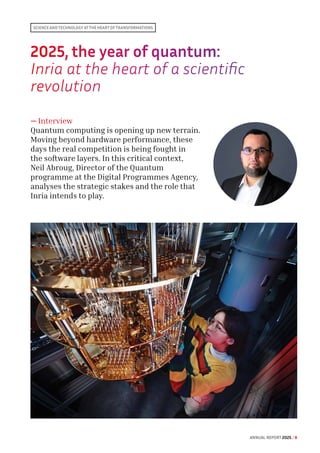
— Interview
Quantum computing is opening up new terrain.
Moving beyond hardware performance, these
days the real competition is being fought in
the software layers. In this critical context,
Neil Abroug, Director of the Quantum
programme at the Digital Programmes Agency,
analyses the strategic stakes and the role that
Inria intends to play.
Science and technology at the heart of transformations
ANNUAL REPORT 2025 / 8
9.
Quantum computing haslong been
a race for more processing power:
number of qubits, gate fidelity,
mastering cryogenics. This way of
looking at the problem is not entirely
mistaken, but it can obscure what is
really going on in the field today. The
real competition has now shifted to
the software platforms. Compilers,
error correction engines, runtimes,
hybridisation tools using high-
performance computing capabilities:
these are the layers where standards
are set, allowing for transferability
between systems architectures and
creating or avoiding technological
dependencies for users.
AI offers an interesting precedent.
NVIDIA's dominance was built not just
on the performance of their GPUs,
but also on CUDA, a software
ecosystem which has become the
de facto standard in the domain,
something which goes above and
beyond the technical superiority of
NVIDIA's accelerators compared with
the competition. Quantum computing
will have its CUDA moment. In
February 2026 China released Origin
Pilot OS, claimed to be the first
quantum operating system which can
be installed locally and is compatible
with three different hardware
approaches. This strategy mirrors
what DeepSeek sought to do for AI:
to dominate integration layers by
means of an open approach, while
Western players are still arguing
over the governance of their various
standards. This is not a mere technical
detail. It is an act of strategic
positioning.
The European paradox is well known:
We’re strong on research, strong on
hardware (over 50% of the global
market, shared between around
twenty startups), but structurally
weak when it comes to building
software platforms. Europe produces
fundamental IP; others acquire that IP
and control the way it creates value.
Without a shared, effectively-
governed software layer, and patience
from Europe's capitals, European
technological diversity risks
descending into fragmentation.
This firm conviction has guided Inria's
strategy since 2019: Quantum
sovereignty is not just a matter for
physics labs; it's about compilers,
quantum programming languages,
hybrid HPC-quantum architectures.
Within the last six years we have
launched eight project teams
spanning the whole software stack,
multiplied our permanent staff by
five, formed industrial partnerships
with national startups (Alice Bob,
Quandela, Qobly), and co-led the
Quantum PEPR, the HQI programme
and the QLoopchallenge: a coherent
chain has been consolidated, from
research through to tech transfer.
But operating at national level is not
enough. That's why Inria has taken
the initiative, with partners in
Germany, Denmark, the Netherlands
and Finland, to propose a coordinated
response to the American DARPA-QBI
programme, based on open
roadmapping, coordination in
uncertain times, and open source
governance.
Openness must not be used as an alibi
for industrial immobilism, and open
standards must be backed up with
certified distribution, proper support
and cloud-HPC integration. That's
how scikit-learn has become a global
platform, rather than just another
research project. Quantum computing
needs to follow the same path.
In the meantime, Inria is developing
bilateral partnerships with leading
institutions: Simula in Norway,
the Novo Nordisk Foundation in
Denmark, IQM in Finland, CWI in the
Netherlands and the University of
Waterloo in Canada, as well as CQT in
Singapore. These cooperations are
driven by a core conviction: the
standards which will structure the
future of quantum computing need
to be negotiated now, and scientific
influence only counts if it is
translated into real, binding
commitments.
The window of opportunity is still
open. No quantum software
architecture has emerged as the
universal standard, yet. But the
choices made in the next two or three
years, in terms of standards, API and
governance, will determine the
technological dependencies of the
next decade. Inria intends to have
a say in those choices.
Quantum sovereignty is not just a matter for
physics labs; it's about compilers, quantum
programming languages, hybrid HPC-quantum
architectures.
Neil Abroug, Director of the Quantum programme at the Digital
Programmes Agency
9 / ANNUAL REPORT 2025
10.
— Project review—
Alice Bob are working with
Inria to improve the quality
of magic state distillation
in order to enable genuinely useful
quantum computing
Working with Inria researchers, scientists from Alice Bob -
the global leader in the race to develop fault-tolerant quantum
computing - recently submitted a new study for peer review,
setting out what currently stands as the most hardware-efficient
method of generating magic states in superconducting quantum
computers, a crucial step towards viable quantum computing.
Magic state distillation remains one of the most resource-intensive
aspects of quantum computing. This latest work, published in
Nature in February 2026, proposes a less qubit-intensive and
considerably faster method, consolidating a road map which could
lead to the universal fault-tolerant gates required to run quantum
applications on a large scale.
Quantum networks:
a major step towards the internet
of the future
Although the quantum internet may still be in its infancy,
the generic IT approach developed by the “Quantum Internet
Alliance” European research programme represents a major leap
forward. The scientists of the QAT project team (Quantum
Architectures, Algorithms, Applications and their Theory) recently
contributed to the construction of a prototype quantum network
whose architecture incorporates a generic software layer, known
as QnodeOS, including the software validation layer for key
network functions. This system brings the technology out of
the laboratory, introducing a more universal layer which is not
dependent on the platform used, and will eventually become
interoperable to a certain extent. This architecture provides a solid
foundation for the programming of quantum networks, and was
warmly received by prestigious international journal Nature.
Quantum computing:
Innovative architecture
to eliminate errors,
in partnership with Alice Bob
In order for a quantum computer to perform
useful calculations, estimates suggest that it
must be capable of precisely completing
anywhere between a million and a billion
operations. But, as things stand, one in every
1000 operations contains an error. This error
rate renders the results unusable... However,
Inria researchers (from the QUANTIC, COSMIQ
and MOCQUA project teams), working in
collaboration with startup Alice Bob, may well
have found a solution to overcome such errors,
by combining a type of quantum information
unit (‘cat qubits’) with linear error correcting
codes (LDPC). Their work was featured in an
article published in Nature Communications
on 26 January 2025.
Quobly and Quandela:
two new partnerships
with startups
to rise to the challenges
of quantum computing
France is home to some of the leading startups
in the field of quantum computing, but the
scientific and technological obstacles to be
overcome are much heftier here than in other
sectors. Partnerships with public sector
research institutions are essential in order to
boost the innovation capacity of these young
businesses.
Recent partnerships with Quandela (quantum
photonics) and Quobly (silicon-based quantum
computing), signed in June 2025, are fully in
keeping with this mission, complementing the
work being done by the Quantum Computing
initiative overseen by the Digital Programmes
Agency (PEPR, HQI, QLoop, Quantxium) under
the banner of the national quantum strategy
coordinated by the SGPI.
ANNUAL REPORT 2025 / 10
2025, the year of quantum:Inria at the heart of a scientific revolution
11.
— Project review—
Unprecedented
photonic interactions :
one step closer to a quantum
computer?
Scientists from the QUANTIC joint project team
(Inria, ENS-PSL, Mines Paris-PSL, CNRS) have
made another giant step towards quantum
computing. Using innovative superconducting
circuits, they were able to observe strong
interactions involving multiple photons,
exceeding system losses. This opens up new
horizons for microwave quantum optics, and
could accelerate the development of quantum
technologies. This significant work was
recently published in prestigious scientific
journal Nature Communications.
Securing our data in the quantum
era: a major challenge
The Canari project team based at the University of Bordeaux Inria
Centre, a joint initiative with the CNRS and the University of
Bordeaux, specialises in algorithmic number theory, with potential
applications in the development of post-quantum cryptographic
protocols and algorithms. These methods are designed to
withstand attacks from future quantum computers. The stakes are
high: existing cryptographic mechanisms need to be updated, but
post-quantum performance levels must be at least comparable
with those achieved by existing, “pre-quantum” algorithms.
Using traditional
algorithms to assess
the performance
of quantum computers
In quantum computing, describing the state of
a quantum system is always a major challenge
because the number of parameters in play is
exponential. In a bid to tackle this complexity,
Omar Fawzi (Research Director of the QInfo
project team based in both Lyon and Grenoble,
a joint initiative with ENS Lyon, Université
Claude Bernard Lyon 1 UCBL and Université
Grenoble Alpes), has succeeded in developing
an algorithm capable of calculating the
physical properties of quantum systems. What
makes it special? This algorithm can be used to
calculate the physical properties of any
quantum system, yielding certified results.
Tools to facilitate quantum
cryptanalysis
Within a few years, quantum
computers will bring about
an exponential increase in
computation power. This will
have serious consequences for
cryptography: we need to
strengthen the cryptographic
protocols currently used to
secure digital communications.
Mathematicians all over the
world are working on new
protocols capable of
withstanding future attacks,
building upon other solutions
currently considered to be
“secure”.
But how can we be sure that
these algorithms are truly
invincible? André
Schrottenloher, a researcher on
the Capsule project team at the
University of Rennes Inria
Centre, has launched a four-
year project to design new tools
for automatic cryptanalysis of
symmetric-key algorithms.
His goal is to automatically
quantify the number of
operations required to crack
different encryption systems.
11 / ANNUAL REPORT 2025
2025, the year of quantum:Inria at the heart of a scientific revolution
12.
Artificial Intelligence:
impact models
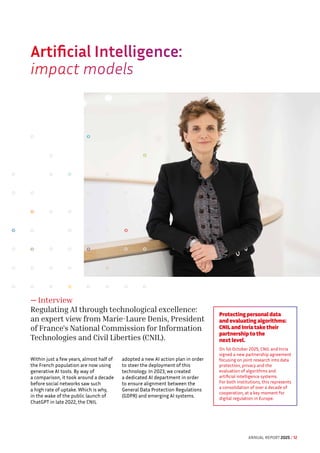
—Interview
Regulating AI through technological excellence:
an expert view from Marie-Laure Denis, President
of France's National Commission for Information
Technologies and Civil Liberties (CNIL).
Within just a few years, almost half of
the French population are now using
generative AI tools. By way of
a comparison, it took around a decade
before social networks saw such
a high rate of uptake. Which is why,
in the wake of the public launch of
ChatGPT in late 2022, the CNIL
adopted a new AI action plan in order
to steer the deployment of this
technology. In 2023, we created
a dedicated AI department in order
to ensure alignment between the
General Data Protection Regulations
(GDPR) and emerging AI systems.
Protecting personal data
and evaluating algorithms:
CNIL and Inria take their
partnership to the
next level.
On 1st October 2025, CNIL and Inria
signed a new partnership agreement
focusing on joint research into data
protection, privacy and the
evaluation of algorithms and
artificial intelligence systems.
For both institutions, this represents
a consolidation of over a decade of
cooperation, at a key moment for
digital regulation in Europe.
ANNUAL REPORT 2025 / 12
13.
Meanwhile, as weawaited the
application of the European AI Act,
the CNIL made AI one of the key
pillars of our strategic plan for 2025-
2028, with the ambition of promoting
an ethical vision of AI which respects
fundamental rights. That goal is clear,
and the CNIL must live up to its
ambitions in all of its various
missions.
Currently, that includes our long-
standing role as France's public data
protection authority, regulating the
algorithms that use our personal data.
In the future, as the supervisory board
designated by the AI regulations (RIA),
we will be responsible for the majority
of high-risk AI systems (biometrics,
employment, immigration, law
enforcement etc.) and for ensuring
that the technology is not used for
prohibited purposes (predictive
policing, remote biometric
identification in real time for
policing purposes etc.).
The challenges we face are
considerable, and will require
collaboration with multiple actors,
not least among whom is Inria,
a trusted partner whose expertise in
this field, and so many others, has
already proven to be invaluable.
At a key moment for digital regulation
in Europe, our two institutions must
continue to share the benefits of our
experience, comparing and
challenging our respective viewpoints.
The new partnership agreement we
signed in 2025 provides a framework
for doing just that, as well as
continuing to pursue our numerous
joint research projects on privacy
protection and the evaluation of AI
systems and algorithms. The PANAME
project is a fine example of this
collaboration, working to develop
a tool for auditing the confidentiality
credentials of AI models.
In 2026 we’ll be celebrating the 15th
anniversary of the first partnership
agreement between the CNIL and
Inria. This anniversary is testament
to the strength of our shared
commitments, and should motivate
us to continue working together to
build a digital world that people
can trust.
With David Alis, President of the University
of Rennes
In November 2025, the Shanghai
Ranking named the University of
Rennes France's leading university for
digital sciences. This international
recognition reflects the dynamism of
our university, which became an EPE
consortium in 2023 by uniting five
founding institutions - EHESP, ENS
Rennes, ENSC Rennes, INSA Rennes and
Sciences Po Rennes – with support from
national research organisations (CNRS,
INRAE, Inria and Inserm).
In 2025, the University of Rennes and
Inria have continued to collaborate
under the banner of the University of
Rennes Inria Centre, working together
on numerous topics. The simplification
measures initiated by the ministry in the
wake of the Gillet report have also served
to strengthen the ties between the
functional departments of the university
and the research support departments
at Inria. Inria has also joined 2PE -
Brittany’s European project platform -
in order to boost our collective capacity
to make a success of European
programmes. This actually represents
our third joint administrative venture,
following on from technological
development and administrative
assistance for research teams.
In terms of international relations,
the University of Rennes combines local
collaborations with joint delegations
(India, Canada, Germany) and close
national collaboration with the
international relations department
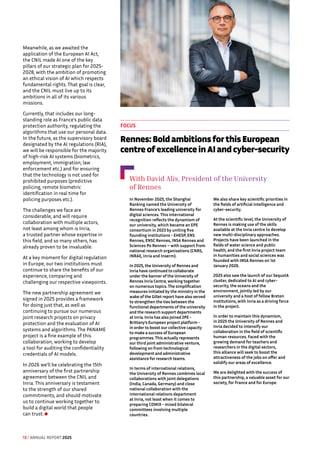
at Inria, not least when it comes to
preparing COMIX - mixed bilateral
committees involving multiple
countries.
We also share key scientific priorities in
the fields of artificial intelligence and
cyber-security.
At the scientific level, the University of
Rennes is making use of the skills
available at the Inria centre to develop
new multi-disciplinary approaches.
Projects have been launched in the
fields of water science and public
health, and the first Inria project team
in humanities and social sciences was
founded with INSA Rennes on 1st
January 2026.
2025 also saw the launch of our SequoIA
cluster, dedicated to AI and cyber-
security, the oceans and the
environment, jointly led by our
university and a host of fellow Breton
institutions, with Inria as a driving force
in the project.
In order to maintain this dynamism,
in 2025 the University of Rennes and
Inria decided to intensify our
collaboration in the field of scientific
human resources. Faced with the
growing demand for teachers and
researchers in the digital sectors,
this alliance will seek to boost the
attractiveness of the jobs on offer and
solidify our areas of excellence.
We are delighted with the success of
this partnership, a valuable asset for our
society, for France and for Europe.
FOCUS
Rennes: Bold ambitions for this European
centre of excellence in AI and cyber-security
13 / ANNUAL REPORT 2025
14.
— Project review—
Artificial intelligence:impact models
Understanding, tools, action:
LaborIA for the future of work
Founded in 2021 by France's Ministry of Work and Inria,
under the SNIA banner, LaborIA is a research-action
programme dedicated to the impact of artificial
intelligence on employment, work and skills. After two
years of research, the first phase of the project (LaborIA
Explorer) recently published a set of results,
recommendations and practical tools to help with
the deployment of AI within organisations.
LaborIA is also studying the consequences of AI for social
work (with the DGCS - Directorate General for Social
Cohesion) and for inspection and investigation work
(with the Ministry for the Economy,
Finance and Industrial and Digital
Sovereignty).
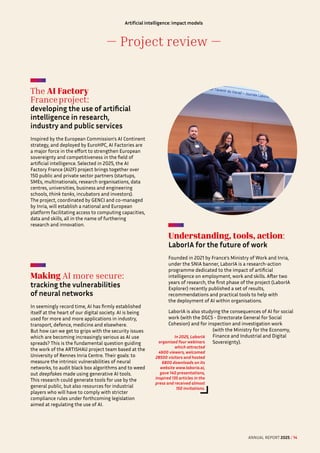
The AI Factory
Franceproject:
developing the use of artificial
intelligence in research,
industry and public services
Inspired by the European Commission's AI Continent
strategy, and deployed by EuroHPC, AI Factories are
a major force in the effort to strengthen European
sovereignty and competitiveness in the field of
artificial intelligence. Selected in 2025, the AI
Factory France (AI2F) project brings together over
150 public and private sector partners (startups,
SMEs, multinationals, research organisations, data
centres, universities, business and engineering
schools, think tanks, incubators and investors).
The project, coordinated by GENCI and co-managed
by Inria, will establish a national and European
platform facilitating access to computing capacities,
data and skills, all in the name of furthering
research and innovation.
Making AI more secure:
tracking the vulnerabilities
of neural networks
In seemingly record time, AI has firmly established
itself at the heart of our digital society. AI is being
used for more and more applications in industry,
transport, defence, medicine and elsewhere.
But how can we get to grips with the security issues
which are becoming increasingly serious as AI use
spreads? This is the fundamental question guiding
the work of the ARTISHAU project team based at the
University of Rennes Inria Centre. Their goals: to
measure the intrinsic vulnerabilities of neural
networks, to audit black box algorithms and to weed
out deepfakes made using generative AI tools.
This research could generate tools for use by the
general public, but also resources for industrial
players who will have to comply with stricter
compliance rules under forthcoming legislation
aimed at regulating the use of AI.
In 2025, LaborIA
organised four webinars
which attracted
4600 viewers, welcomed
28500 visitors and hosted
6800 downloads on its
website www.laboria.ai,
gave 140 presentations,
inspired 135 articles in the
press and received almost
150 invitations.
ANNUAL REPORT 2025 / 14
15.
— Project review—
Artificial intelligence: impact models
AI Action Summit 2025:
Inria and the importance of research for informed
public policy-making
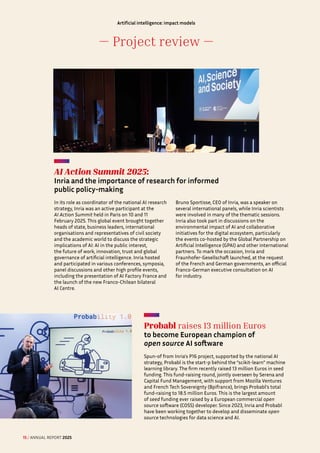
In its role as coordinator of the national AI research
strategy, Inria was an active participant at the
AI Action Summit held in Paris on 10 and 11
February 2025. This global event brought together
heads of state, business leaders, international
organisations and representatives of civil society
and the academic world to discuss the strategic
implications of AI: AI in the public interest,
the future of work, innovation, trust and global
governance of artificial intelligence. Inria hosted
and participated in various conferences, symposia,
panel discussions and other high profile events,
including the presentation of AI Factory France and
the launch of the new Franco-Chilean bilateral
AI Centre.
Bruno Sportisse, CEO of Inria, was a speaker on
several international panels, while Inria scientists
were involved in many of the thematic sessions.
Inria also took part in discussions on the
environmental impact of AI and collaborative
initiatives for the digital ecosystem, particularly
the events co-hosted by the Global Partnership on
Artificial Intelligence (GPAI) and other international
partners. To mark the occasion, Inria and
Fraunhofer-Gesellschaft launched, at the request
of the French and German governments, an official
Franco-German executive consultation on AI
for industry.
Probabl raises 13 million Euros
to become European champion of
open source AI software
Spun-of from Inria's P16 project, supported by the national AI
strategy, Probabl is the start-p behind the “scikit-learn” machine
learning library. The firm recently raised 13 million Euros in seed
funding. This fund-raising round, jointly overseen by Serena and
Capital Fund Management, with support from Mozilla Ventures
and French Tech Sovereignty (Bpifrance), brings Probabl's total
fund-raising to 18.5 million Euros. This is the largest amount
of seed funding ever raised by a European commercial open
source software (COSS) developer. Since 2023, Inria and Probabl
have been working together to develop and disseminate open
source technologies for data science and AI.
15 / ANNUAL REPORT 2025
16.
Digital applications inhealthcare are of vital
scientific, economic and democratic importance.
Together, we have a responsibility to make them
a force for progress, for our patients and for the
greater good.
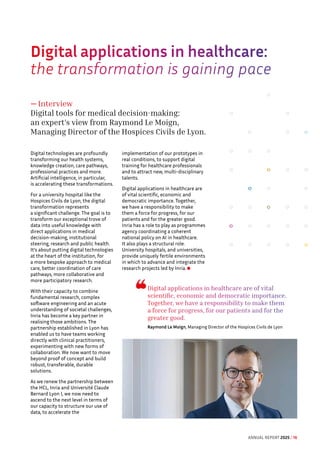
Raymond Le Moign, Managing Director of the Hospices Civils de Lyon
Digital applications in healthcare:
the transformation is gaining pace
— Interview
Digital tools for medical decision-making:
an expert's view from Raymond Le Moign,
Managing Director of the Hospices Civils de Lyon.
Digital technologies are profoundly
transforming our health systems,
knowledge creation, care pathways,
professional practices and more.
Artificial intelligence, in particular,
is accelerating these transformations.
For a university hospital like the
Hospices Civils de Lyon, the digital
transformation represents
a significant challenge. The goal is to
transform our exceptional trove of
data into useful knowledge with
direct applications in medical
decision-making, institutional
steering, research and public health.
It's about putting digital technologies
at the heart of the institution, for
a more bespoke approach to medical
care, better coordination of care
pathways, more collaborative and
more participatory research.
With their capacity to combine
fundamental research, complex
software engineering and an acute
understanding of societal challenges,
Inria has become a key partner in
realising those ambitions. The
partnership established in Lyon has
enabled us to have teams working
directly with clinical practitioners,
experimenting with new forms of
collaboration. We now want to move
beyond proof of concept and build
robust, transferable, durable
solutions.
As we renew the partnership between
the HCL, Inria and Université Claude
Bernard Lyon I, we now need to
ascend to the next level in terms of
our capacity to structure our use of
data, to accelerate the
implementation of our prototypes in
real conditions, to support digital
training for healthcare professionals
and to attract new, multi-disciplinary
talents.
Digital applications in healthcare are
of vital scientific, economic and
democratic importance. Together,
we have a responsibility to make
them a force for progress, for our
patients and for the greater good.
Inria has a role to play as programmes
agency coordinating a coherent
national policy on AI in healthcare.
It also plays a structural role.
University hospitals, and universities,
provide uniquely fertile environments
in which to advance and integrate the
research projects led by Inria.
ANNUAL REPORT 2025 / 16
17.
— Project review—
Digital applications in healthcare: the transformation is gaining pace
Using AI to improve
clinical diagnoses
and care pathways,
in partnership
with Doctolib
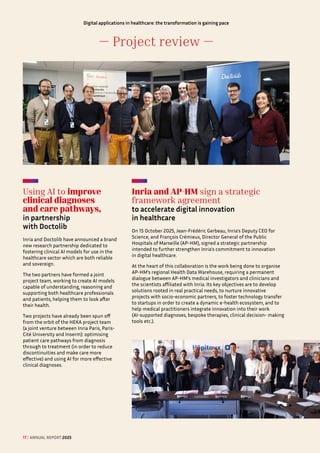
Inria and Doctolib have announced a brand
new research partnership dedicated to
fostering clinical AI models for use in the
healthcare sector which are both reliable
and sovereign.
The two partners have formed a joint
project team, working to create AI models
capable of understanding, reasoning and
supporting both healthcare professionals
and patients, helping them to look after
their health.
Two projects have already been spun off
from the orbit of the HEKA project team
(a joint venture between Inria Paris, Paris-
Cité University and Inserm): optimising
patient care pathways from diagnosis
through to treatment (in order to reduce
discontinuities and make care more
effective) and using AI for more effective
clinical diagnoses.
Inria and AP-HM sign a strategic
framework agreement
to accelerate digital innovation
in healthcare
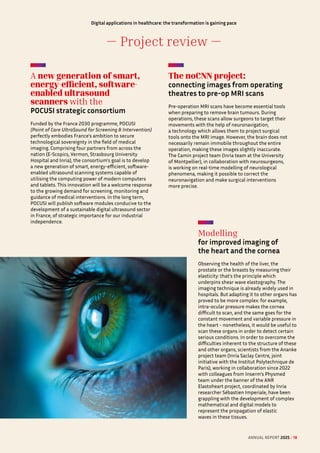
On 15 October 2025, Jean-Frédéric Gerbeau, Inria's Deputy CEO for
Science, and François Crémieux, Director General of the Public
Hospitals of Marseille (AP-HM), signed a strategic partnership
intended to further strengthen Inria's commitment to innovation
in digital healthcare.
At the heart of this collaboration is the work being done to organise
AP-HM’s regional Health Data Warehouse, requiring a permanent
dialogue between AP-HM's medical investigators and clinicians and
the scientists affiliated with Inria. Its key objectives are to develop
solutions rooted in real practical needs, to nurture innovative
projects with socio-economic partners, to foster technology transfer
to startups in order to create a dynamic e-health ecosystem, and to
help medical practitioners integrate innovation into their work
(AI-supported diagnoses, bespoke therapies, clinical decision- making
tools etc.).
17 / ANNUAL REPORT 2025
18.
— Project review—
Digital applications in healthcare: the transformation is gaining pace
The noCNN project:
connecting images from operating
theatres to pre-op MRI scans
Pre-operation MRI scans have become essential tools
when preparing to remove brain tumours. During
operations, these scans allow surgeons to target their
movements with the help of neuronavigation,
a technology which allows them to project surgical
tools onto the MRI image. However, the brain does not
necessarily remain immobile throughout the entire
operation, making these images slightly inaccurate.
The Camin project team (Inria team at the University
of Montpellier), in collaboration with neurosurgeons,
is working on real-time modelling of neurological
phenomena, making it possible to correct the
neuronavigation and make surgical interventions
more precise.
A new generation of smart,
energy-efficient, software-
enabled ultrasound
scanners with the
POCUSI strategic consortium
Funded by the France 2030 programme, POCUSI
(Point of Care UltraSound for Screening Intervention)
perfectly embodies France's ambition to secure
technological sovereignty in the field of medical
imaging. Comprising four partners from across the
nation (E-Scopics, Vermon, Strasbourg University
Hospital and Inria), the consortium's goal is to develop
a new generation of smart, energy-efficient, software-
enabled ultrasound scanning systems capable of
utilising the computing power of modern computers
and tablets. This innovation will be a welcome response
to the growing demand for screening, monitoring and
guidance of medical interventions. In the long term,
POCUSI will publish software modules conducive to the
development of a sustainable digital ultrasound sector
in France, of strategic importance for our industrial
independence.
Modelling
for improved imaging of
the heart and the cornea
Observing the health of the liver, the
prostate or the breasts by measuring their
elasticity: that's the principle which
underpins shear wave elastography. The
imaging technique is already widely used in
hospitals. But adapting it to other organs has
proved to be more complex: for example,
intra-ocular pressure makes the cornea
difficult to scan, and the same goes for the
constant movement and variable pressure in
the heart - nonetheless, it would be useful to
scan these organs in order to detect certain
serious conditions. In order to overcome the
difficulties inherent to the structure of these
and other organs, scientists from the Ananke
project team (Inria Saclay Centre, joint
initiative with the Institut Polytechnique de
Paris), working in collaboration since 2022
with colleagues from Inserm’s Physmed
team under the banner of the ANR
Elastoheart project, coordinated by Inria
researcher Sébastien Imperiale, have been
grappling with the development of complex
mathematical and digital models to
represent the propagation of elastic
waves in these tissues.
ANNUAL REPORT 2025 / 18
19.
— Project review—
Digital applications in healthcare: the transformation is gaining pace
Getting to the heart of cardiac simulation:
HPC casts new light on the mysteries of arrhythmia
Behind each heartbeat lies an electrical
phenomenon as precise as it is vital: cardiac
electrophysiology. This mechanism ensures
the synchronised contraction of the almost
four billion muscle cells which make up the
heart. But if the mechanism gets out of sync,
arrhythmia can have serious consequences.
The Carmen project team, formed by the
University of Bordeaux Inria Centre and
the Liryc University Hospital Institute,
is combining cutting edge cardiac simulation
with HPC (high performance computing)
in a bid to better understand this condition.
Their work forms part of the broader
European project MICROCARD-2. Coordinated
by Mark Potse, a researcher at the University
of Bordeaux, this project brings together
scientists from ten partner institutions
(in France, Germany, Italy and Norway),
with a view to creating a software solution
capable of simulating the behaviour of
individual cells.
Brain aneurysms:
AI for better diagnoses
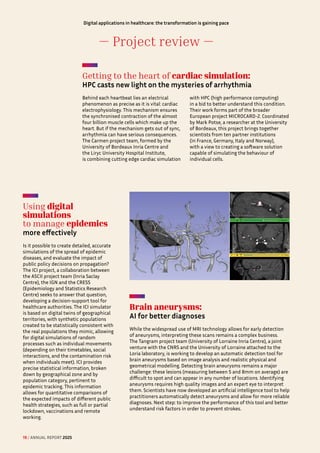
While the widespread use of MRI technology allows for early detection
of aneurysms, interpreting these scans remains a complex business.
The Tangram project team (University of Lorraine Inria Centre), a joint
venture with the CNRS and the University of Lorraine attached to the
Loria laboratory, is working to develop an automatic detection tool for
brain aneurysms based on image analysis and realistic physical and
geometrical modelling. Detecting brain aneurysms remains a major
challenge: these lesions (measuring between 5 and 8mm on average) are
difficult to spot and can appear in any number of locations. Identifying
aneurysms requires high quality images and an expert eye to interpret
them. Scientists have now developed an artificial intelligence tool to help
practitioners automatically detect aneurysms and allow for more reliable
diagnoses. Next step: to improve the performance of this tool and better
understand risk factors in order to prevent strokes.
Using digital
simulations
to manage epidemics
more effectively
Is it possible to create detailed, accurate
simulations of the spread of epidemic
diseases, and evaluate the impact of
public policy decisions on propagation?
The ICI project, a collaboration between
the ASCII project team (Inria Saclay
Centre), the IGN and the CRESS
(Epidemiology and Statistics Research
Centre) seeks to answer that question,
developing a decision-support tool for
healthcare authorities. The ICI simulator
is based on digital twins of geographical
territories, with synthetic populations
created to be statistically consistent with
the real populations they mimic, allowing
for digital simulations of random
processes such as individual movements
(depending on their timetables, social
interactions, and the contamination risk
when individuals meet). ICI provides
precise statistical information, broken
down by geographical zone and by
population category, pertinent to
epidemic tracking. This information
allows for quantitative comparisons of
the expected impacts of different public
health strategies, such as full or partial
lockdown, vaccinations and remote
working.
19 / ANNUAL REPORT 2025
20.
Stronger partnerships
fordigital sovereignty
— Innovation and sovereignty:
An expert view from Michel Paulin, President of the
“Trusted Software and Digital Solutions” strategic
committee under the aegis of the National Industrial
Council, and member of Inria's board of directors.
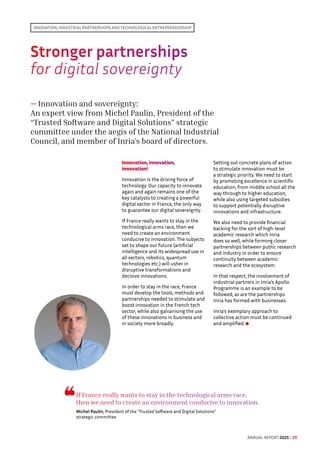
Innovation, innovation,
innovation!
Innovation is the driving force of
technology. Our capacity to innovate
again and again remains one of the
key catalysts to creating a powerful
digital sector in France, the only way
to guarantee our digital sovereignty.
If France really wants to stay in the
technological arms race, then we
need to create an environment
conducive to innovation. The subjects
set to shape our future (artificial
intelligence and its widespread use in
all sectors, robotics, quantum
technologies etc.) will usher in
disruptive transformations and
decisive innovations.
In order to stay in the race, France
must develop the tools, methods and
partnerships needed to stimulate and
boost innovation in the French tech
sector, while also galvanising the use
of these innovations in business and
in society more broadly.
Setting out concrete plans of action
to stimulate innovation must be
a strategic priority. We need to start
by promoting excellence in scientific
education, from middle school all the
way through to higher education,
while also using targeted subsidies
to support potentially disruptive
innovations and infrastructure.
We also need to provide financial
backing for the sort of high-level
academic research which Inria
does so well, while forming closer
partnerships between public research
and industry in order to ensure
continuity between academic
research and the ecosystem.
In that respect, the involvement of
industrial partners in Inria’s Apollo
Programme is an example to be
followed, as are the partnerships
Inria has formed with businesses.
Inria's exemplary approach to
collective action must be continued
and amplified.
Innovation, industrial partnerships and technological entrepreneurship
If France really wants to stay in the technological arms race,
then we need to create an environment conducive to innovation.
Michel Paulin, President of the “Trusted Software and Digital Solutions”
strategic committee
ANNUAL REPORT 2025 / 20
21.
Franco-German AI,
Europe’stech engine
— Interview
Antonio Krüger, Managing Director of the DFKI
In an era of rapid transformation
powered by AI, and the increasingly
urgent need for European
technological sovereignty, the
strategic alliance between the DFKI
and Inria is more important now
than ever before. Since 2020, our
institutions have established a solid
partnership, built upon joint
governance and a shared vision of
what trustworthy AI means. Over
the years, we have nurtured a rich
portfolio of collaborative projects
focused on critical sectors where
people come first: health, industry
and agriculture.
Our cooperation also extends to
championing the next generation of
AI talents and supporting innovation.
Thanks to the annual Inria-DFKI
European AI summer school, our joint
workshops and our united presence at
major events such as Vivatech and the
AI Action Summit in Paris in 2025,
we have comprehensively bridged the
gap between our national research
ecosystems. But we are not content
with simply promoting progress in
academic research; we are also
actively shaping the AI landscape in
Europe with our participation in key
Horizon Europe programmes, as well
as launching successful joint startup
initiatives such as SouthwestX.
Today, in order to better capitalise on
opportunities for synergy and rise to
the major challenges of digital
sovereignty, we are ready to take
things to the next level.
The DFKI and Inria are currently
developing a bilateral Franco-German
AI Centre, with a formal agreement
set to be signed in 2026.
This bi-national centre will be an
institutional manifestation of our
integrated approach, with a dual
governance structure, dedicated
offices in both countries and a shared
Project Factory open to academic
partners and external partners from
industry. By strengthening our shared
portfolio in vital areas such as
trustworthy AI, neuro- symbolic
systems and AI for energy supply,
this centre will serve as an invaluable
bridge between research and
scientific practice. It will propose
a shared strategic roadmap for
achieving technological sovereignty,
ensuring that “AI Made in Europe”
remains a competitive advantage
on the global scene.
Together, Inria and the DKFI have
made a firm commitment to
empowering citizens, to supporting
public debate on AI culture and to
helping steer the course of AI
innovation in Europe. Germany and
France, as the two largest economies
in the EU, have a vital role to play in
shaping the future of AI in Europe,
and our new bi-national institute will
be fully focused on that goal.
In an era of rapid
transformation
powered by AI, and
the increasingly
urgent need for
European technological
sovereignty, the strategic
alliance between the
DFKI and Inria is more
important now than
ever before.
Antonio Krüger, Managing Director
of the DFKI
21 / ANNUAL REPORT 2025
22.
— Project review—
Stronger partnerships for digital sovereignty
AI, data, robotics:
Adra-e lays the foundations for a coordinated,
lasting European strategy
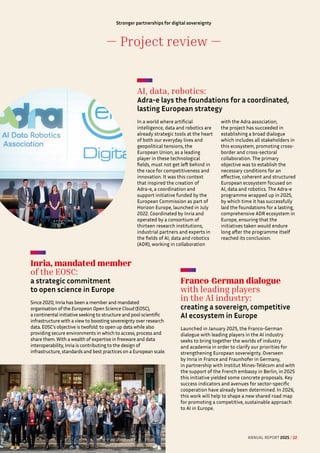
In a world where artificial
intelligence, data and robotics are
already strategic tools at the heart
of both our everyday lives and
geopolitical tensions, the
European Union, as a leading
player in these technological
fields, must not get left behind in
the race for competitiveness and
innovation. It was this context
that inspired the creation of
Adra-e, a coordination and
support initiative funded by the
European Commission as part of
Horizon Europe, launched in July
2022. Coordinated by Inria and
operated by a consortium of
thirteen research institutions,
industrial partners and experts in
the fields of AI, data and robotics
(ADR), working in collaboration
with the Adra association,
the project has succeeded in
establishing a broad dialogue
which includes all stakeholders in
this ecosystem, promoting cross-
border and cross-sectoral
collaboration. The primary
objective was to establish the
necessary conditions for an
effective, coherent and structured
European ecosystem focused on
AI, data and robotics. The Adra-e
programme wrapped up in 2025,
by which time it has successfully
laid the foundations for a lasting,
comprehensive ADR ecosystem in
Europe, ensuring that the
initiatives taken would endure
long after the programme itself
reached its conclusion.
Franco-German dialogue
with leading players
in the AI industry:
creating a sovereign, competitive
AI ecosystem in Europe
Launched in January 2025, the Franco-German
dialogue with leading players in the AI industry
seeks to bring together the worlds of industry
and academia in order to clarify our priorities for
strengthening European sovereignty. Overseen
by Inria in France and Fraunhofer in Germany,
in partnership with Institut Mines-Télécom and with
the support of the French embassy in Berlin, in 2025
this initiative yielded some concrete proposals. Key
success indicators and avenues for sector-specific
cooperation have already been determined. In 2026,
this work will help to shape a new shared road map
for promoting a competitive, sustainable approach
to AI in Europe.
Inria, mandated member
of the EOSC:
a strategic commitment
to open science in Europe
Since 2020, Inria has been a member and mandated
organisation of the European Open Science Cloud (EOSC),
a continental initiative seeking to structure and pool scientific
infrastructure with a view to boosting sovereignty over research
data. EOSC's objective is twofold: to open up data while also
providing secure environments in which to access, process and
share them. With a wealth of expertise in freeware and data
interoperability, Inria is contributing to the design of
infrastructure, standards and best practices on a European scale.
ANNUAL REPORT 2025 / 22
23.
Technological
entrepreneurship
— Focus onthree software-intensive
startup projects supported by Inria
Startup Studio in 2025.
HOPE VALLEY AI
HOPE VALLEY AI is a deeptech startup
and spin-off of Inria and CEA, awarded
the France 2030 label as well as the
2025 iLab and Women TechEU prizes.
It is currently developing
GEN-IV AI, a next generation AI
technology designed to identify and
analyse rare health conditions. The
company’s first application, HOPE,
is a smart e-clinic for breast
examinations suitable for use on
asmartphone, a CE-labelled medical
device in use since October 2025.
In 2026, the startup is undertaking
a strategic reorientation to focus its
efforts on HOPE METRIX, its SaaS
platform for digital oncology
research.
AUGURA SPACE
Spun off from the CNRS, Augura Space
develops AI-based space weather
solutions to protect critical systems
in orbit, in flight and on the ground.
Their platform spans the entire
operational cycle: post-event analysis
to understand past incidents, real-
time surveillance of current space
conditions, and forecasting to prepare
for the future impact of solar flares
on satellites, aviation and terrestrial
infrastructure.
ELEYA
Founded in 2025 by Thomas
Benchetrit and Hippolyte Labat
Missey, Eleya offers an AI-powered
solution for enriching consumer data.
Eleya trains AI agents to reproduce
the behaviour of each individual
present in the databases provided
by its clients. These thousands
of simulated agents are then
interviewed, and their responses are
summarised and fed into the original
data set to create augmented data
sources. Eleya is already working with
leading institutions such as IFOP,
as well as major advertising firms
including Publicis, providing data
enrichment solutions to help them
better analyse and understand
consumers.
Hivenet and
Inria are
reinforcing
their partnership
with a new challenge:
a sovereign,
sustainable
distributed
Cloud service
After a successful inaugural
collaboration in the field of
distributed data storage, Inria
and Hivenet embarked on
a new adventure in February
2025 with the launch of the
CUPSELI challenge.
This ambitious programme
seeks to push the boundaries
of distributed computing for
artificial intelligence,
proposing a sovereign, secure,
sustainable alternative to
centralised cloud solutions.
Three major challenges have
already been identified:
sustainable AI optimisation
on heterogeneous distributed
platforms, secure distributed
computing, and large scale
computing using volatile
resources. In order to rise to
these challenges, a sizeable
scientific community, including
eleven Inria project teams
from six Inria University
Centres, has been mobilised
for this collaboration with
a host of top level academic
institutions (including the
University of Bordeaux, the
University of Lorraine, the
University of Rennes and Côte
d’Azur University, alongside
Bordeaux’s Institut
Polytechnique, Institut
Mines-Telecom and ENS Lyon),
along with various research
organisations (including
the CNRS).
Seven entrepreneurs
supported by the Inria
Startup Studio won prizes at
the i-PhD and i-Lab 2025
innovation contests,
awarded by Bpifrance
i-PhD winners:
Alfred Audio: Said Alexander
Alvarado Marin, Leonardo Jesus
Ward Valdez, Miguel Fernández
Di Stefano
SensiPh: Claude Kengoum Pedie
Augura Space: François Ginisty,
Hadrien Mariaccia
Allendia: Tara Vanhatalo,
Huguette Château Laurent
Physicae: Julien Mellet
Switch2Prod: Thibault Clavier
(non ISS)
i-Labwinner:
Hope Valley: Hakima Berdouz
Enhance Lab: Jean Ponce, Julien
Mairal (non ISS)
Fast-growing startups:
funding rounds and
acquisitions
Acquisitions
Pulse Audition by EssilorLuxottica,
Malizen by WALLIX (Euronext
ALLIX), Pollen Robotics by Hugging
Face and Pixyl by Gleamer.
Fund-raising rounds:
Probabl, AlphaBrain, Augur, Darwin,
SkyId and AiVerse.
23 / ANNUAL REPORT 2025
24.
Defence and nationalsecurity:
major new projects
— Inria Defence and Security: structuring digital research
in pursuit of strategic priorities.
Inria Defence and Security occupies
a key role in the transformation of
research into operational capacities
in the service of France's defence
priorities. 2025 saw Inria
strengthening strategic partnerships
and expanding the scope of our work.
SERVING AS A STRATEGIC INTERFACE
In an age of global scientific and
technological competition, Inria
Defence and Security occupies a key
position at the interface between
government ministries (particularly
the Ministry for the Armed Forces),
industrial players and the academic
ecosystem.
Our mission: to reduce the lead time
between strategic needs being
formulated and operational solutions
being deployed, supporting the
ministries with their scientific
planning. Aligned with national and
European strategies, Inria Defence
and Security coordinates scientific
priorities, identifies needs, analyses
them in detail and creates projects
to respond to them.
PRIORITIES DEFINED IN TANDEM
WITH GOVERNMENT PARTNERS
The strategic priorities for 2025 were
defined at the annual senior
governance meeting between Inria
and the Ministry for the Armed
Forces, in line with the priorities set
out in the military spending act and
the national strategic review. While
artificial intelligence and cyber-
security remain key concerns, other
subjects such as robotics and
networks are becoming increasingly
important, as is the fight against the
manipulation of information.
Meanwhile, fields such as quantum
computing and space are emerging as
new strategic priorities. The quantum
campus for defence continues to
evolve, promoting collaboration
between public and private sector
actors, both civilian and military,
while New Space is tackling the
growing demand for analysis of
data from space.
STRONGER PARTNERSHIPS
TO KEEP CITIZENS SAFE
2025 also saw the consolidation of
existing collaborations with France's
General Secretariat for Defence and
National Security (SGDSN). These have
included the work done with VIGINUM
to fight back against the
manipulation of information, as well
as ongoing projects with the state
security and protection division (PSE)
looking at potential applications of AI
for civil defence purposes, particularly
improving forecasting and advance
warning of natural disasters.
2026: FOCUS ON EUROPE AND
BOLSTERING COLLABORATIONS
WITH UNIVERSITIES
In 2026, Inria Defence and Security
intends to consolidate its position as
a key player in European defence and
security, while continuing to solidify
our institution’s territorial roots and
close collaborations with partner
universities. An important step in
this process is the construction of
a clear offering aimed at academic
partners.
In an age of global scientific and technological
competition, Inria Defence and Security occupies a key
position at the interface between government ministries,
industrial players and the academic ecosystem.
Frédérique Segond, Director of Inria Defence and Security
ANNUAL REPORT 2025 / 24
25.
Planning, protecting, takingaction:
Inria and SGDSN tackle technological
challenges together
— At a time when disruptive technological
transformations are redefining the balances of
power, leaving nation states exposed to new
vulnerabilities, mastering the digital domain
has become a strategic imperative. Nicolas
Roche, Secretary General of the SGDSN, offers
his analysis of these challenges and the central
role of Inria in anticipating risks, structuring
national efforts and translating scientific
excellence into operational capacities.
Disruptive technological
transformations are reshaping the
national security landscape. They are
modifying balances of power, creating
new vulnerabilities and blurring the
boundaries between times of peace
and crisis situations. The
appropriation of these technologies
by governmental and non-
governmental actors leaves our
nation exposed to new forms of
dependency and coercion.
As highlighted in the national
strategic review, updated in summer
2025, control over critical technologies
(digital, space, energy, biotech) will
directly determine governments’
capacity for action, with consequences
for their sovereignty. Keeping up with
the times is no longer enough: we
need to anticipate future evolutions,
assess the risks they pose and make
sure that they serve our national
security rather than undermining it.
The most obvious example comes
from the digital sphere, which has
long since become a critical
infrastructure in its own right: it is
essential to continuity of activity,
and the government's analytical
and decision-making capacities.
Inria occupies a prominent role in this
landscape. By dint of the sheer quality
of its work and its capacity to coordinate
national research and innovation
efforts, the institute is making a direct
contribution to our mastery of critical
technologies. Its role as programmes
agency, its involvement in national
strategies and its participation in INESIA
all further cement Inria's position as
a central player in the scientific and
technological control of the digital
realm. Our expectations of Inria are as
high as the stakes at play: to produce
top level scientific work in decisive
fields, while ensuring that this
knowledge can be rapidly translated
into capacities for public action.
This is the philosophy behind the
partnership between SGDSN and Inria.
It aims to unite scientific and
operational forces in order to better
plan for, prevent and manage major
crises; to ensure the protection of
information systems and critical
infrastructure; to stand up to
information manipulation campaigns;
and to rigorously assess the security of
new technologies, particularly artificial
intelligence systems, in order to keep
associated risks under control.
Such are the necessary conditions for
mobilising the resources required to
deliver lasting action in a strategic
environment marked by competition,
opposition and technological
acceleration.
25 / ANNUAL REPORT 2025
26.
— Project review—
Information
manipulation:
Inria and VIGINUM
join forces
Faced with the rise in information
manipulation, amplified by AI in
particular, Inria and VIGINUM are
strengthening their collaboration.
This partnership combines VIGINUM's
operational expertise in the detection
of digital interference by foreign
players with Inria’s skills in AI,
data analysis and modelling.
Joint projects have focused on the
identification of manipulated content,
analysing those manipulations,
detecting coordinated campaigns
and weeding out disinformation
propagated via multiple channels,
as well as analysing such
dissemination tactics. Twenty-plus
Inria project teams are likely to be
actively involved in this partnership.
Accelerating digital simulation in key sectors such as
aeronautics and defence
In the aeronautical, defence and
energy sectors, digital simulations
are essential but extremely time and
energy-consuming. So how can we
keep costs under control? The
Monhade project team, based at the
University of Bordeaux Inria Centre,
in partnership with the CNRS, the
University of Bordeaux, Bordeaux's
Institut National Polytechnique and
the ONERA (national office for space
studies and research), aims to rise to
this challenge by finding new ways
to reduce complexity and achieve
greater control over mathematical
model simulations.
Instead of starting over again with
each new simulation, for example
when making geometrical
adjustments to the wing of a plane,
the idea is to make use of existing
simulations, collected in a database,
to find similar solutions and reduce
compute costs.
Secure, sovereign and environmentally
responsible data storage:
a partnership between Scality and Inria
Scality, French and global leader in
distributed data storage solutions,
has joined forces with Inria on the
Cyberté project. Their goal: to
develop data storage solutions
that are secure, reliable, sovereign
and environmentally responsible,
by incorporating AI into software
infrastructures. The research done
by the Inria project teams
involved in this partnership will
enable Scality to integrate new
tools into their solutions:
AI-powered predictive models to
anticipate hardware and software
failures, algorithms capable of
detecting unusual behaviour in
real time and rapidly identify the
early signs of an attack, and low-
compute AI methods keeping
energy consumption under
control thanks to detailed
measurement of software usage
(PowerAPI toolbox). The Cyberté
project is an “i-Démo” supported
by France 2030.
ANNUAL REPORT 2025 / 26
27.
— Project review—
Naval Group, Inria and Simula
have signed a partnership
agreement to strengthen
Franco-Norwegian cooperation
on research involving defence technologies
Naval Group, Inria and research
laboratory Simula signed a new
partnership and cooperation
agreement on 5 June 2025.
The agreement was signed at the
Norwegian Club in Paris, under the
aegis of Norway's official body for
promoting the country’s trade and
investment: Innovation Norway.
This partnership lays the
foundations for closer cooperation
between these experts in advanced
research and innovation in key
technological fields for digital and
maritime defence, spanning topics
such as communications systems
and the digital transformation,
all of vital importance to modern
naval capacities. This is our second
industrial partnership with Naval
Group, following on from the deal
signed in 2021 with India (IIT Delhi).
Strategic
cryptography:
anticipating threats,
protecting
functionalities
The scientists of the GRACE project
team (Inria Saclay) are working to
strengthen digital security, particularly
for defence applications. Olivier Blazy
is working with the CNIL and European
partners to create age verification
solutions which respect the anonymity
of web users, with the results already
integrated into regulatory frameworks.
Daniel Augot, a specialist in sanity
checks and zero-knowledge proofs, is
leading the “tout-ZK” project aimed at
conducting large scale evaluations of
these cryptographic systems in
industrial contexts. Last but not least,
Thomas Debris-Alazard has detected
major vulnerabilities in post-quantum
cryptography, paving the way for new
security analyses to ward off future
threats.
Improving security at the software-
hardware interface
SUSHI (University of Rennes Inria Centre), a joint project team with
CentraleSupélec, the CNRS and ENS-Rennes, is devoted to exploring the risks
arising at the ever-more complex frontier between software and hardware.
The team’s scientists are interested in analysing vulnerabilities, deploying
formal methods to demonstrate the security of products, and also using
automatic detection and response tools in the event of an attack on an
individual machine.
The project team is also involved with SecurEval, one of the ten projects which
make up the Cyber-Security PEPR scheme.
27 / ANNUAL REPORT 2025
28.
Inria, an institution
withprinciples:
talent, fairness, ethics
— Day after day, Inria is working to foster
an exacting, inclusive working environment
consistent with the values that drive us. Ethics,
diversity and integrity: these commitments,
shared by all employees and partners of our
institution, are the hallmarks of a vision of
public research which puts people at the centre
of its priorities.
INRIA+ALUMNI: A VIBRANT
COMMUNITY
Inria+alumni is a community of
current and past employees, doctoral
students, scientists, engineers and
support staff who have all
contributed, at one time in their
careers, to the work of Inria.
Its goal: To offer a range of services
which strengthen the lasting bonds
between the people who have made
the institute what it is today,
nurturing a sense of belonging.
Since relaunching in Autumn 2024,
Inria+alumni has launched a number
of initiatives aimed at mobilising the
community, which had over 1500
active members as of late 2025
(an increase of 200%): networking,
newsletters, career updates, alumni
events and meet-ups in France and
elsewhere in the world. Inria+alumni
offers members privileged access to
job opportunities via its careers
service, drawing upon the industrial
partnerships and ecosystems
established by Inria's sites, as well
as members keen to recruit talents
educated at Inria. It is a forum for
interactions between research,
teaching, industry and
entrepreneurship, boosting the
attractiveness and reach of our
institute.
DEONTOLOGY, RESEARCH INTEGRITY
AND ETHICS: A CHARTER FOR
EMPLOYEES AND PARTNERS
Collectively constructed and inspired
by best practices, including many
taken from our academic partners,
Inria's Deontology, Research Integrity
and Ethics Charter was drawn up to
set out the guiding principles that
everybody working with Inria must
undertake to uphold.
The charter brings together the most
important existing rules, making
them easier to understand, absorb
and apply. This strategic document
was presented to the board of
directors on 17 October 2025, as part
of ongoing efforts to reinforce our
ethical and compliance frameworks.
Initially focused on research and tech
transfer, the charter has since been
expanded to encompass all aspects of
Inria's work, with special attention
devoted to proper conduct, in response
to the recommendations issued by the
French anti-corruption agency.
Disabilities:
Inria reaffirms
its commitment
to inclusion.
2025 marked an important milestone
in Inria's disability policy, which has
been a priority since 2018. As well as
being the first year of the 2025-2028
Disability Strategy, it coincided with
the renewal of the convention signed
with the FIPHFP in 2021. Inria has
a comprehensive, proactive policy
to ensuring that disabilities do not
become obstacles to recruitment,
continued employment or career
advancement. The signature of the
2025-2028 Disability Strategy and
the renewal of our convention with
the FIPHFP reaffirm the long-term
commitments of our institution on
these matters.
In 2025, 90 Inria employees received
support from our network of
disability support officers.
26 benefited from adjustments to
their working environments, while
20 more obtained official recognition
of their circumstances. Last year also
saw 20 new recruits join Inria,
including four apprentices, three
doctoral and post-doc researchers,
two researchers and nine interns.
Among the highlights of the year
were the webinars and workshops
on the subject of digital accessibility,
aimed at employees and volunteers,
as well as the launch of our Instant H
podcast on Youtube, where it is now
available to the general public.
The results recorded since 2019 show
that significant progress has been
made: the proportion of employees
with disabilities has grown from
2.82% to 4.63%, in a period when
Inria’s total headcount has increased
considerably (+40%). This dynamism
has been made possible by the
dynamism of our network of disability
support officers and all of the
colleagues who have played an active
role in the deployment of the policy.
Community and reach
ANNUAL REPORT 2025 / 28
29.
Digital accessibility: Inria's
networkcontinues to grow!
In 2025, Inria's digital accessibility
team conducted audits or counter-
audits of seven major applications,
taking the total number of
applications audited to 12 (two were
compliant, seven partially compliant
and three failed to comply with
RGAA standards, the reference
framework for improving
accessibility). The institution has
also set up a network of digital
accessibility officers, charged with
ensuring that best practices are
applied within Inria.
HANDITECH LAB INRIA
Handitech Lab Inria (HLI) works to
develop digital solutions for and
with people living with disabilities.
A member of the Humanlabs network,
HLI draws upon Inria’s scientific and
technical expertise to find solutions
to the needs expressed by users or
partners working directly with users.
Adopting a frugal, open source approach
to innovation, HLI designs solutions
(software, prototypes) ranging from
bespoke support with day- to-day tasks
to disability awareness-raising tools.
For several years, HLI has been an active
contributor to the BIONICOHAND
project, devoted to developing an open
source myoelectric prosthetic hand.
There have been some noteworthy
successes over the past year:
»
publication of an academic article
detailing the design and current
performance of the prosthesis;
»
project leader Nicolas Huchet secured
funding from Inria Startup Studio to
help this technology reach more
amputees;
»
Christophe Braillon, an engineer with
the experiments and development
department at Grenobles Alpes
University Inria Centre, also secured
funding, this time from the Inria
Quadrant Programme (PIQ) to finance
the development of an advanced
version which can be more easily
duplicated and customised.
Inria: an institution committed
to equal opportunities
Inria has also put in place,
in consultation with union
representatives, a strategy for
promoting equal opportunities
for women and men in the period
2024-2028.
This plan, one of the milestones of the
Objectives and Performance Contract
(5.1.4) sets out a clear trajectory:
»
Reducing the pay gap
»
Guaranteeing equal professional
opportunities
»
Combating gender stereotypes
»
Attracting talented women
»
Improving the work-life balance
»
Fighting against sexual and sexist
violence, harassment and
discrimination
»
Promoting women’s health at work
This commitment, which has mobilised
numerous Inria employees across a wide
variety of initiatives, is already bearing
fruit: the results of the gender parity
index were encouraging, with our
overall score improving from 75.6/100
in 2024 to 83.8/100 in 2025.
FOCUS
Chiche!
Achieving equal opportunities in
the professional sphere will require
more effort to reach out to those
generations who will shortly be
joining the workforce. Awakening
their curiosity for digital science and
technology, introducing them to the
career opportunities available in
research and encouraging pupils,
especially girls, to continue
exploring the sciences and the
professional pathways they offer...
All in a day's work for the Chiche!
programme, supported by the
Ministry of Education. In 2025
the programme organised
332 presentations in classrooms all
over France, reaching 10,784 pupils
including 5549 girls.
TechPourToutes
Awareness is all well and good,
but support is even better! With
that goal in mind, future women
in science can count on the
TechpourToutes programme
financed by France 2030. The
programme is overseen by the Inria
Foundation along with a diverse
consortium of partners (France
Universités, the Committee of
Directors of French Engineering
Schools (CDEFI), the Grandes Ecoles
Committee (CGE), Femmes@
Numérique, BECOMTECH, Latitudes,
JobIRL and Numeum). It is free of
charge, and works to support girls
and young women on their digital
career paths, giving them the
resources they need to secure
the job of their dreams.
29 / ANNUAL REPORT 2025
30.
“Women in digital”:
Celebrating women in science with
a series of nine portraits of female
scientists at Inria
— Under the banner of the equal opportunities strategy
for 2024-2028, numerous initiatives have been launched
with the goal of reaching young women and boosting
their career prospects;
With that goal in mind, the “Women
in Digital” collection turns the
spotlight on Inria researchers and
engineers whose work is testament to
our shared convictions. Launched in
2025, this portrait series embodies
Inria's proactive approach to
promoting equal opportunities and
encouraging young women to pursue
careers in the digital sector. Extracts
from the nine interviews published in
2025 with scientists at the University
of Bordeaux Inria Centre and the Inria
Saclay Centre.
Émilie Chouzenoux, Head of the
OPIS project team at Inria Saclay.
“Leading a team is an exciting
challenge which has enabled me
to learn a lot about management,
organisation, relational styles and
communication. It's totally compatible
with my skills as a researcher. ”
Oana Goga, Research Director with
the CEDAR project team (Inria Saclay)
“In France, there are many initiatives
created to help women in science to
find jobs at research institutes, for
example, or to boost their profile.
I think that I've benefited from the
work of previous generations. ”
Margot Vulliez, researcher
with the Auctus project team
(Inria Bordeaux University)
“Women, gender minorities and
people from ethnic minorities are
still under-represented. ”
Clémence Frioux researcher
with the PLEIADE project team
(Inria Bordeaux University)
“Collectively, there are a certain
number of tools at our disposal to get
more women (into digital sciences),
improve their day-to-day lives [...] and,
above all, create an atmosphere that
makes them want to stay. ”
Gwladys Ravon, Research Engineer
with the Experiments and
Development Department at the
University of Bordeaux Inria Centre.
“Things are getting better in terms of
the number of women working as
research directors and lecturers.
(…) However, the representation of
women in the engineering sphere
is still very disappointing…”
Marianne Akian, research director
with the Tropical project team
(Inria Saclay University)
“That's really the message I want to
get out there for young girls: don't
be afraid to do a job that you enjoy.
You can enjoy maths for maths’ sake,
without having to find an immediate
use for it. The usefulness often comes
later. If you like maths, go for it! ”
Emmanuelle Saillard, researcher
with the Storm project team
(Inria Bordeaux University)
“I've always been surrounded by
very respectful people. Nonetheless,
there's no denying the under-
representation of women in science.
In my preparatory classes, I was one
of two girls. You get used to it... but
it's not normal. ”
Cécile Mazon, lecturer and researcher
on the Flowers project team
(Inria Bordeaux University)
“Women are under-represented in
maths and computer science because,
in my opinion, we take on board all
these social norms from such a young
age, and those gender stereotypes
get in there at a young age, or very
quickly.
Mélanie Prague, Head of the
SISTM project team at the University
of Bordeaux Inria Centre.
“You have to take a chance, persevere
[...] give yourself the tools to succeed. ”
ANNUAL REPORT 2025 / 30
31.
ERC Starting Grant:
Thomas Debris-Alazard at the cutting
edge of post-quantum cryptography
— Quantum computing is not yet a reality,
but the race to develop quantum-resistant
cryptographic standards is already on. Thomas
Debris-Alazard, a researcher at Inria Saclay and
member of the GRACE joint project team, was
recently awarded an ERC Starting Grant worth
€1.4 million over a five-year period. Thanks to
this high profile European funding, he will now
be able to test the solidity of the post-quantum
algorithms currently being standardised,
subjecting them to actual quantum attacks.
WHY QUANTUM COMPUTING
REQUIRES US TO RETHINK 50 YEARS
OF CRYPTOGRAPHY
Since the late 1970s, the security of
our communications has been largely
dependent on RSA encryption. This
system is based on a mathematical
problem considered to be impossible
for a classical computer to solve
within a reasonable time frame:
factoring the product of two
large prime numbers. However,
in 1994 mathematician Peter Shor
demonstrated that a quantum
algorithm could resolve such
problems in a time frame much less
sensitive to the size of the key than
the best classical algorithms.
Although large scale quantum
computing is not yet an operational
reality, governments and industry
leaders cannot afford to wait and see:
data which is currently encrypted
could potentially be stored for future
decryption, a threat known as harvest
now, decrypt later .
So what is the solution? The
development of post-quantum
or quantum safe cryptography:
algorithms capable of withstanding
attacks from future quantum
computers. Standard-setting bodies,
such as America's NIST, have identified
two broad families of solutions:
Encryption based on error-correcting
codes, and encryption based on
Euclidean lattices. In both cases,
security is guaranteed by the
difficulty, even for a quantum
computer, of finding the closest
point to a given point in a very high-
dimensional mathematical lattice
(with a thousand, or even two
thousands coordinates).
IQ-SCALE: TESTING TO IMPROVE
PROTECTION
Are these solutions really robust
enough to withstand quantum
algorithms? That's the central
question which the IQ-SCALe project
seeks to address. Because even
though some hundred-plus proposed
post-quantum algorithms have been
presented to the NIST, none of them
has yet been tested against a genuine
quantum attack. The scientific
community lacks researchers with
the necessary expertise in the
intersection of cryptography and
quantum algorithms, a blind spot
that Thomas Debris-Alazard intends
to resolve.
The researcher draws inspiration
from the work of Oded Regev, who
has attempted to adapt the Shor
algorithm to Euclidean networks.
Thomas Debris-Alazard has
determined that the efficacy of this
approach depends on the maths of
high-dimensional sphere packing.
Since the terminals used by Regev
were not sufficiently precise, fine-
tuning these results could improve
the algorithm and potentially find
breaches in the systems currently
being standardised by the NIST.
TRAINING THE NEXT GENERATION
OF CRYPTOGRAPHERS
The IQ-SCALe project raises two
potential solutions: corrective
action if an attack succeeds,
or demonstrating the robustness of
systems in the event of a failure.
The project will also help to train
three doctoral students and two
post-doctoral researchers in the
overlapping complexities of two
disciplines which are too often
treated separately – a key priority
for scientific sovereignty as well as
digital security.
31 / ANNUAL REPORT 2025
32.
Researchers
in the spotlightin 2025
Major international awards
ACM-IEEE ECKERT–MAUCHLY
AWARD
André Seznec, of the PACAP project
team (University of Rennes Inria
Centre and the University of Rennes,
within UMR IRISA)
This prize is the world's highest
honour in the field of computer
architecture, recognising Profe.
Seznec's pioneering work on
processors.
Mentored by Jacques Lenfant,
who would go on to serve as President
of the University of Rennes 1, André
Seznec joined the Inria Centre in
Rennes in 1983. He started out as
a doctoral student, before taking up
a research post. He subsequently led
two project teams (CAPS and ALF) over
a period which stretched from 1994 to
2016. An IEEE Fellow since 2013 and
ACM Fellow since 2016, he was
awarded the Intel Research Impact
medal in 2012 and the Intel
Outstanding Research prize in 2019.
He was also awarded the IEEE B.
Ramakrishna Rau Prize in 2020
and the Inria - French Academy
of Sciences - Dassault Systèmes
Innovation Prize in 2022. His research
has influenced the cache structure
and branch prediction design of
countless processors.
EARLY CAREER RESEARCH AWARD
FROM THE ACM SIGGRAPH
Jiong Chen (Inria), Geomerix project
team (joint venture between Inria
Saclay and Paris)
IEEE LIFE FELLOW
Josiane Zerubia (Inria), Côte d'Azur
University
FRONTIERS OF KNOWLEDGE PRIZE
(BBVA FOUNDATION)
Michael I. Jordan, Inria Centre Paris -
Inria Foundation Chair, supported by
Air Liquide, BNP Paribas Asset
Management Europe, EDF, Orange
and SNCF
A prestigious international
prize recognising Prof. Jordan’s
fundamental contributions to
machine learning.
THE BCI SOCIETY EARLY
CAREER AWARD
Marie-Constance Corsi (Inria), Nerv
project team (Inria Paris, CNRS,
Inserm and the Sorbonne)
IEEE FELLOW
Denis Efimov (Inria), Valse project
team (Inria Centre University of Lille,
École Centrale de Lille and University
of Lille)
PCM SIGGRAPH ACHIEVEMENT
AWARD
George Drettakis, GraphDeco project
team (Côte d’Azur University Inria
Centre)
A major international honour in
the field of computer graphics,
recognising Dr. Drettakis’
contributions to realistic light
simulation.
EUROPEAN ASSOCIATION FOR
SIGNAL PROCESSING (EURASIP)
Early Career Award, Émilie
Chouzenoux (Inria), Opis project
team (Inria Saclay and Université
Paris-Saclay)
Software, collective research and open science
LEVCHIN PRIZE FOR REAL-WORLD CRYPTOGRAPHY
Pierrick Gaudry (CNRS), Emmanuel Thomé (Inria) and Paul Zimmermann
(Inria) from the Caramba project team (University of Lorraine Inria Centre,
University of Lorraine and CNRS), for CADO-NFS, the benchmark-setting
cryptanalysis software tool.
OPEN SCIENCE AWARD FOR OPEN SOURCE RESEARCH SOFTWARE (MESR)
GNU MPFR by Paul Zimmermann (Inria) from the Caramba project team
(University of Lorraine Inria Centre, University of Lorraine and CNRS), and
Vincent Lefèvre (Inria) from the Pascaline project team (Inria Lyon, CNRS,
ENS Lyon and UCBL), an essential library for high-precision digital calculations,
used all over the world.
ANNUAL REPORT 2025 / 32
33.
National and institutionalhonours
MEMBERSHIP OF THE ACADÉMIE
DES SCIENCES
Bertrand Thirion, MINID project team
(Inria Saclay and CEA)
Specialising in the application of
advanced statistical methods to brain
imaging, Bertrand Thirion develops
novel approaches designed to improve
the analysis and interpretation of
neuroscience data. His research
combines artificial intelligence,
statistics and software engineering,
helping to further our understanding
of the brain and the medical
applications of technology.
GRAND PRIX INRIA –
ACADÉMIE DES SCIENCES.
Jean-Michel Muller, CNRS Research
Director, Pascaline project team
(Inria Lyon, CNRS, ENS Lyon and
UCBL)
THE INRIA– FRENCH ACADEMY OF
SCIENCES - DASSAULT SYSTÈMES
INNOVATION PRIZE
Teddy Furon, Inria research director,
leader of the Artishau project team
(Inria Rennes and University of
Rennes)
INRIA – ACADÉMIE DES SCIENCES
YOUNG RESEARCHER AWARD
Clémentine Maurice, CNRS
researcher and member of the
Spirals project team (Inria Lille,
University of Lille and CNRS)
L’ORÉAL-UNESCO YOUNG TALENT
AWARD FOR WOMEN IN SCIENCE
Bianca Marin Moreno, Inria THOTH
project team (Grenoble Alpes
University Inria Centre) and EDF RD
ORDRE NATIONAL DU MÉRITE
(KNIGHTHOOD)
Virginie Ehrlacher, (École des Ponts),
MATHERIALS project team (Inria
Centre Paris and École des Ponts)
SIF – ACADÉMIE DES SCIENCES
LOVELACE – BABBAGE PRIZE 2025
Nataliia Bielova, Inria Research
Director, PRIVATICS project team
(Inria Centre Lyon and the National
Institute for Applied Sciences, Lyon)
CNIL – INRIA PRIZE 2025
Nataliia Bielova, PRIVATICS project
team (Inria Lyon and National
Institute for Applied Sciences, Lyon),
Cristiana Santos, Assistant Professor
of Law at the University of Utrecht
(Netherlands) and Colin M. Gray,
Associate Professor at Indiana
University Bloomington (USA) for
their article “Two worlds apart!
Closing the gap between regulating
EU consent and user studies”
Securing the systems at the
heart of our digital lives
Accessing the data stored on
a computer using a software tool
which exploits flaws in the hardware
system: that, in a nutshell, is the
definition of a micro-architectural
attack, Clémentine Maurice's area of
expertise (CNRS). Now a member of
the Spirals project team (a joint
initiative between the Inria Centre at
the University of Lille and the CNRS),
Clémentine Maurice has become
a key figure in her field. At just
35 years of age, she writes articles
for leading journals, sits on a number
of expert committees, helps put
together programmes for major
international events and has won
a number of prestigious awards.
She is also a researcher with
a commitment to causes such as
open science and promoting the
role of women in research.
Building a more
transparent web
Nataliia Bielova is a computer science
researcher with the PRIVATICS team.
From September 2021 to December
2022 she was on secondment to the
CNIL (France's National Commission
for Information Technologies and
Civil Liberties). Her research focuses
on data protection and online
confidentiality. Dr. Bielova has
developed a multidisciplinary
approach to her work, collaborating
with specialists from the fields of law
and design. She is particularly
motivated by the potential
ramifications of her research for
our society. In the sensitive field of
personal privacy and data protection,
her goal is to inform and enlighten
political decision-making with the
help of results from the very latest
research.
33 / ANNUAL REPORT 2025
34.
Resources and highlights
Annualbudget
report for 2025
Inria's 2025 budget shows an increase in the Institute's
spending, in keeping with the significant expansion of
our activities described in the pages of this annual
report. Expenditure increased by around €16.4 million,
from €312.8M in 2024 to €329.2M in 2025.
Revenue fell by €21.1 million, dropping from €323.2M in
2024 to €302.1M in 2025. This decrease can be largely
attributed to the one-off payment of €19M received in
2024 in relation to the Inria Quadrant Programme.
Under the combined effect of rising costs and shrinking
revenue, 2025 saw a budget deficit of €27.1M after
a surplus of €10.4M in 2024.
Looking at revenue in greater detail, the Public Service
Subsidy stood at €209.0M, compared with €191.6M in
2023 and €204.9m in 2024. It thus represented 69 % of
the total revenue received for the 2025 financial year.
Additionally, an investment subsidy to the tune of
€2M was received as a contribution to the budget for
the construction of the new Inria headquarters.
Equitystands at €91.1M. This represents 30 % of the
Institute's total resources in 2025.
— THESE EQUITY RESOURCES COME FROM—
By nature, expenditure breaks down as follows: €255.7m
of payroll costs (78 % of total expenditure), including
€186.8m for the Scheduled Wage Bill and €68.9m for the
Non-Scheduled Wage Bill.
Total headcount “beneath the salary cap” reached
1830.6 full-time equivalent posts (FTE), up from 1686 in
2023 and 1786 in 2024. The number of staff not subject to
the salary cap (i.e. those whose pay is covered by Inria’s
own resources) was 1421.2 FTE compared to 1134.0 in 2023
and 1227.4 in 2024.
€64.4M went on non-scheduled investment and
operating costs (FCI);
€9.1m on expenditure related to scheduled investment
transactions (OIP).
By purpose, expenditure in 2025 included:
” €225.2M on scientific activities at the research centres
(item 1), i.e. 68% of total expenditure in 2025;
” €29.3M on joint research activity (item 2), i.e. 9 %;
” €74.7M on support functions (item 3), i.e. 23%;
Income received for the work of the Programmes Agency
stood at €28.9M in 2025, accounting for almost 40% of
total project and programme subsidies received by Inria
last year (€73.3M). This revenue breaks down as follows:
Post-exascale scientific computing programme €2.1 M
Cyber-security programme €7.3 M
Artificial intelligence programme €5.5 M
Virtual worlds programme €0.5 M
Digital applications for healthcare programme €2.4 M
Digital technology and the environment programme €1.7 M
Quantum computing programme €5.1 M
Systems, Networks and Cloud programme €2.2 M
Other €2.1 M
Total €28.9 M
Les contrats
de recherche avec tiers
privés et publics
12,1 M€
Les ventes de produits :
éditions, colloques…
2,3 M€
Dons et legs affectés
0,3 M€
Les redevances
pour brevets et licences
0,6 M€
Opérations financières –
Immobilisations
0,4 M€
Autres produits
2,1 M€
Les subventions sur
projet ou programme
de recherche
73,3 M€
ANNUAL REPORT 2025 / 34
35.
January 2025
OFFICIAL LAUNCH,AT INRIA SACLAY,
OF OUR NINE CENTRES OF
EXCELLENCE IN RESEARCH AND
EDUCATION (“AI CLUSTERS”), attended
by Élisabeth Borne (Minister for
Education, Higher Education and
Research), Philippe Baptiste (Minister
for Higher Education, Research and
Space) and Clara Chappaz (secretary
of state for AI and Digital
Technologies).
—
CREATION OF THE NATIONAL
INSTITUTE FOR AI EVALUATION AND
SAFETY (INESIA), jointly chaired by
the General Secretariat for Defence
and National Security (SGDSN) and
the General Business Directorate
(DGE). INESIA coordinates the work
of four public organisations with
complementary action remits:
the National Agency for Information
Systems Security (ANSSI),
the National Laboratory for
Metrology and Testing (LNE),
the Expert Centre on Digital
Regulation (PEReN) and Inria.
February 2025
INRIA WAS A PROMINENT FORCE AT
THE AI ACTION SUMMIT, especially
in discussions of trustworthy AI,
the environment, work and
multilateral AI governance.
March 2025
SIGNATURE OF A STRATEGIC
PARTNERSHIP AGREEMENT between
Inria and the University of Lorraine,
establishing the University of
Lorraine Inria Centre.
April 2025
SIGNATUREOFTHEOBJECTIVESAND
PERFORMANCECONTRACT2024-2028
with Philippe Baptiste, Minister for
Higher Education, Research and
Space, Clara Chappaz, secretary of
state for Artificial Intelligence and
Digital Technologies, and Bruno
Sportisse, CEO of Inria.
June 2025
SIGNATURE OF AN AGREEMENT WITH
NAVAL GROUP AND NORWEGIAN
RESEARCH LABORATORY SIMULA,
focusing on communications systems
and the digital transformation,
essential issues for modern naval
capacities.
—
VIVATECH SIGNS FOUR STRATEGIC
PARTNERSHIPS: Cetim (collaboration
between public-sector digital
research and the industrial sector),
Quobly (quantum), Quandela
(quantum), AMIAD (ministerial
agency for artificial intelligence in
defence), and a statement of intent
with Fraunhofer Gesellschaft (Franco-
German dialogue on AI in industry).
July 2025
LAUNCH OF THE FRANCE 2030
“AI PIONEERS” CALL FOR PROPOSALS,
OVERSEEN BY BPIFRANCE AND INRIA
in our capacity as digital programmes
agency, in partnership with the
General Secretariat for Investment
(SGPI), the DGE, the Directorate
General for Research and Innovation
and the CGDD.
October 2025
SIGNATURE OF A NEW PARTNERSHIP
AGREEMENT between Inria and
the CNIL.
—
RENEWAL OF OUR FRAMEWORK
AGREEMENT with INSEP.
—
SIGNATURE OF A NEW AGREEMENT
WITH THE JOINT RESEARCH CENTRE OF
THE EUROPEAN COMMISSION (JRC)
covering cyber-security, artificial
intelligence and data generation.
November 2025
CREATION OF THE NEW CHAIR
“AI: MAKING THE FUTURE OF WORK
POSITIVE” with Macif, backed
by LaborIA.
—
PUBLICATION OF REPORTS
BY THE COUR DES COMPTES
on Programme Agencies and
the SNIA.
—
ADOPT AI AT THE GRAND PALAIS
Official launch of the new bilateral
Franco-German artificial intelligence
centre, with the DFKI.
—
SIGNATURE OF A NEW PARTNERSHIP
BETWEEN INRIA AND DOCTOLIB,
for research into AI in the
healthcare sector.
December 2025
LAUNCH OF THE INRIA VIGINUM
AWARDS supporting European
research in the fight against
information manipulation.
— 2025 —
I N A F E W K E Y D A T E S
35 / ANNUAL REPORT 2025
36.
INRIA, DIGITAL SOVEREIGNTYTHROUGH RESEARCH AND INNOVATION
Inria, France’s national institute for research in digital science and technology,
supports the French government in national research and innovation strategies in
the digital field, in its role as Digital Programmes Agency. Inria leads over 300 research
and innovation projects with its 3500 scientists, engineers, and support staff,
in partnership with universities and the digital ecosystem (businesses, entrepreneurs,
and public stakeholders).
Together, we explore strategic fields such as artificial intelligence, cybersecurity,
quantum computing, cloud technologies, digital transformation in healthcare, digital
twins, and digital technologies for defence.
We develop practical solutions such as software, tech startups, partnerships with
national companies, and cutting-edge training programmes.
Our goal is to drive scientific, technological, and industrial excellence to secure
France’s digital sovereignty.