ANIn Pune 2026 | AI Literacy and Ideation Framework for Workforce Enablement by Ashish Khare & Silky Gupta
1.
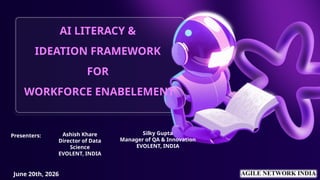
AI LITERACY &
IDEATIONFRAMEWORK
FOR
WORKFORCE ENABELEMENT
Presenters: Ashish Khare
Director of Data
Science
EVOLENT, INDIA
Silky Gupta
Manager of QA & Innovation
EVOLENT, INDIA
June 20th, 2026
Disclaimer by Speaker
3
Foreducational use. Includes public and attributed content. Attribution details provided at end of presentation.
1. Views, thoughts, and opinions expressed in the session and presentation, collectively referred as “the
content”, belong solely to me in my personal capacity, and not necessarily to my employer / organization /
client, etc.
2. “The content” is based on my learning, experience as well as knowledge gathered through material available
publicly on the internet.
3. I do not endorse or promote any organization, committee, product or person through this session.
4. I have agreed to the Code of Conduct, Privacy Policy, Speaker Engagement Policy as referred in the Speaker
Application Form submitted by me or on my behalf on the Agile Network India website.
Speaker Name and Date:
Ashish Khare & Silky Gupta
20-June-2026
5.
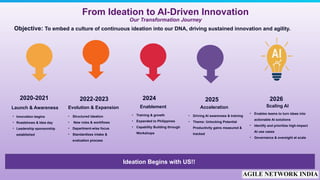
From Ideation toAI Driven Innovation
‑
Our Transformation Journey
Ideation Begins with US!!
Objective: To embed a culture of continuous ideation into our DNA, driving sustained innovation and agility.
2026
2020-2021 2022-2023 2024 2025
Launch & Awareness Evolution & Expansion Enablement Acceleration
• Innovation begins
• Roadshows & Idea day
• Leadership sponsorship
established
• Structured Ideation
• New roles & workflows
• Department-wise focus
• Standardizes intake &
evaluation process
• Training & growth
• Expanded to Philippines
• Capability Building through
Workshops
• Driving AI awareness & training
• Theme: Unlocking Potential
Productivity gains measured &
tracked
• Enables teams to turn ideas into
actionable AI solutions
• Identify and prioritize high-impact
AI use cases
• Governance & oversight at scale
Scaling AI
6.
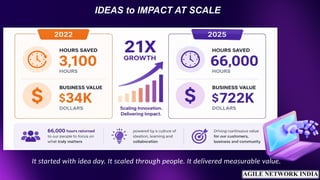
IDEAS to IMPACTAT SCALE
It started with idea day. It scaled through people. It delivered measurable value.
7.
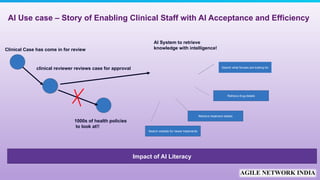
AI Use case– Story of Enabling Clinical Staff with AI Acceptance and Efficiency
Impact of AI Literacy
Clinical Case has come in for review
clinical reviewer reviews case for approval
1000s of health policies
to look at!!
AI System to retrieve
knowledge with intelligence!
Search what Nurses are looking for
Retrieve drug details
Retrieve treatment details
Search website for newer treatments
8.
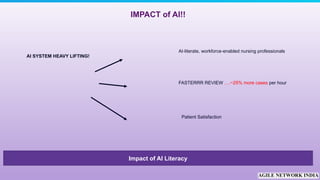
IMPACT of AI!!
Impactof AI Literacy
AI SYSTEM HEAVY LIFTING!
AI literate, workforce enabled nursing professionals
‑ ‑
FASTERRR REVIEW ….~25% more cases per hour
Patient Satisfaction
9.
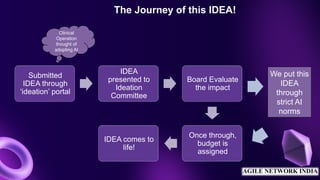
Submitted
IDEA through
‘ideation’ portal
IDEA
presentedto
Ideation
Committee
Board Evaluate
the impact
Once through,
budget is
assigned
IDEA comes to
life!
Clinical
Operation
thought of
adopting AI
We put this
IDEA
through
strict AI
norms
The Journey of this IDEA!
10.
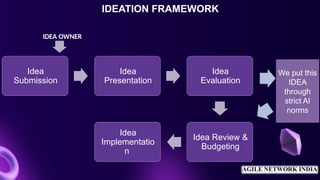
We put this
IDEA
through
strictAI
norms
Idea
Submission
Idea
Presentation
Idea
Evaluation
Idea Review &
Budgeting
Idea
Implementatio
n
IDEA OWNER
IDEATION FRAMEWORK
Evolent | Confidential—Donot distribute | 12
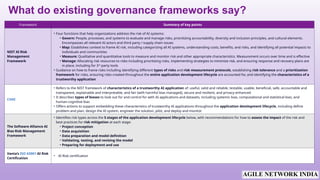
What do existing governance frameworks say?
Framework Summary of key points
NIST AI Risk
Management
Framework
• Four functions that help organizations address the risk of AI systems:
• Govern: People, processes, and systems to evaluate and manage risks, prioritizing accountability, diversity and inclusion principles, and cultural elements.
Encompasses all relevant AI actors and third party / supply chain issues
• Map: Establishes context to frame AI risk, including categorizing all AI systems, understanding costs, benefits, and risks, and identifying all potential impacts to
individuals and communities
• Measure: Qualitative and quantitative tools to measure and monitor risk and other appropriate characteristics. Measurement occurs over time and is effective
• Manage: Allocating risk resources to risks including prioritizing risks, implementing strategies to minimize risk, and ensuring response and recovery plans are
in place, including for 3rd
party tools
• Guidance on how to frame risks including identifying different types of risks and risk measurement protocols, establishing risk tolerance and a prioritization
framework for risks, ensuring risks created throughout the entire application development lifecycle are accounted for, and identifying the characteristics of a
trustworthy application
CHAI
• Refers to the NIST framework of characteristics of a trustworthy AI application of: useful, valid and reliable, testable, usable, beneficial, safe, accountable and
transparent, explainable and interpretable, and fair (with harmful bias managed), secure and resilient, and privacy-enhanced
• It describes types of biases to look out for and control for with AI applications and datasets, including systemic bias, computational and statistical bias, and
human-cognitive bias
• Offers actions to support embedding these characteristics of trustworthy AI applications throughout the application development lifecycle, including define
problem and plan, design the AI system, engineer the solution, pilot, and deploy and monitor
The Software Alliance AI
Bias Risk Management
Framework
• Identifies risk types across the 5 stages of the application development lifecycle below, with recommendations for how to assess the impact of the risk and
best practices for risk mitigation at each stage:
• Project conception
• Data acquisition
• Data preparation and model definition
• Validating, testing, and revising the model
• Preparing for deployment and use
Vanta’s ISO 42001 AI Risk
Certification
• AI Risk certification
13.
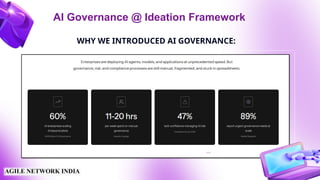
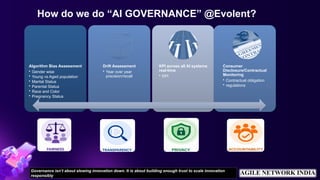
How do wedo “AI GOVERNANCE” @Evolent?
Algorithm Bias Assessment
• Gender wise
• Young vs Aged population
• Marital Status
• Parental Status
• Race and Color
• Pregnancy Status
Drift Assessment
• Year over year
precision/recall
KPI across all AI systems
real-time
• KPI
Consumer
Disclosure/Contractual
Monitoring
• Contractual obligation
• regulations
Governance isn’t about slowing innovation down. It is about building enough trust to scale innovation
responsibly
14.
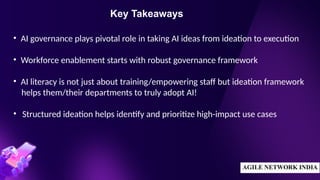
Key Takeaways
• AIgovernance plays pivotal role in taking AI ideas from ideation to execution
• Workforce enablement starts with robust governance framework
• AI literacy is not just about training/empowering staff but ideation framework
helps them/their departments to truly adopt AI!
• Structured ideation helps identify and prioritize high-impact use cases
 Most read
 Most read
 Most read