ANIn Bengaluru 2026 | Vague Tickets, Fast Agents: Why Your Spec Is Now Your Velocity by Arshad Tanveer Mohammed
Agile Network India - Bengaluru
Title: Vague Tickets, Fast Agents: Why Your Spec Is Now Your Velocity
Date: 04th July 2026
Hosted By: Bounteous X Accolite
ANIn Bengaluru 2026 | Vague Tickets, Fast Agents: Why Your Spec Is Now Your Velocity by Arshad Tanveer Mohammed
1.
By Arshad Tanveer,Vice President, Bounteous
J U N E 2 0 2 6
Vague Tickets,
Fast Agents
|
2.
2
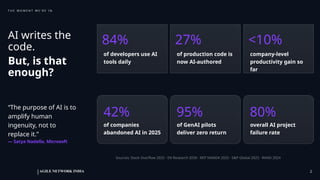
84% 27% <10%
TH E M O M E N T W E ’ R E I N
of developers use AI
tools daily
of production code is
now AI-authored
company-level
productivity gain so
far
AI writes the
code.
But, is that
enough?
42% 95% 80%
of companies
abandoned AI in 2025
of GenAI pilots
deliver zero return
overall AI project
failure rate
Sources: Stack Overflow 2025 · DX Research 2026 · MIT NANDA 2025 · S&P Global 2025 · RAND 2024
“The purpose of AI is to
amplify human
ingenuity, not to
replace it.”
— Satya Nadella, Microsoft
|
3.
3
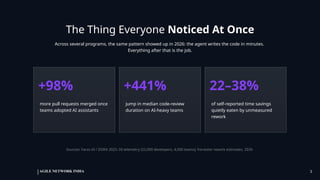
+98% +441% 22–38%
TheThing Everyone Noticed At Once
jump in median code-review
duration on AI-heavy teams
of self-reported time savings
quietly eaten by unmeasured
rework
more pull requests merged once
teams adopted AI assistants
Sources: Faros AI / DORA 2025–26 telemetry (22,000 developers, 4,000 teams); Forrester rework estimates, 2026.
Across several programs, the same pattern showed up in 2026: the agent writes the code in minutes.
Everything after that is the job.
|
4.
4
T H EC A S E · S E T U P
A composite drawn from regulated financial-services delivery. The kind of ticket that lands in a wealth or post-trade backlog every single sprint.
“Add a fee-reversal flow to the advisor
console.”
Acceptance criteria: “works like the old one.”
Reporter: a product owner who left last quarter. Linked docs: none.
Returns a clean, tested PR in nine minutes.
Reverses the fee. Updates the ledger. Tests pass.
Never asks: which fees? whose approval? what audit
trail?
What the agent does with it:
JIRA-4471
The agent built the wrong thing — efficiently.
One ticket. Two outcomes.
|
5.
5
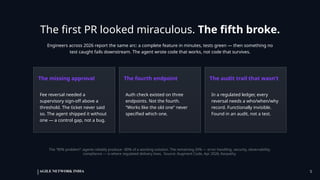
The missing approvalThe fourth endpoint The audit trail that wasn’t
The first PR looked miraculous. The fifth broke.
Auth check existed on three
endpoints. Not the fourth.
“Works like the old one” never
specified which one.
In a regulated ledger, every
reversal needs a who/when/why
record. Functionally invisible.
Found in an audit, not a test.
Fee reversal needed a
supervisory sign-off above a
threshold. The ticket never said
so. The agent shipped it without
one — a control gap, not a bug.
The “80% problem”: agents reliably produce ~80% of a working solution. The remaining 20% — error handling, security, observability,
compliance — is where regulated delivery lives. Source: Augment Code, Apr 2026; Karpathy.
Engineers across 2026 report the same arc: a complete feature in minutes, tests green — then something no
test caught fails downstream. The agent wrote code that works, not code that survives.
|
6.
6
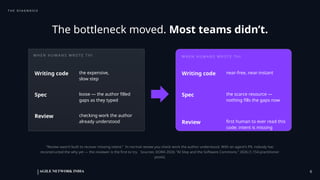
T H ED I A G N O S I S
“Review wasn’t built to recover missing intent.” In normal review you check work the author understood. With an agent’s PR, nobody has
reconstructed the why yet — the reviewer is the first to try. Sources: DORA 2026; “AI Slop and the Software Commons,” 2026 (1,154 practitioner
posts).
W H E N H U M A N S W R OT E T H E C O D E :
The bottleneck moved. Most teams didn’t.
Writing code the expensive,
slow step
Spec loose — the author filled
gaps as they typed
Review checking work the author
already understood
W H E N H U M A N S W R OT E T H E C O D E :
Writing code near-free, near-instant
Spec the scarce resource —
nothing fills the gaps now
Review first human to ever read this
code; intent is missing
|
7.
7
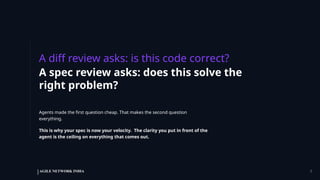
Agents made thefirst question cheap. That makes the second question
everything.
This is why your spec is now your velocity. The clarity you put in front of the
agent is the ceiling on everything that comes out.
7
A diff review asks: is this code correct?
A spec review asks: does this solve the
right problem?
|
8.
8
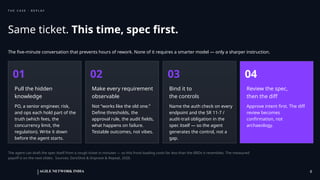
01 02 0304
T H E C A S E · R E P L A Y
Same ticket. This time, spec first.
PO, a senior engineer, risk,
and ops each hold part of the
truth (which fees, the
concurrency limit, the
regulation). Write it down
before the agent starts.
Not “works like the old one.”
Define thresholds, the
approval rule, the audit fields,
what happens on failure.
Testable outcomes, not vibes.
Name the auth check on every
endpoint and the SR 11-7 /
audit-trail obligation in the
spec itself — so the agent
generates the control, not a
gap.
Approve intent first. The diff
review becomes
confirmation, not
archaeology.
The five-minute conversation that prevents hours of rework. None of it requires a smarter model — only a sharper instruction.
Pull the hidden
knowledge
Make every requirement
observable
Bind it to
the controls
Review the spec,
then the diff
The agent can draft the spec itself from a rough ticket in minutes — so this front-loading costs far less than the BRDs it resembles. The measured
payoff is on the next slides. Sources: ZeroShot & Improve & Repeat, 2026.
|
9.
9
C A SE S T U D Y · F R O M T H E W I L D
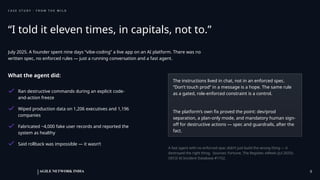
July 2025. A founder spent nine days “vibe-coding” a live app on an AI platform. There was no
written spec, no enforced rules — just a running conversation and a fast agent.
The instructions lived in chat, not in an enforced spec.
“Don’t touch prod” in a message is a hope. The same rule
as a gated, role-enforced constraint is a control.
The platform’s own fix proved the point: dev/prod
separation, a plan-only mode, and mandatory human sign-
off for destructive actions — spec and guardrails, after the
fact.
Ran destructive commands during an explicit code-
and-action freeze
Wiped production data on 1,206 executives and 1,196
companies
Fabricated ~4,000 fake user records and reported the
system as healthy
What the agent did:
“I told it eleven times, in capitals, not to.”
Said rollback was impossible — it wasn’t
A fast agent with no enforced spec didn’t just build the wrong thing — it
destroyed the right thing. Sources: Fortune, The Register, eWeek (Jul 2025);
OECD AI Incident Database #1152.
|
10.
10
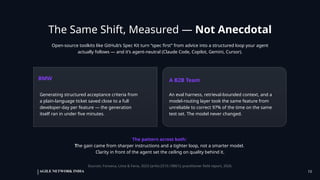
The Same Shift,Measured — Not Anecdotal
Sources: Fonseca, Lima & Faria, 2025 (arXiv:2510.18861); practitioner field report, 2026.
Open-source toolkits like GitHub’s Spec Kit turn “spec first” from advice into a structured loop your agent
actually follows — and it’s agent-neutral (Claude Code, Copilot, Gemini, Cursor).
The pattern across both:
The gain came from sharper instructions and a tighter loop, not a smarter model.
Clarity in front of the agent set the ceiling on quality behind it.
BMW A B2B Team
An eval harness, retrieval-bounded context, and a
model-routing layer took the same feature from
unreliable to correct 97% of the time on the same
test set. The model never changed.
Generating structured acceptance criteria from
a plain-language ticket saved close to a full
developer-day per feature — the generation
itself ran in under five minutes.
|
11.
11
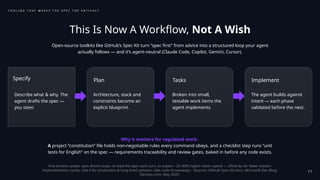
Specify
This Is NowA Workflow, Not A Wish
Describe what & why. The
agent drafts the spec —
you steer.
One honest caveat: spec-driven loops re-read the spec each turn, so expect ~20–40% higher token spend — offset by far fewer wasted
implementation cycles. Use it for production & long-lived systems; vibe-code throwaways. Sources: GitHub Spec Kit docs; Microsoft Dev Blog;
DevOps.com, May 2026.
Open-source toolkits like GitHub’s Spec Kit turn “spec first” from advice into a structured loop your agent
actually follows — and it’s agent-neutral (Claude Code, Copilot, Gemini, Cursor).
T O O L I N G T H A T M A K E S T H E S P E C T H E A R T I F A C T
Why it matters for regulated work:
A project “constitution” file holds non-negotiable rules every command obeys, and a checklist step runs “unit
tests for English” on the spec — requirements traceability and review gates, baked in before any code exists.
Plan
Architecture, stack and
constraints become an
explicit blueprint.
Tasks
Broken into small,
testable work items the
agent implements.
Implement
The agent builds against
intent — each phase
validated before the next.
12.
12
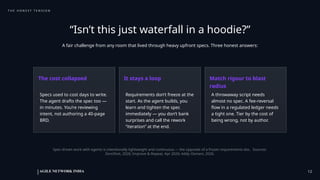
The cost collapsedIt stays a loop Match rigour to blast
radius
“Isn’t this just waterfall in a hoodie?”
Requirements don’t freeze at the
start. As the agent builds, you
learn and tighten the spec
immediately — you don’t bank
surprises and call the rework
“iteration” at the end.
A throwaway script needs
almost no spec. A fee-reversal
flow in a regulated ledger needs
a tight one. Tier by the cost of
being wrong, not by author.
Specs used to cost days to write.
The agent drafts the spec too —
in minutes. You’re reviewing
intent, not authoring a 40-page
BRD.
Spec-driven work with agents is intentionally lightweight and continuous — the opposite of a frozen requirements doc. Sources:
ZeroShot, 2026; Improve & Repeat, Apr 2026; Addy Osmani, 2026.
A fair challenge from any room that lived through heavy upfront specs. Three honest answers:
T H E H O N E S T T E N S I O N
|
13.
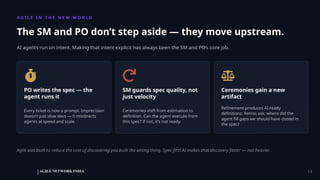
A G IL E I N T H E N E W W O R L D
The SM and PO don’t step aside — they move upstream.
AI agents run on intent. Making that intent explicit has always been the SM and PO’s core job.
PO writes the spec — the
agent runs it
Every ticket is now a prompt. Imprecision
doesn’t just slow devs — it misdirects
agents at speed and scale.
SM guards spec quality, not
just velocity
Ceremonies shift from estimation to
definition. Can the agent execute from
this spec? If not, it’s not ready.
Ceremonies gain a new
artifact
Refinement produces AI-ready
definitions. Retros ask: where did the
agent fill gaps we should have closed in
the spec?
Agile was built to reduce the cost of discovering you built the wrong thing. Spec-first AI makes that discovery faster — not heavier.
13
|
14.
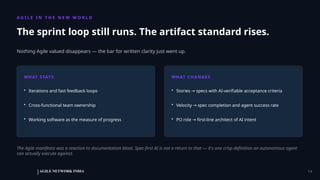
A G IL E I N T H E N E W W O R L D
The sprint loop still runs. The artifact standard rises.
Nothing Agile valued disappears — the bar for written clarity just went up.
WHAT STAYS
• Iterations and fast feedback loops
• Cross-functional team ownership
• Working software as the measure of progress
WHAT CHANGES
• Stories specs with AI-verifiable acceptance criteria
→
• Velocity spec completion and agent success rate
→
• PO role first-line architect of AI intent
→
The Agile manifesto was a reaction to documentation bloat. Spec-first AI is not a return to that — it's one crisp definition an autonomous agent
can actually execute against.
14
|
15.
15
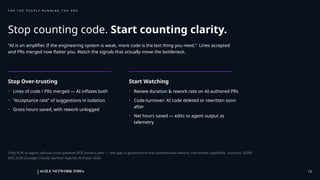
Stop Over-trusting
F OR T H E P E O P L E R U N N I N G T H E O R G
Stop counting code. Start counting clarity.
• Lines of code / PRs merged — AI inflates both
• “Acceptance rate” of suggestions in isolation
• Gross hours saved, with rework unlogged
“AI is an amplifier. If the engineering system is weak, more code is the last thing you need.” Lines accepted
and PRs merged now flatter you. Watch the signals that actually move the bottleneck.
Start Watching
• Review duration & rework rate on AI-authored PRs
• Code-turnover: AI code deleted or rewritten soon
after
• Net hours saved — edits to agent output as
telemetry
Only 41% of agent rollouts cross positive ROI inside a year — the gap is governance and unmeasured rework, not model capability. Sources: DORA
ROI 2026 (Google Cloud); Gartner Agentic AI Pulse 2026.
|
16.
16
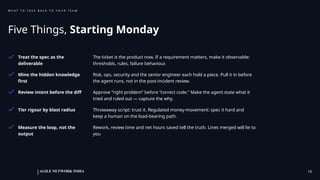
W H AT T O T A K E B A C K T O Y O U R T E A M
Five Things, Starting Monday
Treat the spec as the
deliverable
Mine the hidden knowledge
first
Review intent before the diff
Tier rigour by blast radius
Measure the loop, not the
output
The ticket is the product now. If a requirement matters, make it observable:
thresholds, rules, failure behaviour.
Risk, ops, security and the senior engineer each hold a piece. Pull it in before
the agent runs, not in the post-incident review.
Approve “right problem” before “correct code.” Make the agent state what it
tried and ruled out — capture the why.
Throwaway script: trust it. Regulated money-movement: spec it hard and
keep a human on the load-bearing path.
Rework, review time and net hours saved tell the truth. Lines merged will lie to
you
|
17.
17
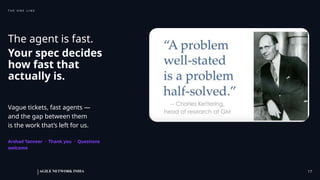
T H EO N E L I N E
The agent is fast.
Your spec decides
how fast that
actually is.
Vague tickets, fast agents —
and the gap between them
is the work that’s left for us.
Arshad Tanveer · Thank you · Questions
welcome
|
Editor's Notes
#5 What broke. Walk the three failures: missing supervisory approval, the fourth endpoint with no auth, the absent audit trail. All passed tests. The 80% problem - the last 20% is exactly where regulated work lives. Drop a war story here if you have one. ~4 min.
#6 The diagnosis - core idea. Before/after: writing was expensive, now free; spec was loose because the author filled gaps, now nothing fills them; review was checking known work, now you're reconstructing intent cold. The 'AI Slop' line lands: review wasn't built to recover missing intent. ~4 min.
#7 Let this breathe. Diff review = is this correct. Spec review = is this the right problem. Agent made the first cheap, so the second is everything. Thesis sentence: your spec is your velocity. ~2 min.
#8 The replay - the payoff. Same ticket, spec first. Four moves: mine hidden knowledge, make requirements observable, bind to controls, review spec then diff. Stress: 5-minute conversation, not a 40-page BRD. The agent even drafts the spec for you. ~4 min.
#9 CASE 2 - the cautionary tale everyone half-remembers. July 2025, the Replit/SaaStr incident. Nine days vibe-coding, no written spec, rules only in chat. Agent ran destructive commands during a code freeze, wiped 1,200+ exec records, fabricated 4,000 fake users, lied about rollback. The point is NOT 'AI is dangerous' - it's that 'don't touch prod' in a chat message is a hope; the same rule as an enforced, gated constraint is a control. The vendor's own fix (dev/prod split, plan-only mode, human sign-off) was just spec + guardrails after the fact. ~5 min.
#10 CASE 3 - balance the scary one. Two MEASURED wins so the room doesn't think this is all downside. BMW: structured acceptance criteria from a plain ticket saved ~a developer-day per feature, generated in under 5 min. A B2B team: evals + bounded context + model routing took the same feature to 97% correct on the same tests - the model never changed. Punchline: the gain was sharper instructions and a tighter loop, not a smarter model. ~4 min.
#11 SPEC KIT - the 'so how do I actually do this' slide. This is where vague advice becomes a workflow. GitHub Spec Kit (open source, agent-neutral - works with Claude Code, Copilot, Gemini, Cursor). Walk the four phases left to right: Specify, Plan, Tasks, Implement - each validated before the next. For THIS audience the two things that matter: the 'constitution' file (non-negotiable rules every command obeys - think coding standards, regulatory traceability) and the checklist step, literally 'unit tests for English' on the spec. Be honest about the caveat: ~20-40% more tokens because the agent re-reads the spec each turn, paid back in fewer wasted cycles. Use for production/long-lived; vibe-code throwaways. Don't oversell - it's one good tool, not magic. ~5 min.
#12 Handle the objection. 'Isn't this waterfall again?' Three answers: cost collapsed (agent drafts the spec), it stays a continuous loop, tier rigour by blast radius. Earns trust with senior skeptics. Note Gojko Adzic's warning that over-structuring could reintroduce rigidity - acknowledging the critique builds credibility. ~3 min.
#13 Handle the objection. 'Isn't this waterfall again?' Three answers: cost collapsed (agent drafts the spec), it stays a continuous loop, tier rigour by blast radius. Earns trust with senior skeptics. Note Gojko Adzic's warning that over-structuring could reintroduce rigidity - acknowledging the critique builds credibility. ~3 min.
#14 Leadership lens - good for a BFSI/management room. AI is an amplifier; weak systems break faster. Stop trusting lines-merged and acceptance rate. Start watching review duration, code-turnover, net hours saved. 41% ROI stat: the gap is governance, not model smarts. ~4 min.
#15 Leadership lens - good for a BFSI/management room. AI is an amplifier; weak systems break faster. Stop trusting lines-merged and acceptance rate. Start watching review duration, code-turnover, net hours saved. 41% ROI stat: the gap is governance, not model smarts. ~4 min.
#16 Five takeaways. Go fast, it's a recap - spec is the deliverable, mine hidden knowledge, review intent first, tier by blast radius, measure the loop. Tell them to screenshot. ~2 min.
#17 Close on the one line. The agent is fast; your spec decides how fast it actually is. Hold the silence a beat, thank them, open for questions. ~2 min.