ANIn Bengaluru 2026 | Identity at the Edge of Autonomy by Kiran Potnuru
1.
Identity at theEdge of Autonomy
AI Agents, and the Rise of Non-Human Identities
2026
Kiran Potnuru
2.
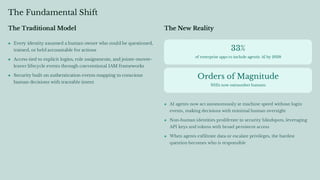
The Fundamental Shift
TheTraditional Model The New Reality
33%
of enterprise apps to include agentic AI by 2028
Orders of Magnitude
NHIs now outnumber humans
● Every identity assumed a human owner who could be questioned,
trained, or held accountable for actions
● Access tied to explicit logins, role assignments, and joiner-mover-
leaver lifecycle events through conventional IAM frameworks
● Security built on authentication events mapping to conscious
human decisions with traceable intent
● AI agents now act autonomously at machine speed without login
events, making decisions with minimal human oversight
● Non-human identities proliferate in security blindspots, leveraging
API keys and tokens with broad persistent access
● When agents exfiltrate data or escalate privileges, the hardest
question becomes who is responsible
3.
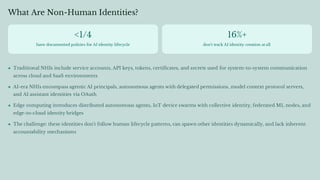
What Are Non-HumanIdentities?
<1/4
have documented policies for AI identity lifecycle
16%+
don't track AI identity creation at all
● Traditional NHIs include service accounts, API keys, tokens, certificates, and secrets used for system-to-system communication
across cloud and SaaS environments
● AI-era NHIs encompass agentic AI principals, autonomous agents with delegated permissions, model context protocol servers,
and AI assistant identities via OAuth
● Edge computing introduces distributed autonomous agents, IoT device swarms with collective identity, federated ML nodes, and
edge-to-cloud identity bridges
● The challenge: these identities don't follow human lifecycle patterns, can spawn other identities dynamically, and lack inherent
accountability mechanisms
4.
Source: Non-human identities:Agentic AI's new frontier of cy...
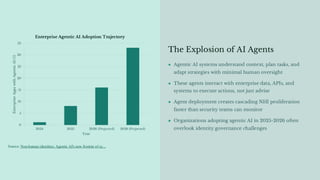
The Explosion of AI Agents
● Agentic AI systems understand context, plan tasks, and
adapt strategies with minimal human oversight
● These agents interact with enterprise data, APIs, and
systems to execute actions, not just advise
● Agent deployment creates cascading NHI proliferation
faster than security teams can monitor
● Organizations adopting agentic AI in 2025-2026 often
overlook identity governance challenges
0
5
10
15
20
25
30
35
2024 2025 2026 (Projected) 2028 (Projected)
Enterprise
Apps
with
Agentic
AI
(%)
Year
Enterprise Agentic AI Adoption Trajectory
5.
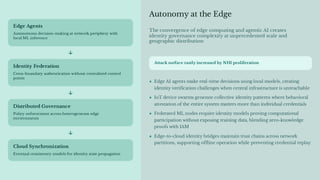
Edge Agents
Autonomous decision-makingat network periphery with
local ML inference
Identity Federation
Cross-boundary authentication without centralized control
points
Distributed Governance
Policy enforcement across heterogeneous edge
environments
Cloud Synchronization
Eventual consistency models for identity state propagation
Autonomy at the Edge
The convergence of edge computing and agentic AI creates
identity governance complexity at unprecedented scale and
geographic distribution
Attack surface vastly increased by NHI proliferation
● Edge AI agents make real-time decisions using local models, creating
identity verification challenges when central infrastructure is unreachable
● IoT device swarms generate collective identity patterns where behavioral
attestation of the entire system matters more than individual credentials
● Federated ML nodes require identity models proving computational
participation without exposing training data, blending zero-knowledge
proofs with IAM
● Edge-to-cloud identity bridges maintain trust chains across network
partitions, supporting offline operation while preventing credential replay
6.
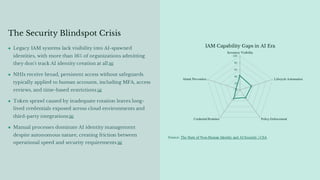
The Security BlindspotCrisis
Source: The State of Non-Human Identity and AI Security | CSA
● Legacy IAM systems lack visibility into AI-spawned
identities, with more than 16% of organizations admitting
they don't track AI identity creation at all [6]
● NHIs receive broad, persistent access without safeguards
typically applied to human accounts, including MFA, access
reviews, and time-based restrictions [4]
● Token sprawl caused by inadequate rotation leaves long-
lived credentials exposed across cloud environments and
third-party integrations [6]
● Manual processes dominate AI identity management
despite autonomous nature, creating friction between
operational speed and security requirements [6]
0
20
40
60
80
100
Inventory Visibility
Lifecycle Automation
Policy Enforcement
Credential Rotation
Attack Prevention
IAM Capability Gaps in AI Era
7.
Philosophical Questions ofAutonomy
When identities act independently with consequential impact, our philosophical
frameworks for responsibility, consent, and personhood face unprecedented tests
● If an AI agent makes a consequential decision within its granted permissions, who
bears responsibility: the human who deployed it, the organization that owns it, or the
agent itself as a quasi-principal?
● Traditional identity models assume intent and consciousness, but autonomous agents
execute actions based on training data, inference patterns, and environmental context
rather than deliberate human choice
● The question of AI personhood remains philosophically unsettled, yet we grant these
entities credentials, permissions, and the ability to modify systems with real-world
impact
● Edge computing distributes this agency geographically, creating scenarios where
autonomous systems make irreversible decisions without central oversight or the
possibility of human intervention in time-critical situations
● Our legal and ethical frameworks still assume human actors, but the gap between who
acts in systems and who can be held accountable is widening rapidly
8.
Identity Governance inthe Agentic Era
Every agent action must produce audit event Write-path tools route through same policy engine
● Agents authenticate as named principals with tenant-scoped tokens, enabling every action to be traced to a specific identity with
defined permissions and rate limits
● Write-path operations from AI agents must route through the same policy evaluation and approval workflows as equivalent
human actions, ensuring consistent governance
● Model Context Protocol servers expose governed API surfaces where AI agents invoke platform capabilities under explicit
permission models with PII masking and audit trails
● Agent-originated changes carry identifying metadata in immutable audit logs including agent principal, calling prompt or task
ID, tool name, inputs, and outcomes for forensic analysis
● Per-agent rate limits protect against runaway behavior, credential compromise enables immediate revocation affecting all
subsequent calls, and policy denials return rationale for transparency
9.
The Accountability Challenge
TraditionalAccountability Agentic Accountability
● Human identities map to natural persons who can be
questioned or held legally accountable for actions.
● Audit trails trace actions to individuals with employment
relationships and contractual obligations to the organization.
● When incidents occur, investigations focus on human intent,
training failures, and policy violations with clear remediation.
● AI agents act on delegated authority but execute decisions
independently based on training and inference patterns
beyond direct control.
● When agents escalate privileges within granted permissions,
determining fault requires examining training data,
deployment decisions, and permission scope.
● Organizations face liability for agent actions even when no
human explicitly authorized the specific behavior.
● The accountability gap widens at the edge where autonomous
systems make time-critical decisions before human oversight
can intervene.
10.
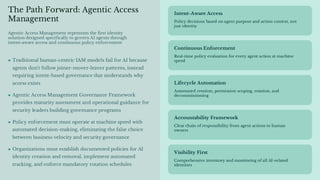
The Path Forward:Agentic Access
Management
Agentic Access Management represents the first identity
solution designed specifically to govern AI agents through
intent-aware access and continuous policy enforcement
Intent-Aware Access
Policy decisions based on agent purpose and action context, not
just identity
Continuous Enforcement
Real-time policy evaluation for every agent action at machine
speed
Lifecycle Automation
Automated creation, permission scoping, rotation, and
decommissioning
Accountability Framework
Clear chain of responsibility from agent actions to human
owners
Visibility First
Comprehensive inventory and monitoring of all AI-related
identities
● Traditional human-centric IAM models fail for AI because
agents don't follow joiner-mover-leaver patterns, instead
requiring intent-based governance that understands why
access exists
● Agentic Access Management Governance Framework
provides maturity assessment and operational guidance for
security leaders building governance programs
● Policy enforcement must operate at machine speed with
automated decision-making, eliminating the false choice
between business velocity and security governance
● Organizations must establish documented policies for AI
identity creation and removal, implement automated
tracking, and enforce mandatory rotation schedules
11.
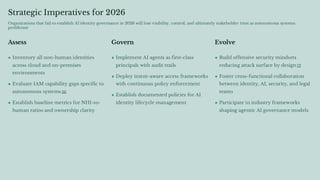
Strategic Imperatives for2026
Organizations that fail to establish AI identity governance in 2026 will lose visibility, control, and ultimately stakeholder trust as autonomous systems
proliferate
Assess Govern Evolve
● Inventory all non-human identities
across cloud and on-premises
environments
● Evaluate IAM capability gaps specific to
autonomous systems [6]
● Establish baseline metrics for NHI-to-
human ratios and ownership clarity
● Implement AI agents as first-class
principals with audit trails
● Deploy intent-aware access frameworks
with continuous policy enforcement
● Establish documented policies for AI
identity lifecycle management
● Build offensive security mindsets
reducing attack surface by design [7]
● Foster cross-functional collaboration
between identity, AI, security, and legal
teams
● Participate in industry frameworks
shaping agentic AI governance models
12.
References
Non-human identities: AgenticAI's new frontier of cy...
Identity Security 2025: The Rise of AI Agents & NHIs
The State of Non-Human Identity and AI Security | CSA
[Non-Human Identities, AI Risk, and the End of Traditi...