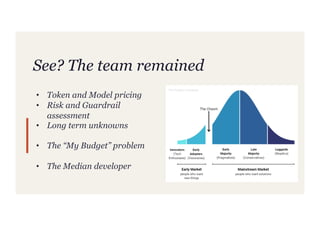
See? The teamremained
• Token and Model pricing
• Risk and Guardrail
assessment
• Long term unknowns
• The “My Budget” problem
• The Median developer
12.
Is “Winning” inAI programs going to
cost us next year’s revenue?
13.
Is “Winning” inAI programs going to
cost us next year’s revenue?
We see this tension clearly in GCC Bids
14.
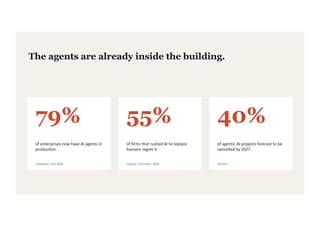
The agents arealready inside the building.
79%
of enterprises now have AI agents in
production.
Composio, mid-2026
55%
of firms that rushed AI to replace
humans regret it.
Orgvue / Forrester, 2025
40%
of agentic AI projects forecast to be
cancelled by 2027.
Gartner
15.
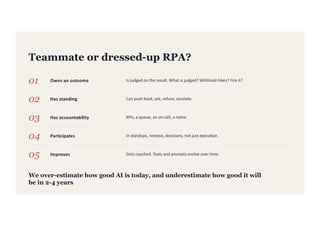
Teammate or dressed-upRPA?
01 Owns an outcome Is judged on the result. What is judged? Withhold hikes? Fire it?
02 Has standing Can push back, ask, refuse, escalate.
03 Has accountability KPIs, a queue, an on-call, a name.
04 Participates In standups, reviews, decisions, not just execution.
05 Improves Gets coached. Tools and prompts evolve over time.
We over-estimate how good AI is today, and underestimate how good it will
be in 2-4 years
16.
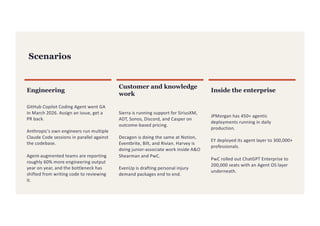
Scenarios
Engineering
GitHub Copilot CodingAgent went GA
in March 2026. Assign an issue, get a
PR back.
Anthropic's own engineers run multiple
Claude Code sessions in parallel against
the codebase.
Agent-augmented teams are reporting
roughly 60% more engineering output
year on year, and the bottleneck has
shifted from writing code to reviewing
it.
Customer and knowledge
work
Sierra is running support for SiriusXM,
ADT, Sonos, Discord, and Casper on
outcome-based pricing.
Decagon is doing the same at Notion,
Eventbrite, Bilt, and Rivian. Harvey is
doing junior-associate work inside A&O
Shearman and PwC.
EvenUp is drafting personal injury
demand packages end to end.
Inside the enterprise
JPMorgan has 450+ agentic
deployments running in daily
production.
EY deployed its agent layer to 300,000+
professionals.
PwC rolled out ChatGPT Enterprise to
200,000 seats with an Agent OS layer
underneath.
17.
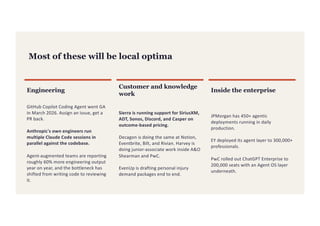
Most of thesewill be local optima
Engineering
GitHub Copilot Coding Agent went GA
in March 2026. Assign an issue, get a
PR back.
Anthropic's own engineers run
multiple Claude Code sessions in
parallel against the codebase.
Agent-augmented teams are reporting
roughly 60% more engineering output
year on year, and the bottleneck has
shifted from writing code to reviewing
it.
Customer and knowledge
work
Sierra is running support for SiriusXM,
ADT, Sonos, Discord, and Casper on
outcome-based pricing.
Decagon is doing the same at Notion,
Eventbrite, Bilt, and Rivian. Harvey is
doing junior-associate work inside A&O
Shearman and PwC.
EvenUp is drafting personal injury
demand packages end to end.
Inside the enterprise
JPMorgan has 450+ agentic
deployments running in daily
production.
EY deployed its agent layer to 300,000+
professionals.
PwC rolled out ChatGPT Enterprise to
200,000 seats with an Agent OS layer
underneath.
Bhai, we arehere for
Pricing (Service lens –
Product lens is easier)
20.
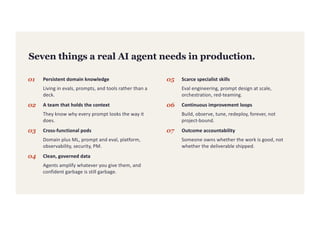
Seven things areal AI agent needs in production.
01 Persistent domain knowledge
Living in evals, prompts, and tools rather than a
deck.
02 A team that holds the context
They know why every prompt looks the way it
does.
03 Cross-functional pods
Domain plus ML, prompt and eval, platform,
observability, security, PM.
04 Clean, governed data
Agents amplify whatever you give them, and
confident garbage is still garbage.
05 Scarce specialist skills
Eval engineering, prompt design at scale,
orchestration, red-teaming.
06 Continuous improvement loops
Build, observe, tune, redeploy, forever, not
project-bound.
07 Outcome accountability
Someone owns whether the work is good, not
whether the deliverable shipped.
21.
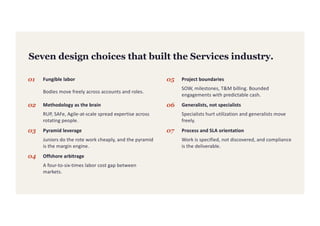
Seven design choicesthat built the Services industry.
01 Fungible labor
Bodies move freely across accounts and roles.
02 Methodology as the brain
RUP, SAFe, Agile-at-scale spread expertise across
rotating people.
03 Pyramid leverage
Juniors do the rote work cheaply, and the pyramid
is the margin engine.
04 Offshore arbitrage
A four-to-six-times labor cost gap between
markets.
05 Project boundaries
SOW, milestones, T&M billing. Bounded
engagements with predictable cash.
06 Generalists, not specialists
Specialists hurt utilization and generalists move
freely.
07 Process and SLA orientation
Work is specified, not discovered, and compliance
is the deliverable.
22.
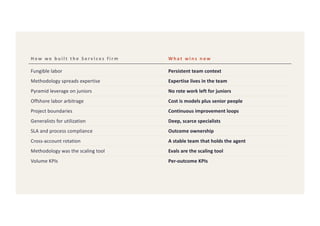
H o ww e b u i l t t h e S e r v i c e s f i r m W h a t w i n s n o w
Fungible labor Persistent team context
Methodology spreads expertise Expertise lives in the team
Pyramid leverage on juniors No rote work left for juniors
Offshore labor arbitrage Cost is models plus senior people
Project boundaries Continuous improvement loops
Generalists for utilization Deep, scarce specialists
SLA and process compliance Outcome ownership
Cross-account rotation A stable team that holds the agent
Methodology was the scaling tool Evals are the scaling tool
Volume KPIs Per-outcome KPIs
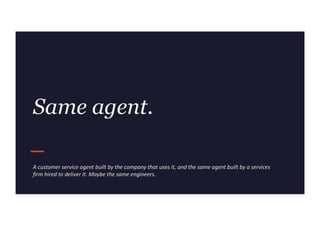
Same agent.
A customerservice agent built by the company that uses it, and the same agent built by a services
firm hired to deliver it. Maybe the same engineers.
25.
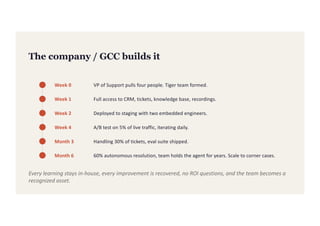
The company /GCC builds it
Week 0 VP of Support pulls four people. Tiger team formed.
Week 1 Full access to CRM, tickets, knowledge base, recordings.
Week 2 Deployed to staging with two embedded engineers.
Week 4 A/B test on 5% of live traffic, iterating daily.
Month 3 Handling 30% of tickets, eval suite shipped.
Month 6 60% autonomous resolution, team holds the agent for years. Scale to corner cases.
Every learning stays in-house, every improvement is recovered, no ROI questions, and the team becomes a
recognized asset.
26.
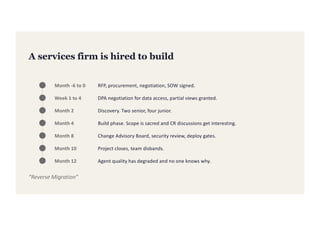
A services firmis hired to build
Month -6 to 0 RFP, procurement, negotiation, SOW signed.
Week 1 to 4 DPA negotiation for data access, partial views granted.
Month 2 Discovery. Two senior, four junior.
Month 4 Build phase. Scope is sacred and CR discussions get interesting.
Month 8 Change Advisory Board, security review, deploy gates.
Month 10 Project closes, team disbands.
Month 12 Agent quality has degraded and no one knows why.
“Reverse Migration”
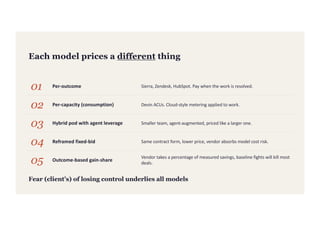
Each model pricesa different thing
01 Per-outcome Sierra, Zendesk, HubSpot. Pay when the work is resolved.
02 Per-capacity (consumption) Devin ACUs. Cloud-style metering applied to work.
03 Hybrid pod with agent leverage Smaller team, agent-augmented, priced like a larger one.
04 Reframed fixed-bid Same contract form, lower price, vendor absorbs model cost risk.
05 Outcome-based gain-share
Vendor takes a percentage of measured savings, baseline fights will kill most
deals.
Fear (client’s) of losing control underlies all models
29.
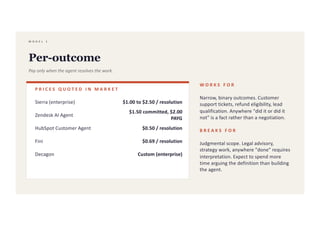
M O DE L 1
Per-outcome
Pay only when the agent resolves the work.
P R I C E S Q U O T E D I N M A R K E T
Sierra (enterprise) $1.00 to $2.50 / resolution
Zendesk AI Agent
$1.50 committed, $2.00
PAYG
HubSpot Customer Agent $0.50 / resolution
Fini $0.69 / resolution
Decagon Custom (enterprise)
W O R K S F O R
Narrow, binary outcomes. Customer
support tickets, refund eligibility, lead
qualification. Anywhere "did it or did it
not" is a fact rather than a negotiation.
B R E A K S F O R
Judgmental scope. Legal advisory,
strategy work, anywhere "done" requires
interpretation. Expect to spend more
time arguing the definition than building
the agent.
30.
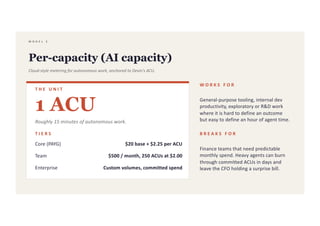
M O DE L 2
Per-capacity (AI capacity)
Cloud-style metering for autonomous work, anchored to Devin's ACU.
T H E U N I T
1 ACU
Roughly 15 minutes of autonomous work.
T I E R S
Core (PAYG) $20 base + $2.25 per ACU
Team $500 / month, 250 ACUs at $2.00
Enterprise Custom volumes, committed spend
W O R K S F O R
General-purpose tooling, internal dev
productivity, exploratory or R&D work
where it is hard to define an outcome
but easy to define an hour of agent time.
B R E A K S F O R
Finance teams that need predictable
monthly spend. Heavy agents can burn
through committed ACUs in days and
leave the CFO holding a surprise bill.
31.
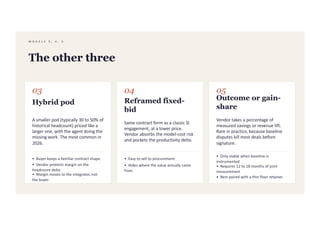
M O DE L S 3 , 4 , 5
The other three
03
Hybrid pod
A smaller pod (typically 30 to 50% of
historical headcount) priced like a
larger one, with the agent doing the
missing work. The most common in
2026.
• Buyer keeps a familiar contract shape
• Vendor protects margin on the
headcount delta
• Margin moves to the integrator, not
the buyer
04
Reframed fixed-
bid
Same contract form as a classic SI
engagement, at a lower price.
Vendor absorbs the model-cost risk
and pockets the productivity delta.
• Easy to sell to procurement
• Hides where the value actually came
from
05
Outcome or gain-
share
Vendor takes a percentage of
measured savings or revenue lift.
Rare in practice, because baseline
disputes kill most deals before
signature.
• Only viable when baseline is
instrumented
• Requires 12 to 18 months of joint
measurement
• Best paired with a thin floor retainer
32.
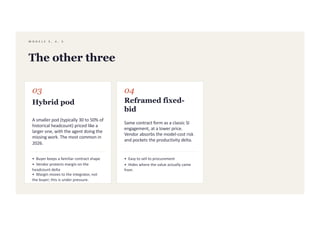
M O DE L S 3 , 4 , 5
The other three
03
Hybrid pod
A smaller pod (typically 30 to 50% of
historical headcount) priced like a
larger one, with the agent doing the
missing work. The most common in
2026.
• Buyer keeps a familiar contract shape
• Vendor protects margin on the
headcount delta
• Margin moves to the integrator, not
the buyer; this is under pressure.
04
Reframed fixed-
bid
Same contract form as a classic SI
engagement, at a lower price.
Vendor absorbs the model-cost risk
and pockets the productivity delta.
• Easy to sell to procurement
• Hides where the value actually came
from
33.
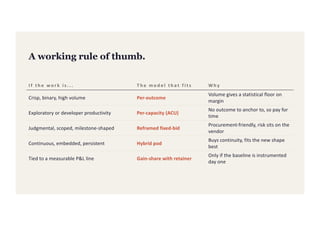
A working ruleof thumb.
I f t h e w o r k i s . . . T h e m o d e l t h a t f i t s W h y
Crisp, binary, high volume Per-outcome
Volume gives a statistical floor on
margin
Exploratory or developer productivity Per-capacity (ACU)
No outcome to anchor to, so pay for
time
Judgmental, scoped, milestone-shaped Reframed fixed-bid
Procurement-friendly, risk sits on the
vendor
Continuous, embedded, persistent Hybrid pod
Buys continuity, fits the new shape
best
Tied to a measurable P&L line Gain-share with retainer
Only if the baseline is instrumented
day one
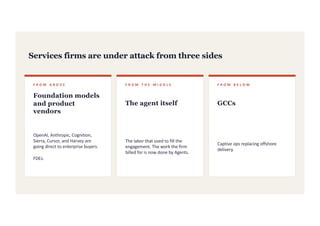
Services firms areunder attack from three sides
F R O M A B O V E
Foundation models
and product
vendors
OpenAI, Anthropic, Cognition,
Sierra, Cursor, and Harvey are
going direct to enterprise buyers.
FDEs.
F R O M T H E M I D D L E
The agent itself
The labor that used to fill the
engagement. The work the firm
billed for is now done by Agents.
F R O M B E L O W
GCCs
Captive ops replacing offshore
delivery.
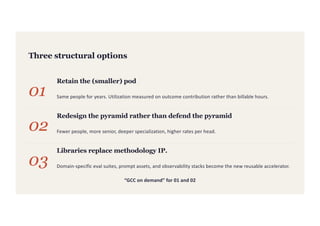
Three structural options
01
Retainthe (smaller) pod
Same people for years. Utilization measured on outcome contribution rather than billable hours.
02
Redesign the pyramid rather than defend the pyramid
Fewer people, more senior, deeper specialization, higher rates per head.
03
Libraries replace methodology IP.
Domain-specific eval suites, prompt assets, and observability stacks become the new reusable accelerator.
“GCC on demand” for 01 and 02
38.
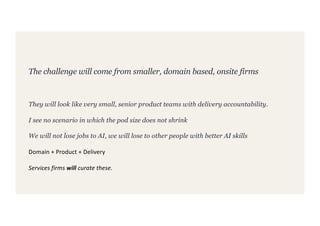
The challenge willcome from smaller, domain based, onsite firms
They will look like very small, senior product teams with delivery accountability.
I see no scenario in which the pod size does not shrink
We will not lose jobs to AI, we will lose to other people with better AI skills
Domain + Product + Delivery
Services firms will curate these.
39.
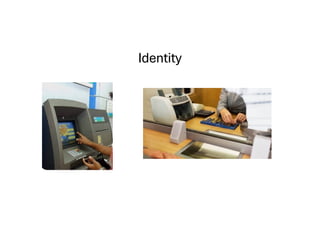
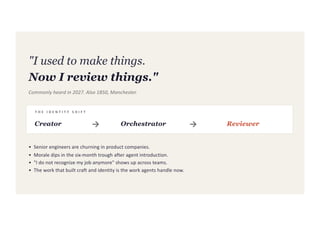
"I used tomake things.
Now I review things."
Commonly heard in 2027. Also 1850, Manchester.
T H E I D E N T I T Y S H I F T
Creator → Orchestrator → Reviewer
• Senior engineers are churning in product companies.
• Morale dips in the six-month trough after agent introduction.
• "I do not recognize my job anymore" shows up across teams.
• The work that built craft and identity is the work agents handle now.
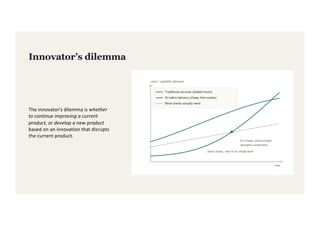
Innovator’s dilemma
The innovator'sdilemma is whether
to continue improving a current
product, or develop a new product
based on an innovation that disrupts
the current product.
42.
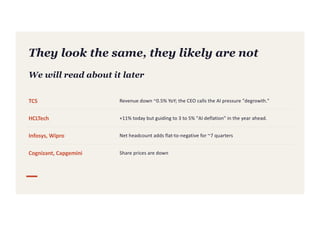
They look thesame, they likely are not
We will read about it later
TCS Revenue down ~0.5% YoY; the CEO calls the AI pressure "degrowth."
HCLTech +11% today but guiding to 3 to 5% "AI deflation" in the year ahead.
Infosys, Wipro Net headcount adds flat-to-negative for ~7 quarters
Cognizant, Capgemini Share prices are down