ANIn Ahmedabad 2026 | From Vision to Value: Engineering Future-Ready Business Ecosystems by Asha Mangtani
1.
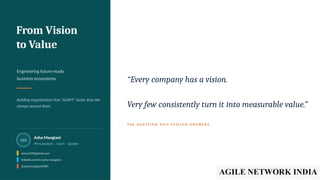
From Vision
to Value
Engineeringfuture-ready
business ecosystems
Building organizations that “ADAPT” faster than the
change around them
AM
Asha Mangtani
PM Consultant · Coach · Speaker
ashuu109@gmail.com
linkedin.com/in/asha-mangtani
@ashamangtani9385
“Every company has a vision.
Very few consistently turn it into measurable value.”
T H E Q U E S T I O N T H I S S E S S I O N A N S W E R S
2.
W HAT' SAC TUAL LY H AP PE NI NG
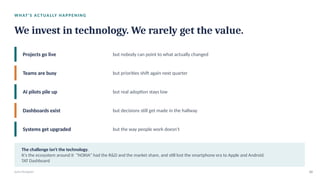
We invest in technology. We rarely get the value.
Projects go live but nobody can point to what actually changed
Teams are busy but priorities shift again next quarter
AI pilots pile up but real adoption stays low
Dashboards exist but decisions still get made in the hallway
Systems get upgraded but the way people work doesn't
The challenge isn't the technology.
It's the ecosystem around it “NOKIA” had the R&D and the market share, and still lost the smartphone era to Apple and Android.
TAT Dashboard
Asha Mangtani 02
3.
W HY GOO D STR ATEG I ES FAI L
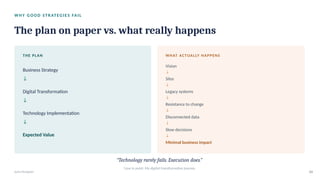
The plan on paper vs. what really happens
THE PLAN
Business Strategy
↓
Digital Transformation
↓
Technology Implementation
↓
Expected Value
WHAT ACTUALLY HAPPENS
Vision
↓
Silos
↓
Legacy systems
↓
Resistance to change
↓
Disconnected data
↓
Slow decisions
↓
Minimal business impact
“Technology rarely fails. Execution does.”
Case in point: My digital transformation journey
Asha Mangtani 03
4.
THE F RA MEWOR K
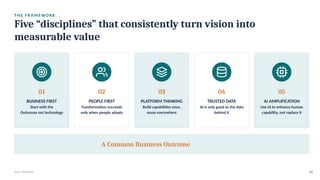
Five “disciplines” that consistently turn vision into
measurable value
01
BUSINESS FIRST
Start with the
Outcomes not technology
02
PEOPLE FIRST
Transformation succeeds
only when people adopts
03
PLATFORM THINKING
Build capabilities once,
reuse everywhere
04
TRUSTED DATA
AI is only good as the data
behind it
05
AI AMPLIFICATION
Use AI to enhance human
capability, not replace it
Asha Mangtani 04
A Common Business Outcome
5.
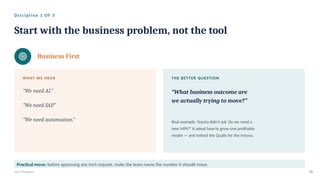
D i sci pl i n e 1 O F 5
Start with the business problem, not the tool
WHAT WE HEAR
“We need AI.”
“We need SAP.”
“We need automation.”
THE BETTER QUESTION
“What business outcome are
we actually trying to move?”
Real example: Toyota didn't ask 'do we need a
new MPV?' It asked how to grow one profitable
model — and retired the Qualis for the Innova.
Practical move: before approving any tech request, make the team name the number it should move.
Asha Mangtani 05
Business First
6.
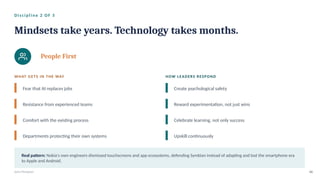
D i sci pl i n e 2 O F 5
Mindsets take years. Technology takes months.
WHAT GETS IN THE WAY
Fear that AI replaces jobs
Resistance from experienced teams
Comfort with the existing process
Departments protecting their own systems
HOW LEADERS RESPOND
Create psychological safety
Reward experimentation, not just wins
Celebrate learning, not only success
Upskill continuously
Real pattern: Nokia's own engineers dismissed touchscreens and app ecosystems, defending Symbian instead of adapting and lost the smartphone era
to Apple and Android.
Asha Mangtani 06
People First
7.
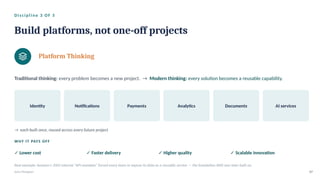
D i sci pl i n e 3 O F 5
Build platforms, not one-off projects
Traditional thinking: every problem becomes a new project. → Modern thinking: every solution becomes a reusable capability.
Identity Notifications Payments Analytics Documents AI services
→ each built once, reused across every future project
WHY IT PAYS OFF
✓ Lower cost ✓ Faster delivery ✓ Higher quality ✓ Scalable innovation
Real example: Amazon's 2002 internal "API mandate" forced every team to expose its data as a reusable service — the foundation AWS was later built on.
Asha Mangtani 07
Platform Thinking
8.
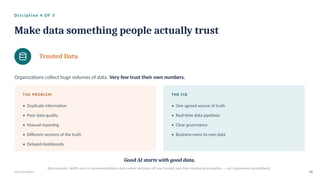
D i sci pl i n e 4 O F 5
Make data something people actually trust
Organizations collect huge volumes of data. Very few trust their own numbers.
THE PROBLEM
• Duplicate information
• Poor data quality
• Manual reporting
• Different versions of the truth
• Delayed dashboards
THE FIX
• One agreed source of truth
• Real-time data pipelines
• Clear governance
• Business owns its own data
Good AI starts with good data.
Real example: Netflix runs its recommendations and content decisions off one trusted, real-time viewing-data pipeline — not fragmented spreadsheets.
Asha Mangtani 08
Trusted Data
9.
D i sci pl i n e 5 O F 5
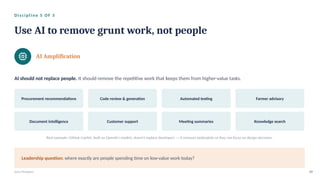
Use AI to remove grunt work, not people
AI should not replace people. It should remove the repetitive work that keeps them from higher-value tasks.
Procurement recommendations Code review & generation Automated testing Farmer advisory
Document intelligence Customer support Meeting summaries Knowledge search
Real example: GitHub Copilot, built on OpenAI's models, doesn't replace developers — it removes boilerplate so they can focus on design decisions.
Leadership question: where exactly are people spending time on low-value work today?
Asha Mangtani 09
AI Amplification
10.
G ET TING PR AC TI CAL
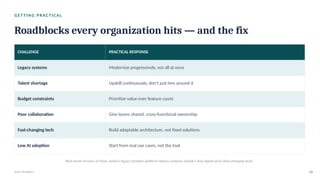
Roadblocks every organization hits — and the fix
CHALLENGE PRACTICAL RESPONSE
Legacy systems Modernize progressively, not all at once
Talent shortage Upskill continuously, don't just hire around it
Budget constraints Prioritize value over feature count
Poor collaboration Give teams shared, cross-functional ownership
Fast-changing tech Build adaptable architecture, not fixed solutions
Low AI adoption Start from real use cases, not the tool
Real-world versions of these: Nokia's legacy Symbian platform (legacy systems); Kodak's slow digital pivot (fast-changing tech).
Asha Mangtani 10
11.
F RO MPR OJ EC TS TO P RO DU C TS
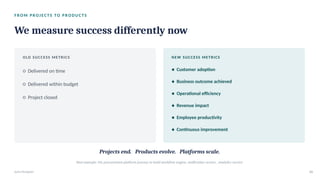
We measure success differently now
OLD SUCCESS METRICS
○ Delivered on time
○ Delivered within budget
○ Project closed
NEW SUCCESS METRICS
● Customer adoption
● Business outcome achieved
● Operational efficiency
● Revenue impact
● Employee productivity
● Continuous improvement
Projects end. Products evolve. Platforms scale.
Real example: My procurement platform journey to build workflow engine, notification service , analytics service
Asha Mangtani 11
12.
L EAD ERSHI P I N THE AI E R A
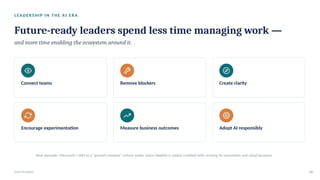
Future-ready leaders spend less time managing work —
and more time enabling the ecosystem around it.
Connect teams Remove blockers Create clarity
Encourage experimentation Measure business outcomes Adopt AI responsibly
Real example: Microsoft's shift to a "growth mindset" culture under Satya Nadella is widely credited with reviving its innovation and cloud business.
Asha Mangtani 12
13.
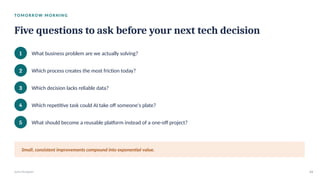
TO MO RROW MO R N I NG
Five questions to ask before your next tech decision
1 What business problem are we actually solving?
2 Which process creates the most friction today?
3 Which decision lacks reliable data?
4 Which repetitive task could AI take off someone's plate?
5 What should become a reusable platform instead of a one-off project?
Small, consistent improvements compound into exponential value.
Asha Mangtani 13
14.
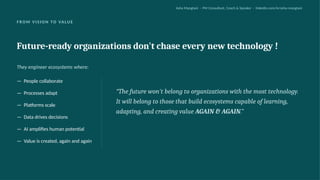
F RO MV I SI O N TO VALU E
Future-ready organizations don't chase every new technology !
They engineer ecosystems where:
— People collaborate
— Processes adapt
— Platforms scale
— Data drives decisions
— AI amplifies human potential
— Value is created, again and again
“The future won't belong to organizations with the most technology.
It will belong to those that build ecosystems capable of learning,
adapting, and creating value AGAIN & AGAIN.”
Asha Mangtani · PM Consultant, Coach & Speaker · linkedin.com/in/asha-mangtani
15.
From Vision
to Value
Engineeringfuture-ready
business ecosystems
Building organizations that “ADAPT” faster than the
change around them
AM
Asha Mangtani
PM Consultant · Coach · Speaker
ashuu109@gmail.com
linkedin.com/in/asha-mangtani
@ashamangtani9385
“Every company has a vision.
Very few consistently turn it into measurable value.”
Thank You!
Time for Q&A