ANIn Ahmedabad 2026 | Design Tomorrow’s Default: First Principles for Future Products by Mitesh Shethwala
1.
AGI LE NETWORKINDI A • AHMEDABAD CHAPTER • 08 AUG 2026
Design Tomorrow's
Default.
First Principles for Future Products
Mitesh Shethwala Founder, Currently Tech Private Limited
2.
T H EH O O K
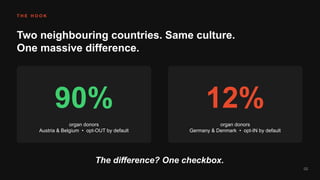
Two neighbouring countries. Same culture.
One massive difference.
90%
organ donors
Austria & Belgium • opt-OUT by default
12%
organ donors
Germany & Denmark • opt-IN by default
The difference? One checkbox.
02
3.
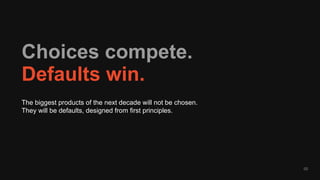
Choices compete.
Defaults win.
Thebiggest products of the next decade will not be chosen.
They will be defaults, designed from first principles.
03
4.
W H YD E F A U L T S W I N
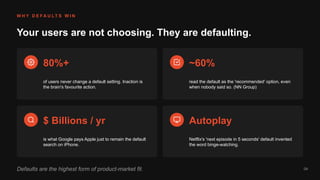
Your users are not choosing. They are defaulting.
80%+
of users never change a default setting. Inaction is
the brain's favourite action.
~60%
read the default as the 'recommended' option, even
when nobody said so. (NN Group)
$ Billions / yr
is what Google pays Apple just to remain the default
search on iPhone.
Autoplay
Netflix's 'next episode in 5 seconds' default invented
the word binge-watching.
Defaults are the highest form of product-market fit. 04
5.
T H ET R A P
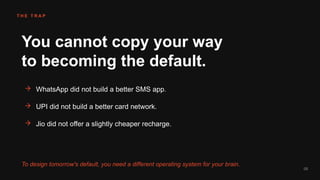
You cannot copy your way
to becoming the default.
WhatsApp did not build a better SMS app.
UPI did not build a better card network.
Jio did not offer a slightly cheaper recharge.
To design tomorrow's default, you need a different operating system for your brain.
05
6.
F I RS T P R I N C I P L E S 1 0 1
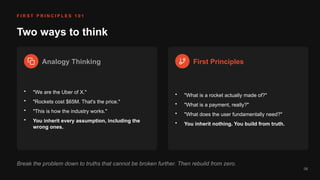
Two ways to think
Analogy Thinking
• "We are the Uber of X."
• "Rockets cost $65M. That's the price."
• "This is how the industry works."
• You inherit every assumption, including the
wrong ones.
First Principles
• "What is a rocket actually made of?"
• "What is a payment, really?"
• "What does the user fundamentally need?"
• You inherit nothing. You build from truth.
Break the problem down to truths that cannot be broken further. Then rebuild from zero.
06
7.
C A SE : S P A C E X
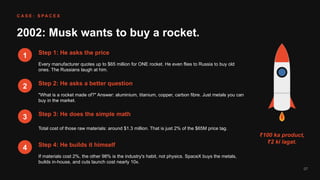
2002: Musk wants to buy a rocket.
1 Step 1: He asks the price
Every manufacturer quotes up to $65 million for ONE rocket. He even flies to Russia to buy old
ones. The Russians laugh at him.
2 Step 2: He asks a better question
"What is a rocket made of?" Answer: aluminium, titanium, copper, carbon fibre. Just metals you can
buy in the market.
3 Step 3: He does the simple math
Total cost of those raw materials: around $1.3 million. That is just 2% of the $65M price tag.
4 Step 4: He builds it himself
If materials cost 2%, the other 98% is the industry's habit, not physics. SpaceX buys the metals,
builds in-house, and cuts launch cost nearly 10x.
₹100 ka product,
₹2 ki lagat.
07
8.
C A SE : S P A C E X
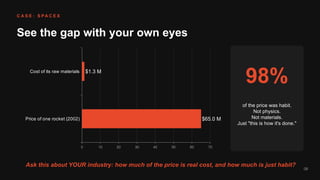
See the gap with your own eyes
Price of one rocket (2002)
Cost of its raw materials
0 10 20 30 40 50 60 70
$65.0 M
$1.3 M
98%
of the price was habit.
Not physics.
Not materials.
Just "this is how it's done."
Ask this about YOUR industry: how much of the price is real cost, and how much is just habit?
08
9.
C A SE : U P I • I N D I A
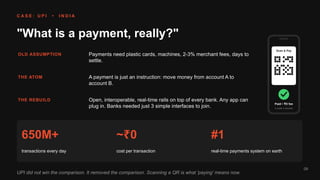
"What is a payment, really?"
OLD ASSUMPTION Payments need plastic cards, machines, 2-3% merchant fees, days to
settle.
THE ATOM A payment is just an instruction: move money from account A to
account B.
THE REBUILD Open, interoperable, real-time rails on top of every bank. Any app can
plug in. Banks needed just 3 simple interfaces to join.
650M+
transactions every day
~ 0
₹
cost per transaction
#1
real-time payments system on earth
UPI did not win the comparison. It removed the comparison. Scanning a QR is what 'paying' means now.
09
10.
C A SE : J I O • I N D I A
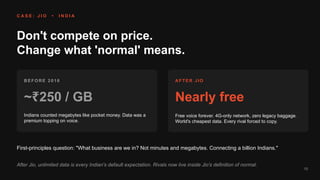
Don't compete on price.
Change what 'normal' means.
B EF O R E 2 0 1 6
~ 250 / GB
₹
Indians counted megabytes like pocket money. Data was a
premium topping on voice.
A F T E R J I O
Nearly free
Free voice forever. 4G-only network, zero legacy baggage.
World's cheapest data. Every rival forced to copy.
First-principles question: "What business are we in? Not minutes and megabytes. Connecting a billion Indians."
After Jio, unlimited data is every Indian's default expectation. Rivals now live inside Jio's definition of normal.
10
11.
C A SE : W H A T S A P P
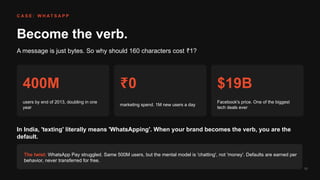
Become the verb.
A message is just bytes. So why should 160 characters cost 1?
₹
400M
users by end of 2013, doubling in one
year
₹0
marketing spend. 1M new users a day
$19B
Facebook's price. One of the biggest
tech deals ever
In India, 'texting' literally means 'WhatsApping'. When your brand becomes the verb, you are the
default.
The twist: WhatsApp Pay struggled. Same 500M users, but the mental model is 'chatting', not 'money'. Defaults are earned per
behavior, never transferred for free.
11
12.
C A SE : Z E R O D H A • I N D I A
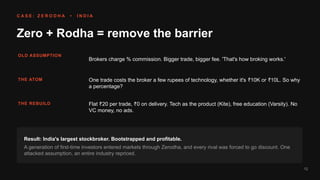
Zero + Rodha = remove the barrier
OLD ASSUMPTION
Brokers charge % commission. Bigger trade, bigger fee. 'That's how broking works.'
THE ATOM One trade costs the broker a few rupees of technology, whether it's 10K or 10L. So why
₹ ₹
a percentage?
THE REBUILD Flat 20 per trade, 0 on delivery. Tech as the product (Kite), free education (Varsity). No
₹ ₹
VC money, no ads.
Result: India's largest stockbroker. Bootstrapped and profitable.
A generation of first-time investors entered markets through Zerodha, and every rival was forced to go discount. One
attacked assumption, an entire industry repriced.
12
13.
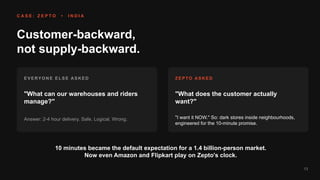
C A SE : Z E P T O • I N D I A
Customer-backward,
not supply-backward.
E VERYO N E E L S E AS KE D
"What can our warehouses and riders
manage?"
Answer: 2-4 hour delivery. Safe. Logical. Wrong.
Z E PTO AS K ED
"What does the customer actually
want?"
"I want it NOW." So: dark stores inside neighbourhoods,
engineered for the 10-minute promise.
10 minutes became the default expectation for a 1.4 billion-person market.
Now even Amazon and Flipkart play on Zepto's clock.
13
14.
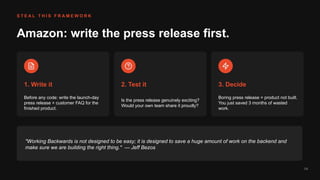
S T EA L T H I S F R A M E W O R K
Amazon: write the press release first.
1. Write it
Before any code: write the launch-day
press release + customer FAQ for the
finished product.
2. Test it
Is the press release genuinely exciting?
Would your own team share it proudly?
3. Decide
Boring press release = product not built.
You just saved 3 months of wasted
work.
"Working Backwards is not designed to be easy; it is designed to save a huge amount of work on the backend and
make sure we are building the right thing." — Jeff Bezos
14
15.
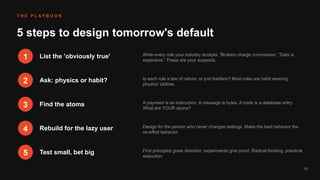
T H EP L AY B O O K
5 steps to design tomorrow's default
1 List the 'obviously true' Write every rule your industry accepts. 'Brokers charge commission.' 'Data is
expensive.' These are your suspects.
2 Ask: physics or habit? Is each rule a law of nature, or just tradition? Most rules are habit wearing
physics' clothes.
3 Find the atoms A payment is an instruction. A message is bytes. A trade is a database entry.
What are YOUR atoms?
4 Rebuild for the lazy user Design for the person who never changes settings. Make the best behavior the
no-effort behavior.
5 Test small, bet big First principles gives direction; experiments give proof. Radical thinking, practical
execution.
15
16.
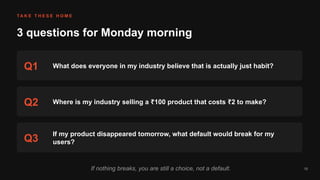
T A KE T H E S E H O M E
3 questions for Monday morning
Q1 What does everyone in my industry believe that is actually just habit?
Q2 Where is my industry selling a 100 product that costs 2 to make?
₹ ₹
Q3
If my product disappeared tomorrow, what default would break for my
users?
If nothing breaks, you are still a choice, not a default. 16
17.
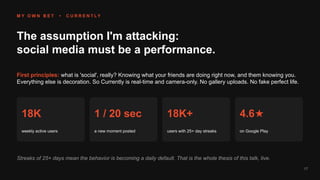
M Y OW N B E T • C U R R E N T LY
The assumption I'm attacking:
social media must be a performance.
First principles: what is 'social', really? Knowing what your friends are doing right now, and them knowing you.
Everything else is decoration. So Currently is real-time and camera-only. No gallery uploads. No fake perfect life.
18K
weekly active users
1 / 20 sec
a new moment posted
18K+
users with 25+ day streaks
4.6★
on Google Play
Streaks of 25+ days mean the behavior is becoming a daily default. That is the whole thesis of this talk, live.
17
18.
Stop building abetter option.
Design tomorrow's default,
before someone else does.
Mitesh Shethwala Founder, Currently • currently.club
Thank you • Questions welcome
Editor's Notes
#1 Walk on. No intro. Go straight into the organ donation hook on the next slide. Energy high, pace slow.
#2 Ask the audience to guess first: money? religion? education? Pause. Then reveal: one checkbox. Punchline: 'A checkbox decided who lives. Imagine what defaults decide in your product.' (Johnson & Goldstein, Science 2003)
#3 This is the thesis. Say it slowly. You will repeat this exact line at the end of the talk.
#4 Interactive moment: 'Take out your phone. How many home-screen apps did you consciously compare and choose? Exactly. They just... became yours.' Also Save More Tomorrow story if time permits.
#5 Bridge slide into first principles. 'Copying the current default only makes you a cheaper version of the past.'
#6 Hinglish delivery: 'Todo problem ko uske sabse chhote sach tak.' Aristotle called first principles 'the first basis from which a thing is known.' Physicists use it daily. Musk made it famous for founders.
#7 Tell it like a movie, step by step, no jargon. The whole trick is one question: 'What is it actually made of?' Land the simple version: rocket ka price 65 million, uske saman ka price sirf 1.3 million. Baaki sab habit tha.
#8 Pause and let the chart speak. The tiny bar next to the huge bar is the whole talk in one picture. Then deliver the closing question slowly.
#9 Local color: the paan wala's ₹2 printed QR code vs Visa's 60 years and 2-3% fees. This is designing a default at civilisation scale. Audience will feel national pride; ride it.
#10 UPI adoption, the creator economy, and the short-video boom all rode on this one first-principles decision. Data cost very little to deliver at scale on an all-IP network; the ₹250 price was habit.
#11 Ruthless focus story: no ads, no games, just messaging that works on cheap phones and weak networks. The Pay twist is your 'advanced' point; product people in the room will nod.
#12 Ahmedabad founders will love this: no VC, no celebrity ads, no media buzz. The company name itself is the first-principles thesis in three syllables.
#13 Two 19-year-olds reset the delivery default. Start from the customer's truth, not the industry's convenience.
#14 Audience challenge: 'Monday morning, before your next feature, write its 1-page press release. If your own team wouldn't share it excitedly, kill the feature.' This is first principles: start from the customer's experience, reason backward to the tech.
#15 This is the screenshot slide. Say: 'Cameras out, this one is for you.' Walk through each step slowly with one example each.
#16 Pause on Q3. It stings a little, and that is the point.
#17 Speak from the field, not the textbook. Share one assumption you got wrong and killed; audiences trust deleted features more than shipped ones. Optional, once, with a smile: Anupam Mittal on Shark Tank: 'Agar India se koi social network bana sakta hai, toh woh ho tum.'
#18 Deliver the closing line, pause 2 seconds, then thank the audience. Have one seeded question ready if Q&A starts quiet: 'What assumption in social media will break next?'