VIVEKANANDHA
ARTS AND SCIENCECOLLEGE FOR WOMAN
Veerachipalayam-637 303,Sankagiri,Salem Dt, Tamilnadu,India.
Affiliated to Periyar University Salem ; recognised under
section 2(f)&12(b) of the UGC act,1956
DEPARTMENT OF MICROBIOLOGY
TITLE : ANIMAL BIOTECHNOLOGY –
EQUIPMENT AND MEDIA USED FOR ANIMAL
CELL CULTURE
SUBJECT INCHARGE :
Mythili Dr. R,
Head Of the Department
Department of Microbiology
VIAAS , Sankagiri .
SUBMITTED BY :
Nandhini Vengadachalam
II M.sc Microbiology
Department of Microbiology
VIAAS , Sankagiri .
SUBJECT : MOLECULAR BIOLOGY AND RECOMBINANT DNA TECHNOLOGY
INTRODUCTION
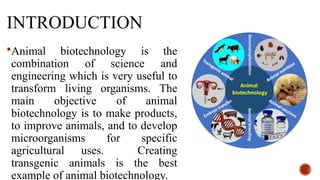
Animal biotechnology isthe
combination of science and
engineering which is very useful to
transform living organisms. The
main objective of animal
biotechnology is to make products,
to improve animals, and to develop
microorganisms for specific
agricultural uses. Creating
transgenic animals is the best
example of animal biotechnology.
5.
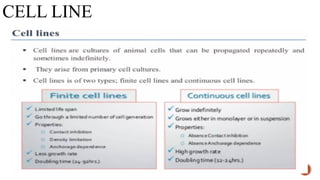
ANIMAL CELL CULTURE
Fatherof animal cell culture is Ross . G Harrison – 1907
Achieve - first successfully frog nerve tissue outside body (in vitro )
animal cells could survive and grow under laboratory conditions .
Roux in 1885 for the first time maintained embryonic chick cells in a
cell culture.
The culture of animal cells and tissues is a generally and widely used
technique that involves isolation of cells, tissues and organs from
animals and growing them in an in vitro or artificial environment. The
term culture means to keep alive and grow in an appropriate medium
that simulates the natural conditions.
6.
ANIMAL CELL CULTUREHISTORY
1885 Maintained embryonic chick cells in a saline culture Roux
1897 Demonstrated the survival of cells isolated from blood and
connective tissue in serum and plasma Loeb
1907 Cultivated frog nerve cells in a lymph clot held by the “hanging
drop” method and observed the growth of nerve fibers in vitro for
several weeks Harrisone
1911 First liquid media consisted of sea water, serum, embryo extract,
salts and peptones Lewis and Lewwis
1916 Proteolytic enzyme trypsin for the subculture of adherent cells
Rousand Jones
1923 T-flask as the first specifically designed cell culture vessel
Carrel and Baker
7.
1948 Isolated mousel fibroblasts which formed clones from
single cells Earle
1949 Polio virus could be grown on human embryonic cells
in culture Enders
1952 Continuous cell line from a human cervical carcinoma
known as hela (helen lane) cells Gey
1955 Nutrient requirements Eagle
1964 Hat medium for cell selection Littlefield
1975 First Hybridoma capable of secreting a monoclonal
antibody Koehler and Milstein
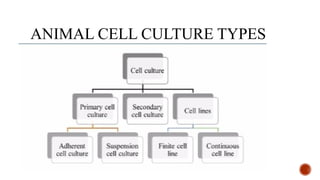
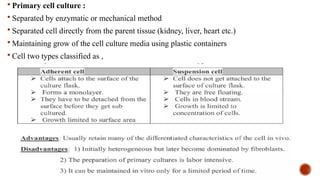
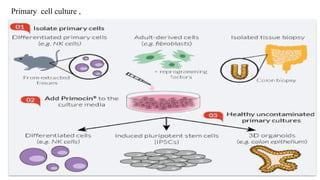
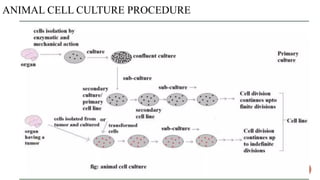
Primary cellculture :
Separated by enzymatic or mechanical method
Separated cell directly from the parent tissue (kidney, liver, heart etc.)
Maintaining grow of the cell culture media using plastic containers
Cell two types classified as ,
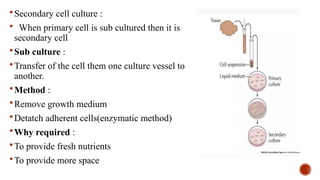
Secondary cell culture:
When primary cell is sub cultured then it is
secondary cell
Sub culture :
Transfer of the cell them one culture vessel to
another.
Method :
Remove growth medium
Detatch adherent cells(enzymatic method)
Why required :
To provide fresh nutrients
To provide more space
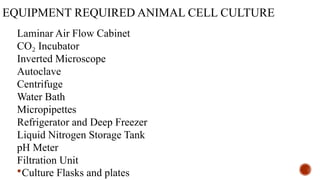
EQUIPMENT REQUIRED ANIMALCELL CULTURE
Laminar Air Flow Cabinet
CO Incubator
₂
Inverted Microscope
Autoclave
Centrifuge
Water Bath
Micropipettes
Refrigerator and Deep Freezer
Liquid Nitrogen Storage Tank
pH Meter
Filtration Unit
Culture Flasks and plates
15.
LAMINAR AIR FLOW
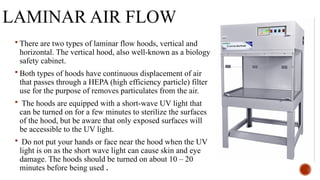
There are two types of laminar flow hoods, vertical and
horizontal. The vertical hood, also well-known as a biology
safety cabinet.
Both types of hoods have continuous displacement of air
that passes through a HEPA (high efficiency particle) filter
use for the purpose of removes particulates from the air.
The hoods are equipped with a short-wave UV light that
can be turned on for a few minutes to sterilize the surfaces
of the hood, but be aware that only exposed surfaces will
be accessible to the UV light.
Do not put your hands or face near the hood when the UV
light is on as the short wave light can cause skin and eye
damage. The hoods should be turned on about 10 – 20
minutes before being used .
16.
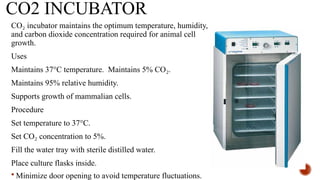
CO2 INCUBATOR
CO incubatormaintains the optimum temperature, humidity,
₂
and carbon dioxide concentration required for animal cell
growth.
Uses
Maintains 37°C temperature. Maintains 5% CO .
₂
Maintains 95% relative humidity.
Supports growth of mammalian cells.
Procedure
Set temperature to 37°C.
Set CO concentration to 5%.
₂
Fill the water tray with sterile distilled water.
Place culture flasks inside.
Minimize door opening to avoid temperature fluctuations.
17.
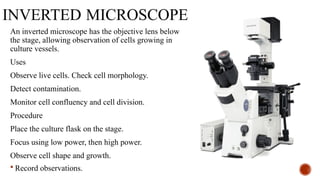
INVERTED MICROSCOPE
An invertedmicroscope has the objective lens below
the stage, allowing observation of cells growing in
culture vessels.
Uses
Observe live cells. Check cell morphology.
Detect contamination.
Monitor cell confluency and cell division.
Procedure
Place the culture flask on the stage.
Focus using low power, then high power.
Observe cell shape and growth.
Record observations.
18.
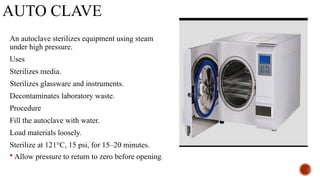
AUTO CLAVE
An autoclavesterilizes equipment using steam
under high pressure.
Uses
Sterilizes media.
Sterilizes glassware and instruments.
Decontaminates laboratory waste.
Procedure
Fill the autoclave with water.
Load materials loosely.
Sterilize at 121°C, 15 psi, for 15–20 minutes.
Allow pressure to return to zero before opening.
19.
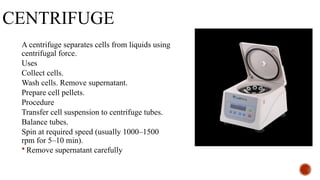
CENTRIFUGE
A centrifuge separatescells from liquids using
centrifugal force.
Uses
Collect cells.
Wash cells. Remove supernatant.
Prepare cell pellets.
Procedure
Transfer cell suspension to centrifuge tubes.
Balance tubes.
Spin at required speed (usually 1000–1500
rpm for 5–10 min).
Remove supernatant carefully.
20.
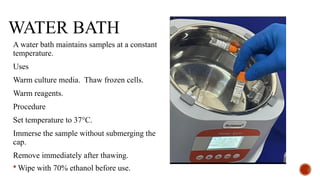
WATER BATH
A waterbath maintains samples at a constant
temperature.
Uses
Warm culture media. Thaw frozen cells.
Warm reagents.
Procedure
Set temperature to 37°C.
Immerse the sample without submerging the
cap.
Remove immediately after thawing.
Wipe with 70% ethanol before use.
21.
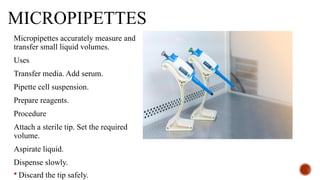
MICROPIPETTES
Micropipettes accurately measureand
transfer small liquid volumes.
Uses
Transfer media. Add serum.
Pipette cell suspension.
Prepare reagents.
Procedure
Attach a sterile tip. Set the required
volume.
Aspirate liquid.
Dispense slowly.
Discard the tip safely.
22.
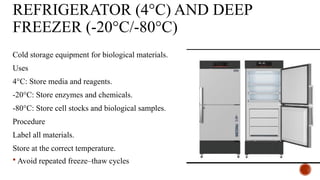
REFRIGERATOR (4°C) ANDDEEP
FREEZER (-20°C/-80°C)
Cold storage equipment for biological materials.
Uses
4°C: Store media and reagents.
-20°C: Store enzymes and chemicals.
-80°C: Store cell stocks and biological samples.
Procedure
Label all materials.
Store at the correct temperature.
Avoid repeated freeze–thaw cycles
23.
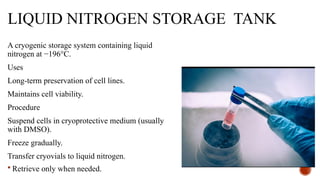
LIQUID NITROGEN STORAGETANK
A cryogenic storage system containing liquid
nitrogen at −196°C.
Uses
Long-term preservation of cell lines.
Maintains cell viability.
Procedure
Suspend cells in cryoprotective medium (usually
with DMSO).
Freeze gradually.
Transfer cryovials to liquid nitrogen.
Retrieve only when needed.
24.
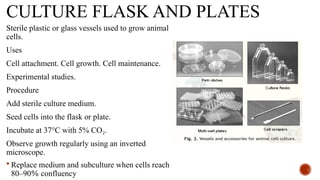
CULTURE FLASK ANDPLATES
Sterile plastic or glass vessels used to grow animal
cells.
Uses
Cell attachment. Cell growth. Cell maintenance.
Experimental studies.
Procedure
Add sterile culture medium.
Seed cells into the flask or plate.
Incubate at 37°C with 5% CO .
₂
Observe growth regularly using an inverted
microscope.
Replace medium and subculture when cells reach
80–90% confluency
25.
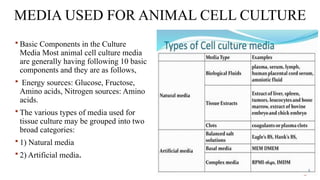
MEDIA USED FORANIMAL CELL CULTURE
Basic Components in the Culture
Media Most animal cell culture media
are generally having following 10 basic
components and they are as follows,
Energy sources: Glucose, Fructose,
Amino acids, Nitrogen sources: Amino
acids.
The various types of media used for
tissue culture may be grouped into two
broad categories:
1) Natural media
2) Artificial media.
27.
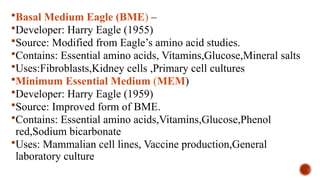
Basal Medium Eagle(BME) –
Developer: Harry Eagle (1955)
Source: Modified from Eagle’s amino acid studies.
Contains: Essential amino acids, Vitamins,Glucose,Mineral salts
Uses:Fibroblasts,Kidney cells ,Primary cell cultures
Minimum Essential Medium (MEM)
Developer: Harry Eagle (1959)
Source: Improved form of BME.
Contains: Essential amino acids,Vitamins,Glucose,Phenol
red,Sodium bicarbonate
Uses: Mammalian cell lines, Vaccine production,General
laboratory culture
28.
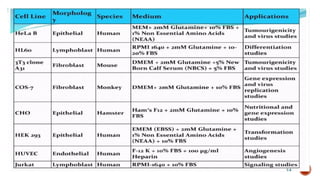
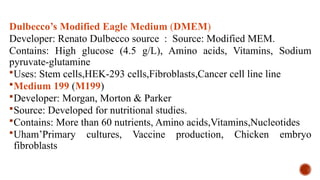
Dulbecco’s Modified EagleMedium (DMEM)
Developer: Renato Dulbecco source : Source: Modified MEM.
Contains: High glucose (4.5 g/L), Amino acids, Vitamins, Sodium
pyruvate-glutamine
Uses: Stem cells,HEK-293 cells,Fibroblasts,Cancer cell line line
Medium 199 (M199)
Developer: Morgan, Morton & Parker
Source: Developed for nutritional studies.
Contains: More than 60 nutrients, Amino acids,Vitamins,Nucleotides
Uham’Primary cultures, Vaccine production, Chicken embryo
fibroblasts
29.
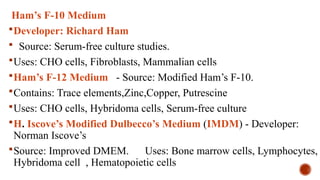
Ham’s F-10 Medium
Developer:Richard Ham
Source: Serum-free culture studies.
Uses: CHO cells, Fibroblasts, Mammalian cells
Ham’s F-12 Medium - Source: Modified Ham’s F-10.
Contains: Trace elements,Zinc,Copper, Putrescine
Uses: CHO cells, Hybridoma cells, Serum-free culture
H. Iscove’s Modified Dulbecco’s Medium (IMDM) - Developer:
Norman Iscove’s
Source: Improved DMEM. Uses: Bone marrow cells, Lymphocytes,
Hybridoma cell , Hematopoietic cells
30.
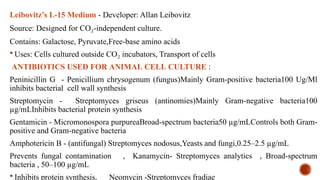
Leibovitz’s L-15 Medium- Developer: Allan Leibovitz
Source: Designed for CO -independent culture.
₂
Contains: Galactose, Pyruvate,Free-base amino acids
Uses: Cells cultured outside CO incubators, Transport of cells
₂
ANTIBIOTICS USED FOR ANIMAL CELL CULTURE :
Peninicillin G - Penicillium chrysogenum (fungus)Mainly Gram-positive bacteria100 Ug/Ml
inhibits bacterial cell wall synthesis
Streptomycin - Streptomyces griseus (antinomies)Mainly Gram-negative bacteria100
µg/mLInhibits bacterial protein synthesis
Gentamicin - Micromonospora purpureaBroad-spectrum bacteria50 µg/mLControls both Gram-
positive and Gram-negative bacteria
Amphotericin B - (antifungal) Streptomyces nodosus,Yeasts and fungi,0.25–2.5 µg/mL
Prevents fungal contamination , Kanamycin- Streptomyces analytics , Broad-spectrum
bacteria , 50–100 µg/mL
Inhibits protein synthesis, Neomycin -Streptomyces fradiae
31.
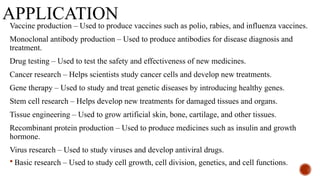
APPLICATION
Vaccine production –Used to produce vaccines such as polio, rabies, and influenza vaccines.
Monoclonal antibody production – Used to produce antibodies for disease diagnosis and
treatment.
Drug testing – Used to test the safety and effectiveness of new medicines.
Cancer research – Helps scientists study cancer cells and develop new treatments.
Gene therapy – Used to study and treat genetic diseases by introducing healthy genes.
Stem cell research – Helps develop new treatments for damaged tissues and organs.
Tissue engineering – Used to grow artificial skin, bone, cartilage, and other tissues.
Recombinant protein production – Used to produce medicines such as insulin and growth
hormone.
Virus research – Used to study viruses and develop antiviral drugs.
Basic research – Used to study cell growth, cell division, genetics, and cell functions.
32.
ADVANTAGE
Provides a controlledenvironment for cell growth.
Reduces the use of experimental animals.
Produces reproducible and reliable results.
Enables large-scale production of vaccines and therapeutic proteins.
Supports genetic engineering and recombinant DNA technology.
Useful for disease diagnosis and drug screening.
Allows continuous maintenance of cell lines.
Facilitates stem cell and regenerative medicine research.
Saves time compared with whole-animal experiments.
Essential for modern biomedical and pharmaceutical research.
33.
DISADVANTAGE
High cost ofequipment, media, and reagents.
Requires strict aseptic techniques to prevent contamination.
Skilled personnel are needed to maintain cultures.
Cell lines may undergo genetic or phenotypic changes after repeated passages.
Some primary cells have a limited lifespan in culture.
Risk of contamination by bacteria, fungi, viruses, or mycoplasma.
Specialized laboratory facilities are required.
Mammalian cells grow more slowly than microbial cells.
Ethical concerns may arise regarding the use of animal tissues and serum.
Continuous monitoring and maintenance increase operational costs.
34.
CURRENT ANIMAL CELLCULTURE
Vaccine production – Used to make vaccines (polio, rabies, influenza, COVID-19).
Medicine production – Used to produce medicines such as insulin and monoclonal
antibodies.
Cancer research – Helps study cancer and develop new treatments.
Drug testing – Tests whether new medicines are safe and effective.
Stem cell research – Used to repair damaged tissues and organs.
Gene therapy – Helps treat genetic diseases by replacing defective genes.
Artificial organs and tissues – Used to grow skin, cartilage, and other tissues for
transplantation.
Virus research – Used to study viruses and develop antiviral medicines.
Cultured meat (Lab-grown meat) – Animal cells are used to produce meat without raising
or slaughtering animals.
Veterinary research – Helps improve animal health and develop animal vaccines.
35.
REFERENCE
Butler M. AnimalCell Culture and Technology.
Glick BR & Pasternak JJ. Molecular Biotechnology: Principles
and Applications of Recombinant DNA.
Freshney RI (2016). “Culture of Animal Cells: Principles and
Practice.
"Advances in Bioscience and Biotechnology
Received 11 February 2012; revised 22 March 2012; accepted
9 April 2012
 Most read