ORIGIN
The vascularcambium and the primary vascular tissues
differentiate from procambium.
Procambium develops from the derivative cells of apical
meristem. Transverse sections of a growing vegetative shoot
apex reveal the presence of a cylinder of cells that are highly
cytoplasmic and more densely staining.
3.
This ring ofcells is regarded as a residum of the
meristematic tissue of apical meristem and so
termed as residual meristem. Within the residual
meristem more densely staining regions are
present and these regions have a topographic
relationship with leaf primordia.
This region constitutes procambium that
develops as leaf trace.
The remainder of residual meristem forms the
interfascicular parenchyma. In longitudinal
section of vegetative apical shoot of angiosperm
and gymnosperm it is observed that the
procambial ring or strand is continuous and
develops acropetally.
4.
Cambium thatdevelops within the vascular bundles in the
stem of a plant.
In the beginning the fascicular cambium is primary
meristem and later is developed into secondary meristem.
Non-continuous cambium between primary xylem and
primary phloem.
INTRAFASICULAR CAMBIUM
5.
● The cambiumarising between the vascular bundles in the
stem of a plant
● A type of secondary meristem
● Derived from the permanent tissues of the stem
● Only occurs in the secondary parts of the stem
Interfascicular cambium bridges the gaps between
vascular bundles. It connects with intrafascicular cambium
within the bundles
Its coordination with intrafascicular cambium, the
cambial ring is completed.
INTERFASCICULAR CAMBIUM
6.
TYPES OF VASCULARCAMBIAL CELLS
●The vascular cambium is composed of two
kinds of cells, ray initials and fusiform
initials. In cross section these look very
similar. Both are small, flattened cells with thin
walls.
● Fusiform initials are elongated cells that
divide periclinally and give rise to axially
elongated cells in the xylem and phloem, i.e.,
is, tracheary cells, sieve elements, fibres, and
parenchyma cells or vertical files of
parenchyma cells, called parenchyma strands.
7.
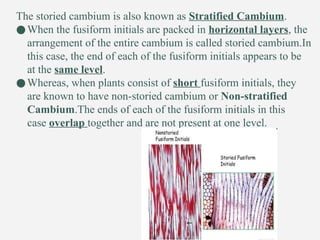
The storied cambiumis also known as Stratified Cambium.
●When the fusiform initials are packed in horizontal layers, the
arrangement of the entire cambium is called storied cambium.In
this case, the end of each of the fusiform initials appears to be
at the same level.
●Whereas, when plants consist of short fusiform initials, they
are known to have non-storied cambium or Non-stratified
Cambium.The ends of each of the fusiform initials in this
case overlap together and are not present at one level.
8.
●Ray initials aremore
or less isodiametric
and occur in clusters
that appear spindle
shaped in tangential
sections. Ray initials
give rise to xylem
and phloem rays,
which extend radially
into the xylem and
phloem and provide
for the radial
transport of water,
minerals
9.
DEVELOPMENT OF CAMBIUM
●Two types of mitotic divisions characterize an active cambium-periclinal and
anticlinal. As a result of periclinal divisions new cells of secondary xylem and-
phloem are produced. Anticlinal divisions give rise to new cambial initials.
● At the time of secondary growth the fusiform initial divides periclinally. One of
the two cells thus formed remains as fusiform cambial initial whereas the other
is an immature cambial derivative that is added to the cambial zone.
● The derivative cells may differentiate directly into new secondary phloem to the
exterior and new secondary xylem to the interior.
● Continued periclinal divisions in fusiform cambial initials and in their derivative
cells result in radially oriented files of cells of similar shape that mature to
secondary vascular tissues.
● Such radial oriented files of cells are conspicuous in the secondary xylem of
conifers where the secondary xylem is largely composed of tracheids.
● In angiosperms such radial files of cells are less conspicuous due the formation
of vessels. Vessels often increase greatly in diameter and as a result distortion of
files occurs.
● The derivative cells mature into tracheids, trachea and xylem fibre of xylem and
sieve tube, companion cell and phloem fibre of phloem as they compose the
axial system of plants.
10.
●The ray cellinitial divides periclinally to form two cells.
One of the daughter cells remains as cambial ray
initial.
●The other cell differentiates into either xylem
parenchyma if it is the inner cell or phloem
parenchyma if it is the outer cell.
●Ray initials produce mostly xylem and phloem
parenchyma.
●In a cambial zone only one layer of true cambial
initials is present. Periclinal division in a cambial cell
forms two cells.
●One of the daughter cells differentiates into
secondary xylem or —phloem. The other cell retains
its meristematic properties. This process continues
throughout the life of a plant and therefore the
division of cambium is limitless.