1.6 Scope of the Study
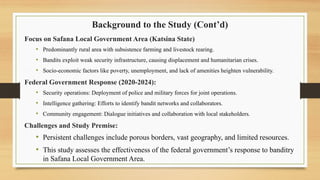
Focus Area: Federal government’s response to banditry in Safana Local Government, Katsina State, representing banditry issues in northern Nigeria.
Key Elements Examined: Strategies, successes, limitations, and socio-economic factors.
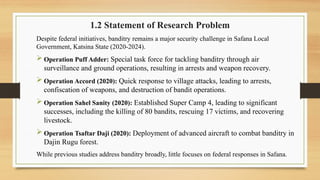
Time Frame: 2020–2024, capturing the escalation of banditry, federal responses (e.g., "Operation Sahel Sanity"), and complexities from the COVID-19 pandemic.
1.7 Significance of the Study
Academic Contribution: Fills a research gap by providing a detailed analysis of federal strategies addressing banditry in Safana, contributing to the literature on security challenges in Nigeria.
Policy Implications: Offers actionable insights for policymakers and security agencies to enhance strategies against banditry.
Community Development: Highlights socio-economic vulnerabilities, aiding in the design of interventions to address root causes like poverty and unemployment, fostering development.
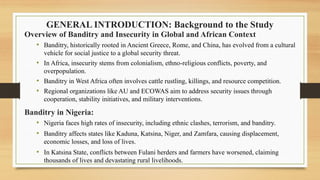
Overview of Banditry and Insecurity in Global and African Context
Banditry, historically rooted in Ancient Greece, Rome, and China, has evolved from a cultural vehicle for social justice to a global security threat.
In Africa, insecurity stems from colonialism, ethno-religious conflicts, poverty, and overpopulation.
Banditry in West Africa often involves cattle rustling, killings, and resource competition.
Regional organizations like AU and ECOWAS aim to address security issues through cooperation, stability initiatives, and military interventions.
Banditry in Nigeria:
Nigeria faces high rates of insecurity, including ethnic clashes, terrorism, and banditry.
Banditry affects states like Kaduna, Katsina, Niger, and Zamfara, causing displacement, economic losses, and loss of lives.
In Katsina State, conflicts between Fulani herders and farmers have worsened, claiming thousands of lives and devastating rural livelihoods.