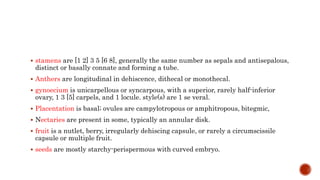
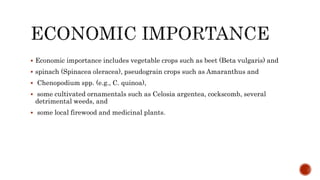
 Amaranthaceae has a largely worldwide distribution, members common in some
deserts, estuarine or alkaline regions, tropical areas, and some temperate regions.
 Amaranthaceae consist of annual or perennial, dioecious, monoecious, or
polygamous herbs, vines, shrubs, or rarely trees.
 The stems are sometimes jointed or succulent.
 leaves are simple, spiral or opposite, exstipulate, succulent or reduced in some
taxa.
 inflorescence is of solitary flowers or a spike, panicle, cyme, or thyrse, with bracts
and bracteoles bristle-like and pigmented in some taxa.
 flowers are small, bisexual or unisexual, usually actinomorphic, hypogynous
 perianth is uniseriate (usually termed a calyx, by default), consisting of [0 2] 3 5 [6
8] distinct or rarely basally connate sepals.
 stamens are [1 2] 3 5 [6 8], generally the same number as sepals and antisepalous,
distinct or basally connate and forming a tube.
 Anthers are longitudinal in dehiscence, dithecal or monothecal.
 gynoecium is unicarpellous or syncarpous, with a superior, rarely half-inferior
ovary, 1 3 [5] carpels, and 1 locule. style(s) are 1 se veral.
 Placentation is basal; ovules are campylotropous or amphitropous, bitegmic,
 Nectaries are present in some, typically an annular disk.
 fruit is a nutlet, berry, irregularly dehiscing capsule, or rarely a circumscissile
capsule or multiple fruit.
 seeds are mostly starchy-perispermous with curved embryo.
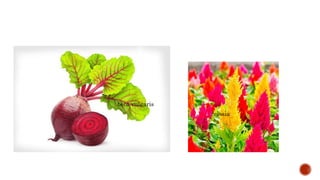
 Economic importance includes vegetable crops such as beet (Beta vulgaris) and
 spinach (Spinacea oleracea), pseudograin crops such as Amaranthus and
 Chenopodium spp. (e.g., C. quinoa),
 some cultivated ornamentals such as Celosia argentea, cockscomb, several
detrimental weeds, and
 some local firewood and medicinal plants.
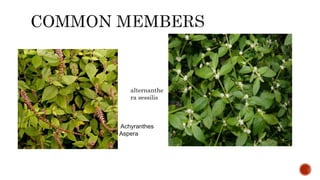
Achyranthes
Aspera
alternanthe
ra sessilis
beta vulgaris
celosia