Aligning Classroom Assessments with National and PISA Frameworks for Enhanced Learning Outcomes
Explore principles of assessment literacy, formative and summative assessments, and designing PISA-like classroom tests aligned with national standards to improve student learning and educational accountability.
INCORPORATING THE NATIONALASSESSMENTS FRAMEWORK IN CLASSROOM ASSESSMENT
Key Point
Formative assessment is very important to prepare learners in summative
assessments and quarterly exams.
Alignment of Classroom National
Assessments
3.
INCORPORATING THE NATIONALASSESSMENTS FRAMEWORK IN CLASSROOM ASSESSMENT
Main Objective
Construct classroom assessment item aligned with the structure, format, and quality of those used in national and
international large-scale assessment.
Alignment of Classroom National
Assessments
4.
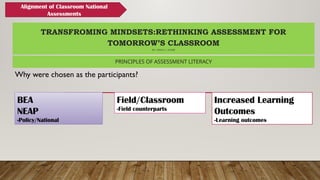
TRANSFROMING MINDSETS:RETHINKING ASSESSMENTFOR
TOMORROW’S CLASSROOM
BY -ANALY L. OCIER
PRINCIPLES OF ASSESSMENT LITERACY
BEA
NEAP
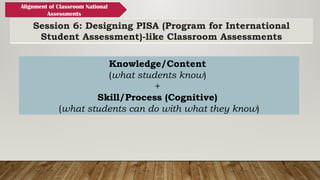
-Policy/National
Field/Classroom
-Field counterparts
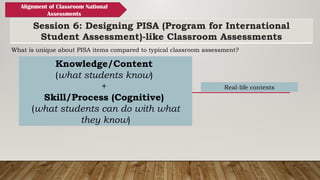
Increased Learning
Outcomes
-Learning outcomes
Why were chosen as the participants?
Alignment of Classroom National
Assessments
5.
INCORPORATING THE NATIONALASSESSMENTS FRAMEWORK IN CLASSROOM ASSESSMENT
Assessment Literacy
Refers to the understanding, skills, and competencies teachers need to design, select, interpret,
and use assessments effectively to improve students learning and outcomes.
What are the components of Assessment Literacy?
• Understanding the purpose of Assessment
• Assessment Design and Development
• Data Analysis and Interpretation
• Feedback and Instructional Decision]-Making
• Ethical and Fair Use of Assessment
Alignment of Classroom National
Assessments
6.
An assessment literateteacher must
Know and how to assess
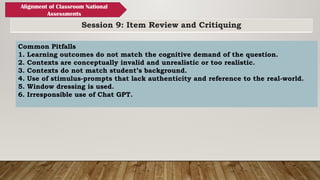
PRINCIPLES OF ASSESSMENT LITERACY
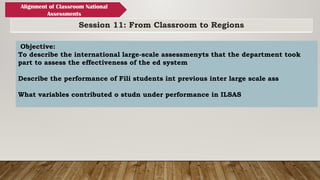
Alignment of Classroom National
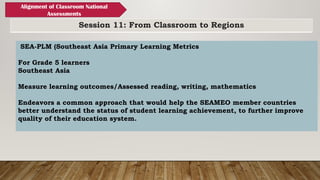
Assessments
7.
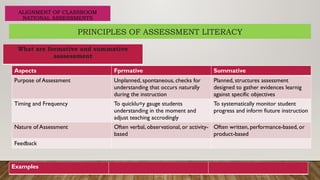
ALIGNMENT OF CLASSROOM
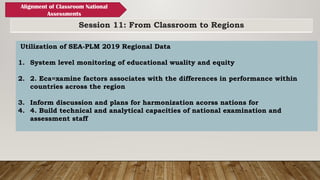
NATIONALASSESSMENTS
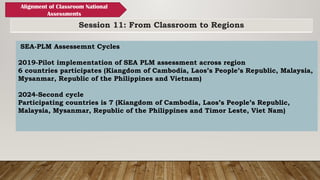
What are formative and summative
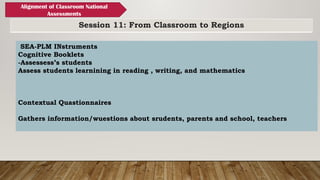
asssessment
PRINCIPLES OF ASSESSMENT LITERACY
Aspects Fprmative Summative
Purpose of Assessment Unplanned, spontaneous, checks for
understanding that occurs naturally
during the instruction
Planned, structures assessment
designed to gather evidences learnig
against specific objectives
Timing and Frequency To quicklu=y gauge students
understanding in the moment and
adjust teaching accrodingly
To systematically monitor student
progress and inform fiuture instruction
Nature of Assessment Often verbal, observational, or activity-
based
Often written, performance-based, or
product-based
Feedback
Examples
8.
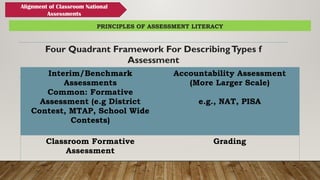
Four Quadrant FrameworkFor DescribingTypes f
Assessment
(Susan Brookharts)
PRINCIPLES OF ASSESSMENT LITERACY
Interim/Benchmark
Assessments
Common: Formative
Assessment (e.g District
Contest, MTAP, School Wide
Contests)
Accountability Assessment
(More Larger Scale)
e.g., NAT, PISA
Classroom Formative
Assessment
Grading
Alignment of Classroom National
Assessments
9.
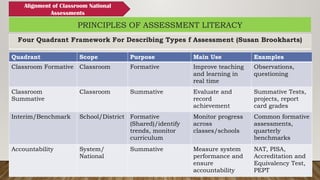
Four Quadrant FrameworkFor Describing Types f Assessment (Susan Brookharts)
PRINCIPLES OF ASSESSMENT LITERACY
Quadrant Scope Purpose Main Use Examples
Classroom Formative Classroom Formative Improve teaching
and learning in
real time
Observations,
questioning
Classroom
Summative
Classroom Summative Evaluate and
record
achievement
Summative Tests,
projects, report
card grades
Interim/Benchmark School/District Formative
(Shared)/identify
trends, monitor
curriculum
Monitor progress
across
classes/schools
Common formative
assessments,
quarterly
benchmarks
Accountability System/
National
Summative Measure system
performance and
ensure
accountability
NAT, PISA,
Accreditation and
Equivalency Test,
PEPT
Alignment of Classroom National
Assessments
10.
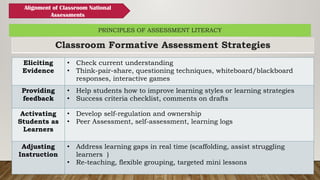
Classroom Formative AssessmentStrategies
PRINCIPLES OF ASSESSMENT LITERACY
Eliciting
Evidence
• Check current understanding
• Think-pair-share, questioning techniques, whiteboard/blackboard
responses, interactive games
Providing
feedback
• Help students how to improve learning styles or learning strategies
• Success criteria checklist, comments on drafts
Activating
Students as
Learners
• Develop self-regulation and ownership
• Peer Assessment, self-assessment, learning logs
Adjusting
Instruction
• Address learning gaps in real time (scaffolding, assist struggling
learners )
• Re-teaching, flexible grouping, targeted mini lessons
Alignment of Classroom National
Assessments
11.
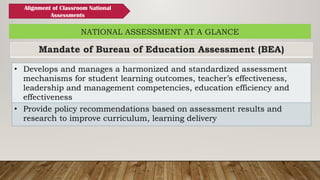
Mandate of Bureauof Education Assessment (BEA)
NATIONAL ASSESSMENT AT A GLANCE
• Develops and manages a harmonized and standardized assessment
mechanisms for student learning outcomes, teacher’s effectiveness,
leadership and management competencies, education efficiency and
effectiveness
• Provide policy recommendations based on assessment results and
research to improve curriculum, learning delivery
Alignment of Classroom National
Assessments
12.
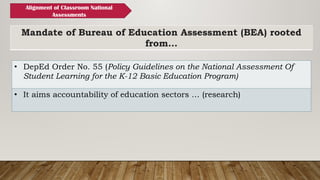
Mandate of Bureauof Education Assessment (BEA) rooted
from…
• DepEd Order No. 55 (Policy Guidelines on the National Assessment Of
Student Learning for the K-12 Basic Education Program)
• It aims accountability of education sectors … (research)
Alignment of Classroom National
Assessments
13.
Mandate of Bureauof Education Assessment (BEA) rooted
from..
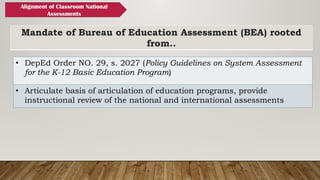
• DepEd Order NO. 29, s. 2027 (Policy Guidelines on System Assessment
for the K-12 Basic Education Program)
• Articulate basis of articulation of education programs, provide
instructional review of the national and international assessments
Alignment of Classroom National
Assessments
14.
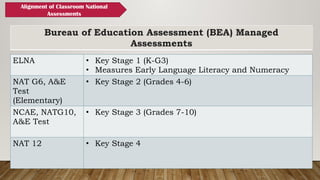
Bureau of EducationAssessment (BEA) Managed
Assessments
ELNA • Key Stage 1 (K-G3)
• Measures Early Language Literacy and Numeracy
NAT G6, A&E
Test
(Elementary)
• Key Stage 2 (Grades 4-6)
NCAE, NATG10,
A&E Test
• Key Stage 3 (Grades 7-10)
NAT 12 • Key Stage 4
Alignment of Classroom National
Assessments
15.
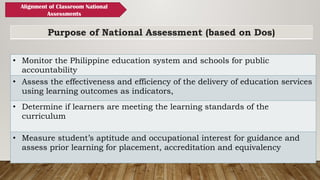
Purpose of NationalAssessment (based on Dos)
• Monitor the Philippine education system and schools for public
accountability
• Assess the effectiveness and efficiency of the delivery of education services
using learning outcomes as indicators,
• Determine if learners are meeting the learning standards of the
curriculum
• Measure student’s aptitude and occupational interest for guidance and
assess prior learning for placement, accreditation and equivalency
Alignment of Classroom National
Assessments
16.
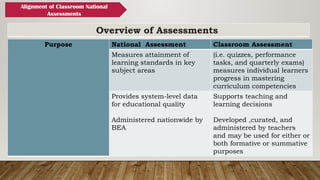
Overview of Assessments
PurposeNational Assessment Classroom Assessment
Measures attainment of
learning standards in key
subject areas
(i.e. quizzes, performance
tasks, and quarterly exams)
measures individual learners
progress in mastering
curriculum competencies
Provides system-level data
for educational quality
Administered nationwide by
BEA
Supports teaching and
learning decisions
Developed ,curated, and
administered by teachers
and may be used for either or
both formative or summative
purposes
Alignment of Classroom National
Assessments
17.
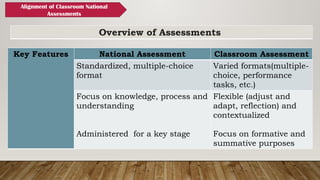
Overview of Assessments
KeyFeatures National Assessment Classroom Assessment
Standardized, multiple-choice
format
Varied formats(multiple-
choice, performance
tasks, etc.)
Focus on knowledge, process and
understanding
Administered for a key stage
Flexible (adjust and
adapt, reflection) and
contextualized
Focus on formative and
summative purposes
Alignment of Classroom National
Assessments
18.
Session 3: CraftingBetter Tests: The Art of Item Writing for
Classroom-Based Assessment
Alignment of Classroom National
Assessments
• Item (Single Question/Task)
19.
Session 3: CraftingBetter Tests: The Art of Item Writing for
Classroom-Based Assessment
Alignment of Classroom National
Assessments
Item
Domain
Competency
20.
Session 4: CraftingTest Items (canva file)
Alignment of Classroom National
Assessments
Item
Domain
Competency
21.
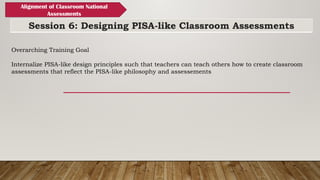
Session 6: DesigningPISA-like Classroom Assessments
Alignment of Classroom National
Assessments
Overarching Training Goal
Internalize PISA-like design principles such that teachers can teach others how to create classroom
assessments that reflect the PISA-like philosophy and assessements
22.
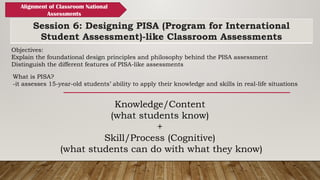
Session 6: DesigningPISA (Program for International
Student Assessment)-like Classroom Assessments
Alignment of Classroom National
Assessments
Objectives:
Explain the foundational design principles and philosophy behind the PISA assessment
Distinguish the different features of PISA-like assessments
What is PISA?
-it assesses 15-year-old students’ ability to apply their knowledge and skills in real-life situations
Knowledge/Content
(what students know)
+
Skill/Process (Cognitive)
(what students can do with what they know)
23.
Session 6: DesigningPISA (Program for International
Student Assessment)-like Classroom Assessments
Alignment of Classroom National
Assessments
Knowledge/Content
(what students know)
+
Skill/Process (Cognitive)
(what students can do with what they know)
24.
Session 6: DesigningPISA (Program for International
Student Assessment)-like Classroom Assessments
Alignment of Classroom National
Assessments
Activity 2:
Comparing PISA and Classroom Assessments
25.
Session 6: DesigningPISA (Program for International
Student Assessment)-like Classroom Assessments
Alignment of Classroom National
Assessments
What is unique about PISA items compared to typical classroom assessment?
Knowledge/Content
(what students know)
+
Skill/Process (Cognitive)
(what students can do with what
they know)
Real-life contexts
26.
Session 6: DesigningPISA (Program for International
Student Assessment)-like Classroom Assessments
Alignment of Classroom National
Assessments
Features of PISA items?
1. Students need to apply what they know (knowledge) to solve a problem or complete a task (skill).
2. The knowledge and skill are assessed within a purposelysituated, real-life contexts
27.
Session 6: DesigningPISA (Program for International
Student Assessment)-like Classroom Assessments
Alignment of Classroom National
Assessments
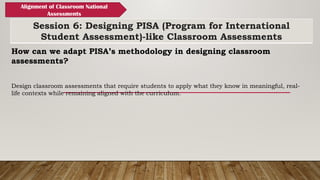
How can we adapt PISA’s methodology in designing classroom
assessments?
Design classroom assessments that require students to apply what they know in meaningful, real-
life contexts while remaining aligned with the curriculum.
28.
Session 6: DesigningPISA (Program for International Student Assessment)-like
Classroom Assessments
Alignment of Classroom National
Assessments
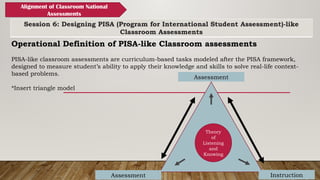
Operational Definition of PISA-like Classroom assessments
PISA-like classroom assessments are curriculum-based tasks modeled after the PISA framework,
designed to measure student’s ability to apply their knowledge and skills to solve real-life context-
based problems.
*Insert triangle model
Theory
of
Listening
and
Knowing
Assessment
Assessment Instruction
29.
Session 6: DesigningPISA (Program for International
Student Assessment)-like Classroom Assessments
Alignment of Classroom National
Assessments
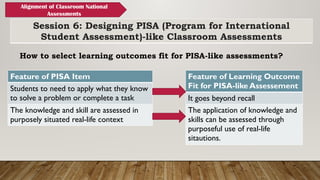
How to select learning outcomes fit for PISA-like assessments?
Feature of PISA Item
Students to need to apply what they know
to solve a problem or complete a task
The knowledge and skill are assessed in
purposely situated real-life context
Feature of Learning Outcome
Fit for PISA-like Assessement
It goes beyond recall
The application of knowledge and
skills can be assessed through
purposeful use of real-life
sitautions.
30.
Session 6: DesigningPISA (Program for International
Student Assessment)-like Classroom Assessments
Alignment of Classroom National
Assessments
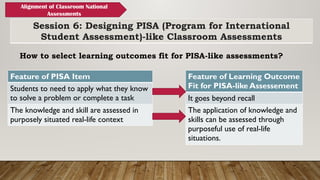
How to select learning outcomes fit for PISA-like assessments?
Feature of PISA Item
Students to need to apply what they know
to solve a problem or complete a task
The knowledge and skill are assessed in
purposely situated real-life context
Feature of Learning Outcome
Fit for PISA-like Assessement
It goes beyond recall
The application of knowledge and
skills can be assessed through
purposeful use of real-life
situations.
31.
Session 6: DesigningPISA (Program for International
Student Assessment)-like Classroom Assessments
Alignment of Classroom National
Assessments
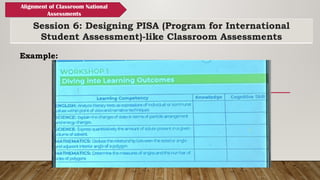
Example:
32.
Session 7: DesigningMeaningful Contexts for PISA-like Assessments
Alignment of Classroom National
Assessments
Objectives:
1. Explain what context means in PISA-like assessments
2. Apply the criteria for selecting meaningful for PISA-like
Assessments
3. Translate context to test stimulus
33.
Session 7: DesigningMeaningful Contexts for PISA-like Assessments
Alignment of Classroom National
Assessments
PISA purposefully situates assessment tasks within realistic
and meaningful contexts that relate to students’ lives and
future challenges (OECD 2016;2023)
34.
Session 7: DesigningMeaningful Contexts for PISA-like Assessments
Alignment of Classroom National
Assessments
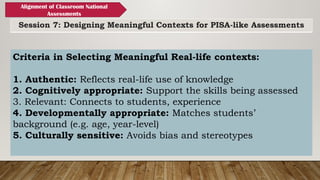
Criteria in Selecting Meaningful Real-life contexts:
1. Authentic: Reflects real-life use of knowledge
2. Cognitively appropriate: Support the skills being assessed
3. Relevant: Connects to students, experience
4. Developmentally appropriate: Matches students’
background (e.g. age, year-level)
5. Culturally sensitive: Avoids bias and stereotypes
35.
Session 7: DesigningMeaningful Contexts for PISA-like Assessments
Alignment of Classroom National
Assessments
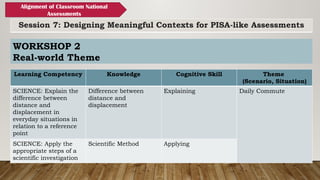
WORKSHOP 2
Real-world Theme
Learning Competency Knowledge Cognitive Skill Theme
(Scenario, Situation)
SCIENCE: Explain the
difference between
distance and
displacement in
everyday situations in
relation to a reference
point
Difference between
distance and
displacement
Explaining Daily Commute
SCIENCE: Apply the
appropriate steps of a
scientific investigation
Scientific Method Applying
36.
Session 7: DesigningMeaningful Contexts for PISA-like Assessments
Alignment of Classroom National
Assessments
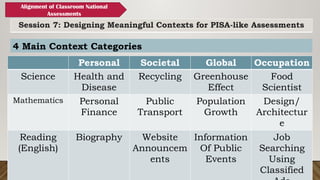
4 Main Context Categories
Personal Societal Global Occupation
Science Health and
Disease
Recycling Greenhouse
Effect
Food
Scientist
Mathematics Personal
Finance
Public
Transport
Population
Growth
Design/
Architectur
e
Reading
(English)
Biography Website
Announcem
ents
Information
Of Public
Events
Job
Searching
Using
Classified
37.
Session 7: DesigningMeaningful Contexts for PISA-like Assessments
Alignment of Classroom National
Assessments
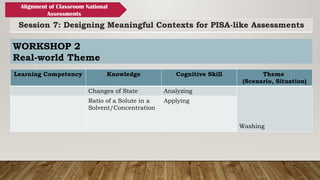
WORKSHOP 2
Real-world Theme
Learning Competency Knowledge Cognitive Skill Theme
(Scenario, Situation)
Changes of State Analyzing
Washing
Ratio of a Solute in a
Solvent/Concentration
Applying
38.
Session 7: DesigningMeaningful Contexts for PISA-like Assessments
Alignment of Classroom National
Assessments
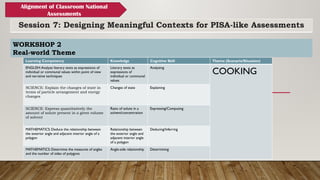
WORKSHOP 2
Real-world Theme
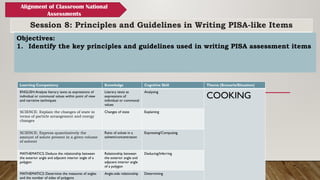
Learning Competency Knowledge Cognitive Skill Theme (Scenario/Situation)
ENGLISH:Analyze literary texts as expressions of
individual or communal values within point of view
and narrative techniques
Literary texts as
expressions of
individual or communal
values
Analyzing
COOKING
SCIENCE: Explain the changes of state in
terms of particle arrangement and energy
changes
Changes of state Explaining
SCIENCE: Express quantitatively the
amount of solute present in a given volume
of solvent
Ratio of solute in a
solvent/concentration
Expressing/Computing
MATHEMATICS: Deduce the relationship between
the exterior angle and adjacent interior angle of a
polygon
Relationship between
the exterior angle and
adjacent interior angle
of a polygon
Deducing/Inferring
MATHEMATICS: Determine the measures of angles
and the number of sides of polygons
Angle-side relationship Determining
39.
Session 8: Principlesand Guidelines in Writing PISA-like Items
Alignment of Classroom National
Assessments
Objectives:
1. Identify the key principles and guidelines used in writing PISA assessment items
Learning Competency Knowledge Cognitive Skill Theme (Scenario/Situation)
ENGLISH:Analyze literary texts as expressions of
individual or communal values within point of view
and narrative techniques
Literary texts as
expressions of
individual or communal
values
Analyzing
COOKING
SCIENCE: Explain the changes of state in
terms of particle arrangement and energy
changes
Changes of state Explaining
SCIENCE: Express quantitatively the
amount of solute present in a given volume
of solvent
Ratio of solute in a
solvent/concentration
Expressing/Computing
MATHEMATICS: Deduce the relationship between
the exterior angle and adjacent interior angle of a
polygon
Relationship between
the exterior angle and
adjacent interior angle
of a polygon
Deducing/Inferring
MATHEMATICS: Determine the measures of angles
and the number of sides of polygons
Angle-side relationship Determining
40.
Session 8: Principlesand Guidelines in Writing PISA-like Items
Alignment of Classroom National
Assessments
Steps in Designing PISA-like Classroom Assessments
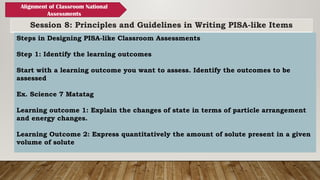
Step 1: Identify the learning outcomes
Start with a learning outcome you want to assess. Identify the outcomes to be
assessed
Ex. Science 7 Matatag
Learning outcome 1: Explain the changes of state in terms of particle arrangement
and energy changes.
Learning Outcome 2: Express quantitatively the amount of solute present in a given
volume of solute
41.
Session 8: Principlesand Guidelines in Writing PISA-like Items
Alignment of Classroom National
Assessments
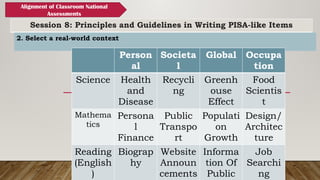
2. Select a real-world context
Person
al
Societa
l
Global Occupa
tion
Science Health
and
Disease
Recycli
ng
Greenh
ouse
Effect
Food
Scientis
t
Mathema
tics
Persona
l
Finance
Public
Transpo
rt
Populati
on
Growth
Design/
Architec
ture
Reading
(English
)
Biograp
hy
Website
Announ
cements
Informa
tion Of
Public
Job
Searchi
ng
42.
Session 8: Principlesand Guidelines in Writing PISA-like Items
Alignment of Classroom National
Assessments
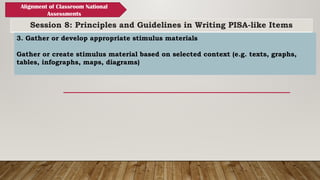
3. Gather or develop appropriate stimulus materials
Gather or create stimulus material based on selected context (e.g. texts, graphs,
tables, infographs, maps, diagrams)
43.
Session 8: Principlesand Guidelines in Writing PISA-like Items
Alignment of Classroom National
Assessments
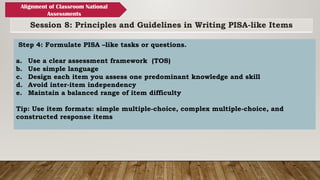
Step 4: Formulate PISA –like tasks or questions.
a. Use a clear assessment framework (TOS)
b. Use simple language
c. Design each item you assess one predominant knowledge and skill
d. Avoid inter-item independency
e. Maintain a balanced range of item difficulty
Tip: Use item formats: simple multiple-choice, complex multiple-choice, and
constructed response items
44.
Session 8: Principlesand Guidelines in Writing PISA-like Items
Alignment of Classroom National
Assessments
Step 5: Develop a scoring guide or rubric
Develop a scoring guide or rubric for constructed-response items
45.
Session 8: Principlesand Guidelines in Writing PISA-like Items
Alignment of Classroom National
Assessments
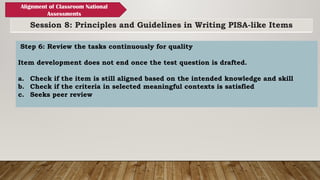
Step 6: Review the tasks continuously for quality
Item development does not end once the test question is drafted.
a. Check if the item is still aligned based on the intended knowledge and skill
b. Check if the criteria in selected meaningful contexts is satisfied
c. Seeks peer review
46.
Session 9: ItemReview and Critiquing
Alignment of Classroom National
Assessments
Objective:
To review and define drafted PISA items based on established quality criteria
47.
Session 9: ItemReview and Critiquing
Alignment of Classroom National
Assessments
Common Pitfalls
1. Learning outcomes do not match the cognitive demand of the question.
2. Contexts are conceptually invalid and unrealistic or too realistic.
3. Contexts do not match student’s background.
4. Use of stimulus-prompts that lack authenticity and reference to the real-world.
5. Window dressing is used.
6. Irresponsible use of Chat GPT.
48.
Session 11: FromClassroom to Regions
Alignment of Classroom National
Assessments
Objective:
To describe the international large-scale assessmenyts that the department took
part to assess the effectiveness of the ed system
Describe the performance of Fili students int previous inter large scale ass
What variables contributed o studn under performance in ILSAS
49.
Session 11: FromClassroom to Regions
Alignment of Classroom National
Assessments
SEA-PLM (Southeast Asia Primary Learning Metrics
For Grade 5 learners
Southeast Asia
Measure learning outcomes/Assessed reading, writing, mathematics
Endeavors a common approach that would help the SEAMEO member countries
better understand the status of student learning achievement, to further improve
quality of their education system.
50.
Session 11: FromClassroom to Regions
Alignment of Classroom National
Assessments
SEA-PLM 2019 National Results
51.
Session 11: FromClassroom to Regions
Alignment of Classroom National
Assessments
SEA-PLM 2019 National Results
52.
Session 11: FromClassroom to Regions
Alignment of Classroom National
Assessments
Utilization of SEA-PLM 2019 Regional Data
1. System level monitoring of educational wuality and equity
2. 2. Eca=xamine factors associates with the differences in performance within
countries across the region
3. Inform discussion and plans for harmonization acorss nations for
4. 4. Build technical and analytical capacities of national examination and
assessment staff
53.
Session 11: FromClassroom to Regions
Alignment of Classroom National
Assessments
SEA-PLM Assessemnt Cycles
2019-Pilot implementation of SEA PLM assessment across region
6 countries participates (Kiangdom of Cambodia, Laos’s People’s Republic, Malaysia,
Mysanmar, Republic of the Philippines and Vietnam)
2024-Second cycle
Participating countries is 7 (Kiangdom of Cambodia, Laos’s People’s Republic,
Malaysia, Mysanmar, Republic of the Philippines and Timor Leste, Viet Nam)
54.
Session 11: FromClassroom to Regions
Alignment of Classroom National
Assessments
SEA-PLM INstruments
Cognitive Booklets
-Assessess’s students
Assess students learnining in reading , writing, and mathematics
Contextual Quastionnaires
Gathers information/wuestions about srudents, parents and school, teachers
55.
Session 11: FromClassroom to Regions
Alignment of Classroom National
Assessments
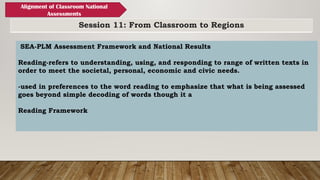
SEA-PLM Assessment Framework and National Results
Reading-refers to understanding, using, and responding to range of written texts in
order to meet the societal, personal, economic and civic needs.
-used in preferences to the word reading to emphasize that what is being assessed
goes beyond simple decoding of words though it a
Reading Framework
56.
Session 12: BridgingGlobal Assessments and Local Classrooms: The
TIMSS Connection
Alignment of Classroom National
Assessments
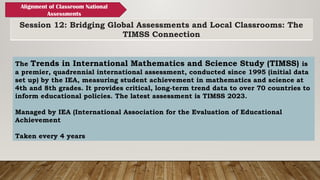
The Trends in International Mathematics and Science Study (TIMSS) is
a premier, quadrennial international assessment, conducted since 1995 (initial data
set up) by the IEA, measuring student achievement in mathematics and science at
4th and 8th grades. It provides critical, long-term trend data to over 70 countries to
inform educational policies. The latest assessment is TIMSS 2023.
Managed by IEA (International Association for the Evaluation of Educational
Achievement
Taken every 4 years
57.
Session 12: BridgingGlobal Assessments and Local Classrooms: The
TIMSS Connection
Alignment of Classroom National
Assessments
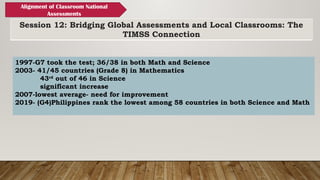
1997-G7 took the test; 36/38 in both Math and Science
2003- 41/45 countries (Grade 8) in Mathematics
43rd
out of 46 in Science
significant increase
2007-lowest average- need for improvement
2019- (G4)Philippines rank the lowest among 58 countries in both Science and Math
58.
Session 12: BridgingGlobal Assessments and Local Classrooms: The
TIMSS Connection
Alignment of Classroom National
Assessments
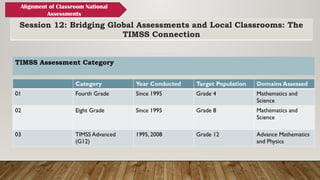
TIMSS Assessment Category
Category Year Conducted Target Population Domains Assessed
01 Fourth Grade Since 1995 Grade 4 Mathematics and
Science
02 Eight Grade Since 1995 Grade 8 Mathematics and
Science
03 TIMSS Advanced
(G12)
1995, 2008 Grade 12 Advance Mathematics
and Physics
59.
Session 12: BridgingGlobal Assessments and Local Classrooms: The
TIMSS Connection
Alignment of Classroom National
Assessments
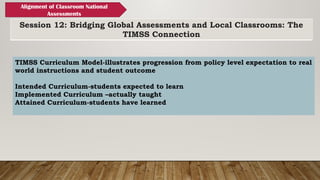
TIMSS Curriculum Model-illustrates progression from policy level expectation to real
world instructions and student outcome
Intended Curriculum-students expected to learn
Implemented Curriculum –actually taught
Attained Curriculum-students have learned
60.
Session 12: BridgingGlobal Assessments and Local Classrooms: The
TIMSS Connection
Alignment of Classroom National
Assessments
Content and Context for Learning Mathematics and Science
TIMSS uses the curriculum, broadly defined, as the major organizing concept in
considering how education opportunities are provided to students and the factors
that influence how students use these opportunities.
61.
Session 12: BridgingGlobal Assessments and Local Classrooms: The
TIMSS Connection
Alignment of Classroom National
Assessments
TIMSS Contextual data
Provide information/data for revisions and improvement of curriculum
62.
Session 12: BridgingGlobal Assessments and Local Classrooms: The
TIMSS Connection
Alignment of Classroom National
Assessments
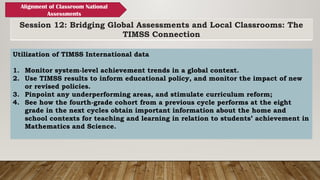
Utilization of TIMSS International data
1. Monitor system-level achievement trends in a global context.
2. Use TIMSS results to inform educational policy, and monitor the impact of new
or revised policies.
3. Pinpoint any underperforming areas, and stimulate curriculum reform;
4. See how the fourth-grade cohort from a previous cycle performs at the eight
grade in the next cycles obtain important information about the home and
school contexts for teaching and learning in relation to students’ achievement in
Mathematics and Science.
63.
Session 12: BridgingGlobal Assessments and Local Classrooms: The
TIMSS Connection
Alignment of Classroom National
Assessments
TIMSS Assessment Framework
http;//files.eric.ed.gov/fulltext/ED596167pdf
64.
Session 12: BridgingGlobal Assessments and Local Classrooms: The
TIMSS Connection
Alignment of Classroom National
Assessments

![INCORPORATING THE NATIONAL ASSESSMENTS FRAMEWORK IN CLASSROOM ASSESSMENT
Assessment Literacy
Refers to the understanding, skills, and competencies teachers need to design, select, interpret,
and use assessments effectively to improve students learning and outcomes.
What are the components of Assessment Literacy?
• Understanding the purpose of Assessment
• Assessment Design and Development
• Data Analysis and Interpretation
• Feedback and Instructional Decision]-Making
• Ethical and Fair Use of Assessment
Alignment of Classroom National
Assessments](https://image.slidesharecdn.com/alignmentofclassroomnationalassessmentsppt-260820004920-50fe001a/85/Aligning-Classroom-Assessments-with-National-and-PISA-Frameworks-for-Enhanced-Learning-Outcomes-5-320.jpg)
 Most read
 Most read
 Most read