Bonedeish Study Guide 1
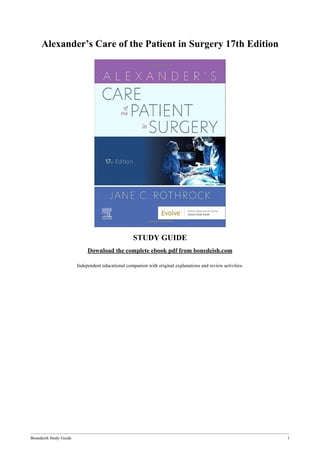
Alexander’s Care of the Patient in Surgery 17th Edition
STUDY GUIDE
Download the complete ebook pdf from bonedeish.com
Independent educational companion with original explanations and review activities.
Bonedeish Study Guide 2
How to Use This Study Guide
Use this guide actively. Read a topic once for understanding, close the page, explain the idea from memory,
and then return to correct what you missed. Retrieval and correction are more valuable than repeated
passive reading.
Study map
1. Perioperative Care Foundations 12. Pain Management
2. Preoperative Assessment 13. Respiratory Monitoring
3. Patient Safety and Identification 14. Cardiovascular Monitoring
4. Asepsis and Infection Prevention 15. Neurologic Considerations
5. Surgical Positioning 16. Gastrointestinal Procedures
6. Anesthesia-Surgery Coordination 17. Genitourinary Procedures
7. Hemostasis and Blood Loss 18. Orthopedic Procedures
8. Fluid and Temperature Management 19. Emergency and Trauma Surgery
9. Instruments and Surgical Technology 20. Post-Anesthesia Recovery
10. Specimen Management 21. Complication Recognition
11. Wound Healing 22. Team Communication and Documentation
A practical mastery test is simple: can you define the idea, explain the relationship, apply it to a new case,
and recognize a common mistake without reading from the page? If not, mark the topic for another pass.
Bonedeish Study Guide 3
1. Perioperative Care Foundations
Core idea
Safe surgical care depends on preparation, anatomy, sterile technique, coordinated teamwork, physiological
monitoring, and early recognition of complications. Perioperative Care Foundations is one piece of that
larger picture. A useful way to approach this topic is to begin with the underlying purpose and then move
toward the details.
Build the reasoning
Study each procedure through the same clinical sequence: indication, preparation, key anatomy, major
steps, hazards, monitoring, and postoperative priorities. For Perioperative Care Foundations, first state the
idea in ordinary language. Next identify the main variables, structures, actors, or steps involved. Then ask
what evidence would support a correct interpretation and what evidence would make you reconsider it.
Key checkpoints
• Define Perioperative Care Foundations without copying a textbook sentence.
• Identify two important relationships or cause-and-effect links.
• Give one clear example and one contrasting example.
• Connect this page to one earlier topic in the guide.
• Write one question you would ask if the situation were ambiguous.
Apply it
Compare a normal or expected case with a contrasting case. The difference usually reveals the most
important rule. Technical detail should never obscure the patient. Safety checks, communication, and
physiological response remain central throughout the perioperative period.
Quick review
1. What is the most important idea behind Perioperative Care Foundations?
2. Which detail is most likely to be misunderstood, and why?
3. How would you use this knowledge in a new example, case, problem, or interpretation?
Bonedeish Study Guide 4
2. Preoperative Assessment
Core idea
Safe surgical care depends on preparation, anatomy, sterile technique, coordinated teamwork, physiological
monitoring, and early recognition of complications. Preoperative Assessment is one piece of that larger
picture. This topic makes more sense when it is treated as part of a larger system rather than as a standalone
definition.
Build the reasoning
Study each procedure through the same clinical sequence: indication, preparation, key anatomy, major
steps, hazards, monitoring, and postoperative priorities. For Preoperative Assessment, first state the idea in
ordinary language. Next identify the main variables, structures, actors, or steps involved. Then ask what
evidence would support a correct interpretation and what evidence would make you reconsider it.
Key checkpoints
• Define Preoperative Assessment without copying a textbook sentence.
• Identify two important relationships or cause-and-effect links.
• Give one clear example and one contrasting example.
• Connect this page to one earlier topic in the guide.
• Write one question you would ask if the situation were ambiguous.
Apply it
Draw a one-page map linking definition, mechanism, evidence, application, and common error. Technical
detail should never obscure the patient. Safety checks, communication, and physiological response remain
central throughout the perioperative period.
Quick review
1. What is the most important idea behind Preoperative Assessment?
2. Which detail is most likely to be misunderstood, and why?
3. How would you use this knowledge in a new example, case, problem, or interpretation?
Bonedeish Study Guide 5
3. Patient Safety and Identification
Core idea
Safe surgical care depends on preparation, anatomy, sterile technique, coordinated teamwork, physiological
monitoring, and early recognition of complications. Patient Safety and Identification is one piece of that
larger picture. The central task here is to separate what must be remembered from what should be reasoned
through.
Build the reasoning
Study each procedure through the same clinical sequence: indication, preparation, key anatomy, major
steps, hazards, monitoring, and postoperative priorities. For Patient Safety and Identification, first state the
idea in ordinary language. Next identify the main variables, structures, actors, or steps involved. Then ask
what evidence would support a correct interpretation and what evidence would make you reconsider it.
Key checkpoints
• Define Patient Safety and Identification without copying a textbook sentence.
• Identify two important relationships or cause-and-effect links.
• Give one clear example and one contrasting example.
• Connect this page to one earlier topic in the guide.
• Write one question you would ask if the situation were ambiguous.
Apply it
Turn the topic into a short scenario and decide what information would matter first, what would matter
next, and why. Technical detail should never obscure the patient. Safety checks, communication, and
physiological response remain central throughout the perioperative period.
Quick review
1. What is the most important idea behind Patient Safety and Identification?
2. Which detail is most likely to be misunderstood, and why?
3. How would you use this knowledge in a new example, case, problem, or interpretation?
Bonedeish Study Guide 6
4. Asepsis and Infection Prevention
Core idea
Safe surgical care depends on preparation, anatomy, sterile technique, coordinated teamwork, physiological
monitoring, and early recognition of complications. Asepsis and Infection Prevention is one piece of that
larger picture. Good revision starts by identifying the few relationships that organize the rest of the detail.
Build the reasoning
Study each procedure through the same clinical sequence: indication, preparation, key anatomy, major
steps, hazards, monitoring, and postoperative priorities. For Asepsis and Infection Prevention, first state the
idea in ordinary language. Next identify the main variables, structures, actors, or steps involved. Then ask
what evidence would support a correct interpretation and what evidence would make you reconsider it.
Key checkpoints
• Define Asepsis and Infection Prevention without copying a textbook sentence.
• Identify two important relationships or cause-and-effect links.
• Give one clear example and one contrasting example.
• Connect this page to one earlier topic in the guide.
• Write one question you would ask if the situation were ambiguous.
Apply it
Create a small example of your own, then change one condition and predict how the result should change.
Technical detail should never obscure the patient. Safety checks, communication, and physiological
response remain central throughout the perioperative period.
Quick review
1. What is the most important idea behind Asepsis and Infection Prevention?
2. Which detail is most likely to be misunderstood, and why?
3. How would you use this knowledge in a new example, case, problem, or interpretation?
Bonedeish Study Guide 7
5. Surgical Positioning
Core idea
Safe surgical care depends on preparation, anatomy, sterile technique, coordinated teamwork, physiological
monitoring, and early recognition of complications. Surgical Positioning is one piece of that larger picture.
Instead of memorizing a paragraph, build a mental model that lets you reconstruct the answer when needed.
Build the reasoning
Study each procedure through the same clinical sequence: indication, preparation, key anatomy, major
steps, hazards, monitoring, and postoperative priorities. For Surgical Positioning, first state the idea in
ordinary language. Next identify the main variables, structures, actors, or steps involved. Then ask what
evidence would support a correct interpretation and what evidence would make you reconsider it.
Key checkpoints
• Define Surgical Positioning without copying a textbook sentence.
• Identify two important relationships or cause-and-effect links.
• Give one clear example and one contrasting example.
• Connect this page to one earlier topic in the guide.
• Write one question you would ask if the situation were ambiguous.
Apply it
Explain the idea aloud as if you were teaching a classmate; any point where you become vague is a useful
target for review. Technical detail should never obscure the patient. Safety checks, communication, and
physiological response remain central throughout the perioperative period.
Quick review
1. What is the most important idea behind Surgical Positioning?
2. Which detail is most likely to be misunderstood, and why?
3. How would you use this knowledge in a new example, case, problem, or interpretation?
Bonedeish Study Guide 8
6. Anesthesia-Surgery Coordination
Core idea
Safe surgical care depends on preparation, anatomy, sterile technique, coordinated teamwork, physiological
monitoring, and early recognition of complications. Anesthesia-Surgery Coordination is one piece of that
larger picture. A useful way to approach this topic is to begin with the underlying purpose and then move
toward the details.
Build the reasoning
Study each procedure through the same clinical sequence: indication, preparation, key anatomy, major
steps, hazards, monitoring, and postoperative priorities. For Anesthesia-Surgery Coordination, first state
the idea in ordinary language. Next identify the main variables, structures, actors, or steps involved. Then
ask what evidence would support a correct interpretation and what evidence would make you reconsider it.
Key checkpoints
• Define Anesthesia-Surgery Coordination without copying a textbook sentence.
• Identify two important relationships or cause-and-effect links.
• Give one clear example and one contrasting example.
• Connect this page to one earlier topic in the guide.
• Write one question you would ask if the situation were ambiguous.
Apply it
Compare a normal or expected case with a contrasting case. The difference usually reveals the most
important rule. Technical detail should never obscure the patient. Safety checks, communication, and
physiological response remain central throughout the perioperative period.
Quick review
1. What is the most important idea behind Anesthesia-Surgery Coordination?
2. Which detail is most likely to be misunderstood, and why?
3. How would you use this knowledge in a new example, case, problem, or interpretation?
Bonedeish Study Guide 9
7. Hemostasis and Blood Loss
Core idea
Safe surgical care depends on preparation, anatomy, sterile technique, coordinated teamwork, physiological
monitoring, and early recognition of complications. Hemostasis and Blood Loss is one piece of that larger
picture. This topic makes more sense when it is treated as part of a larger system rather than as a standalone
definition.
Build the reasoning
Study each procedure through the same clinical sequence: indication, preparation, key anatomy, major
steps, hazards, monitoring, and postoperative priorities. For Hemostasis and Blood Loss, first state the idea
in ordinary language. Next identify the main variables, structures, actors, or steps involved. Then ask what
evidence would support a correct interpretation and what evidence would make you reconsider it.
Key checkpoints
• Define Hemostasis and Blood Loss without copying a textbook sentence.
• Identify two important relationships or cause-and-effect links.
• Give one clear example and one contrasting example.
• Connect this page to one earlier topic in the guide.
• Write one question you would ask if the situation were ambiguous.
Apply it
Draw a one-page map linking definition, mechanism, evidence, application, and common error. Technical
detail should never obscure the patient. Safety checks, communication, and physiological response remain
central throughout the perioperative period.
Quick review
1. What is the most important idea behind Hemostasis and Blood Loss?
2. Which detail is most likely to be misunderstood, and why?
3. How would you use this knowledge in a new example, case, problem, or interpretation?
Bonedeish Study Guide 10
8. Fluid and Temperature Management
Core idea
Safe surgical care depends on preparation, anatomy, sterile technique, coordinated teamwork, physiological
monitoring, and early recognition of complications. Fluid and Temperature Management is one piece of
that larger picture. The central task here is to separate what must be remembered from what should be
reasoned through.
Build the reasoning
Study each procedure through the same clinical sequence: indication, preparation, key anatomy, major
steps, hazards, monitoring, and postoperative priorities. For Fluid and Temperature Management, first state
the idea in ordinary language. Next identify the main variables, structures, actors, or steps involved. Then
ask what evidence would support a correct interpretation and what evidence would make you reconsider it.
Key checkpoints
• Define Fluid and Temperature Management without copying a textbook sentence.
• Identify two important relationships or cause-and-effect links.
• Give one clear example and one contrasting example.
• Connect this page to one earlier topic in the guide.
• Write one question you would ask if the situation were ambiguous.
Apply it
Turn the topic into a short scenario and decide what information would matter first, what would matter
next, and why. Technical detail should never obscure the patient. Safety checks, communication, and
physiological response remain central throughout the perioperative period.
Quick review
1. What is the most important idea behind Fluid and Temperature Management?
2. Which detail is most likely to be misunderstood, and why?
3. How would you use this knowledge in a new example, case, problem, or interpretation?
Bonedeish Study Guide 11
9. Instruments and Surgical Technology
Core idea
Safe surgical care depends on preparation, anatomy, sterile technique, coordinated teamwork, physiological
monitoring, and early recognition of complications. Instruments and Surgical Technology is one piece of
that larger picture. Good revision starts by identifying the few relationships that organize the rest of the
detail.
Build the reasoning
Study each procedure through the same clinical sequence: indication, preparation, key anatomy, major
steps, hazards, monitoring, and postoperative priorities. For Instruments and Surgical Technology, first
state the idea in ordinary language. Next identify the main variables, structures, actors, or steps involved.
Then ask what evidence would support a correct interpretation and what evidence would make you
reconsider it.
Key checkpoints
• Define Instruments and Surgical Technology without copying a textbook sentence.
• Identify two important relationships or cause-and-effect links.
• Give one clear example and one contrasting example.
• Connect this page to one earlier topic in the guide.
• Write one question you would ask if the situation were ambiguous.
Apply it
Create a small example of your own, then change one condition and predict how the result should change.
Technical detail should never obscure the patient. Safety checks, communication, and physiological
response remain central throughout the perioperative period.
Quick review
1. What is the most important idea behind Instruments and Surgical Technology?
2. Which detail is most likely to be misunderstood, and why?
3. How would you use this knowledge in a new example, case, problem, or interpretation?
Bonedeish Study Guide 12
10. Specimen Management
Core idea
Safe surgical care depends on preparation, anatomy, sterile technique, coordinated teamwork, physiological
monitoring, and early recognition of complications. Specimen Management is one piece of that larger
picture. Instead of memorizing a paragraph, build a mental model that lets you reconstruct the answer when
needed.
Build the reasoning
Study each procedure through the same clinical sequence: indication, preparation, key anatomy, major
steps, hazards, monitoring, and postoperative priorities. For Specimen Management, first state the idea in
ordinary language. Next identify the main variables, structures, actors, or steps involved. Then ask what
evidence would support a correct interpretation and what evidence would make you reconsider it.
Key checkpoints
• Define Specimen Management without copying a textbook sentence.
• Identify two important relationships or cause-and-effect links.
• Give one clear example and one contrasting example.
• Connect this page to one earlier topic in the guide.
• Write one question you would ask if the situation were ambiguous.
Apply it
Explain the idea aloud as if you were teaching a classmate; any point where you become vague is a useful
target for review. Technical detail should never obscure the patient. Safety checks, communication, and
physiological response remain central throughout the perioperative period.
Quick review
1. What is the most important idea behind Specimen Management?
2. Which detail is most likely to be misunderstood, and why?
3. How would you use this knowledge in a new example, case, problem, or interpretation?
Bonedeish Study Guide 13
11. Wound Healing
Core idea
Safe surgical care depends on preparation, anatomy, sterile technique, coordinated teamwork, physiological
monitoring, and early recognition of complications. Wound Healing is one piece of that larger picture. A
useful way to approach this topic is to begin with the underlying purpose and then move toward the details.
Build the reasoning
Study each procedure through the same clinical sequence: indication, preparation, key anatomy, major
steps, hazards, monitoring, and postoperative priorities. For Wound Healing, first state the idea in ordinary
language. Next identify the main variables, structures, actors, or steps involved. Then ask what evidence
would support a correct interpretation and what evidence would make you reconsider it.
Key checkpoints
• Define Wound Healing without copying a textbook sentence.
• Identify two important relationships or cause-and-effect links.
• Give one clear example and one contrasting example.
• Connect this page to one earlier topic in the guide.
• Write one question you would ask if the situation were ambiguous.
Apply it
Compare a normal or expected case with a contrasting case. The difference usually reveals the most
important rule. Technical detail should never obscure the patient. Safety checks, communication, and
physiological response remain central throughout the perioperative period.
Quick review
1. What is the most important idea behind Wound Healing?
2. Which detail is most likely to be misunderstood, and why?
3. How would you use this knowledge in a new example, case, problem, or interpretation?
Bonedeish Study Guide 14
12. Pain Management
Core idea
Safe surgical care depends on preparation, anatomy, sterile technique, coordinated teamwork, physiological
monitoring, and early recognition of complications. Pain Management is one piece of that larger picture.
This topic makes more sense when it is treated as part of a larger system rather than as a standalone
definition.
Build the reasoning
Study each procedure through the same clinical sequence: indication, preparation, key anatomy, major
steps, hazards, monitoring, and postoperative priorities. For Pain Management, first state the idea in
ordinary language. Next identify the main variables, structures, actors, or steps involved. Then ask what
evidence would support a correct interpretation and what evidence would make you reconsider it.
Key checkpoints
• Define Pain Management without copying a textbook sentence.
• Identify two important relationships or cause-and-effect links.
• Give one clear example and one contrasting example.
• Connect this page to one earlier topic in the guide.
• Write one question you would ask if the situation were ambiguous.
Apply it
Draw a one-page map linking definition, mechanism, evidence, application, and common error. Technical
detail should never obscure the patient. Safety checks, communication, and physiological response remain
central throughout the perioperative period.
Quick review
1. What is the most important idea behind Pain Management?
2. Which detail is most likely to be misunderstood, and why?
3. How would you use this knowledge in a new example, case, problem, or interpretation?
Bonedeish Study Guide 15
13. Respiratory Monitoring
Core idea
Safe surgical care depends on preparation, anatomy, sterile technique, coordinated teamwork, physiological
monitoring, and early recognition of complications. Respiratory Monitoring is one piece of that larger
picture. The central task here is to separate what must be remembered from what should be reasoned
through.
Build the reasoning
Study each procedure through the same clinical sequence: indication, preparation, key anatomy, major
steps, hazards, monitoring, and postoperative priorities. For Respiratory Monitoring, first state the idea in
ordinary language. Next identify the main variables, structures, actors, or steps involved. Then ask what
evidence would support a correct interpretation and what evidence would make you reconsider it.
Key checkpoints
• Define Respiratory Monitoring without copying a textbook sentence.
• Identify two important relationships or cause-and-effect links.
• Give one clear example and one contrasting example.
• Connect this page to one earlier topic in the guide.
• Write one question you would ask if the situation were ambiguous.
Apply it
Turn the topic into a short scenario and decide what information would matter first, what would matter
next, and why. Technical detail should never obscure the patient. Safety checks, communication, and
physiological response remain central throughout the perioperative period.
Quick review
1. What is the most important idea behind Respiratory Monitoring?
2. Which detail is most likely to be misunderstood, and why?
3. How would you use this knowledge in a new example, case, problem, or interpretation?
Bonedeish Study Guide 16
14. Cardiovascular Monitoring
Core idea
Safe surgical care depends on preparation, anatomy, sterile technique, coordinated teamwork, physiological
monitoring, and early recognition of complications. Cardiovascular Monitoring is one piece of that larger
picture. Good revision starts by identifying the few relationships that organize the rest of the detail.
Build the reasoning
Study each procedure through the same clinical sequence: indication, preparation, key anatomy, major
steps, hazards, monitoring, and postoperative priorities. For Cardiovascular Monitoring, first state the idea
in ordinary language. Next identify the main variables, structures, actors, or steps involved. Then ask what
evidence would support a correct interpretation and what evidence would make you reconsider it.
Key checkpoints
• Define Cardiovascular Monitoring without copying a textbook sentence.
• Identify two important relationships or cause-and-effect links.
• Give one clear example and one contrasting example.
• Connect this page to one earlier topic in the guide.
• Write one question you would ask if the situation were ambiguous.
Apply it
Create a small example of your own, then change one condition and predict how the result should change.
Technical detail should never obscure the patient. Safety checks, communication, and physiological
response remain central throughout the perioperative period.
Quick review
1. What is the most important idea behind Cardiovascular Monitoring?
2. Which detail is most likely to be misunderstood, and why?
3. How would you use this knowledge in a new example, case, problem, or interpretation?
Bonedeish Study Guide 17
15. Neurologic Considerations
Core idea
Safe surgical care depends on preparation, anatomy, sterile technique, coordinated teamwork, physiological
monitoring, and early recognition of complications. Neurologic Considerations is one piece of that larger
picture. Instead of memorizing a paragraph, build a mental model that lets you reconstruct the answer when
needed.
Build the reasoning
Study each procedure through the same clinical sequence: indication, preparation, key anatomy, major
steps, hazards, monitoring, and postoperative priorities. For Neurologic Considerations, first state the idea
in ordinary language. Next identify the main variables, structures, actors, or steps involved. Then ask what
evidence would support a correct interpretation and what evidence would make you reconsider it.
Key checkpoints
• Define Neurologic Considerations without copying a textbook sentence.
• Identify two important relationships or cause-and-effect links.
• Give one clear example and one contrasting example.
• Connect this page to one earlier topic in the guide.
• Write one question you would ask if the situation were ambiguous.
Apply it
Explain the idea aloud as if you were teaching a classmate; any point where you become vague is a useful
target for review. Technical detail should never obscure the patient. Safety checks, communication, and
physiological response remain central throughout the perioperative period.
Quick review
1. What is the most important idea behind Neurologic Considerations?
2. Which detail is most likely to be misunderstood, and why?
3. How would you use this knowledge in a new example, case, problem, or interpretation?
Bonedeish Study Guide 18
16. Gastrointestinal Procedures
Core idea
Safe surgical care depends on preparation, anatomy, sterile technique, coordinated teamwork, physiological
monitoring, and early recognition of complications. Gastrointestinal Procedures is one piece of that
larger picture. A useful way to approach this topic is to begin with the underlying purpose and then move
toward the details.
Build the reasoning
Study each procedure through the same clinical sequence: indication, preparation, key anatomy, major
steps, hazards, monitoring, and postoperative priorities. For Gastrointestinal Procedures, first state the idea
in ordinary language. Next identify the main variables, structures, actors, or steps involved. Then ask what
evidence would support a correct interpretation and what evidence would make you reconsider it.
Key checkpoints
• Define Gastrointestinal Procedures without copying a textbook sentence.
• Identify two important relationships or cause-and-effect links.
• Give one clear example and one contrasting example.
• Connect this page to one earlier topic in the guide.
• Write one question you would ask if the situation were ambiguous.
Apply it
Compare a normal or expected case with a contrasting case. The difference usually reveals the most
important rule. Technical detail should never obscure the patient. Safety checks, communication, and
physiological response remain central throughout the perioperative period.
Quick review
1. What is the most important idea behind Gastrointestinal Procedures?
2. Which detail is most likely to be misunderstood, and why?
3. How would you use this knowledge in a new example, case, problem, or interpretation?
Bonedeish Study Guide 19
17. Genitourinary Procedures
Core idea
Safe surgical care depends on preparation, anatomy, sterile technique, coordinated teamwork, physiological
monitoring, and early recognition of complications. Genitourinary Procedures is one piece of that larger
picture. This topic makes more sense when it is treated as part of a larger system rather than as a standalone
definition.
Build the reasoning
Study each procedure through the same clinical sequence: indication, preparation, key anatomy, major
steps, hazards, monitoring, and postoperative priorities. For Genitourinary Procedures, first state the idea in
ordinary language. Next identify the main variables, structures, actors, or steps involved. Then ask what
evidence would support a correct interpretation and what evidence would make you reconsider it.
Key checkpoints
• Define Genitourinary Procedures without copying a textbook sentence.
• Identify two important relationships or cause-and-effect links.
• Give one clear example and one contrasting example.
• Connect this page to one earlier topic in the guide.
• Write one question you would ask if the situation were ambiguous.
Apply it
Draw a one-page map linking definition, mechanism, evidence, application, and common error. Technical
detail should never obscure the patient. Safety checks, communication, and physiological response remain
central throughout the perioperative period.
Quick review
1. What is the most important idea behind Genitourinary Procedures?
2. Which detail is most likely to be misunderstood, and why?
3. How would you use this knowledge in a new example, case, problem, or interpretation?
Bonedeish Study Guide 20
18. Orthopedic Procedures
Core idea
Safe surgical care depends on preparation, anatomy, sterile technique, coordinated teamwork, physiological
monitoring, and early recognition of complications. Orthopedic Procedures is one piece of that larger
picture. The central task here is to separate what must be remembered from what should be reasoned
through.
Build the reasoning
Study each procedure through the same clinical sequence: indication, preparation, key anatomy, major
steps, hazards, monitoring, and postoperative priorities. For Orthopedic Procedures, first state the idea in
ordinary language. Next identify the main variables, structures, actors, or steps involved. Then ask what
evidence would support a correct interpretation and what evidence would make you reconsider it.
Key checkpoints
• Define Orthopedic Procedures without copying a textbook sentence.
• Identify two important relationships or cause-and-effect links.
• Give one clear example and one contrasting example.
• Connect this page to one earlier topic in the guide.
• Write one question you would ask if the situation were ambiguous.
Apply it
Turn the topic into a short scenario and decide what information would matter first, what would matter
next, and why. Technical detail should never obscure the patient. Safety checks, communication, and
physiological response remain central throughout the perioperative period.
Quick review
1. What is the most important idea behind Orthopedic Procedures?
2. Which detail is most likely to be misunderstood, and why?
3. How would you use this knowledge in a new example, case, problem, or interpretation?
Bonedeish Study Guide 21
19. Emergency and Trauma Surgery
Core idea
Safe surgical care depends on preparation, anatomy, sterile technique, coordinated teamwork, physiological
monitoring, and early recognition of complications. Emergency and Trauma Surgery is one piece of that
larger picture. Good revision starts by identifying the few relationships that organize the rest of the detail.
Build the reasoning
Study each procedure through the same clinical sequence: indication, preparation, key anatomy, major
steps, hazards, monitoring, and postoperative priorities. For Emergency and Trauma Surgery, first state the
idea in ordinary language. Next identify the main variables, structures, actors, or steps involved. Then ask
what evidence would support a correct interpretation and what evidence would make you reconsider it.
Key checkpoints
• Define Emergency and Trauma Surgery without copying a textbook sentence.
• Identify two important relationships or cause-and-effect links.
• Give one clear example and one contrasting example.
• Connect this page to one earlier topic in the guide.
• Write one question you would ask if the situation were ambiguous.
Apply it
Create a small example of your own, then change one condition and predict how the result should change.
Technical detail should never obscure the patient. Safety checks, communication, and physiological
response remain central throughout the perioperative period.
Quick review
1. What is the most important idea behind Emergency and Trauma Surgery?
2. Which detail is most likely to be misunderstood, and why?
3. How would you use this knowledge in a new example, case, problem, or interpretation?
Bonedeish Study Guide 22
20. Post-Anesthesia Recovery
Core idea
Safe surgical care depends on preparation, anatomy, sterile technique, coordinated teamwork, physiological
monitoring, and early recognition of complications. Post-Anesthesia Recovery is one piece of that larger
picture. Instead of memorizing a paragraph, build a mental model that lets you reconstruct the answer when
needed.
Build the reasoning
Study each procedure through the same clinical sequence: indication, preparation, key anatomy, major
steps, hazards, monitoring, and postoperative priorities. For Post-Anesthesia Recovery, first state the idea
in ordinary language. Next identify the main variables, structures, actors, or steps involved. Then ask what
evidence would support a correct interpretation and what evidence would make you reconsider it.
Key checkpoints
• Define Post-Anesthesia Recovery without copying a textbook sentence.
• Identify two important relationships or cause-and-effect links.
• Give one clear example and one contrasting example.
• Connect this page to one earlier topic in the guide.
• Write one question you would ask if the situation were ambiguous.
Apply it
Explain the idea aloud as if you were teaching a classmate; any point where you become vague is a useful
target for review. Technical detail should never obscure the patient. Safety checks, communication, and
physiological response remain central throughout the perioperative period.
Quick review
1. What is the most important idea behind Post-Anesthesia Recovery?
2. Which detail is most likely to be misunderstood, and why?
3. How would you use this knowledge in a new example, case, problem, or interpretation?
Bonedeish Study Guide 23
21. Complication Recognition
Core idea
Safe surgical care depends on preparation, anatomy, sterile technique, coordinated teamwork, physiological
monitoring, and early recognition of complications. Complication Recognition is one piece of that larger
picture. A useful way to approach this topic is to begin with the underlying purpose and then move toward
the details.
Build the reasoning
Study each procedure through the same clinical sequence: indication, preparation, key anatomy, major
steps, hazards, monitoring, and postoperative priorities. For Complication Recognition, first state the idea
in ordinary language. Next identify the main variables, structures, actors, or steps involved. Then ask what
evidence would support a correct interpretation and what evidence would make you reconsider it.
Key checkpoints
• Define Complication Recognition without copying a textbook sentence.
• Identify two important relationships or cause-and-effect links.
• Give one clear example and one contrasting example.
• Connect this page to one earlier topic in the guide.
• Write one question you would ask if the situation were ambiguous.
Apply it
Compare a normal or expected case with a contrasting case. The difference usually reveals the most
important rule. Technical detail should never obscure the patient. Safety checks, communication, and
physiological response remain central throughout the perioperative period.
Quick review
1. What is the most important idea behind Complication Recognition?
2. Which detail is most likely to be misunderstood, and why?
3. How would you use this knowledge in a new example, case, problem, or interpretation?
Bonedeish Study Guide 24
22. Team Communication and Documentation
Core idea
Safe surgical care depends on preparation, anatomy, sterile technique, coordinated teamwork, physiological
monitoring, and early recognition of complications. Team Communication and Documentation is one
piece of that larger picture. This topic makes more sense when it is treated as part of a larger system rather
than as a standalone definition.
Build the reasoning
Study each procedure through the same clinical sequence: indication, preparation, key anatomy, major
steps, hazards, monitoring, and postoperative priorities. For Team Communication and Documentation,
first state the idea in ordinary language. Next identify the main variables, structures, actors, or steps
involved. Then ask what evidence would support a correct interpretation and what evidence would make
you reconsider it.
Key checkpoints
• Define Team Communication and Documentation without copying a textbook sentence.
• Identify two important relationships or cause-and-effect links.
• Give one clear example and one contrasting example.
• Connect this page to one earlier topic in the guide.
• Write one question you would ask if the situation were ambiguous.
Apply it
Draw a one-page map linking definition, mechanism, evidence, application, and common error. Technical
detail should never obscure the patient. Safety checks, communication, and physiological response remain
central throughout the perioperative period.
Quick review
1. What is the most important idea behind Team Communication and Documentation?
2. Which detail is most likely to be misunderstood, and why?
3. How would you use this knowledge in a new example, case, problem, or interpretation?
Bonedeish Study Guide 25
Final Review and Self-Test
Finish with a closed-book review. The aim is not to reproduce wording from these pages; it is to show that
you can reconstruct the ideas and use them independently.
• Explain five topics in three sentences each.
• Choose two topics that interact and describe the connection.
• Create one realistic case or problem that requires knowledge from at least three sections.
• List five technical terms that must be defined precisely.
• Write down two common mistakes and how you would avoid them.
• Identify the three sections that still need the most revision.
• Teach one difficult topic aloud without looking at the guide.
Mastery standard
Recognition is only the first level of learning. Aim for recall, explanation, comparison, and application.
When you can do those four things with an unfamiliar example, the knowledge is much more likely to hold
during an exam or real task.
Download the complete ebook pdf from bonedeish.com