AI Readiness at Scale: Building Smarter
Organizations Through Training, Transformation, and
Capability Development
Artificial intelligence is not a silly choice reserved for testing teams or innovation
labs. Organizations across industries are integrating AI into operations, user
research, planning, and selection of the workers. Yet technology rarely creates
results on its own. Success is based on people, processes, and sound management.
Many organizations find that purchasing AI equipment is easy because
incorporating it into day-to-day workflows is something much more complex.
Employees need mentors, leaders want strategic courses, and groups need to build
systems that support sustainable adoption.
This is why modern companies are increasingly aware of knowing the established,
organizational choice and enabling the workforce. Companies that spend money on
capabilities and implementation technology are often better placed to create long-term
value out of AI operations.
Why Organizations Need Structured AI Strategies
The adoption of AI creates opportunities, but additionally introduces complexity. Teams
often struggle with questionable workflows, inconsistent utilization, and a lagging
understanding of talent.
Common organizational demanding situations include:
●​ Low Employee Confidence in AI Tools
●​ unclear government policy
●​ switching resistance
●​ Skills gaps in various departments
●​ Lack of measurable management plans
●​ Incompatible adoption between parties
Organizations that quickly tackle these obstacles usually turn around faster and create
sustainable results.
Understanding AI Training for Organizations
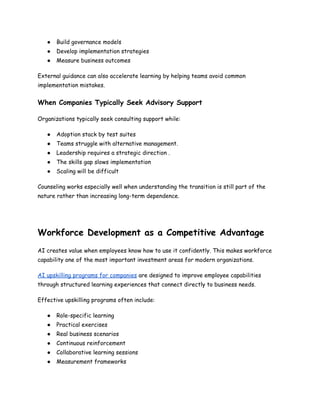
AI training for organizations focuses on building practical capabilities across teams
rather than teaching isolated technical skills. Effective school applications align learning
with business goals and employee desires.
Modern stock identification efforts generally focus on:
●​ practical utility
●​ Role-based totally finding the way
●​ Interdepartmental Collaboration
●​ Hands-On:
●​ Ethical and Responsible Use
●​ Building Long-Term Business
The goal is not to introduce AI tools at all. The goal is to build trust, improve productivity,
and enable employees to successfully use AI within existing workflows.
Benefits of Organization-Wide Learning Programs
Structured schooling provides benefits in several entrepreneurial characteristics.
The main benefits are:
●​ Rapid adoption of new technology
●​ Reduced implementation friction
●​ Better Decision Aids
●​ Increased employee confidence
●​ Improve Operational Performance
●​ Stronger collaboration in groups
Organizations that prioritize learning often reduce the space between experience and
execution.
The Growing Importance of Enterprise AI
Transformation
Technology initiatives frequently fail when organizations treat AI as a standalone project
rather than a company-wide capability shift.
Enterprise AI transformation involves redesigning workflows, processes, and
decision-making systems so AI becomes integrated into everyday operations.
Transformation efforts typically impact:
●​ Leadership strategies
●​ Operational workflows
●​ Customer experiences
●​ Team structures
●​ Learning systems
●​ Performance measurement
This process is rarely linear. Organizations often move through stages of experimentation,
validation, scaling, and optimization.
Core Components of Successful Transformation
Following transformation initiatives, organizations are regularly aware of several key areas.
Management Coordination
Managers and department heads need to understand why AI matters and how it supports
business goals.
Workforce Readiness
Employees need training, property and hygiene requirements.
Governance Framework
Policies help reduce risk and improve responsible consumption.
Workflow Integration
Teams want real structures instead of discrete tests.
Measurement System
Clear criteria help song adoption and business enterprise impact.
Organizations that connect these areas are more likely to build sustainable businesses.
Why External Expertise Matters
Many businesses lack internal resources to design large-scale AI initiatives. This creates
demand for outside expertise that combines technical understanding with business
strategy.
AI consulting for organizations provides structured support for implementation, planning,
governance, and capability building.
Consulting engagements often help businesses:
●​ Identify use cases
●​ Prioritize investments
●​ Create adoption roadmaps
●​ Build governance models
●​ Develop implementation strategies
●​ Measure business outcomes
External guidance can also accelerate learning by helping teams avoid common
implementation mistakes.
When Companies Typically Seek Advisory Support
Organizations typically seek consulting support while:
●​ Adoption stack by test suites
●​ Teams struggle with alternative management.
●​ Leadership requires a strategic direction .
●​ The skills gap slows implementation
●​ Scaling will be difficult
Counseling works especially well when understanding the transition is still part of the
nature rather than increasing long-term dependence.
Workforce Development as a Competitive Advantage
AI creates value when employees know how to use it confidently. This makes workforce
capability one of the most important investment areas for modern organizations.
AI upskilling programs for companies are designed to improve employee capabilities
through structured learning experiences that connect directly to business needs.
Effective upskilling programs often include:
●​ Role-specific learning
●​ Practical exercises
●​ Real business scenarios
●​ Continuous reinforcement
●​ Collaborative learning sessions
●​ Measurement frameworks
The strongest programs create repeatable learning systems rather than one-time
workshops.
Departments That Benefit From Upskilling
Different teams often require different approaches.
Leadership Teams
Focus areas include strategy, governance, and decision-making.
HR Teams
Priorities often include workforce planning and policy development.
Marketing Teams
Common needs involve automation, content workflows, and personalization.
Operations Teams
Teams typically focus on efficiency and workflow optimization.
Customer-Facing Roles
Learning often centers on communication, productivity, and service improvements.
Customized learning pathways usually create stronger outcomes than generic training.
Building an Organizational AI Roadmap
Successful organizations rarely adopt AI randomly. They create phased approaches that
balance experimentation with structure.
A practical roadmap may include:
Phase One: Assessment
●​ Evaluate skills gaps
●​ Identify use cases
●​ Understand readiness levels
Phase Two: Pilot Programs
●​ Test small initiatives
●​ Gather feedback
●​ Validate outcomes
Phase Three: Scale Adoption
●​ Expand successful workflows
●​ Train additional teams
●​ Build governance systems
Phase Four: Optimization
●​ Measure results
●​ Refine workflows
●​ Improve efficiency
This phased approach reduces risk while increasing organizational confidence.
Common Mistakes Organizations Should Avoid
Many organizations experience delays because of avoidable mistakes.
The constant problems are:
●​ Prioritize equipment over people
●​ Ignoring Task Force Preparedness
●​ Scale too fast
●​ Failure to Measure Outcomes
●​ AI is treated as an independent measure
●​ Underestimating Alternative Leadership
Recognizing those risks early builds more powerful management foundations.
Measuring Success and Demonstrating ROI
Executives often ask how AI investments should be measured. Adoption alone rarely
proves business value. Organizations need performance indicators that connect learning
and implementation efforts to measurable outcomes.
Useful metrics may include:
●​ Time saved on repetitive tasks
●​ Employee adoption rates
●​ Workflow efficiency improvements
●​ Customer satisfaction changes
●​ Productivity gains
●​ Reduction in operational costs
Tracking these indicators helps organizations understand where adoption succeeds and
where additional support may be required.
Qualitative Indicators Also Matter
Not every improvement appears immediately in dashboards. Organizations should also
monitor softer indicators.
Examples include:
●​ Employee confidence levels
●​ Cross-team collaboration improvements
●​ Increased experimentation
●​ Better knowledge sharing
●​ Reduced resistance to change
Combining quantitative and qualitative data creates a more accurate view of progress.
Creating a Culture That Supports AI Adoption
Technology initiatives often fail when culture remains unchanged. Employees may hesitate
to experiment if they fear mistakes or uncertainty.
Organizations that encourage learning cultures generally create stronger adoption
outcomes.
Important cultural practices include:
●​ Reward experimentation
●​ Encourage responsible usage
●​ Share success stories
●​ Promote collaboration
●​ Normalize continuous learning
Leaders play a major role in setting expectations and creating psychological safety around
new technologies.
The Role of Managers in AI Adoption
Managers frequently act as the bridge between strategy and execution.
Their responsibilities often include:
●​ Reinforcing training initiatives
●​ Identifying workflow opportunities
●​ Supporting team experimentation
●​ Monitoring adoption challenges
●​ Encouraging skill development
Organizations that equip managers with resources and guidance often experience
smoother transitions.
Responsible and Sustainable Implementation
As AI usage expands, organizations must balance innovation with responsibility.
Governance frameworks support consistency while reducing risk.
Responsible implementation usually includes:
●​ Data privacy guidelines
●​ Security protocols
●​ Usage policies
●​ Human oversight processes
●​ Ethical review systems
These practices help organizations scale AI usage more confidently.
Looking Beyond Short-Term Wins
For starters, many companies focus on short-term productivity gains. While early wins
build momentum, long-term fulfillment depends on incremental structures that evolve as
time changes.
Organizations that continually update efficiencies, workflows, and governance systems are
often more adaptable.
Long-term priorities typically include:
●​ Ongoing workforce education
●​ Process optimization
●​ Leadership development
●​ Continuous experimentation
●​ Capability expansion
AI adoption should be viewed as an evolving capability rather than a finished project.
Building Cross-Functional Collaboration
AI projects rarely belong to one department. Strong collaboration between technical
teams, business leaders, and frontline employees creates more realistic impact.
Collaboration between users helps:
●​ Faster sharing of expertise
●​ Excellent Use Case Discovery
●​ Reduced Duplication of Efforts
●​ More Consistent Management
●​ Improved implementation speed
When teams work together, companies often find opportunities that remote departments
miss. Shared use will also increase accountability and encourage broader use across
business tools. Building communities of coaching, internal champions, and peers can tighten
collaboration while supporting employee research from real-world research at the
employer. These structures regularly build powerful momentum and facilitate long-term
nonstop improvements after the initial planning efforts are complete.
Preparing for the Future of Work
The adoption of AI is changing how groups collaborate, learn, and solve problems. These
days, organizations that invest in the skills of their workforce are often better equipped
for a turn of events.
Companies that are prepared for the future typically prioritize:
●​ Continued Mastery of Culture
●​ Cross-Practice Collaboration
●​ Responsive AI Training
●​ Flexible Running Model
●​ Employee Empowerment
●​ These capabilities make it bigger over time and affect long-term competitiveness.
These capabilities extend beyond technology and influence long-term competitiveness.
Final Thoughts
Adopting AI isn’t always just about implementing equipment. Aligning time with people,
processes, and business priorities leads to sustainable fulfillment. Organizations that
invest in grounded learning, changing strategies, business operations, and building employee
efficiencies, flowing more efficiently from routine use to measurable impact Corporate
awareness, changing roadmaps, consulting support, or employee development, long-term
success is dependent on helping systems develop employees to use AI as expected. Many
organizations exploring these approaches look toward providers such as The GenAI
Academy to support practical implementation, enterprise learning, and future-focused
capability building.