An AI and NLP-driven platform that transforms unstructured safety reports into actionable risk intelligence, enabling early detection of Serious Injury and Fatality (SIF) precursors to enhance workplace safety.
S M AR T I N D I A H A C K AT H O N 2 0 2 6
AI-Powered SIF Precursor
Detection & Safety
Intelligence Platform
Turning unstructured safety narratives into explainable, actionable risk intelligence
PROBLEM STATEMENT ID SIH26165
PROBLEM STATEMENT SIF Precursor Detection
ORGANIZATION Oil India Limited
PS CATEGORY Software
THEME / DOMAIN AI, NLP & Industrial Safety
TEAM ID
[Team ID Placeholder]
TEAM NAME
[Team Name Placeholder]
Software · AI/NLP · Industrial Safety
Oil India Limited | Problem Statement SIH26165
2.
I D EA / P R O P O S E D S O LU T I O N
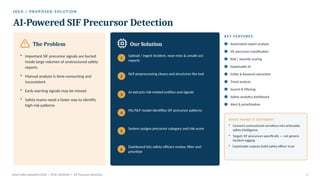
AI-Powered SIF Precursor Detection
The Problem
• Important SIF precursor signals are buried
inside large volumes of unstructured safety
reports
• Manual analysis is time-consuming and
inconsistent
• Early warning signals may be missed
• Safety teams need a faster way to identify
high-risk patterns
Our Solution
1
Upload / ingest incident, near-miss & unsafe-act
reports
2
NLP preprocessing cleans and structures the text
3
AI extracts risk-related entities and signals
4
ML/NLP model identifies SIF precursor patterns
5
System assigns precursor category and risk score
6
Dashboard lets safety officers review, filter and
prioritize
KEY FEATURES
Automated report analysis
SIF precursor classification
Risk / severity scoring
Explainable AI
Entity & keyword extraction
Trend analysis
Search & filtering
Safety analytics dashboard
Alert & prioritization
WHAT MAKES IT DIFFERENT
• Converts unstructured narratives into actionable
safety intelligence
• Targets SIF precursors specifically — not generic
incident tagging
• Explainable outputs build safety-officer trust
Smart India Hackathon 2026 | PS ID: SIH26165 | SIF Precursor Detection 2
3.
SYS T EM D E S I G N
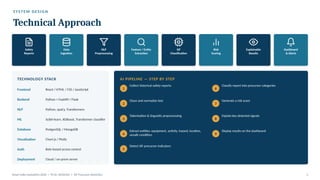
Technical Approach
Safety
Reports
→ Data
Ingestion
→ NLP
Preprocessing
→ Feature / Entity
Extraction
→ SIF
Classification
→ Risk
Scoring
→ Explainable
Results
→ Dashboard
& Alerts
TECHNOLOGY STACK
Frontend React / HTML / CSS / JavaScript
Backend Python + FastAPI / Flask
NLP Python, spaCy, Transformers
ML Scikit-learn, XGBoost, Transformer classifier
Database PostgreSQL / MongoDB
Visualization Chart.js / Plotly
Auth Role-based access control
Deployment Cloud / on-prem server
AI PIPELINE — STEP BY STEP
1
Collect historical safety reports
2
Clean and normalize text
3
Tokenization & linguistic preprocessing
4
Extract entities: equipment, activity, hazard, location,
unsafe condition
5
Detect SIF precursor indicators
6
Classify report into precursor categories
7
Generate a risk score
8
Explain key detected signals
9
Display results on the dashboard
Smart India Hackathon 2026 | PS ID: SIH26165 | SIF Precursor Detection 3
4.
G R OU N D E D A S S E S S M E N T
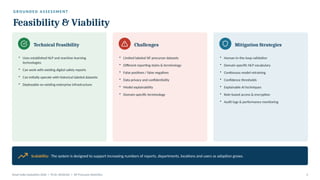
Feasibility & Viability
Technical Feasibility
• Uses established NLP and machine-learning
technologies
• Can work with existing digital safety reports
• Can initially operate with historical labeled datasets
• Deployable on existing enterprise infrastructure
Challenges
• Limited labeled SIF precursor datasets
• Different reporting styles & terminology
• False positives / false negatives
• Data privacy and confidentiality
• Model explainability
• Domain-specific terminology
Mitigation Strategies
• Human-in-the-loop validation
• Domain-specific NLP vocabulary
• Continuous model retraining
• Confidence thresholds
• Explainable AI techniques
• Role-based access & encryption
• Audit logs & performance monitoring
Scalability: The system is designed to support increasing numbers of reports, departments, locations and users as adoption grows.
Smart India Hackathon 2026 | PS ID: SIH26165 | SIF Precursor Detection 4
5.
VA LU ED E L I V E R E D
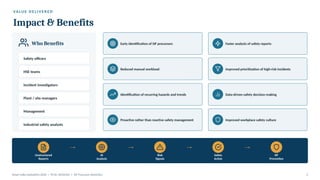
Impact & Benefits
Who Benefits
Safety officers
HSE teams
Incident investigators
Plant / site managers
Management
Industrial safety analysts
Early identification of SIF precursors Faster analysis of safety reports
Reduced manual workload Improved prioritization of high-risk incidents
Identification of recurring hazards and trends Data-driven safety decision making
Proactive rather than reactive safety management Improved workplace safety culture
Unstructured
Reports
→
AI
Analysis
→
Risk
Signals
→
Safety
Action
→
SIF
Prevention
Smart India Hackathon 2026 | PS ID: SIH26165 | SIF Precursor Detection 5
6.
G R OU N D E D I N C R E D I B L E S O U R C E S
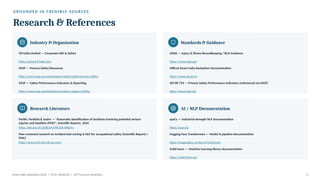
Research & References
Industry & Organization
Oil India Limited — Corporate HSE & Safety
https://www.oil-india.com
IOGP — Process Safety Resources
https://www.iogp.org/workstreams/safety/safety/process-safety/
IOGP — Safety Performance Indicators & Reporting
https://www.iogp.org/bookstore/product-category/safety/
Standards & Guidance
OSHA — Injury & Illness Recordkeeping / RCA Guidance
https://www.osha.gov
Official Smart India Hackathon Documentation
https://www.sih.gov.in
API RP 754 — Process Safety Performance Indicators (referenced via IOGP)
https://www.iogp.org
Research Literature
Parikh, Penfield & Juaire — "Automatic identification of incidents involving potential serious
injuries and fatalities (PSIF)", Scientific Reports, 2024
https://doi.org/10.1038/s41598-024-58824-y
Peer-reviewed research on incident-text mining & NLP for occupational safety (Scientific Reports /
PMC)
https://www.ncbi.nlm.nih.gov/pmc
AI / NLP Documentation
spaCy — Industrial-strength NLP documentation
https://spacy.io
Hugging Face Transformers — Model & pipeline documentation
https://huggingface.co/docs/transformers
Scikit-learn — Machine learning library documentation
https://scikit-learn.org
Smart India Hackathon 2026 | PS ID: SIH26165 | SIF Precursor Detection 6