AI-Driven SDLC and Zero-Touch IT Operations with MuleSoft Agent Fabric
Explore MuleSoft Agent Fabric for orchestrating AI agents, enabling zero-touch IT operations, governance, and secure integration within enterprise ecosystems using MuleSoft and Salesforce platforms.
● Technology Architectat Infosys
● MuleSoft Ambassador
● MuleSoft Meetup Leader
● MuleSoft Certified Integration Architect
● 14 years of Experience in Integration Domain
https://www.linkedin.com/in/vikas-sharma-50b391a5/
https://www.youtube.com/@YourIntegrationBuddy 2
Vikas Sharma
Speaker
Your Photo
3.
Speaker
Venkatesh is aMuleSoft mentor and working as a Lead
Consultant at Infosys. He has great experience in
Integration, development, execution and delivery using the
MuleSoft products and offerings. Venkatesh has completed
the following certifications –
• Integration Associate
• MCD Level 1 and 2
• MCPA and MCIA
• Hyperautomation Specialist
• Salesforce AI Associate
• Salesforce AI Specialist
✔ LinkedIn – https://www.linkedin.com/in/venkatesh-jujarao-6a4349106/
✔ Medium - https://medium.com/@vicksjujarao
4.
Agent Fabric Inside:Agents, Broker, and
Governance
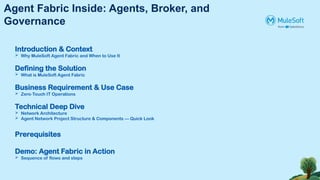
Introduction & Context
Why MuleSoft Agent Fabric and When to Use It
Defining the Solution
What is MuleSoft Agent Fabric
Business Requirement & Use Case
Zero Touch IT Operations
‑
Technical Deep Dive
Network Architecture
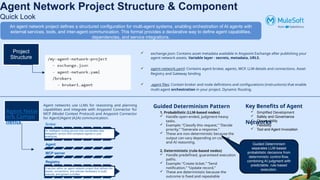
Agent Network Project Structure & Components — Quick Look
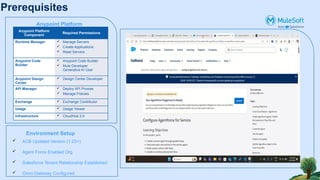
Prerequisites
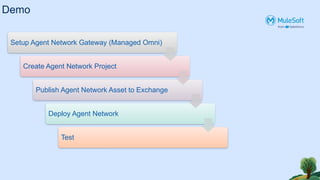
Demo: Agent Fabric in Action
Sequence of flows and steps
5.
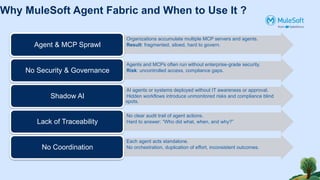
Why MuleSoft AgentFabric and When to Use It ?
Organizations accumulate multiple MCP servers and agents.
Result: fragmented, siloed, hard to govern.
Agent & MCP Sprawl
Agents and MCPs often run without enterprise grade security.
‑
Risk: uncontrolled access, compliance gaps.
No Security & Governance
AI agents or systems deployed without IT awareness or approval.
Hidden workflows introduce unmonitored risks and compliance blind
spots.
Shadow AI
No clear audit trail of agent actions.
Hard to answer: “Who did what, when, and why?”
Lack of Traceability
Each agent acts standalone.
No orchestration, duplication of effort, inconsistent outcomes.
No Coordination
6.
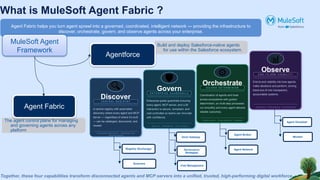
What is MuleSoftAgent Fabric ?
Agent Fabric helps you turn agent sprawl into a governed, coordinated, intelligent network — providing the infrastructure to
discover, orchestrate, govern, and observe agents across your enterprise.
🔍
Discover
C E N T R A L R E G I S T R Y
A central registry with automated
discovery where every agent and MCP
server — regardless of where it's built
— can be cataloged, discovered, and
reused.
Eliminates duplication · Compose from
existing assets
️
🛡️
Govern
E N T E R P R I S E G U A R D R A I L S
Enterprise-grade guardrails ensuring
every agent, MCP server, and LLM
interaction is secure, compliant, and
cost-controlled so teams can innovate
with confidence.
Security · Compliance · Cost Control
⚙️
Orchestrate
G U I D E D D E T E R M I N I S M
Coordination of agents and tools
across ecosystems with guided
determinism, so multi-step processes
run smoothly and every agent delivers
reliable outcomes.
Multi-vendor · Cross-platform · Reliable
📊
Observe
E N D - T O - E N D V I S I B I L I T Y
End-to-end visibility into how agents
make decisions and perform, turning
black-box AI into transparent,
accountable systems.
Decisions · Performance · Accountability
Together, these four capabilities transform disconnected agents and MCP servers into a unified, trusted, high-performing digital workforce.
Build and deploy Salesforce-native agents
for use within the Salesforce ecosystem.
Agentforce
The agent control plane for managing
and governing agents across any
platform
Agent Fabric
MuleSoft Agent
Framework
Registry (Exchange)
Scanners
Agent Broker
Agent Network
Agent Visualizer
Monitor
Omni Gateway
Governance
Strategies
Cost Management
7.
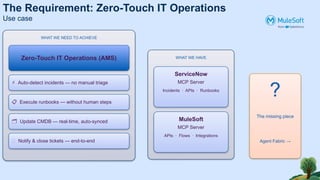
The Requirement: Zero-TouchIT Operations
Use case
WHAT WE NEED TO ACHIEVE
Zero-Touch IT Operations (AMS)
⚡ Auto-detect incidents — no manual triage
📋 Execute runbooks — without human steps
️
🗂️ Update CMDB — real-time, auto-synced
🔔 Notify & close tickets — end-to-end
WHAT WE HAVE
ServiceNow
MCP Server
Incidents · APIs · Runbooks
MuleSoft
MCP Server
APIs · Flows · Integrations
?
The missing piece
Agent Fabric →
8.
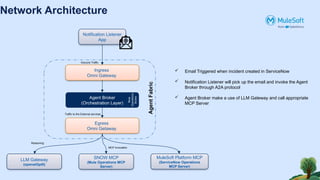
Network Architecture
Notification Listener
App
Ingress
OmniGateway
Egress
Omni Getaway
Agent Broker
(Orchestration Layer)
LLM Gateway
(openaiGpt5)
SNOW MCP
(Mule Operations MCP
Server)
MuleSoft Platform MCP
(ServiceNow Operations
MCP Server)
Traffic to the External services
Reasoning
MCP Invocation
Inbound Traffic
Agent
Fabric
Email Triggered when incident created in ServiceNow
Notification Listener will pick up the email and invoke the Agent
Broker through A2A protocol
Agent Broker make a use of LLM Gateway and call appropriate
MCP Server
Mule
Operations
Broker
9.
Agent Network ProjectStructure & Component
Quick Look
An agent network project defines a structured configuration for multi-agent systems, enabling orchestration of AI agents with
external services, tools, and inter-agent communication. This format provides a declarative way to define agent capabilities,
dependencies, and service integrations.
Project
Structure
exchange.json: Contains asset metadata available in Anypoint Exchange after publishing your
agent network assets. Variable layer - secrets, metadata, URLS.
agent-network.yaml: Contains agent broker, agents, MCP, LLM details and connections. Asset
Registry and Gateway binding
.agent files: Contain broker and node definitions and configurations (instructions) that enable
multi-agent orchestration in your project. Dynamic Routing.
Agent Netw
ork Compo
nents
Agent networks use LLMs for reasoning and planning
capabilities and integrate with Anypoint Connector for
MCP (Model Context Protocol) and Anypoint Connector
for Agent2Agent (A2A) communication.
Broker
An intelligent routing service that coordinates task
delegation across A2A-compliant agents in your
enterprise.
Agent
MCP server
Registry
A section within an agent network project that defines the
assets, connections, and policies necessary to build,
execute, and govern a broker
Key Benefits of Agent
Networks
Simplified Development
Safety and Governance
Observability
Flexibility
Tool and Agent Invocation
Guided Determinism Pattern
1. Probabilistic (LLM‑based nodes)
Handle open‑ended, judgment‑heavy
tasks.
Example: “Classify this request,” “Decide
priority,” “Generate a response.”
These are non‑deterministic because the
output can vary depending on context
and AI reasoning.
2. Deterministic (rule‑based nodes)
Handle predefined, guaranteed execution
paths.
Example: “Create ticket,” “Send
notification,” “Update record.”
These are deterministic because the
outcome is fixed and repeatable
Guided Determinism
separates LLM based
‑
probabilistic decisions from
deterministic control flow,
‑
combining AI judgment with
predictable, rule based
‑
execution.
10.
Prerequisites
Anypoint Platform
Component
Required Permissions
RuntimeManager Manage Servers
Create Applications
Read Servers
Anypoint Code
Builder
Anypoint Code Builder
Mule Developer
Generative AI User
Anypoint Design
Center
Design Center Developer
API Manager Deploy API Proxies
Manage Policies
Exchange Exchange Contributor
Usage Usage Viewer
Infrastructure CloudHub 2.0
Anypoint Platform
Environment Setup
ACB Updated Version (1.23+)
Agent Force Enabled Org
Salesforce Tenant Relationship Established
Omni Gateway Configured
11.
Demo
Setup Agent NetworkGateway (Managed Omni)
Create Agent Network Project
Publish Agent Network Asset to Exchange
Deploy Agent Network
Test