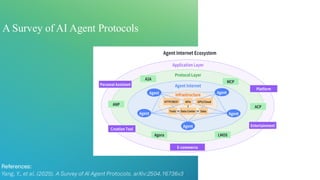
A Survey ofAI Agent Protocols
References:
Yang, Y., et al. (2025). A Survey of AI Agent Protocols. arXiv:2504.16736v3.
2.
Slide 1: ATechnical Deep Dive into AI Agent Protocols
Subtitle: Moving from Isolated Chatbots to the "Internet of Agents”
Presenter: Harshavardhan Gadila
Source Material: arXiv:2504.16736v3
3.
Slide 2: TheCurrent Landscape
The Boom: Widespread deployment of LLM agents in customer service,
content generation, and data analysis.
•The Crisis: We are facing a "Tower of Babel" moment. There is no standard
way for agents to communicate with external tools or each other.
•The Consequence: Agents function like isolated computer networks of the
1970s - powerful individually, but disconnected.
4.
Slide 3: TheNeed for Standardization
Interoperability Bottleneck: Lack of protocols limits scaling and the ability
to tackle complex, real-world tasks.
Fragmentation: LLM providers use proprietary tool formats; data providers
use custom APIs.
Development Cost: Developers must build bespoke integrations for every
new tool or agent interaction
5.
Slide 4: TheVision: Collective Intelligence
The "Internet of Agents": A unified protocol would trigger the formation of
collective intelligence
Dynamic Coalitions: Specialized agents (e.g., Medical, Radiology, Pharma)
forming temporary teams to solve problems
The TCP/IP Analogy: Just as HTTP/TCP revolutionized the internet, Agent
Protocols will revolutionize AI connectivity
6.
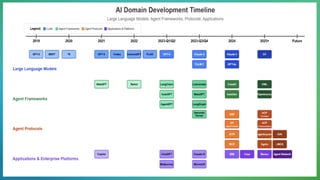
Slide 5: TheEvolution of the Stack
Timeline:
2023: Rise of Agent Frameworks (LangChain, AutoGPT)
2024: Introduction of MCP (Model Context Protocol)
2025+: Emergence of Inter-Agent Protocols (A2A, ANP, Agora) and the
Agent Internet
Trend: Moving from "Model-Centric" to "Protocol-Centric" architectures.
7.
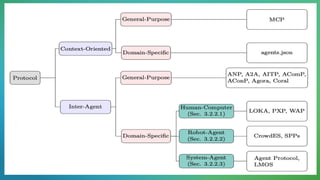
Slide 6: ANew Taxonomy for Agent Protocols
The Framework: A two-dimensional classification system
Dimension 1 (Object Orientation):
Context-Oriented: Agent-to-Resource (Tools/Data)
Inter-Agent: Agent-to-Agent (Collaboration)
Dimension 2 (Application Scenario):
General-Purpose vs. Domain-Specific
9.
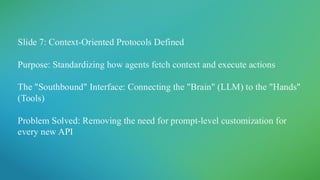
Slide 7: Context-OrientedProtocols Defined
Purpose: Standardizing how agents fetch context and execute actions
The "Southbound" Interface: Connecting the "Brain" (LLM) to the "Hands"
(Tools)
Problem Solved: Removing the need for prompt-level customization for
every new API
10.
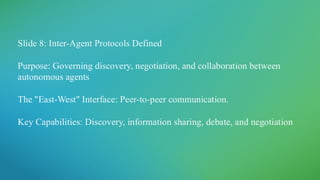
Slide 8: Inter-AgentProtocols Defined
Purpose: Governing discovery, negotiation, and collaboration between
autonomous agents
The "East-West" Interface: Peer-to-peer communication.
Key Capabilities: Discovery, information sharing, debate, and negotiation
11.
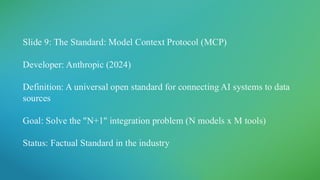
Slide 9: TheStandard: Model Context Protocol (MCP)
Developer: Anthropic (2024)
Definition: A universal open standard for connecting AI systems to data
sources
Goal: Solve the "N+1" integration problem (N models x M tools)
Status: Factual Standard in the industry
12.
Slide 10: MCPArchitecture
Host: The LLM application (the initiator)
Client: Manages the 1:1 connection with servers
Server: Provides context and tools (the resource wrapper)
Resource: The actual data or API
13.
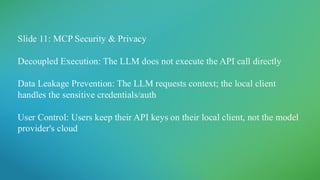
Slide 11: MCPSecurity & Privacy
Decoupled Execution: The LLM does not execute the API call directly
Data Leakage Prevention: The LLM requests context; the local client
handles the sensitive credentials/auth
User Control: Users keep their API keys on their local client, not the model
provider's cloud
14.
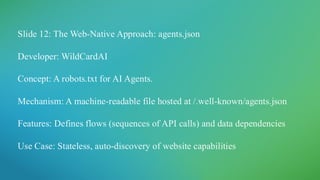
Slide 12: TheWeb-Native Approach: agents.json
Developer: WildCardAI
Concept: A robots.txt for AI Agents.
Mechanism: A machine-readable file hosted at /.well-known/agents.json
Features: Defines flows (sequences of API calls) and data dependencies
Use Case: Stateless, auto-discovery of website capabilities
15.
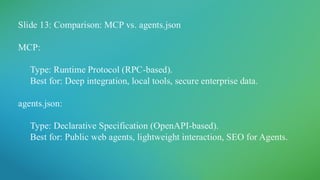
Slide 13: Comparison:MCP vs. agents.json
MCP:
Type: Runtime Protocol (RPC-based).
Best for: Deep integration, local tools, secure enterprise data.
agents.json:
Type: Declarative Specification (OpenAPI-based).
Best for: Public web agents, lightweight interaction, SEO for Agents.
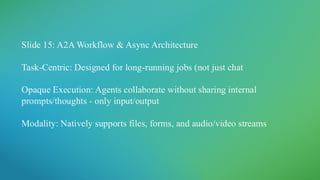
Slide 15: A2AWorkflow & Async Architecture
Task-Centric: Designed for long-running jobs (not just chat
Opaque Execution: Agents collaborate without sharing internal
prompts/thoughts - only input/output
Modality: Natively supports files, forms, and audio/video streams
18.
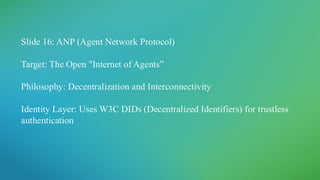
Slide 16: ANP(Agent Network Protocol)
Target: The Open "Internet of Agents”
Philosophy: Decentralization and Interconnectivity
Identity Layer: Uses W3C DIDs (Decentralized Identifiers) for trustless
authentication
19.
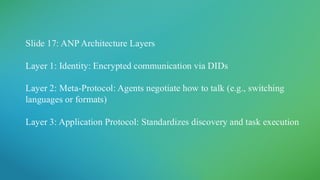
Slide 17: ANPArchitecture Layers
Layer 1: Identity: Encrypted communication via DIDs
Layer 2: Meta-Protocol: Agents negotiate how to talk (e.g., switching
languages or formats)
Layer 3: Application Protocol: Standardizes discovery and task execution
20.
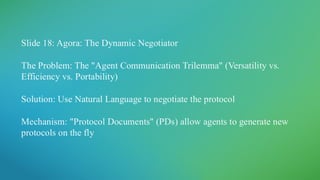
Slide 18: Agora:The Dynamic Negotiator
The Problem: The "Agent Communication Trilemma" (Versatility vs.
Efficiency vs. Portability)
Solution: Use Natural Language to negotiate the protocol
Mechanism: "Protocol Documents" (PDs) allow agents to generate new
protocols on the fly
21.
Slide 19: Agora'sAdaptive Mechanism
Infrequent Peers: Use Natural Language (High versatility, high cost)
Frequent Peers: Negotiate a switch to structured binary/JSON (High
efficiency, low cost)
Benefit: Solves the rigidness of static APIs.
22.
Slide 20: OtherNotable Inter-Agent Specs
AITP (NEAR): Focuses on "Trust Boundaries" and blockchain-based value
exchange
Coral Protocol: A decentralized infrastructure with a "Coral Server"
coordination layer
AConP (Cisco): Standardizes the interface to invoke and configure agents
23.
Slide 21: Human-AgentInteraction (PXP)
Protocol: Predict and Explain Protocol (PXP)
Domain: High-stakes (Radiology, Drug Synthesis).
Mechanism: Agents must explain predictions; Humans use tags: RATIFY,
REFUTE, REVISE, REJECT
Goal: Intelligibility and alignment, not just speed.
24.
Slide 22: Robot-AgentInteraction (CrowdES)
Challenge: Physical constraints and spatial reasoning
Protocol: CrowdES
Mechanism: Simulates realistic crowd dynamics to help robots navigate
populated environments
SPPs: Spatial Population Protocols for decentralized geometric consensus
in swarms
25.
Slide 23: System-AgentInteraction (LMOS)
Protocol: Language Model Operating System (LMOS)
Developer: Eclipse Foundation
Layers:
Application (JSON-LD)
Transport (MQTT/HTTP)
Identity (DIDs)
26.
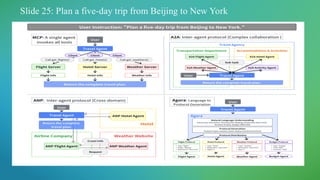
Slide 24: The"Travel to New York" Scenario
User Instruction: "Plan a five-day trip from Beijing to New York
Comparison: We analyze how MCP, A2A, ANP, and Agora handle this same
request.
Slide 26:
MCP vs.A2A Implementation
MCP (Centralized): One "Travel Agent" calls Flight, Hotel, and Weather
servers sequentially.
A2A (Federated): Travel Agent delegates to "Transport Dept" and "Lodging
Dept" agents.
ANP vs. Agora Implementation
ANP (Open Market): Agent performs discovery to find a 3rd party Hotel
Agent and negotiates via DID trust
Agora (Translator): Agent parses natural language, generates a "Flight
Protocol" and "Budget Protocol," and routes them
29.
Slide 27: EvaluatingEfficiency
Metric: TPS-N (Throughput per Second at Concurrency N)
Metric: Token Consumption. Protocols introduce "header" overhead;
efficient protocols minimize this "chatter”
Challenge: Semantic processing makes agent protocols slower than raw
TCP/HTTP
30.
Slide 28: Scalability& Reliability
Node Scalability: Performance degradation as no. of agents increases
Link Scalability: Handling the geometric explosion of connections in a
mesh
Reliability: Mechanisms like ARC (Automatic Retry Count) and UDR
(Unexpected Disconnection Rate)
31.
Slide 29: SecurityMetrics
Authentication Diversity: Support for OAuth, DIDs, API Keys
Context Desensitization: Critical Metric. Can the protocol mask PII before
sharing context with another agent?
ACL Granularity: Field-level vs. Task-level permissions
33.
Slide 30: TheFuture: Agent Mesh & Evolvable Protocols
Agent Mesh: Moving from pair-wise communication to group-based
"Mesh" networking (like a chat group for agents)
Evolvable Protocols: Agents that don't follow static rules but "learn" or
"download" protocol modules at runtime
Conclusion: We are building the infrastructure for the next decade of
Collective Intelligence
 Most read
 Most read