AI Agent Memory: The Evolution
of Digital Intelligence
How short-term and long-term memory architectures are transforming AI
agents from stateless responders into intelligent, context-aware companions
— capable of learning, adapting, and growing over time.
The Stateless Limit
Large Language Models are, at their core, naturally stateless — every new
request arrives without any memory of what came before, as if the
conversation never happened. This architectural reality creates a fundamental
problem for AI agents operating across extended interactions.
The Amnesia Problem
Without persistent memory, agents repeat the same mistakes, lose track
of ongoing goals, and fail to build on prior context — leading to
frustrating and inconsistent user experiences.
The Lost-in-the-Middle Problem
Even within a single session, context window constraints mean that crucial
information buried in the middle of a long interaction is effectively invisible
to the model, making sustained, complex tasks nearly impossible.
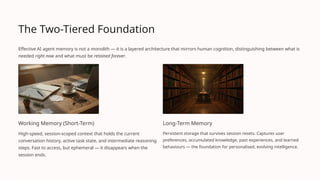
The Two-Tiered Foundation
Effective AI agent memory is not a monolith — it is a layered architecture that mirrors human cognition, distinguishing between what is
needed right now and what must be retained forever.
Working Memory (Short-Term)
High-speed, session-scoped context that holds the current
conversation history, active task state, and intermediate reasoning
steps. Fast to access, but ephemeral — it disappears when the
session ends.
Long-Term Memory
Persistent storage that survives session resets. Captures user
preferences, accumulated knowledge, past experiences, and learned
behaviours — the foundation for personalised, evolving intelligence.
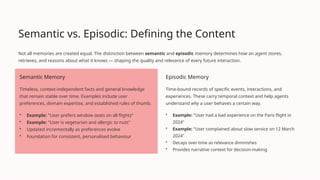
Semantic vs. Episodic: Defining the Content
Not all memories are created equal. The distinction between semantic and episodic memory determines how an agent stores,
retrieves, and reasons about what it knows — shaping the quality and relevance of every future interaction.
Semantic Memory
Timeless, context-independent facts and general knowledge
that remain stable over time. Examples include user
preferences, domain expertise, and established rules of thumb.
• Example: "User prefers window seats on all flights"
• Example: "User is vegetarian and allergic to nuts"
• Updated incrementally as preferences evolve
• Foundation for consistent, personalised behaviour
Episodic Memory
Time-bound records of specific events, interactions, and
experiences. These carry temporal context and help agents
understand why a user behaves a certain way.
• Example: "User had a bad experience on the Paris flight in
2024"
• Example: "User complained about slow service on 12 March
2024"
• Decays over time as relevance diminishes
• Provides narrative context for decision-making
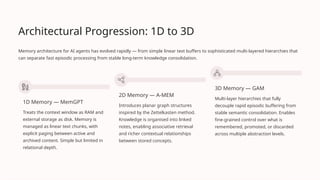
Architectural Progression: 1D to 3D
Memory architecture for AI agents has evolved rapidly — from simple linear text buffers to sophisticated multi-layered hierarchies that
can separate fast episodic processing from stable long-term knowledge consolidation.
1D Memory — MemGPT
Treats the context window as RAM and
external storage as disk. Memory is
managed as linear text chunks, with
explicit paging between active and
archived content. Simple but limited in
relational depth.
2D Memory — A-MEM
Introduces planar graph structures
inspired by the Zettelkasten method.
Knowledge is organised into linked
notes, enabling associative retrieval
and richer contextual relationships
between stored concepts.
3D Memory — GAM
Multi-layer hierarchies that fully
decouple rapid episodic buffering from
stable semantic consolidation. Enables
fine-grained control over what is
remembered, promoted, or discarded
across multiple abstraction levels.
Tools of the Trade
Building production-grade agent memory requires a robust ecosystem of frameworks,
databases, and protocols working in concert.
LangChain & CrewAI
Frameworks that provide ready-made
abstractions for integrating memory
modules into agent pipelines, supporting
both in-session and persistent memory
management with minimal boilerplate.
Vector Databases
Tools like Pinecone, Weaviate, and Redis
enable semantic search across massive
memory stores — retrieving the most
contextually relevant memories rather
than relying on exact keyword matches.
MCP — Model Context Protocol
A standardised interface that allows agents to connect with diverse external
memory servers seamlessly, reducing integration complexity and enabling
modular, interoperable memory architectures.
The Art of Intelligent Extraction
Storing everything is not memory — it is noise. Truly intelligent agents must exercise active judgement about what is worth remembering,
how to represent it precisely, and how to prioritise it against competing information.
Score
Ground
Extract
Grounding is especially critical: replacing vague pronouns with "User" and converting relative time expressions like "yesterday" into absolute dates ensures that
retrieved memories remain accurate and actionable long after the original session has ended. Importance scoring then filters signal from noise.
The Challenge of Forgetting
Counterintuitively, the hardest problem in AI memory is not what to remember — it is what to let go. Unbounded retention leads to stale,
contradictory knowledge that actively degrades agent performance.
Selective Forgetting
Episodic memories are given controlled lifespans — for instance,
resetting after 90 days — ensuring that transient events do not
permanently colour an agent's understanding of a user's current
needs and preferences.
• Time-based expiry for episodic records
• Relevance scoring triggers early pruning
• Archived rather than deleted for auditability
Managing Semantic Drift
Long-term knowledge graphs are vulnerable to gradual corruption
— small inconsistencies accumulate into contradictions. Active
drift management uses consistency checks, version control, and
conflict resolution to keep semantic memory coherent.
• Periodic graph consistency audits
• Versioned updates with rollback capability
• Contradiction detection before write commits
Toward Multimodal Intelligence
The next frontier of agent memory moves decisively beyond text. By incorporating visual keyframes, audio spectral embeddings, and
cross-modal linkages, agents can build a far richer and more faithful model of the world they inhabit.
Visual Memory
Storing keyframes from video interactions
allows agents to remember what was shown,
not just what was said. A whiteboard
diagram captured mid-session becomes a
retrievable, queryable memory asset.
Audio Embeddings
Spectral embeddings of voice interactions
capture tone, urgency, and identity —
enabling retrieval based on emotional
context or speaker recognition, far beyond
simple transcription.
Cross-Modal Linking
The most powerful capability: directly
connecting a visual artefact to the spoken
discussion around it, enabling multimodal
queries — finding memories based on faces,
objects, sounds, or any combination thereof.
The Future: Memory as Identity
Memory is the bridge between a tool and a companion. When an agent can remember your history, understand your preferences, and
build on every past interaction, it ceases to be a utility and becomes a trusted, evolving partner.
From Data Retention to
Knowledge Management
The shift is philosophical as much as
technical — moving from passive
storage toward structured, curated,
and purposeful knowledge that actively
shapes agent behaviour over time.
Consistency & Personalisation at
Scale
Memory enables agents to maintain a
coherent identity across millions of
users and billions of interactions —
every conversation building on the last,
never starting from zero.
The Call to Action
Build systems that learn, evolve, and
grow alongside their users. Close the
gap between artificial intelligence and
true intelligence — one remembered
interaction at a time.