Agile Gurugram & Delhi National Capital Region 2026 _ The AI Shift_ Skill Gaps & the Changing Workplace by Rahul Jain
1.
Internal
FUTURE OF AIIN WORKPLACE · KEYNOTE
The AI Shift
Skill Gaps & the Changing Workplace
What it means for the next generation walking into the workforce
Rahul Jain
Chief Strategy Officer, PNB Housing Finance Ltd.
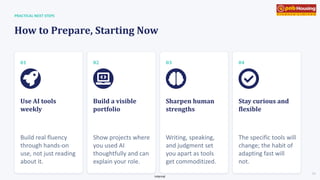
2.
Internal
WHERE WE STANDTODAY
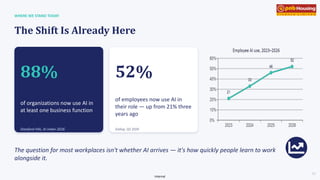
The Shift Is Already Here
88%
of organizations now use AI in
at least one business function
Stanford HAI, AI Index 2026
52%
of employees now use AI in
their role — up from 21% three
years ago
Gallup, Q2 2026
The question for most workplaces isn't whether AI arrives — it's how quickly people learn to work
alongside it.
02
3.
Internal
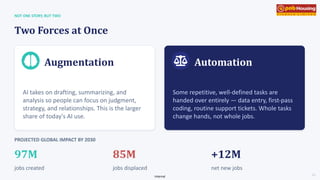
Augmentation
AI takes ondrafting, summarizing, and
analysis so people can focus on judgment,
strategy, and relationships. This is the larger
share of today's AI use.
Automation
Some repetitive, well-defined tasks are
handed over entirely — data entry, first-pass
coding, routine support tickets. Whole tasks
change hands, not whole jobs.
NOT ONE STORY, BUT TWO
Two Forces at Once
PROJECTED GLOBAL IMPACT BY 2030
97M
jobs created
85M
jobs displaced
+12M
net new jobs
03
4.
Internal
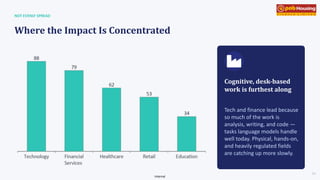
NOT EVENLY SPREAD
Wherethe Impact Is Concentrated
Cognitive, desk-based
work is furthest along
Tech and finance lead because
so much of the work is
analysis, writing, and code —
tasks language models handle
well today. Physical, hands-on,
and heavily regulated fields
are catching up more slowly.
04
5.
Internal
THE PART THATMATTERS MOST TO YOU
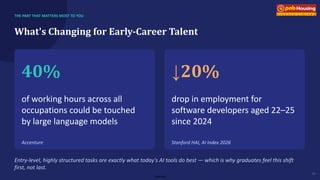
What's Changing for Early-Career Talent
40%
of working hours across all
occupations could be touched
by large language models
Accenture
↓20%
drop in employment for
software developers aged 22–25
since 2024
Stanford HAI, AI Index 2026
Entry-level, highly structured tasks are exactly what today's AI tools do best — which is why graduates feel this shift
first, not last.
05
6.
Internal
THE OTHER SIDEOF THE LEDGER
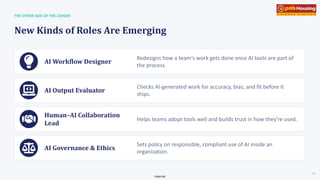
New Kinds of Roles Are Emerging
AI Workflow Designer
Redesigns how a team's work gets done once AI tools are part of
the process.
AI Output Evaluator
Checks AI-generated work for accuracy, bias, and fit before it
ships.
Human–AI Collaboration
Lead
Helps teams adopt tools well and builds trust in how they're used.
AI Governance & Ethics
Sets policy on responsible, compliant use of AI inside an
organization.
06
7.
Internal
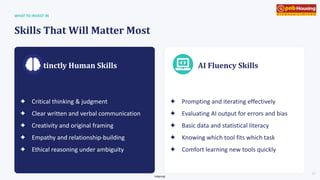
Distinctly Human Skills
✦Critical thinking & judgment
✦ Clear written and verbal communication
✦ Creativity and original framing
✦ Empathy and relationship-building
✦ Ethical reasoning under ambiguity
AI Fluency Skills
✦ Prompting and iterating effectively
✦ Evaluating AI output for errors and bias
✦ Basic data and statistical literacy
✦ Knowing which tool fits which task
✦ Comfort learning new tools quickly
WHAT TO INVEST IN
Skills That Will Matter Most
07
8.
Internal
BEHIND THE HIRINGDECISIONS
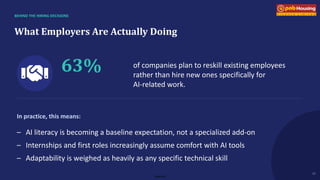
What Employers Are Actually Doing
63% of companies plan to reskill existing employees
rather than hire new ones specifically for
AI-related work.
In practice, this means:
– AI literacy is becoming a baseline expectation, not a specialized add-on
– Internships and first roles increasingly assume comfort with AI tools
– Adaptability is weighed as heavily as any specific technical skill
08
9.
Internal
Use AI tools
weekly
Buildreal fluency
through hands-on
use, not just reading
about it.
Build a visible
portfolio
Show projects where
you used AI
thoughtfully and can
explain your role.
Sharpen human
strengths
Writing, speaking,
and judgment set
you apart as tools
get commoditized.
Stay curious and
flexible
The specific tools will
change; the habit of
adapting fast will
not.
PRACTICAL NEXT STEPS
How to Prepare, Starting Now
01 02 03 04
09
10.
Internal
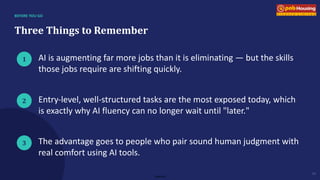
BEFORE YOU GO
ThreeThings to Remember
1
2
3
AI is augmenting far more jobs than it is eliminating — but the skills
those jobs require are shifting quickly.
Entry-level, well-structured tasks are the most exposed today, which
is exactly why AI fluency can no longer wait until "later."
The advantage goes to people who pair sound human judgment with
real comfort using AI tools.
10