Advancing
Environmental
Peacebuilding:
Pathways for
Progress
OLIVIER SERRAT
2026
“Cooperation does not arise from declarations
or negotiations. It grows from joint engagement
with shared environmental concerns and from
the slow, patient rebuilding of ties across
divides.”
― OLIVIER SERRAT
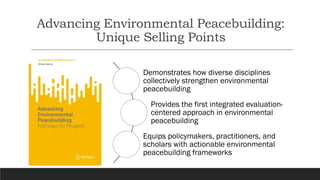
Advancing Environmental Peacebuilding:
Unique Selling Points
Demonstrates how diverse disciplines
collectively strengthen environmental
peacebuilding
Provides the first integrated evaluation-
centered approach in environmental
peacebuilding
Equips policymakers, practitioners, and
scholars with actionable environmental
peacebuilding frameworks
Environmental Peacebuilding: Why It
Matters
• Shared ecosystems generate inherent incentives for
cooperation.
• Environmental degradation often reflects social fragmentation—
and can intensify it.
• Joint environmental action can rebuild trust, ease tensions, and
strengthen long-term stability.
• The field is emerging at the nexus of climate change, natural
resource governance, and peacebuilding.
Environmental peacebuilding connects ecological
stewardship with the transformation of conflict.
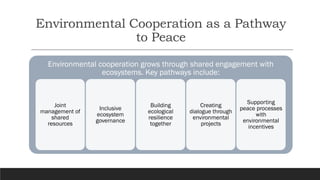
Environmental Cooperation as a Pathway
to Peace
Environmental cooperation grows through shared engagement with
ecosystems. Key pathways include:
Joint
management of
shared
resources
Inclusive
ecosystem
governance
Building
ecological
resilience
together
Creating
dialogue through
environmental
projects
Supporting
peace processes
with
environmental
incentives
Advancing Environmental Peacebuilding:
Preface (1)
“Throughout history, communities have developed practices that linked
environmental stewardship with social stability … [T]hey reflected a long-
standing recognition of the interdependence between ecological
conditions and social order.” (Cont'd)
Advancing Environmental Peacebuilding:
Preface (2)
“[This SpringerBrief] argues that without evaluative frameworks capable
of addressing complexity, uncertainty, and the hybrid nature of socio-
ecological systems, [environmental peacebuilding] risks falling short of its
potential as a pathway to peace … By clarifying the field’s foundations
while pointing toward new evaluative and conceptual pathways, this Brief
seeks to contribute to a field that is still taking shape—one whose promise
depends on both analytical rigor and sustained imagination.” (Olivier
Serrat, Georgetown University, Washington, DC, USA)
Advancing Environmental Peacebuilding:
Letter to the Reader (1)
“I did not set out to write this [Brief] with a specific theory in mind. It
developed from a realization that had become clearer over time: the
environment is not merely a backdrop to human conflict but frequently
the first to absorb the consequences of our divisions and the extractive
practices that both shape and result from them, with repercussions
that return in ways we rarely anticipate.” (Cont’d)
Advancing Environmental Peacebuilding:
Letter to the Reader (2)
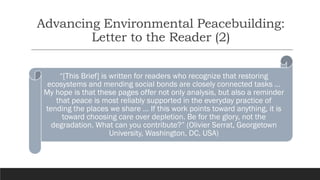
“[This Brief] is written for readers who recognize that restoring
ecosystems and mending social bonds are closely connected tasks …
My hope is that these pages offer not only analysis, but also a reminder
that peace is most reliably supported in the everyday practice of
tending the places we share … If this work points toward anything, it is
toward choosing care over depletion. Be for the glory, not the
degradation. What can you contribute?” (Olivier Serrat, Georgetown
University, Washington, DC, USA)
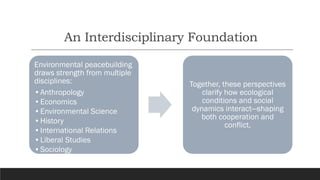
An Interdisciplinary Foundation
Environmental peacebuilding
draws strength from multiple
disciplines:
•Anthropology
•Economics
•Environmental Science
•History
•International Relations
•Liberal Studies
•Sociology
Together, these perspectives
clarify how ecological
conditions and social
dynamics interact—shaping
both cooperation and
conflict.
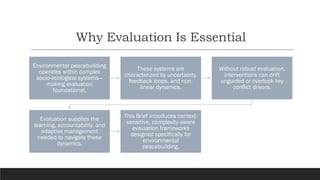
Why Evaluation Is Essential
Environmental peacebuilding
operates within complex
socio-ecological systems—
making evaluation
foundational.
These systems are
characterized by uncertainty,
feedback loops, and non-
linear dynamics.
Without robust evaluation,
interventions can drift
unguided or overlook key
conflict drivers.
Evaluation supplies the
learning, accountability, and
adaptive management
needed to navigate these
dynamics.
This Brief introduces context-
sensitive, complexity-aware
evaluation frameworks
designed specifically for
environmental
peacebuilding.
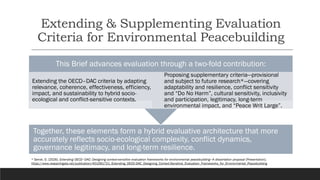
Extending & Supplementing Evaluation
Criteria for Environmental Peacebuilding
Together, these elements form a hybrid evaluative architecture that more
accurately reflects socio-ecological complexity, conflict dynamics,
governance legitimacy, and long-term resilience.
This Brief advances evaluation through a two-fold contribution:
Extending the OECD–DAC criteria by adapting
relevance, coherence, effectiveness, efficiency,
impact, and sustainability to hybrid socio-
ecological and conflict-sensitive contexts.
Proposing supplementary criteria—provisional
and subject to future research*—covering
adaptability and resilience, conflict sensitivity
and “Do No Harm”, cultural sensitivity, inclusivity
and participation, legitimacy, long-term
environmental impact, and “Peace Writ Large”.
* Serrat, O. (2026). Extending OECD–DAC: Designing context-sensitive evaluation frameworks for environmental peacebuilding—A dissertation proposal [Presentation].
https://www.researchgate.net/publication/401091721_Extending_OECD-DAC_Designing_Context-Sensitive_Evaluation_Frameworks_for_Environmental_Peacebuilding
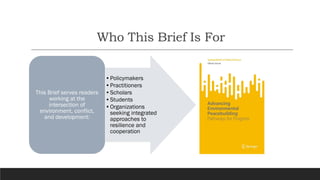
Who This Brief Is For
•Policymakers
•Practitioners
•Scholars
•Students
•Organizations
seeking integrated
approaches to
resilience and
cooperation
This Brief serves readers
working at the
intersection of
environment, conflict,
and development:
Advancing Environmental Peacebuilding:
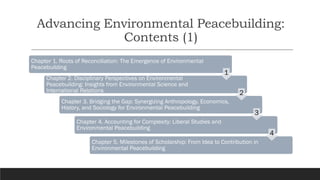
Contents (1)
Chapter 1. Roots of Reconciliation: The Emergence of Environmental
Peacebuilding
Chapter 2. Disciplinary Perspectives on Environmental
Peacebuilding: Insights from Environmental Science and
International Relations
Chapter 3. Bridging the Gap: Synergizing Anthropology, Economics,
History, and Sociology for Environmental Peacebuilding
Chapter 4. Accounting for Complexity: Liberal Studies and
Environmental Peacebuilding
Chapter 5. Milestones of Scholarship: From Idea to Contribution in
Environmental Peacebuilding
1
2
3
4
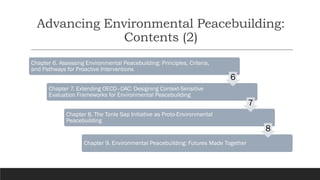
Advancing Environmental Peacebuilding:
Contents (2)
Chapter 6. Assessing Environmental Peacebuilding: Principles, Criteria,
and Pathways for Proactive Interventions
Chapter 7. Extending OECD–DAC: Designing Context-Sensitive
Evaluation Frameworks for Environmental Peacebuilding
Chapter 8. The Tonle Sap Initiative as Proto-Environmental
Peacebuilding
Chapter 9. Environmental Peacebuilding: Futures Made Together
6
7
8
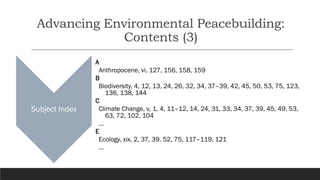
Advancing Environmental Peacebuilding:
Contents (3)
Subject Index
A
Anthropocene, vi, 127, 156, 158, 159
B
Biodiversity, 4, 12, 13, 24, 26, 32, 34, 37–39, 42, 45, 50, 53, 75, 123,
136, 138, 144
C
Climate Change, v, 1, 4, 11–12, 14, 24, 31, 33, 34, 37, 39, 45, 49, 53,
63, 72, 102, 104
…
E
Ecology, xix, 2, 37, 39, 52, 75, 117–119, 121
…
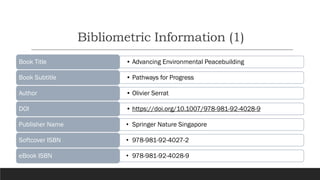
Bibliometric Information (1)
https://doi.org/10.1007/978-981-92-4028-9
• Advancing Environmental Peacebuilding
Book Title
• Pathways for Progress
Book Subtitle
• Olivier Serrat
Author
• https://doi.org/10.1007/978-981-92-4028-9
DOI
• Springer Nature Singapore
Publisher Name
• 978-981-92-4027-2
Softcover ISBN
• 978-981-92-4028-9
eBook ISBN
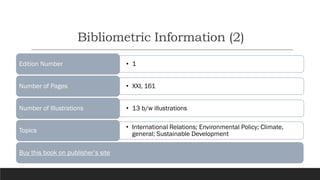
Bibliometric Information (2)
Buy this book on publisher’s site
• 1
Edition Number
• XXI, 161
Number of Pages
• 13 b/w illustrations
Number of Illustrations
• International Relations; Environmental Policy; Climate,
general; Sustainable Development
Topics
Buy this book on publisher’s site
About the Author
Olivier Serrat is an environmental peacebuilding researcher at Georgetown University whose work
examines how environmental challenges, organizational leadership, and systems thinking shape
pathways to sustainable development. He is the author of Advancing Environmental
Peacebuilding (2026), Anthropogenic Solutions for Climate Change (2025), and several other
books on development, leadership, and performance, including Leading Organizations of the
Future (2023), Digital Solutions (2023), Leading Solutions (2021), Knowledge Solutions (2017),
and Learning in Development (2010). He has also conceptualized and edited volumes for the
Asian Development Bank. His writing extends into the humanities as well, with recent titles such
as The Anthropology of Desire (2026), Myth, Philosophy, & Literature (2025), Mere Words,
These (2023), and Flash Fiction (2022). From 2008 to 2012, he led knowledge management at
the Asian Development Bank, following earlier roles in evaluation, policy, strategy, programs, and
project operations. He holds degrees from the University of Kent, the University of London, and
The Chicago School of Professional Psychology.
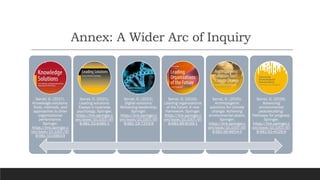
Annex: A Wider Arc of Inquiry
https://link.springer.c
om/book/10.1007/97
8-981-10-0983-9
https://link.springer.c
om/book/10.1007/97
8-981-33-6485-1
https://link.springer.c
om/book/10.1007/97
8-981-19-7253-9
https://link.springer.c
om/book/10.1007/97
8-981-99-8199-1 https://link.springer.c
om/book/10.1007/97
8-981-96-8654-4
https://link.springer.c
om/book/10.1007/97
8-981-92-4028-9
Serrat, O. (2017).
Knowledge solutions:
Tools, methods, and
approaches to drive
organizational
performance.
Springer.
https://link.springer.c
om/book/10.1007/97
8-981-10-0983-9
Serrat, O. (2021).
Leading solutions:
Essays in business
psychology. Springer.
https://link.springer.c
om/book/10.1007/97
8-981-33-6485-1
Serrat, O. (2023).
Digital solutions:
Reframing leadership.
Springer.
https://link.springer.c
om/book/10.1007/97
8-981-19-7253-9
Serrat, O. (2023).
Leading organizations
of the future: A new
framework. Springer.
https://link.springer.c
om/book/10.1007/97
8-981-99-8199-1
Serrat, O. (2025).
Anthropogenic
solutions for climate
change: Achieving
environmental peace.
Springer.
https://link.springer.c
om/book/10.1007/97
8-981-96-8654-4
Serrat, O. (2026).
Advancing
environmental
peacebuilding:
Pathways for progress.
Springer.
https://link.springer.c
om/book/10.1007/97
8-981-92-4028-9
Annex: Quick Response Codes
@Academia.edu @Google Scholar @LinkedIn @ResearchGate @SlideShare @X