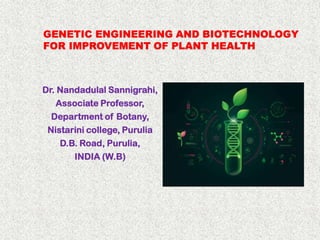
GENETIC ENGINEERING AND BIOTECHNOLOGY
FOR IMPROVEMENT OF PLANT HEALTH
Dr. Nandadulal Sannigrahi,
Associate Professor,
Department of Botany,
Nistarini college, Purulia
D.B. Road, Purulia,
INDIA (W.B)
INTRODUCTION
 While the global population continues to grow, it has heightened
demand for better agricultural output by maintaining sustainable plant
health.
 Traditional breeding techniques have played a great role in the
improvement of crop yields, but they are not very efficient and not
very excellent because they take quite a period of time and are not
quite based on scope to address the requirement.
 Genetic engineering is a more precise, powerful approach with more
direct influence on a plant genome; hence, the genetic engineering
approach provides an alternative means of increasing the productivity
of crops through the manipulation of the plant genome.
 With the increasing effects of climate change, dwindling arable land
resources, and the imperative for sustainable food production, genetic
engineering has emerged as a dominant tool in mitigating these
effects.
 The effects of disease and the development in the retrospect of
climate change only to be addressed by the using of genetic
engineering and biotechnology, the science of 21st century.
INTRODUCTION
 Genetic engineering has quickly become one of the most high-priority
technologies in modern agriculture, promising unprecedented
precision and efficiency to crop improvement by keeping sustainable
plant health.
 Genetic engineering allows for the direct modification of a plant’s
genetic makeup, introducing desirable traits that significantly improve
crop yield, disease resistance, and environmental adaptability.
 CRISPR-Cas9, transgenic methods, and RNA interference (RNAi) are
some of the technologies that have revolutionized scientists’
approaches to crop development by allowing rapid, targeted
alterations to the plant genome.
 Besides the most novel transfer method of gene technology, there are
several other classical methods are also being used in this domain to
maintain plant health and productivity like physical methods,
chemical methods and Agrobacterium mediated gene transfer
technologies to design and develop transgenic plants for the same.
SCOPE OF GENETIC ENGINEERING &
BIOTECHNOLOGY
 The Biotechnology in the domain of plant has immense potential to
enable sustainable plant health by ensuring the following practices as
stated below in this regard.
 1.To quickly propagate clones in order to obtain pathogen-free mother
plants.
 2. Genetically altered new plants are likely to exhibit instability
towards their habitat’s pathogenic microorganisms and environmental
conditions. Pathology has a role to play in this.
 3. The primary method by which genes are transferred from donors to
recipients in plant diseases, particularly the cauliflower mosaic virus
and the bacterium Agrobacterium tumefaciens.
 4. Using genetic engineering techniques to introduce resistant genes
into plants, plant diseases can be controlled.
 5. Genetic engineering techniques have already made a significant
contribution to the study of plant genes for disease resistance and of
pathogen genes for virulence to pathogen ((Fagwalawa,2013).
SCOPE OF GENETIC ENGINEERING &
BIOTECHNOLOGY
 The Genetic Engineering and Biotechnology can also play a very
crucial role for the exploration of the following aspects for
development and modification of the host by using this novel gene
editing technologies.
 (1) the genetic regulation of various metabolites, including mannitol,
glycine betaine, glutathione, unsaturated fatty acids, osmotine,
polyamines, and trehalose;
 (2) the regulation of genes associated with hormone pathways (e.g.
ethylene), water channels (e.g. aquaporins) and ion transport;
 (3) the manipulation of heat shock proteins;
 (4) the regulation of enzymes in antioxidant systems, such as
oxidoreductase, catalase, ascorbate peroxidase, and superoxide
dismutase; and
 (5) the genetic transformation of regulatory genes (e.g. transcription
factors and kinases) and other components of signaling systems (e.g.
systemin, expansin, and late embryogenesis abundant protein).
KEY ASPECTS FOR CROP HEALTH
 DISEASE RESISTANCE
 There are novel techniques like RNA interference (RNAi) and gene
editing to create resistance of plants against the different types of
pathogens like virus, bacteria, fungi and nematodes to stop the
immature death of the plants along with the normal growth and
development of plants to ensure sustainable health and optimum crop
productivity.
 The plants may suffer from the different diverse biotic and abiotic
issues and the disease resistance against the different types of stresses
can be minimized to uses.
 PEST CONTROL
 To control pest for the restoration of plant health and productivity,
the genetic engineering and biotechnology can play a very crucial
role in this regard by the genetic modification of plants as found in
bt-Cotton, bt-Bringel and many more to resist infection by the toxin
beta toxin introduced by Bacillus thurangenesis.
KEY ASPECTS FOR CROP HEALTH
 ABIOTIC AND BIOTIC STRESS
 Plant suffers from the different types of stress- both biotic and
abiotic,
 The biotic stress mostly comes from the pathogens while the abiotic
stress derives from the different types of natural consequences like
drought, salinity, water stagnation, drought, nutritional deficiencies
and many more,
 All these factors play a very crucial role for the normal growth and
development of the plant health,
 The genetic engineering and biotechnology enriched with the
different sophisticated techniques can able to address the problems.
 SOIL QUALITY AND NUTRIENT MANAGEMENT
 Soil is the most important renewable resources and the soil fertility is
ensured by the different issues like microbes-soil interactions,
allelopathic effects and endemic flora and fauna,
 The restoration of spoil to soil can be done and natural fertility can be
restored by the judicious application of modern tools and techniques.
KEY ASPECTS FOR CROP HEALTH
 INTEGRATED PEST MANAGEMENT
 Natural defense mechanisms as operated by plants themselves and the
reduction of the uses of pesticides, fungicides and weedicides are very
important for the soil sustainability and replenishment,
 The IPM comprising of the using of beneficial insects and reduction
of uses of synthetic chemicals are needed to address in this regard,
 The GE and Biotechnology garnished with modern tools and
techniques can play a very crucial role in this regard.
 CROP GENETICS
 The most important issues for the plant health is its genetics and the
transmission of the different factors for the sustainable plant health,
 The different genetically principles along with their statistical analysis
is very important in this regard,
 Plant genetic databases are to be addressed properly for the same
using the GE and Biotechnology principles.
METHODS USED FOR THE SAME
 To enhance plant health and sustainability, different methods are
employed as stated below:
 CRISPER-CAS technology for gene editing,
 Transgenesis to design genetic modified plants,
 Genome editing using CRISPER-CAS, ZFNs, TALENs and others,
 Protoplast fusion,
 Micro-propagation and tissue culture techniques,
 Induced mutagenesis,
 Others techniques for the restoration of soil health and sustainability.
CRISPR-CAS TECHNOLOGY
 Clustered regularly-interspaced short palindromic repeats (CRISPR)
is a new and effective genetic editing tool. Because of the efficiency
and affinity, CRISPR has been considered to be a revolutionary
invention in the field of genetic-editing and molecular biology.
 Compared with other genetic-editing techniques, CRISPR has an
irreplaceable advantage, which is its accessibility.
 The idea of the CRISPR comes from some bacteria which use this
tool as a method to defend themselves against virus and it was
initially thought as useless tool,
 When Viruses start to invade the living cells of bacteria, they will
release their own invading DNA strands into the bacteria cells for
turning the invaded cells into factories that produce more Viruses.
 At this moment, the immune system of bacteria will make a copy of
one DNA strand of the invading virus, and then inserts it into a group
of genome of bacteria, which is called CRISPR array.
CRISPR-CAS TECHNOLOGY
 Dr. Emmanuelle Charpentier, one of our scientific founders, co-
invented CRISPR/Cas9 gene editing. She and her collaborator, Dr.
Jennifer Doudna, won a Nobel Prize for this groundbreaking work.
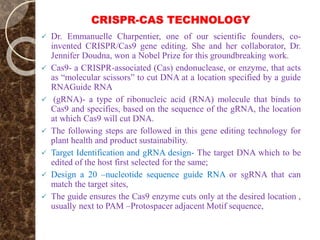
 Cas9- a CRISPR-associated (Cas) endonuclease, or enzyme, that acts
as “molecular scissors” to cut DNA at a location specified by a guide
RNAGuide RNA
 (gRNA)- a type of ribonucleic acid (RNA) molecule that binds to
Cas9 and specifies, based on the sequence of the gRNA, the location
at which Cas9 will cut DNA.
 The following steps are followed in this gene editing technology for
plant health and product sustainability.
 Target Identification and gRNA design- The target DNA which to be
edited of the host first selected for the same;
 Design a 20 –nucleotide sequence guide RNA or sgRNA that can
match the target sites,
 The guide ensures the Cas9 enzyme cuts only at the desired location ,
usually next to PAM –Protospacer adjacent Motif sequence,
CRISPR-CAS TECHNOLOGY
 Formation of CRISPR-CAS9 Complex- the designed guide rRNA is
now combined with CAS9 enzyme (molecular scissors) to form the
functional ribonucleoprotein complex,
 Delivery into the host cells- both the complex of CRISPR-Cas9
complex is introduced into the target cells by any techniques like
transfection, electroporation or viral vectors,
 Recognition and Cleavage- the target site is being edited to the
precise location where CAs9 binds with the PAM site and creates a
double stranded break (DSB) in the DNA ,
 DNA repair and modification- any of the two methods are used for
the editing
i. Non-Homologous End Joining(NHEJ)- the cells join ends break
together, often creating small insertions or deletions that knock out
undesired as well as defective gene,
ii. Homology Directed Repair (HDR)- when the donor DNA is
provided, the cell is used to repair the break , allowing precise gene
correction or insertion i.e. knock in.
TRANSGENESIS
 Verification- the entire editing of the defective gene is done using
sequencing technique or restriction enzyme digestion to check and
verify,
 The gene editing technology is now come full potential of the host
plant to remove the defective gene for using it full potential as desired
for the same.
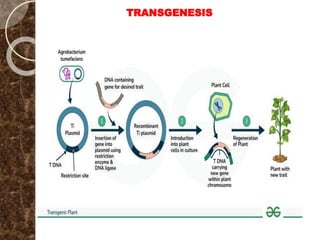
 TRANSGENESIS
 Transgenic plants are plants in which one or more genes from another
species have been introduced into the genome using genetic
engineering processes.
 A transgenic plant contains a gene or genes that have been artificially
inserted. The inserted gene sequence is known as the transgene, it
may come from an unrelated plant or from a completely different
species. Techniques include the biolistic method—in which a heavy
metal is coated with plasmid DNA is shot into cells—and
Agrobacterium tumefaciens mediated transformation
TRANSGENESIS
 Weed resistance-Weeds compete with the crops for light & nutrients,
besides harboring various pathogens . So it is estimated that the
worlds crop yield is reduced by 10 – 15 % due to the presence of
weeds. Herbicide resistance plants can be designed by transgenesis.
 Insect resistance plants -can be designed by the transgenesis as
designed in Bt-cotton, Bt- bringel and many other plants by using
Agrobacterium thuriengiensis toxin production potential,
 Abiotic stress tolerance-the plant growth and productivity of many
crops are adversely affected by several abiotic stresses including
salinity, drought, heat, flood, frost and mineral toxicities by using the
transgenesis techniques,
 For fungal and bacterial diseases resistance-the following four
strategies have been applied to make disease resistant transgenic
plant: transgenic disease-resistant plants used - genes encoding
pathogenesis-related proteins (PR proteins), antimicrobial peptides or
antimicrobial metabolites, genes that encode detoxification
mechanisms, genes that have a role in pathogen recognition and genes
that regulate defense mechanism.
TRANSGENESIS
 There are different methods of gene transfer into the host plats depending
upon the requirements and accessibility as follows:
 Vector mediated or indirect gene transfer- Agrobacterium, the natures’
genetic engineer, has been used as a vector to create transgenic plants.
Agrobacterium-mediated gene transfer in plants is a highly efficient
transformation process which is governed by various factors including
genotype of the host plant, explants, vector, plasmid, bacterial strain,
composition of culture medium, tissue damage, and temperature of co-
cultivation.
 Direct Gene or vector independent transfer-The term direct transfer of
gene is used when the foreign DNA is directly introduced into the plant
genome .
 Direct DNA transfer methods rely on the delivery of naked DNA into the
plant cells. The direct gene transfer can be broadly divided into two
categories.
i. Physical gene transfer methods— electroporation, microinjection,
particle bombardment.
ii. Chemical gene transfer methods—Poly ethylene glycol (PEG)-
mediated, diethyl amino ethyl (DEAE) dextran -mediated, calcium
phosphate precipitation.
TRANSGENESIS
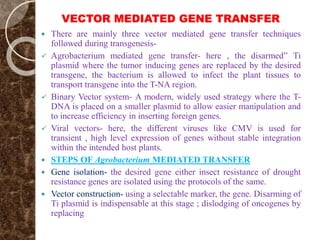
VECTOR MEDIATED GENE TRANSFER
 There are mainly three vector mediated gene transfer techniques
followed during transgenesis-
 Agrobacterium mediated gene transfer- here , the disarmed” Ti
plasmid where the tumor inducing genes are replaced by the desired
transgene, the bacterium is allowed to infect the plant tissues to
transport transgene into the T-NA region.
 Binary Vector system- A modern, widely used strategy where the T-
DNA is placed on a smaller plasmid to allow easier manipulation and
to increase efficiency in inserting foreign genes.
 Viral vectors- here, the different viruses like CMV is used for
transient , high level expression of genes without stable integration
within the intended host plants.
 STEPS OF Agrobacterium MEDIATED TRANSFER
 Gene isolation- the desired gene either insect resistance of drought
resistance genes are isolated using the protocols of the same.
 Vector construction- using a selectable marker, the gene. Disarming of
Ti plasmid is indispensable at this stage ; dislodging of oncogenes by
replacing
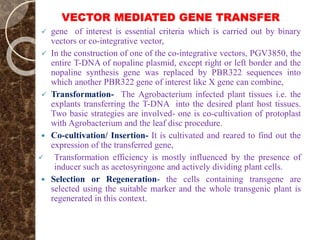
VECTOR MEDIATED GENE TRANSFER
 gene of interest is essential criteria which is carried out by binary
vectors or co-integrative vector,
 In the construction of one of the co-integrative vectors, PGV3850, the
entire T-DNA of nopaline plasmid, except right or left border and the
nopaline synthesis gene was replaced by PBR322 sequences into
which another PBR322 gene of interest like X gene can combine,
 Transformation- The Agrobacterium infected plant tissues i.e. the
explants transferring the T-DNA into the desired plant host tissues.
Two basic strategies are involved- one is co-cultivation of protoplast
with Agrobacterium and the leaf disc procedure.
 Co-cultivation/ Insertion- It is cultivated and reared to find out the
expression of the transferred gene,
 Transformation efficiency is mostly influenced by the presence of
inducer such as acetosyringone and actively dividing plant cells.
 Selection or Regeneration- the cells containing transgene are
selected using the suitable marker and the whole transgenic plant is
regenerated in this context.
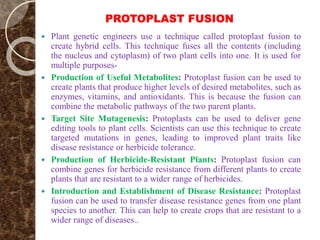
PROTOPLAST FUSION
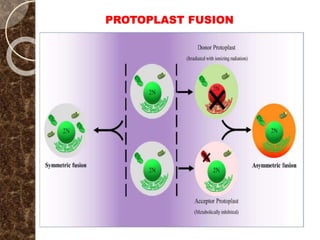
 Plant genetic engineers use a technique called protoplast fusion to
create hybrid cells. This technique fuses all the contents (including
the nucleus and cytoplasm) of two plant cells into one. It is used for
multiple purposes-
 Production of Useful Metabolites: Protoplast fusion can be used to
create plants that produce higher levels of desired metabolites, such as
enzymes, vitamins, and antioxidants. This is because the fusion can
combine the metabolic pathways of the two parent plants.
 Target Site Mutagenesis: Protoplasts can be used to deliver gene
editing tools to plant cells. Scientists can use this technique to create
targeted mutations in genes, leading to improved plant traits like
disease resistance or herbicide tolerance.
 Production of Herbicide-Resistant Plants: Protoplast fusion can
combine genes for herbicide resistance from different plants to create
plants that are resistant to a wider range of herbicides.
 Introduction and Establishment of Disease Resistance: Protoplast
fusion can be used to transfer disease resistance genes from one plant
species to another. This can help to create crops that are resistant to a
wider range of diseases..
PROTOPLAST FUSION
PROTOPLAST FUSION
 Insect Pest Control: Protoplast fusion can be used to create plants that
are resistant to insect pests. We can achieve this by combining genes for
insect resistance from different plants.
 STEPS OF PROTOPLAST FUSION
 The enzyme-treated tissue is incubated in a solution with a concentration
different from the cell contents (osmoticum). This causes the cells to
shrink (plasmolyze), making enzyme digestion more efficient.
 The digested solution is then filtered or centrifuged to separate the
protoplasts from cell debris and enzyme residues.
 Protoplast Purification:
 Techniques like differential centrifugation or density gradient
centrifugation are used to purify the protoplasts from unwanted materials
further.
 Protoplast Culture (Optional):
 Isolated protoplasts can be cultured in a specific medium to induce cell
wall regeneration and division, potentially leading to the formation of
whole plants.
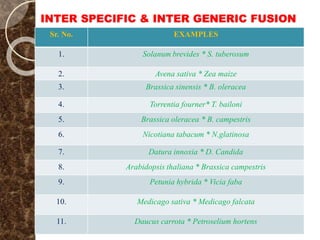
INTER SPECIFIC & INTER GENERIC FUSION
Sr. No. EXAMPLES
1. Solanum brevides * S. tuberosum
2. Avena sativa * Zea maize
3. Brassica sinensis * B. oleracea
4. Torrentia fourner* T. bailoni
5. Brassica oleracea * B. campestris
6. Nicotiana tabacum * N.glatinosa
7. Datura innoxia * D. Candida
8. Arabidopsis thaliana * Brassica campestris
9. Petunia hybrida * Vicia faba
10. Medicago sativa * Medicago falcata
11. Daucus carrota * Petroselium hortens
PROTOPLAST FUSION
 Protoplast fusion can be done by- chemical & Electro fusion
 Chemical fusion- Sodium nitrate, Polyethylene glycol, and Calcium
ion. Calcium are administered for efficient fusion of protoplast. PEG
can initiate tight agglutination of protoplast,
 When protoplast are exposed to electric field, membrane fusion is
achieved followed by transient break down and reorganization of
membrane contact using AC& DC,
 Screening of Somatic Hybrids- Several screening strategies are used
; more than 40-50% of the protoplasts fusion are considered ideal.
 Microscopic visual selection- It is done on the basis of fusion between
colored and colorless protoplast followed by the integration of
structural characteristics of both parental protoplasts.
 Bochemical verification of somatic hybrid, verification of molecular
screening and chromosomal analysis of the designed one is also done
in this regard,
 Cytoplasmic hybrids- nucleus of one parent & cytoplasm of both
parents are also be accomplished by this method.
MICRO-PROPAGATION AND TISSUE
CULTURE TECHNIQUES
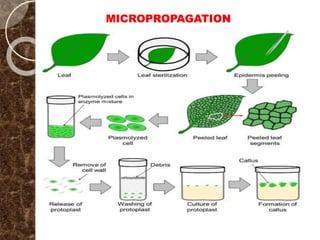
 The term “micropropagation” refers to the large-scale multiplication
of plants by bud proliferation or bud induction on plant culture media
in vitro . It is implicit that when micropropagation is used
commercially as an alternative to vegetative propagation, the plants
produced should be true-to-type, free of pathogens, and free of
microbial contaminants.
 The latter are environmental organisms that enter the cultures on or in
the explants at establishment of the tissue culture, or enter during the
serial subculture steps in multiplication.
 It is used to enrich plant health by the exploring following properties-
 Virus elimination by meristems culture as the meristems remain free
from virus infection, to design virus free plantlets,
 Production of elite clones to produce “true-to- type” plants with
superior traits like vigor, resistance to diseases and more,
 Uniform quality plantlets can be designed for sustainable plant health
in large scale,
MICROPROPAGATION
MICROPROPAGATION
i. Stage 0- Mother plant selection , mostly disease free plants are chosen
ii. Establishment of Aseptic Culture-
iii. Multiplication of shoots by callus mediated shoot multiplication or in-
vitro multiplication of adventitious shoots, auxiliary shoot proliferation
or any other means,
iv. In vitro rooting by placing them into suitable rooting media by adding
auxins without use of Cytokinines,
v. Transplantation or Hardening by transferring into the soil from the
ascetic in vitro condition,
 Enables quick plant production from a small part of plant tissue
 Produces uniform plants with similar growth pattern and yield
Contributes in the production of disease free planting material in
controlled environment
 Less land is needed as compared to the conventional ways of propagation
Enables young plant production/regeneration throughout the year,
independent of seasons
 Applicable for storing of rare, endangered, or hard to propagate plant
species.
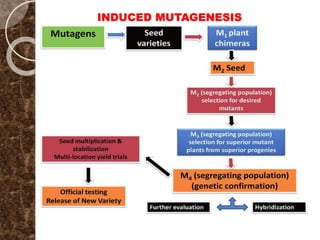
INDUCED MUTAGENESIS
 Induced mutagenesis is one of the most efficient tools that has been
utilized extensively to create genetic variation as well as for
identification of key regulatory genes for economically important
traits toward the crop improvement,
 It is a promising approach to develop new varieties with improved
agronomic characteristics, such as higher stress tolerance potential
(biotic and abiotic stress) and bio-fortification.
 Additionally, various mutagenesis approaches have been used to
study the evolutionary relationship as well as for the genetic
improvement of many organisms, including microbes, animals, and
plants.
 Physical mutagens, like fast neutron, UV, X-ray, and gamma
radiations, and chemical mutagens, including N-methyl-N-
nitrosourea (MNU), sodium azide, hydrogen fluoride (HF), methyl
methanesulfonate (MMS), or ethyl methanesulfonate (EMS), have
been widely explored. Furthermore, biological mutagens include
Agrobacterium and transposon -based chromosomal integration are
used for the same.
INDUCED MUTAGENESIS
THANKS FOR YOUR VISIT
 ACKNOWLEDGEMENTS:
a. Google for images,
b. Different websites for enriching the course content,
c. Science Direct pages,
d. Plant Molecular Biotechnology- S. Mahesh,
e. Plant diseases, insects and pests- NCBI-NH,
f. https://www.researchgate.net
g. www.nature.com
h. www.spruce.com
i. www.aphis.usda.gov
j. Puregreensaz.com
k. www.fao.org
l. Many more websites for references.
 This presentation has been designed to address the academic fraternity
without any financial interest. This is absolutely free to use . The author
does not claim any kind of financial benefits from this content.