Exploring the role and significance in modern society.
Information
Technology
Introduction
This presentation delves into the
definition, importance, and key
components of Information Technology
in contemporary settings.
Overview
01
Definition of
Information
Technology
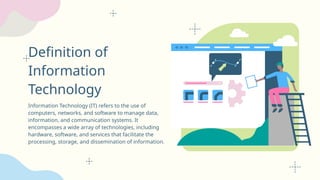
Information Technology (IT) refers to the use of
computers, networks, and software to manage data,
information, and communication systems. It
encompasses a wide array of technologies, including
hardware, software, and services that facilitate the
processing, storage, and dissemination of information.
Importance in
today's world
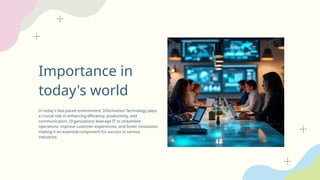
In today's fast-paced environment, Information Technology plays
a crucial role in enhancing efficiency, productivity, and
communication. Organizations leverage IT to streamline
operations, improve customer experiences, and foster innovation,
making it an essential component for success in various
industries.
Key components
The key components of Information Technology
include hardware (physical devices), software
(applications and operating systems), networks
(communication systems), and databases
(organized data storage). These components
work together to support digital operations and
processing.
Applications
02
Business
applications
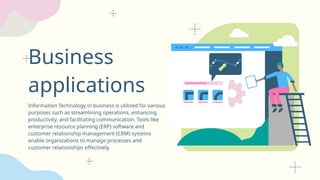
Information Technology in business is utilized for various
purposes such as streamlining operations, enhancing
productivity, and facilitating communication. Tools like
enterprise resource planning (ERP) software and
customer relationship management (CRM) systems
enable organizations to manage processes and
customer relationships effectively.
Healthcare innovations
In healthcare, IT solutions such as electronic
health records (EHR), telemedicine, and health
informatics have transformed patient care.
These technologies improve efficiency, enhance
patient outcomes, and enable better data
management, thus allowing healthcare
professionals to make informed decisions.
Education
technology
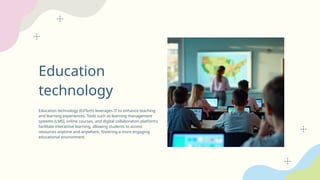
Education technology (EdTech) leverages IT to enhance teaching
and learning experiences. Tools such as learning management
systems (LMS), online courses, and digital collaboration platforms
facilitate interactive learning, allowing students to access
resources anytime and anywhere, fostering a more engaging
educational environment.
Conclusions
In conclusion, Information Technology is a pivotal
force driving innovation and efficiency across various
sectors. Its application in business, healthcare, and
education highlights the transformative impact of IT,
emphasizing the necessity for ongoing adaptation
and integration of new technologies.
CREDITS: This presentation template was created by Slidesgo,
and includes icons, infographics & images by Freepik
Do you have any questions?
Thank you!