The document discusses the processes that needs to be followed during admission and discharge of patient in hospital. It provides detail information on the purpose, type and importance.
Admission
• Admission ofa patient means, allowing a patient to stay in a
hospital for investigation, observation and treatment of disease
he/she is suffering from.
• Admission is entry of the patient in hospital or ward for
therapeutic or diagnostic purposes.
3.
Purposes of admission
•To provide immediate care.
• To provide safety and comfort to the patient.
• To manage and improve the general condition of patient.
• To diagnose the condition by observing signs and symptomsof a
disease condition.
• To be ready for any emergency.
• To facilitate follow up of the patient.
• To obtain information about patient such as any informationthat
serves as a basis of care e.g. Allergy, Diabetes etc.
• To establish IPR (INTERPERSONAL RELATIONSHIP).
4.
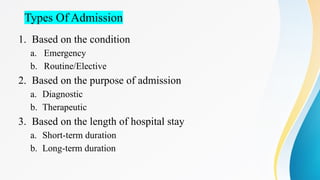
Types Of Admission
1.Based on the condition
a. Emergency
b. Routine/Elective
2. Based on the purpose of admission
a. Diagnostic
b. Therapeutic
3. Based on the length of hospital stay
a. Short-term duration
b. Long-term duration
5.
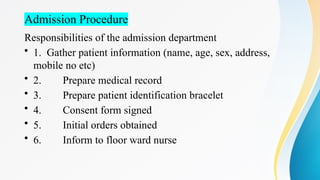
Admission Procedure
Responsibilities ofthe admission department
• 1. Gather patient information (name, age, sex, address,
mobile no etc)
• 2. Prepare medical record
• 3. Prepare patient identification bracelet
• 4. Consent form signed
• 5. Initial orders obtained
• 6. Inform to floor ward nurse
6.
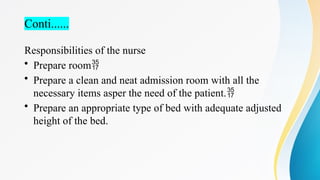
Conti......
Responsibilities of thenurse
• Prepare room
• Prepare a clean and neat admission room with all the
necessary items asper the need of the patient.
• Prepare an appropriate type of bed with adequate adjusted
height of the bed.
7.
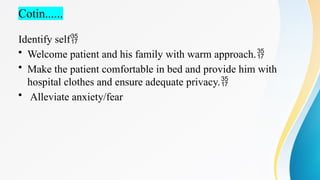
Cotin......
Identify self
• Welcomepatient and his family with warm approach.
• Make the patient comfortable in bed and provide him with
hospital clothes and ensure adequate privacy.
• Alleviate anxiety/fear
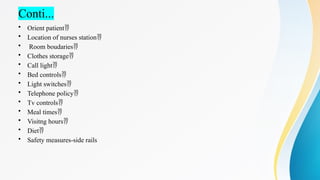
Conti....
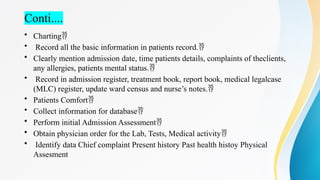
• Charting
• Recordall the basic information in patients record.
• Clearly mention admission date, time patients details, complaints of theclients,
any allergies, patients mental status.
• Record in admission register, treatment book, report book, medical legalcase
(MLC) register, update ward census and nurse’s notes.
• Patients Comfort
• Collect information for database
• Perform initial Admission Assessment
• Obtain physician order for the Lab, Tests, Medical activity
• Identify data Chief complaint Present history Past health histoy Physical
Assesment
11.
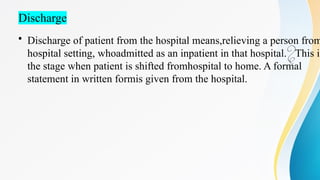
Discharge
• Discharge ofpatient from the hospital means,relieving a person from
hospital setting, whoadmitted as an inpatient in that hospital. This is
the stage when patient is shifted fromhospital to home. A formal
statement in written formis given from the hospital.
12.
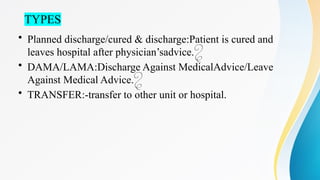
TYPES
• Planned discharge/cured& discharge:Patient is cured and
leaves hospital after physician’sadvice.
• DAMA/LAMA:Discharge Against MedicalAdvice/Leave
Against Medical Advice.
• TRANSFER:-transfer to other unit or hospital.
13.
conti.......
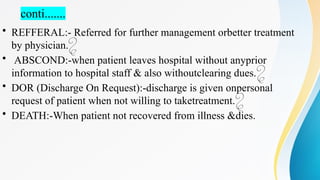
• REFFERAL:- Referredfor further management orbetter treatment
by physician.
• ABSCOND:-when patient leaves hospital without anyprior
information to hospital staff & also withoutclearing dues.
• DOR (Discharge On Request):-discharge is given onpersonal
request of patient when not willing to taketreatment.
• DEATH:-When patient not recovered from illness &dies.
14.
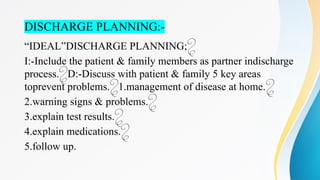
DISCHARGE PLANNING:-
“IDEAL”DISCHARGE PLANNING;
I:-Includethe patient & family members as partner indischarge
process. D:-Discuss with patient & family 5 key areas
toprevent problems. 1.management of disease at home.
2.warning signs & problems.
3.explain test results.
4.explain medications.
5.follow up.
15.
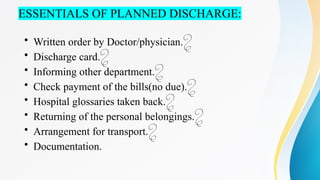
ESSENTIALS OF PLANNEDDISCHARGE:
• Written order by Doctor/physician.
• Discharge card.
• Informing other department.
• Check payment of the bills(no due).
• Hospital glossaries taken back.
• Returning of the personal belongings.
• Arrangement for transport.
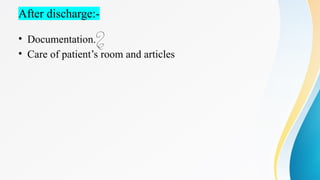
• Documentation.
16.
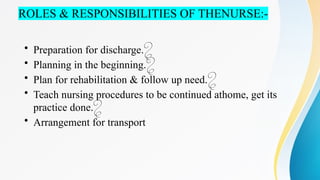
ROLES & RESPONSIBILITIESOF THENURSE:-
• Preparation for discharge.
• Planning in the beginning.
• Plan for rehabilitation & follow up need.
• Teach nursing procedures to be continued athome, get its
practice done.
• Arrangement for transport
17.
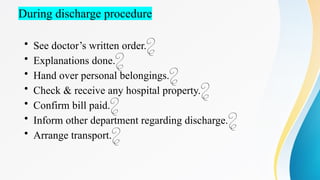
During discharge procedure
•See doctor’s written order.
• Explanations done.
• Hand over personal belongings.
• Check & receive any hospital property.
• Confirm bill paid.
• Inform other department regarding discharge.
• Arrange transport.