ADA AMENDMENTS ACT
       AND PROPOSED REGULATIONS:
      WHAT EMPLOYERS NEED TO KNOW


Presented by:
Daniel A. Schwartz & Margaret M. Sheahan

October 13, 2009


                     © 2009 PULLMAN & COMLEY, LLC
Before We Start

• Powerpoint materials can be downloaded directly from
  drop.io/danielschwartz.
• This webinar will be available for rebroadcast and
  download later today from the same site.
• Other materials: www.ctemploymentlawblog.com
• Please feel free to submit any questions you might have
  and we’ll try to address them in the end.
• If you have any issues, please feel free to e-mail me at
  dschwartz@pullcom.com.
• If you have a question, submit it through the webinar.

                    © 2009 PULLMAN & COMLEY, LLC
What’s New?

• Court decisions on “disability” perceived as making
  enforcement too difficult

• Congress “corrected” it through legislation

• EEOC proposed implementing regulations


                    © 2009 PULLMAN & COMLEY, LLC
Timeline

• ADA enacted 1990; amendments passed in September
  2008.
• ADAAA Effective date January 1, 2009
  – Not Retroactive
  – Only applies to allegations arising after that date
• EEOC proposed regulations on September 23, 2009
• Comments due by 11/23/09
• Final regulations soon thereafter
  – no earlier than Q1 2010

                     © 2009 PULLMAN & COMLEY, LLC
Key Supreme Court and EEOC Positions Overturned

• The ADA Amendments Act of 2008 reverses two US
  Supreme Court decisions by name:
   – Sutton v. United Air Lines, Inc., 527 U.S. 471 (1999),
     which required mitigating measures to be factored in the
     determination of whether a plaintiff has a disability.
   – Toyota Motor Manufacturing, Kentucky, Inc. v.
     Williams, 534 U.S. 184 (2002), which called for strict
     interpretation of the terms “substantially” in the
     “substantially limits” concept and “major” in the “major
     life activity” concept.
• The 2008 statute also specifically rejected an EEOC
  interpretive regulation that defined “substantially
  limits” as “significantly restricts.”
                     © 2009 PULLMAN & COMLEY, LLC
What Did NOT Change?

•   Still applies to employers with 15 or more employees
•   Actual definition of “disability”
•   Duty to provide “reasonable accommodations”
•   Employer defenses (direct threat, undue hardship)


                      © 2009 PULLMAN & COMLEY, LLC
What are The Key Changes?

• Employers must now adopt a broad standard to
  determine if someone is “disabled” – something found
  in the language of the amendments itself.
• Courts are to provide coverage to individuals “to the
  maximum extent permitted.”
• Focus should be on whether discrimination occurred.
   – Whether someone is “disabled” should be a fairly
     simple, preliminary matter.
   – Start treating issue as with other “protected classes.”


                      © 2009 PULLMAN & COMLEY, LLC
Changes to Definition of “Major Life Activities”

• Expands the definition of "major life activities" by
  including two non-exhaustive lists:
   – the first list includes many activities that the EEOC has
     recognized (e.g., walking) as well as activities that EEOC
     has not specifically recognized (e.g., reading, bending,
     and communicating)
   – the second list includes major bodily functions (e.g.,
     "functions of the immune system, normal cell growth,
     digestive, bowel, bladder, neurological, brain, respiratory,
     circulatory, endocrine, and reproductive functions")


                      © 2009 PULLMAN & COMLEY, LLC
Changes to “Substantially Limits”

• Directs EEOC to revise that portion of its regulations
  defining the term “substantially limits”
• Must be interpreted consistent with Congress’s findings
  and purposes:
   – Defining it as “significantly restricted” is too high a
     standard according to Congress.


                       © 2009 PULLMAN & COMLEY, LLC
Other Rules of Construction Changes

• Clarifies that an impairment that is episodic or in
  remission is a disability if it would substantially limit a
  major life activity when active
• An impairment that substantially limits one major life
  activity need not limit other major life activities in order
  to be considered a disability


                      © 2009 PULLMAN & COMLEY, LLC
Changes to “Regarded As” Definition


• Under the amendments, an individual now must show
  only that the employer perceived the individual as
  having a mental or physical impairment:
   – Individual does not need to show that that employer
     perceived an impairment that substantially limits a major
     life activity.
• “Regarded as” individuals NOT entitled to reasonable
  accommodation


                     © 2009 PULLMAN & COMLEY, LLC
What About Mitigating Measures?

• Previously, courts and employers had to determine a
  person’s disability taking into account the effects of
  mitigating measures such as prosthetics, medications or
  hearing aids.
• Now, employers and courts must ignore those
  measures in the threshold issue of whether employee
  has a “disability.”
• However, in reasonable accommodation analysis, these
  measures can and should be considered.


                    © 2009 PULLMAN & COMLEY, LLC
Big Exception – Glasses

• Congress created an exception for ordinary eyeglasses
  and contact lenses.

• Those items CAN be considered when determining if
  someone is disabled.


                    © 2009 PULLMAN & COMLEY, LLC
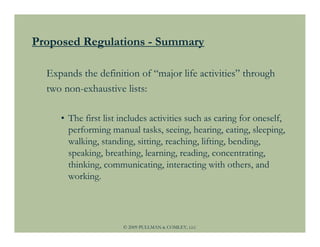
Proposed Regulations - Summary

  Expands the definition of “major life activities” through
  two non-exhaustive lists:

     • The first list includes activities such as caring for oneself,
       performing manual tasks, seeing, hearing, eating, sleeping,
       walking, standing, sitting, reaching, lifting, bending,
       speaking, breathing, learning, reading, concentrating,
       thinking, communicating, interacting with others, and
       working.


                      © 2009 PULLMAN & COMLEY, LLC
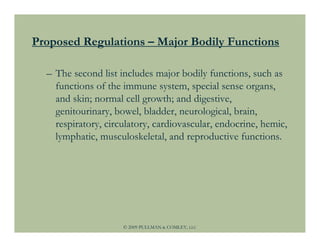
Proposed Regulations – Major Bodily Functions

  – The second list includes major bodily functions, such as
    functions of the immune system, special sense organs,
    and skin; normal cell growth; and digestive,
    genitourinary, bowel, bladder, neurological, brain,
    respiratory, circulatory, cardiovascular, endocrine, hemic,
    lymphatic, musculoskeletal, and reproductive functions.


                     © 2009 PULLMAN & COMLEY, LLC
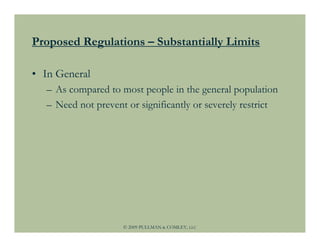
Proposed Regulations – Substantially Limits

• In General
  – As compared to most people in the general population
  – Need not prevent or significantly or severely restrict


                    © 2009 PULLMAN & COMLEY, LLC
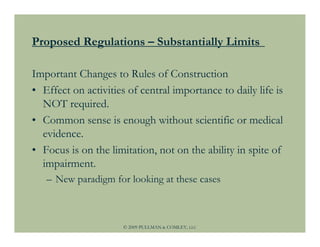
Proposed Regulations – Substantially Limits

Important Changes to Rules of Construction
• Effect on activities of central importance to daily life is
  NOT required.
• Common sense is enough without scientific or medical
  evidence.
• Focus is on the limitation, not on the ability in spite of
  impairment.
   – New paradigm for looking at these cases


                      © 2009 PULLMAN & COMLEY, LLC
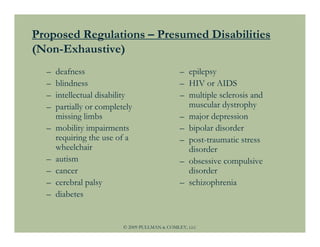
Proposed Regulations – Presumed Disabilities
(Non-Exhaustive)
  –   deafness                                 – epilepsy
  –   blindness                                – HIV or AIDS
  –   intellectual disability                  – multiple sclerosis and
  –   partially or completely                    muscular dystrophy
      missing limbs                            – major depression
  –   mobility impairments                     – bipolar disorder
      requiring the use of a                   – post-traumatic stress
      wheelchair                                 disorder
  –   autism                                   – obsessive compulsive
  –   cancer                                     disorder
  –   cerebral palsy                           – schizophrenia
  –   diabetes


                          © 2009 PULLMAN & COMLEY, LLC
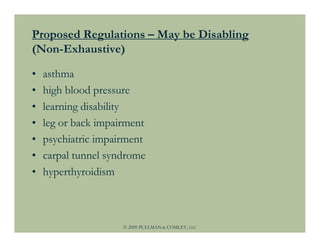
Proposed Regulations – May be Disabling
(Non-Exhaustive)

•   asthma
•   high blood pressure
•   learning disability
•   leg or back impairment
•   psychiatric impairment
•   carpal tunnel syndrome
•   hyperthyroidism


                     © 2009 PULLMAN & COMLEY, LLC
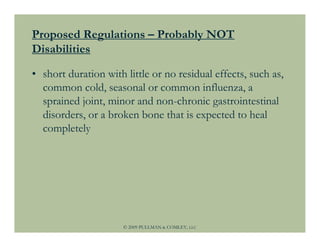
Proposed Regulations – Probably NOT
Disabilities

• short duration with little or no residual effects, such as,
  common cold, seasonal or common influenza, a
  sprained joint, minor and non-chronic gastrointestinal
  disorders, or a broken bone that is expected to heal
  completely


                      © 2009 PULLMAN & COMLEY, LLC
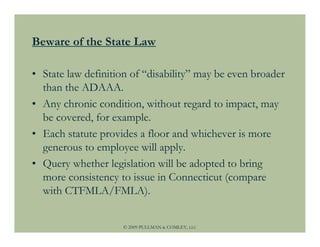
Beware of the State Law

• State law definition of “disability” may be even broader
  than the ADAAA.
• Any chronic condition, without regard to impact, may
  be covered, for example.
• Each statute provides a floor and whichever is more
  generous to employee will apply.
• Query whether legislation will be adopted to bring
  more consistency to issue in Connecticut (compare
  with CTFMLA/FMLA).


                    © 2009 PULLMAN & COMLEY, LLC
Action Steps For Employers

• Review and update policies for outdated limitations.
• Train and educate human resources and front-line
  supervisors.
• Look for common-sense view on potential disability
  scenarios.
• Default position is likely to be that individual IS
  protected; emphasis on what then.
• As always, document rationale and steps considered
  and taken to accommodate any difficulties.

                    © 2009 PULLMAN & COMLEY, LLC
Swine Flu & ADA (In Brief)

• Generally, ADA prohibits disability-related inquiry or
  medical exam unless job-related & consistent with
  business necessity
    – Can show likely to be impaired by medical condition
    – Employee will pose a “direct threat” (check EEOC)
    – But can ask e’ees if experiencing flu-like symptoms
•   Regardless, all information should be kept confidential
•   Can send e’ees home if display flu-like symptoms
•   Can implement telework, infection-control
•   If employee has been absent, can ask why

                      © 2009 PULLMAN & COMLEY, LLC
In Conclusion

• Webinar series continues the second Wednesday of
  every month
   – November will be moved because of Veterans Day
• Questions?
   – Be sure to either “raise hand” or submit question on the
     toolbar.
   – If your question isn’t answered, we will try to followup
     in the next 24 hours.


                     © 2009 PULLMAN & COMLEY, LLC
Dan Schwartz                                Margaret Sheahan
        Pullman & Comley, LLC                         Pullman & Comley, LLC
         90 State House Square                            850 Main Street
           Hartford, CT 06604                          Bridgeport, CT 06601
            p 860.424.4359                                p 203.330.2138
        dschwartz@pullcom.com                         msheahan@pullcom.com
    www.ctemploymentlawblog.com
http://www.linkedin.com/in/ctattorney
   http://twitter.com/danielschwartz


 Bridgeport
 Hartford
 Stamford
 White Plains


                                                               www.pullcom.com
                            © 2009 PULLMAN & COMLEY, LLC