9. Bryophytes-Marchantia.pptx Class 11 Ppt slides NEB
1.
BRYOPHYTES
GENERAL CHARACTERS OFBRYOPHYTES
• Bryophytes are multicellular eukaryotic and photosynthetic plants having thalloid
body with few differentiation.
• They are commonly grow in moist shaded areas.
• Bryophytes are also called amphibian plant because these plants are terrestrial but
their body surface is moist and water is essential for their fertilization during sexual
reproduction.
• Plant body is thallus-like and prostrate or erect and attached to the substratum by
unicellular or multicellular rhizoids.
• They lack true roots, stem or leaves and may possess root-like, leaf-like or stem-like
structures in some higher bryophytes.
• The main plant body of the bryophyte is haploid (n), produces gametes, and hence is
called a gametophyte.
• Male sex organ is called antheridium, which produce biflagellate antherozoids and
female sex organ is called Archegonium which is flask-shaped, produces a single egg.
• The antherozoids are released into water where they come in contact with
archegonium and fuses with the egg to produce the zygote.
• Zygotes produce a multicellular special diploid (2n) body called a sporophyte, which
is found attached wih gametophyte from where they absorb food.
• Some cells of the sporophyte undergo reduction division to produce haploid(n)
spores, which germinate to produce gametophytic plant.
• There is distinct alternation of generation to complete their life cycle.
2.
Classification Of Bryophytes
Accordingto the latest classification, Bryophyte is divided into three classes:
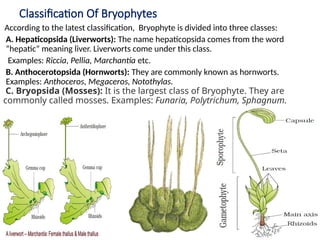
A. Hepaticopsida (Liverworts): The name hepaticopsida comes from the word
“hepatic” meaning liver. Liverworts come under this class.
Examples: Riccia, Pellia, Marchantia etc.
B. Anthocerotopsida (Hornworts): They are commonly known as hornworts.
Examples: Anthoceros, Megaceros, Notothylas.
C. Bryopsida (Mosses): It is the largest class of Bryophyte. They are
commonly called mosses. Examples: Funaria, Polytrichum, Sphagnum.
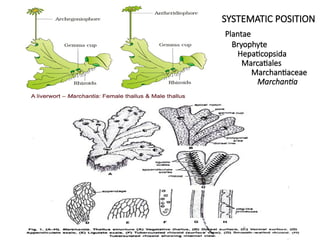
External Structure /Morphology:
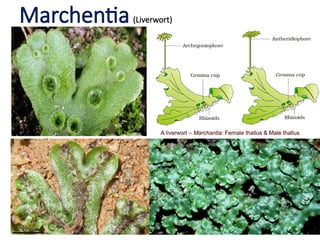
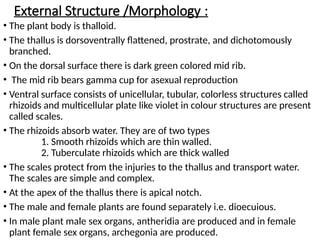
• The plant body is thalloid.
• The thallus is dorsoventrally flattened, prostrate, and dichotomously
branched.
• On the dorsal surface there is dark green colored mid rib.
• The mid rib bears gamma cup for asexual reproduction
• Ventral surface consists of unicellular, tubular, colorless structures called
rhizoids and multicellular plate like violet in colour structures are present
called scales.
• The rhizoids absorb water. They are of two types
1. Smooth rhizoids which are thin walled.
2. Tuberculate rhizoids which are thick walled
• The scales protect from the injuries to the thallus and transport water.
The scales are simple and complex.
• At the apex of the thallus there is apical notch.
• The male and female plants are found separately i.e. dioecuious.
• In male plant male sex organs, antheridia are produced and in female
plant female sex organs, archegonia are produced.
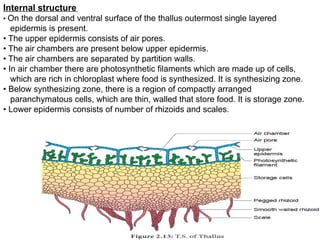
Internal structure
• Onthe dorsal and ventral surface of the thallus outermost single layered
epidermis is present.
• The upper epidermis consists of air pores.
• The air chambers are present below upper epidermis.
• The air chambers are separated by partition walls.
• In air chamber there are photosynthetic filaments which are made up of cells,
which are rich in chloroplast where food is synthesized. It is synthesizing zone.
• Below synthesizing zone, there is a region of compactly arranged
paranchymatous cells, which are thin, walled that store food. It is storage zone.
• Lower epidermis consists of number of rhizoids and scales.
7.
Reproduction / LifeCycle
Marchantia reproduce by Vegetative, asexual and sexual
methods.
1. Vegetative reproduction :
• By fragmentation
In this older region of thallus decayed or degenerate and younger
region or apical region again regenerate and produce new plant
body by progressive death and decay of older parts.
• By adventitious branches
In this method, branches develop on the ventral surface of
thallus. These branches may grow into new plant body.
2. Asexual reproduction:
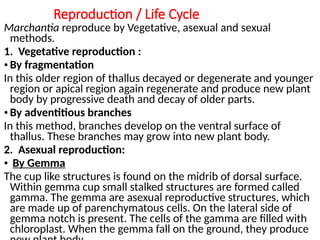
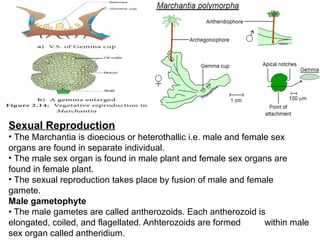
• By Gemma
The cup like structures is found on the midrib of dorsal surface.
Within gemma cup small stalked structures are formed called
gamma. The gemma are asexual reproductive structures, which
are made up of parenchymatous cells. On the lateral side of
gemma notch is present. The cells of the gamma are filled with
chloroplast. When the gemma fall on the ground, they produce
8.
Sexual Reproduction
• TheMarchantia is dioecious or heterothallic i.e. male and female sex
organs are found in separate individual.
• The male sex organ is found in male plant and female sex organs are
found in female plant.
• The sexual reproduction takes place by fusion of male and female
gamete.
Male gametophyte
• The male gametes are called antherozoids. Each antherozoid is
elongated, coiled, and flagellated. Anhterozoids are formed within male
sex organ called antheridium.
9.
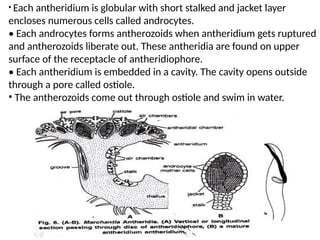
• Each antheridiumis globular with short stalked and jacket layer
encloses numerous cells called androcytes.
• Each androcytes forms antherozoids when antheridium gets ruptured
and antherozoids liberate out. These antheridia are found on upper
surface of the receptacle of antheridiophore.
• Each antheridium is embedded in a cavity. The cavity opens outside
through a pore called ostiole.
• The antherozoids come out through ostiole and swim in water.
10.
Female gametophyte
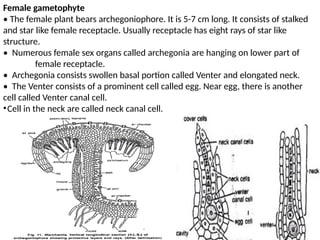
• Thefemale plant bears archegoniophore. It is 5-7 cm long. It consists of stalked
and star like female receptacle. Usually receptacle has eight rays of star like
structure.
• Numerous female sex organs called archegonia are hanging on lower part of
female receptacle.
• Archegonia consists swollen basal portion called Venter and elongated neck.
• The Venter consists of a prominent cell called egg. Near egg, there is another
cell called Venter canal cell.
•Cell in the neck are called neck canal cell.
11.
Fertilization
Swimming antherozoid reachto the archegonia tip with the help of water. Neck canal cell of
archegonia gets dissolved. A kind of mucilage is secreted by dissolving neck canal cells and
reaches to the venter canal cell and gets fused with egg and zygote is formed.
Sporophyte
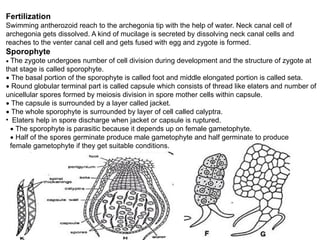
• The zygote undergoes number of cell division during development and the structure of zygote at
that stage is called sporophyte.
• The basal portion of the sporophyte is called foot and middle elongated portion is called seta.
• Round globular terminal part is called capsule which consists of thread like elaters and number of
unicellular spores formed by meiosis division in spore mother cells within capsule.
• The capsule is surrounded by a layer called jacket.
• The whole sporophyte is surrounded by layer of cell called calyptra.
• Elaters help in spore discharge when jacket or capsule is ruptured.
• The sporophyte is parasitic because it depends up on female gametophyte.
• Half of the spores germinate produce male gametophyte and half germinate to produce
female gametophyte if they get suitable conditions.
13.
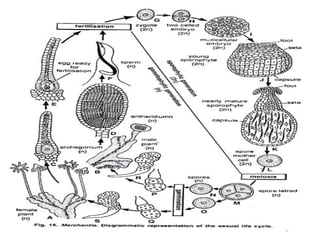
Alternation of Generationin Marchantia:
The life cycle of Marchantia shows regular alternation of two
morphologically distinct gametophytic (n) and sporophytic (2n)
phases.
(i) Haploid phase(n) or Gametophytic Phase:
In Marchantia this phase is dominant and produces the sex organs.
Sex organs produce gametes to form a diploid(2n) zygote after
fertilization.
(ii) Diploid Phase (2n) or Sporophytic Phase:
Zygote develops into sporophyte. In Marchantia sporophyte is
represented by foot, seta and capsule. The sporophyte produces the
spores after meiosis in the capsule. The spores on germination
produce the gametophytic plant.
So, in Marchantia two morphologically distinct phases (Haplophase
and Diplophase) found their life cycle. The life cycle in which
gametophytic (n) and sporophytic (2n) phases come one after another
alternately to complete their life cycle is called alternation of
generation.
THANK YOU