Module learning outcomes:
Upon successful completion of the course,
you will be able to:
Understand the term curriculum under various
curriculum views
Identify the expected roles of the teacher in
relation to the views of curriculum
Recognize the differences between curriculum
development and curriculum planning
Identify the steps involved in curriculum
development and curriculum planning process
3.
Cont---
Participate incurriculum development and
planning process
Make appropriate curriculum decision as
practitioners
Appreciate the different historical periods in the
history of Ethiopian formal school curriculum.
Explore the nature of secondary school
curricula in the different periods of Ethiopian
Education
4.
Cont---
Recognize thedifferent instructional methods
applicable at secondary school level
Apply the appropriate instructional methods in
presenting their subjects under the concrete
school reality
Plan lessons using varieties of active learning
methods in ways that motivate students for
learning
Organize and manage their classrooms
effectively
5.
Unit One: IntroductoryRemark on the
Term Curriculum and Related Issues
Learning Outcomes: At the end of this unit, you will
be able to:
Define the term curriculum using different views held
Identify the expected roles of the teacher under the
different perspectives
Identify the major foundations in curriculum and
the corresponding roles of the expected roles of the
teacher under the different perspectives
Describe the reasons for the variations in the
conception held on the term curriculum
Relate the roles of the teacher with the different
perspectives
6.
1.1: Definition ofCurriculum
Operational Definition:
Most of the definitions seem to come from a Latin word
‘currere’ which means ‘racecourse’
“currere”-meaning a race course/ground - a relatively
standardized ground to be covered by runners toward the
finish line
The school curriculum is a race to be run, a series of
obstacles or hurdles (subjects) to be passed
Curriculum can thus be regarded as relatively standardized subject
matters/courses to be mastered/covered by learners during a definable time
toward the finish line (certificate, diploma, or degree).
7.
1.1.1: Broad Definitions
1.1.1:Broad Definitions
The broad definitions are open to many
interpretations. In other words, one broad definition
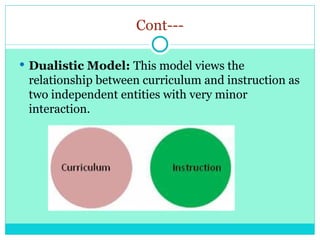
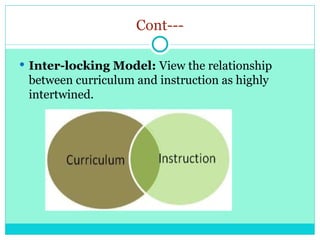
of the word curriculum contains different
specific concepts.
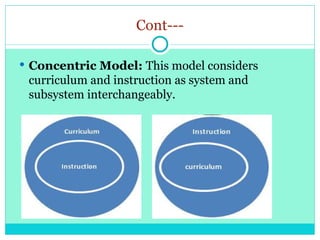
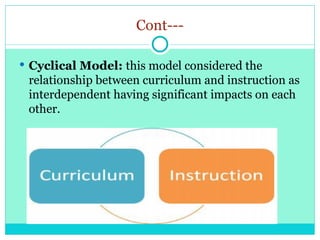
Ralph Tyler (1949): All of the learning of students
which are planned and directed by the school
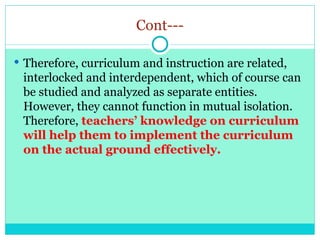
to attain its educational goals.
D. K. Wheeler (1967): By curriculum we mean the
planned experiences offered to the learner under
the guidance of the school.
8.
Br.Def---
Lewis (1981): aplan for providing sets of learning
opportunities for persons to be educated. Learning
opportunity implies a planned and controlled
relationship between pupils, teacher, materials,
equipment and the environment, in which it is hoped
that desired learning will take place.
Shilbeck (1984): The learning experiences of
students, in so far as they are expressed or
anticipated in goals and objectives, plans and
designs for learning and the implementation of
these plans and designs in school environments.
9.
Br.Def---
Glatthorn (1987):the plan made for guiding
learning in schools, usually represented in
retrievable documents of several levels of generally,
and the actualization of those plans in the classroom,
as experienced by the learners and as recorded by an
observer; those experiences take place in a learning
environment which also influences what is learned.
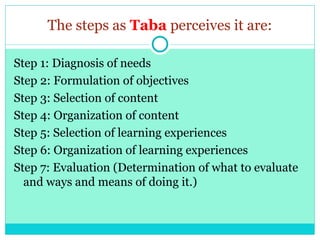
10.
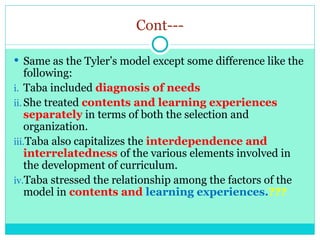
1.1.2: Specific Definitions
Curriculum is an outline of a course of study
(Print, 1987).
Curriculum is a set of subjects (Marsh, 2001).
Curriculum is a school timetable .
11.
1.1.3: Definitions Basedon the Role Placed
on Schools
Curriculum could also be defined based on the roles of
schools as prescribed by society or educators.
1. Subject Center: Consider the role of schools
as “Promoting students’ intellectual
capacity”. Thus curriculum is defined as “the
collection of subjects offered to students to train
the intellectual capacity”.
12.
Def---
2. Experience Center:consider curriculum as a
means to make students shape a new social
order and lead life in it, which involves everything
that cover the planning process and the instructional
objectives.
13.
Curriculum from ConstructivistPoint of
View
The constructivist movement in recent cognitive
psychology has reemphasized the active role
students’ play in acquiring knowledge and the social
construction of knowledge has been an
important principle in socio-cultural theory.
Knowledge-acquisition is active and strategic,
focused on many factors, including problems of
understanding, diversity of expertise, learning styles,
thinking styles, and interests.
14.
Constructivist---
Curriculum, according toconstructive view, is taken
as ‘enacted’ between students and teachers, and
collaboration and reflection in a ‘community of
inquiry.
15.
Summary
Most educators agreethat Curriculum refers to
the means and materials with which students
will interact for the purpose of achieving identified
educational outcomes. In fact, curriculum is a
means of communicating the essential principles
and features of an educational proposal that
includes the goals, broad contents, methods
and evaluation mechanisms in such a form that
it is open to critical scrutiny and capable of effective
translation into practice.
16.
The scope ofCurriculum
Curriculum Scope denotes to the question what
learning content, learning experience,
methods, etc should be included to and excluded
from the curriculum.
Curriculum is delimited to the knowledge of
curriculum development, curriculum
planning and curriculum design.
17.
Cont---
Curriculum Development:-concerned with how
curriculum evolved, implemented, evaluated
and what various people, process and
procedures are involved in the construction of the
curriculum.
Curriculum Planning: - is a process of making
the curriculum materials after identified
objectives, selecting contents and learning
experiences, instructional materials and developing
evaluation mechanisms.
18.
Cont---
Curriculum Design:- refers to the way one
conceptualizes a curriculum arranges its major
components to provide direction and guidance in
developing the curriculum.
19.
Curriculum as aDiscipline
What is a discipline?
• According to Oliva (1982), a discipline has the
following characteristics:
– A discipline should have an organized set of
theoretical principles.
– A discipline encompasses a body of knowledge
and skills pertinent to that discipline.
– A discipline has its theoreticians and its
practitioners.
1.2. Foundations ofCurriculum
Curriculum foundations may be defined as those
basic forces that influence and shape the minds of
curriculum developers and hence the content and
structure of the subsequent curriculum.
22.
1. Philosophical Foundation
Philosophy and philosophical assumptions are basic
to all curriculum foundations as they are concerned
with making sense of what we encounter in our lives.
How curriculum developers and implementers
perceive the world, and hence education, may
be determined by posing the following three
philosophical questions. These are:
What are real? Ontology. What is good?
Axiology. What is true? Epistemology.
23.
Cont---
Hence, How curriculumdevelopers
perceive the world and
education may be determined by
the philosophical questions such as
what is real? What is good?
And what is true?
24.
Educational Philosophies
Withinthe epistemological frame that focuses on the
nature of knowledge and how we come to
know there are four major educational philosophies,
each related to one or more of the general or world
philosophies.
These educational philosophies focus heavily on
WHAT we should teach the curriculum aspect.
They are discussed as follows.
25.
1. Perennialism
Theaim of education is to ensure that students
acquire understandings about the great ideas of
Western civilization.
These ideas have the potential for solving problems
in any era
The focus is to teach ideas that are everlasting,
to seek enduring truths which are constant,
not changing, as the natural and human worlds at
their most essential level, do not change.
Teaching unchanging principles is critical.
26.
Cont---
The demandingcurriculum focuses on attaining
cultural literacy, stressing students' growth in
enduring disciplines.
The higher accomplishments of humankind are
emphasized in the great works of literature and art, the
laws or principles of science.
27.
2. Essentialism
Essentialistsbelieve that there is a common core
of knowledge that needs to be transmitted to
students in a systematic, disciplined way.
The emphasis in this conservative perspective is on
intellectual and moral standards that schools
should teach.
The core of the curriculum is essential knowledge
and skills and academic rigor.
28.
3. Progressivism
Progressivistsbelieve that education should focus on
the whole child, rather than on the content or
the teacher.
This educational philosophy stresses that students
should test ideas by active experimentation.
Learning is rooted in the questions of learners
that arise through experiencing the world. It is
active, not passive.
29.
Cont---
Curriculum contentis derived from student
interests and questions.
The school should improve the way of life of our
citizens through experiencing freedom and
democracy in schools.
Books are tools, rather than authority.
30.
4. Reconstruction /Critical Theory
is a philosophy that emphasizes the addressing of
social questions
and a quest to create a better society and worldwide
democracy.
Reconstructionist educators focus on a curriculum
that highlights social reform as the aim of
education.
31.
Cont---
curriculum focuseson student experience and taking
social action on real problems, such as violence,
hunger, international terrorism, inflation, and
inequality.
Strategies for dealing with controversial issues
(particularly in social studies and literature), inquiry,
dialogue, and multiple perspectives are the focus.
Community-based learning and bringing the world
into the classroom are also strategies.
32.
Information Processing
focuson the mind and how it works to explain how
learning occurs.
The focus is on the processing of a relatively fixed
body of knowledge and how it is attended to,
received in the mind, processed, stored, and
retrieved from memory.
This model is derived from analogies between how
the brain works and computer processing.
Information processing theorists focus on the
individual rather than the social aspects of thinking
and learning.
33.
Cont---
The mindis a symbolic processor that stores
information in schema or hierarchically arranged
structures.
34.
5. Rationalism
Rationalismview reason as the chief source and test
of knowledge or any view appealing to reason as a
source of knowledge or justification.
More formally, rationalism is defined as a
methodology or a theory in which the criterion of the
truth is not sensory but intellectual and deductive.
35.
Rationalists believereality has an intrinsically logical
structure. Because of this, rationalists argue that
certain truths exist and that the intellect can directly
grasp these truths.
That is to say, rationalists assert that certain rational
principles exist in logic, mathematics, ethics,
and metaphysics that are so fundamentally true
that denying them causes one to fall into
contradiction.
36.
Cont---
Rationalists havesuch a high confidence in reason
that proof and physical evidence are unnecessary to
ascertain truth – in other words, "there are
significant ways in which our concepts and
knowledge are gained independently of sense
experience".
The Rationalists have claimed that the ultimate
starting point for all knowledge is not the
senses but reason.
6. Empiricism
Empiricismis a theory which states that knowledge
comes only or primarily from sensory experience.
Empiricism, often used by natural scientists,
asserts that "knowledge is based on experience“
The Empiricists believe that there is no such thing
as innate knowledge, and that instead knowledge
is derived from experience (either sensed via the
five senses or reasoned via the brain or mind).
Empiricists view the curriculum as a subject matter
of the physical world.
39.
7. Behaviorism
Behavioristtheorists believe that behavior is
shaped deliberately by forces in the
environment and that the type of person and
actions desired can be the product of design
Repetition of a meaningful connection results in
learning. If the student is ready for the connection,
learning is enhanced; if not, learning is inhibited.
Motivation to learn is the satisfying aftereffect, or
reinforcement.
40.
Cont---
Behaviorists searchfor laws that govern human
behavior, like scientists who look for patterns in
empirical events. Change in behavior must be
observable; internal thought processes are
not considered.
41.
8. Constructivism
Constructivistsbelieve that the learner actively
constructs his or her own understandings of
reality through interaction with objects, events,
and people in the environment, and reflecting
on these interactions.
42.
Cont---
For learningto occur, an event, object, or experience
must conflict with what the learner already knows.
Therefore, the learner's previous experiences
determine what can be learned. Motivation to learn
is experiencing conflict with what one knows, which
causes an imbalance, which triggers a quest to
restore the equilibrium.
43.
2. Sociological Foundation
It is hardly surprising that society and culture
exert enormous influences on the formation of the
school curriculum.
Curriculum developers serve the function of
translating traditional assumptions, ideas,
values, knowledge and attitudes into
curriculum objectives, content, learning activities
and evaluation of these curriculum elements,
sociological sources have their greatest
impact on content.
44.
Cont---
Society andculture influence curriculum developers
simply because they are members of a
particular society. When the process of
curriculum development takes place, the cultural
traits within developers influence the very selection
of objectives, contents, methods and evaluations that
constitute the curriculum they are devising.
45.
Cont---
Above all,curriculum developers, whether at
systematic, local or school level within educational
enterprise, should not forget that they are a product
of their culture and that every decision that they
make will be culturally related.
46.
3. Psychological Foundation
The contribution of psychological sources to the
foundation of curriculum is significant and growing.
Curriculum, therefore, _ can draw upon psychology,
particularly educational objectives, student
characteristics, learning processes, teaching methods
and evaluation procedures.
The study of psychology does not, at least for the
moment, provide a source for content in a secondary
school curriculum.
47.
Mental Discipline andCurriculum
Mental discipline is a theory of learning, which was
also known as faculty psychology. According to this
theory, the mind was made up of series of faculties,
each of which was related to a particular function or
ability of the mind.
Curriculum content was often chosen on the basis of
how well it would discipline and exercise the mind,
rather than because of its value in the life of the
student.
48.
Connectionism and Curriculum
Connectionism is a theory of learning based on the
connection of the various elements of the nervous
system in causing behavior. The curriculum dictated
by connectionism has a great deal of drill and
repetition in it.
49.
Behaviorism and Curriculum
Behaviorism developed along strictly scientific lines
that are behavior was dealt with and explained in
terms of observable reactions. The curriculum
implied by behaviorism differs little from that for
connectionism. Drill remained a prominent method
of teaching but experiences selected here so as to
produce conditioned responses.
50.
Gestalt Theory andCurriculum
The greatest contribution of the gestalt theorists was
in the area of perception. Gestalt theory leads to the
development of a curriculum that offers the learner
an opportunity to discover processes and
relationships.
Emphasis is placed upon perceiving a whole in order
to understand the importance of a specific
Generalities and principles are emphasized in
preference to isolated facts and meaningless drill.
51.
4. Historical Foundation
Study of the history of the country, locality and the
school system of the country is important while the
curriculum planning is in progress. This helps the
curriculum to be based on the socio-cultural and
politico-economic development of the country.
52.
Cont---
Curriculum iscreated by people based on the
circumstances and beliefs during that period of time.
The curriculum is reflective of the political
ideologies, economic systems, religious convictions
and conceptions of knowledge at a particular point in
time.
53.
5. Scientific andTechnological Foundation
The innovations, mechanics, mere benefits, etc are
results of science and technology, environmental
pollution, degradation of resource, deterioration of
human values, the dissolving of religious sanctions,
restructuring of political democracy, specializations,
psychological witness, etc are the negative results of
science and technological developments.
54.
Cont---
The implications ofthese to curriculum planning are
that:
The need for the inclusion of many things to be
learned and culture to be transmitted
Updating the curriculum to satisfy the increasing
demand of skilled manpower
The unlimited demands for intercultural exchange
Securing knowledge about what is going on around
the world and making it part of once life.
55.
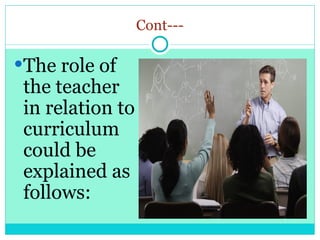
1.3 Teachers Roleand the Major
Curriculum Views
formal education is led by well designed curriculum
which is expected to be implemented by
teachers. Therefore, curriculum and teachers
have strong relationship.
56.
Cont---
Teachers canplay a great role on the curriculum
being :
implementers,
adopters,
developers,
researchers and
evaluators
57.
Cont---
where ascurriculum serves as the major source of
valuable information for the teacher concerning :
the overall purposes, objectives of instruction,
contents,
patterns of organization,
methods, techniques and strategies of instruction, etc.
1. Work asan instructional designer
Teachers may have focused on the learners’
developmental, emotional and affective needs in
their teaching. They may have focused on learner
critical thinking, problem-solving and collaborative
skills.
Research identified that teachers well-designed
learning activities that foster language use in
authentic and real life settings, can support learner’s
needs and facilitate deep learning.
60.
2. Work asan intercultural practitioner
The role of teachers, as an intercultural practitioner,
is first to analyze a culture, its concepts and
keywords, and then to introduce and explain
them to learners by way of paraphrase or presenting
the affective behavior within a situation-oriented
approach, and finally to step back and let learners
discover and interpret the meanings for themselves.
(primarily for language and culture teachers)
61.
3. Work withtheir colleagues to adapt the
curricular standards to their own teaching:
Researchers found that there are two ways helpful for a
teacher’s professional development under the
mandated curriculum standards and testing system:
1) careful study of the curriculum materials that
were authoritatively, specifically, and
consistently structured;
2) and continuous and substantial participation
in the collaborative observations, discussions,
and reflections on each other’s lesson
development, teaching, and lesson debriefing
in schools.
62.
4. Work asan effective room manager:
Classroom management is not separated from academic
curriculum. A successfully designed and implemented
curriculum cannot do without effective classroom management
strategies.
Chinese researchers suggested teachers:
set explicit rules,
give punishment and award appropriately,
give students some control in a limited range,
set up teacher’s authority via respect,
develop mutual trust and positive relationships with students,
and
communicate with the parents.
63.
5. Work withparents and community in
designing your schoolwork and homework:
classroom is not the only place to learn curriculum.
So the school work needs to be connected to what
students can learn at home and make their
learning an integrated and consolidated daily
experience.
In that sense, homework needs to be considered
in our curricular design. And the parents’
involvement is vital for this process.
Teachers need work with parents and make use
of varied and meaningful homework to help
students engage in goal-directed learning.
64.
Here are someexamples of how to involve
parents in schoolwork and homework:
1. Objectives: explains the learning goals of the
activity, if this is not clear from the title or letter.
2. Prewriting: gives the student space to plan a
letter, essay, story, or poem by outlining,
brainstorming, listing, designing nets and webs,
or by using other planning strategies.
65.
Cont---
3. First draft:gives the student space to write and
edit. A student who needs more space may add
paper. Some teachers ask the student to write a final
copy on other paper at home or at school.
4. Interactions: guides the student to conduct a
family survey or interview, talk with a family partner
about ideas or memories, read work aloud for
reactions, edit work, practice a speech, or conduct
other interactions. Other assignments include
exchanges focused on grammar, vocabulary, reading,
and other language arts skills.
66.
1.4 The Needand Purposes of Curriculum
Knowledge and the Teacher
The knowledge of curriculum is important to make
educational discussions and decisions at different
levels. Decision makers, officials and teachers need
to know and share experiences in order to provide
quality, equity and relevant education for all.
There is a strong relationship between curriculum
and instruction. This relationship between
curriculum and instruction could be explained
in the following four different models.
67.
Cont---
Dualistic Model:This model views the
relationship between curriculum and instruction as
two independent entities with very minor
interaction.
Cont---
Concentric Model:This model considers
curriculum and instruction as system and
subsystem interchangeably.
70.
Cont---
Cyclical Model:this model considered the
relationship between curriculum and instruction as
interdependent having significant impacts on each
other.
71.
Cont---
Therefore, curriculumand instruction are related,
interlocked and interdependent, which of course can
be studied and analyzed as separate entities.
However, they cannot function in mutual isolation.
Therefore, teachers’ knowledge on curriculum
will help them to implement the curriculum
on the actual ground effectively.
72.
Unit Two: CurriculumDevelopment and
the Planning Process
Learning outcomes:
After successful study of this unit, you will be able
to:
Define the concepts curriculum development and
design
Explain major qualities of curriculum design
Identify the six major principles of effective
curriculum design
Elaborate the major curriculum development
models
73.
Cont---
Outline themajor criteria used to select curriculum
contents
Explain the major elements used to organize
curriculum contents and learning experiences
Develop curriculum evaluation skills
Provide Comments on the different curriculum
development models.
74.
2.1 Meaning ofCurriculum Development
and Design
Curriculum Development :-can also be articulated as a
series of steps, such as:
define educational purposes;
selection of contents and learning experiences;
organizing of contents and learning experiences;
Construct activities/experiences that can meet these
purposes;
Evaluate whether the educational purposes have been
met or not.
75.
Cont---
Generally, asa process, curriculum development is
concerned with reviewing, planning,
developing, implementing and maintaining
curriculum while ensuring that the
stakeholders engaged in this process have a high
level of commitment to and ownership of the
curriculum.
76.
Curriculum Design
Taba(1962) defines curriculum design as a
statement which identifies the elements of the
curriculum, states what their relationships are to
each other, and indicates the principles of
organization and the requirements of that
organization for the administrative conditions under
which it is to operate.
77.
Cont---
When curriculumis planned those who construct the
curriculum may place different emphases on these
component parts of the curriculum. Usually more
emphasis is placed on the subject matter.
Designs also deals with Horizontal and Vertical
Organization of the curriculum component parts.
Whereas horizontal organization deals with scope
and integration: side-by-side arrangement of
activities;
vertical organization deals with sequence and
continuity: longitudinal placement of activities.
78.
Summary of theSix Principles of Effective
Curriculum Design
1. Big Ideas: Limit the number of new concepts
introduced in a lesson, and focus first on the most
basic concepts before advancing to the more
complex concepts. Be sure that students
understand one concept before introducing the
second.
2. Conspicuous Strategies : Use clear models to
teach basic concepts. Use simple language.
79.
Cont---
3. Mediated Scaffolding
Limit the number of concepts introduced, and
separate those that are likely to be confused. To
reduce the language demands, refrain from
introducing two new and unfamiliar labels in one
day. It is also important to provide sufficient guided
practice for the group before progressing to
individual turns.
80.
Cont---
4. Strategic Integration
When the basic concepts are reliably known by
learners, introduce comparative and superlative
concepts strategically to build higher-order skills.
Higher order skills will not be useful or reliable if the
basic concepts are not firm.
5. Judicious Review: To really "know" a concept,
students must use it frequently and in a variety of
concepts. Lessons following the initial lesson should
apply new concepts to build up the students' ability
to remember and recall the concepts.
81.
Cont---
6. Primed BackgroundKnowledge
It is also important to ensure that students have the
prerequisite knowledge before using that knowledge
in more complex contexts
82.
Attributes of CurriculumDesign
1. Curriculum design is purposeful
It is not just to “have” a course of study. Its grand
purpose is to improve student learning, but it may
have other purposes as well. Whether the purposes
are in harmony or in conflict, explicit or implied,
immediate or long-range, political or technical,
curriculum designers do well to be as clear as
possible about what the real purposes are, so that
they can respond accordingly
83.
Cont---
2.Curriculum design isdeliberate.
To be effective, curriculum design must be a
conscious planning effort. It is not casual, nor is it
the sum total of lots of different changes being made
in the curriculum over weeks, months, and years. It
involves using an explicit process that identifies
clearly what will be done, by whom, and when.
84.
Cont---
3. Curriculum designis creative.
Curriculum design is not a neatly defined procedure
that can be pursued in a rigorous series of steps. At
every stage of curriculum design there are
opportunities for innovative thinking, novel
concepts, and invention to be introduced. Good
curriculum design is at once systematic and creative
—feet-on-the ground and head-in-theclouds
85.
Cont---
4. Curriculum designoperates on many levels.
Design decisions at one level must be compatible
with those at the other levels. A middle-school
curriculum design that is incompatible with the
elementary- and high-school designs will almost
certainly result in a defective K-12 curriculum, no
matter how good each part is on its own. By the same
token, the middle-school curriculum itself cannot be
effective as a whole unless the designs of its grades
are in harmony.
86.
Cont---.
5.Curriculum design requirescompromises
The challenge is to come up with a curriculum that
works well—perfection is not its aim.
In developing a design that meets complex
specifications, trade-offs inevitably have to be made
among benefits, costs, constraints, and risks.
No matter how systematic the planning or how
inventive the thinking, curriculum designs always
end up not being everything that everyone would
want.
87.
Cont---
6.Curriculum designs canfail.
A design can fail because one or more of its components
fail or because the components do not work well
together.
Or, the people who have to carry it out may reject the
design because they misunderstand it or find it
distasteful.
In most cases, however, curriculum designs are neither
wholly satisfactory nor abject failures.
Indeed, a key element in curriculum design is to provide
for continuous correction and improvement, both during
the design process and afterward.
88.
Cont---
8.Curriculum design hasstages
The stages, which are considered in turn in the rest
of this chapter, are establishing curriculum-design
specifications conceptualizing a curriculum design;
developing a curriculum design; and refining a
curriculum design.
89.
2.2 Curriculum DevelopmentModels
1. The Objective Model
known as rational, classical models
Its root is the behavioral psychology
emphasize the fixed sequence of curriculum
elements, beginning with objectives and
following a sequential pattern from objectives to
content, method and finally evaluation.
The two principal proponents of objectives models
are Ralph Tyler and Hilda Taba.
90.
Tyler’s Model
Tyler arguedthat to develop any curriculum, one had
to pose the following four fundamental questions.
1. What educational purpose that schools seek to
attain? (Objectives).
2. What educational experiences can be provided that
are likely to attain these objectives? (Instructional
strategies and content)
91.
Cont---
3. How canthese educational experiences be organized
effectively? (Organizing curriculum
experiences)
4. How can we determine whether these purposes are
being attained? (Assessment and Evaluation)
Tyler Sometimes referred to as the father of the
curriculum movement.
92.
Cont---
Tyler describesand analyses sources of objectives
that come from learners, studies of
contemporary life, academic subjects,
philosophy and the psychology of learning.
In general, Tyler has viewed curriculum planning as
a four step process. These are:
Step 1: Formulation of objectives ;
Step 2: Selection of contents and learning
experiences ;
Step 3: Organization of contents and learning
experiences;
Step 4: Evaluation
93.
Cont---
Study of thelearners: According to Tyler, before
the formulation of educational objectives, the
needs, interests and background of the
learners should be carefully investigated. Based on
the investigation, what the learners lack or do
not have are made to be part of the educational
objectives.
94.
Cont---
Study of thecontemporary life: Tyler
recommends that major activities of the world of
work, significant problems, demands and
trends of the society need to be systematically
studied and incorporated in the objectives of the
school curriculum.
Suggestions from subject matter specialists:
Since subject specialists are experts or professionals,
their suggestions could be utilized in the
formulation of objectives.
95.
The two ScreeningDevices of Objectives
1. philosophical screening: helps to select the
objectives in terms of what is good and valuable
to learn.
2. psychological screening: helps to select
objectives that are appropriate in terms of the nature
and process of learning and in relation to the needs
and maturity levels of the learners.
Tyler’s model is known as simplified and linear.
96.
Taba’s Model:
HildaTaba proposed a seven steps approach to the
process of curriculum design and development in
1962.
The model proposed by her gives priority to the
needs of the students and the procedure of
curriculum development begins with the diagnosis of
needs.
97.
The steps asTaba perceives it are:
Step 1: Diagnosis of needs
Step 2: Formulation of objectives
Step 3: Selection of content
Step 4: Organization of content
Step 5: Selection of learning experiences
Step 6: Organization of learning experiences
Step 7: Evaluation (Determination of what to evaluate
and ways and means of doing it.)
98.
Cont---
Same asthe Tyler’s model except some difference like the
following:
i. Taba included diagnosis of needs
ii. She treated contents and learning experiences
separately in terms of both the selection and
organization.
iii.Taba also capitalizes the interdependence and
interrelatedness of the various elements involved in
the development of curriculum.
iv.Taba stressed the relationship among the factors of the
model in contents and learning experiences.???
99.
Cont---
In general,she included in her model the
fundamental elements of curriculum such as:
objectives, contents, learning experiences
organization and evaluation.
100.
Wheeler’s Model
Basically,Wheeler used the fundamental elements of
the curriculum processes as suggested by Tyler.
But, Wheeler considered Tyler’s approach is linear
and argues that curriculum development is a
continuous process.
Thus, the activities involved in the planning need to
be interrelated in a continuous and cyclical form.