PLEADINGS
Gaurav Pathak
WHAT ARE PLEADINGS?
■ A “pleading” means a plaint or a written statement. The underlying object of
pleadings is to ascertain the real dispute between the parties, to narrow down the
areas of conflict, to make each side aware of the questions which are to be argued,
to preclude one party from taking the other by surprise and to prevent miscarriage of
justice.
ALTERNATIVE AND INCONSISTENT
PLEADINGS
■ “Alternative pleading” refers to a form of pleading by which a pleader sets forth two or more statements, by way of claim or defence,
which are not necessarily consistent with each other. “Inconsistent pleadings” refers to statements made in a plaint or a written
statement that are mutually repugnant or contrary to one another so that the acceptance or establishment of one implies the
abrogation of the other.
■ The Code of Civil Procedure, 1908 does not contain any provisions to prevent a party from making two or more inconsistent sets of
allegations and claiming relief under them in the alternative. Thus, a plaintiff can institute a suit for possession on the ground of
title or alternatively on the basis of a lease. Similarly, a landlord can claim possession on the ground of personal requirement of the
property or, in the alternative, for non-payment of rent. Again, a person may claim specific performance of an agreement or
damages for breach of contract. A defendant may put up a defence of claim of ownership or an easement in a suit for possession of
property. Similarly, a defendant may plead that the document relied upon by the plaintiff to prove his claim is either forged or,
alternatively, has been executed under undue influence or coercion. He may plead denial of contract or in the alternative that the
contract is one of wagering and hence opposed to public policy.
■ However, all inconsistent pleas must be maintainable at law. For example, a plaintiff
cannot claim a declaration that a contract is void and in the alternative claim
specific performance of the same contract as it is not permissible under law. Also, a
court may strike out inconsistent pleas if it is of the opinion that they may embarrass
the fair trial of the suit. Finally, once a party has taken a definite stand and the court
has proceeded to decide the matter on that basis, he cannot turn round and raise
an inconsistent plea.
VARIANCE BETWEEN PLEADINGS AND
PROOF
■ A party cannot adduce evidence and set up a case inconsistent with his pleadings. No amount of proof can substitute
pleadings which are the foundation of a claim of a litigating party. The rationale behind the above rule is to appraise the
opposite party, distinctly and specifically, of the case he is called upon to answer, so that he may properly prepare his
defence, and to preserve an accurate record of the cause of action as a protection against a second proceeding founded
upon the same allegations.
■ However, where there is foundation in the pleading and there is no prejudice to the other side a party cannot be denied
just relief. Whether or not, a particular plea has been raised must be decided by reading the pleading of a party as a
whole and considering the substance and not the form of pleadings. Where the parties go to trial with the knowledge
that a particular question is at issue absence of a specific pleading is merely an irregularity.
BASIC RULES OF PLEADINGS
■ The basic rules of pleadings are as follows:
■ every pleading must contain, and contain only, a statement in a concise form of the
material facts on which the party pleading relies for his claim or defence, as the
case may be, but not the evidence by which they are to be proved;
■ every pleading must, when necessary, be divided into numbered paragraphs with
each allegation being, so far as is convenient, contained in a separate paragraph;
■ dates, sums and numbers in a pleading must be expressed in figures as well as in
words
PLEAD FACTS, NOT LAW
■ The first basic principle of pleadings is that they should contain facts and only facts, and not law. The duty
of a party, or his pleader, is to set out the facts upon which he relies and not the legal inference to be
drawn from them, as it is for the courts to apply the law to the stated facts.
■ Examples of facts that may be pleaded are (1) the existence of a custom; (2) negligence; (3) in a suit for
specific performance of an agreement, willingness on the part of the plaintiff to perform his part of the
agreement.
■ However, the maintainability of a suit or an appeal is a point of law and need not be pleaded. Similarly, in
a suit for the recovery of a debt from the sons of a Hindu after his demise, it is not necessary to formulate
the doctrine of Hindu law regarding the pious obligation of sons to repay their father’s debt. Also the
construction of a document need not be pleaded as it is a point of law.
BREVITY IS THE KEY, MATERIAL FACTS
ONLY
■ The second basic rule of pleadings is that they should state material facts only. “Material facts” means all
facts upon which the plaintiff’s cause of action or the defendant’s defence depends.
■ Material facts differ from the particulars of a case. While material facts are the primary and basic facts
which must be pleaded by a party in support of the case set up by him, since in the absence of pleadings
a party cannot be permitted to lead evidence and failure to state material facts will result in the dismissal
of a suit, particulars are the details of the case set up by a party so as to amplify, refine and embellish the
material facts.
■ The distinction between material facts and particulars is one of degree. Whether a particular fact is a
material fact, and hence must be pleaded, depends on the facts and circumstances of the case.
■ The third important rule is that every pleading must contain only a statement of the material facts on which the party
relies (facta probanda) and not the evidence by which those material facts are to be proved (facta probantia).
■ For example, where a suit is instituted against an insurance company against a life policy of A and one of the conditions
provided that the policy would be void if the insured committed suicide, the company must only plead that A committed
suicide and not that A was melancholy for weeks and that he bought a pistol and shot himself. Similarly, in an election
petition, the material fact which must be pleaded is that the returned candidate used cars for carrying voters contrary to
election law and not facts such as from whom the cars were obtained, who were the voters carried in those cars and the
names of the booths and divisions where they were taken.
■ However, what are material facts and what is evidence depends on the facts and circumstances of every case.
CONCISE
■ Pleadings must be concise and precise. A concise form of pleading is important so
as to ensure that the defendant is not taken by surprise at the trial or be kept
guessing as to what the plaintiff intends to convey by means of a vague or
ambiguous pleading.
■ Other rules of pleadings, dealing with special situations, are as follows.
• The forms given in the Code of Civil Procedure, 1908 must be used when applicable, and where they are not applicable,
forms of similar character must be used for all pleadings.
• In cases where a party relies on misrepresentation, fraud, breach of trust, wilful default or undue influence and in all
other cases in which particulars may be necessary beyond such as are exemplified in the forms provided for in the Code,
particulars, with dates and items if necessary, must be stated in the pleading. Although what particulars are to be stated
depends on the facts of each case, as a general rule as much certainty and particularity must be inserted as is
reasonable having regard to the circumstances and to the nature of the acts.
• Any condition precedent, the performance or occurrence of which is intended to be contested, must be distinctly
specified in the pleadings and an averment of the performance or occurrence of all conditions precedent necessary for
the case must be implied in the pleadings.
• No pleading may, except by way of an amendment, raise any new ground of claim or contain any allegation of fact
inconsistent with the previous pleadings of the party pleading them.
• Where a contract is alleged in any pleading, a bare denial of it by the opposite party will be construed only as a denial in fact of
the express contract alleged or of the matters of fact from which the contract may be implied and not as a denial of the legality or
sufficiency in law of such contract.
• Where the contents of a document are material, it is sufficient to state in the pleadings their effect briefly without setting out the
whole or any part of it unless the precise words of the document are material.
• Where it is material to allege malice, fraudulent intention, knowledge or any other condition of the mind of a person it is sufficient
to allege it as a fact without setting out the circumstances from which it is to be inferred.
• Where it is material to allege notice to a person of any fact, matter or thing it is sufficient to allege the notice as a fact unless the
form or the precise terms of such notice or the circumstances from which it is to be inferred are material.
• Where a contract or any relation between certain persons is to be implied from a series of letters or conversations or otherwise
from a number of circumstances, it is sufficient to allege such contract or relation as a fact and to refer generally to such letters,
conversations or circumstances without setting them out in detail, and if the person so pleading desires to rely, in the alternative,
upon more contracts or relations than one as to be implied from the circumstances, he may state so in the alternative.
INTERPRETATION
■ Pleadings must be interpreted liberally with emphasis being paid to the substance of
the matter rather than to the form of the pleadings.
■ They must be read as a whole and no part of a pleading ought to be interpreted out
of context and in isolation.
STRIKING OUT
■ The court may, at any stage of the proceedings, order a matter in a pleading which
■ (1) may be unnecessary, scandalous, frivolous or vexatious; or
■ (2) may tend to prejudice, embarrass or delay the fair trial of a suit; or
■ (3) is otherwise an abuse of the process of the court,
to be struck out or amended. However, the court must exercise this power sparingly and
with great care and circumspection.
SIGNING AND VERIFICATION
■ A party and his pleader, if any, must sign every pleading. However, where a party pleading is, owing to absence or for other good
cause, unable to sign a pleading it may be signed by a person duly authorised by him to sign it or to sue or defend on his behalf.
■ Except as provided under any law for the time being in force, every pleading must be verified at the foot by a party or by one of the
parties pleading or by some other person proved to the satisfaction of the court to be acquainted with the facts of the case. The
person verifying must specify, by reference to the numbered paragraphs of the pleading, what he verifies of his own knowledge
and what he verifies upon information received and believed to be true. The verification must be signed by the person making it
and must state the date on which and the place at which it was signed. The person verifying the pleading must also furnish an
affidavit in support of his pleadings.
■ The object of verification of pleadings is to fix liability upon the party verifying the pleadings for the statements made in them.
■ A defect in the matter of signing and verification of pleading is merely an irregularity and can be corrected later on. The court has
to give an opportunity to the party to sign verify and file proper affidavit.
SERVICE AND NOTICE
■ Every pleading when filed by a party must be accompanied by a statement in the prescribed form, duly signed, regarding the address of the party. The address may
be changed, from time to time, by filing a form stating the new address of the party and accompanied by a verified petition. The address furnished in the statement
is called the registered address of a party and is deemed until duly changed to be the address of the party for the purpose of service of all processes in the suit or in
an appeal from any decree or order and for the purpose of execution and holds good for a period of two years after the final determination of the cause or matter.
■ Service of any process may be effected upon a party at his registered address in all respects as though that party resided there. Where the registered address of a
party is found by the court to be incomplete, false or fictitious, the court may, either on its own motion or on the application of any of the parties, order the stay of the
suit.
■ Where the registered address was furnished by the plaintiff, or where the registered address was furnished by a defendant, order his defence to be struck out and
he be placed in the same position as if he had not put up a defence. Where a suit is stayed or a defence struck out, the plaintiff or the defendant, as the case may
be, may, after furnishing his true address, apply to the court for an order to set aside the order of stay or the striking out of the defence.
■ If the court is satisfied that a party was prevented by any sufficient cause from filing the true address at the proper time, it must set aside the order of stay or the
order striking out the defence, on such terms as to costs or otherwise as it thinks fit, and appoint a day for proceeding with the suit or the defence as the case may
be.
■ However, nothing in these provisions prevents a court from directing the service of a process at any other address if it thinks fit.
AMENDMENT OF PLEADINGS
■ A court may at any stage of the proceedings allow either party to alter or amend his pleadings in such manner and
on such terms as may be just, and all such amendments as are necessary for the purpose of determining the real
questions in controversy between the parties must be made. However, no application for amendment will be
allowed after the commencement of trial unless the court comes to the conclusion that, in spite of due diligence,
a party could not have raised the matter before the commencement of trial.
■ Amendments to pleadings must not cause injury, injustice or prejudice to the other party and a court must
exercise the discretionary power of allowing amendment of pleadings with care and circumspection.
ILLUSTRATIONS OF WHEN AMENDMENTS
MAY BE GRANTED OR REFUSED
■ Examples of cases in which the amendment of pleadings has been permitted include:
(1) to avoid multiplicity of suits;
(2) to describe the parties to the suit correctly;
(3) to include properties inadvertently left out;
(4) to include necessary averments left out of the plaint bona fide;
(5) to grant consequential relief;
(6) to give a different approach to the same facts;
(7) to take notice of subsequent events;
(8) to alter the formal nature of a plaint,
(9) to clarify the pleadings;
(10) where it was suggested by the court.
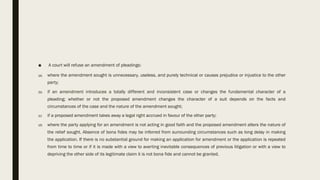
■ A court will refuse an amendment of pleadings:
(a) where the amendment sought is unnecessary, useless, and purely technical or causes prejudice or injustice to the other
party;
(b) if an amendment introduces a totally different and inconsistent case or changes the fundamental character of a
pleading; whether or not the proposed amendment changes the character of a suit depends on the facts and
circumstances of the case and the nature of the amendment sought;
(c) if a proposed amendment takes away a legal right accrued in favour of the other party;
(d) where the party applying for an amendment is not acting in good faith and the proposed amendment alters the nature of
the relief sought. Absence of bona fides may be inferred from surrounding circumstances such as long delay in making
the application. If there is no substantial ground for making an application for amendment or the application is repeated
from time to time or if it is made with a view to averting inevitable consequences of previous litigation or with a view to
depriving the other side of its legitimate claim it is not bona fide and cannot be granted.
APPEALS FROM ORDERS PERTAINING
TO AMENDMENT OF PLEADINGS
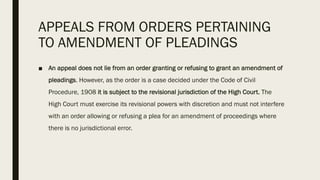
■ An appeal does not lie from an order granting or refusing to grant an amendment of
pleadings. However, as the order is a case decided under the Code of Civil
Procedure, 1908 it is subject to the revisional jurisdiction of the High Court. The
High Court must exercise its revisional powers with discretion and must not interfere
with an order allowing or refusing a plea for an amendment of proceedings where
there is no jurisdictional error.
EFFECT OF AMENDMENT OF
PLEADINGS
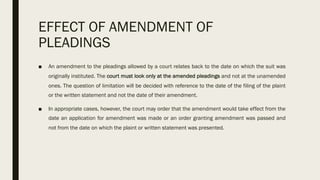
■ An amendment to the pleadings allowed by a court relates back to the date on which the suit was
originally instituted. The court must look only at the amended pleadings and not at the unamended
ones. The question of limitation will be decided with reference to the date of the filing of the plaint
or the written statement and not the date of their amendment.
■ In appropriate cases, however, the court may order that the amendment would take effect from the
date an application for amendment was made or an order granting amendment was passed and
not from the date on which the plaint or written statement was presented.
FAILURE TO AMEND PLEADINGS
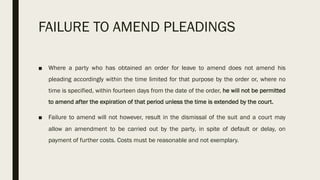
■ Where a party who has obtained an order for leave to amend does not amend his
pleading accordingly within the time limited for that purpose by the order or, where no
time is specified, within fourteen days from the date of the order, he will not be permitted
to amend after the expiration of that period unless the time is extended by the court.
■ Failure to amend will not however, result in the dismissal of the suit and a court may
allow an amendment to be carried out by the party, in spite of default or delay, on
payment of further costs. Costs must be reasonable and not exemplary.
WRITTEN STATEMENT
■ Although the Code of Civil Procedure, 1908 does not define a “written statement” it
may be described as a reply of the defendant to the plaint of the plaintiff. It is a
pleading of the defendant dealing with all the material facts set out in the plaint but
not the evidence by which those facts are to be proved. It may also contain new facts
in favour of the defendant or legal objections against the claim of the plaintiff.
RULES FOR DRAFTING WS
■ While drafting a written statement, a defendant must keep in mind the following rules.
■ The defendant must within thirty days from the date of service of the summons on him present a written statement of his defence. However, where the
defendant fails to file a written statement within the specified period of thirty days he will be allowed to file it on such other day as may be specified by
the court, for reasons to be recorded in writing, but which must not be later than ninety days from the date of service of the summons.
■ It has, however, been held that the provision relating to time limit (of ninety days) is directory and not mandatory.
■ Where the defendant bases his defence upon some document or relies upon any document in his possession or power in support of his defence or
claim for set-off or counter-claim he must enter such document in a list and produce it in court when the written statement is presented by him and
must at the same time deliver the document along with a copy, to be filed with the written statement. Where any such document relied upon is not in
the possession or power of the defendant he must, wherever possible, state in whose possession or power it is. A document which ought to be
produced in court by the defendant under these provisions but is not produced may not, without the leave of the court, be received in evidence on his
behalf at the hearing of the suit. These provisions do not apply to documents produced for the cross-examination of the plaintiff’s witnesses or handed
over to a witness merely to refresh his memory.
■ The defendant must raise by his pleading all matters which show the suit not to be maintainable or that the
transaction is either void or voidable in point of law, and all such grounds of defence as, if not raised, would be
likely to take the opposite party by surprise or would raise issues of fact not arising out of the plaint, such as
fraud, limitation, release, payment, performance, or facts showing illegality.
■ This is a rule of practice, convenience and justice. It is a procedural provision to subserve and not to enslave the
cause of justice. If a particular plea is not taken, it may lead the plaintiff to believe that the defendant has
waived his right on that point. Whether a plea has been raised in the written statement or not is a matter of
construction of the written statement.
■ A general denial by a defendant, in his written statement, of the grounds alleged by the plaintiff is not sufficient:
he must deal specifically with each allegation of fact of which he does not admit the truth, except damages.
■ However, if the plaintiff makes general allegations in the plaint they can be denied generally in the written
statement. For example, if it is stated in the plaint that the action of the defendant is discriminatory, it is
impossible for the defendant to meet it adequately unless he knows in what manner the discrimination is alleged
to have been made and hence a mere denial in the written statement of the allegation of the plaintiff is neither
vague nor evasive.
■ For deciding whether the allegations in the plaint have been denied or not, the
written statement is to be read as a whole.
■ Where a defendant denies an allegation of fact in the plaint, he must not do so
evasively, but answer the point of substance. Thus, if it is alleged that he received a
certain sum of money, it is not sufficient to deny that he received that particular
amount, but he must deny that he received that sum or any part of it or else set out
how much he received. If an allegation is made with diverse circumstances it will not
be sufficient to deny it along with those circumstances.
■ Every allegation of fact in the plaint, if not denied specifically or by necessary
implication or stated to be not admitted in the pleading of the defendant, will be
regarded as admitted except as against a person under a disability. However, the
court may in its discretion require any fact so admitted to be proved otherwise than
by such admission.
■ This is an exception to the general rule of evidence that a fact which is admitted
need not be proved. In construing pleadings, the proviso must be invoked only in
exceptional circumstances, so as to prevent obvious injustice to a party or to relieve
him from the results of an accidental slip or omission, and not to help a party who
deliberately made vague denials and thereafter sought to rely upon them for non-
suiting the plaintiff.
■ Where the defendant has not filed a pleading, the court may pronounce judgment
on the basis of the facts contained in the plaint, except as against a person under a
disability, but it may, in its discretion, require the facts to be proved. Whenever such
a judgment is pronounced, a decree must be drawn up in accordance with the
judgment and the decree must bear the date on which the judgment was
pronounced.
■ In exercising its discretion relating to specific denial under the Code of Civil
Procedure, 1908, the court must give due regard to whether the defendant could
have, or has, engaged a pleader.
GROUNDS OF DEFENCE IN WS
■ Where the defendant relies upon several distinct grounds of defence or set-off or
counter-claim founded upon separate and distinct facts, they must be stated, as far
as may be, separately and distinctly.
■
This provision is intended to prevent the trial being embarrassed from want of clear
and categorical grounds in the written statement.
■ A ground of defence arising after the institution of a suit or the presentation of a
written statement claiming a set-off or counter-claim, may be raised by the
defendant or plaintiff, as the case may be, in his written statement.
■ This provision seeks to shorten the litigation and to do complete justice between the
parties by avoiding multiplicity of proceedings.
SUBSEQUENT PLEADINGS IN WS
■ No pleading subsequent to the written statement of a defendant, other than by way
of defence to a set-off or counter-claim, may be presented except by the leave of the
court and upon such terms as the court thinks fit, but the court may at any time
require a written statement or additional written statement from any of the parties
and fix a time of not more than thirty days for its presentation.
■ The primary object of the subsequent pleading is to supply what might have been
omitted inadvertently or unintentionally in the pleading of the opposite party.
FAILURE TO PRESENT WS
■ Where a party from whom a written statement is required fails to present it within
the time permitted or fixed by the court, the court must pronounce judgment against
him or make such order in relation to the suit as it thinks fit and on the
pronouncement of such judgment a decree must be drawn up.
■ The provision has been held to be discretionary. The words “or make such order in
relation to the suit as it (court) thinks fit” confer discretion on the court not to
pronounce judgment against the defendant even if he has not filed a written
statement.
SET OFF
■ “Set-off” means a claim set against another. It is a cross-claim which partly offsets the original
claim. It is an extinction of the debts of which two persons are reciprocally debtors to one another
by the credits of which they are reciprocally creditors to one another. Where there are mutual debts
between the plaintiff and the defendant one debt may be set against the other. In other words, it is
a reciprocal acquittal of debts between two persons.
■ When a defendant pleads set-off, he is in the position of the plaintiff to the extent of the amount
claimed by him. The right of the defendant in a set-off is independent, and even if the suit of the
plaintiff is dismissed, for default or by withdrawal or on merits or otherwise, it does not affect the
claim of set-off put forward by the defendant and a decree may be passed in his favour if he is able
to substantiate his claim. Although there are two cross suits, one by the plaintiff against the
defendant and the other by the defendant against the plaintiff, no separate suit number is given to
a set-off.
LEGAL SET OFF
■ The Code of Civil Procedure, 1908 makes the following specific provision with regard
to set-offs.
■ 1. Particulars of a set-off to be given in the written statement. Where in a suit for the
recovery of money, the defendant claims to set off against the plaintiff’s demand
any ascertained sum of money legally recoverable by him from the plaintiff, not
exceeding the pecuniary limits of the jurisdiction of the court, and both the parties
fill the same character as they fill in the plaintiff’s suit, the defendant may, at the
first hearing of the suit, but not afterwards unless permitted by the court, present a
written statement containing the particulars of the debt sought to be set off.
■ 2. Effect of a set-off. The written statement will have the same effect as a plaint in a
cross-suit so as to enable the court to pronounce a final judgment in respect of both
the original claim and the set-off, but this will not affect the lien upon the amount
decreed, of any pleader, in respect of the costs payable to him under the decree.
■ 3. Rules relating to a written statement to apply. The rules relating to a written
statement by a defendant apply to a written statement in answer to a claim of set-
off.
EQUITABLE SET OFF
■ The Code of Civil Procedure, 1908 contains provisions dealing with legal set-off and
their application is limited to ascertained sums of money only. But equitable set-off
has also been allowed by the courts, where the claim may be in respect of
unascertained sum of money. Thus, where cross-claims arise out of one and the
same transaction or are connected with each other in such a manner that they can
be considered as one transaction, the defendant can be allowed to plead set-off
although the amount may not be ascertained.
■ However, equitable set-off cannot be claimed by a defendant if he has filed a
substantive suit against the plaintiff and it has been dismissed by a competent
court.
DISTINCTION BETWEEN LEGAL AND
EQUITABLE SET-OFF
■ Legal set-off and equitable set-off have the following distinctions.
■ Legal set-off must always be for an ascertained sum of money whereas equitable set-off may be
allowed even for an unascertained sum of money.
■ Legal set-off can be claimed as of right and the court must adjudicate upon it. Equitable set-off
cannot be claimed as a matter of right and the court may refuse to entertain it.
■ In a legal set-off, cross-demands need not arise from the same transaction. But an equitable set-
off can be allowed only when cross-demands arise out of the same transaction.
■ In a legal set-off, the amount must be legally recoverable. However, an equitable set-off may be
allowed even if the amount is time barred, if there exists a fiduciary relationship between the
parties.
■ In the case of a legal set-off the court fee must be paid, but no court fee has to be paid in the case
of an equitable set-off.
COUNTER CLAIM
■ A “counter-claim” is a claim made by a defendant in a suit against a plaintiff. It is a claim, independent of
and separable from the plaintiff’s claim, which can be enforced by a cross-action. It is a cause of action in
favour of the defendant against the plaintiff. The defendant, in his counter-claim, may ask for any relief to
which he is entitled. Thus, in a suit for an injunction, the court may allow a counter-claim of possession by
the defendant. For example, when A has a claim of any land against B and brings an action to enforce
that claim, and B has a cross-claim of any kind against A which he is entitled to raise and have disposed
of in the action brought by A, B is said to have a right of counter-claim.
■ As a counter-claim is a creation of a statute, in the absence of statutory provisions, it is not admissible.
■ The provisions relating to counter-claim seek to save time of the courts, exclude inconvenience caused to
parties to litigation and decide all the disputes avoiding unnecessary multiplicity of judicial proceedings
and prolonged trials.
■ The Code of Civil Procedure, 1908 provides for the following rules pertaining to counter-claims.
■ 1. Counter-claim by defendant. A defendant in a suit may, in addition to his right of pleading a set-off,
set up, by way of a counter-claim against the claim of the plaintiff, any right or claim in respect of a
cause of action accruing to the defendant against the plaintiff either before or after the filing of the suit
but before the defendant has delivered his defence or before the time limited for delivering his defence
has expired, whether such counter-claim is in the nature of a claim for damages or not. However, the
counter-claim must not exceed the pecuniary limits of the jurisdiction of the court.
■ The counter-claim will have the same effect as a cross-suit so as to enable the court to pronounce a
final judgment in the same suit, both on the original claim and on the counter-claim. The plaintiff may
file a written statement in answer to the counter-claim of the defendant within such period as may be
fixed by the court. The counter-claim is treated as a plaint and governed by the rules applicable to
plaints.
■ 2. Counter-claim to be stated. Where a defendant relies upon certain grounds for supporting a right of
counter-claim he must specifically state in his written statement that he does so by way of a counter-
claim.
■ 3. Exclusion of counter-claim. Where a defendant sets up a counter-claim and the plaintiff contends
that the claim thus raised ought not to be disposed by way of counter-claim but in an independent
suit, he may, at any time before the issues in relation to the counter-claim are settled, apply to the
court for an order that the counter-claim be excluded, and the court may, on the hearing of the
application, make such order as it thinks fit.
■ 4. Effect of discontinuance of suit. A counter-claim set up by a defendant may continue even if the
suit of the plaintiff is stayed, discontinued or dismissed.
■ 5. Default of plaintiff to reply to counter-claim. If a plaintiff defaults in replying to the counter-claim
made by the defendant, the court may pronounce judgment against the plaintiff in relation to the
counter-claim made against him or make such order in relation to the counter-claim as it thinks fit.
■ 6. Relief to defendant where counter-claim succeeds. Where in any suit a set-off or counter-claim is
established as a defence against the plaintiff’s claim and any balance is found due to the plaintiff
or the defendant, as the case may be, the court may give a judgment in favour of the party entitled
to the balance.
■ 7. Rules relating to a written statement to apply. The rules relating to a written statement by a
defendant apply to a written statement filed in answer to a counter-claim.
DISTINCTION BETWEEN SET-OFF AND
COUNTER-CLAIM
■ The differences between set-off and counter-claim are as follows.
■ A set-off is a statutory defence whereas a counter-claim is a cross-action.
■ A set-off is for an ascertained sum or arising from the same transaction as the claim while a
counter-claim is an independent action.
■ A set-off is a ground of defence which affords an answer to the plaintiff’s entire claim. On the other
hand, a counter-claim is a method by which the defendant can enforce the claim against the
plaintiff.
■ In the case of a set-off, the amount must be recoverable at the date of the institution of the suit
while in counter-claim, the amount must be recoverable at the date of the filing of the written
statement.
■ When the defendant makes a demand for an amount below or up to the suit claim, it is a set-off
stricto sensu. When it is for a larger amount, the claim for the excess amount is really a counter-
claim.
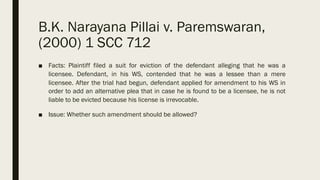
B.K. Narayana Pillai v. Paremswaran,
(2000) 1 SCC 712
■ Facts: Plaintiff filed a suit for eviction of the defendant alleging that he was a
licensee. Defendant, in his WS, contended that he was a lessee than a mere
licensee. After the trial had begun, defendant applied for amendment to his WS in
order to add an alternative plea that in case he is found to be a licensee, he is not
liable to be evicted because his license is irrevocable.
■ Issue: Whether such amendment should be allowed?
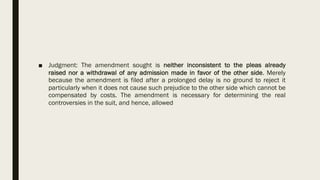
■ Judgment: The amendment sought is neither inconsistent to the pleas already
raised nor a withdrawal of any admission made in favor of the other side. Merely
because the amendment is filed after a prolonged delay is no ground to reject it
particularly when it does not cause such prejudice to the other side which cannot be
compensated by costs. The amendment is necessary for determining the real
controversies in the suit, and hence, allowed
Rajesh Kumar Aggarwal v. KK Modi,
(2006) 4 SCC 385
■ Facts: An Officers’ Welfare Trust formed for the general benefit of the employees of a
Company purchased 58000 equity shares of Godfrey Philips (GPI) which were held in the
name of the Trustee who had opened a separate bank account in his own name and not
in the name of the Trust. Any share certificates issued by GPI were not being received by
the beneficiaries nor any bonus shares were forwarded to them.
■ Procedural History: Not being able to derive any benefit from the Trust, beneficiaries filed
a suit for declaration, and permanent and mandatory injunction against the Trustee.
Later, they sought to amend their plaint to incorporate the relief of directing the
defendants to sell the shares of GPI held by the Trust and use the sale proceeds for the
benefit of the beneficiary-employees.
■ Issue: Whether such amendment should be allowed?
■ Judgment: The first part of Order 6 Rule 17 is discretionary which leaves it to the
court to allow amendment of pleading at any stage of the suit. The second part,
however, is imperative and enjoins the court to allow all such amendments which
are necessary for determining the real questions in controversy between the parties
(here, for the interest of the beneficiaries of the Trust as the Trustee was in exclusive
possession of the shares of GPI and on the dividends and was still exercising voting
rights). Here, the proposed amendment does not change the nature of the suit and
there is no inconsistency with the relief claimed in original plaint. Considering these
reasons, and without going into the merits of the case in amendment, it was held
that if the same relief can be prayed for in the new suit, it can also be incorporated
in the pending suit.
Balraj Taneja v. Sunil Madan, (1998) 8
SCC 396
■ Facts & Procedural History: Sunil Madan (SM) filed a suit against Balraj Taneja (BT) in 1996 for
specific performance of an agreement for sale of a property entered into in 1992. BT appeared and
sought time to file WS which was granted. WS was not filed on the adjourned date as well, instead
further time was sought. One last opportunity was granted and the WS was not granted on that
date either.
■ The High Court then decreed the suit in favor of SM under Order 8 Rule 10 and directed him to
deposit the balance sale consideration within certain time after which he could apply for executing
the sale deed. The plaint of SM was not assessed by the court in passing this order. Both review
application and appeal by the other side were dismissed; therefore, they filed an SLP before the
Supreme Court.
■ Issue: Whether the High Court was right for issuing a decree under Order 8 Rule 10 without setting
out reasons?
■ Judgment: While enabling the court to pronounce judgment in a situation where no
WS is filed by the defendant, the Court has also been given the discretion to pass
any such order as it may think fit as an alternative. Thus, it is a matter of Court’s
satisfaction that in cases where no WS is filed, and if the Court feels no facts need
to be proved on account of deemed admission by the defendant, the Court can
conveniently pass a judgment against the Defendant who has not filed the WS. This
discretion is very wide in nature. Therefore, the court should not proceed blindly to
pass judgment merely because a WS has not been filed by the defendant traversing
the facts set out by the plaintiff. Even a decree under Order 8 Rule 10 must be
accompanied by a judgment, setting out facts and reasons for the decree being
issued
T Arivandanam v. T.V. Satyapal (1977) 4
SCC467
■ Facts & Procedural History: The petitioner who contested an eviction proceeding against him, lost
it, appealed against it, lost it again, moved a revision which was rejected by the High Court. He was
granted a 6 months time to vacate the premises. After this, he filed an application praying for
further time to vacate. Pending that proceeding, he filed a fresh suit for declaration that the order
of eviction has been obtained by fraud and collusion and sought an injunction against the
execution of that eviction order. The High Court granted another 5 months time to vacate the
premises on the basis that the suit for injunction would be withdrawn by the petitioner. After
withdrawing that, he filed another suit for ex parte injunction which was not granted, and the
appeal went unsuccessful. The petitioner then came to the High Court in revision which was
dismissed on merits. The petitioner undauntedly applied for an SLP.
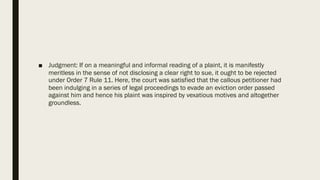
■ Issue: Whether the plaint is vexatious and meritless and ought to be rejected under Order 7 Rule
11?
■ Judgment: If on a meaningful and informal reading of a plaint, it is manifestly
meritless in the sense of not disclosing a clear right to sue, it ought to be rejected
under Order 7 Rule 11. Here, the court was satisfied that the callous petitioner had
been indulging in a series of legal proceedings to evade an eviction order passed
against him and hence his plaint was inspired by vexatious motives and altogether
groundless.
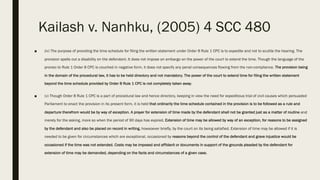
Kailash v. Nanhku, (2005) 4 SCC 480
■ (iv) The purpose of providing the time schedule for filing the written statement under Order 8 Rule 1 CPC is to expedite and not to scuttle the hearing. The
provision spells out a disability on the defendant. It does not impose an embargo on the power of the court to extend the time. Though the language of the
proviso to Rule 1 Order 8 CPC is couched in negative form, it does not specify any penal consequences flowing from the non-compliance. The provision being
in the domain of the procedural law, it has to be held directory and not mandatory. The power of the court to extend time for filing the written statement
beyond the time schedule provided by Order 8 Rule 1 CPC is not completely taken away.
■ (v) Though Order 8 Rule 1 CPC is a part of procedural law and hence directory, keeping in view the need for expeditious trial of civil causes which persuaded
Parliament to enact the provision in its present form, it is held that ordinarily the time schedule contained in the provision is to be followed as a rule and
departure therefrom would be by way of exception. A prayer for extension of time made by the defendant shall not be granted just as a matter of routine and
merely for the asking, more so when the period of 90 days has expired. Extension of time may be allowed by way of an exception, for reasons to be assigned
by the defendant and also be placed on record in writing, howsoever briefly, by the court on its being satisfied. Extension of time may be allowed if it is
needed to be given for circumstances which are exceptional, occasioned by reasons beyond the control of the defendant and grave injustice would be
occasioned if the time was not extended. Costs may be imposed and affidavit or documents in support of the grounds pleaded by the defendant for
extension of time may be demanded, depending on the facts and circumstances of a given case.