4_rp-HVPE2.x Harmony_Family. How much our family is important.pptx.pdf
1.
Harmony in theFamily
Understanding Relationship
– Justice
Mr.S.Muthuraj
Assist . Professor / IT
Sanjivani College of
Engineering
2.
2
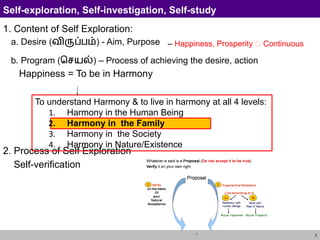
Self-exploration, Self-investigation, Self-study
1.Content of Self Exploration:
a. Desire (விருப்பம்) - Aim, Purpose
b. Program (ெசயல்) – Process of achieving the desire, action
Happiness = To be in Harmony
2. Process of Self Exploration
Self-verification
– Happiness, Prosperity 🡪 Continuous
To understand Harmony & to live in harmony at all 4 levels:
1. Harmony in the Human Being
2. Harmony in the Family
3. Harmony in the Society
4. Harmony in Nature/Existence
3.
3
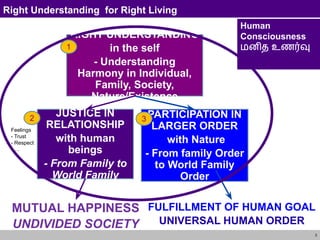
Right Understanding forRight Living
JUSTICE IN
RELATIONSHIP
with human
beings
- From Family to
World Family
PARTICIPATION IN
LARGER ORDER
with Nature
- From family Order
to World Family
Order
RIGHT UNDERSTANDING
in the self
- Understanding
Harmony in Individual,
Family, Society,
Nature/Existence
MUTUAL HAPPINESS
UNDIVIDED SOCIETY
FULFILLMENT OF HUMAN GOAL
UNIVERSAL HUMAN ORDER
3
2
1
Feelings
- Trust
- Respect
- …
Human
Consciousness
மனித உணர்வு
4.
4
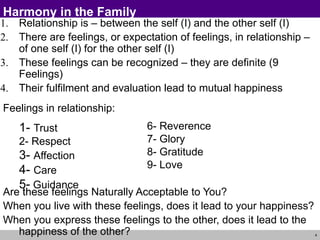
Harmony in theFamily
1. Relationship is – between the self (I) and the other self (I)
2. There are feelings, or expectation of feelings, in relationship –
of one self (I) for the other self (I)
3. These feelings can be recognized – they are definite (9
Feelings)
4. Their fulfilment and evaluation lead to mutual happiness
Feelings in relationship:
Are these feelings Naturally Acceptable to You?
When you live with these feelings, does it lead to your happiness?
When you express these feelings to the other, does it lead to the
happiness of the other?
1- Trust
2- Respect
3- Affection
4- Care
5- Guidance
6- Reverence
7- Glory
8- Gratitude
9- Love
5.
5
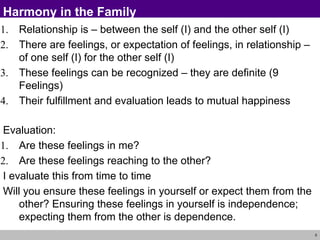
Harmony in theFamily
1. Relationship is – between the self (I) and the other self (I)
2. There are feelings, or expectation of feelings, in relationship –
of one self (I) for the other self (I)
3. These feelings can be recognized – they are definite (9
Feelings)
4. Their fulfillment and evaluation leads to mutual happiness
Evaluation:
1. Are these feelings in me?
2. Are these feelings reaching to the other?
I evaluate this from time to time
Will you ensure these feelings in yourself or expect them from the
other? Ensuring these feelings in yourself is independence;
expecting them from the other is dependence.
6.
6
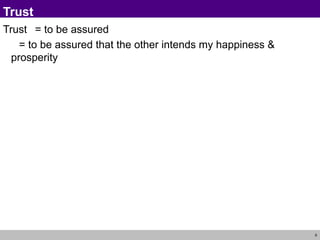
Trust
Trust = tobe assured
= to be assured that the other intends my happiness &
prosperity
7.
7
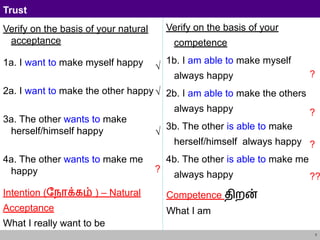
Verify on thebasis of your natural
acceptance
1a. I want to make myself happy
2a. I want to make the other happy
3a. The other wants to make
herself/himself happy
4a. The other wants to make me
happy
Verify on the basis of your
competence
1b. I am able to make myself
always happy
2b. I am able to make the others
always happy
3b. The other is able to make
herself/himself always happy
4b. The other is able to make me
always happy
Trust
Intention (ேநாக்கம் ) – Natural
Acceptance
What I really want to be
Competence திறன்
What I am
√
?
?
?
??
?
√
√
8.
8
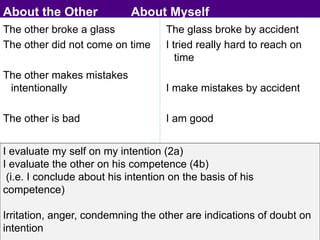
The other brokea glass
The other did not come on time
The other makes mistakes
intentionally
The other is bad
The glass broke by accident
I tried really hard to reach on
time
I make mistakes by accident
I am good
About the Other About Myself
I evaluate my self on my intention (2a)
I evaluate the other on his competence (4b)
(i.e. I conclude about his intention on the basis of his
competence)
Irritation, anger, condemning the other are indications of doubt on
intention
9.
9
Verify on thebasis of your natural
acceptance
1a. I want to make myself happy
2a. I want to make the other happy
3a. The other wants to make
herself/himself happy
4a. The other wants to make me
happy
Verify on the basis of your
competence
1b. I am able to make myself
always happy
2b. I am able to make the others
always happy
3b. The other is able to make
herself/himself always happy
4b. The other is able to make me
always happy
Trust
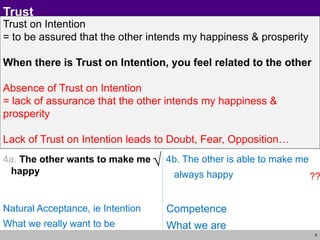
Natural Acceptance, ie Intention
What we really want to be
Competence
What we are
√
?
?
?
??
√
√
Trust on Intention
= to be assured that the other intends my happiness & prosperity
When there is Trust on Intention, you feel related to the other
Absence of Trust on Intention
= lack of assurance that the other intends my happiness &
prosperity
Lack of Trust on Intention leads to Doubt, Fear, Opposition…
√
10.
10
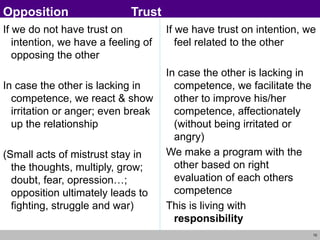
If we donot have trust on
intention, we have a feeling of
opposing the other
In case the other is lacking in
competence, we react & show
irritation or anger; even break
up the relationship
(Small acts of mistrust stay in
the thoughts, multiply, grow;
doubt, fear, opression…;
opposition ultimately leads to
fighting, struggle and war)
If we have trust on intention, we
feel related to the other
In case the other is lacking in
competence, we facilitate the
other to improve his/her
competence, affectionately
(without being irritated or
angry)
We make a program with the
other based on right
evaluation of each others
competence
This is living with
responsibility
Opposition Trust
11.
11
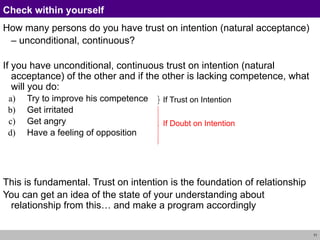
Check within yourself
Howmany persons do you have trust on intention (natural acceptance)
– unconditional, continuous?
If you have unconditional, continuous trust on intention (natural
acceptance) of the other and if the other is lacking competence, what
will you do:
a) Try to improve his competence
b) Get irritated
c) Get angry
d) Have a feeling of opposition
This is fundamental. Trust on intention is the foundation of relationship
You can get an idea of the state of your understanding about
relationship from this… and make a program accordingly
If Trust on Intention
If Doubt on Intention
12.
12
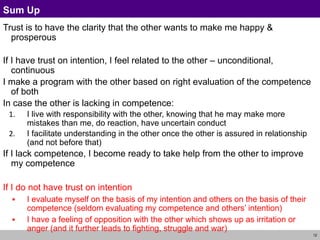
Sum Up
Trust isto have the clarity that the other wants to make me happy &
prosperous
If I have trust on intention, I feel related to the other – unconditional,
continuous
I make a program with the other based on right evaluation of the competence
of both
In case the other is lacking in competence:
1. I live with responsibility with the other, knowing that he may make more
mistakes than me, do reaction, have uncertain conduct
2. I facilitate understanding in the other once the other is assured in relationship
(and not before that)
If I lack competence, I become ready to take help from the other to improve
my competence
If I do not have trust on intention
▪ I evaluate myself on the basis of my intention and others on the basis of their
competence (seldom evaluating my competence and others’ intention)
▪ I have a feeling of opposition with the other which shows up as irritation or
anger (and it further leads to fighting, struggle and war)
15
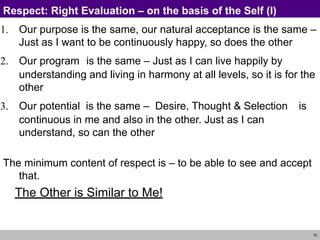
Respect: Right Evaluation– on the basis of the Self (I)
1. Our purpose is the same, our natural acceptance is the same –
Just as I want to be continuously happy, so does the other
2. Our program is the same – Just as I can live happily by
understanding and living in harmony at all levels, so it is for the
other
3. Our potential is the same – Desire, Thought & Selection is
continuous in me and also in the other. Just as I can
understand, so can the other
The minimum content of respect is – to be able to see and accept
that.
The Other is Similar to Me!
16.
16
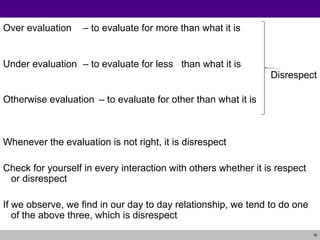
Over evaluation –to evaluate for more than what it is
Under evaluation – to evaluate for less than what it is
Otherwise evaluation – to evaluate for other than what it is
Whenever the evaluation is not right, it is disrespect
Check for yourself in every interaction with others whether it is respect
or disrespect
If we observe, we find in our day to day relationship, we tend to do one
of the above three, which is disrespect
Disrespect
17.
17
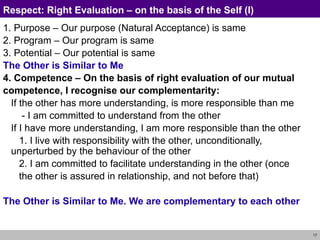
Respect: Right Evaluation– on the basis of the Self (I)
1. Purpose – Our purpose (Natural Acceptance) is same
2. Program – Our program is same
3. Potential – Our potential is same
The Other is Similar to Me
4. Competence – On the basis of right evaluation of our mutual
competence, I recognise our complementarity:
If the other has more understanding, is more responsible than me
- I am committed to understand from the other
If I have more understanding, I am more responsible than the other
1. I live with responsibility with the other, unconditionally,
unperturbed by the behaviour of the other
2. I am committed to facilitate understanding in the other (once
the other is assured in relationship, and not before that)
The Other is Similar to Me. We are complementary to each other
18.
18
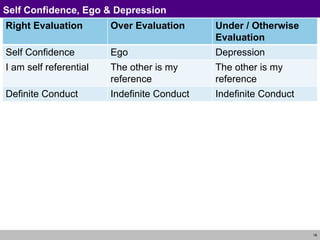
Self Confidence, Ego& Depression
Right Evaluation Over Evaluation Under / Otherwise
Evaluation
Self Confidence Ego Depression
I am self referential The other is my
reference
The other is my
reference
Definite Conduct Indefinite Conduct Indefinite Conduct
19.
19
What would bethe basis for respect – Body or Self?
What effort are you making
– the other is similar to me – my effort is to be natural
– the other is not like me – my effort is to be special
Current basis of respect is differentiation
If we understand this, we can live with a feeling of respect toward one,
toward all
What is natural
– the other is similar to me, to live with a feeling of respect?
– differentiation, to live with a feeling of dis-respect?
So these feelings need to be ensured in me or
These feelings are to be expected from the other?
20.
20
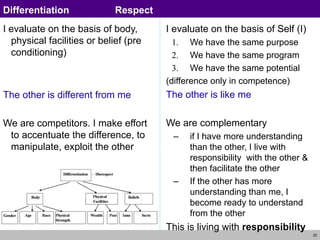
I evaluate onthe basis of body,
physical facilities or belief (pre
conditioning)
The other is different from me
We are competitors. I make effort
to accentuate the difference, to
manipulate, exploit the other
I evaluate on the basis of Self (I)
1. We have the same purpose
2. We have the same program
3. We have the same potential
(difference only in competence)
The other is like me
We are complementary
– if I have more understanding
than the other, I live with
responsibility with the other &
then facilitate the other
– If the other has more
understanding than me, I
become ready to understand
from the other
This is living with responsibility
Differentiation Respect
21.
21
Sum Up
Respect isRight Evaluation
Under evaluation, over evaluation or otherwise evaluation is disrespect
Differentiation is disrespect
Respect on the basis of Self(I) – The other is like me. We are complementary
to each other. The only difference is in our level of understanding (how much
of our desire, thought & expectation is on the basis of our Natural
Acceptance)
If the other has more understanding & is more responsible than me
− I am committed to understand from the other
If I have more understanding & I am more responsible than the other
1. I live with responsibility with the other, unconditionally,
unpeturbed by the behaviour of the other
2. I am committed to facilitate understanding in the other (once the
other is assured in relationship, and not before that)
23
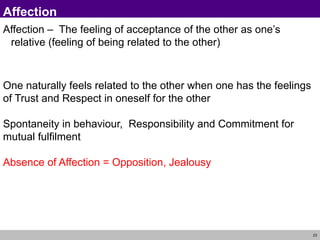
Affection
Affection – Thefeeling of acceptance of the other as one’s
relative (feeling of being related to the other)
One naturally feels related to the other when one has the feelings
of Trust and Respect in oneself for the other
Spontaneity in behaviour, Responsibility and Commitment for
mutual fulfilment
Absence of Affection = Opposition, Jealousy
24.
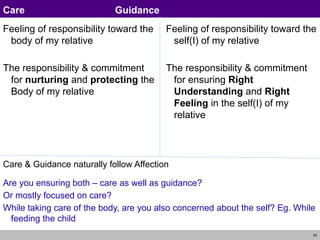
24
Feeling of responsibilitytoward the
body of my relative
The responsibility & commitment
for nurturing and protecting the
Body of my relative
Feeling of responsibility toward the
self(I) of my relative
The responsibility & commitment
for ensuring Right
Understanding and Right
Feeling in the self(I) of my
relative
Care Guidance
Care & Guidance naturally follow Affection
Are you ensuring both – care as well as guidance?
Or mostly focused on care?
While taking care of the body, are you also concerned about the self? Eg. While
feeding the child
25.
25
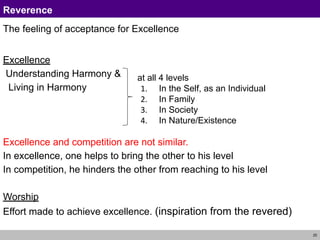
Reverence
The feeling ofacceptance for Excellence
Excellence
Understanding Harmony &
Living in Harmony
Excellence and competition are not similar.
In excellence, one helps to bring the other to his level
In competition, he hinders the other from reaching to his level
Worship
Effort made to achieve excellence. (inspiration from the revered)
at all 4 levels
1. In the Self, as an Individual
2. In Family
3. In Society
4. In Nature/Existence
26.
26
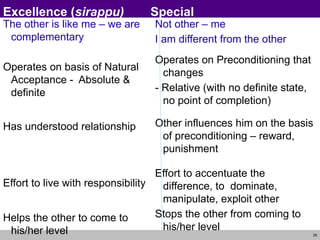
Not other –me
I am different from the other
Operates on Preconditioning that
changes
- Relative (with no definite state,
no point of completion)
Other influences him on the basis
of preconditioning – reward,
punishment
Effort to accentuate the
difference, to dominate,
manipulate, exploit other
Stops the other from coming to
his/her level
The other is like me – we are
complementary
Operates on basis of Natural
Acceptance - Absolute &
definite
Has understood relationship
Effort to live with responsibility
Helps the other to come to
his/her level
Excellence (sirappu) Special
27.
27
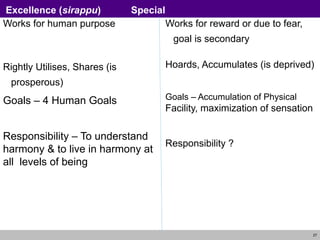
Works for rewardor due to fear,
goal is secondary
Hoards, Accumulates (is deprived)
Goals – Accumulation of Physical
Facility, maximization of sensation
Responsibility ?
Works for human purpose
Rightly Utilises, Shares (is
prosperous)
Goals – 4 Human Goals
Responsibility – To understand
harmony & to live in harmony at
all levels of being
Excellence (sirappu) Special
28.
28
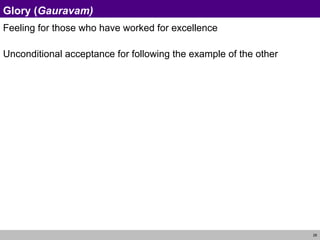
Glory (Gauravam)
Feeling forthose who have worked for excellence
Unconditional acceptance for following the example of the other
29.
29
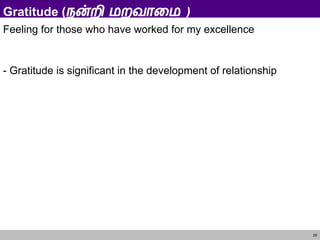
Gratitude (நன்றி மறவாைம)
Feeling for those who have worked for my excellence
- Gratitude is significant in the development of relationship
30.
30
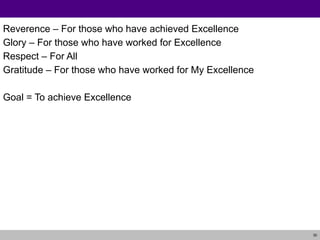
Reverence – Forthose who have achieved Excellence
Glory – For those who have worked for Excellence
Respect – For All
Gratitude – For those who have worked for My Excellence
Goal = To achieve Excellence
31.
31
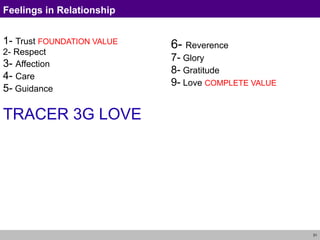
Feelings in Relationship
1-Trust FOUNDATION VALUE
2- Respect
3- Affection
4- Care
5- Guidance
TRACER 3G LOVE
6- Reverence
7- Glory
8- Gratitude
9- Love COMPLETE VALUE
32.
32
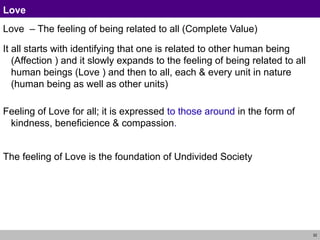
Love
Love – Thefeeling of being related to all (Complete Value)
It all starts with identifying that one is related to other human being
(Affection ) and it slowly expands to the feeling of being related to all
human beings (Love ) and then to all, each & every unit in nature
(human being as well as other units)
Feeling of Love for all; it is expressed to those around in the form of
kindness, beneficience & compassion.
The feeling of Love is the foundation of Undivided Society
33.
33
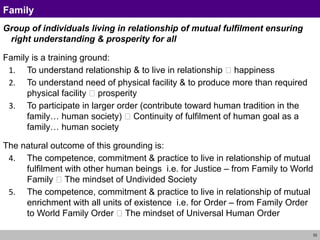
Family
Group of individualsliving in relationship of mutual fulfilment ensuring
right understanding & prosperity for all
Family is a training ground:
1. To understand relationship & to live in relationship 🡪 happiness
2. To understand need of physical facility & to produce more than required
physical facility 🡪 prosperity
3. To participate in larger order (contribute toward human tradition in the
family… human society) 🡪 Continuity of fulfilment of human goal as a
family… human society
The natural outcome of this grounding is:
4. The competence, commitment & practice to live in relationship of mutual
fulfilment with other human beings i.e. for Justice – from Family to World
Family 🡪 The mindset of Undivided Society
5. The competence, commitment & practice to live in relationship of mutual
enrichment with all units of existence i.e. for Order – from Family Order
to World Family Order 🡪 The mindset of Universal Human Order
34.
34
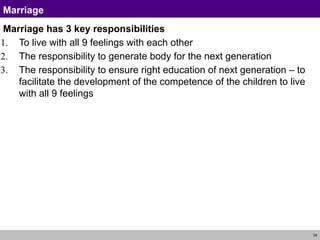
Marriage
Marriage has 3key responsibilities
1. To live with all 9 feelings with each other
2. The responsibility to generate body for the next generation
3. The responsibility to ensure right education of next generation – to
facilitate the development of the competence of the children to live
with all 9 feelings
Love marriage = happy marriage?
Arranged marriage = happy marriage?
Marriage of those who have right understanding & right feeling = happy
marriage?
35.
35
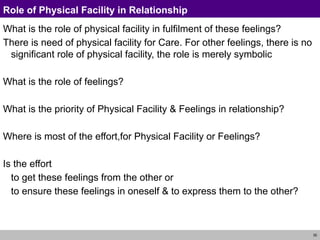
Role of PhysicalFacility in Relationship
What is the role of physical facility in fulfilment of these feelings?
There is need of physical facility for Care. For other feelings, there is no
significant role of physical facility, the role is merely symbolic
What is the role of feelings?
What is the priority of Physical Facility & Feelings in relationship?
Where is most of the effort,for Physical Facility or Feelings?
Is the effort
to get these feelings from the other or
to ensure these feelings in oneself & to express them to the other?
36.
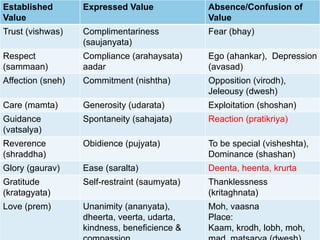
36
Established
Value
Expressed Value Absence/Confusionof
Value
Trust (vishwas) Complimentariness
(saujanyata)
Fear (bhay)
Respect
(sammaan)
Compliance (arahaysata)
aadar
Ego (ahankar), Depression
(avasad)
Affection (sneh) Commitment (nishtha) Opposition (virodh),
Jeleousy (dwesh)
Care (mamta) Generosity (udarata) Exploitation (shoshan)
Guidance
(vatsalya)
Spontaneity (sahajata) Reaction (pratikriya)
Reverence
(shraddha)
Obidience (pujyata) To be special (visheshta),
Dominance (shashan)
Glory (gaurav) Ease (saralta) Deenta, heenta, krurta
Gratitude
(kratagyata)
Self-restraint (saumyata) Thanklessness
(kritaghnata)
Love (prem) Unanimity (ananyata),
dheerta, veerta, udarta,
kindness, beneficience &
Moh, vaasna
Place:
Kaam, krodh, lobh, moh,
37.
37
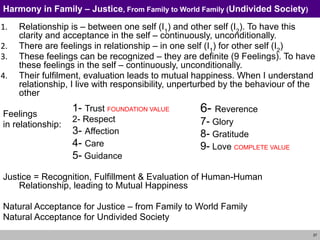
Harmony in Family– Justice, From Family to World Family (Undivided Society)
1. Relationship is – between one self (I1
) and other self (I2
). To have this
clarity and acceptance in the self – continuously, unconditionally.
2. There are feelings in relationship – in one self (I1
) for other self (I2
)
3. These feelings can be recognized – they are definite (9 Feelings). To have
these feelings in the self – continuously, unconditionally.
4. Their fulfilment, evaluation leads to mutual happiness. When I understand
relationship, I live with responsibility, unperturbed by the behaviour of the
other
Feelings
in relationship:
Justice = Recognition, Fulfillment & Evaluation of Human-Human
Relationship, leading to Mutual Happiness
Natural Acceptance for Justice – from Family to World Family
Natural Acceptance for Undivided Society
1- Trust FOUNDATION VALUE
2- Respect
3- Affection
4- Care
5- Guidance
6- Reverence
7- Glory
8- Gratitude
9- Love COMPLETE VALUE
38.
38
• Justice isensuring right understanding in the self leading to
right feelings and it's expression in relationship resulting in
mutual happiness.
• We have Natural Acceptance for Justice for All – from Family to
World Family
• Natural acceptance for Justice is already within you
• Right understanding makes you aware
• Once you are aware of it, there is continuity of these feelings
and you are able to fulfil them
• Having right feelings in oneself leads to one’s happiness
• Expressing these feelings to the other leads to happiness in
the other
Harmony in Family – From Family to World Family (Undivided
Society)
 Most read
 Most read