Audit Company: SMT-Global Report Reference: 4771 Date: May 16, 2016 1
Supplier name: Zhongshan Detron Display Products Co., Ltd
Site country: China
Site name: Zhongshan Mingfeng Display Products Co., Ltd
Parent Company name (of the site): Nil
SMETA Audit Type: 2-Pillar 4-Pillar
Date of Audit May 16, 2016

Audit Company: SMT-Global Report Reference: 4771 Date: May 16, 2016 2
Audit Company Name:
Global Strategy Management Technology Co., Ltd.
Sedex Company Reference:
(only available on Sedex System)
Not provided
Sedex Site Reference:
(only available on Sedex System)
Not provided
Audit Conducted By
Commercial Purchaser
NGO Retailer
Trade Union Brand Owner
Multi–stakeholder Combined Audit (select all that apply)
Auditor Reference Number:
(If applicable)
4771
SMETA Declaration
I declare that the audit underpinning the following report was conducted in accordance with SMETA Best Practice
Guidance and SMETA Measurement Criteria.
Any exceptions to this must be recorded here (e.g. different sample size): Nil
Auditor Name(s) (please list all including all interviewers):
Lead Auditor and Interviewer: Richard Li
Member Auditor and Interviewer: Nil
Date: May 16, 2016
Address: Unit 04 7/F, Bright Way Tower No.33, Mong Kok Road, Kowloon Hong Kong
Email: charles@smt-global.com
Global Strategy Management Technology Co., Ltd

Audit Company: SMT-Global Report Reference: 4771 Date: May 16, 2016 3
Non–Compliance Table
Issue
(please click on the issue title to go direct to
the appropriate audit results by clause)
Area of Non–Conformity
(Only check box when there is a non–conformity,
and only in the box/es where the non–conformity
can be found)
Record the number
of issues by line*:
ETI Base
Code
Local Law
Additional
Elements
(i.e. not part
of ETI code )
NC Obs GE
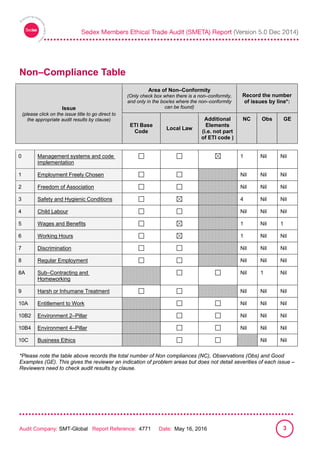
0 Management systems and code
implementation
1 Nil Nil
1 Employment Freely Chosen Nil Nil Nil
2 Freedom of Association Nil Nil Nil
3 Safety and Hygienic Conditions 4 Nil Nil
4 Child Labour Nil Nil Nil
5 Wages and Benefits 1 Nil 1
6 Working Hours 1 Nil Nil
7 Discrimination Nil Nil Nil
8 Regular Employment Nil Nil Nil
8A Sub–Contracting and
Homeworking
Nil 1 Nil
9 Harsh or Inhumane Treatment Nil Nil Nil
10A Entitlement to Work Nil Nil Nil
10B2 Environment 2–Pillar Nil Nil Nil
10B4 Environment 4–Pillar Nil Nil Nil
10C Business Ethics Nil Nil
*Please note the table above records the total number of Non compliances (NC), Observations (Obs) and Good
Examples (GE). This gives the reviewer an indication of problem areas but does not detail severities of each issue –
Reviewers need to check audit results by clause.

Audit Company: SMT-Global Report Reference: 4771 Date: May 16, 2016 4
Summary of Findings
Summary of main findings: (positive and negative)
(Please give a short summary of the main findings per clause)
This initial audit was conducted by Global Strategy Management Technology Co., Ltd. One auditor conducted the
on-site audit on a sampling basis for verification of the factory’s operations and social compliance status against the
ETI Base Code, laws and local regulations.
Summary of Findings:
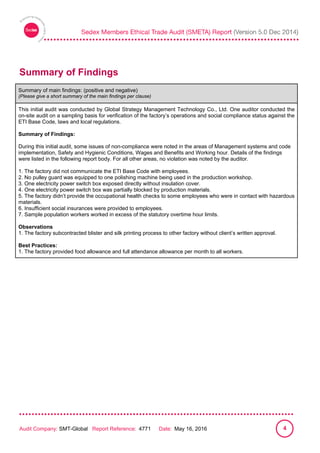
During this initial audit, some issues of non-compliance were noted in the areas of Management systems and code
implementation, Safety and Hygienic Conditions, Wages and Benefits and Working hour. Details of the findings
were listed in the following report body. For all other areas, no violation was noted by the auditor.
1. The factory did not communicate the ETI Base Code with employees.
2. No pulley guard was equipped to one polishing machine being used in the production workshop.
3. One electricity power switch box exposed directly without insulation cover.
4. One electricity power switch box was partially blocked by production materials.
5. The factory didn’t provide the occupational health checks to some employees who were in contact with hazardous
materials.
6. Insufficient social insurances were provided to employees.
7. Sample population workers worked in excess of the statutory overtime hour limits.
Observations
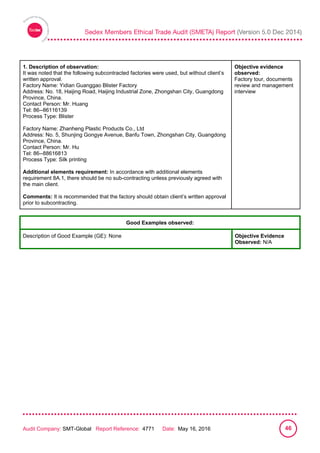
1. The factory subcontracted blister and silk printing process to other factory without client’s written approval.
Best Practices:
1. The factory provided food allowance and full attendance allowance per month to all workers.

Audit Company: SMT-Global Report Reference: 4771 Date: May 16, 2016 5
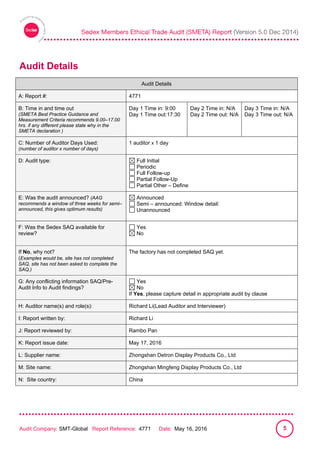
Audit Details
Audit Details
A: Report #: 4771
B: Time in and time out
(SMETA Best Practice Guidance and
Measurement Criteria recommends 9.00–17.00
hrs. if any different please state why in the
SMETA declaration )
Day 1 Time in: 9:00
Day 1 Time out:17:30
Day 2 Time in: N/A
Day 2 Time out: N/A
Day 3 Time in: N/A
Day 3 Time out: N/A
C: Number of Auditor Days Used:
(number of auditor x number of days)
1 auditor x 1 day
D: Audit type: Full Initial
Periodic
Full Follow-up
Partial Follow-Up
Partial Other – Define
E: Was the audit announced? (AAG
recommends a window of three weeks for semi–
announced, this gives optimum results)
Announced
Semi – announced: Window detail:
Unannounced
F: Was the Sedex SAQ available for
review?
Yes
No
If No, why not?
(Examples would be, site has not completed
SAQ, site has not been asked to complete the
SAQ.)
The factory has not completed SAQ yet.
G: Any conflicting information SAQ/Pre-
Audit Info to Audit findings?
Yes
No
If Yes, please capture detail in appropriate audit by clause
H: Auditor name(s) and role(s): Richard Li(Lead Auditor and Interviewer)
I: Report written by: Richard Li
J: Report reviewed by: Rambo Pan
K: Report issue date: May 17, 2016
L: Supplier name: Zhongshan Detron Display Products Co., Ltd
M: Site name: Zhongshan Mingfeng Display Products Co., Ltd
N: Site country: China

Audit Company: SMT-Global Report Reference: 4771 Date: May 16, 2016 6
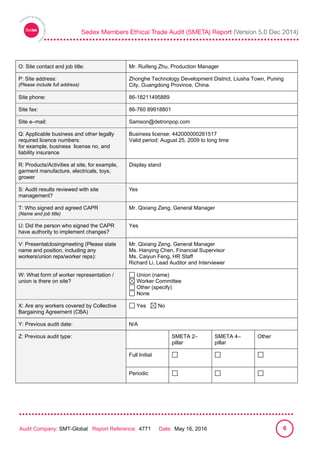
O: Site contact and job title: Mr. Ruifeng Zhu, Production Manager
P: Site address:
(Please include full address)
Zhonghe Technology Development District, Liusha Town, Puning
City, Guangdong Province, China.
Site phone: 86-18211495889
Site fax: 86-760 89918801
Site e–mail: Samson@detronpop.com
Q: Applicable business and other legally
required licence numbers:
for example, business license no, and
liability insurance
Business license: 442000000261517
Valid period: August 25, 2009 to long time
R: Products/Activities at site, for example,
garment manufacture, electricals, toys,
grower
Display stand
S: Audit results reviewed with site
management?
Yes
T: Who signed and agreed CAPR
(Name and job title)
Mr. Qixiang Zeng, General Manager
U: Did the person who signed the CAPR
have authority to implement changes?
Yes
V: Presentatclosingmeeting (Please state
name and position, including any
workers/union reps/worker reps):
Mr. Qixiang Zeng, General Manager
Ms. Hanying Chen, Financial Supervisor
Ms. Caiyun Feng, HR Staff
Richard Li, Lead Auditor and Interviewer
W: What form of worker representation /
union is there on site?
Union (name)
Worker Committee
Other (specify)
None
X: Are any workers covered by Collective
Bargaining Agreement (CBA)
Yes No
Y: Previous audit date: N/A
Z: Previous audit type: SMETA 2–
pillar
SMETA 4–
pillar
Other
Full Initial
Periodic

Audit Company: SMT-Global Report Reference: 4771 Date: May 16, 2016 7
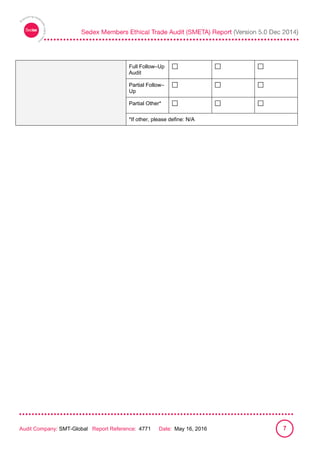
Full Follow–Up
Audit
Partial Follow–
Up
Partial Other*
*If other, please define: N/A

Audit Company: SMT-Global Report Reference: 4771 Date: May 16, 2016 8
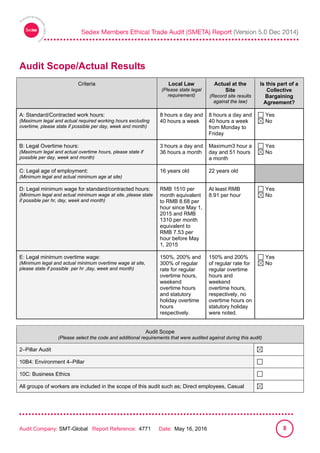
Audit Scope/Actual Results
Criteria Local Law
(Please state legal
requirement)
Actual at the
Site
(Record site results
against the law)
Is this part of a
Collective
Bargaining
Agreement?
A: Standard/Contracted work hours:
(Maximum legal and actual required working hours excluding
overtime, please state if possible per day, week and month)
8 hours a day and
40 hours a week
8 hours a day and
40 hours a week
from Monday to
Friday
Yes
No
B: Legal Overtime hours:
(Maximum legal and actual overtime hours, please state if
possible per day, week and month)
3 hours a day and
36 hours a month
Maximum3 hour a
day and 51 hours
a month
Yes
No
C: Legal age of employment:
(Minimum legal and actual minimum age at site)
16 years old 22 years old
D: Legal minimum wage for standard/contracted hours:
(Minimum legal and actual minimum wage at site, please state
if possible per hr, day, week and month)
RMB 1510 per
month equivalent
to RMB 8.68 per
hour since May 1,
2015 and RMB
1310 per month
equivalent to
RMB 7.53 per
hour before May
1, 2015
At least RMB
8.91 per hour
Yes
No
E: Legal minimum overtime wage:
(Minimum legal and actual minimum overtime wage at site,
please state if possible per hr ,day, week and month)
150%, 200% and
300% of regular
rate for regular
overtime hours,
weekend
overtime hours
and statutory
holiday overtime
hours
respectively.
150% and 200%
of regular rate for
regular overtime
hours and
weekend
overtime hours,
respectively, no
overtime hours on
statutory holiday
were noted.
Yes
No
Audit Scope
(Please select the code and additional requirements that were audited against during this audit)
2–Pillar Audit
10B4: Environment 4–Pillar
10C: Business Ethics
All groups of workers are included in the scope of this audit such as; Direct employees, Casual

Audit Company: SMT-Global Report Reference: 4771 Date: May 16, 2016 9
and agency workers, Workers employed by service providers such as security and catering staff
as well as workers supplied by other contractors.
Note: The main focus of this ethical audit is on the ETI Base Code and local law. The additional elements will not be audited in such
depth or scope, but the audit process will still highlight any specific issues.
This report provides a summary of the findings and other applicable information found/gathered during the social audit conducted
on the above date only and does not officially confirm or certify compliance with any legal regulations or industry standards. The
social audit process requires that information be gathered and considered from records review, worker interviews, management
interviews and visual observation. More information is gathered during the social audit process than is provided here. The audit
process is a sampling exercise only and does not guarantee that the audited site prior, during or post–audit, are in full compliance
with the Code being audited against. The provisions of this Code constitute minimum and not maximum standards and this Code
should not be used to prevent companies from exceeding these standards. Companies applying this Code are expected to comply
with national and other applicable laws and where the provisions of law and this Code address the same subject, to apply that
provision which affords the greater protection. The ownership of this report remains with the party who has paid for the audit.
Release permission must be provided by the owner prior to release to any third parties.
Audit Overview
Audit Overview
Management Worker Representatives
Audit attendance Senior management Worker Committee
representatives
Union representatives
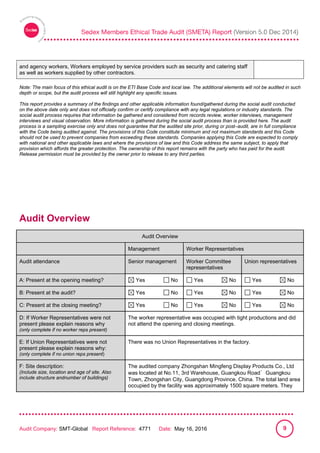
A: Present at the opening meeting? Yes No Yes No Yes No
B: Present at the audit? Yes No Yes No Yes No
C: Present at the closing meeting? Yes No Yes No Yes No
D: If Worker Representatives were not
present please explain reasons why
(only complete if no worker reps present)
The worker representative was occupied with tight productions and did
not attend the opening and closing meetings.
E: If Union Representatives were not
present please explain reasons why:
(only complete if no union reps present)
There was no Union Representatives in the factory.
F: Site description:
(Include size, location and age of site. Also
include structure andnumber of buildings)
The audited company Zhongshan Mingfeng Display Products Co., Ltd
was located at No.11, 3rd Warehouse, Guangkou Road
,
Guangkou
Town, Zhongshan City, Guangdong Province, China. The total land area
occupied by the facility was approximately 1500 square meters. They

Audit Company: SMT-Global Report Reference: 4771 Date: May 16, 2016 10
had started their operation at the existing location since August 25,
2009.
In view of the facility, the factory only rented the one third of 1-storey
production building. No canteen or kitchen facilities were provided to
employees.
A total of 13 employees were currently working in the factory, which
included 10 production employees (5 females and 5 males) and 3 non-
production employees (2 female and 1 male).
The factory adopted fingerprint attendance recording facility to record
working hours for employees. All employees worked for 8 hours per day
in one shift from 08:00 to 17:30 with 90 minutes lunch break from 12:00
to 13:30. As per factory management, there was no obvious peak month
in the factory.
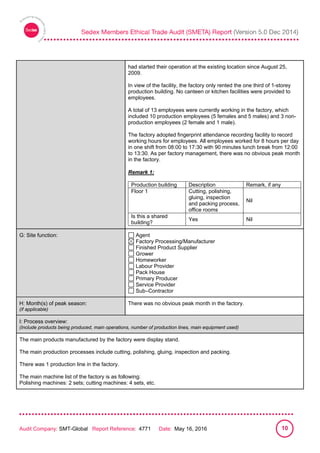
Remark 1:
Production building Description Remark, if any
Floor 1 Cutting, polishing,
gluing, inspection
and packing process,
office rooms
Nil
Is this a shared
building?
Yes Nil
G: Site function: Agent
Factory Processing/Manufacturer
Finished Product Supplier
Grower
Homeworker
Labour Provider
Pack House
Primary Producer
Service Provider
Sub–Contractor
H: Month(s) of peak season:
(if applicable)
There was no obvious peak month in the factory.
I: Process overview:
(Include products being produced, main operations, number of production lines, main equipment used)
The main products manufactured by the factory were display stand.
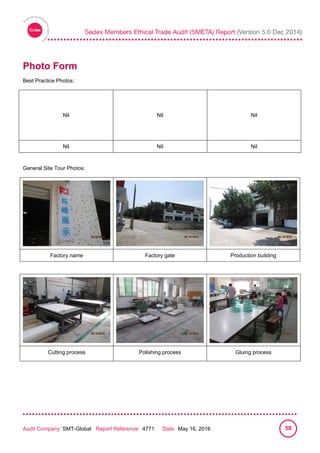
The main production processes include cutting, polishing, gluing, inspection and packing.
There was 1 production line in the factory.
The main machine list of the factory is as following:
Polishing machines: 2 sets; cutting machines: 4 sets, etc.

Audit Company: SMT-Global Report Reference: 4771 Date: May 16, 2016 11
J: Attitude of workers:
(Include their attitude to management, workplace and the interview process. Both positive and negative information should be
included) Note: Do not document any information that could put workers at risk
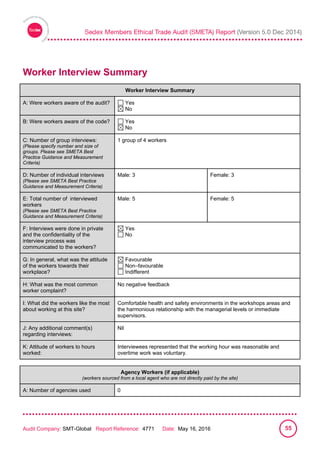
10 workers were randomly selected for interview, including 5 males and 5 female employees. The workers were
guaranteed that their employer would not know the identity of the interviewees. (More details of the profile of these
workers cannot be divulged for purposes of confidentiality). This group included workers from different departments
and there were both men and woman, who attended the interview. All interviews were conducted in the absence of
any staff or management representatives, assuring the respondents total confidentiality of the views that they
expressed.
All 10 workers interviewed stated they were satisfied with the working conditions in the factory. 4 interviewees were
local people and others were migrants from other provinces of China. Based on factory tour, workers could freely
leave their workstations for toilet or drinking area. All interviewees showed positive attitudes towards the factory and
all of them enjoyed the comfortable health and safety environments in the workshops areas and the harmonious
relationship with the managerial levels or immediate supervisors. The interviewees did not raise negative concerns
during the interview process.
K: Attitude of workers committee/union reps:
(Include their attitude to management, workplace and the interview process. Both positive and negative information should be
included) Note: Do not document any information that could put workers at risk
Worker representative showed positive attitude towards auditor during interview process. They could freely express
their concerns and thoughts to management on workers’ side. They collected workers’ suggestions and complaints
and discussed with factory management every month, if there was an emergent situation, they would help report to
management directly.
L: Attitude of managers:
(Include attitude to audit, and audit process. Both positive and negative information should be included)
Factory management was very positive and cooperative to support the auditor throughout the whole audit process.
They showed respect to the auditor and responded to the auditor promptly during the audit. During the closing
meeting, all representatives of the factory were also positive to accept all non-compliances identified by auditor and
they committed to take the corrective action plans step by step.

Audit Company: SMT-Global Report Reference: 4771 Date: May 16, 2016 12
Key Information
Key Information
(click on the key information title to go to appropriate section of the report)
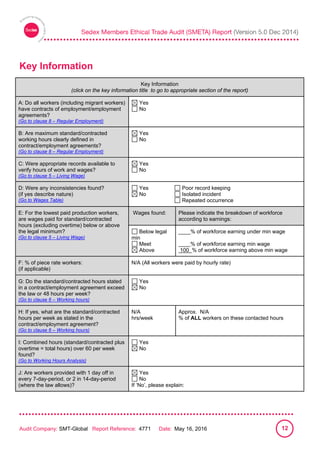
A: Do all workers (including migrant workers)
have contracts of employment/employment
agreements?
(Go to clause 8 – Regular Employment)
Yes
No
B: Are maximum standard/contracted
working hours clearly defined in
contract/employment agreements?
(Go to clause 8 – Regular Employment)
Yes
No
C: Were appropriate records available to
verify hours of work and wages?
(Go to clause 5 – Living Wage)
Yes
No
D: Were any inconsistencies found?
(if yes describe nature)
(Go to Wages Table)
Yes Poor record keeping
No Isolated incident
Repeated occurrence
E: For the lowest paid production workers,
are wages paid for standard/contracted
hours (excluding overtime) below or above
the legal minimum?
(Go to clause 5 – Living Wage)
Wages found: Please indicate the breakdown of workforce
according to earnings:
Below legal
min
Meet
Above
____% of workforce earning under min wage
% of workforce earning min wage
100 % of workforce earning above min wage
F: % of piece rate workers:
(if applicable)
N/A (All workers were paid by hourly rate)
G: Do the standard/contracted hours stated
in a contract/employment agreement exceed
the law or 48 hours per week?
(Go to clause 6 – Working hours)
Yes
No
H: If yes, what are the standard/contracted
hours per week as stated in the
contract/employment agreement?
(Go to clause 6 – Working hours)
N/A
hrs/week
Approx. N/A
% of ALL workers on these contacted hours
I: Combined hours (standard/contracted plus
overtime = total hours) over 60 per week
found?
(Go to Working Hours Analysis)
Yes
No
J: Are workers provided with 1 day off in
every 7-day-period, or 2 in 14-day-period
(where the law allows)?
Yes
No
If ‘No’, please explain:

Audit Company: SMT-Global Report Reference: 4771 Date: May 16, 2016 13
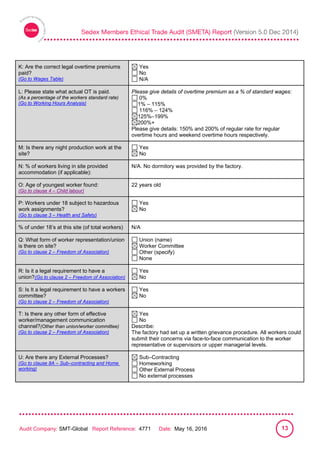
K: Are the correct legal overtime premiums
paid?
(Go to Wages Table)
Yes
No
N/A
L: Please state what actual OT is paid.
(As a percentage of the workers standard rate)
(Go to Working Hours Analysis)
Please give details of overtime premium as a % of standard wages:
0%
1% – 115%
116% – 124%
125%–199%
200%+
Please give details: 150% and 200% of regular rate for regular
overtime hours and weekend overtime hours respectively.
M: Is there any night production work at the
site?
Yes
No
N: % of workers living in site provided
accommodation (if applicable):
N/A. No dormitory was provided by the factory.
O: Age of youngest worker found:
(Go to clause 4 – Child labour)
22 years old
P: Workers under 18 subject to hazardous
work assignments?
(Go to clause 3 – Health and Safety)
Yes
No
% of under 18’s at this site (of total workers) N/A
Q: What form of worker representation/union
is there on site?
(Go to clause 2 – Freedom of Association)
Union (name)
Worker Committee
Other (specify)
None
R: Is it a legal requirement to have a
union?(Go to clause 2 – Freedom of Association)
Yes
No
S: Is It a legal requirement to have a workers
committee?
(Go to clause 2 – Freedom of Association)
Yes
No
T: Is there any other form of effective
worker/management communication
channel?(Other than union/worker committee)
(Go to clause 2 – Freedom of Association)
Yes
No
Describe:
The factory had set up a written grievance procedure. All workers could
submit their concerns via face-to-face communication to the worker
representative or supervisors or upper managerial levels.
U: Are there any External Processes?
(Go to clause 8A – Sub–contracting and Home
working)
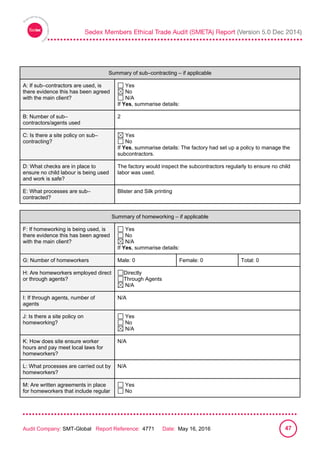
Sub–Contracting
Homeworking
Other External Process
No external processes

Audit Company: SMT-Global Report Reference: 4771 Date: May 16, 2016 14
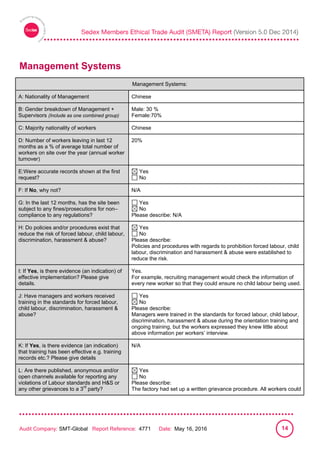
Management Systems
Management Systems:
A: Nationality of Management Chinese
B: Gender breakdown of Management +
Supervisors (Include as one combined group)
Male: 30 %
Female:70%
C: Majority nationality of workers Chinese
D: Number of workers leaving in last 12
months as a % of average total number of
workers on site over the year (annual worker
turnover)
20%
E:Were accurate records shown at the first
request?
Yes
No
F: If No, why not? N/A
G: In the last 12 months, has the site been
subject to any fines/prosecutions for non–
compliance to any regulations?
Yes
No
Please describe: N/A
H: Do policies and/or procedures exist that
reduce the risk of forced labour, child labour,
discrimination, harassment & abuse?
Yes
No
Please describe:
Policies and procedures with regards to prohibition forced labour, child
labour, discrimination and harassment & abuse were established to
reduce the risk.
I: If Yes, is there evidence (an indication) of
effective implementation? Please give
details.
Yes.
For example, recruiting management would check the information of
every new worker so that they could ensure no child labour being used.
J: Have managers and workers received
training in the standards for forced labour,
child labour, discrimination, harassment &
abuse?
Yes
No
Please describe:
Managers were trained in the standards for forced labour, child labour,
discrimination, harassment & abuse during the orientation training and
ongoing training, but the workers expressed they knew little about
above information per workers’ interview.
K: If Yes, is there evidence (an indication)
that training has been effective e.g. training
records etc.? Please give details
N/A
L: Are there published, anonymous and/or
open channels available for reporting any
violations of Labour standards and H&S or
any other grievances to a 3rd
party?
Yes
No
Please describe:
The factory had set up a written grievance procedure. All workers could

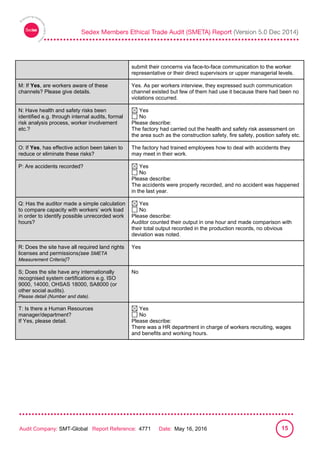
Audit Company: SMT-Global Report Reference: 4771 Date: May 16, 2016 15
submit their concerns via face-to-face communication to the worker
representative or their direct supervisors or upper managerial levels.
M: If Yes, are workers aware of these
channels? Please give details.
Yes. As per workers interview, they expressed such communication
channel existed but few of them had use it because there had been no
violations occurred.
N: Have health and safety risks been
identified e.g. through internal audits, formal
risk analysis process, worker involvement
etc.?
Yes
No
Please describe:
The factory had carried out the health and safety risk assessment on
the area such as the construction safety, fire safety, position safety etc.
O: If Yes, has effective action been taken to
reduce or eliminate these risks?
The factory had trained employees how to deal with accidents they
may meet in their work.
P: Are accidents recorded? Yes
No
Please describe:
The accidents were properly recorded, and no accident was happened
in the last year.
Q: Has the auditor made a simple calculation
to compare capacity with workers’ work load
in order to identify possible unrecorded work
hours?
Yes
No
Please describe:
Auditor counted their output in one hour and made comparison with
their total output recorded in the production records, no obvious
deviation was noted.
R: Does the site have all required land rights
licenses and permissions(see SMETA
Measurement Criteria)?
Yes
S; Does the site have any internationally
recognised system certifications e.g. ISO
9000, 14000, OHSAS 18000, SA8000 (or
other social audits).
Please detail (Number and date).
No
T: Is there a Human Resources
manager/department?
If Yes, please detail.
Yes
No
Please describe:
There was a HR department in charge of workers recruiting, wages
and benefits and working hours.

Audit Company: SMT-Global Report Reference: 4771 Date: May 16, 2016 16
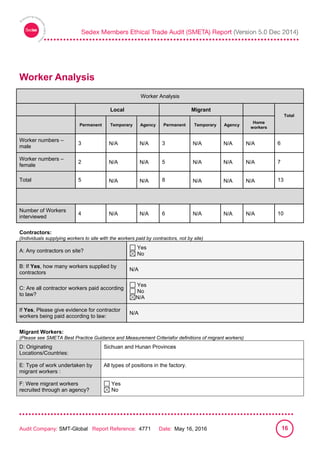
Worker Analysis
Worker Analysis
Local Migrant
Total
Permanent Temporary Agency Permanent Temporary Agency
Home
workers
Worker numbers –
male
3 N/A N/A 3 N/A N/A N/A 6
Worker numbers –
female
2 N/A N/A 5 N/A N/A N/A 7
Total 5 N/A N/A 8 N/A N/A N/A 13
Number of Workers
interviewed
4 N/A N/A 6 N/A N/A N/A 10
Contractors:
(Individuals supplying workers to site with the workers paid by contractors, not by site)
A: Any contractors on site?
Yes
No
B: If Yes, how many workers supplied by
contractors
N/A
C: Are all contractor workers paid according
to law?
Yes
No
N/A
If Yes, Please give evidence for contractor
workers being paid according to law:
N/A
Migrant Workers:
(Please see SMETA Best Practice Guidance and Measurement Criteriafor definitions of migrant workers)
D: Originating
Locations/Countries:
Sichuan and Hunan Provinces
E: Type of work undertaken by
migrant workers :
All types of positions in the factory.
F: Were migrant workers
recruited through an agency?
Yes
No

Audit Company: SMT-Global Report Reference: 4771 Date: May 16, 2016 17
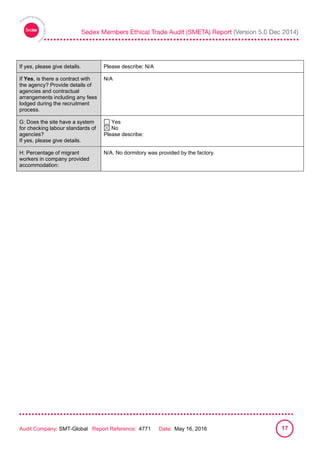
If yes, please give details. Please describe: N/A
If Yes, is there a contract with
the agency? Provide details of
agencies and contractual
arrangements including any fees
lodged during the recruitment
process.
N/A
G: Does the site have a system
for checking labour standards of
agencies?
If yes, please give details.
Yes
No
Please describe:
H: Percentage of migrant
workers in company provided
accommodation:
N/A. No dormitory was provided by the factory.

Audit Company: SMT-Global Report Reference: 4771 Date: May 16, 2016 18
Audit Results by Clause
0: Management systems and Code Implementation
0: Managements system and Code Implementation(click here to return to NC Table)
0.1 Suppliers are expected to implement and maintain systems for delivering compliance to this Code.
0.2 Suppliers shall appoint a senior member of management who shall be responsible for compliance with the Code.
0.3 Suppliers are expected to communicate this Code to all employees.
0.4 Suppliers should communicate this code to their own suppliers and, where reasonably practicable, extend the
principles of this Ethical Code through their supply chain.
Current Systems and Evidence Examined
To complete ‘current systems’Auditorsexaminepoliciesandwrittenproceduresinconjunction with relevant managers, to understand, and
record what controls and processes are currently in place e.g. record what policies are in place, what relevant procedures are carried out,
who is/are responsible for the management of this item of the code. Evidence checked should detail any documentary or verbal evidence
shown to support the systems.
Current systems:
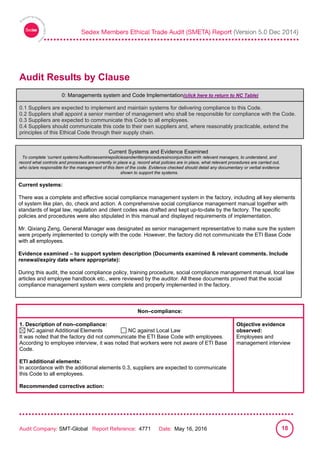
There was a complete and effective social compliance management system in the factory, including all key elements
of system like plan, do, check and action. A comprehensive social compliance management manual together with
standards of legal law, regulation and client codes was drafted and kept up-to-date by the factory. The specific
policies and procedures were also stipulated in this manual and displayed requirements of implementation.
Mr. Qixiang Zeng, General Manager was designated as senior management representative to make sure the system
were properly implemented to comply with the code. However, the factory did not communicate the ETI Base Code
with all employees.
Evidence examined – to support system description (Documents examined & relevant comments. Include
renewal/expiry date where appropriate):
During this audit, the social compliance policy, training procedure, social compliance management manual, local law
articles and employee handbook etc., were reviewed by the auditor. All these documents proved that the social
compliance management system were complete and properly implemented in the factory.
Non–compliance:
1. Description of non–compliance:
NC against Additional Elements NC against Local Law
It was noted that the factory did not communicate the ETI Base Code with employees.
According to employee interview, it was noted that workers were not aware of ETI Base
Code.
ETI additional elements:
In accordance with the additional elements 0.3, suppliers are expected to communicate
this Code to all employees.
Recommended corrective action:
Objective evidence
observed:
Employees and
management interview

Audit Company: SMT-Global Report Reference: 4771 Date: May 16, 2016 19
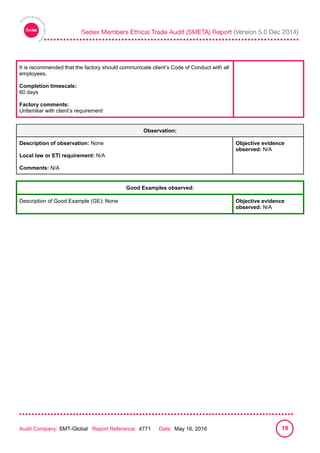
It is recommended that the factory should communicate client’s Code of Conduct with all
employees.
Completion timescale:
60 days
Factory comments:
Unfamiliar with client’s requirement
Observation:
Description of observation: None
Local law or ETI requirement: N/A
Comments: N/A
Objective evidence
observed: N/A
Good Examples observed:
Description of Good Example (GE): None Objective evidence
observed: N/A

Audit Company: SMT-Global Report Reference: 4771 Date: May 16, 2016 20
1: Employment is Freely Chosen
(Click here to return to NC–table)
ETI
1.1 There is no forced, bonded or involuntary prison labour.
1.2 Workers are not required to lodge “deposits” or their identity papers with their employer and are free to leave their
employer after reasonable notice.
Current Systems and Evidence Examined
To complete ‘current systems’ Auditors examine policies and written procedures in conjunction with relevant managers, to understand, and record
what controls and processes are currently in place e.g. record what policies are in place, what relevant procedures are carried out, who is/are
responsible for the management of this item of the code. Evidence checked should detail any documentary or verbal evidence shown to support the
systems.
Current systems:
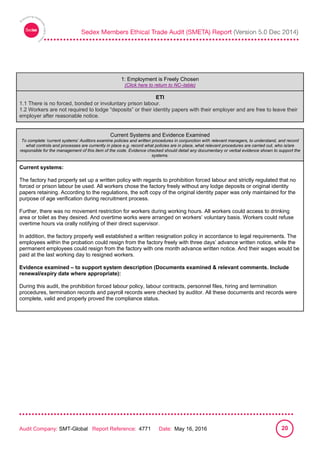
The factory had properly set up a written policy with regards to prohibition forced labour and strictly regulated that no
forced or prison labour be used. All workers chose the factory freely without any lodge deposits or original identity
papers retaining. According to the regulations, the soft copy of the original identity paper was only maintained for the
purpose of age verification during recruitment process.
Further, there was no movement restriction for workers during working hours. All workers could access to drinking
area or toilet as they desired. And overtime works were arranged on workers’ voluntary basis. Workers could refuse
overtime hours via orally notifying of their direct supervisor.
In addition, the factory properly well established a written resignation policy in accordance to legal requirements. The
employees within the probation could resign from the factory freely with three days’ advance written notice, while the
permanent employees could resign from the factory with one month advance written notice. And their wages would be
paid at the last working day to resigned workers.
Evidence examined – to support system description (Documents examined & relevant comments. Include
renewal/expiry date where appropriate):
During this audit, the prohibition forced labour policy, labour contracts, personnel files, hiring and termination
procedures, termination records and payroll records were checked by auditor. All these documents and records were
complete, valid and properly proved the compliance status.

Audit Company: SMT-Global Report Reference: 4771 Date: May 16, 2016 21
Non–compliance:
Description of non–compliance: None
NC against ETI NC against Local Law:
Local law and/or ETI requirement: N/A
Recommended corrective action: N/A
Completion timescale: N/A
Factory comments: N/A
Objective evidence
observed: N/A
Observation:
Description of observation: None
Local law or ETI requirement: N/A
Comments: N/A
Objective evidence
observed: N/A
Good Examples observed:
Description of Good Example (GE): None Objective evidence
observed: N/A

Audit Company: SMT-Global Report Reference: 4771 Date: May 16, 2016 22
2: Freedom of Association and Right to Collective Bargaining are Respected
2: Freedom of Association and Right to Collective Bargaining are Respected(Click here to return to NC–table)
(Click here to return to Key Information)
ETI
2.1 Workers, without distinction, have the right to join or form trade unions of their own choosing and to bargain
collectively.
2.2 The employer adopts an open attitude towards the activities of trade unions and their organisational activities.
2.3 Workers’ representatives are not discriminated against and have access to carry out their representative
functions in the workplace.
2.4 Where the right to freedom of association and collective bargaining is restricted under law, the employer
facilitates, and does not hinder, the development of parallel means for independent and free association and
bargaining.
Current Systems and Evidence Examined
To complete ‘current systems’ Auditors examine policies and written procedures in conjunction with relevant managers, to understand, and
record what controls and processes are currently in place e.g. record what policies are in place, what relevant procedures are carried out, who
is/are responsible for the management of this item of the code. Evidence checked should detail any documentary or verbal evidence shown to
support the systems.
Current systems:
The factory management always respected workers’ choice and the freedom of association and never interferes
with workers to join the trade union or any other kind of workers committee.
There was no trade union but a worker committee in the factory. The worker committee was made up of 1 worker
representative, who was democratically elected by the production workers. The worker representative normally
would have a meeting on a monthly basis to summarize the concerns and complaints from production workers. All
interviewed workers stated that they could report their concerns to the worker representative or directly to the
supervisor or upper management. In addition, workers could also response their concerns through suggestion box.
And all complaints or suggestions would be tackled within a short time.
Evidence examined – to support system description (Documents examined & relevant comments. Include
renewal/expiry date where appropriate):
The factory policy, factory principles, grievance procedures and meeting records were reviewed by auditor during
this audit. All these documents were complete and valid for proving the factory social compliance status.
Non–compliance:
Description of non–compliance: None
NC against ETI NC against Local Law
Local law and/or ETI requirement: N/A
Recommended corrective action: N/A
Completion timescale: N/A
Factory comments: N/A
Objective evidence
observed: N/A

Audit Company: SMT-Global Report Reference: 4771 Date: May 16, 2016 23
Observation:
Description of observation: None
Local law or ETI requirement: N/A
Comments: N/A
Objective evidence
observed: N/A
A: Name of union and union
representative, if applicable:
N/A Is there evidence of free elections?
Yes No N/A
B: If no union what is parallel means of
consultation with workers e.g. worker
committees?
All workers could directly report
their concerns via the worker
representative, suggestion box,
or directly report to their
supervisors.
Is there evidence of free elections?
Yes No N/A
C: Were worker representatives/union
representatives interviewed
Yes No
If Yes, please state how many: 1
D: State any evidence that
union/workers committee is effective?
Specify date of last meeting; topics covered;
how minutes were communicated etc.
Yes.
Meeting minutes were available for review and workers interview
confirmed that worker representative would hold meeting with workers
to discuss workers’ concerns on regular basis. The last meeting was
held on May 4, 2016 with the topic of improving the working
environment.
E: Are any workers covered by
Collective Bargaining Agreement (CBA)
Yes No
F: If Yes what percentage by trade
Union/worker representation
__N/A__% workers covered by
Union CBA
__N/A__% workers covered by
worker rep CBA
G: If Yes, does the Collective
Bargaining Agreement (CBA) include
rates of pay
Yes
No
No CBA
Good Examples observed:
Description of Good Example (GE): None Objective evidence
observed: N/A

Audit Company: SMT-Global Report Reference: 4771 Date: May 16, 2016 24
3: Working Conditions are Safe and Hygienic(Click here to return to NC–table)
(Click here to return to Key Information)
ETI
3.1 A safe and hygienic working environment shall be provided, bearing in mind the prevailing knowledge of the
industry and of any specific hazards. Adequate steps shall be taken to prevent accidents and injury to health
arising out of, associated with, or occurring in the course of work, by minimising, so far as is reasonably
practicable, the causes of hazards inherent in the working environment.
3.2 Workers shall receive regular and recorded Health & Safety training, and such training shall be repeated for
new or reassigned workers.
3.3 Access to clean toilet facilities and to potable water, and, if appropriate, sanitary facilities for food storage shall
be provided.
3.4 Accommodation, where provided, shall be clean, safe, and meet the basic needs of the workers.
3.5 The company observing the code shall assign responsibility for Health & Safety to a senior management
representative.
Current Systems and Evidence Examined
To complete ‘current systems’ Auditors examine policies and written procedures in conjunction with relevant managers, to understand, and
record what controls and processes are currently in place e.g. record what policies are in place, what relevant procedures are carried out, who
is/are responsible for the management of this item of the code. Evidence checked should detail any documentary or verbal evidence shown to
support the systems.
Current systems:
The factory was operated in a safe and sound working environment with proper lighting and ventilation system
except for the findings noted in below report. Sanitary drinking water and toilets were available to all workers on
each production floor.
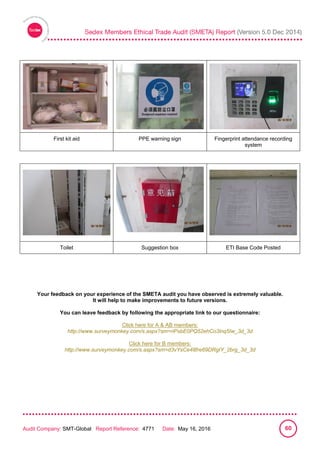
The fire-fighting equipment was properly installed and maintained in the factory. And the functional inspection was
conducted monthly to make sure all facilities were available to emergency events. In addition, the factory carried
out fire drills twice per year and the latest fire drill was conducted on March 31, 2016. All relevant records and
photos were also well kept in documentation for review.
Most electrical wires and electricity facilities were maintained in good condition without exposure and posted with
warning sign. Meanwhile, most machines were properly equipped with safety devices.
Mr. Qixiang Zeng, General Managerwas responsible for all occupational health and safety related issues in
production workshops. She would conduct inspection for the health and safety system regularly.
Furthermore, the factory had a program and materials to provide EHS training to all workers including first aid,
machine operations instructions, proper use of personal protective equipment etc.
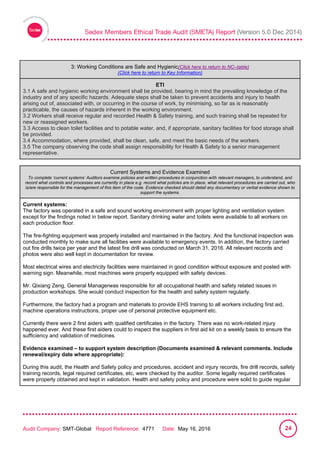
Currently there were 2 first aiders with qualified certificates in the factory. There was no work-related injury
happened ever. And these first aiders could to inspect the suppliers in first aid kit on a weekly basis to ensure the
sufficiency and validation of medicines.
Evidence examined – to support system description (Documents examined & relevant comments. Include
renewal/expiry date where appropriate):
During this audit, the Health and Safety policy and procedures, accident and injury records, fire drill records, safety
training records, legal required certificates, etc, were checked by the auditor. Some legally required certificates
were properly obtained and kept in validation. Health and safety policy and procedure were solid to guide regular

Audit Company: SMT-Global Report Reference: 4771 Date: May 16, 2016 25
implementation. The supplementary records were properly maintained to support daily operations.
Non–compliance:
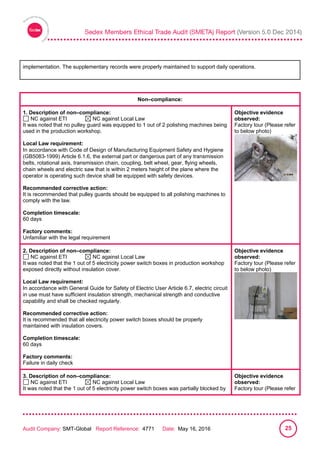
1. Description of non–compliance:
NC against ETI NC against Local Law
It was noted that no pulley guard was equipped to 1 out of 2 polishing machines being
used in the production workshop.
Local Law requirement:
In accordance with Code of Design of Manufacturing Equipment Safety and Hygiene
(GB5083-1999) Article 6.1.6, the external part or dangerous part of any transmission
belts, rotational axis, transmission chain, coupling, belt wheel, gear, flying wheels,
chain wheels and electric saw that is within 2 meters height of the plane where the
operator is operating such device shall be equipped with safety devices.
Recommended corrective action:
It is recommended that pulley guards should be equipped to all polishing machines to
comply with the law.
Completion timescale:
60 days
Factory comments:
Unfamiliar with the legal requirement
Objective evidence
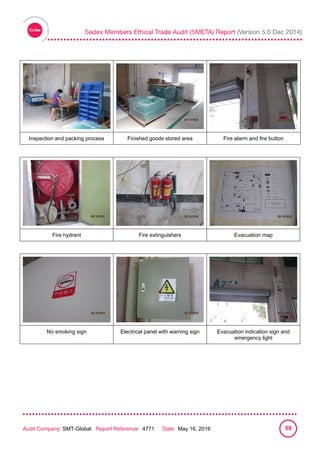
observed:
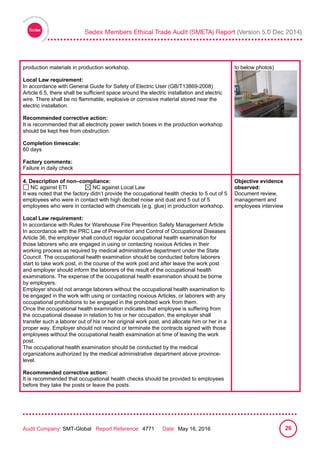
Factory tour (Please refer
to below photo)
2. Description of non–compliance:
NC against ETI NC against Local Law
It was noted that the 1 out of 5 electricity power switch boxes in production workshop
exposed directly without insulation cover.
Local Law requirement:
In accordance with General Guide for Safety of Electric User Article 6.7, electric circuit
in use must have sufficient insulation strength, mechanical strength and conductive
capability and shall be checked regularly.
Recommended corrective action:
It is recommended that all electricity power switch boxes should be properly
maintained with insulation covers.
Completion timescale:
60 days
Factory comments:
Failure in daily check
Objective evidence
observed:
Factory tour (Please refer
to below photo)
3. Description of non–compliance:
NC against ETI NC against Local Law
It was noted that the 1 out of 5 electricity power switch boxes was partially blocked by
Objective evidence
observed:
Factory tour (Please refer

Audit Company: SMT-Global Report Reference: 4771 Date: May 16, 2016 26
production materials in production workshop.
Local Law requirement:
In accordance with General Guide for Safety of Electric User (GB/T13869-2008)
Article 6.5, there shall be sufficient space around the electric installation and electric
wire. There shall be no flammable, explosive or corrosive material stored near the
electric installation.
Recommended corrective action:
It is recommended that all electricity power switch boxes in the production workshop
should be kept free from obstruction.
Completion timescale:
60 days
Factory comments:
Failure in daily check
to below photos)
4. Description of non–compliance:
NC against ETI NC against Local Law
It was noted that the factory didn’t provide the occupational health checks to 5 out of 5
employees who were in contact with high decibel noise and dust and 5 out of 5
employees who were in contacted with chemicals (e.g. glue) in production workshop.
Local Law requirement:
In accordance with Rules for Warehouse Fire Prevention Safety Management Article
In accordance with the PRC Law of Prevention and Control of Occupational Diseases
Article 36, the employer shall conduct regular occupational health examination for
those laborers who are engaged in using or contacting noxious Articles in their
working process as required by medical administrative department under the State
Council. The occupational health examination should be conducted before laborers
start to take work post, in the course of the work post and after leave the work post
and employer should inform the laborers of the result of the occupational health
examinations. The expense of the occupational health examination should be borne
by employers.
Employer should not arrange laborers without the occupational health examination to
be engaged in the work with using or contacting noxious Articles, or laborers with any
occupational prohibitions to be engaged in the prohibited work from them.
Once the occupational health examination indicates that employee is suffering from
the occupational disease in relation to his or her occupation, the employer shall
transfer such a laborer out of his or her original work post, and allocate him or her in a
proper way. Employer should not rescind or terminate the contracts signed with those
employees without the occupational health examination at time of leaving the work
post.
The occupational health examination should be conducted by the medical
organizations authorized by the medical administrative department above province-
level.
Recommended corrective action:
It is recommended that occupational health checks should be provided to employees
before they take the posts or leave the posts.
Objective evidence
observed:
Document review,
management and
employees interview

Audit Company: SMT-Global Report Reference: 4771 Date: May 16, 2016 27
Completion timescale:
60 days
Factory comments:
Unfamiliar with the legal requirement
Observation:
Description of observation: None
Local law or ETI requirement: N/A
Comments: N/A
Objective Evidence
Observed: N/A
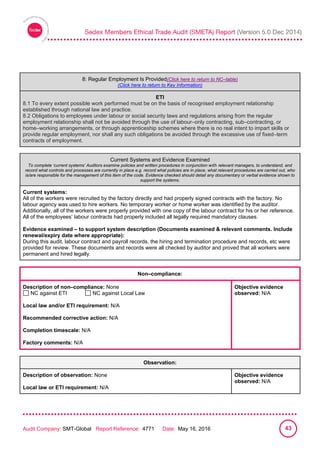
Good Examples observed:
Description of Good Example (GE): None Objective Evidence
Observed: N/A

Audit Company: SMT-Global Report Reference: 4771 Date: May 16, 2016 28
4: Child Labour Shall Not Be Used
4: Child Labour Shall Not Be Used(Click here to return to NC–table)
(Click here to return to Key Information)
ETI
4.1 There shall be no new recruitment of child labour.
4.2 Companies shall develop or participate in and contribute to policies and programmes which provide for the
transition of any child found to be performing child labour to enable her or him to attend and remain in quality
education until no longer a child.
4.3 Children and young persons under 18 shall not be employed at night or in hazardous conditions.
4.4 These policies and procedures shall conform to the provisions of the relevant ILO Standards.
Current Systems and Evidence Examined
To complete ‘current systems’ Auditors examine policies and written procedures in conjunction with relevant managers, to understand, and
record what controls and processes are currently in place e.g. record what policies are in place, what relevant procedures are carried out, who
is/are responsible for the management of this item of the code. Evidence checked should detail any documentary or verbal evidence shown to
support the systems.
Current systems:
There was a written policy in regards to prohibition of child labor, which stipulated that no worker under 16 years
old would be recruited in the factory. To prevent hiring child labor, the factory also established a child remediation
program and age verification mechanism. The HR staffs would authenticate ID card of candidates via physical
appearance comparison, questions testing and ID card authentication facility. All these processes ensured no fake
ID card was used by potential worker during the hiring process. Further, protective policy for juvenile workers were
also established in place and properly documented in the factory regulations.
According to review of employees’ personal files and employee interview, there was no child labor in the factory.
The youngest worker employed in the factory was 22 years old and no juvenile employee in the factory.
Evidence examined – to support system description (Documents examined & relevant comments. Include
renewal/expiry date where appropriate):
During this audit, different kinds of procedures, policies and records on child labour and hiring, labour contracts and
personnel files were provided for review. All these documents and records were complete to track the workers’ age
and make sure no child labour would be used.
Non–compliance:
Description of non–compliance: None
NC against ETI NC against Local Law
Local law and/or ETI requirement: N/A
Recommended corrective action: N/A
Completion timescale: N/A
Factory comments: N/A
Objective evidence
observed: N/A

Audit Company: SMT-Global Report Reference: 4771 Date: May 16, 2016 29
Observation:
Description of observation: None
Local law or ETI requirement: N/A
Comments: N/A
Objective evidence
observed: N/A
Good Examples observed:
Description of Good Example (GE): None Objective evidence
observed: N/A

Audit Company: SMT-Global Report Reference: 4771 Date: May 16, 2016 30
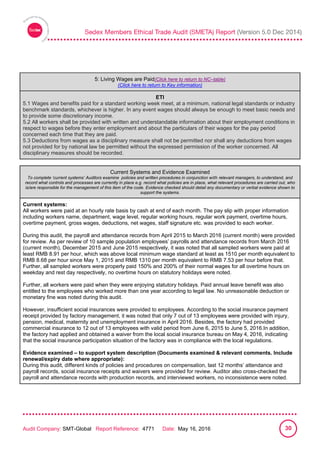
5: Living Wages are paid
5: Living Wages are Paid(Click here to return to NC–table)
(Click here to return to Key information)
ETI
5.1 Wages and benefits paid for a standard working week meet, at a minimum, national legal standards or industry
benchmark standards, whichever is higher. In any event wages should always be enough to meet basic needs and
to provide some discretionary income.
5.2 All workers shall be provided with written and understandable information about their employment conditions in
respect to wages before they enter employment and about the particulars of their wages for the pay period
concerned each time that they are paid.
5.3 Deductions from wages as a disciplinary measure shall not be permitted nor shall any deductions from wages
not provided for by national law be permitted without the expressed permission of the worker concerned. All
disciplinary measures should be recorded.
Current Systems and Evidence Examined
To complete ‘current systems’ Auditors examine policies and written procedures in conjunction with relevant managers, to understand, and
record what controls and processes are currently in place e.g. record what policies are in place, what relevant procedures are carried out, who
is/are responsible for the management of this item of the code. Evidence checked should detail any documentary or verbal evidence shown to
support the systems.
Current systems:
All workers were paid at an hourly rate basis by cash at end of each month. The pay slip with proper information
including workers name, department, wage level, regular working hours, regular work payment, overtime hours,
overtime payment, gross wages, deductions, net wages, staff signature etc. was provided to each worker.
During this audit, the payroll and attendance records from April 2015 to March 2016 (current month) were provided
for review. As per review of 10 sample population employees’ payrolls and attendance records from March 2016
(current month), December 2015 and June 2015 respectively, it was noted that all sampled workers were paid at
least RMB 8.91 per hour, which was above local minimum wage standard at least as 1510 per month equivalent to
RMB 8.68 per hour since May 1, 2015 and RMB 1310 per month equivalent to RMB 7.53 per hour before that.
Further, all sampled workers were properly paid 150% and 200% of their normal wages for all overtime hours on
weekday and rest day respectively, no overtime hours on statutory holidays were noted.
Further, all workers were paid when they were enjoying statutory holidays. Paid annual leave benefit was also
entitled to the employees who worked more than one year according to legal law. No unreasonable deduction or
monetary fine was noted during this audit.
However, insufficient social insurances were provided to employees. According to the social insurance payment
receipt provided by factory management, it was noted that only 7 out of 13 employees were provided with injury,
pension, medical, maternity and unemployment insurance in April 2016. Besides, the factory had provided
commercial insurance to 12 out of 13 employees with valid period from June 6, 2015 to June 5, 2016.In addition,
the factory had applied and obtained a waiver from the local social insurance bureau on May 4, 2016, indicating
that the social insurance participation situation of the factory was in compliance with the local regulations.
Evidence examined – to support system description (Documents examined & relevant comments. Include
renewal/expiry date where appropriate):
During this audit, different kinds of policies and procedures on compensation, last 12 months’ attendance and
payroll records, social insurance receipts and waivers were provided for review. Auditor also cross-checked the
payroll and attendance records with production records, and interviewed workers, no inconsistence were noted.

Audit Company: SMT-Global Report Reference: 4771 Date: May 16, 2016 31
Non–compliance:
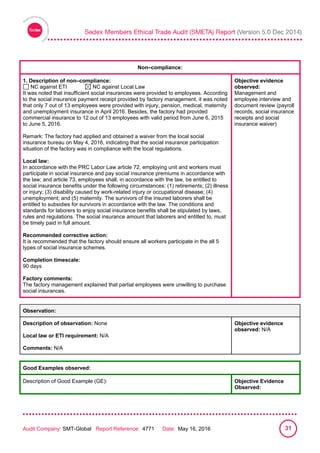
1. Description of non–compliance:
NC against ETI NC against Local Law
It was noted that insufficient social insurances were provided to employees. According
to the social insurance payment receipt provided by factory management, it was noted
that only 7 out of 13 employees were provided with injury, pension, medical, maternity
and unemployment insurance in April 2016. Besides, the factory had provided
commercial insurance to 12 out of 13 employees with valid period from June 6, 2015
to June 5, 2016.
Remark: The factory had applied and obtained a waiver from the local social
insurance bureau on May 4, 2016, indicating that the social insurance participation
situation of the factory was in compliance with the local regulations.
Local law:
In accordance with the PRC Labor Law article 72, employing unit and workers must
participate in social insurance and pay social insurance premiums in accordance with
the law; and article 73, employees shall, in accordance with the law, be entitled to
social insurance benefits under the following circumstances: (1) retirements; (2) illness
or injury; (3) disability caused by work-related injury or occupational disease; (4)
unemployment; and (5) maternity. The survivors of the insured laborers shall be
entitled to subsidies for survivors in accordance with the law. The conditions and
standards for laborers to enjoy social insurance benefits shall be stipulated by laws,
rules and regulations. The social insurance amount that laborers and entitled to, must
be timely paid in full amount.
Recommended corrective action:
It is recommended that the factory should ensure all workers participate in the all 5
types of social insurance schemes.
Completion timescale:
90 days
Factory comments:
The factory management explained that partial employees were unwilling to purchase
social insurances.
Objective evidence
observed:
Management and
employee interview and
document review (payroll
records, social insurance
receipts and social
insurance waiver)
Observation:
Description of observation: None
Local law or ETI requirement: N/A
Comments: N/A
Objective evidence
observed: N/A
Good Examples observed:
Description of Good Example (GE): Objective Evidence
Observed:

Audit Company: SMT-Global Report Reference: 4771 Date: May 16, 2016 32
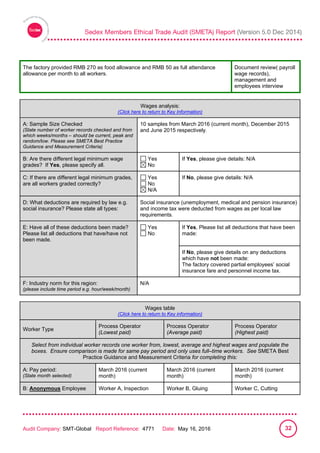
The factory provided RMB 270 as food allowance and RMB 50 as full attendance
allowance per month to all workers.
Document review( payroll
wage records),
management and
employees interview
Wages analysis:
Wages analysis:
(Click here to return to Key Information)
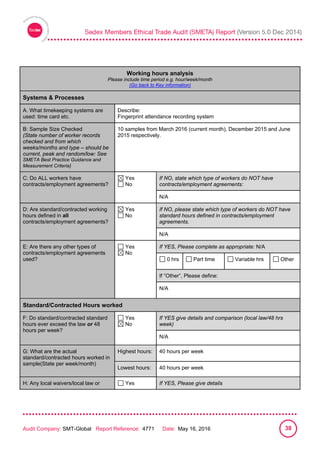
A: Sample Size Checked
(State number of worker records checked and from
which weeks/months – should be current, peak and
random/low. Please see SMETA Best Practice
Guidance and Measurement Criteria)
10 samples from March 2016 (current month), December 2015
and June 2015 respectively.
B: Are there different legal minimum wage
grades? If Yes, please specify all.
Yes
No
If Yes, please give details: N/A
C: If there are different legal minimum grades,
are all workers graded correctly?
Yes
No
N/A
If No, please give details: N/A
D: What deductions are required by law e.g.
social insurance? Please state all types:
Social insurance (unemployment, medical and pension insurance)
and income tax were deducted from wages as per local law
requirements.
E: Have all of these deductions been made?
Please list all deductions that have/have not
been made.
Yes
No
If Yes, Please list all deductions that have been
made:
If No, please give details on any deductions
which have not been made:
The factory covered partial employees’ social
insurance fare and personnel income tax.
F: Industry norm for this region:
(please include time period e.g. hour/week/month)
N/A
Wages table
Wages table
(Click here to return to Key information)
Worker Type
Process Operator
(Lowest paid)
Process Operator
(Average paid)
Process Operator
(Highest paid)
Select from individual worker records one worker from, lowest, average and highest wages and populate the
boxes. Ensure comparison is made for same pay period and only uses full–time workers. See SMETA Best
Practice Guidance and Measurement Criteria for completing this:
A: Pay period:
(State month selected)
March 2016 (current
month)
March 2016 (current
month)
March 2016 (current
month)
B: Anonymous Employee Worker A, Inspection Worker B, Gluing Worker C, Cutting

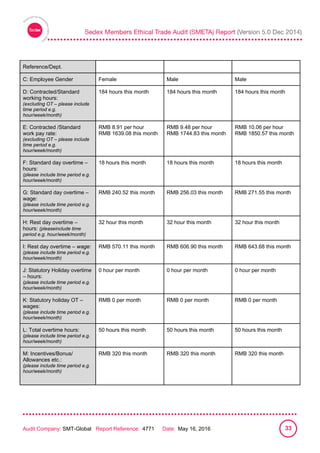
Audit Company: SMT-Global Report Reference: 4771 Date: May 16, 2016 33
Reference/Dept.
C: Employee Gender Female Male Male
D: Contracted/Standard
working hours:
(excluding OT – please include
time period e.g.
hour/week/month)
184 hours this month 184 hours this month 184 hours this month
E: Contracted /Standard
work pay rate:
(excluding OT – please include
time period e.g.
hour/week/month)
RMB 8.91 per hour
RMB 1639.08 this month
RMB 9.48 per hour
RMB 1744.83 this month
RMB 10.06 per hour
RMB 1850.57 this month
F: Standard day overtime –
hours:
(please include time period e.g.
hour/week/month)
18 hours this month 18 hours this month 18 hours this month
G: Standard day overtime –
wage:
(please include time period e.g.
hour/week/month)
RMB 240.52 this month RMB 256.03 this month RMB 271.55 this month
H: Rest day overtime –
hours: (pleaseinclude time
period e.g. hour/week/month)
32 hour this month 32 hour this month 32 hour this month
I: Rest day overtime – wage:
(please include time period e.g.
hour/week/month)
RMB 570.11 this month RMB 606.90 this month RMB 643.68 this month
J: Statutory Holiday overtime
– hours:
(please include time period e.g.
hour/week/month)
0 hour per month 0 hour per month 0 hour per month
K: Statutory holiday OT –
wages:
(please include time period e.g.
hour/week/month)
RMB 0 per month RMB 0 per month RMB 0 per month
L: Total overtime hours:
(please include time period e.g.
hour/week/month)
50 hours this month 50 hours this month 50 hours this month
M: Incentives/Bonus/
Allowances etc.:
(please include time period e.g.
hour/week/month)
RMB 320 this month RMB 320 this month RMB 320 this month

Audit Company: SMT-Global Report Reference: 4771 Date: May 16, 2016 34
N: Gross wages:
(please include time period e.g.
hour/week/month)
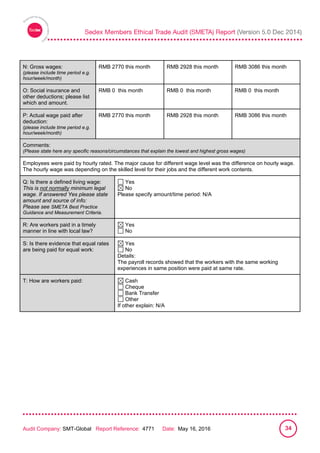
RMB 2770 this month RMB 2928 this month RMB 3086 this month
O: Social insurance and
other deductions; please list
which and amount.
RMB 0 this month RMB 0 this month RMB 0 this month
P: Actual wage paid after
deduction:
(please include time period e.g.
hour/week/month)
RMB 2770 this month RMB 2928 this month RMB 3086 this month
Comments:
(Please state here any specific reasons/circumstances that explain the lowest and highest gross wages)
Employees were paid by hourly rated. The major cause for different wage level was the difference on hourly wage.
The hourly wage was depending on the skilled level for their jobs and the different work contents.
Q: Is there a defined living wage:
This is not normally minimum legal
wage. If answered Yes please state
amount and source of info:
Please see SMETA Best Practice
Guidance and Measurement Criteria.
Yes
No
Please specify amount/time period: N/A
R: Are workers paid in a timely
manner in line with local law?
Yes
No
S: Is there evidence that equal rates
are being paid for equal work:
Yes
No
Details:
The payroll records showed that the workers with the same working
experiences in same position were paid at same rate.
T: How are workers paid: Cash
Cheque
Bank Transfer
Other
If other explain: N/A

Audit Company: SMT-Global Report Reference: 4771 Date: May 16, 2016 35
6: Working Hours are not Excessive
6: Working Hours are not Excessive(Click here to return to NC–table)
(Click here to return to Key Information)
ETI
6.1 Working hours must comply with national laws, collective agreements, and the provisions of 6.2 to 6.6 below,
whichever affords the greater protection for workers. Sub–clauses 6.2 to 6.6 are based on international labour
standards.
6.2 Working hours, excluding overtime, shall be defined by contract, and shall not exceed 48 hours per week.
6.3 All overtime shall be voluntary. Overtime shall be used responsibly, taking into account all the following: the
extent, frequency and hours worked by individual workers and the workforce as a whole. It shall not be used to
replace regular employment. Overtime shall always be compensated at a premium rate, which is recommended to
be not less than 125% of the regular rate of pay.
6.4 The total hours worked in any 7 day period shall not exceed 60 hours, except where covered by clause 6.5
below.
6.5 Working hours may exceed 60 hours in any 7 day period only in exceptional circumstances where all of the
following are met:
–this is allowed by national law;
–this is allowed by a collective agreement freely negotiated with a workers’ organisation representing a
significant portion of the workforce;
–appropriate safeguards are taken to protect the workers’ health and safety; and
–The employer can demonstrate that exceptional circumstances apply such as unexpected production
peaks, accidents or emergencies.
6.6 Workers shall be provided with at least one day off in every 7 day period or, where allowed by national law, 2
days off in every 14 day period.
Current Systems and Evidence Examined
To complete ‘current systems’ Auditors examine policies and written procedures in conjunction with relevant managers, to understand, and
record what controls and processes are currently in place e.g. record what policies are in place, what relevant procedures are carried out, who
is/are responsible for the management of this item of the code. Evidence checked should detail any documentary or verbal evidence shown to
support the systems.
Current systems:
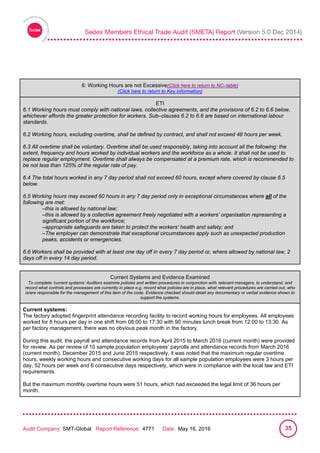
The factory adopted fingerprint attendance recording facility to record working hours for employees. All employees
worked for 8 hours per day in one shift from 08:00 to 17:30 with 90 minutes lunch break from 12:00 to 13:30. As
per factory management, there was no obvious peak month in the factory.
During this audit, the payroll and attendance records from April 2015 to March 2016 (current month) were provided
for review. As per review of 10 sample population employees’ payrolls and attendance records from March 2016
(current month), December 2015 and June 2015 respectively, it was noted that the maximum regular overtime
hours, weekly working hours and consecutive working days for all sample population employees were 3 hours per
day, 52 hours per week and 6 consecutive days respectively, which were in compliance with the local law and ETI
requirements.
But the maximum monthly overtime hours were 51 hours, which had exceeded the legal limit of 36 hours per
month.

Audit Company: SMT-Global Report Reference: 4771 Date: May 16, 2016 36
Evidence examined – to support system description (Documents examined & relevant comments. Include
renewal/expiry date where appropriate):
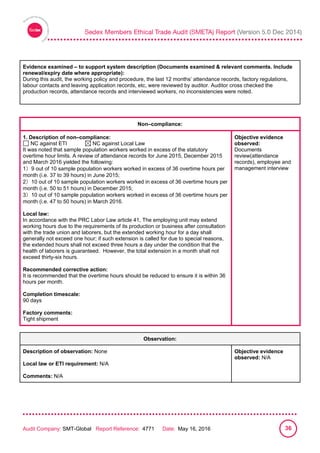
During this audit, the working policy and procedure, the last 12 months’ attendance records, factory regulations,
labour contacts and leaving application records, etc, were reviewed by auditor. Auditor cross checked the
production records, attendance records and interviewed workers, no inconsistencies were noted.
Non–compliance:
1. Description of non–compliance:
NC against ETI NC against Local Law
It was noted that sample population workers worked in excess of the statutory
overtime hour limits. A review of attendance records for June 2015, December 2015
and March 2016 yielded the following:
1
)
9 out of 10 sample population workers worked in excess of 36 overtime hours per
month (i.e. 37 to 39 hours) in June 2015;
2
)
10 out of 10 sample population workers worked in excess of 36 overtime hours per
month (i.e. 50 to 51 hours) in December 2015;
3
)
10 out of 10 sample population workers worked in excess of 36 overtime hours per
month (i.e. 47 to 50 hours) in March 2016.
Local law:
In accordance with the PRC Labor Law article 41, The employing unit may extend
working hours due to the requirements of its production or business after consultation
with the trade union and laborers, but the extended working hour for a day shall
generally not exceed one hour; if such extension is called for due to special reasons,
the extended hours shall not exceed three hours a day under the condition that the
health of laborers is guaranteed. However, the total extension in a month shall not
exceed thirty-six hours.
Recommended corrective action:
It is recommended that the overtime hours should be reduced to ensure it is within 36
hours per month.
Completion timescale:
90 days
Factory comments:
Tight shipment
Objective evidence
observed:
Documents
review(attendance
records), employee and
management interview
Observation:
Description of observation: None
Local law or ETI requirement: N/A
Comments: N/A
Objective evidence
observed: N/A

Audit Company: SMT-Global Report Reference: 4771 Date: May 16, 2016 37
Good Examples observed:
Description of Good Example (GE): None Objective Evidence
Observed: N/A
Working hours a

Audit Company: SMT-Global Report Reference: 4771 Date: May 16, 2016 38
Working hours analysis
Please include time period e.g. hour/week/month
(Go back to Key information)
Systems & Processes
A. What timekeeping systems are
used: time card etc.
Describe:
Fingerprint attendance recording system
B: Sample Size Checked
(State number of worker records
checked and from which
weeks/months and type – should be
current, peak and random/low: See
SMETA Best Practice Guidance and
Measurement Criteria)
10 samples from March 2016 (current month), December 2015 and June
2015 respectively.
C: Do ALL workers have
contracts/employment agreements?
Yes
No
If NO, state which type of workers do NOT have
contracts/employment agreements:
N/A
D: Are standard/contracted working
hours defined in all
contracts/employment agreements?
Yes
No
If NO, please state which type of workers do NOT have
standard hours defined in contracts/employment
agreements.
N/A
E: Are there any other types of
contracts/employment agreements
used?
Yes
No
If YES, Please complete as appropriate: N/A
0 hrs Part time Variable hrs Other
If “Other”, Please define:
N/A
Standard/Contracted Hours worked
F: Do standard/contracted standard
hours ever exceed the law or 48
hours per week?
Yes
No
If YES give details and comparison (local law/48 hrs
week)
N/A
G: What are the actual
standard/contracted hours worked in
sample(State per week/month)
Highest hours: 40 hours per week
Lowest hours: 40 hours per week
H: Any local waivers/local law or Yes If YES, Please give details

Audit Company: SMT-Global Report Reference: 4771 Date: May 16, 2016 39
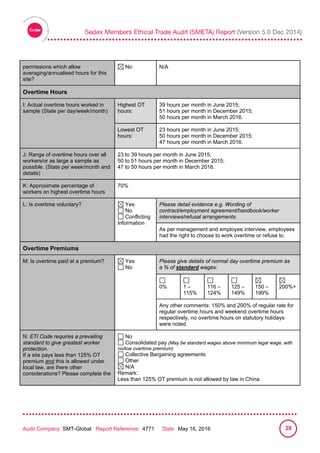
permissions which allow
averaging/annualised hours for this
site?
No N/A
Overtime Hours
I: Actual overtime hours worked in
sample (State per day/week/month)
Highest OT
hours:
39 hours per month in June 2015;
51 hours per month in December 2015;
50 hours per month in March 2016.
Lowest OT
hours:
23 hours per month in June 2015;
50 hours per month in December 2015;
47 hours per month in March 2016.
J: Range of overtime hours over all
workers/or as large a sample as
possible. (State per week/month and
details)
23 to 39 hours per month in June 2015;
50 to 51 hours per month in December 2015;
47 to 50 hours per month in March 2016.
K: Approximate percentage of
workers on highest overtime hours
70%
L: Is overtime voluntary? Yes
No
Conflicting
Information
Please detail evidence e.g. Wording of
contract/employment agreement/handbook/worker
interviews/refusal arrangements:
As per management and employee interview, employees
had the right to choose to work overtime or refuse to.
Overtime Premiums
M: Is overtime paid at a premium? Yes
No
Please give details of normal day overtime premium as
a % of standard wages:
0% 1 –
115%
116 –
124%
125 –
149%
150 –
199%
200%+
Any other comments: 150% and 200% of regular rate for
regular overtime hours and weekend overtime hours
respectively, no overtime hours on statutory holidays
were noted.
N: ETI Code requires a prevailing
standard to give greatest worker
protection.
If a site pays less than 125% OT
premium and this is allowed under
local law, are there other
considerations? Please complete the
No
Consolidated pay (May be standard wages above minimum legal wage, with
no/low overtime premium)
Collective Bargaining agreements
Other
N/A
Remark:
Less than 125% OT premium is not allowed by law in China

Audit Company: SMT-Global Report Reference: 4771 Date: May 16, 2016 40
boxes where relevant. Multi select is
possible.
Please explain any checked boxes in N above e.g. detail of consolidated
pay CBA or Other.
N/A
Rest Days
O: Are workers provided with 1 day
off in every 7–day–period, or 2 in 14–
day–period (where the law allows)?
Yes
No
Maximum number of days worked without a day off (in
sample):
6 days
Total Hours
P: Range of total hours:
(Quote highest and lowest please include
time period e.g. hour/week/month)
Highest total
hours
52 hours per week in June 2015;
52 hours per week in December 2015;
52 hours per week in March 2016.
Lowest total
hours
50 hours per week in June 2015;
48 hours per week in December 2015;
48 hours per week in March 2016.
R: If more than 60 total hours per
week and this is legally allowed, are
there other considerations? Please
complete the boxes where relevant.
Multi select is possible.
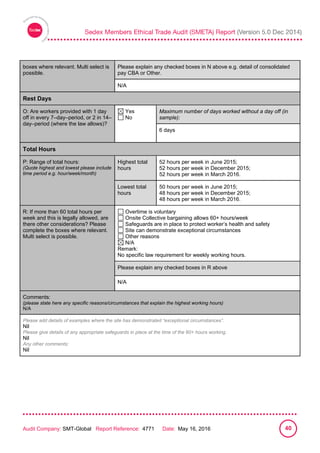
Overtime is voluntary
Onsite Collective bargaining allows 60+ hours/week
Safeguards are in place to protect worker’s health and safety
Site can demonstrate exceptional circumstances
Other reasons
N/A
Remark:
No specific law requirement for weekly working hours.
Please explain any checked boxes in R above
N/A
Comments:
(please state here any specific reasons/circumstances that explain the highest working hours)
N/A
Please add details of examples where the site has demonstrated “exceptional circumstances”.
Nil
Please give details of any appropriate safeguards in place at the time of the 60+ hours working.
Nil
Any other comments:
Nil

Audit Company: SMT-Global Report Reference: 4771 Date: May 16, 2016 41
7: No Discrimination is practiced
7: No Discrimination is Practiced
(Click here to return to NC–table)
ETI
7.1 There is no discrimination in hiring, compensation, access to training, promotion, termination or retirement
based on race, caste, national origin, religion, age, disability, gender, marital status, sexual orientation, union
membership or political affiliation.
Current Systems and Evidence Examined
To complete ‘current systems’ Auditors examine policies and written procedures in conjunction with relevant managers, to understand, and
record what controls and processes are currently in place e.g. record what policies are in place, what relevant procedures are carried out, who
is/are responsible for the management of this item of the code. Evidence checked should detail any documentary or verbal evidence shown to
support the systems.
Current systems:
All workers in this factory were employed and promoted solely based on their working abilities and experiences
rather than their race, caste, national origin, religion, age, disability, gender, marital status, sexual orientation, union
membership or political affiliation.
Female workers in this factory were not required to take pregnant tests before or during their employment. Equal
job were being paid on the same level. Gender divisions were visible in the factory; both female and male workers
were distributed to each working and managerial position.
Evidence examined – to support system description (Documents examined & relevant comments. Include
renewal/expiry date where appropriate):
During this audit, policy and procedures with regards to Prohibition of Discrimination, labour contracts, hiring and
termination procedure, promotion and training procedure and records, payroll records and grievance procedure
were checked. No discrimination related case was noted based on these documents and records.
Non–compliance:
Description of non–compliance: None
NC against ETI NC against Local Law
Local law and/or ETI requirement: N/A
Recommended corrective action: N/A
Completion timescale: N/A
Factory comments: N/A
Objective evidence
observed: N/A
Observation:
Description of observation: None
Local law or ETI requirement: N/A
Comments: N/A
Objective evidence
observed: N/A

Audit Company: SMT-Global Report Reference: 4771 Date: May 16, 2016 42
Good Examples observed:
Description of Good Example (GE): None Objective Evidence
Observed: N/A

Audit Company: SMT-Global Report Reference: 4771 Date: May 16, 2016 43
8: Regular Employment Is Provided
8: Regular Employment Is Provided(Click here to return to NC–table)
(Click here to return to Key Information)
ETI
8.1 To every extent possible work performed must be on the basis of recognised employment relationship
established through national law and practice.
8.2 Obligations to employees under labour or social security laws and regulations arising from the regular
employment relationship shall not be avoided through the use of labour–only contracting, sub–contracting, or
home–working arrangements, or through apprenticeship schemes where there is no real intent to impart skills or
provide regular employment, nor shall any such obligations be avoided through the excessive use of fixed–term
contracts of employment.
Current Systems and Evidence Examined
To complete ‘current systems’ Auditors examine policies and written procedures in conjunction with relevant managers, to understand, and
record what controls and processes are currently in place e.g. record what policies are in place, what relevant procedures are carried out, who
is/are responsible for the management of this item of the code. Evidence checked should detail any documentary or verbal evidence shown to
support the systems.
Current systems:
All of the workers were recruited by the factory directly and had properly signed contracts with the factory. No
labour agency was used to hire workers. No temporary worker or home worker was identified by the auditor.
Additionally, all of the workers were properly provided with one copy of the labour contract for his or her reference.
All of the employees’ labour contracts had properly included all legally required mandatory clauses.
Evidence examined – to support system description (Documents examined & relevant comments. Include
renewal/expiry date where appropriate):
During this audit, labour contract and payroll records, the hiring and termination procedure and records, etc were
provided for review. These documents and records were all checked by auditor and proved that all workers were
permanent and hired legally.
Non–compliance:
Description of non–compliance: None
NC against ETI NC against Local Law
Local law and/or ETI requirement: N/A
Recommended corrective action: N/A
Completion timescale: N/A
Factory comments: N/A
Objective evidence
observed: N/A
Observation:
Description of observation: None
Local law or ETI requirement: N/A
Objective evidence
observed: N/A

Audit Company: SMT-Global Report Reference: 4771 Date: May 16, 2016 44
Comments: N/A
Good Examples observed:
Description of Good Example (GE): None Objective evidence
observed: N/A

Audit Company: SMT-Global Report Reference: 4771 Date: May 16, 2016 45
8A: Sub–Contracting and Homeworking:
8A: Sub–Contracting and Homeworking(Click here to return to NC–table)
(Click here to return to Key Information)
8A.1. There should be no sub–contracting unless previously agreed with the main client.
8A.2. Systems and processes should be in place to manage sub–contracting, homeworking and external
processing.
Note to auditor on homeworking:
Report on whether it is direct or via agents. How many workers, relationship with site and what control systems are
in place.
Current Systems and Evidence Examined
To complete ‘current systems’ Auditors examine policies and written procedures in conjunction with relevant managers, to understand, and
record what controls and processes are currently in place e.g. record what policies are in place, what relevant procedures are carried out, who
is/are responsible for the management of this item of the code. Evidence checked should detail any documentary or verbal evidence shown to
support the systems.
Current systems:
As per evaluation of factory’s capacity and capability, the factory used two subcontractors for blister and silk
printing process when necessary.
Evidence examined – to support system description (Documents examined & relevant comments. Include
renewal/expiry date where appropriate):
Daily production records, warehouse in and out records and QC records were all properly reviewed by auditor. All
documents and records showed there was no practice of home-working in this factory.
If any processes are sub–contracted – please populate below boxes
Process Subcontracted Blister Silk printing
Name of factory Yidian Guanggao Blister Factory Zhanheng Plastic Products Co., Ltd
Address
No. 18, Haijing Road, Haijing
Industrial Zone, Zhongshan City,
Guangdong Province, China.
Contact Person: Mr. Huan
No. 5, Shunjing Gongye Avenue,
Banfu Town, Zhongshan City,
Guangdong Province, China.
Non–compliance:
Description of non–compliance: None
NC against ETI/Additional Elements NC against Local Law
Local law and/or ETI /Additional Elements requirement: N/A
Recommended corrective action: N/A
Completion timescale: N/A
Factory comments: N/A
Objective evidence
observed: N/A
Observation:

Audit Company: SMT-Global Report Reference: 4771 Date: May 16, 2016 46
1. Description of observation:
It was noted that the following subcontracted factories were used, but without client’s
written approval.
Factory Name: Yidian Guanggao Blister Factory
Address: No. 18, Haijing Road, Haijing Industrial Zone, Zhongshan City, Guangdong
Province, China.
Contact Person: Mr. Huang
Tel: 86--86116139
Process Type: Blister
Factory Name: Zhanheng Plastic Products Co., Ltd
Address: No. 5, Shunjing Gongye Avenue, Banfu Town, Zhongshan City, Guangdong
Province, China.
Contact Person: Mr. Hu
Tel: 86--88616813
Process Type: Silk printing
Additional elements requirement: In accordance with additional elements
requirement 8A.1, there should be no sub-contracting unless previously agreed with
the main client.
Comments: It is recommended that the factory should obtain client’s written approval
prior to subcontracting.
Objective evidence
observed:
Factory tour, documents
review and management
interview
Good Examples observed:
Description of Good Example (GE): None Objective Evidence
Observed: N/A

Audit Company: SMT-Global Report Reference: 4771 Date: May 16, 2016 47
Summary of sub–contracting – if applicable
A: If sub–contractors are used, is
there evidence this has been agreed
with the main client?
Yes
No
N/A
If Yes, summarise details:
B: Number of sub–
contractors/agents used
2
C: Is there a site policy on sub–
contracting?
Yes
No
If Yes, summarise details: The factory had set up a policy to manage the
subcontractors.
D: What checks are in place to
ensure no child labour is being used
and work is safe?
The factory would inspect the subcontractors regularly to ensure no child
labor was used.
E: What processes are sub–
contracted?
Blister and Silk printing
Summary of homeworking – if applicable
F: If homeworking is being used, is
there evidence this has been agreed
with the main client?
Yes
No
N/A
If Yes, summarise details:
G: Number of homeworkers Male: 0 Female: 0 Total: 0
H: Are homeworkers employed direct
or through agents?
Directly
Through Agents
N/A
I: If through agents, number of
agents
N/A
J: Is there a site policy on
homeworking?
Yes
No
N/A
K: How does site ensure worker
hours and pay meet local laws for
homeworkers?
N/A
L: What processes are carried out by
homeworkers?
N/A
M: Are written agreements in place
for homeworkers that include regular
Yes
No

Audit Company: SMT-Global Report Reference: 4771 Date: May 16, 2016 48
employment? N/A
N: Are full records available at the
site?
Yes
No
N/A

Audit Company: SMT-Global Report Reference: 4771 Date: May 16, 2016 49
9: No Harsh or Inhumane Treatment is allowed
9: No Harsh or Inhumane Treatment is Allowed(Click here to return to NC–table)
ETI
9.1 Physical abuse or discipline, the threat of physical abuse, sexual or other harassment and verbal abuse or
other forms of intimidation shall be prohibited.
Current Systems and Evidence Examined
To complete ‘current systems’ Auditors examine policies and written procedures in conjunction with relevant managers, to understand, and
record what controls and processes are currently in place e.g. record what policies are in place, what relevant procedures are carried out, who is
/are responsible for the management of this item of the code. Evidence checked should detail any documentary or verbal evidence shown to
support the systems.
Current systems:
The factory had properly set up an escalating disciplinary mechanism for workers’ misbehaviours in place, which
included oral warning, written warning, termination etc. Additionally, no abuse or harassment related issue had ever
happened in the factory. Moreover, all workers appeared relax, worked together in harmony and concord condition.
Evidence examined – to support system description (Documents examined & relevant comments. Include
renewal/expiry date where appropriate):
During this audit, the policy and procedure on prevention of harassment and abuse, disciplinary rules and records,
grievance procedure, factory rules and training records were checked. All documents and records showed no form
of intimidation was occurred in this factory.
Non–compliance:
Description of non–compliance: None
NC against ETI NC against Local Law
Local law and/or ETI requirement: N/A
Recommended corrective action: N/A
Completion timescale: N/A
Factory comments: N/A
Objective evidence
observed: N/A
Observation:
Description of observation: None
Local law or ETI requirement: N/A
Comments: N/A
Objective evidence
observed: N/A
Good Examples observed:

Audit Company: SMT-Global Report Reference: 4771 Date: May 16, 2016 50
Description of Good Example (GE): None Objective evidence
observed: N/A

Audit Company: SMT-Global Report Reference: 4771 Date: May 16, 2016 51
10 A: Entitlement to Work and Immigration
10. Other Issue areas: 10 A:Entitlement to Work and Immigration(Click here to return to NC–table)
Additional Elements
10A1 Only workers with a legal right to work shall be employed or used by the supplier.
10A2 All workers, including employment agency staff, must be validated by the supplier for their legal right to work
by reviewing original documentation.
10A3 Employment agencies must only supply workers registered with them.
10A4 The supplier shall implement processes to enable adequate control over agencies with regards the above
points and related legislation.
Current Systems and Evidence Examined
To complete ‘current systems’ Auditors examine policies and written procedures in conjunction with relevant managers, to understand, and
record what controls and processes are currently in place e.g. record what policies are in place, what relevant procedures are carried out, who
is/are responsible for the management of this item of the code. Evidence checked should detail any documentary or verbal evidence shown to
support the systems.
Current systems:
All workers in the factory were Chinese. There were 5 local workers and 8 migrant workers from other province of
China. All workers had the proper legal rights to work in this region and their ages were at least 22 years old. All of
them were recruited directly by the factory and no talent agency was involved in factory’s recruitment processes.
Evidence examined – to support system description (Documents examined & relevant comments. Include
renewal/expiry date where appropriate):
During this audit, the hiring procedure, personnel records and labour contracts, etc were reviewed by auditor. No
agency staff or foreign worker was used by the factory.
Non–compliance:
Description of non–compliance: None
NC against ETI/Additional Elements NC against Local Law
Local law and/or ETI /Additional Elements requirement: N/A
Recommended corrective action: N/A
Completion timescale: N/A
Factory comments: N/A
Objective evidence
observed: N/A
Observation:
Description of observation: None
Local law or ETI/Additional elements requirement: N/A
Comments: N/A
Objective evidence
observed: N/A

Audit Company: SMT-Global Report Reference: 4771 Date: May 16, 2016 52
Good examples observed:
Description of Good Example (GE): None Objective evidence
observed: N/A

Audit Company: SMT-Global Report Reference: 4771 Date: May 16, 2016 53
10 B 2: Environment 2–pillar
10. Other issue areas 10 B 2: Environment 2–pillar(Click here to return to NC–table)
To be completed for a 2–Pillar SMETA Audit, and remove the following page which is 10B4 environment 4 pillar
10B2. 1 Suppliers must comply with the requirements of local and international laws and regulations
includinghaving necessary permits.
10B2. 2 The supplier should be aware of and comply with their end clients’ environmental requirements.
Note for auditors and readers, This is not a full environmental assessment but a check on basic systems and
management approach.
Current Systems and Evidence Examined
To complete ‘current systems’ Auditors examine policies and written procedures in conjunction with relevant managers, to understand, and
record what controls and processes are currently in place e.g. record what policies are in place, what relevant procedures are carried out, who is
/are responsible for the management of this item of the code. Evidence checked should detail any documentary or verbal evidence shown to
support the systems.
Current systems:
According to documents review, all legally required environmental documents were obtained and kept updated by
the factory. The factory had signed contract with the qualified collector and all hazardous waste generated by the
factory would be submitted to the collector.
Evidence examined – to support system description (Documents examined & relevant comments. Include
renewal/expiry date where appropriate):
During this audit, different kinds of legally required certificates including environmental impact appraisal
documents, approval of environmental impact assessment document, hazardous waste collector qualification
documents etc. were provided for review. All legally required documents were well obtained and valid for review.
Non–compliance:
Description of non–compliance: None
NC against ETI/Additional Elements NC against Local Law
Local law and/or ETI /Additional Elements requirement: N/A
Recommended corrective action: N/A
Completion timescale: N/A
Factory comments: N/A
Objective evidence
observed: N/A
Observation:
Description of observation: None
Local law or ETI/Additional elements requirement: N/A
Comments: N/A
Objective evidence
observed: N/A

Audit Company: SMT-Global Report Reference: 4771 Date: May 16, 2016 54
Good examples observed:
Description of Good Example (GE): None Objective evidence
observed: N/A

Audit Company: SMT-Global Report Reference: 4771 Date: May 16, 2016 55
Worker Interview Summary
A: Were workers aware of the audit? Yes
No
B: Were workers aware of the code? Yes
No
C: Number of group interviews:
(Please specify number and size of
groups. Please see SMETA Best
Practice Guidance and Measurement
Criteria)
1 group of 4 workers
D: Number of individual interviews
(Please see SMETA Best Practice
Guidance and Measurement Criteria)
Male: 3 Female: 3
E: Total number of interviewed
workers
(Please see SMETA Best Practice
Guidance and Measurement Criteria)
Male: 5 Female: 5
F: Interviews were done in private
and the confidentiality of the
interview process was
communicated to the workers?
Yes
No
G: In general, what was the attitude
of the workers towards their
workplace?
Favourable
Non–favourable
Indifferent
H: What was the most common
worker complaint?
No negative feedback
I: What did the workers like the most
about working at this site?
Comfortable health and safety environments in the workshops areas and
the harmonious relationship with the managerial levels or immediate
supervisors.
J: Any additional comment(s)
regarding interviews:
Nil
K: Attitude of workers to hours
worked:
Interviewees represented that the working hour was reasonable and
overtime work was voluntary.
Agency Workers
Agency Workers (if applicable)
(workers sourced from a local agent who are not directly paid by the site)
A: Number of agencies used 0

Audit Company: SMT-Global Report Reference: 4771 Date: May 16, 2016 56
(average): And names if available: N/A
B: Were agency workers’
age/pay/hours included within scope
of this audit
Yes
No
N/A
C: Were sufficient documents for
agency workers available for review?
Yes
No
N/A

Audit Company: SMT-Global Report Reference: 4771 Date: May 16, 2016 57
Other findings
Other Findings Outside the Scope of the Code
Nil
Community Benefits
(Please list below any specific community benefits that the site management stated that they were involved in, for example, HIV
programme, education, sports facilities)
Nil

Audit Company: SMT-Global Report Reference: 4771 Date: May 16, 2016 58
Photo Form
Best Practice Photos:
Nil Nil Nil
Nil Nil Nil
General Site Tour Photos:
Factory name Factory gate Production building
Cutting process Polishing process Gluing process

Audit Company: SMT-Global Report Reference: 4771 Date: May 16, 2016 59
Inspection and packing process Finished goods stored area Fire alarm and fire button
Fire hydrant Fire extinguishers Evacuation map
No smoking sign Electrical panel with warning sign Evacuation indication sign and
emergency light

Audit Company: SMT-Global Report Reference: 4771 Date: May 16, 2016 60
First kit aid PPE warning sign Fingerprint attendance recording
system
Toilet Suggestion box ETI Base Code Posted
Your feedback on your experience of the SMETA audit you have observed is extremely valuable.
It will help to make improvements to future versions.
You can leave feedback by following the appropriate link to our questionnaire:
Click here for A & AB members:
http://www.surveymonkey.com/s.aspx?sm=riPsbE0PQ52ehCo3lnq5Iw_3d_3d
Click here for B members:
http://www.surveymonkey.com/s.aspx?sm=d3vYsCe48fre69DRgIY_2brg_3d_3d

Audit Company: SMT-Global Report Reference: 4771 Date: May 16, 2016 61