Curriculum
The termCurriculum is derived from a Latin word “Currere” which means
to run
• It also means a course of study
• According to (Brown, 2006)“Curriculum refers to all student school
experiences relating to the improvement of skills and strategies in thinking
critically and creatively, solving problems, working collaboratively with
others, communicating well, writing more effectively, reading more
analytically and conducting research to solve problems”
4.
Curriculum Implementation
• Theact of working out the plans and suggestions that have been made
by curriculum specialists and subject experts in a classroom or school
setting
• Teachers are the main curriculum implementers, while at the same time
students, parents, school administrators can be directly or indirectly involved
in the implementation process
5.
Educational Strategy forImplementing
Curriculum
The following are the most important aspects to require of teams that are
in charge of curriculum implementation:
• Clear goals - Clearly define what is expected of every team member.
• Resource Management - Do the resources available match the
curriculum goals.?
• Professional Development - Does the plan leave room and address
professional development of those involved with the curriculum?
• Community - Does the plan implement the community, parents, and
other stakeholders in the educational process?
6.
Implementation:
a process ofchange
• Implementation is a major and most important part of
curriculum development.
• Many of the thinkers are now willing that implementation is
also a part of curriculum
• implementation is a single and unique part in the curriculum
action phase.
• The implementation cycle through which logical steps need to
change
7.
Implementation basically involves
attitude,
behavior,
personal interest,
individual knowledge and struggle.
• Definitely it’s a slow but effective process so its take a time to
provoke people over to change.
8.
Ways of change:
•As implementation is an essential part of the curriculum.
• It can change positively in society in several ways,
• the two most important ways are:
Slow change
Rapid change
9.
Guidelines for implantingchange
• For curriculum change to successfully implemented
• Whether the curriculum is slowly or rapid
• we need to considered the following guidelines:
Change and research should be interlinked
Change in distance education system; allocated of funds
responsibilities to students and teachers.
10.
There should bepositive, effective and flexible
changes,
we should make this process successfully, when we
focus on individual’s interest and ability
Implementation of successful change must be easy and
convenient rather than inflexible.
11.
Factors resistance tochange
• Here are a few factors that might have useful for use
Psycho-social barriers
Change is meaning less
Lack of knowledge
The Rapidity of change
Lack of incentives
12.
Issues in curriculumimplementation
• Quality and quantity of teaching staff
• Professional development of teachers
• Lack of school facilities
• Lack of learning resources
• Time management
• Limited funding
13.
Curriculum Implementation Model
•ORC MODEL (Overcoming Resistance to Change)
• LOC MODEL (Leadership-Obstacle Course)
• RCA MODEL ( THE RAND CHANGE AGENT)
14.
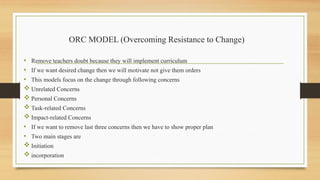
ORC MODEL (OvercomingResistance to Change)
• Remove teachers doubt because they will implement curriculum
• If we want desired change then we will motivate not give them orders
• This models focus on the change through following concerns
Unrelated Concerns
Personal Concerns
Task-related Concerns
Impact-related Concerns
• If we want to remove last three concerns then we have to show proper plan
• Two main stages are
Initiation
incorporation
15.
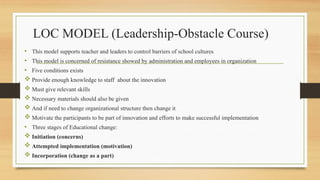
LOC MODEL (Leadership-ObstacleCourse)
• This model supports teacher and leaders to control barriers of school cultures
• This model is concerned of resistance showed by administration and employees in organization
• Five conditions exists
Provide enough knowledge to staff about the innovation
Must give relevant skills
Necessary materials should also be given
And if need to change organizational structure then change it
Motivate the participants to be part of innovation and efforts to make successful implementation
• Three stages of Educational change:
Initiation (concerns)
Attempted implementation (motivation)
Incorporation (change as a part)
16.
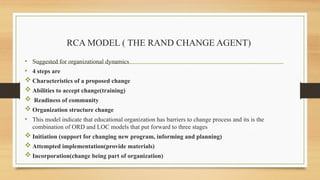
RCA MODEL (THE RAND CHANGE AGENT)
• Suggested for organizational dynamics
• 4 steps are
Characteristics of a proposed change
Abilities to accept change(training)
Readiness of community
Organization structure change
• This model indicate that educational organization has barriers to change process and its is the
combination of ORD and LOC models that put forward to three stages
Initiation (support for changing new program, informing and planning)
Attempted implementation(provide materials)
Incorporation(change being part of organization)
17.
Key players incurriculum implementation
1. Learners
2. Teachers
3. Curriculum Managers and Administrators
4. Parents
5. Community Members
18.
LEARNERS
• Center ofthe curriculum
• The very reason a curriculum is developed
• They are the ones who are directly influenced by it
• The success of the curriculum can only be measured by the extent of
learning that the learners have achieved
19.
ROLES OF ATEACHER
• The teacher prepares activities for the students to do.
• The teachers address the goals and needs interests of the learners by creating experiences from
where the students can learn
• The teacher designs, enriches, and modifies the curriculum to suit the learner’s characteristics
• A teacher is a curriculum maker. He/she writes a curriculum daily through a lesson plan, a unit plan
or a yearly plan.
• A developed curriculum remains inactive, if it is not implemented, teacher role’s shifts from a
developer to an implementer.
• Doing implies guiding, facilitating and directing activities which will be done by the students
• The teachers’ role as an implementer is very crucial. Oftentimes, unsuccessful implementation of the
curriculum becomes the root of educational failure, thus some would say that the root of the
educational problem is the teacher.
20.
CURRICULUM MANAGERS AND
ADMINISTRATORS
•In a school organization, there is always a curriculum manager or school administrator.
In fact, for school principals, one of their functions is being a curriculum manager
• School administrators and curriculum managers are important to the curriculum
implementation because they perform following functions
Supervise curriculum implementation
Select and recruit new teacher
Admit students
Provide procedures, equipment and materials needed for effective teaching
21.
PARENTS
• Supporters ofthe curriculum
• Effective parental involvement in school affairs may be linked
to parent educational programs which is central to high quality
educational experiences of the children
• The parent’s involvement extends from the confine of the
school to the homes
• In most schools the Parents Association is organized
22.
COMMUNITY MEMBERS
• Successin the implementation of the curriculum requires resources
• Respected community members maybe included in school boards
• Some can become resource speakers
• They can provide local and indigenous knowledge in school
curriculum