23 Best Site To Buy TikTok
Accounts
Growth on TikTok is rarely the result of one isolated decision. It is usually an accumulation of
small improvements: clearer storytelling, better audience understanding, stronger
presentation, more relevant topics, and consistent experimentation.
For TikTok Accounts, sustainable growth means more than increasing a follower number.
It means building an audience that recognizes the account, understands its value, and has a
reason to return.
That requires strategy.
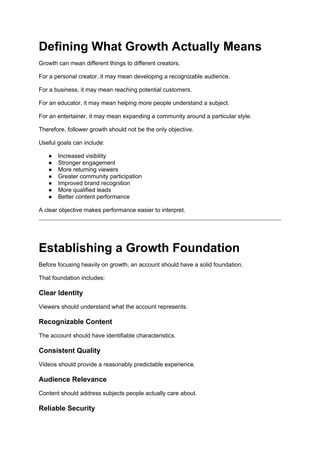
Defining What Growth Actually Means
Growth can mean different things to different creators.
For a personal creator, it may mean developing a recognizable audience.
For a business, it may mean reaching potential customers.
For an educator, it may mean helping more people understand a subject.
For an entertainer, it may mean expanding a community around a particular style.
Therefore, follower growth should not be the only objective.
Useful goals can include:
● Increased visibility
● Stronger engagement
● More returning viewers
● Greater community participation
● Improved brand recognition
● More qualified leads
● Better content performance
A clear objective makes performance easier to interpret.
Establishing a Growth Foundation
Before focusing heavily on growth, an account should have a solid foundation.
That foundation includes:
Clear Identity
Viewers should understand what the account represents.
Recognizable Content
The account should have identifiable characteristics.
Consistent Quality
Videos should provide a reasonably predictable experience.
Audience Relevance
Content should address subjects people actually care about.
Reliable Security
The account should be appropriately protected.
Without these foundations, rapid growth can become difficult to sustain.
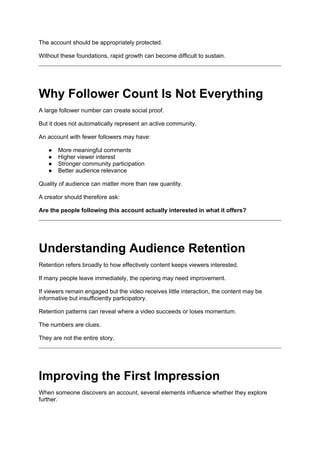
Why Follower Count Is Not Everything
A large follower number can create social proof.
But it does not automatically represent an active community.
An account with fewer followers may have:
● More meaningful comments
● Higher viewer interest
● Stronger community participation
● Better audience relevance
Quality of audience can matter more than raw quantity.
A creator should therefore ask:
Are the people following this account actually interested in what it offers?
Understanding Audience Retention
Retention refers broadly to how effectively content keeps viewers interested.
If many people leave immediately, the opening may need improvement.
If viewers remain engaged but the video receives little interaction, the content may be
informative but insufficiently participatory.
Retention patterns can reveal where a video succeeds or loses momentum.
The numbers are clues.
They are not the entire story.
Improving the First Impression
When someone discovers an account, several elements influence whether they explore
further.
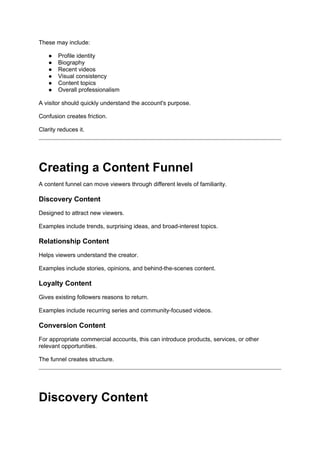
These may include:
● Profile identity
● Biography
● Recent videos
● Visual consistency
● Content topics
● Overall professionalism
A visitor should quickly understand the account's purpose.
Confusion creates friction.
Clarity reduces it.
Creating a Content Funnel
A content funnel can move viewers through different levels of familiarity.
Discovery Content
Designed to attract new viewers.
Examples include trends, surprising ideas, and broad-interest topics.
Relationship Content
Helps viewers understand the creator.
Examples include stories, opinions, and behind-the-scenes content.
Loyalty Content
Gives existing followers reasons to return.
Examples include recurring series and community-focused videos.
Conversion Content
For appropriate commercial accounts, this can introduce products, services, or other
relevant opportunities.
The funnel creates structure.
Discovery Content
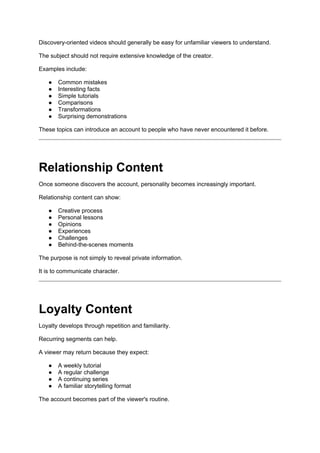
Discovery-oriented videos should generally be easy for unfamiliar viewers to understand.
The subject should not require extensive knowledge of the creator.
Examples include:
● Common mistakes
● Interesting facts
● Simple tutorials
● Comparisons
● Transformations
● Surprising demonstrations
These topics can introduce an account to people who have never encountered it before.
Relationship Content
Once someone discovers the account, personality becomes increasingly important.
Relationship content can show:
● Creative process
● Personal lessons
● Opinions
● Experiences
● Challenges
● Behind-the-scenes moments
The purpose is not simply to reveal private information.
It is to communicate character.
Loyalty Content
Loyalty develops through repetition and familiarity.
Recurring segments can help.
A viewer may return because they expect:
● A weekly tutorial
● A regular challenge
● A continuing series
● A familiar storytelling format
The account becomes part of the viewer's routine.
Building a Community Instead of an
Audience
An audience watches.
A community participates.
That distinction matters.
Community-building can involve:
● Asking thoughtful questions
● Responding to recurring concerns
● Featuring audience ideas
● Creating shared traditions
● Encouraging respectful discussion
The audience begins to feel involved in the account's development.
Turning Followers Into Participants
Participation can take many forms.
A creator might ask viewers to choose between two concepts.
Another might request suggestions for the next experiment.
Another might invite viewers to submit questions.
Participation gives viewers agency.
That sense of involvement can strengthen attachment to the community.
Creating Community Language
Communities often develop recurring phrases, references, or concepts.
These can emerge naturally.
A particular joke may become a recurring reference.
A series may acquire a nickname.
A common audience response may become part of the account's identity.
These small elements create social texture.
Handling Community Conflict
As communities grow, disagreements become inevitable.
Creators should avoid unnecessarily escalating conflict.
Useful principles include:
● Set clear boundaries.
● Avoid encouraging harassment.
● Correct misinformation calmly.
● Remove genuinely harmful interactions where appropriate.
● Keep disagreements focused on ideas rather than individuals.
Healthy communities require moderation.
Collaborations and Audience Expansion
Collaborations can introduce an account to another creator's audience.
The best collaborations have genuine thematic overlap.
A finance educator and a cooking creator may have little obvious connection.
But a finance educator and an entrepreneurship creator may have significant overlap.
Audience compatibility should be considered before collaboration.
Cross-Niche Collaboration
Unexpected collaborations can also work when the connection is creative.
For example:
A photographer and a travel creator can combine visual storytelling with destination content.
A musician and a filmmaker can explore how sound changes visual narratives.
A designer and a business creator can discuss branding.
The unusual combination can itself become the hook.
Building a Creator Network
Long-term relationships with other creators can provide more than occasional collaborations.
Creators can exchange:
● Ideas
● Production techniques
● Industry knowledge
● Feedback
● Creative opportunities
A healthy network can make the creator ecosystem less competitive and more collaborative.
Analytics as a Learning Tool
Analytics should answer questions.
For example:
Which topics attract new viewers?
Which videos encourage interaction?
Which formats retain attention?
Which subjects repeatedly underperform?
Instead of checking numbers without purpose, connect metrics to decisions.
Data becomes useful when it changes what happens next.
Avoiding Obsession With Numbers
Constantly checking performance can become counterproductive.
One video may perform exceptionally well.
Another may perform poorly.
Neither result necessarily defines the entire account.
Content performance can be influenced by many factors.
The more useful approach is to look for patterns across multiple videos.
Testing One Variable at a Time
Suppose two videos discuss the same topic.
One uses a direct question as the opening.
The other uses a visual demonstration.
Comparing them can provide insight into which hook resonates more strongly.
If several variables change simultaneously, learning becomes harder.
Controlled experimentation creates clearer information.
Studying High-Performing Content
When a video performs well, examine why.
Consider:
● Topic
● Hook
● Length
● Presentation
● Timing
● Story structure
● Emotional response
● Audience relevance
Then ask:
Can the underlying principle be repeated?
Do not simply duplicate the video.
Extract the mechanism.
Learning From Low-Performing Content
Poor performance can also provide information.
Perhaps the topic was too narrow.
Perhaps the introduction was unclear.
Perhaps the pacing was slow.
Perhaps the audience was not sufficiently interested.
Instead of deleting the idea mentally, diagnose it.
A failed execution can become a useful lesson.
Content Recycling
A strong idea can sometimes be transformed into several formats.
A long explanation can become:
● A short tip
● A question-and-answer video
● A myth-versus-fact video
● A demonstration
● A checklist
● A story
This allows creators to explore one concept from multiple angles.
Recycling is not necessarily repetition.
It can be reinterpretation.
Building Evergreen Libraries
Over time, creators should build a library of durable content.
These videos can cover:
● Beginner questions
● Fundamental concepts
● Common mistakes
● Basic tutorials
● Frequently requested explanations
A mature account should contain both current material and timeless resources.
Seasonal Opportunities
Certain subjects naturally become relevant at particular times.
Examples include:
● Holidays
● Academic seasons
● Major cultural events
● Industry periods
● Product launches
Seasonal content can provide timely relevance.
However, it should remain consistent with the account's identity.
Creating a Publishing Rhythm
A sustainable publishing rhythm depends on available resources.
Some creators can produce frequently.
Others may prefer fewer, more carefully developed videos.
There is no universal schedule that guarantees success.
Consistency is valuable.
But consistency should be realistic.
A schedule that causes exhaustion is not sustainable.
Protecting Creative Energy
Creative energy requires recovery.
Creators should maintain time for:
● Research
● Observation
● Offline experiences
● Rest
● Experimentation
When every moment becomes a production obligation, creativity can become mechanical.
A sustainable creator protects the ability to think.
Managing Public Expectations
As audiences grow, viewers may begin expecting specific types of content.
This can be useful but also restrictive.
Creators should communicate changes clearly.
If an account is evolving from one niche toward another, gradual transitions can help.
Introduce new themes alongside familiar ones.
Evolution becomes easier when the audience understands the journey.
Developing Professional Standards
Larger TikTok Accounts may eventually require more structured production.
Professional standards can include:
● Content review
● Fact checking
● Privacy checks
● Brand guidelines
● Collaboration procedures
● Security protocols
Not every creator needs a formal organization.
But basic systems can become increasingly valuable as responsibilities grow.
Protecting Account Access
Account access should be treated as an important asset.
Creators should be cautious about sharing credentials.
Team members should understand their responsibilities.
Suspicious login notifications or unusual messages should not be ignored.
The larger the account, the greater the potential consequences of losing access.
Impersonation and Fraud Awareness
Growing creators may encounter fake profiles.
Impersonators can copy:
● Usernames
● Profile photographs
● Branding
● Video content
● Biographical information
Audiences should be educated about official communication channels when impersonation
becomes a concern.
This can reduce confusion.
Commercial Growth
Businesses can use TikTok Accounts to introduce products through storytelling rather than
constant direct advertising.
For example:
Problem → Demonstration → Solution → Experience
This structure makes commercial content feel more useful.
A product should solve something.
The video should show that solution clearly.
Building Brand Recognition
A strong business account should become recognizable beyond individual videos.
Consistency can appear through:
● Visual identity
● Brand voice
● Recurring topics
● Product presentation
● Storytelling style
Recognition accumulates gradually.
One video introduces the brand.
Repeated exposure reinforces it.
Responsible Promotion
Promotional content should remain transparent and accurate.
Avoid exaggerated claims that cannot be substantiated.
Avoid creating artificial urgency when there is none.
Avoid misleading audiences about results.
A business may gain a short-term sale through exaggeration.
But trust is the more valuable long-term asset.
The Importance of Adaptability
No platform remains static.
Features change.
Audience preferences evolve.
Competitors develop new approaches.
Creators therefore need adaptive strategies.
A successful account today should not assume that today's formula will remain equally
effective forever.
Learning must continue.
Long-Term Growth Philosophy
A sustainable growth model can be summarized as:
Create → Observe → Learn → Improve → Repeat
Create meaningful content.
Observe audience response.
Learn from patterns.
Improve the next version.
Repeat the process.
This is more reliable than waiting for a single viral moment.
Conclusion
The growth of TikTok Accounts depends on a combination of creativity, strategic thinking,
community awareness, and continuous learning.
Follower numbers may provide a visible measure of progress, but sustainable growth goes
deeper.
A healthy account develops recognition.
A strong community develops participation.
Useful content develops trust.
Analytics develop understanding.
Experimentation develops adaptability.
Security protects everything that has been built.
The most resilient creators understand that growth is not a destination.
It is a process.
Every video provides information.
Every audience reaction reveals something.
Every experiment creates another lesson.
And every improvement compounds over time.
A successful TikTok presence is therefore less like a single performance and more like an
evolving creative ecosystem—one that becomes stronger when its creator understands the
audience, respects the platform, protects personal boundaries, and remains willing to learn.
23 Best Site To Buy TikTok Accounts.docx