Grade:203
CREATE A SONG USING THE FOLLOWING
LYRICS AND TUNE:
TO THE LEFT
 TO THE LEFT
 TO THE LEFT TO THE LEFT
 ON THE PERIODIC TABLE
 Y IS FOUND TO THE LEFT
 TO THE RIGHT TO THE RIGHT
 Z IS FOUND TO THE RIGHT
 ON STEPS LIKE A STAIR CASE, X IS FOUND ON STEPS LIKE A STAIR CASE
Questions!
1) What do you think the X, Y and Z represent on the periodic table?
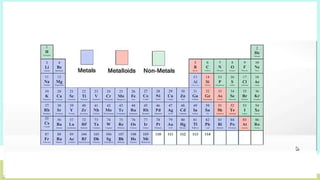
2) Where are the metals, non-metals and metalloids located on the periodic table?
3) What do you think makes metals different from non-metals?
4) How would you define metalloids?
TIME TO OBSERVE METALS AND NON-
METALS
1) DESCRIBE THREE WAYS IN WHICH THE NON-METAL
DIFFERS FROM THE METAL
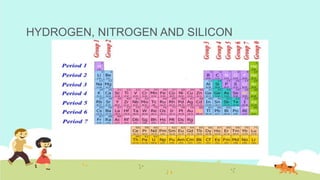
HYDROGEN, NITROGEN AND SILICON
CLASSIFICATION OF ELEMENTS AS METALS, NON-METALS
AND METALLOIDS
 Elements of the periodic table are grouped as metals,
metalloids or semimetals, and nonmetals. The metalloids
separate the metals and nonmetals on a periodic table. Also,
many periodic tables have a stair-step line on the table
identifying the element groups.
CLASSIFICATION OF ELEMENTS AS METALS, NON-
METALS AND METALLOIDS
 The line begins at boron (B) and extends down to polonium (Po). Elements to the left of the
line are considered metals. Elements just to the right of the line exhibit properties of both
metals and nonmetals and are termed metalloids or semimetals. Elements to the far right of
the periodic table are nonmetals. The exception is hydrogen (H), the first element on the
periodic table. At ordinary temperatures and pressures, hydrogen behaves as a nonmetal.
PHYSICAL PROPERTIES OF METALS &
NON-METALS
 Most elements are metals. Examples of metals include iron, tin, sodium, and
plutonium. Metals exhibit the following properties:
 Usually solid at room temperature (mercury is an exception)
 High luster (shiny)
 Metallic appearance
 Good conductors of heat and electricity
 Malleable (can be bent and pounded into thin sheets)
 METALS
 .
PHYSICAL PROPERTIES OF METALS &
NON-METALS
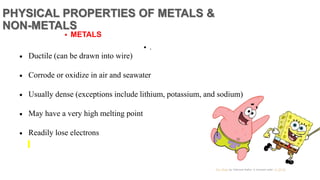
 Ductile (can be drawn into wire)
 Corrode or oxidize in air and seawater
 Usually dense (exceptions include lithium, potassium, and sodium)
 May have a very high melting point
 Readily lose electrons
 METALS
 .
PHYSICAL PROPERTIES OF METALS &
NON-METALS
 Nonmetals exhibit very different properties from metals. Examples of nonmetals include oxygen,
chlorine, and argon. Nonmetals display some or all the following characteristics:
 Dull appearance
 Usually, brittle
 Poor conductors of heat and electricity
 NON-METALS
PHYSICAL PROPERTIES OF METALS &
NON-METALS
 Usually less dense, compared to metals
 Usually low melting point of solids, compared with metals
 Tend to gain electrons in chemical reactions
 NON-METALS
USES OF METALS AND NON-METALS
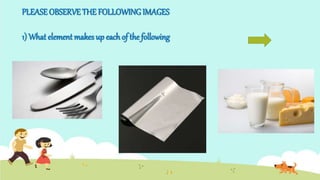
PLEASE OBSERVE THE FOLLOWING IMAGES
1) What element makes up each of the following
TASK
IDENTIFY TWO OTHER ELEMENTS AND CLASSIFY EACH AS A
METAL OR NONMETALAND STATE HOW THAT ELEMENT IS USED IN
REAL LIFE.
USES OF METALS
 Uses of Iron
 It is used in the construction of machinery and machine tools.
 It is used as a structural component of the building.
USES OF METALS
 Uses of Copper
 It is used in making electrical wires.
 It is used in making utensils, steam pipes, etc.
 Uses of Aluminium
 It is used to prepare household items and equipment.
 Aluminium and its alloys are extensively used in
making bodies of automobiles and aircraft.
 Aluminium wires are widely used in electrical work.
 Aluminium foil is used as a wrapping material and is
used in packing medicines.
USES OF METALS
 Uses of Metals
• Iron metal is use for making cooking vessels ,
water boilers , stoves,tools , wires,nails ,
bolts , electromagnets etc.
• Copper is most widely use for making
electric wires and all things related to
electricity because it is a good conductor
of electricity.
• Silver is widely use for making jewellery.
USES OF METALS
 Uses of Metals
• They are made into jewellery due to their
hard and shiny appearance.
• They are used to make pans, since they are
good conductors of heat.
• They are used in electrical cables, because
they are malleable, ductile and good
conductors of electricity.
• They are strong so used to build scaffolding
and bridges.
• They make a ringing sound, hence their use
in bell making.
Uses of Non-Metallic Elements
 Chlorine is useful in removing stains and colour patches as a bleaching agent. Various graded plastics and
insecticides are made with chlorine. It helps in purification of water. How? Adding chlorine to drinking
water kills the bacterias.
 Helium is used as inert gas for scientific experiments. It is also used in weather balloons.
 Iodine helps from throat infections and is used as antiseptic on wounds and cuts.
Uses of Non-Metallic Elements
 Nitrogen
 Fertilizers contain nitrogen. It helps in plant growth.
 It enhances the rate of plant growth.
 The non-metal phosphorus is also used for better plant growth.
 These two nonmetals play a major role in plant growth.
SUMMARY
Quizziz
Periodic Table/Metals/Nonmetals questions &
answers for quizzes and worksheets - Quizizz
Thank you!
3H