Howthe
MarketSpeaks
Three tiers of evidence on what T-shaped professionals
actually need — from company fieldwork to live job data to AI.
Klára Kubíčková · SeSLab, Faculty of Informatics, Masaryk University
I S S I P S P E A K E R S E R I E S
SESLAB FI MUNI ISSIP 2025/26 1 / 14
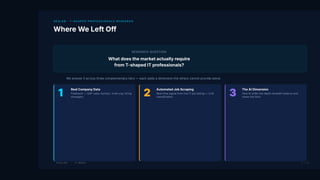
Where We Left Off
RESEARCH QUESTION
What does the market actually require
from T-shaped IT professionals?
We answer it across three complementary tiers — each adds a dimension the others cannot provide alone.
1
Real Company Data
Fieldwork — SAP Labs, Kyndryl, multi-org, hiring
managers 2
Automated Job Scraping
Real-time signal from live IT job listings + LLM
classification 3
The AI Dimension
How AI shifts the depth–breadth balance and
raises the floor
S E S L A B · T- S H A P E D P R O F E S S I O N A L S R E S E A R C H
SESLAB FI MUNI 2 / 14
1 TIER 1 · REAL COMPANY DATA
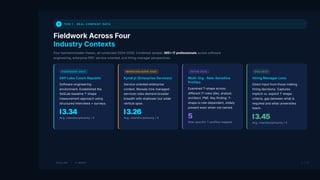
Fieldwork Across Four
Industry Contexts
Four bachelor/master theses, all conducted 2024–2026. Combined sample: 365+ IT professionals across software
engineering, enterprise ERP, service-oriented, and hiring-manager perspectives.
KUBÍČKOVÁ 2024
SAP Labs Czech Republic
Software-engineering
environment. Established the
SeSLab baseline T-shape
measurement approach using
structured interviews + surveys.
I3.34
Avg. interdisciplinarity / 5
MARSCHALKOVÁ 2025
Kyndryl (Enterprise Services)
Service-oriented enterprise
context. Reveals how managed-
services roles demand broader
breadth with shallower but wider
vertical span.
I3.26
Avg. interdisciplinarity / 5
AKTER 2025
Multi-Org · Role-Sensitive
Profiles
Examined T-shape across
different IT roles (dev, analyst,
architect, PM). Key finding: T-
shape is role-dependent, widely
present even when not named.
5
Role-specific T-profiles mapped
DAO 2025
Hiring Manager Lens
Direct input from those making
hiring decisions. Captures
implicit vs. explicit T-shape
criteria, gap between what is
required and what universities
teach.
I3.45
Avg. interdisciplinarity / 5
SESLAB FI MUNI 3 / 14
1 TIER 1 · CASE STUDY 1 OF 4
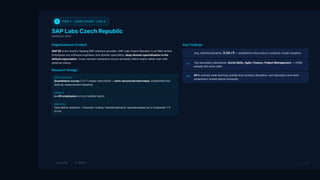
SAP Labs Czech Republic
Kubíčková 2024
Organisational Context
SAP SE is the world's leading ERP software provider. SAP Labs Czech Republic is an R&D centre.
Employees are software engineers and domain specialists; deep domain specialisation is the
default expectation. Cross-domain interaction occurs primarily within teams rather than with
external clients.
Research Design
METHODOLOGY
Quantitative survey (1–5 T-shape instrument) + semi-structured interviews. Established the
SeSLab measurement baseline.
SAMPLE
n ≈ 65 employees across multiple teams
ANALYSIS
Descriptive statistics + thematic coding. Interdisciplinarity operationalised as a composite 1–5
score.
Key Findings
Avg. interdisciplinarity: 3.34 / 5 — establishes the product-company cluster baseline
Top secondary disciplines: Social Skills, Agile, Finance, Project Management — AI/ML
already 6th most cited
82% actively seek learning outside their primary discipline; self-education and work
experience ranked above university
I
01
02
SESLAB FI MUNI 4 / 14
1 TIER 1 · CASE STUDY 2 OF 4
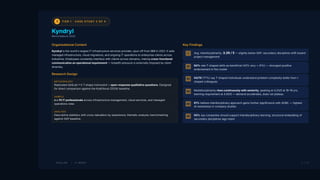
Kyndryl
Marschalková 2025
Organisational Context
Kyndryl is the world's largest IT infrastructure services provider, spun off from IBM in 2021. It sells
managed infrastructure, cloud migrations, and ongoing IT operations to enterprise clients across
industries. Employees constantly interface with clients across domains, making cross-functional
communication an operational requirement — breadth pressure is externally imposed by client
diversity.
Research Design
METHODOLOGY
Replicated SeSLab 1–5 T-shape instrument + open-response qualitative questions. Designed
for direct comparison against the Kubíčková (2024) baseline.
SAMPLE
n ≈ 70 IT professionals across infrastructure management, cloud services, and managed
operations roles
ANALYSIS
Descriptive statistics with cross-tabulation by experience; thematic analysis; benchmarking
against SAP baseline.
Key Findings
Avg. interdisciplinarity: 3.26 / 5 — slightly below SAP; secondary disciplines shift toward
project management
84% rate T-shaped skills as beneficial (43% very + 41%) — strongest positive
endorsement in the cluster
54/70 (77%) say T-shaped individuals understand problem complexity better than I-
shaped colleagues
Multidisciplinarity rises continuously with seniority, peaking at 4.33/5 at 16–19 yrs;
learning requirement at 4.50/5 — demand accelerates, does not plateau
61% believe interdisciplinary approach gains further significance with AI/ML — highest
AI-awareness in company studies
93% say companies should support interdisciplinary learning; structural embedding of
secondary disciplines lags intent
I
01
02
03
04
05
SESLAB FI MUNI 5 / 14
1 TIER 1 · CASE STUDY 3 OF 4
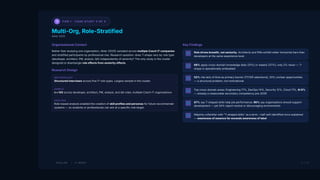
Multi-Org, Role-Stratified
Akter 2025
Organisational Context
Rather than studying one organisation, Akter (2025) sampled across multiple Czech IT companies
and stratified participants by professional role. Research question: does T-shape vary by role type
(developer, architect, PM, analyst, QA) independently of seniority? The only study in the cluster
designed to disentangle role effects from seniority effects.
Research Design
METHODOLOGY
Structured interviews across five IT role types. Largest sample in the cluster.
SAMPLE
n ≈ 105 across developer, architect, PM, analyst, and QA roles; multiple Czech IT organisations
ANALYSIS
Role-based analysis enabled the creation of skill profiles and personas for future recommender
systems — so students or professionals can aim at a specific role target.
Key Findings
Role drives breadth, not seniority. Architects and PMs exhibit wider horizontal bars than
developers at the same experience level
68% apply cross-domain knowledge daily (31%) or weekly (37%); only 2% never — T-
shape is operationally embedded
52% cite lack of time as primary barrier (77/105 selections); 20% unclear opportunities
— a structural problem, not motivational
Top cross-domain areas: Engineering 17%, DevOps 14%, Security 12%, Cloud 11%, AI 8%
— already a measurable secondary competency pre-2026
87% say T-shaped skills help job performance; 96% say organisations should support
development — yet 34% report neutral or discouraging environments
Majority unfamiliar with "T-shaped skills" as a term; ~half self-identified once explained
— awareness of essence far exceeds awareness of label
01
02
03
04
05
06
SESLAB FI MUNI 6 / 14
1 TIER 1 · CROSS- STUDY
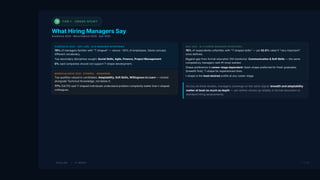
What Hiring Managers Say
Kubíčková 2024 · Marschalková 2025 · Dao 2025
KUBÍČKOVÁ 2024 · SAP LABS · N=9 MANAGER INTERVIEWS
78% of managers familiar with "T-shaped" — versus ~30% of employees. Same concept,
different vocabulary.
Top secondary disciplines sought: Social Skills, Agile, Finance, Project Management.
0% said companies should not support T-shape development.
MARSCHALKOVÁ 2025 · KYNDRYL · MANAGERS
Top qualities valued in candidates: Adaptability, Soft Skills, Willingness to Learn — ranked
alongside Technical Knowledge, not below it.
77% (54/70) said T-shaped individuals understand problem complexity better than I-shaped
colleagues.
DAO 2025 · N=11 HIRING MANAGER INTERVIEWS
76% of respondents unfamiliar with "T-shaped skills" — yet 42.6% rated it "very important"
once defined.
Biggest gap from formal education (59 mentions): Communication & Soft Skills — the same
competency managers rank #1 most wanted.
Shape preference is career-stage dependent: Dash-shape preferred for fresh graduates
(breadth first), T-shape for experienced hires.
I-shape is the least desired profile at any career stage.
Across all three studies,managers converge on the same signal:breadth and adaptability
matter at least as much as depth —yet neither shows up reliably in formal education or
standard hiring assessments.
SESLAB FI MUNI 7 / 14
1 TIER 1 · CROSS- STUDY CONVERGENCE
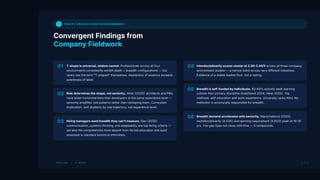
Convergent Findings from
Company Fieldwork
T-shape is universal, seldom named. Professionals across all four
environments consistently exhibit depth + breadth configurations — but
rarely use the term "T-shaped" themselves. Awareness of essence exceeds
awareness of label.
Role determines the shape, not seniority. Akter (2025): architects and PMs
have wider horizontal bars than developers at the same experience level —
seniority amplifies role patterns rather than reshaping them. Curriculum
implication: sort students by role trajectory, not experience level.
Hiring managers want breadth they can't measure. Dao (2025):
communication, systems thinking, and adaptability are top hiring criteria —
yet also the competencies most absent from formal education and least
assessed in standard technical interviews.
Interdisciplinarity scores cluster at 3.26–3.45/5 across all three company-
environment studies — a narrow band across very different industries.
Evidence of a stable market floor, not a ceiling.
Breadth is self-funded by individuals. 82–83% actively seek learning
outside their primary discipline (Kubíčková 2024; Akter 2025). Top
methods: self-education and work experience. University ranks third. No
institution is structurally responsible for breadth.
Breadth demand accelerates with seniority. Marschalková (2025):
multidisciplinarity (4.33/5) and learning requirement (4.50/5) peak at 16–19
yrs. The gap does not close with time — it compounds.
01
02
03
04
05
06
SESLAB FI MUNI 8 / 14
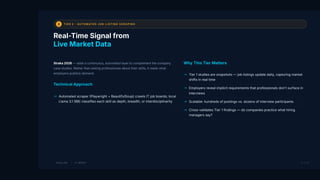
2 TIER 2 · AUTOMATED JOB- LISTING SCRAPING
Real-Time Signal from
Live Market Data
Straka 2026 — adds a continuous, automated layer to complement the company
case studies. Rather than asking professionals about their skills, it reads what
employers publicly demand.
Technical Approach
Why This Tier Matters
Automated scraper (Playwright + BeautifulSoup) crawls IT job boards; local
Llama 3.1 (8B) classifies each skill as depth, breadth, or interdisciplinarity
→
Tier 1 studies are snapshots — job listings update daily, capturing market
shifts in real time
→
Employers reveal implicit requirements that professionals don't surface in
interviews
→
Scalable: hundreds of postings vs. dozens of interview participants
→
Cross-validates Tier 1 findings — do companies practice what hiring
managers say?
→
SESLAB FI MUNI 9 / 14
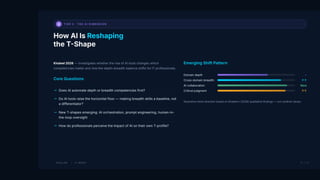
3 TIER 3 · THE AI DIMENSION
How AI Is Reshaping
the T-Shape
Khaleel 2026 — investigates whether the rise of AI tools changes which
competencies matter and how the depth–breadth balance shifts for IT professionals.
Core Questions
Emerging Shift Pattern
Domain depth −
Cross-domain breadth ↑↑
AI collaboration New
Critical judgment ↑↑
Illustrative trend direction based on Khaleel's (2026) qualitative findings — not cardinal values.
Does AI automate depth or breadth competencies first?
→
Do AI tools raise the horizontal floor — making breadth skills a baseline, not
a differentiator?
→
New T-shapes emerging: AI orchestration, prompt engineering, human-in-
the-loop oversight
→
How do professionals perceive the impact of AI on their own T-profile?
→
SESLAB FI MUNI 10 / 14
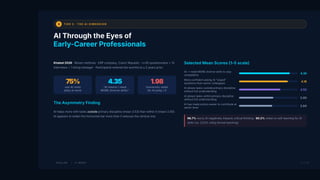
3 TIER 3 · THE AI DIMENSION
AI Through the Eyes of
Early-Career Professionals
Khaleel 2026 · Mixed-methods · ERP company, Czech Republic · n=55 questionnaire + 13
interviews + 1 hiring manager · Participants entered the workforce ≤ 2 years prior.
75%
use AI tools
daily at work
4.35
"AI means I need
MORE diverse skills"
1.98
University rated
for AI prep / 5
The Asymmetry Finding
AI helps more with tasks outside primary discipline (mean 3.53) than within it (mean 2.93).
AI appears to widen the horizontal bar more than it reduces the vertical one.
Selected Mean Scores (1–5 scale)
AI →need MORE diverse skills to stay
competitive 4.35
More confident asking AI "stupid"
questions than senior colleagues 4.18
AI allows tasks outside primary discipline
without full understanding 3.53
AI allows tasks within primary discipline
without full understanding 2.93
AI has made juniors easier to contribute at
senior level 2.84
66.7% worry AI negatively impacts critical thinking · 90.2% relied on self-learning for AI
skills (vs. 23.5% citing formal teaching)
SESLAB FI MUNI 11 / 14
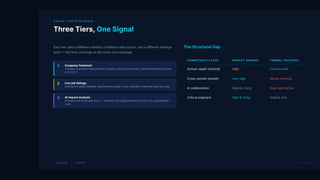
Three Tiers, One Signal
Each tier uses a different method,a different data source,and a different vantage
point —but they converge on the same core message.
1 Company fieldwork
T-shape is present everywhere; breadth acquired informally; interdisciplinarity scores
3.2–3.5 / 5
2 Live job listings
Employers signal breadth requirements daily; cross-validates interview data at scale
3 AI impact analysis
AI raises the horizontal floor — breadth and judgment become the non-automatable
core
The Structural Gap
COMPETENCY CLASS MARKET DEMAND FORMAL TEACHING
Domain depth (vertical) High Covered well
Cross-domain breadth Very high Mostly informal
AI collaboration Rapidly rising Near zero formal
Critical judgment High & rising Implicit only
C R O S S - T I E R S Y N T H E S I S
SESLAB FI MUNI 12 / 14
Sources
Kubíčková, K. (2024)
The Role of T-shape in ERP Enterprises: A Case Study. Master thesis, FI MUNI.
Marschalková, J. (2025)
The Role of T-shape in Service Oriented Enterprises: A Case Study. Master thesis, FI MUNI.
Akter, S. (2025)
T-Shaped Skills Across IT Roles and Organizations: A Case Study. Master thesis, FI MUNI.
Dao, T. N. (2025)
T-Shaped Skills in IT Employees and New Hires: Case Study. Master thesis, FI MUNI.
Straka, P. J. (2026)
Automated Mapping of Professional Profiles from Online Job Advertisements. Bachelor
thesis, FI MUNI. (Czech only)
Khaleel, I. M. (2026)
Integrating AI Skills into T-Shaped Competencies in Early-Career IT Professionals: Case
Study. Master thesis, FI MUNI.
All theses supervised within the SeSLab research group, Faculty of Informatics, Masaryk
University.
Supervisor: Ing. Leonard Walletzký, Ph.D.
R E F E R E N C E S
SESLAB FI MUNI 13 / 14