2026 State of Crypto Security Report
© 2026 CoinGecko
Introduction 2
Crypto Hacks & Breakdown by Attack Vector 3
Top Crypto Attack Vectors Comparison 4
Smart Contract Exploits 5
Oracle & Price Manipulation 6
Supply Chain & Infrastructure Exploits 7
Social Engineering & Private Key Compromise 8
Content
Zhong
Head of Research
Win Win
Research Analyst 1
Crypto Security Audits 9
On-Chain Insurance Protocols 10
CEX Insurance Funds 11
On-Chain Security Measures 12
CEX Security Measures 13
Summary Conclusion 14
Introduction
2026 State of Crypto Security Report
© 2026 CoinGecko
As the crypto space continues to mature, both centralized and decentralized platform have remained on the forefront of provid ing the
highest level of security to safeguard user assets as well as protect users from the plethora of attack vectors that exist to day .
Unfortunately, despite the numerous improvements in security measures and risk mitigation protocols, the industry has continued to
suffer escalating losses due to hacks and exploits, with over $2.5B stolen in 2025 alone .
Across these incidents, the attack vectors vary between centralized and decentralized infrastructure. On the CEX side, privat e k ey
exposure remains the single largest point of failure, while on -chain protocols are more vulnerable to smart contract errors that can be
manipulated to undermine their integrity. However, these vectors are just the tip of the iceberg as more recent exploits have shown that
hackers are quickly adapting their methods of gaining unauthorized access by utilizing fake user interfaces for multi -sig signing and
malicious integrations.
Although the tactics employed by malicious actors have constantly evolved, it’s worth noting that the relevant actors have al so
transformed dramatically; while older exploits tend to be executed by smaller teams of rogue individuals, organized crypto cartels and
syndicates, included state -sponsored hackers from North Korea, are now largely responsible for most of the hacks that occurred i n the
past year . Combined with more sophisticated usage of mixers, bridges and staggered withdrawals to cover their tracks, this new
generation of hackers have notoriously become difficult to trace.
With that said, this report seeks to examine the current level of state of crypto security in 2026 , highlighting and providing deeper insight
on the different kinds of hacks that today’s platforms constantly face. Additionally, we will also take a closer look at the effectiveness of
smart contract auditing, the necessity of crypto insurance protocols and the various security features utilized by CEXes such as Toobit
to protect users at all times .
2
2026 State of Crypto Security Report
© 2026 CoinGecko
Crypto Hacks & Breakdown
by Attack Vector
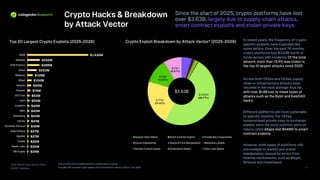
Since the start of 2025, crypto platforms have lost
over $3.63B, largely due to supply -chain attacks,
smart contract exploits and stolen private keys.
Source: DeFiLlama & supplemented by credible news coverage
*Includes 245 recorded crypto exploits that occurred from January 2025 to July 2026 3
In recent years, the frequency of crypto -
specific exploits have exploded like
never before. Over the past 19 months,
crypto platforms lost $3.63B worth of
funds across 245 incidents. Of the total
amount, more than 72.5% was stolen in
the top 10 largest attacks since 2025 .
Across both CEXes and DEXes, supply
chain or infrastructure attacks have
resulted in the most damage thus far,
with over $1.8B lost to these types of
attacks such as the Bybit and KelpDAO
hacks .
Different platforms are more vulnerable
to specific exploits. For CEXes,
compromised private keys to exchange
wallets were the most common point of
failure, while dApps lost $546M to smart
contract exploits .
However, both types of platforms still
succumbed to market and oracle
manipulation caused by errors from
internal mechanisms, such as Bitget,
Binance and Hyperliquid.
Top 20 Largest Crypto Exploits (2025 -2026)
$24M
$25M
$26M
$27M
$27M
$36M
$41M
$42M
$42M
$44M
$50M
$52M
$74M
$90M
$100M
$128M
$223M
$285M
$292M
$1,436M
SBI Crypto
Resolv Labs
Truebit
BigONE
Step Finance
Humanity Protocol
UXLink
Swissborg
GMX
CoinDCX
Infini
BTCTurk
Phemex
Nobitex
Bitget
Balancer
Cetus
Drift Protocol
KelpDao
Bybit
Crypto Exploit Breakdown by Attack Vector* (2025 -2026)
$1,806M
$777M
$431M
$311M
Supply Chain Attack Smart Contract Exploit Private Key Compromise
Social Engineering Oracle & Price Manipulation Reentrancy Attack
Access Control Exploit Governance Attack Flash Loan Attack
$3.63B
(49.77%)
(21.41%)
(11.87%)
(8.57%)
2026 State of Crypto Security Report
© 2026 CoinGecko
Top Crypto Attack Vectors Comparison
Source: CoinGecko
* Drift has rebranded to Velocity after the exploit 4
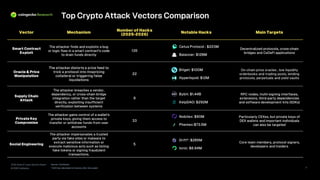
Vector Mechanism
Number of Hacks
(2025 -2026) Notable Hacks Main Targets
Smart Contract
Exploit
The attacker finds and exploits a bug
or logic flaw in a smart contract’s code
to drain funds directly
135
Cetus Protocol : $223M
Balancer: $128M
Decentralized protocols, cross -chain
bridges and CeDeFi applications
Oracle & Price
Manipulation
The attacker distorts a price feed to
trick a protocol into mispricing
collateral or triggering false
liquidations
22
Bitget: $100M
Hyperliquid: $12M
On -chain price oracles , low liquidity
orderbooks and trading pools, lending
protocols, perpetuals and yield vaults
Supply Chain
Attack
The attacker breaches a vendor,
dependency, or cross -chain bridge
integration rather than the target
directly, exploiting insufficient
verification between systems
9
Bybit : $1.44B
KelpDAO : $292M
RPC nodes, multi -signing interfaces,
extensions, third -party dependencies
and software development kits (SDKs)
Private Key
Compromise
The attacker gains control of a wallet's
private keys, giving them access to
transfer or withdraw funds from user
accounts
33
Nobitex : $90M
Phemex :$73.5M
Particularly CEXes, but private keys of
DEX wallets and important individuals
can also be targeted
Social Engineering
The attacker impersonates a trusted
party via fake sites or malware to
extract sensitive information or
execute malicious acts such as listing
fake tokens or signing fraudulent
transactions.
5
Drift*: $285M
Ionic: $6.94M
Core team members, protocol signers,
developers and insiders
2026 State of Crypto Security Report
© 2026 CoinGecko
Smart Contract Exploits
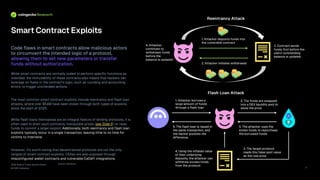
While smart contracts are normally coded to perform specific functions as
intended, the immutability of these contracts also means that hackers can
leverage on flaws in the contract’s logic, such as rounding and accounting
errors, to trigger unintended actions.
The most common smart contract exploits include reentrancy and flash loan
attacks, where over $54M have been stolen through both types of exploits
since the start of 2025.
While flash loans themselves are an integral feature of lending protocols, it is
often used to drain vault contracts, manipulate prices ( see Slide 6 ) or raise
funds to commit a larger exploit. Additionally, both reentrancy and flash loan
exploits typically occur in a single transaction, leaving little to no time for
victims to intervene.
However, it’s worth noting that decentralized protocols are not the only
targets of smart contract exploits; CEXes are also exposed through
misconfigured wallet contracts and vulnerable CeDeFi integrations.
Code flaws in smart contracts allow malicious actors
to circumvent the intended logic of a protocol,
allowing them to set new parameters or transfer
funds without authorization .
Source: CoinGecko
5
Reentrancy Attack
1. Attacker deposits funds into
the vulnerable contract
2. Attacker initiates withdrawal
3. Contract sends
funds first before the
users’ outstanding
balance is updated
4. Attacker
continues to
withdraws funds
before the
balance is updated
Flash Loan Attack
1. Attacker borrows a
large amount of funds
through a flash loan
2. The funds are swapped
into a DEX liquidity pool to
skew the price
3. The target protocol
reads this false spot value
as the real price
4. Using the inflated value
of their underlying
deposits, the attacker can
withdraw excess funds
from the protocol
5. The attacker uses the
stolen funds to repurchase
the borrowed funds
6. The flash loan is repaid in
the same transaction, and
the hacker pockets the
difference.
2026 State of Crypto Security Report
© 2026 CoinGecko
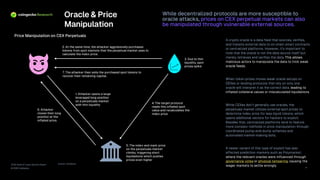
Oracle & Price
Manipulation
While decentralized protocols are more susceptible to
oracle attacks, prices on CEX perpetual markets can also
be manipulated through vulnerable external sources.
Source: CoinGecko
6
2. At the same time, the attacker aggressively purchases
tokens from spot markets that the perpetual market uses to
calculate the index price.
4. The target protocol
reads this inflated spot
value and recalculates the
index price
3. Due to thin
liquidity, spot
prices spike
Price Manipulation on CEX Perpetuals
6. Attacker
closes their long
position at the
inflated price.
5. The index and mark price
on the perpetuals market
climbs, triggering short
liquidations which pushes
prices even higher
1. Attacker opens a large
leveraged long position
on a perpetuals market
with thin liquidity
7. The attacker then sells the purchased spot tokens to
recover their remaining capital.
A crypto oracle is a data feed that sources, verifies,
and transits external data to on -chain smart contracts
or centralized platforms. However, it’s important to
note that the oracle is not the data source itself but
merely retrieves and verifies the data. This allows
malicious actors to manipulate the data to trick weak
oracle feeds.
When token prices moves weak oracle setups on
DEXes or lending protocols that rely on only one
oracle will interpret it as the correct data, leading to
inflated collateral values or miscalculated liquidations .
While CEXes don’t generally use oracles, the
perpetuals market utilizes external spot prices to
determine index price for less liquid tokens, which
opens additional vectors for hackers to exploit.
Besides that, centralized platforms tend to feature
more complex methods in price manipulation through
coordinated pump -and -dump schemes and
automated market -making bots.
A newer variant of this type of exploit has also
affected prediction markets such as Polymarket,
where the relevant oracles were influenced through
governance votes or physical tampering , causing the
wager markets to settle wrongly .
2026 State of Crypto Security Report
© 2026 CoinGecko
Supply Chain &
Infrastructure Exploits
Instead of a direct attack, exploiters often find
alternative points of entry through various firmware and
integrations that crypto platforms rely on .
Source: NCC Group
7
A supply chain attack is where attackers target
weak infrastructure or dependencies that a
protocol relies on, rather than the actual protocol
itself . This includes different tech -specific
components such as compromised packages,
scripts or developer environments.
In the crypto space, hackers have become more
prolific in targeting crypto -specific elements
within platforms such as multi -sig wallets and
RPC nodes.
Notably, this type of exploits tends to produce
outsized damage relative to effort; one hijacked
dependency can affect multiple protocols
simultaneously, especially if they all rely on the
same compromised infrastructure.
However, protocols should also be responsible for
configuring their existing setup to mitigate risks
against potential attacks. In both the Bybit and
KelpDAO exploits, the lack of additional
verification or failsafes for transaction validation
was the key point of failure that enabled hackers
to drain funds.
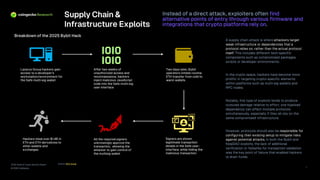
Breakdown of the 2025 Bybit Hack
Lazarus Group hackers gain
access to a developer’s
workstation/environment for
the Safe multi -sig wallet
After two weeks of
unauthorized access and
reconnaissance, hackers
inject malicious JavaScript
code into the Safe multi -sig
user interface
Two days later, Bybit
operators initiate routine
ETH transfer from cold to
warm wallets
Signers are shown
legitimate transaction
details in the Safe user -
interface, while hiding the
malicious transaction
All the required signers
unknowingly approve the
transaction, allowing the
attacker to gain control of
the multisig wallet
Hackers steal over $1.4B in
ETH and ETH derivatives to
other wallets and
exchanges
2026 State of Crypto Security Report
© 2026 CoinGecko
Social Engineering &
Private Key Compromise
Social engineering is one of the most common crypto
attack vectors but also the most difficult to defend
against, often targeting a protocol’s core personnel to
acquire sensitive information
Source: CoinGecko
8
Among all other crypto hacks, social engineering is
still one of the most crucial entry points for
hackers, often serving as the gateway for
subsequent supply chain and access control
exploits .
Unlike other security breaches, which can often be
solved with upgrades and hotfixes, both social
engineering and private key compromises target
the human aspect, which can take place over a very
long duration and requires constant vigilance.
Attackers can utilize various methods to gain
access to insider credentials and private keys such
as sending targeted spear -phishing links and
malware to high -ranking protocol employees or
even masquerading as other known team members .
In recent times, these tactics have become even
more sophisticated, evolving from single target to
complex multi -prong attacks to gain a victim’s
trust. These strategies aim to bolster the hacker’s
legitimacy and urgency in obtaining access to
sensitive information, forcing the victim to panic
and give in before performing additional verification
checks.
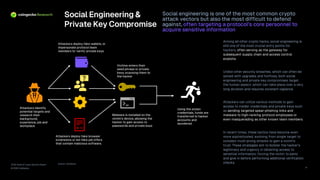
Attackers identify
potential targets and
research their
background,
experience, job and
workplace
Victims enters their
seed phrase or private
keys, exposing them to
the hacker
Malware is installed on the
victim’s device, allowing the
hacker to gain access to
passwords and private keys
Attackers deploy fake wallets, or
impersonate protocol team
members to ‘verify’ private keys
Attackers deploy fake browser
extensions or list fake job offers
that contain malicious software.
Using the stolen
credentials, funds are
transferred to hacker
accounts and
laundered.
2026 State of Crypto Security Report
© 2026 CoinGecko
3
5
7
6
5 5
8
7
10
3
7
9
6
5
9
14
16
9
13
3
2
2
2
1
1
1
4
3
2
2
7
4
6
13
17
23
5
0
5
10
15
20
25
30
35
Jan-25 Feb-25 Mar-25 Apr-25 May-25 Jun-25 Jul-25 Aug-25 Sep-25 Oct-25 Nov-25 Dec-25 Jan-26 Feb-26 Mar-26 Apr-26 May-26 Jun-26 Jul-26
Audited Protocols Unaudited Protocols
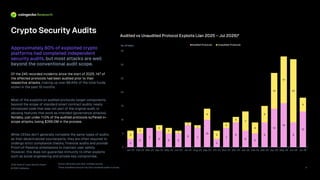
Crypto Security Audits
Of the 245 recorded incidents since the start of 2025, 147 of
the affected protocols had been audited prior to their
respective attacks , making up over 88.44% of the total funds
stolen in the past 19 months.
Most of the exploits on audited protocols target components
beyond the scope of standard smart contract audits, newly
introduced code that was not part of the original audit, or
abusing features that work as intended (governance attacks).
Notably, just under 11.0% of the audited protocols suffered in -
scope attacks, losing $396.0M in the process .
While CEXes don’t generally complete the same types of audits
as their decentralized counterparts, they are often required to
undergo strict compliance checks, financial audits and provide
Proof -of-Reserve attestations to maintain user safety.
However, this does not guarantee immunity to other exploits
such as social engineering and private key compromise.
Approximately 60% of exploited crypto
platforms had completed independent
security audits, but most attacks are well
beyond the conventional audit scope.
Source: DeFiLlama , and other verifiable sources.
*Some unaudited protocols may have completed audits in private.
No. Of Hacks
9
Audited vs Unaudited Protocol Exploits (Jan 2025 – Jul 2026)*
2026 State of Crypto Security Report
© 2026 CoinGecko
$0M
$50M
$100M
$150M
$200M
$250M
$0M
$50M
$100M
$150M
$200M
$250M
Jul-25 Aug-25 Sep-25 Oct-25 Nov-25 Dec-25 Jan-26 Feb-26 Mar-26 Apr-26 May-26 Jun-26
Active Coverage Amount Cumulative Payouts
On-Chain Insurance
Protocols
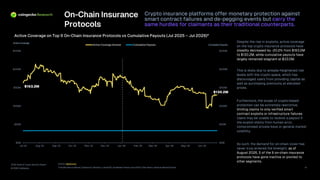
Crypto insurance platforms offer monetary protection against
smart contract failures and de -pegging events but carry the
same hurdles for claimants as their traditional counterparts.
Source: OpenCover
*Includes Nexus Mutual, Chainproof , Sherlock, LunosDAO , Unslashed Finance, InsureDAO , Risk Harbor, Neptune Mutual & Ease.
Active Coverage
10
Active Coverage on Top 9 On -Chain Insurance Protocols vs Cumulative Payouts (Jul 2025 – Jul 2026)*
Cumulative Payouts
$163.2M
$130.2M
Despite the rise in exploits, active coverage
on the top crypto insurance protocols have
steadily decreased by -20.2% from $163.2M
to $130.2M, while cumulative payouts have
largely remained stagnant at $33.0M .
This is likely due to already -heightened risk
levels with the crypto space, which has
discouraged users from providing capital as
well as purchasing premiums at elevated
prices.
Furthermore, the scope of crypto -based
protection can be extremely restrictive,
limiting claims to only verified smart
contract exploits or infrastructure failures .
Users may be unable to receive a payout if
the exploit stems from human error,
compromised private keys or general market
volatility.
As such, the demand for on -chain cover has
never truly entered the limelight; as of
August 2026, 5 of the 9 on -chain insurance
protocols have gone inactive or pivoted to
other segments .
2026 State of Crypto Security Report
© 2026 CoinGecko
CEX Protection Funds
11
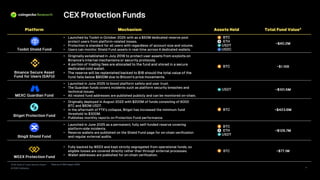
Platform Mechanism Assets Held Total Fund Value*
Toobit Shield Fund
• Launched by Toobit in October 2025 with as a $50M dedicated reserve pool
protect users from platform -related losses.
• Protection is standard for all users with regardless of account size and volume.
• Users can monitor Shield Fund assets in real -time across 4 dedicated wallets.
BTC
ETH
USDT
USDC
~$40.2M
Binance Secure Asset
Fund for Users (SAFU)
• Originally established in July 2018 to protect user assets from exploits on
Binance’s internal mechanisms or security protocols.
• A portion of trading fees are allocated to the fund and stored in a secure
dedicated cold wallet.
• The reserve will be replenished backed to $1B should the total value of the
fund falls below $800M due to Bitcoin’s price movements.
BTC ~$1.16B
MEXC Guardian Fund
• Launched in June 2025 to boost platform safety and user trust.
• The Guardian funds covers incidents such as platform security breaches and
technical issues.
• All related fund addresses are published publicly and can be monitored on -chain.
USDT ~$101.5M
Bitget Protection Fund
• Originally deployed in August 2022 with $200M of funds consisting of 6000
BTC and $80M USDT.
• In the aftermath of FTX’s collapse, Bitget has increased the minimum fund
threshold to $300M.
• Publishes monthly reports on Protection Fund performance.
BTC ~$423.6M
BingX Shield Fund
• Launched in June 2025 as a permanent, fully self -funded reserve covering
platform -side incidents.
• Reserve wallets are published on the Shield Fund page for on -chain verification
and regular external audits.
BTC
ETH
USDT
~$126.7M
WEEX Protection Fund
• Fully backed by WEEX and kept strictly segregated from operational funds, so
eligible losses are covered directly rather than through external processes.
• Wallet addresses are published for on -chain verification.
BTC ~$77.1M
*Data as of 24th August 2026
2026 State of Crypto Security Report
© 2026 CoinGecko
On-Chain Security
Measures
Decentralized protocol utilize a multi -layered approach to ensure
that are all potential vectors – from the smart contract level to the
human aspect – are well protected .
12
Smart Contract Protection
• Running multiple independents audits,
ensuring that new code changes are within
scope.
• Implementing extensive timelocks on key
smart contract functions, allowing ample
time for watchers to raise the alarm and
respond.
• Formal verification of smart contract logic to
ensure they work as intended.
• Constant bug bounty programs that are
meaningful to incentivize participation
instead of exploitation.
• Ensure that dependent smart contract
tooling is up -to-date.
Access Control
• Funds are stored in multisignature wallets,
with access limited to dedicated hardware.
• Delegated control between core team
members, and no individual person can deploy
protocol upgrades.
• Encrypt sensitive data and enable redundant
authentication measures for additional
verification.
• Setting up a separate Security Council with
access to implement emergency measures
should all core member are compromised.
Protocol -Level Protection
• For lending platforms, markets are isolated
with sufficient supply and borrowing caps to
mitigate risks of bad debt.
• Using multiple weighted oracles to derive
mark and index prices help perpetual DEXes
to mitigate price manipulation.
• Implementation of withdrawal delays for
abnormally large fund transfers.
• Constant automated on -chain monitoring to
detect anomalous calls and trigger the
appropriate defense mechanisms.
• Setting up an insurance fund to mitigate
shortfalls and reimburse users post -attack.
2026 State of Crypto Security Report
© 2026 CoinGecko
CEX Security
Measures
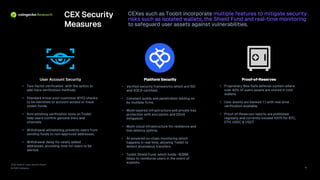
CEXes such as Toobit incorporate multiple features to mitigate security
risks such as isolated wallets, the Shield Fund and real -time monitoring
to safeguard user assets against vulnerabilities.
13
User Account Security
• Two -factor verification with the option to
add more verification methods.
• Standard know -your -customer (KYC) checks
to tie identities to account access or trace
stolen funds.
• Anti -phishing verification tools on Toobit
help users confirm genuine links and
channels.
• Withdrawal whitelisting prevents users from
sending funds to non -approved addresses.
• Withdrawal delay for newly added
addresses, providing time for users to be
alerted.
Proof -of -Reserves
• Proprietary Bee -Safe defense system where
over 90% of users assets are stored in cold
wallets.
• User assets are backed 1:1 with real -time
verification available.
• Proof -of -Reserves reports are published
regularly and currently exceed 100% for BTC,
ETH, USDC & USDT.
Platform Security
• Verified security frameworks which are ISO
and SOC2 -certified.
• Constant audits and penetration testing on
by multiple firms.
• Multi -layered infrastructure and private key
protection with encryption and DDoS
mitigation.
• Multi -cloud infrastructure for resilience and
low -latency uptime.
• AI-powered on -chain monitoring which
happens in real time, allowing Toobit to
detect anomalous transfers.
• Toobit Shield Fund, which holds ~$38M,
helps to reimburse users in the event of
exploits.
2026 State of Crypto Security Report
© 2026 CoinGecko
Summary Conclusion
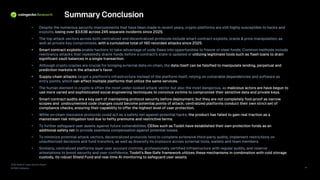
• Despite the numerous security improvements that have been made in recent years, crypto platforms are still highly susceptible to hacks and
exploits, losing over $3.63B across 245 separate incidents since 2025.
• The top attack vectors across both centralized and decentralized protocols include smart contract exploits, oracle & price ma nip ulation, as
well as private key compromises, with a cumulative total of 190 recorded attacks since 2025 .
• Smart contract exploits enable hackers to take advantage of code flaws into opportunities to freeze or steel funds. Common methods include
reentrancy attacks that repeatedly drains funds before a contract’s state is updated or utilizing legitimate tools such as flash loans to drain
significant vault balances in a single transaction .
• Although crypto oracles are crucial for bringing external data on -chain, the data itself can be falsified to manipulate lending, perpetual and
prediction markets in the attacker’s favor .
• Supply -chain attacks target a platform’s infrastructure instead of the platform itself, relying on vulnerable dependencies and software as
entry points, which can affect multiple platforms that utilize the same services .
• The human element in crypto is often the most under -looked attack vector but also the most dangerous, as malicious actors are have begun to
use more varied and sophisticated social engineering techniques to convince victims to compromise their sensitive data and pr iva te keys.
• Smart contract audits are a key part of maintaining protocol security before deployment, but they are not completely fool -proof as narrow
scopes and undocumented code changes could become potential points of attack; centralized platforms conduct their own strict se t of
compliance checks, ensuring their capability to offer the highest level of user protection.
• While on -chain insurance protocols could act as a safety net against potential hacks, the product has failed to gain real traction as a
mainstream risk mitigation tool due to hefty premiums and restrictive terms .
• To further safeguard user assets against future vulnerabilities, CEXes such as Toobit have established their own protection funds as an
additional safety net to provide seamless compensation against potential losses.
• To minimize potential attack vectors, decentralized protocols tend to complete extensive third -party audits, implement restricti ons on
unauthorized decisions and fund transfers, as well as diversify its exposure across external tools, wallets and team members.
• Similarly, centralized platforms layer user account controls, professionally certified infrastructure with regular audits, and reserve
attestations to boost security and user confidence. Toobit’s Bee -Safe framework utilizes these mechanisms in combination with cold storage
custody, its robust Shield Fund and real -time AI monitoring to safeguard user assets .
14
2026 State of Crypto Security Report
© 2026 CoinGecko 15
2026 State of Crypto Security Report
© 2026 CoinGecko
That’s it.
We hope you
enjoyed reading.
Follow us on:
Disclaimer
All content provided herein our website, hyperlinked sites, associated applications, forums, blogs, social media accounts and other platforms (“Site”) is for your general information only, procured from third party sources. We make
no warranties of any kind in relation to our content, including but not limited to accuracy and updatedness . No part of the content that we provide constitutes financial advice, legal advice or any other form of advice meant for you r
specific reliance for any purpose. Any use or reliance on our content is solely at your own risk and discretion. You should c ond uct your own research, review, analyse and verify our content before relying on them. Trading is a highly
risky activity that can lead to major losses, please therefore consult your financial advisor before making any decision. No con tent on our Site is meant to be a solicitation or offer.