Linux 核心專題:
探討 sched_ext 及機器學習
執行人: EricccTaiwan, charliechiou
2025/06/28
2025/06/28
周呈陽 成大電通所碩二
GitHub: EricccTaiwan
LinkedIn: Eric Chou
MS @ NCKUCCE
邱柏穎 成大電通所碩一
GitHub: charliechiou
LinkedIn: Po-Ying Chiu
MS @ NCKUCCE
2
3
● A review of CFS and EEVDF
● Innovations and mechanisms behind sched_ext
● From custom FCFS/RR scheduler to introducing Machine Learning
● What’s Next ?
Outline
4
● A review of CFS and EEVDF
● Innovations and mechanisms behind sched_ext
● From custom FCFS/RR scheduler to introducing Machine Learning
● What’s Next ?
Outline
CFS[1]
and EEVDF[2]
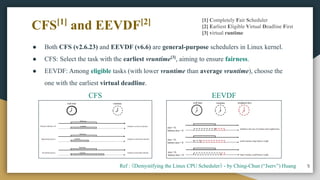
● Both CFS (v2.6.23) and EEVDF (v6.6) are general-purpose schedulers in Linux kernel.
● CFS: Select the task with the earliest vruntime[3]
, aiming to ensure fairness.
● EEVDF: Among eligible tasks (with lower vruntime than average vruntime), choose the
one with the earliest virtual deadline.
5
CFS EEVDF
Ref : 《Demystifying the Linux CPU Scheduler》 - by Ching-Chun (“Jserv”) Huang
[1] Completely Fair Scheduler
[2] Earliest Eligible Virtual Deadline First
[3] virtual runtime
6
● A review of CFS and EEVDF
● Innovations and mechanisms behind sched_ext
○ What is sched_ext ?
○ Why sched_ext ?
○ How sched_ext ?
○ sched_ext keynote
● From custom FCFS/RR scheduler to introducing Machine Learning
● What’s Next ?
Outline
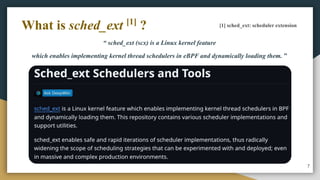
“ sched_ext (scx) is a Linux kernel feature
which enables implementing kernel thread schedulers in eBPF and dynamically loading them. ”
7
What is sched_ext [1]
? [1] sched_ext: scheduler extension
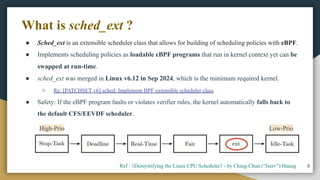
● Sched_ext is an extensible scheduler class that allows for building of scheduling policies with eBPF.
● Implements scheduling policies as loadable eBPF programs that run in kernel context yet can be
swapped at run-time.
● sched_ext was merged in Linux v6.12 in Sep 2024, which is the minimum required kernel.
○ Re: [PATCHSET v6] sched: Implement BPF extensible scheduler class
● Safety: If the eBPF program faults or violates verifier rules, the kernel automatically falls back to
the default CFS/EEVDF scheduler.
8
What is sched_ext ?
Ref : 《Demystifying the Linux CPU Scheduler》 - by Ching-Chun (“Jserv”) Huang
High-Prio Low-Prio
● The default schedulers are tuned for best-effort throughput.
● Custom eBPF schedulers can be workload-aware.
○ e.g., scx_lavd for games (latency-critical tasks).
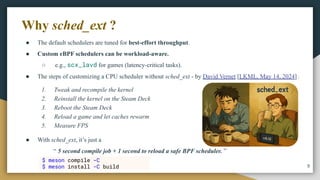
● The steps of customizing a CPU scheduler without sched_ext - by David Vernet [LKML, May 14, 2024] :
9
Why sched_ext ?
● With sched_ext, it’s just a
“ 5 second compile job + 1 second to reload a safe BPF scheduler. ”
1. Tweak and recompile the kernel
2. Reinstall the kernel on the Steam Deck
3. Reboot the Steam Deck
4. Reload a game and let caches rewarm
5. Measure FPS
$ meson compile -C
$ meson install -C build
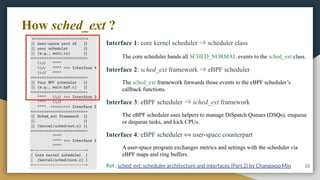
Interface 1: core kernel scheduler ⇒ scheduler class
The core scheduler hands all SCHED_NORMAL events to the sched_ext class.
Interface 2: sched_ext framework ⇒ eBPF scheduler
The sched_ext framework forwards those events to the eBPF scheduler’s
callback functions.
Interface 3: eBPF scheduler ⇒ sched_ext framework
The eBPF scheduler uses helpers to manage DiSpatch Queues (DSQs), enqueue
or dequeue tasks, and kick CPUs.
Interface 4: eBPF scheduler ⟺ user-space counterpart
A user-space program exchanges metrics and settings with the scheduler via
eBPF maps and ring buffers.
10
Ref : sched_ext: scheduler architecture and interfaces (Part 2) by Changwoo Min
How sched_ext ?
“I'm also not a believer in the argument that has been used (multiple times) that the BPF scheduler
would keep people from participating in scheduler development. I personally think the main thing that
keeps people from participating is too high barriers to participation.“
— Linus Torvalds, [LKML, June 24, 2024]
Benefits:
● Flexibility:
○ Customizable schedulers in user space.
● Agility:
○ Faster iteration and development.
● Accessibility:
○ Easier participation in scheduler innovation.
11
sched_ext keynote
12
● A review of CFS and EEVDF
● Innovations and mechanisms behind sched_ext
● From custom FCFS/RR scheduler to introducing Machine Learning
○ FCFS/RR scheduler
○ ML-based load prediction and adaptation
● What’s Next ?
Outline
13
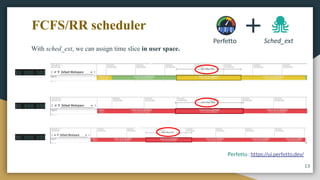
10_000_000
20_000_000
30_000_000
Perfetto : https://ui.perfetto.dev/
FCFS/RR scheduler
Sched_ext
Perfetto
With sched_ext, we can assign time slice in user space.
14
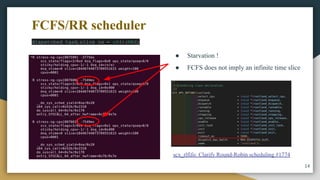
dispatched_task.slice_ns = u64::MAX;
● Starvation !
● FCFS does not imply an infinite time slice
scx_rlfifo: Clarify Round-Robin scheduling #1774
FCFS/RR scheduler
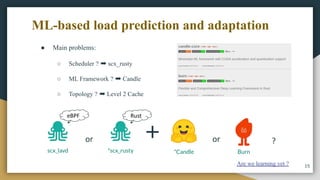
ML-based load prediction and adaptation
15
Are we learning yet ?
*scx_rusty *Candle Burn
or ?
or
scx_lavd
Rust
eBPF
● Main problems:
○ Scheduler ? ➡ scx_rusty
○ ML Framework ? ➡ Candle
○ Topology ? ➡ Level 2 Cache
ML-based load prediction and adaptation
16
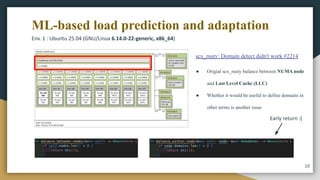
Env. 1 : Ubuntu 25.04 (GNU/Linux 6.14.0-22-generic, x86_64)
Early return :(
● Origial scx_rusty balance between NUMA node
and Last Level Cache (LLC)
● Whether it would be useful to define domains in
other terms is another issue
scx_rusty: Domain detect didn't work #2214
ML-based load prediction and adaptation
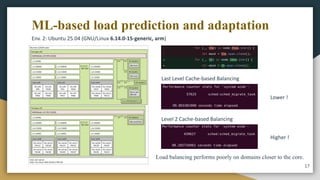
17
Last Level Cache-based Balancing
Level 2 Cache-based Balancing
Env. 2: Ubuntu 25.04 (GNU/Linux 6.14.0-15-generic, arm)
Load balancing performs poorly on domains closer to the core.
Lower !
Higher !
ML-based load prediction and adaptation
18
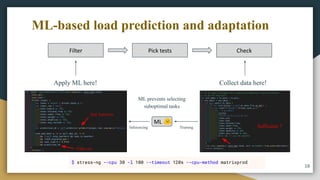
Filter Pick tests Check
Collect data here!
Apply ML here!
Sufficient ?
$ stress-ng --cpu 30 -l 100 --timeout 120s --cpu-method matrixprod
Task Selection
Filter out
ML
Training
Inferencing
ML prevents selecting
suboptimal tasks
ML-based load prediction and adaptation
19
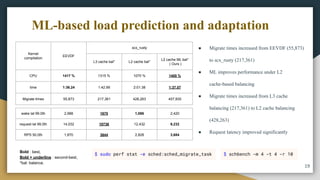
Kernel
compilation
EEVDF
scx_rusty
L3 cache bal* L2 cache bal*
L2 cache ML bal*
( Ours )
CPU 1417 % 1315 % 1070 % 1400 %
time 1:36.24 1:42.99 2:01.38 1:37.07
Migrate times 55,873 217,361 428,263 457,935
$ sudo perf stat -e sched:sched_migrate_task
wake lat 99.0th 2,988 1670 1,086 2,420
request lat 99.0th 14,032 10736 12,432 9,232
RPS 50.0th 1,870 3644 2,828 3,684
$ schbench -m 4 -t 4 -r 10
● Migrate times increased from EEVDF (55,873)
to scx_rusty (217,361)
● ML improves performance under L2
cache-based balancing
● Migrate times increased from L3 cache
balancing (217,361) to L2 cache balancing
(428,263)
● Request latency improved significantly
Bold : best,
Bold + underline : second-best,
*bal: balance.
20
● A review of CFS and EEVDF
● Innovations and mechanisms behind sched_ext
● From custom FCFS/RR scheduler to introducing Machine Learning
● What’s next?
Outline
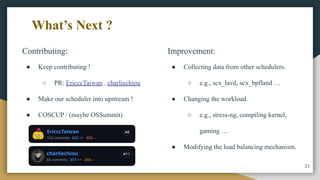
Contributing:
● Keep contributing !
○ PR: EricccTaiwan , charliechiou
● Make our scheduler into upstream !
● COSCUP / (maybe OSSummit)
21
What’s Next ?
Improvement:
● Collecting data from other schedulers.
○ e.g., scx_lavd, scx_bpfland …
● Changing the workload.
○ e.g., stress-ng, compiling kernel,
gaming …
● Modifying the load balancing mechanism.
Special Thanks:
● Ching-Chun (“Jserv”) Huang : Leading us into the world of Linux.
● Sched_ext community : Kindly answering our questions and reviewing our PRs.
● Chia-Ping Tsai : Introducing us to the “opensource4you” community.
Thanks For Listening !
● Why collect data by using stress-ng instead of compiling kernel ?
● The imporvement of request and degrad of wake up latency ?
24
Appendix