Har Ghar Nal Ka Jal
Bringing drinking water home to people in Bihar
07.07.2023
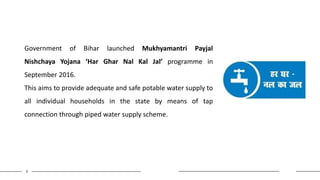
Drinking Water scenario in Bihar
2
• Abundant groundwater resources but diverse
geological, hydrological and climatic conditions
characterize the drinking water availability of
Bihar.
• The piped water supply covered a meager 4%
of the entire population
• with more than 99% of households dependent
on the Handpump for drinking and other
consumption purposes the water provisioning
capability was inadequate at best.
• excessive arsenic, fluoride and iron content
affected the water quality in 31 districts out of
38 districts of the State.
• Piped water supply, too, was erratic, and there
were no fixed hours for water supply.
Before Year 2016
3
Government of Bihar launched Mukhyamantri Payjal
Nishchaya Yojana ‘Har Ghar Nal Kal Jal’ programme in
September 2016.
This aims to provide adequate and safe potable water supply to
all individual households in the state by means of tap
connection through piped water supply scheme.
Har Ghar Nal Ka Jal
• This resolution aims to provide clean drinking water to every citizen of Bihar, without
any discrimination.
• This resolution is an unflinching endeavor to provide clean drinking water in the
homes of approximately 2 crore households in the state through concerted co-
operation of the people of every village and locality in Bihar.
• Under this, Ward level Water Supply schemes have been implemented to provide
piped water supply to every household with a view to end their dependence on
Hand-pumps (chapakal) and other sources of drinking water.
4
Key
Stakeholders
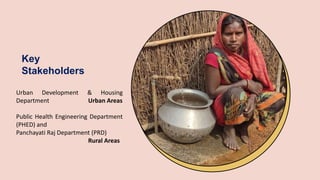
Urban Development & Housing
Department Urban Areas
Public Health Engineering Department
(PHED) and
Panchayati Raj Department (PRD)
Rural Areas
Rural Areas distribution
6 Presentation title 2023
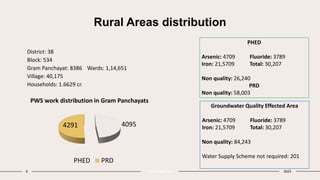
District: 38
Block: 534
Gram Panchayat: 8386 Wards: 1,14,651
Village: 40,175
Households: 1.6629 cr.
4095
4291
PWS work distribution in Gram Panchayats
PHED PRD
Groundwater Quality Effected Area
Arsenic: 4709 Fluoride: 3789
Iron: 21,5709 Total: 30,207
Non quality: 84,243
Water Supply Scheme not required: 201
PHED
Arsenic: 4709 Fluoride: 3789
Iron: 21,5709 Total: 30,207
Non quality: 26,240
PRD
Non quality: 58,003
Implementation Module -1
7 Presentation title 2023
• Idea of Ward Sabha conceptualized and amendment made in the Bihar Panchayat Raj
Act 2006
• Ward Sabha constituted as a lower body of the Gram Sabha and authorized to
prepare development schemes, identify beneficiaries, mobilize and collect
community contribution for defined purposes and generate mass awareness
• Amendment decentralized the scheme implementation power of Mukhiya to a
statutory committee headed by Ward Members called Ward Implementation and
Management Committee (WIMC)
8 Presentation title 2023
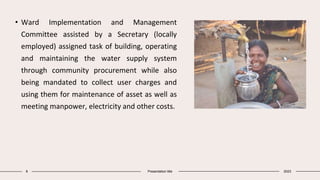
• Ward Implementation and Management
Committee assisted by a Secretary (locally
employed) assigned task of building, operating
and maintaining the water supply system
through community procurement while also
being mandated to collect user charges and
using them for maintenance of asset as well as
meeting manpower, electricity and other costs.
Implementation Module -2
9 Presentation title 2023
• PHE Department implemented schemes in traditional mode by hiring contractor/
agency and undergone in DBOT contract.
• This includes construction of water supply infrastructure on turn key basis with 5
years Operation and Maintenance after completion of trail run period (of 6 months).
Financial Resources
10 Presentation title 2023
• Schemes launched by the State Government for achieving this resolution in rural areas
Panchayati Raj Department
• Mukhyamantri Gramin Peyjal Nishchay Yojana
Public Health Engineering Department
• Mukhyamantri Gramin Peyjal Nishchay Yojana (Quality affected area)
• Mukhyamantri Gramin Peyjal Nishchay Yojana (Non-quality affected area)
• Jal Jeevan Mission (NRDWP/NWQSM/RWSSP-LIS)
Technology and types of Schemes
11 Presentation title 2023
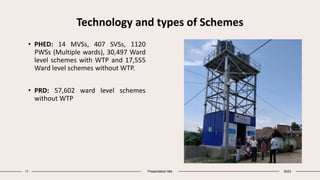
• PHED: 14 MVSs, 407 SVSs, 1120
PWSs (Multiple wards), 30,497 Ward
level schemes with WTP and 17,555
Ward level schemes without WTP.
• PRD: 57,602 ward level schemes
without WTP
Ward Level Scheme
12 Presentation title 2023
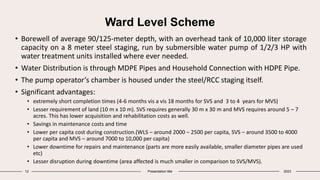
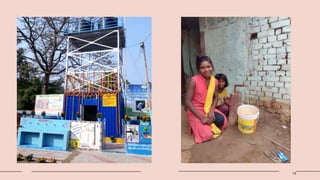
• Borewell of average 90/125-meter depth, with an overhead tank of 10,000 liter storage
capacity on a 8 meter steel staging, run by submersible water pump of 1/2/3 HP with
water treatment units installed where ever needed.
• Water Distribution is through MDPE Pipes and Household Connection with HDPE Pipe.
• The pump operator’s chamber is housed under the steel/RCC staging itself.
• Significant advantages:
• extremely short completion times (4-6 months vis a vis 18 months for SVS and 3 to 4 years for MVS)
• Lesser requirement of land (10 m x 10 m). SVS requires generally 30 m x 30 m and MVS requires around 5 – 7
acres. This has lower acquisition and rehabilitation costs as well.
• Savings in maintenance costs and time
• Lower per capita cost during construction.(WLS – around 2000 – 2500 per capita, SVS – around 3500 to 4000
per capita and MVS – around 7000 to 10,000 per capita)
• Lower downtime for repairs and maintenance (parts are more easily available, smaller diameter pipes are used
etc)
• Lesser disruption during downtime (area affected is much smaller in comparison to SVS/MVS).
13
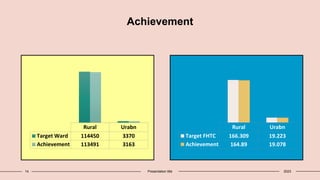
Achievement
Rural Urabn
Target Ward 114450 3370
Achievement 113491 3163
14 Presentation title 2023
Rural Urabn
Target FHTC 166.309 19.223
Achievement 164.89 19.078
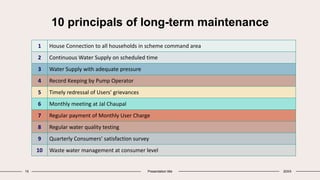
10 principals of long-term maintenance
1 House Connection to all households in scheme command area
2 Continuous Water Supply on scheduled time
3 Water Supply with adequate pressure
4 Record Keeping by Pump Operator
5 Timely redressal of Users’ grievances
6 Monthly meeting at Jal Chaupal
7 Regular payment of Monthly User Charge
8 Regular water quality testing
9 Quarterly Consumers’ satisfaction survey
10 Waste water management at consumer level
15 Presentation title 20XX
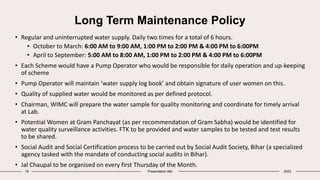
Long Term Maintenance Policy
16 Presentation title 2023
• Regular and uninterrupted water supply. Daily two times for a total of 6 hours.
• October to March: 6:00 AM to 9:00 AM, 1:00 PM to 2:00 PM & 4:00 PM to 6:00PM
• April to September: 5:00 AM to 8:00 AM, 1:00 PM to 2:00 PM & 4:00 PM to 6:00PM
• Each Scheme would have a Pump Operator who would be responsible for daily operation and up-keeping
of scheme
• Pump Operator will maintain ‘water supply log book’ and obtain signature of user women on this.
• Quality of supplied water would be monitored as per defined protocol.
• Chairman, WIMC will prepare the water sample for quality monitoring and coordinate for timely arrival
at Lab.
• Potential Women at Gram Panchayat (as per recommendation of Gram Sabha) would be identified for
water quality surveillance activities. FTK to be provided and water samples to be tested and test results
to be shared.
• Social Audit and Social Certification process to be carried out by Social Audit Society, Bihar (a specialized
agency tasked with the mandate of conducting social audits in Bihar).
• Jal Chaupal to be organised on every first Thursday of the Month.
17 Presentation title 2023
• O&M Agency would primarily be responsible for Operation and Maintenance of scheme.
• A Repairing Team would be made available at Gram Panchayat with a Plumber & two Helpers.
Electrician, Fitter & other skilled persons would be available on call basis.
• PHED would empanel ‘Service Provider’ to bridge the gap of O&M agency. If O&M agency fails
to maintain water supply in stipulated time-period; the team of Service Provider would rush to
site and maintain the water supply at urgent basis.
• Entire cost incurred on repairs would be imposed on the O&M Agency along with a maximum
fine of Rs. 2000 per day for interruption in water supply.
• Each user household would pay Rs. 30/- per month water tariff to Chairman, WIMC
• 50% of collected water tariff will be paid as incentive to Chairman, WIMC and remaining
deposited in revenue head of Gram Panchayat.
Functionality Monitoring System
• Internets of Things (IoT) Devices have already been installed in 86% schemes of PHED and 87%
schemes in PRD and District Control Rooms have been established.
• IoT Devices provide real time functionality status of piped water supply schemes and the non-
functionality of the scheme would be linked with Centralized Grievance Redressal Cell through
Artificial Intelligence based system for necessary redressal in real time basis at the earliest.
• Daily monitoring through tele-call to users for consumer feedback and analyze service level
satisfaction.
• Daily Monitoring Inspection by field officials to check the functionality of schemes by conducting
following activities
• Inspection of civil structures
• Transect walk of distribution network
• Household visit and interpersonal communication with users
• Jal Chaupal and discussion with stakeholders
• Central Grievance Redressal Cell has been strengthened with new complaint registration and
compliance monitoring software.
18 Presentation title 2023
Support Activities
• Capacity building of Pump Operators on their roles, responsibilities and duties
and daily O&M of WTP
• Skill development programme for the Pump Operators on Plumbing and
Electrician through Bihar Skill Development Mission and Government ITIs
• Mobilization of National Rural Livelihood Mission (NRLM)’ SHGs and their Cluster
Level Federations (CLF) and Village Organization (VOs) on judicious usage of
supplied water
19 Presentation title 2023
Water Quality Monitoring and Surveillance
• 11 District Water Testing Labs are NABL accreditation and process initiated for remaining 27
District Labs
• Field Testing Kit (FTK) available in each Gram Panchayat and Pump Operators are trained to
test water sample for water quality surveillance
• Strengthening proposal of District and Sub Divisional Labs is under process
• Capacity building of PRIs’ Members on WQM&S
• Sanitary Survey by Technical Assistants of Panchayati Raj Department.
20 Presentation title 2023
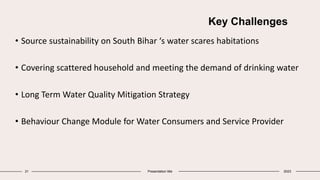
Key Challenges
• Source sustainability on South Bihar ‘s water scares habitations
• Covering scattered household and meeting the demand of drinking water
• Long Term Water Quality Mitigation Strategy
• Behaviour Change Module for Water Consumers and Service Provider
21 Presentation title 2023
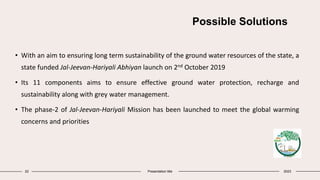
Possible Solutions
• With an aim to ensuring long term sustainability of the ground water resources of the state, a
state funded Jal-Jeevan-Hariyali Abhiyan launch on 2nd October 2019
• Its 11 components aims to ensure effective ground water protection, recharge and
sustainability along with grey water management.
• The phase-2 of Jal-Jeevan-Hariyali Mission has been launched to meet the global warming
concerns and priorities
22 Presentation title 2023
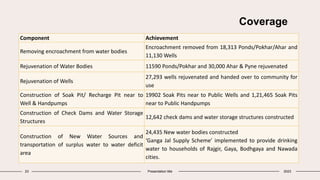
Coverage
Component Achievement
Removing encroachment from water bodies
Encroachment removed from 18,313 Ponds/Pokhar/Ahar and
11,130 Wells
Rejuvenation of Water Bodies 11590 Ponds/Pokhar and 30,000 Ahar & Pyne rejuvenated
Rejuvenation of Wells
27,293 wells rejuvenated and handed over to community for
use
Construction of Soak Pit/ Recharge Pit near to
Well & Handpumps
19902 Soak Pits near to Public Wells and 1,21,465 Soak Pits
near to Public Handpumps
Construction of Check Dams and Water Storage
Structures
12,642 check dams and water storage structures constructed
Construction of New Water Sources and
transportation of surplus water to water deficit
area
24,435 New water bodies constructed
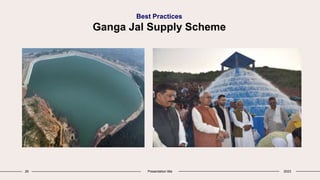
‘Ganga Jal Supply Scheme’ implemented to provide drinking
water to households of Rajgir, Gaya, Bodhgaya and Nawada
cities.
23 Presentation title 2023
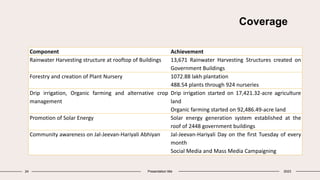
Coverage
Component Achievement
Rainwater Harvesting structure at rooftop of Buildings 13,671 Rainwater Harvesting Structures created on
Government Buildings
Forestry and creation of Plant Nursery 1072.88 lakh plantation
488.54 plants through 924 nurseries
Drip irrigation, Organic farming and alternative crop
management
Drip irrigation started on 17,421.32-acre agriculture
land
Organic farming started on 92,486.49-acre land
Promotion of Solar Energy Solar energy generation system established at the
roof of 2448 government buildings
Community awareness on Jal-Jeevan-Hariyali Abhiyan Jal-Jeevan-Hariyali Day on the first Tuesday of every
month
Social Media and Mass Media Campaigning
24 Presentation title 2023
Strategy to achieve the goal of Sustainable access to
safe and sufficient drinking water
25 Presentation title 2023
• Creation of long-term and climate resilient water sources for ensuring water source sustainability
• Minimising dependency on groundwater and catching the rainwater for harvesting purpose
• Aquifer management through assessment, rejuvenation and capacity development
• Water Grid creation and management
• Water demand management and reduction in Non-Revenue Water
• Creation, Operation, Maintenance and Augmentation of watersheds
• Strict law implementation for prevent water contamination
• Promoting technology/ initiatives for better water management
• Citizen interface for universal access to drinking water service through responsibilities holder
institutions/utilities/authorities.
Best Practices
Ganga Jal Supply Scheme
26 Presentation title 2023
27 Presentation title 2023
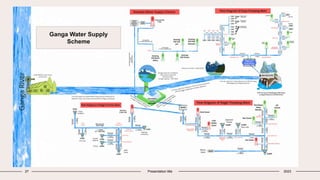
Ganga Water Supply
Scheme
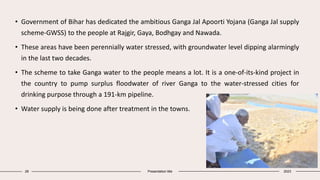
• Government of Bihar has dedicated the ambitious Ganga Jal Apoorti Yojana (Ganga Jal supply
scheme-GWSS) to the people at Rajgir, Gaya, Bodhgay and Nawada.
• These areas have been perennially water stressed, with groundwater level dipping alarmingly
in the last two decades.
• The scheme to take Ganga water to the people means a lot. It is a one-of-its-kind project in
the country to pump surplus floodwater of river Ganga to the water-stressed cities for
drinking purpose through a 191-km pipeline.
• Water supply is being done after treatment in the towns.
28 Presentation title 2023
Priority Areas
• Water Supply Service Improvement through legal, administrative and institutional
interventions
• Water Supply Schemes’ source sustainability
• Water Quality Mitigation
• Climate change resilient infrastructure improvement
• Social and Behaviour Change Communication Campaign for citizen interface of universal
access to drinking water
• Reserve, Recycle, Reuse and Regulate Drinking Water
29 Presentation title 2023
Thank you
Public Health
Engineering Department
Government of Bihar