2022_Business Ethics Ethical Decision Making and Cases (13th ed.) (O.C. Ferrell, John Fraedrich, Linda Ferrell), Cengage.pdf
2.
Business ETHICS
Thirteenth Edition
EthicalDecision Making and Cases
O.C. Ferrell
Auburn University
John Fraedrich
Southern Illinois University—Carbondale
Linda Ferrell
Auburn University
Australia • Brazil • Canada • Mexico • Singapore • United Kingdom • United States
Copyright 2022 Cengage Learning. All Rights Reserved. May not be copied, scanned, or duplicated, in whole or in part. Due to electronic rights, some third party content may be suppressed from the eBook and/or eChapter(s).
Editorial review has deemed that any suppressed content does not materially affect the overall learning experience. Cengage Learning reserves the right to remove additional content at any time if subsequent rights restrictions require it.
3.
This is anelectronic version of the print textbook. Due to electronic rights restrictions,
some third party content may be suppressed. Editorial review has deemed that any suppressed
content does not materially affect the overall learning experience. The publisher reserves the right
to remove content from this title at any time if subsequent rights restrictions require it. For
valuable information on pricing, previous editions, changes to current editions, and alternate
formats, please visit www.cengage.com/highered to search by ISBN#, author, title, or keyword for
materials in your areas of interest.
Important Notice: Media content referenced within the product description or the product
text may not be available in the eBook version.
Copyright 2022 Cengage Learning. All Rights Reserved. May not be copied, scanned, or duplicated, in whole or in part. Due to electronic rights, some third party content may be suppressed from the eBook and/or eChapter(s).
Editorial review has deemed that any suppressed content does not materially affect the overall learning experience. Cengage Learning reserves the right to remove additional content at any time if subsequent rights restrictions require it.
To James CollinsFerrell and
George Collins Ferrell.
—O.C. Ferrell
To Emma, Matthew, Hyrum, and
Ammon, who are the future generation.
—John Fraedrich
To Brett Nafziger.
—Linda Ferrell
Copyright 2022 Cengage Learning. All Rights Reserved. May not be copied, scanned, or duplicated, in whole or in part. Due to electronic rights, some third party content may be suppressed from the eBook and/or eChapter(s).
Editorial review has deemed that any suppressed content does not materially affect the overall learning experience. Cengage Learning reserves the right to remove additional content at any time if subsequent rights restrictions require it.
6.
9: Home DepotWorks on Stakeholder
Relationships 421
10: Brewed to Perfection: New Belgium Brewing 431
11: Google’s Search for Solutions to Privacy Issues 441
12: Big-Box Retailer Walmart Makes Big Moves in Social
Responsibility 457
13: Volkswagen Cleans Up Reputation After Emissions
Scandal 468
14: Zappos Finds the Perfect Fit 475
15: Starbucks Serves Up Its Social Responsibility
Blend 484
16: The Hershey Company’s Bittersweet Success 496
17: Wells Fargo Banks on Recovery 508
18: Whole Foods Market Refreshes Its Commitment to
Stakeholders 516
19: The NCAA Enforces Penalties in College
Athletics 526
20: Enron: Not Accounting for the Future 535
Endnotes 546
Glossary 576
Index 583
Part 1: An Overview of Business Ethics 1
1: The Importance of Business Ethics 1
2: Stakeholder Relationships, Social Responsibility, and
Corporate Governance 26
3: Sustainability: Social and Ethical Dimensions 53
Part 2: Ethical Issues and the
Institutionalization of Business Ethics 84
4: The Institutionalization of Business Ethics 84
5: Emerging Business Ethics Issues 110
Part 3: The Decision-Making Process 135
6: Ethical Decision Making 135
7: Individual Factors: Moral Philosophies and
Values 158
8: Organizational Factors: The Role of Ethical Culture and
Relationships 184
Part 4: Implementing Business Ethics
in a Global Economy 208
9: Developing and Implementing an Effective Ethics
Program 208
10: Global Business Ethics Issues 235
11: Ethical Leadership 269
12: Technology: Ethics and Social Responsibility
Issues 305
Part 5: Cases 330
1: From the Outside In: Corporate Social Responsibility at
Patagonia 332
2: Tesla Accelerates the Transition to Sustainable
Energy 338
3: An Apple a Day: Ethics at Apple Inc. 349
4: TOMS Reinvents the One for One Movement 364
5: CVS Smokes the Competition in Corporate Social
Responsibility 374
6: Bayer Rounds Up Monsanto 387
7: Uber Collides with Controversy 398
8: Herbalife Nutrition Achieves Success by Managing
Risks 407
BRIEF CONTENTS
iv
Copyright 2022 Cengage Learning. All Rights Reserved. May not be copied, scanned, or duplicated, in whole or in part. Due to electronic rights, some third party content may be suppressed from the eBook and/or eChapter(s).
Editorial review has deemed that any suppressed content does not materially affect the overall learning experience. Cengage Learning reserves the right to remove additional content at any time if subsequent rights restrictions require it.
7.
CONTENTS
Issues in SocialResponsibility 35
Social Responsibility and the Importance of a Stakeholder
Orientation 37
Corporate Governance Provides Formalized Responsibility
to Stakeholders 38
Views of Corporate Governance, 41 • The Role
of Boards of Directors, 42 • Greater Demands for
Accountability and Transparency, 43 • Executive
Compensation, 43
Implementing a Stakeholder Perspective 45
Step 1: Assessing the Corporate Culture, 46 •
Step 2: Identifying Stakeholder Groups, 46 • Step 3:
Identifying Stakeholder Issues, 46 • Step 4: Assessing
Organizational Commitment to Stakeholders and
Social Responsibility, 47 • Step 5: Identifying Resources
and Determining Urgency, 47 • Step 6: Gaining
Stakeholder Feedback, 47
Contributions of a Stakeholder Perspective 48
Summary 48
Important Terms for Review, 50 | Resolving Ethical
Business Challenges, 51 | Check Your EQ, 52
Chapter 3: Sustainability: Social and Ethical
Dimensions 53
Chapter Objectives, 53 | Chapter Outline, 53
An Ethical Dilemma 54
Defining Sustainability 55
How Sustainability Relates to Ethical Decision Making and
Social Responsibility 56
Global Environmental Issues 58
Atmospherics, 58 • Water, 61 • Land, 62
Environmental Legislation 66
Environmental Protection Agency (EPA), 67 •
Environmental Regulations, 67
Alternative Energy Sources 71
Wind Power, 71 • Geothermal Power, 71 • Solar Power,
72 • Nuclear Power, 72 • Biofuels, 72 • Hydropower, 73
Business Response to Sustainability Issues 73
Green Marketing, 74 • Greenwashing, 75
Part 1: An Overview of
Business Ethics 1
Chapter 1: The Importance of Business Ethics 1
Chapter Objectives, 1 | Chapter Outline, 1
An Ethical Dilemma 2
Business Ethics Defined 4
Why Study Business Ethics? 5
A Crisis in Business Ethics, 5 • Specific Issues, 6 •
The Reasons for Studying Business Ethics, 7
The Development of Business Ethics 8
Before 1960: Ethics in Business, 8 • The 1960s: The
Rise of Social Issues in Business, 9 • The 1970s:
Business Ethics as an Emerging Field, 10 • The 1980s:
Business Ethics Reaches Maturity, 10 • The 1990s:
Institutionalization of Business Ethics, 11 • The 2000s:
Twenty-First Century Business Ethics, 11 • The 2010s:
New Challenges in Business Ethics, 12 • The 2020s and
Beyond, 15
Developing Organizational and Global Ethical
Cultures 16
The Benefits of Business Ethics 16
Ethics Contributes to Employee Commitment, 17 •
Ethics Contributes to Investor Loyalty, 18 • Ethics
Contributes to Customer Satisfaction, 18 • Ethics
Contributes to Profits, 19
Our Framework For Studying Business Ethics 20
Summary 22
Important Terms for Review, 23 | Resolving Ethical
Business Challenges, 24 | Check Your EQ, 25
Chapter 2: Stakeholder Relationships, Social
Responsibility, and Corporate Governance 26
Chapter Objectives, 26 | Chapter Outline, 26
An Ethical Dilemma 27
Stakeholders Define Ethical Issues in Business 28
Identifying Stakeholders, 30 • A Stakeholder
Orientation, 31
Social Responsibility and Business Ethics 33
v
Copyright 2022 Cengage Learning. All Rights Reserved. May not be copied, scanned, or duplicated, in whole or in part. Due to electronic rights, some third party content may be suppressed from the eBook and/or eChapter(s).
Editorial review has deemed that any suppressed content does not materially affect the overall learning experience. Cengage Learning reserves the right to remove additional content at any time if subsequent rights restrictions require it.
8.
CONTENTS (Continued)
Chapter 5:Emerging Business Ethics Issues 110
Chapter Objectives, 110 | Chapter Outline, 110
An Ethical Dilemma 111
Recognizing an Ethical Issue (Ethical Awareness) 112
Foundational Values for Identifying Ethical Issues 113
Integrity, 113 • Honesty, 114 • Fairness, 114
Emerging Ethical Issues and Dilemmas in Business 115
Misuse of Company Time and Resources, 115 • Abusive
or Intimidating Behavior, 116 • Lying, 118 • Conflicts of
Interest, 119 • Bribery, 119 • Corporate Intelligence, 120
• Discrimination, 122 • Sexual Harassment, 123 • Fraud,
124 • Consumer Fraud, 126 • Financial Misconduct, 128
• Insider Trading, 129
The Challenge of Determining an Ethical Issue in
Business 130
Summary 131
Important Terms for Review, 132 | Resolving Ethical
Business Challenges, 133 | Check Your EQ, 134
Part 3: The Decision-
Making Process 135
Chapter 6: Ethical Decision Making 135
Chapter Objectives, 135 | Chapter Outline, 135
An Ethical Dilemma 136
A Framework for Ethical Decision Making in
Business 137
Ethical Issue Intensity, 137 • Individual Factors, 139 •
Organizational Factors, 141 • Opportunity, 144 • Business
Ethics Intentions, Behavior, and Evaluations, 146
Using the Ethical Decision-Making Model to Improve
Ethical Decisions 147
Normative Considerations in Ethical
Decision Making 148
Institutions as the Foundation for Normative Values, 148
• Implementing Principles and Core Values in Ethical
Business Decision Making, 151
Understanding Ethical Decision Making 153
Summary 154
Important Terms for Review, 155 | Resolving Ethical
Business Challenges, 156 | Check Your EQ, 157
Strategic Implementation of Environmental
Responsibility 76
Recycling Initiatives, 77 • Stakeholder Assessment, 77 •
Risk Analysis, 77 • The Strategic Environmental Audit, 78
Summary 79
Important Terms for Review, 81 | Resolving Ethical
Business Challenges, 82 | Check Your EQ, 83
Part 2: Ethical Issues and
the Institutionalization of
Business Ethics 84
Chapter 4: The Institutionalization
of Business Ethics 84
Chapter Objectives, 84 | Chapter Outline, 84
An Ethical Dilemma 85
Managing Ethical Risk Through Mandated, Core, and
Voluntary Practices 86
Mandated Requirements for Legal Compliance 88
Laws Regulating Competition, 90 • Laws Protecting
Consumers, 92 • Laws Promoting Equity and Safety, 94
The Sarbanes–Oxley (SOX) Act 95
Public Company Accounting Oversight Board, 96 •
Auditor and Analyst Independence, 97 • Whistle-Blower
Protection, 98 • Cost of Compliance, 98
Dodd–Frank Wall Street Reform and Consumer
Protection Act 98
Financial Agencies Created by the
Dodd–Frank Act, 99 • Consumer Financial Protection
Bureau, 99 • Whistle-Blower Bounty Program, 99
Laws that Encourage Ethical Conduct 100
Federal Sentencing Guidelines for Organizations 101
Core or Best Practices 103
Voluntary Responsibilities, 103 • Cause-Related
Marketing, 104 • Strategic Philanthropy, 104 • Social
Entrepreneurship, 105
The Importance of Institutionalization in
Business Ethics 105
Summary 106
Important Terms for Review, 107 | Resolving Ethical
Business Challenges, 108 | Check Your EQ, 109
vi
Copyright 2022 Cengage Learning. All Rights Reserved. May not be copied, scanned, or duplicated, in whole or in part. Due to electronic rights, some third party content may be suppressed from the eBook and/or eChapter(s).
Editorial review has deemed that any suppressed content does not materially affect the overall learning experience. Cengage Learning reserves the right to remove additional content at any time if subsequent rights restrictions require it.
9.
Part 4: Implementing
BusinessEthics in a
Global Economy 208
Chapter 9: Developing and Implementing
an Effective Ethics Program 208
Chapter Objectives, 208 | Chapter Outline, 208
An Ethical Dilemma 209
The Responsibility of the Corporation to
Stakeholders 210
The Need For Organizational Ethics Programs 211
An Effective Ethics Program 213
An Ethics Program Can Help Avoid
Legal Problems, 213 • Values versus Compliance
Programs, 215
Codes of Conduct 215
Ethics Officers 217
Ethics Training and Communication 218
Systems to Monitor and Enforce Ethical Standards 220
Continuous Improvement of an Ethics Program, 222 •
Common Mistakes in Designing and Implementing an
Ethics Program, 222
The Ethics Audit 223
The Auditing Process, 224 • Informal Ethics Audits, 225 •
Integrity Measurement Frameworks, 227 • Implementing
Programs, Audits, and Measurements to Sustain an
Ethical Culture, 230
Summary 230
Important Terms for Review, 232 | Resolving Ethical
Business Challenges, 233 | Check Your EQ, 234
Chapter 10: Global Business Ethics Issues 235
Chapter Objectives, 235 | Chapter Outline, 235
An Ethical Dilemma 236
Global Culture, Values, and Practices 237
Economic Foundations of Business Ethics 240
Economic Systems, 242
Multinational Corporations 245
Global Organizations to Support Responsible Business 247
United Nations Global Compact, 247 • Global Business
Organizations that Affect Ethical Behavior, 248
Chapter 7: Individual Factors: Moral
Philosophies and Values 158
Chapter Objectives, 158 | Chapter Outline, 158
An Ethical Dilemma 159
Moral Philosophy Defined 160
Moral Philosophies 162
Instrumental and Intrinsic Goodness, 163 • Teleology, 164
• Deontology, 166 • Relativist Perspective, 167 • Virtue
Ethics, 169 • Justice, 170
Applying Moral Philosophy to Ethical Decision
Making 173
Cognitive Moral Development and Limitations 174
White-Collar Crime 176
Individual Factors in Business Ethics 179
Summary 180
Important Terms for Review, 181 |
Resolving Ethical Business Challenges, 182 |
Check Your EQ, 183
Chapter 8: Organizational Factors: The Role
of Ethical Culture and Relationships 184
Chapter Objectives, 184 | Chapter Outline, 184
An Ethical Dilemma 185
Defining Corporate Culture 186
The Role of Corporate Culture in Ethical Decision
Making 188
Ethical Frameworks and Evaluations of Corporate
Culture, 188 • Ethics as a Component of Corporate
Culture, 190 • Compliance Versus Values-Based Ethical
Cultures, 192 • Differential Association, 193 • Whistle-
Blowing, 193
Organizational Structure 197
Group Dimensions of Corporate Structure and
Culture 199
Types of Groups, 200 • Group Norms, 201
Variation in Employee Conduct 202
Can People Control Their Actions Within a Corporate
Culture? 203
Summary 204
Important Terms for Review, 205 |
Resolving Ethical Business Challenges, 206 |
Check Your EQ, 207
vii
Copyright 2022 Cengage Learning. All Rights Reserved. May not be copied, scanned, or duplicated, in whole or in part. Due to electronic rights, some third party content may be suppressed from the eBook and/or eChapter(s).
Editorial review has deemed that any suppressed content does not materially affect the overall learning experience. Cengage Learning reserves the right to remove additional content at any time if subsequent rights restrictions require it.
10.
CONTENTS (Continued)
Defining Technology307
Technology Ethics, 308 • Technologies to Watch, 309
Ethics Issues in Technology 314
Privacy, 315 • Intellectual Property, 317 •
Cybercrime, 318 • The Digital Divide, 320 •
Biotechnology, 320
Managing Ethics Issues in Technology 322
The Future of Technology Ethics 324
Summary 326
Important Terms for Review, 327 |
Resolving Ethical Business Challenges, 328 |
Check Your EQ, 329
Part 5: Cases 330
Case 1: From the Outside In: Corporate Social
Responsibility at Patagonia 332
Case 2: Tesla Accelerates the Transition to Sustainable
Energy 338
Case 3: An Apple a Day: Ethics at Apple Inc. 349
Case 4: TOMS Reinvents the One for One
Movement 364
Case 5: CVS Smokes the Competition in Corporate Social
Responsibility 374
Case 6: Bayer Rounds Up Monsanto 387
Case 7: Uber Collides with Controversy 398
Case 8: Herbalife Nutrition Achieves Success by Managing
Risks 407
Case 9: Home Depot Works on Stakeholder
Relationships 421
Case 10: Brewed to Perfection: New Belgium
Brewing 431
Case 11: Google’s Search for Solutions to Privacy
Issues 441
Case 12: Big-Box Retailer Walmart Makes Big Moves in
Social Responsibility 457
Case 13: Volkswagen Cleans Up Reputation After
Emissions Scandal 468
Case 14: Zappos Finds the Perfect Fit 475
Global Ethics Issues 250
Bribery, 250 • Antitrust Activity, 254 • Internet
Security and Privacy, 255 • Human Rights, 257
• Healthcare, 258 • Supply Chain, 259 • Labor
and Right to Work, 259 • Compensation, 260 •
Consumerism, 261
The Importance of Ethical Decision Making
in Global Business 262
Summary 264
Important Terms for Review, 265 |
Resolving Ethical Business Challenges, 266 |
Check Your EQ, 268
Chapter 11: Ethical Leadership 269
Chapter Objectives, 269 | Chapter Outline, 269
An Ethical Dilemma 270
Defining Ethical Leadership 271
Requirements for Ethical Leadership 273
Benefits of Ethical Leadership 276
Ethical Leadership and Organizational Culture 277
Power, 279 • Motivating Ethical Behavior, 282
Managing Ethical Business Conflicts 283
Conflict Management Styles, 283
Ethical Crisis Management and Recovery 286
Ethical Leaders Empower Employees 288
Ethical Leadership Communication 289
Ethical Leadership Communication Skills, 290
Leader–Follower Relationships 293
Ethics Programs and Communication, 293 • Power
Differences and Workplace Politics, 294 • Feedback, 295
Leadership Styles and Ethical Decisions 296
The RADAR Model 298
Summary 300
Important Terms for Review, 302 |
Resolving Ethical Business Challenges, 303 |
Check Your EQ, 304
Chapter 12: Technology: Ethics and
Social Responsibility Issues 305
Chapter Objectives, 305 | Chapter Outline, 305
An Ethical Dilemma 306
viii
Copyright 2022 Cengage Learning. All Rights Reserved. May not be copied, scanned, or duplicated, in whole or in part. Due to electronic rights, some third party content may be suppressed from the eBook and/or eChapter(s).
Editorial review has deemed that any suppressed content does not materially affect the overall learning experience. Cengage Learning reserves the right to remove additional content at any time if subsequent rights restrictions require it.
11.
Case 19: TheNCAA Enforces Penalties in College
Athletics 526
Case 20: Enron: Not Accounting for the Future 535
Endnotes 546
Glossary 576
Index 583
Case 15: Starbucks Serves Up Its Social Responsibility
Blend 484
Case 16: The Hershey Company’s Bittersweet
Success 496
Case 17: Wells Fargo Banks on Recovery 508
Case 18: Whole Foods Market Refreshes Its Commitment
to Stakeholders 516
ix
Copyright 2022 Cengage Learning. All Rights Reserved. May not be copied, scanned, or duplicated, in whole or in part. Due to electronic rights, some third party content may be suppressed from the eBook and/or eChapter(s).
Editorial review has deemed that any suppressed content does not materially affect the overall learning experience. Cengage Learning reserves the right to remove additional content at any time if subsequent rights restrictions require it.
12.
Preface
The 13th editionof Business Ethics: Ethical Decision Making and Cases is a complete and
comprehensive revision and includes the most up-to-date content and cases as well as a new
chapter on technology ethics. We provide current coverage of changes in the ethical, legal,
social, and political environments. As the first ethics textbook with a managerial framework,
we continue to address ethical decision making in an organizational context.
Our approach is to help students understand and participate in effective ethical deci-
sion making in organizations. We approach business ethics from an applied perspective,
focusing on conceptual frameworks, risks, issues, and dilemmas that will be faced in the real
world of business. We prepare students for the challenges they will face in understanding
how organizational ethical decision making works. We describe how ethical decisions in
an organization involve collaboration in groups, teams, and discussions with peers. Many
decisions fall into gray areas where the right decision may not be clear and require the use
of organizational resources and the advice of others. Our approach helps prepare students
to understand and address ethical dilemmas in their careers. One approach to business eth-
ics education is to include only a theoretical foundation related to ethical reasoning. Our
method is to provide a balanced approach that includes the concepts of ethical reasoning as
well as the organizational environment that influences ethical decision making.
The 13th edition provides new examples and cases that make foundational concepts come
to life. Each chapter has been revised based on the latest research and best practices available.
A new chapter, “Technology: Ethics and Social Responsibility Issues,” has been added to exam-
ine technology and its economic impact, understand how technology creates ethics issues,
examine ways to manage ethics issues in technology, and explore the future of technology
ethics. There are five new cases, and the remaining cases have been completely revised. Most of
the case titles are new, reflect current developments, and are designed to engage students. The
five new cases are Tesla Accelerates the Transition to Sustainable Energy; From the Outside In:
Corporate Social Responsibility at Patagonia; TOMS Reinvents the One for One Movement;
Home Depot Works on Stakeholder Relationships; and The Hershey Company’s Bittersweet
Success. All of the new cases were developed with the author’s oversight and are crafted to
provide students an opportunity to apply what they are learning to real-world business ethics
challenges. They are also designed to enhance critical thinking skills.
Using a managerial framework, we explain how ethics can be integrated into strategic
business decisions. This framework provides an overview of the concepts, processes, manda-
tory, core, and voluntary business practices associated with successful business ethics pro-
grams. Some approaches to business ethics are excellent as exercises in intellectual reasoning,
but they cannot deal with the many actual issues and considerations that people in business
organizations face. Our approach supports ethical reasoning and the value of individuals
being able to face ethical challenges and voice their concerns about appropriate behavior.
Employees in organizations are ultimately in charge of their own behavior and need to be
skillful in making decisions in gray areas where the appropriate conduct is not always obvious.
We have been diligent in this revision to provide the most relevant examples of how
the lack of business ethics has challenged our economic viability and entangled countries
and companies around the world. This book remains the market leader because it addresses
the complex environment of ethical decision making in organizations and pragmatic, actual
x
Copyright 2022 Cengage Learning. All Rights Reserved. May not be copied, scanned, or duplicated, in whole or in part. Due to electronic rights, some third party content may be suppressed from the eBook and/or eChapter(s).
Editorial review has deemed that any suppressed content does not materially affect the overall learning experience. Cengage Learning reserves the right to remove additional content at any time if subsequent rights restrictions require it.
13.
Preface
business concerns. Everyindividual has unique personal principles and values, and every
organization has its own set of values, rules, and organizational ethical culture. Business
ethics must consider the organizational culture and interdependent relationships between
the individual and other significant persons involved in organizational decision making.
Without effective guidance, a businessperson cannot make ethical decisions while facing a
short-term orientation, feeling organizational pressure to perform well and seeing rewards
based on outcomes in a challenging competitive environment.
By focusing on individual issues and organizational environments, this book gives stu-
dents the opportunity to see the roles and responsibilities they will face in business. The past
decade has reinforced the value of understanding the role of business ethics in the effective
management of an organization. Widespread misconduct reported in the mass media every
day demonstrates that businesses, governments, nonprofits, and institutions of higher learn-
ing need to address business ethics.
Our primary goal has always been to enhance the awareness and the ethical deci-
sion-making skills that students will need to make business ethics decisions that con-
tribute to responsible business conduct. By focusing on these concerns and issues of
today’s challenging business environment, we demonstrate that the study of business
ethics is imperative to the long-term well-being of not only businesses but also our
economic system.
Philosopy of This Text
The purpose of this book is to help students improve their ability to make ethical decisions
in business by providing them with a framework that they can use to identify, analyze, and
resolve ethical issues in business decision making. Individual values and ethics are important
in this process. By studying business ethics, students begin to understand how to cope with
conflicts between their personal values and those of the organization.
Many ethical decisions in business are close calls. It often takes years of experience in
a particular industry to know what is acceptable. In this book, we do not provide ethical
answers but instead attempt to prepare students to make informed ethical decisions. First,
we do not moralize by indicating what to do in a specific situation. Second, although we pro-
vide an overview of moral philosophies and decision-making processes, we do not prescribe
any one philosophy or process as best or most ethical. Third, by itself, this book will not
make students more ethical, nor will it tell them how to judge the ethical behavior of others.
Rather, its goal is to help students understand and use their current values and convictions
in making business decisions and to encourage everyone to think about the effects of their
decisions on business and society.
Many people believe that business ethics cannot be taught. Although we do not
claim to teach ethics, we suggest that by studying business ethics, a person can improve
ethical decision making by identifying ethical issues and recognizing the approaches
available to resolve them. An organization’s reward system can reinforce appropriate
behavior and help shape attitudes and beliefs about important issues. For example, the
success of some campaigns to end racial or gender discrimination in the workplace
provides evidence that attitudes and behavior can be changed with new information,
awareness, and shared values.
Content and Organization
In writing Business Ethics, 13th Edition, we strived to be as informative, complete, acces-
sible, and up-to-date as possible. Instead of focusing on one area of ethics, such as moral
philosophy or social responsibility, we provide balanced coverage of all areas relevant to the
current development and practice of ethical decision making. In short, we have tried to keep
pace with new developments and current thinking in teaching and practices.
xi
Copyright 2022 Cengage Learning. All Rights Reserved. May not be copied, scanned, or duplicated, in whole or in part. Due to electronic rights, some third party content may be suppressed from the eBook and/or eChapter(s).
Editorial review has deemed that any suppressed content does not materially affect the overall learning experience. Cengage Learning reserves the right to remove additional content at any time if subsequent rights restrictions require it.
14.
Preface
The first halfof the text consists of 12 chapters, which provide a framework to identify,
analyze, and understand how businesspeople make ethical decisions and deal with ethical
issues. Several enhancements have been made to chapter content for this edition. Some of
the most important are listed in the next paragraphs.
Part 1, “An Overview of Business Ethics,” includes three chapters that help provide a
broader context for the study of business ethics. Chapter 1, “The Importance of Business
Ethics,” has been revised with many new examples and survey results to describe issues
and concerns important to business ethics. Chapter 2, “Stakeholder Relationships, Social
Responsibility, and Corporate Governance,” has been significantly reorganized and updated
with new examples and issues. Chapter 3, “Sustainability: Social and Ethical Dimensions,”
is a chapter on sustainability that examines the ethical and social responsibility dimensions
of sustainability.
Part 2, “Ethical Issues and the Institutionalization of Business Ethics,” consists of two
chapters that provide the background that students need to identify ethical issues and
understand how society, through the legal system, has attempted to hold organizations
responsible for managing these issues. Chapter 4, “The Institutionalization of Business
Ethics,” examines key elements of core or best practices in corporate America today along
with legislation and regulation requirements that support business ethics initiatives.
The chapter is divided into three main areas: mandated, core, and voluntary practices.
Chapter 5, “Emerging Business Ethics Issues,” provides expanded coverage of ethical
issues in the context of organizational ethics and highlights emerging ethical issues and
dilemmas in business.
Part 3, “The Decision-Making Process” consists of three chapters, which provide a
framework to identify, analyze, and understand how businesspeople make ethical deci-
sions and deal with ethical issues. Chapter 6, “Ethical Decision Making,” has been revised
and updated to reflect current research and understanding of ethical decision making
and contains a section on normative considerations in ethical decision making. Chapter
7, “Individual Factors: Moral Philosophies and Values,” has been updated and revised to
explore the role of moral philosophies and moral development as individual factors in the
ethical decision-making process. Chapter 8, “Organizational Factors: The Role of Ethical
Culture and Relationships,” considers organizational influences on business decisions, such
as role relationships, differential association, and other organizational pressures, as well as
whistle-blowing.
Part 4, “Implementing Business Ethics in a Global Economy,” looks at specific mea-
sures that companies can take to build an effective ethics program as well as how these
programs may be affected by global issues, leadership, and technology issues. Chapter
9, “Developing and Implementing an Effective Ethics Program,” has been refined and
updated to discuss corporate best practices for developing effective ethics programs and
examine the role of the ethics audit. Such audits can help companies pinpoint problem
areas, measure their progress in improving conduct, and even provide a “debriefing”
opportunity after a crisis. Chapter 10, “Global Business Ethics Issues,” has been updated
to reflect the complex and dynamic events that occur in global business. This chapter
will help students understand the major issues involved in making decisions in a global
environment. Chapter 11, “Ethical Leadership,” defines ethical leadership and discusses
its impact on organizational culture. Reviewers indicated that they wanted more infor-
mation provided on the importance of leadership to an ethical culture, and this chap-
ter answers these requests. Chapter 12, “Technology: Ethics and Social Responsibility
Issues,” examines technology and its economic impact as well as the ethical implications
of technology.
Part 5 consists of 20 cases that bring reality into the learning process. Five of these
cases are new to the 13th edition, and the remaining 15 have been revised and updated. The
companies and situations portrayed in these cases are real; names and other facts are not
disguised; and all cases include developments up to the beginning of 2021. By reading and
analyzing these cases, students can gain insight into ethical decisions and the realities of
making decisions in complex situations.
xii
Copyright 2022 Cengage Learning. All Rights Reserved. May not be copied, scanned, or duplicated, in whole or in part. Due to electronic rights, some third party content may be suppressed from the eBook and/or eChapter(s).
Editorial review has deemed that any suppressed content does not materially affect the overall learning experience. Cengage Learning reserves the right to remove additional content at any time if subsequent rights restrictions require it.
15.
Preface
Text Features
Many toolsare available in this text to help both students and instructors in the quest to
improve students’ ability to make ethical business decisions.
• Each chapter opens with an outline and a list of learning objectives.
• Immediately following is “An Ethical Dilemma” that should provoke discussion about
ethical issues related to the chapter. The short vignette describes a hypothetical incident
involving an ethical conflict. Questions at the end of the “Ethical Dilemma” section
focus discussion on how the dilemma could be resolved.
• Each chapter has a “Debate Issue” that reflects current ethical issues in business and
challenges students to take a stand. These debate issues have been found to stimulate
thoughtful discussion relating to content issues in the chapter. Topics of the debate
issues include the downsides of technology, workplace bullying, white-collar crime, the
impact of ethical conduct to financial performance, privacy in the workplace, and the
impact of carbon emission restrictions.
• Each chapter has a “Business Ethics in the Real World” boxed feature that makes foun-
dational concepts come to life through ethics issues in the real world of business. Topics
include bid rigging, auditing, sustainability, drones, and more. Companies discussed
include Ernst & Young, Airbus, and Patagonia, among others.
• At the end of each chapter are a chapter summary and an important terms’ list, both of
which are handy tools for review. Also included at the end of each chapter is a “Resolving
Ethical Business Challenges” section. The vignette describes a realistic drama that helps
students experience the process of ethical decision making. The “Resolving Ethical
Business Challenges” minicases presented in this text are hypothetical; any resemblance
to real persons, companies, or situations is coincidental. Keep in mind that there are
no right or wrong solutions to the minicases. Each chapter concludes with a series of
questions that allow students to test their EQ (Ethics Quotient).
• In Part 5, following each real-world case are questions to guide students in recognizing
and resolving ethical issues. For some cases, students can conduct additional research
to determine recent developments because many ethical issues in companies take years
to resolve.
Effective Tools for Teaching and Learning
MindTap. MindTap is a digital learning solution that powers students from memoriza-
tion to mastery. MindTap is a personalized teaching experience that gives you complete
ownership of your course. With it, you can challenge all students, build their confidence,
and empower them to be unstoppable.
• Access Everything You Need in One Place. Cut down on prep with MindTap’s
preloaded, organized course materials. Teach more efficiently with interactive
multimedia, concept quizzes, assignments, and more. And give your students the power
to read, listen, and study on their phones, so they can learn on their terms.
• Empower Your Students to Reach Their Potential. Twelve distinct metrics give you
actionable insights into student engagement. Identify topics troubling your entire class
and instantly communicate with struggling students. And students can track their
scores to stay motivated toward their goals. Together, you can accelerate progress.
• YourCourse,YourContent. Only MindTap gives you complete control over your course.
You have the flexibility to reorder textbook chapters, add your own notes, and embed a
variety of content including OER. Personalize course content to your students’ needs.
They can even read your notes, add their own, and highlight key text to aid their progress.
xiii
Copyright 2022 Cengage Learning. All Rights Reserved. May not be copied, scanned, or duplicated, in whole or in part. Due to electronic rights, some third party content may be suppressed from the eBook and/or eChapter(s).
Editorial review has deemed that any suppressed content does not materially affect the overall learning experience. Cengage Learning reserves the right to remove additional content at any time if subsequent rights restrictions require it.
16.
Preface
• A DedicatedTeam Whenever You Need Them. MindTap isn’t just a tool, it’s backed
by a personalized team eager to support you. We help you set up your course and tailor
it to your specific objectives, so you’ll be ready to make an impact from day one. And
we’ll be standing by to help you and your students until the final day of the term.
Cengage Instructor Center. You can find the following teaching tools on the password-
protected instructor site.
• Case Notes. Case notes for every chapter provide additional context around each
case, discussion questions, and resource links. This tool includes talking points to help
instructors lead student discussion and debate.
• PowerPoints. PowerPoint continues to be a very popular teaching device, and a spe-
cial effort has been made to upgrade the PowerPoint program to enhance classroom
teaching. Lecture slides, containing such content as tables, graphs, and data, have been
created to provide instructors with up-to-date content to supplement in-class chapter
discussion. Lecture slides for students are also available via MindTap.
• Instructor’s Manual. The Instructor’s Manual contains a wealth of information.
Teaching notes for every chapter include a brief chapter summary, detailed lecture
outline, chapter objectives, key terms, links to relevant YouTube videos along with
suggested discussion questions, and notes for using the “Ethical Dilemma” and
“Resolving Ethical Business Challenges” sections.
• Role-Play Exercises. The 13th edition provides eight behavioral simulation role-play
exercises developed for use in the business ethics course. Role-play exercises simulate a
complex, realistic, and timely business ethics situation. Students form teams and make
decisions based on an assigned role. The role-play exercise complements and enhances
traditional approaches to business learning experiences because it (1) gives students
the opportunity to practice ethical decision-making; (2) recreates the power, pressures,
and information that affect decision making at various levels of management; and
(3) provides students with a team-based experience that enriches their understanding of
group processes and dynamics. The role-play exercises can be used with classes of any size.
• Cengage Learning Testing Powered by Cognero. This is a flexible online system that
allows you to author, edit, and manage test bank content from multiple Cengage Learn-
ing solutions; create multiple test versions in an instant; and deliver tests from your
LMS, your classroom, or wherever you want.
• Case Bank. Four short cases are available on the Cengage Instructor Center: The
Challenges of Expense Account Fraud, The Cocoa Exchange Finds a Sweet Spot in the
Supply Chain, The Container Store: An Employee-Centric Retailer, and The Ethics
Program at Eaton Corporation.
• Additional Teaching Resources. The Center for Ethical Organizational Cultures
in the Raymond J. Harbert College of Business at Auburn University offers teaching
resources, including cases and debate issues, that are not included with the textbook.
These resources have been developed by the authors to allow open-source access to
enhance customization in teaching. The Center for Ethical Organizational Cultures pro-
vides other information related to business ethics education. The teaching resources can
be accessed at https://harbert.auburn.edu/research-faculty/centers/center-for-ethical-
organizational-cultures/index.html.
• Ethical Leadership Certification. Students also have the ability to receive ethical
leadership certification from the National Association of State Boards of Accountancy
(NASBA) Center for Public Trust. This program encompasses six modules of online
content (delivered through Brain-shark, containing videos, graphics, and a voiceover).
At the end of each of the six modules, students will take an online examination through
NASBA. When students complete all six modules successfully, they will receive NASBA
Center for the Public Trust Ethical Leadership Certification. As business ethics increases
in importance, such certification can give your students an edge in the workplace. For
more information, visit https://learning.thecpt.org/.
xiv
Copyright 2022 Cengage Learning. All Rights Reserved. May not be copied, scanned, or duplicated, in whole or in part. Due to electronic rights, some third party content may be suppressed from the eBook and/or eChapter(s).
Editorial review has deemed that any suppressed content does not materially affect the overall learning experience. Cengage Learning reserves the right to remove additional content at any time if subsequent rights restrictions require it.
17.
Preface
Acknowledgments
A number ofindividuals provided reviews and suggestions that helped to improve this text.
We sincerely appreciate their time and effort.
Carolyn Ashe
University of Houston—Downtown
Laura Barelman
Wayne State College
B. Barbara Boerner
Brevard College
Serena Breneman
University of Arkansas at Pine Bluff
Lance Brown
Miami Dade College
Judie Bucholz
Guilford College
Hoa Burrows
Miami Dade College
Robert Chandler
Lipscomb University
April Chatham-Carpenter
University of Northern Iowa
Leslie Connell
University of Central Florida
Peggy Cunningham
Dalhousie University
Carla Dando
Idaho State University
James E. Donovan
Detroit College of Business
Douglas Dow
University of Texas at Dallas
Philip E. Esler
University of Gloucestershire
Joseph M. Foster
Indiana Vocational Technical
College—Evansville
Lynda Fuller
Wilmington University
Robert Giacalone
University of Richmond
Suresh Gopalan
Winston-Salem University
Karen Gore
Ivy Technical College
Charles E. Harris, Jr.
Texas A&M University
Kenneth A. Heischmidt
Southeast Missouri State University
Walter Hill
Green River Community College
Jack Hires
Valparaiso University
David Jacobs
Morgan State University
R. J. Johansen
Montana State University—Bozeman
Jeff Johnson
Athens State University
Eduard Kimman
Vrije Universiteit
Janet Knight
Purdue North Central
Anita Leffel
University of Texas at San Antonio
Barbara Limbach
Chadron State College
Victor Lipe
Trident Tech
Nick Lockard
Texas Lutheran College
Terry Loe
Kennesaw State University
Nick Maddox
Stetson University
Isabelle Maignan
Dutchwaters B.V.
Phylis Mansfield
Pennsylvania State University—Erie
Robert Markus
Babson College
Therese Maskulka
Kutztown University
Randy McLeod
Harding University
Francy Milner
University of Colorado
Ali Mir
William Paterson University
Debi P. Mishra
Binghamton University State University of
New York
Patrick E. Murphy
University of Notre Dame
xv
Copyright 2022 Cengage Learning. All Rights Reserved. May not be copied, scanned, or duplicated, in whole or in part. Due to electronic rights, some third party content may be suppressed from the eBook and/or eChapter(s).
Editorial review has deemed that any suppressed content does not materially affect the overall learning experience. Cengage Learning reserves the right to remove additional content at any time if subsequent rights restrictions require it.
18.
Preface
Lester Myers
Georgetown University
CatherineNeal
Northern Kentucky University
Cynthia Nicola
Carlow College
Carol Nielsen
Bemidji State University
Sharon Palmitier
Grand Rapids
Community College
Lee Richardson
University of Baltimore
William M. Sannwald
San Diego State University
Ruth Schaa
Black River Technical College
Zachary Shank
Central New Mexico
Community College
Cynthia A. M. Simerly
Lakeland Community College
Karen Smith
Columbia Southern University
Filiz Tabak
Towson University
Debbie Thorne
Texas State University—San Marcos
Wanda V. Turner
Ferris State College
Gina Vega
Salem State College
William C. Ward
Mid-Continent University
David Wasieleski
Duquesne University
Jim Weber
Duquesne University
Ed Weiss
National-Louis University
Joseph W Weiss
Bentley University
Jan Zahrly
University of North Dakota
We wish to acknowledge the many people who assisted us in writing this book. We are
deeply grateful to Kelsey Reddick for helping to manage the chapter revision, supporting in
the revision of MindTap activities and textbook supplements, and for helping to develop the
cases and revise the case notes. Additionally, we thank Gwyn Walters for her work on the
cases. Finally, we express appreciation to the administration and to colleagues at the Auburn
University and Southern Illinois University at Carbondale for their support.
We invite your comments, questions, or criticisms. We want to do our best to provide
teaching materials that enhance the study of business ethics. Your suggestions will be sin-
cerely appreciated.
– O.C. Ferrell
– John Fraedrich
– Linda Ferrell
xvi
Copyright 2022 Cengage Learning. All Rights Reserved. May not be copied, scanned, or duplicated, in whole or in part. Due to electronic rights, some third party content may be suppressed from the eBook and/or eChapter(s).
Editorial review has deemed that any suppressed content does not materially affect the overall learning experience. Cengage Learning reserves the right to remove additional content at any time if subsequent rights restrictions require it.
19.
iStock.com/sbelov
Chapter Objectives
•
• Exploreconceptualizations
of business ethics from an
organizational perspective
•
• Examine the historical foundations
and evolution of business ethics
•
• Provide evidence that ethical
value systems support business
performance
•
• Describe the extent of ethical
misconduct in the workplace and the
pressures for unethical behavior
Chapter Outline
1-1 Business Ethics Defined
1-2 Why Study Business Ethics?
1-2a A Crisis in Business Ethics
1-2b Specific Issues
1-2c
The Reasons for Studying
Business Ethics
1-3
The Development of Business
Ethics
1-3a
Before 1960: Ethics
in Business
1-3b
The 1960s: The Rise of
Social Issues in Business
1-3c
The 1970s: Business Ethics
as an Emerging Field
1-3d
The 1980s: Business
Ethics Reaches Maturity
1-3e
The 1990s: Institutionalization
of Business Ethics
1-3f
The 2000s: Twenty-First
Century Business Ethics
1-3g
The 2010s: New Challenges
in Business Ethics
1-3h The 2020s and Beyond
1-4
Developing Organizational and
Global Ethical Cultures
1-5 The Benefits of Business Ethics
1-5a
Ethics Contributes to
Employee Commitment
1-5b
Ethics Contributes to
Investor Loyalty
1-5c
Ethics Contributes to
Customer Satisfaction
1-5d Ethics Contributes to Profits
1-6
Our Framework for Studying
Business Ethics
Chapter 1
The Importance of
Business Ethics
Copyright 2022 Cengage Learning. All Rights Reserved. May not be copied, scanned, or duplicated, in whole or in part. Due to electronic rights, some third party content may be suppressed from the eBook and/or eChapter(s).
Editorial review has deemed that any suppressed content does not materially affect the overall learning experience. Cengage Learning reserves the right to remove additional content at any time if subsequent rights restrictions require it.
20.
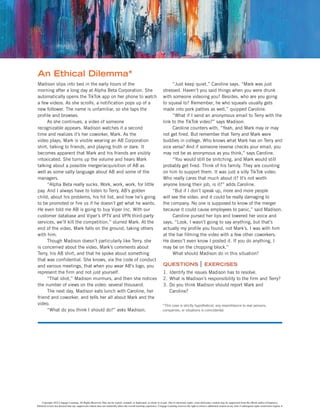
An Ethical Dilemma*
“Justkeep quiet,” Caroline says. “Mark was just
stressed. Haven’t you said things when you were drunk
with someone videoing you? Besides, who are you going
to squeal to? Remember, he who squeals usually gets
made into pork patties as well,” quipped Caroline.
“What if I send an anonymous email to Terry with the
link to the TikTok video?” says Madison.
Caroline counters with, “Yeah, and Mark may or may
not get fired. But remember that Terry and Mark were
buddies in college. Who knows what Mark has on Terry and
vice versa? And if someone reverse checks your email, you
may not be as anonymous as you think,” says Caroline.
“You would still be snitching, and Mark would still
probably get fired. Think of his family. They are counting
on him to support them. It was just a silly TikTok video.
Who really cares that much about it? It’s not worth
anyone losing their job, is it?” adds Caroline.
“But if I don’t speak up, more and more people
will see the video, and it could be really damaging to
the company. No one is supposed to know of the merger
because it could cause employees to panic,” said Madison.
Caroline pursed her lips and lowered her voice and
says, “Look, I wasn’t going to say anything, but that’s
actually my profile you found, not Mark’s. I was with him
at the bar filming the video with a few other coworkers.
He doesn’t even know I posted it. If you do anything, I
may be on the chopping block.”
What should Madison do in this situation?
Questions | Exercises
1. Identify the issues Madison has to resolve.
2. What is Madison’s responsibility to the firm and Terry?
3. Do you think Madison should report Mark and
Caroline?
Madison slips into bed in the early hours of the
morning after a long day at Alpha Beta Corporation. She
automatically opens the TikTok app on her phone to watch
a few videos. As she scrolls, a notification pops up of a
new follower. The name is unfamiliar, so she taps the
profile and browses.
As she continues, a video of someone
recognizable appears. Madison watches it a second
time and realizes it’s her coworker, Mark. As the
video plays, Mark is visible wearing an AB Corporation
shirt, talking to friends, and playing truth or dare. It
becomes apparent that Mark and his friends are visibly
intoxicated. She turns up the volume and hears Mark
talking about a possible merger/acquisition of AB as
well as some salty language about AB and some of the
managers.
“Alpha Beta really sucks. Work, work, work, for little
pay. And I always have to listen to Terry, AB’s golden
child, about his problems, his hit list, and how he’s going
to be promoted or fire us if he doesn’t get what he wants.
He even told me AB is going to buy Viper Inc. With our
customer database and Viper’s IPTV and VPN third-party
services, we’ll kill the competition,” slurred Mark. At the
end of the video, Mark falls on the ground, taking others
with him.
Though Madison doesn’t particularly like Terry, she
is concerned about the video, Mark’s comments about
Terry, his AB shirt, and that he spoke about something
that was confidential. She knows, via the code of conduct
and various meetings, that when you wear AB’s logo, you
represent the firm and not just yourself.
“That idiot,” Madison murmurs, and then she notices
the number of views on the video: several thousand.
The next day, Madison eats lunch with Caroline, her
friend and coworker, and tells her all about Mark and the
video.
“What do you think I should do?” asks Madison.
*This case is strictly hypothetical; any resemblance to real persons,
companies, or situations is coincidental.
Copyright 2022 Cengage Learning. All Rights Reserved. May not be copied, scanned, or duplicated, in whole or in part. Due to electronic rights, some third party content may be suppressed from the eBook and/or eChapter(s).
Editorial review has deemed that any suppressed content does not materially affect the overall learning experience. Cengage Learning reserves the right to remove additional content at any time if subsequent rights restrictions require it.
21.
Chapter 1: TheImportance of Business Ethics
T
he ability to anticipate and deal with business ethics issues and dilemmas has become
a significant priority in the twenty-first century. In recent years, a number of well-
publicized scandals resulted in public outrage about deception, fraud, and distrust in
business and a subsequent demand for improved business ethics, greater corporate responsi-
bility, and laws to protect the public. The publicity and debate surrounding highly publicized
legal and ethical lapses at well-known firms highlight the need for businesses to integrate
ethics and responsibility into all business decisions. On the other hand, most businesses have
a few major ethical lapses and are rarely recognized in the mass media for their good con-
duct. Companies doing business based on responsible and ethical decisions do not generate
media interest. The reality of such inattention for rewarding good practices can lull firms
and employees into complacency, leaving them vulnerable to ethical lapses. Minor lapses
are often forgotten—only to be resurrected into larger, more impactful ethical or legal issues
and dilemmas by media sources down the line. The result is bad press and distrust from
stakeholders. Organizations need to develop an ethical culture and deal with instances of
minor lapses in conduct.
Highly visible business ethics issues influence the public’s attitudes toward business and
destroy trust. Ethically charged decisions are a part of everyday life for those who work in
organizations at all levels. Business ethics is not just an isolated personal issue; codes, rules,
and informal communications for responsible conduct are embedded in an organization’s
operations. This means ethical or unethical conduct is the province of everyone who works
in an organization, from the lowest level employee to the CEO.
Making good business ethical decisions is just as important to business success as mas-
tering management, marketing, finance, and accounting. While education and training
emphasize functional areas of business, business ethics is often viewed as easy to master,
something that happens with little effort. You will hear the suggestion that business ethics is
just doing what is right. All you have to do is remember your values and stick to them. The
exact opposite is the case. Decisions with an ethical component are an everyday occurrence
requiring people to identify issues and make quick decisions. Ethical behavior in business
requires understanding and identifying issues, areas and types of risk, and approaches to
making choices in an organizational environment. Businesses need to be vigilant and under-
stand both their employees and other groups of employees outside the firm. They need to
understand the drivers of positive behavior and how to help those who have difficulty in
adhering to codes of conduct. On the other hand, people can act unethically simply by fail-
ing to identify a situation that has an ethical issue. Ethical blindness results from individuals
who fail to sense the nature and complexity of their decisions.1
Some approaches to business ethics look only at the philosophical backgrounds of indi-
viduals and the social consequences of decisions. This approach fails to address the complex
organizational environment of businesses and pragmatic business concerns. By contrast, our
approach is managerial and incorporates real-world decisions that impact the organization
and stakeholders. Our book will help you better understand what, how, and why ethics is
important in the business world.
It is important to learn how to make decisions in the internal environment of an organi-
zation to achieve personal and organizational goals. But business does not exist in a vacuum.
As stated, decisions in business have implications for investors, employees, customers, sup-
pliers, and society. Ethical decisions must take these stakeholders into account, for unethical
conduct can negatively affect people, companies, industries, and society as a whole. Our
approach focuses on the practical consequences of decisions and on positive outcomes that
have the potential to contribute to individuals, business, and society at large. The field of
business ethics deals with questions about whether specific conduct and business practices
are acceptable. For example, should a salesperson omit facts about a product’s poor safety
record in a sales presentation to a client? Should accountants report inaccuracies they dis-
cover in an audit of a client, knowing the auditing company will probably be fired by the
client for doing so? Should an automobile tire manufacturer intentionally conceal safety
concerns to avoid a massive and costly tire recall? Regardless of their legality, others will
certainly judge the actions in such situations as right or wrong, ethical or unethical. By its
very nature, the field of business ethics is controversial, and there is no universally accepted
3
Copyright 2022 Cengage Learning. All Rights Reserved. May not be copied, scanned, or duplicated, in whole or in part. Due to electronic rights, some third party content may be suppressed from the eBook and/or eChapter(s).
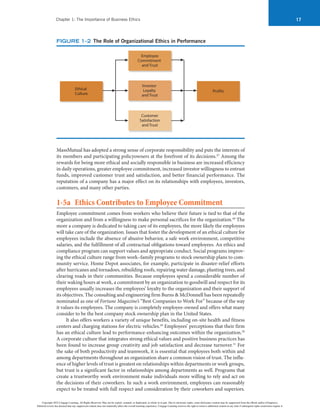
Editorial review has deemed that any suppressed content does not materially affect the overall learning experience. Cengage Learning reserves the right to remove additional content at any time if subsequent rights restrictions require it.
22.
morals
A person’s personal
philosophiesabout what is
right or wrong
business ethics
Comprises organizational
principles, values, and norms
that may originate from
individuals, organizational
statements, or from the legal
system that primarily guide
individual and group behavior
in business
principles
Specific and pervasive
boundaries for behavior that
should not be violated
values
Enduring beliefs and ideals
that are socially enforced
approach for resolving its dilemmas. All organizations have to deal with misconduct, but
some highly visible misconduct creates damaging publicity for firms. Wells Fargo expe-
rienced a loss of confidence when its sales department opened new accounts for clients
without their knowledge.2
The opportunity for the sales department to manipulate clients
was created by an unethical culture that top managers supported. The result was loss of trust
and closed accounts as well as loss of many potential clients.
Before we get started, it is important to state our approach to business ethics. First, we
do not moralize by stating what is right or wrong in a specific situation, although we offer
background on normative guidelines for appropriate conduct. Second, although we provide
an overview of group and individual decision-making processes, we do not prescribe one
approach or process as the best or most ethical. However, we provide many examples of suc-
cessful ethical decision making. Third, by itself, this book will not make you more ethical,
nor will it tell you how to judge the ethical behavior of others. Rather, its goal is to help you
understand, use, and improve your current values and convictions when making business
decisions so that you think about the effects of those decisions on business and society.
Our approach will help you understand what businesses are doing to improve their ethical
conduct. To this end, we aim to help you learn to recognize and resolve ethical issues within
business organizations. As a manager, you will be responsible for your decisions and the
conduct of the employees you supervise. For this reason, we provide a chapter on ethical
leadership. The framework we developed focuses on how organizational decisions are made
and ways companies can improve their ethical conduct. This process is more complex than
many think. People who believe they know how to make the “right” decision usually come
away with more uncertainty about their own decision skills after learning about the com-
plexity of ethical decision making. This is a normal occurrence, and our approach will help
you evaluate your own values as well as those of others. It will also help you to understand
the nature of business ethics and incentives found in the workplace that change the way you
make decisions in business versus at home.
In this chapter, we first develop a definition of business ethics and discuss why it has
become an important topic in business education. We also discuss why studying busi-
ness ethics can be beneficial. Next, we examine the evolution of business ethics in North
America. Then we explore the performance benefits of ethical decision making for busi-
nesses. Finally, we provide a brief overview of the framework we use for examining business
ethics in this text.
1-1 Business Ethics Defined
To understand business ethics, you must first recognize that most people do not have specific
definitions they use to define ethics-related issues. The terms morals, principles, values, and
ethics are often used interchangeably, and you will find this is true in companies as well.
Consequently, there is much confusion regarding this topic. To help you understand these
differences, we discuss these terms.
For our purposes, morals refer to a person’s personal philosophies about what is right
or wrong. The important point is that when one speaks of morals, it is personal or singular.
Morals relate to you and you alone. You may use your personal moral convictions in mak-
ing ethical decisions in any context. Business ethics comprises organizational principles,
values, and norms that may originate from individuals, organizational statements, or from
the legal system that primarily guide individual and group behavior in business. Principles
are specific and pervasive boundaries for behavior that should not be violated and often
become the basis for rules. Some examples of principles could include human rights, free-
dom of speech, and the fundamentals of justice. Values are enduring beliefs and ideals that
are socially enforced. Several desirable or ethical values for business today are teamwork,
trust, and integrity. Morals, values, and principles describe positive or good traits that are
often applied to the business organization or industry. When they are identified and applied,
they usually represent what is called “best practices.” Investors, employees, customers, inter-
est groups, the legal system, and the community often determine whether a specific action or
Part 1: An Overview of Business Ethics
4
Copyright 2022 Cengage Learning. All Rights Reserved. May not be copied, scanned, or duplicated, in whole or in part. Due to electronic rights, some third party content may be suppressed from the eBook and/or eChapter(s).
Editorial review has deemed that any suppressed content does not materially affect the overall learning experience. Cengage Learning reserves the right to remove additional content at any time if subsequent rights restrictions require it.
23.
Chapter 1: TheImportance of Business Ethics
standard is ethical or unethical. Although these groups influence the determination of what
is ethical or unethical for business, they also can be at odds with one another. Even though
this is the reality of business and such groups may not necessarily be right, their judgments
influence society’s acceptance or rejection of business practices.
Ethics is defined as behavior or decisions made within a group’s values or morals. In our
case, we are discussing decisions made in business by groups of people that represent the busi-
ness organization. One can have business ethics such as healthcare, accounting, marketing,
management, or financial ethics. But one can also have engineering, architectural, or publish-
ing ethics as related to different disciplines or associations. The important concept in business
ethics is that right and wrong behavior is defined by the group, which might be a company
or an industry. Because the Supreme Court defined companies as having limited individual
rights, it is logical such groups have an identity that includes core values.3
This is known
as being part of a corporate culture. Within this culture, there are rules and
regulations—
both written and unwritten—that determine what decisions employees consider right or
wrong as it relates to the firm. Such evaluations are judgments by the organization and are
defined as its ethics (or, in this case, their business ethics). One difference between an ordi-
nary decision and an ethical one lies in “the point where the accepted rules no longer serve,
and the decision maker is faced with the responsibility for weighing values and reaching
a judgment in a situation which is not quite the same as any he or she has faced before.”4
Another difference relates to the amount of emphasis decision makers place on their own
values and accepted practices within their company. Consequently, values and judgments
play a critical role when we make ethical decisions.
Building on these definitions, we begin to develop a concept of business ethics. Most
people agree that businesses should hire individuals with sound moral principles. However,
some special aspects must be considered when applying ethics to business. First, to survive
and contribute to society, businesses must earn a profit. There is no conflict or trade-offs
between profits and business ethics. For instance, Canon, Intel, and Volvo are highly profit-
able companies that have earned a reputation for ethical conduct.5
Second, to be successful,
businesses must address the needs and desires of stakeholders. The good news is that the
world’s most ethical companies often have superior stock performance.6
To address these
unique aspects of the business world, society has developed rules—both legal and implicit—
to guide businesses in their efforts to earn profits in ways that help individuals or society and
contribute to social and economic well-being.
1-2 Why Study Business Ethics?
1-2a A Crisis in Business Ethics
Business ethics has become a major concern. The Ethics Compliance Initiative (ECI)
conducts the Global Business Ethics Survey (GBES) that measures workplace integrity in
leading world economies. Sample sizes average 1,000 employees per country and gather
reliable data on key ethics and compliance outcomes to help identify and better understand
the ethics issues that are important to employees. The GBES measures workplace integrity as
the pressure to compromise organizational standards, observed misconduct, reporting of
misconduct when observed, and retaliation against reports. Table 1–1 provides an overview
of observed misconduct in the United States.
Business ethics decisions and activities have come under greater scrutiny by many dif-
ferent stakeholders, including consumers, employees, investors, government regulators, and
special interest groups.7
Figure 1–1 shows the percentage of global respondents who say
they trust a variety of businesses in various industries. Financial services have some of the
lowest ratings, indicating that the financial sector has not been able to restore its reputation
since the most recent recession. There is no doubt negative publicity associated with major
misconduct lowered the public’s trust in certain business sectors.8
Decreased trust leads
to a reduction in customer satisfaction and customer loyalty, which in turn can negatively
impact the firm or industry.9
ethics
Behavior or decisions made
within a group’s values or
morals
workplace integrity
The pressure to compromise
organizational standards,
observed misconduct,
reporting of misconduct when
observed, and retaliation
against reports
5
Copyright 2022 Cengage Learning. All Rights Reserved. May not be copied, scanned, or duplicated, in whole or in part. Due to electronic rights, some third party content may be suppressed from the eBook and/or eChapter(s).
Editorial review has deemed that any suppressed content does not materially affect the overall learning experience. Cengage Learning reserves the right to remove additional content at any time if subsequent rights restrictions require it.
24.
1-2b Specific Issues
Thereare a number of ethical issues that must be addressed to prevent misconduct. Misuse
of company resources, abusive behavior, harassment, accounting fraud, conflicts of inter-
est, defective products, bribery, product knock-offs, and employee theft are all problems
cited as potential risk areas. For example, former British Airway executive Steven Clark was
indicted for accepting bribes in exchange for offering contracts at JFK airport to Ground
Services International (GSI), a ground handling company. The bribery was concealed by
phony invoices, and money was laundered through fake companies.10
Generally, ethics plays an important role in the public sector as well. In government or
political ethics, several politicians and high-ranking officials have experienced significant
negative publicity. Israeli prime minister Benjamin Netanyahu was indicted on bribery and
fraud charges for exchanging official favors for positive publicity. Though the charges could
potentially lead to a 10-year prison sentence, Netanyahu denies the charges and says he
will remain as prime minister.11
Some officials have even resigned in disgrace over ethical
indiscretions. For example, Martin Sandoval, an Illinois senator of 16 years, resigned while
under investigation for bribery and fraud.12
These examples demonstrate the legal aspect of business ethics. Within political ethics,
those who do not violate the law but nonetheless are judged to be unethical can be expelled,
censured, or reprimanded. For example, expulsion usually occurs if a
government official is
convicted of a crime. Former New York Congressman Charles B. Rangel was censured for
improper solicitation of funds, inaccurate financial disclosure statements, and failure to pay
Observed misconduct 49%
Abusive behavior 22%
Lying to employees and external stakeholders 25%
Conflicts of interest 23%
Health violations 22%
Pressure to compromise standards 30%
Report observed misconduct 81%
Experience retaliation for reporting 79%
Source: Ethics and Compliance Initiative, Global Business Ethics Survey, The State of Ethics Compliance in the Workplace, March 2021,
(Arlington, VA: Ethics and Compliance Initiative, 2021), 16–22.
Table 1–1 Observed Misconduct in the U.S. Workforce
Figure 1–1 Global Trust in Industry Sectors
52%
0% 10% 20% 30% 40% 50% 60% 70% 80% 90%
Financial Services
59%
Energy
61%
Telecommunications
60%
Automotive
60%
Consumer Packaged Goods
65%
Food and Beverage
Technology 68%
Source: Edelman, Edelman Trust Barometer 2021, https://www.edelman.com/sites/g/files/aatuss191/files/2021-01/2021-edelman-trust-
barometer.pdf (accessed March 11, 2021).
Part 1: An Overview of Business Ethics
6
Copyright 2022 Cengage Learning. All Rights Reserved. May not be copied, scanned, or duplicated, in whole or in part. Due to electronic rights, some third party content may be suppressed from the eBook and/or eChapter(s).
Editorial review has deemed that any suppressed content does not materially affect the overall learning experience. Cengage Learning reserves the right to remove additional content at any time if subsequent rights restrictions require it.
25.
Chapter 1: TheImportance of Business Ethics
taxes.13
A reprimand and fine can occur, as was the case for former California representative
Laura Richardson who used official resources for personal purposes in her reelection cam-
paign and faced a $10,000 fine.14
Such political scandals demonstrate that political ethical
behavior must be proactively practiced at all levels of public service.
Every organization has the potential for unethical behavior. For instance, William
Singer, the founder of a college preparatory business, was the mastermind behind the largest
college admissions prosecution ever by the Department of Justice. He accepted millions of
dollars in order to falsify standardized test results and bribe athletic coaches and university
administrators at universities such as Stanford and Yale. More than 50 people were charged
in the admissions scandal, including celebrities, business leaders, and college coaches.15
Even nonprofits can be subject to ethical lapses. William Weatherby, former president of
Christian-based nonprofit Feed My Lambs, stole more than $500,000 for personal use. The
funds were intended to go toward the education of underprivileged children.16
This incident
highlights the need for greater accountability for nonprofit leaders as well.
Whether they are made in the realm of business, politics, science, or sports, most deci-
sions are judged as right or wrong, ethical or unethical. Regardless of what an individual
believes about a particular action, if society judges it to be unethical or wrong, new legisla-
tion usually follows. Whether correct or not, that judgment directly affects a company’s
ability to achieve its business goals. You should be aware that the public is more tolerant of
questionable consumer practices than of similar business practices. Double standards are at
least partly due to differences in wealth and the success between businesses and consumers.
The more successful a company, the more the public is critical when misconduct occurs.17
For this reason alone, it is important to understand business ethics and recognize ethical
issues.
1-2c The Reasons for Studying Business Ethics
Studying business ethics is valuable for several reasons. Business ethics is more than an
extension of an individual’s own personal values. Many people believe if a company hires
good people with strong values, then it will be a “good citizen” organization. But as we show
throughout this text, an individual’s personal moral values are only one factor in the ethical
decision-making process. True, moral values can be applied to a variety of situations in life,
and some people do not distinguish everyday ethical issues and dilemmas from business
ones. Our concern, however, is with the application of principles, values, and standards in
the business context. Many important issues are not related to a business context, although
they remain complex moral dilemmas in a person’s own life. For example, although abortion
and human cloning are moral issues, they are not an issue in most business organizations.
Professionals in any field, including business, must deal with individuals’ personal
moral dilemmas because such dilemmas affect everyone’s ability to function on the job. A
moral dilemma is defined as a situation where the person is faced with multiple choices, all of
which are undesirable as defined by the person. A value dilemma is the same, only that the
individual’s beliefs are grounded in societal norms. Normally, a business does not dictate a
person’s morals. Such policies would be illegal. Only when a person’s morals influence his or
her performance on the job does it involve a dimension within business ethics.
Just being a good person and having sound personal values may not be sufficient to han-
dle the ethical issues that arise in a business organization. Although truthfulness, honesty,
fairness, and openness are often assumed to be self-evident and accepted, business-strategy
decisions involve complex and detailed discussions. For example, there is considerable
debate over what constitutes antitrust, deceptive advertising, and violations of the Foreign
Corrupt Practices Act that defines bribery in global business. A high level of personal moral
development may not prevent an individual from violating the law in a complicated orga-
nizational context where even experienced lawyers debate the exact meaning of the law. For
instance, the National Labor Relations Board ruled that employees have the right to use
company email systems to discuss working conditions and unionization as long as it is not on
company time. Employer groups claim that employees have plenty of options for discussing
these topics and maintain that it will be hard to ensure employees are not using company
moral dilemma
Two or more morals in conflict
with one another
value dilemma
Two or more beliefs/ideals in
conflict with one another
7
Copyright 2022 Cengage Learning. All Rights Reserved. May not be copied, scanned, or duplicated, in whole or in part. Due to electronic rights, some third party content may be suppressed from the eBook and/or eChapter(s).
Editorial review has deemed that any suppressed content does not materially affect the overall learning experience. Cengage Learning reserves the right to remove additional content at any time if subsequent rights restrictions require it.
26.
computer servers forthese purposes during work hours. The right of employees versus
employers is more controversial and will continue to need clarification from the courts.18
Some approaches to business ethics assume ethics training is for people whose per-
sonal moral development is unacceptable, but that is not the case. Because organizations
are culturally diverse and personal morals must be respected, ensuring collective agreement
on organizational ethics (that is, codes reasonably capable of preventing misconduct) is as
vital as any other effort an organization’s management may undertake. Failure to establish
shared values and ethics codes will result in a wide range of conduct when faced with the
same ethical issues.
Many people with limited business experience suddenly find themselves making deci-
sions about product quality, advertising, pricing, sales techniques, hiring practices, and
pollution control. The morals they learned from family, religion, and school may not pro-
vide specific guidelines for these complex business decisions. In other words, a person’s
experiences and decisions at home, in school, and in the community may be quite differ-
ent from his or her experiences and decisions at work. Many business ethics decisions are
close calls. In addition, managerial responsibility and ethical leadership for the conduct of
others requires knowledge of ethics and compliance processes and systems. Years of expe-
rience in a particular industry may be required to know what is acceptable. For example,
when are advertising claims more exaggeration than truth? When does such exaggeration
become unethical? Unilever Australia came under fire for an ice cream advertisement in
New Zealand that said, “Ice cream makes you happy.” Although Unilever Australia defended
the tagline as puffery—an exaggerated claim that customers should not take seriously—the
Advertising Standards Authority ordered the company to remove the ad because it could
undermine the health of consumers by linking ice cream and level of happiness.19
Studying business ethics will help you begin to identify ethical issues when they arise
and recognize the approaches available for resolving them. You will learn more about the
ethical decision-making process and about ways to promote ethical behavior within your
organization. By studying business ethics, you may also begin to understand how to cope
with conflicts between your own personal values and those of the organization in which you
work. As stated earlier, if after reading this book you feel a little more unsettled about poten-
tial decisions in business, your decisions will be more ethical, and you will have knowledge
within this area.
1-3 The Development of Business Ethics
The study of business ethics in North America has evolved through distinct stages and
continues to evolve in the twenty-first century (see Table 1–2).
1-3a Before 1960: Ethics in Business
Before 1960, the United States endured several agonizing phases of questioning the concept
of capitalism. In the 1920s, the progressive movement attempted to provide citizens with a
“living wage,” defined as income sufficient for education, recreation, health, and retirement.
Businesses were asked to check unwarranted price increases and any other practices that
would hurt a family’s living wage. In the 1930s came the New Deal that specifically blamed
business for the country’s economic woes. Business was asked to work more closely with
the government to raise family income. By the 1950s, the New Deal evolved into Presi-
dent Harry S. Truman’s Fair Deal, a program that defined such matters as civil rights and
environmental responsibility as ethical issues that businesses had to address. Government
relationships, social issues, and economic fairness were major concerns in the first half of
the twentieth century.
Until 1960, ethical issues related to business were often discussed within the domain
of theology or philosophy or in the realm of legal and competitive relationships. Religious
leaders raised questions about fair wages, labor practices, and the morality of capitalism. For
example, Catholic social ethics, expressed in a series of papal encyclicals, included concern
Part 1: An Overview of Business Ethics
8
Copyright 2022 Cengage Learning. All Rights Reserved. May not be copied, scanned, or duplicated, in whole or in part. Due to electronic rights, some third party content may be suppressed from the eBook and/or eChapter(s).
Editorial review has deemed that any suppressed content does not materially affect the overall learning experience. Cengage Learning reserves the right to remove additional content at any time if subsequent rights restrictions require it.
27.
Chapter 1: TheImportance of Business Ethics
for morality in business, workers’ rights, and living wages; for humanistic values rather than
materialistic ones; and for improving the conditions of the poor. The Protestant work ethic
encouraged individuals to be frugal, to work hard, and to attain success in the capitalistic
system. Such religious traditions provided a foundation for the future field of business ethics.
The first book on business ethics was published in 1937 by Frank Chapman Sharp and
Philip G. Fox. The authors separated their book into four sections: fair service, fair treatment
of competitors, fair price, and moral progress in the business world. This early textbook
discusses ethical ideas based largely on economic theories and moral philosophies. However,
the section’s titles indicate the authors also take different stakeholders into account. Most
notably, competitors and customers are the main stakeholders emphasized, but the text also
identifies stockholders, employees, business partners such as suppliers, and government
agencies.20
Although the theory of stakeholder orientation would not evolve for many more
years, this earliest business ethics textbook demonstrates the necessity of the ethical treat-
ment of different stakeholders.
1-3b The 1960s: The Rise of Social Issues in Business
During the 1960s, American society witnessed the development of an antibusiness trend
because many critics attacked the vested interests that controlled the economic and politi-
cal aspects of society—the so-called military–industrial complex. The 1960s saw the decay
of inner cities and the growth of ecological problems such as pollution and the disposal of
toxic and nuclear wastes. This period also witnessed the rise of consumerism—activities
undertaken by independent individuals, groups, and organizations to protect their rights as
consumers. In 1962, President John F. Kennedy delivered a “Special Message on Protecting
the Consumer Interest” that outlined four basic consumer rights: the right to safety, the right
to be informed, the right to choose, and the right to be heard. These came to be known as
the Consumers’ Bill of Rights.
The modern consumer movement is generally considered to have begun in 1965 with
the publication of Ralph Nader’s Unsafe at Any Speed that criticized the auto industry as a
consumers’ bill of rights
From President John F.
Kennedy’s 1962 “Special
Message on Protecting the
Consumer Interest” that
outlined four basic consumer
rights: the right to safety, the
right to be informed, the right
to choose, and the right to be
heard
1960s 1970s 1980s 1990s 2000s 2010s and 2020s
Environmental
issues
Employee
militancy
Bribes
and illegal
contracting
practices
Sweatshops and
unsafe working
conditions in third-
world countries
Cybercrime Uses of big data
Civil rights
issues
Human rights
issues
Influence
peddling
Rising corporate
liability for personal
damages (for
example, cigarette
companies)
Financial
misconduct
Social media and
networking exposing new
areas of vulnerability
Increased
employee–
employer
tension
Covering up
rather than
correcting
issues
Deceptive
advertising
Financial
mismanagement
and fraud
Global issues,
product safety,
bribery
Tension between
increasing transparency
and protecting privacy
Changing
work ethic
Disadvantaged
consumers
Financial
fraud (for
example,
savings and
loan scandal)
Organizational
ethical misconduct
Sustainability Responsible use of technology
in the workplace
Rising
drug use
Transparency
issues
Intellectual
property theft
Diversity, equity, and inclusion
Source: Adapted from Ethics Compliance Initiative, “Business Ethics and Compliance Timeline,” www.ethics.org/resources/free-toolkit/ethics-timeline (accessed December 6, 2019).
Table 1–2 Timeline of Ethical and Socially Responsible Concerns
9
Copyright 2022 Cengage Learning. All Rights Reserved. May not be copied, scanned, or duplicated, in whole or in part. Due to electronic rights, some third party content may be suppressed from the eBook and/or eChapter(s).
Editorial review has deemed that any suppressed content does not materially affect the overall learning experience. Cengage Learning reserves the right to remove additional content at any time if subsequent rights restrictions require it.
28.
defense industry
initiative onbusiness
ethics and conduct
An organization developed to
guide corporate support for
ethical conduct
whole, and General Motors Corporation (GM) in particular, for putting profit and style
ahead of lives and safety. GM’s Corvair was the main target of Nader’s criticism. His con-
sumer protection organization, popularly known as Nader’s Raiders, fought successfully for
legislation requiring automobile makers to equip cars with safety belts, padded dashboards,
stronger door latches, head restraints, shatterproof windshields, and collapsible steering
columns. Consumer activists also helped secure passage of consumer protection laws such as
the Wholesome Meat Act of 1967, the Radiation Control for Health and Safety Act of 1968,
the Clean Water Act of 1972, and the Toxic Substance Act of 1976.21
After Kennedy came President Lyndon B. Johnson and the “Great Society,” a series of
programs that extended national capitalism and told the business community the U.S. gov-
ernment’s responsibility was to provide all citizens with some degree of economic stability,
equality, and social justice. Activities that could destabilize the economy or discriminate
against any class of citizens began to be viewed as politically unethical and unlawful.
1-3c The 1970s: Business Ethics as an Emerging Field
Business ethics began to develop as a field of study in the 1970s. Theologians and philoso-
phers laid the groundwork by suggesting certain moral principles could be applied to busi-
ness activities. Using this foundation, business professors began to teach and write about
corporate social responsibility (CSR), an organization’s obligation to maximize its positive
impact on stakeholders and minimize its negative impact. Philosophers increased their
involvement, applying ethical theory and philosophical analysis to structure the discipline
of business ethics. Companies became more concerned with their public image, and as social
demands grew, many businesses realized they needed to address ethical issues more directly.
The Nixon administration’s Watergate scandal focused public interest on the importance
of ethics in government. Conferences were held to discuss the social responsibilities and
ethical issues of business. Centers dealing with issues of business ethics were established.
Interdisciplinary meetings brought together business professors, theologians, philosophers,
and businesspeople. President Jimmy Carter attempted to focus on personal and adminis-
trative efforts to uphold ethical principles in government. The Foreign Corrupt Practices
Act (FCPA) was passed during his administration, making it illegal for U.S. businesses to
bribe government officials of other countries. Today, this law is the highest priority of the
U.S. Department of Justice.
By the end of the 1970s, a number of major ethical issues had emerged, including
bribery, deceptive advertising, price collusion, product safety, and ecology. Business ethics
became a common expression. Academic researchers sought to identify ethical issues and
describe how businesspeople might choose to act in particular situations. However, only
limited efforts were made to describe how the ethical decision-making process worked and
to identify the many variables that influence this process in organizations.
1-3d The 1980s: Business Ethics Reaches Maturity
In the 1980s, business academics and practitioners acknowledged business ethics as a field of
study, and a growing and varied group of institutions with diverse interests promoted it. Cen-
ters for business ethics provided publications, courses, conferences, and seminars. R. Edward
Freeman was among the first scholars to pioneer the concept of stakeholders as a founda-
tional theory for business ethics decisions. Freeman defined stakeholders as “any group or
individual who can affect or is affected by the achievement of the organizations objectives.”22
Freeman’s defense of stakeholder theory had a major impact on strategic management and
corporations’ views of their responsibilities. Business ethics were also a prominent concern
within leading companies such as General Electric, Hershey Foods, General Motors, IBM,
Caterpillar, and S. C. Johnson Son, Inc. Many of these firms established ethics and social
policy committees to address ethical issues.
In the 1980s, the Defense Industry Initiative on Business Ethics and Conduct was developed
to guide corporate support for ethical conduct. In 1986, 18 defense contractors drafted
principles for guiding business ethics and conduct.23
The organization has since grown to
corporate social
responsibility (CSR)
An organization’s obligation to
maximize its positive impact
on stakeholders and minimize
its negative impact
Part 1: An Overview of Business Ethics
10
Copyright 2022 Cengage Learning. All Rights Reserved. May not be copied, scanned, or duplicated, in whole or in part. Due to electronic rights, some third party content may be suppressed from the eBook and/or eChapter(s).
Editorial review has deemed that any suppressed content does not materially affect the overall learning experience. Cengage Learning reserves the right to remove additional content at any time if subsequent rights restrictions require it.
29.
Chapter 1: TheImportance of Business Ethics
nearly 80 members. This effort established a method for discussing best practices and work-
ing tactics to link organizational practice and policy to successful ethical compliance. The
initiative includes six principles. First, it supports codes of conduct and their widespread
distribution. These codes of conduct must be understandable and cover their more substan-
tive areas in detail. Second, member companies are expected to provide ethics training for
their employees as well as continuous support between training periods. Third, defense
contractors must create an open atmosphere in which employees feel comfortable reporting
violations without fear of retribution. Fourth, companies need to perform extensive internal
audits and develop effective internal reporting and voluntary disclosure plans. Fifth, the
initiative insists that member companies preserve the integrity of the defense industry. And
sixth, member companies must adopt a philosophy of public accountability.24
The 1980s ushered in the Reagan–Bush era, with the accompanying belief that self-
regulation, rather than regulation by government, was in the public’s interest. Many tariffs
and trade barriers were lifted, and businesses merged and divested within an increasingly
global atmosphere. Thus, while business schools were offering courses in business ethics, the
rules of business were changing at a phenomenal rate because of less regulation. Corpora-
tions that once were nationally based began operating internationally and found themselves
mired in value structures where accepted rules of business behavior no longer applied.
1-3e The 1990s: Institutionalization of Business Ethics
The administration of President Bill Clinton continued to support self-regulation and free
trade. However, it also took unprecedented government action to deal with health-related
social issues such as teenage smoking. Its proposals included restricting cigarette advertising,
banning cigarette vending machine sales, and ending the use of cigarette logos in connection
with sports events.25
Clinton also appointed Arthur Levitt as chairman of the Securities and
Exchange Commission (SEC) in 1993. Levitt unsuccessfully pushed for many reforms that, if
passed, could have prevented the accounting scandals exemplified by Enron and WorldCom
in the early twenty-first century.26
Federal Sentencing Guidelines for Organizations (FSGO), approved by Congress in Novem-
ber 1991, set the tone for organizational ethical compliance programs in the 1990s. The
guidelines, which were based on the six principles of the Defense Industry Initiative on
Business Ethics and Conduct, broke new ground by codifying into law incentives to reward
organizations for taking action to prevent misconduct, such as developing effective internal
legal and ethical compliance programs.27
Provisions in the guidelines mitigate penalties for
businesses striving to root out misconduct and establish high ethical and legal standards.28
On the other hand, under FSGO, if a company lacks an effective ethical compliance program
and its employees violate the law, it can incur severe penalties. The guidelines focus on firms
taking action to prevent and detect business misconduct in cooperation with government
regulation. At the heart of the FSGO is the carrot-and-stick approach—that is, by taking
preventive action against misconduct, a company may avoid onerous penalties should a
violation occur. A mechanical approach using legalistic logic will not suffice to avert serious
penalties. The company must develop corporate values, enforce its own code of ethics, and
strive to prevent misconduct. The law develops new amendments almost every year. We will
provide more detail on the FSGO’s role in business ethics programs in Chapters 4 and 8.
1-3f The 2000s: Twenty-First Century Business Ethics
Although business ethics appeared to become more institutionalized in the 1990s, new evi-
dence emerged in the early 2000s that not all business executives and managers had fully
embraced the public’s desire for high ethical standards. After George W. Bush became presi-
dent in 2001, highly publicized corporate misconduct at Enron, WorldCom, Halliburton,
and the accounting firm Arthur Andersen caused the government and the public to look for
new ways to encourage ethical behavior.29
Accounting scandals, especially falsifying financial
reports, became part of the culture of many companies. Firms outside the United States, such
as Royal Ahold in the Netherlands and Parmalat in Italy, became major examples of global
federal sentencing
guidelines for
organizations (fsgo)
Guidelines that codified into
law incentives to reward
organizations for taking
action to prevent misconduct,
such as developing effective
internal legal and ethical
compliance programs
11
Copyright 2022 Cengage Learning. All Rights Reserved. May not be copied, scanned, or duplicated, in whole or in part. Due to electronic rights, some third party content may be suppressed from the eBook and/or eChapter(s).
Editorial review has deemed that any suppressed content does not materially affect the overall learning experience. Cengage Learning reserves the right to remove additional content at any time if subsequent rights restrictions require it.
30.
dodd–frank wall street
reformand consumer
protection act
Legislation that addressed
some of the issues related
to the financial crisis and
recession and designed to
make the financial services
industry more ethical and
responsible
accounting fraud. Although the Bush administration tried to minimize government regula-
tion, there appeared to be no alternative to developing more regulatory oversight of business.
Such abuses increased public and political demands to improve ethical standards in
business. To address the loss of confidence in financial reporting and corporate ethics, in
2002 Congress passed the Sarbanes–Oxley Act, the most far-reaching change in organizational
control and accounting regulations since the Securities and Exchange Act of 1934. The new
law made securities fraud a criminal offense and stiffened penalties for corporate fraud. It
also created an accounting oversight board that requires corporations to establish codes
of ethics for financial reporting and to develop greater transparency in financial reports
to investors and other interested parties. Additionally, the law requires top executives to
sign off on their firms’ financial reports and risk fines and long prison sentences if they
misrepresent their companies’ financial positions. The legislation further requires company
executives to disclose stock sales immediately and prohibits companies from giving loans
to top managers.30
Amendments to the FSGO require that a business’s governing authority be well informed
about its ethics program with respect to content, implementation, and effectiveness. This
places the responsibility squarely on the shoulders of the firm’s leadership, usually the board
of directors. The board is required to provide resources to oversee the discovery of risks and
to design, implement, and modify approaches to deal with those risks.
The Sarbanes–Oxley Act and the FSGO institutionalized the need to discover and
address ethical and legal risk. Top management and the board of directors of a corporation
are accountable for discovering risk associated with ethical conduct. Such specific industries
as the public sector, energy and chemicals, healthcare, insurance, and retail have to discover
the unique risks associated with their operations and develop ethics programs to prevent
ethical misconduct before it creates a crisis. Most firms are developing formal and informal
mechanisms that affect interactive communication and transparency about issues associated
with the risk of misconduct. Business leaders should consider the greatest danger to their
organizations lies in not discovering any serious misconduct or illegal activities that may be
lurking. Unfortunately, most managers do not view the risk of an ethical disaster as being as
important as the risk associated with fires, natural disasters, or technology failure. In fact,
ethical disasters can be significantly more damaging to a company’s reputation than risks
managed through insurance and other methods. The great investor Warren Buffett stated
it is impossible to eradicate all wrongdoing in a large organization, and one can only hope
the misconduct is small and is caught in time. Buffett’s fears were realized in 2008, when
the financial system almost collapsed because of pervasive, systemic use of instruments
such as credit default swaps, risky debt such as subprime lending, and corruption in major
corporations.
In 2009, Barack Obama became president in the middle of the Great Recession, which
was caused by a meltdown in the global financial industry. Many firms—such as AIG,
Lehman Brothers, Merrill Lynch, and Countrywide Financial—engaged in ethical miscon-
duct in developing and selling high-risk financial products. Though he inherited an econ-
omy in peril, Obama’s presidency was marked by legislation that led the country to economic
recovery with such legislation as the American Recovery and Reinvestment Act (ARRA)
that provided a stimulus for recovery, cutting $288 billion in taxes.31
President Obama’s
legislation to improve healthcare and provide more protection for consumers focused on
social concerns. The Affordable Care Act (ACA) passed in 2009. The ACA, more commonly
known as Obamacare, was a big move in social regulation. It aimed to allow more people to
have affordable health insurance and to expand the Medicaid program to cover more adults.
Additionally, it aimed to support innovative healthcare delivery methods. Ultimately, the
ACA was intended to decrease the cost of healthcare.
1-3g The 2010s: New Challenges in Business Ethics
Moving into the 2010s, Congress passed legislation regarding credit card accountability,
improper payments related to federal agencies, fraud and waste, and food safety. The Dodd–
Frank Wall Street Reform and Consumer Protection Act in 2010 addressed some of the issues
Sarbanes–Oxley Act
The most far-reaching change
in organizational control
and accounting regulations
since the Securities and
Exchange Act of 1934, which
made securities fraud a
criminal offense and stiffened
penalties for corporate fraud
Part 1: An Overview of Business Ethics
12
Copyright 2022 Cengage Learning. All Rights Reserved. May not be copied, scanned, or duplicated, in whole or in part. Due to electronic rights, some third party content may be suppressed from the eBook and/or eChapter(s).
Editorial review has deemed that any suppressed content does not materially affect the overall learning experience. Cengage Learning reserves the right to remove additional content at any time if subsequent rights restrictions require it.
31.
Chapter 1: TheImportance of Business Ethics
related to the financial crisis and recession. The Dodd–Frank Act was the most sweeping
financial legislation since the Sarbanes–Oxley Act and possibly since laws put into effect
during the Great Depression. It was designed to make the financial services industry more
ethical and responsible. This complex law required regulators to create hundreds of rules to
promote financial stability, improve accountability and transparency, and protect consumers
from abusive financial practices.
Enforcement of the FCPA, created in the 1970s, became a top priority for the SEC in
the 2010s, marked by the creation of a specialized unit to support enforcement of the FCPA.
Outside of the United States, the United Kingdom instituted sweeping anti-bribery legisla-
tion 2010 with the Bribery Act. It is the strictest legislation internationally, and it places the
burden of proof on companies to show they have sufficient procedures in place to prevent
bribery. The Bribery Act creates four main offenses: (1) offering, promising, or giving of an
advantage; (2) requesting, agreeing to receive, or accepting an advantage; (3) bribery of a
foreign public official; and (4) failure by a commercial organization to prevent a bribe being
paid to obtain or retain business or a business advantage (should an offense be committed,
it will be a defense that the organization has adequate procedures in place to prevent brib-
ery). With an extensive territorial scope, the act impacts both U.K.-based companies and
international companies with a U.K. presence. For U.S. businesses, it’s important to realize
that FCPA-compliant anti-bribery programs may not be sufficient to meet the requirements
of the Bribery Act.32
Intense distrust of corporate America coincided with the influx of Millennials into the
workforce, the largest generation in the U.S. labor force. In 2016, Millennials represented
more than a third of labor force participants, according to Pew Research Center.33
Millenni-
als and the following generation, Generation Z (also known as Gen Z), highly value authen-
ticity and transparency from businesses and have become influential consumer groups,
seeking products that align with their values. These generations let business ethics and CSR
issues guide not only product purchase decisions but also employer choices. Companies
need to take a stance on important social and environmental issues in order to recruit and
retain young talent.34
The multigenerational workplace has created new challenges due to
varying attitudes and motivations between generations. For example, Millennial and Gen Z
employees are more loyal to employers as a result of recognition rewards.35
To effectively
manage a multigenerational workforce, companies must identify the benefits and rewards
that will have the greatest impact for each employee.
Tension between increasing transparency and protecting privacy emerged in the 2010s.
Consumers increasingly called upon businesses to more responsibly collect and protect their
data. The European Union has made significant progress in enacting data protection leg-
islation compared to other developed countries. A ruling in 2014 by the Court of Justice
of the European Union known as “the right to be forgotten” declared that people have the
right to ask search engines to remove results for queries that include their name. Addi-
tionally, the European Union passed the General Data Protection Regulation (GDPR) in
2016, requiring businesses to ask consumers for permission to collect data and respond to
consumer inquiries about data usage within 72 hours, placing the burden on companies to
protect information about their users. This impacts all companies that do business with the
European Union.36
In fact, Google was fined €50 million by France for violating GDPR.37
Many countries—including Brazil, China, India, Japan, South Korea, and Thailand—have
enacted their own legislation to protect the data of their citizens, though the United States
has not followed suit.
In 2017, Donald Trump became the president based on promises to once again decrease
regulation and eliminate environmental and financial regulations. Support for sustainability
was questioned as the Keystone pipeline—that President Obama had blocked—was restored.
On the other hand, economic prosperity was emphasized by promises to make trade fair and
create more jobs. Lower taxes were supposed to improve the economy but decrease social
services. The basic assumptions of capitalism have been questioned as countries around the
world work to stabilize markets and question those who manage the finances of individual
corporations and nonprofits. The financial crisis caused many people to question govern-
ment institutions that provide oversight and regulation. As societies work to create change
13
Copyright 2022 Cengage Learning. All Rights Reserved. May not be copied, scanned, or duplicated, in whole or in part. Due to electronic rights, some third party content may be suppressed from the eBook and/or eChapter(s).
Editorial review has deemed that any suppressed content does not materially affect the overall learning experience. Cengage Learning reserves the right to remove additional content at any time if subsequent rights restrictions require it.
32.
for the better,they must address issues related to law, ethics, and the required level of com-
pliance necessary for government and business to serve the public interest. Not since the
Great Depression and President Franklin Delano Roosevelt has the United States seen such
widespread government intervention and regulation—something deemed necessary by most
but is nevertheless worrisome to free market capitalists.
During the COVID-19 pandemic, which began in 2019 and spread into the United
States in 2020, unemployment reached record levels, at least temporarily. The government
pumped trillions of dollars into the economy to support businesses that could not operate
and employees that could not work due to the need for social distancing. Both large and
small businesses did not have to pay back some of the loans if they could keep or rehire
their employees during this economic crisis. Interest rates and oil prices dropped to record
lows. Overall the government’s action demonstrated more involvement in the economy and
society.
Business Ethics in the Real World
The Nuts and Bolts of the “Robot Tax” Debate
Emerging technology has introduced new ethical concerns, creating and exposing new
areas of vulnerability. The responsible use of technology in the workplace has been a
growing concern due to the use of artificial intelligence and enablers such as big data
and robotics. Many people are concerned not only that robots and automated systems
are taking jobs from humans but that this could lead to a decrease in tax revenue. Cur-
rently, the federal government receives about 50 percent of its revenue from income
tax, which could be in jeopardy with the influx of robots into the workforce.
Robots with the ability to perform humanlike tasks have the potential to complete
repetitive tasks such as cleaning or stocking shelves more efficiently and for less money
to the employer. Automation has the potential to assist even the most complex jobs,
potentially freeing workers to focus on other responsibilities. While this automation
stands to increase revenue, it also would mean shrinking taxes paid by human
employees.
Supporters for a so-called “robot tax” suggest lawmakers reduce or eliminate deductions
for businesses that replace people with robots or introduce new tax laws.
Critics of the robot tax say automation has eliminated jobs throughout history,
creating new types of jobs. They believe the introduction of robots is part of this
natural evolution, so there is no reason to change tax practices. For example, the
introduction of PCs in the 1980s and 1990s eliminated many clerical jobs, but new
roles emerged such as software designer and social media manager. In fact, countries
such as
Germany already have four times the robot power of the United States and
very low unemployment. Additionally, many fear changes to the tax system would
deter companies from investing in innovative technology. A study from the McKinsey
Global Institute suggests that 15 percent of work could be automated by 2030, but
employment rates may not be affected.
Attempts to define what qualifies as a robot could be challenging for legislators.
Additionally, it’s important that new rules and regulations do not discourage innovation
or push companies to move operations out of the United States. As more companies
embrace robotics, it becomes increasingly important to understand and analyze the
issue, measuring the impact on tax revenue and the workforce and making predictions
for the future.
Sources: Meredith Somers, “The Case for Taxing Robots – or Not,” MIT Sloan School of Management, June
14, 2019, https://mitsloan.mit.edu/ideas-made-to-matter/case-taxing-robots-or-not (accessed January 22,
2020); Richard Rubin, “The ‘Robot Tax’ Debate Heats Up,” The Wall Street Journal, January 8, 2020, https://
www.wsj.com/articles/the-robot-tax-debate-heats-up-11578495608 (accessed January 22, 2020); Tom
Davenport, “Advancing the Debate on Taxing Robots,” Forbes, June 13, 2019, https://www.forbes.com/sites/
tomdavenport/2019/06/13/advancing-the-debate-on-taxing-robots/#d12f60625a43 (accessed January 22, 2020).
Part 1: An Overview of Business Ethics
14
Copyright 2022 Cengage Learning. All Rights Reserved. May not be copied, scanned, or duplicated, in whole or in part. Due to electronic rights, some third party content may be suppressed from the eBook and/or eChapter(s).
Editorial review has deemed that any suppressed content does not materially affect the overall learning experience. Cengage Learning reserves the right to remove additional content at any time if subsequent rights restrictions require it.
33.
Chapter 1: TheImportance of Business Ethics
1-3h The 2020s and Beyond
Environmental Social Governance (ESG), which is becoming an important initiative in the 2020s,
relates to stakeholder demands for firms to protect the environment, contribute to social
causes, and engage in conduct that is responsible and ethical.38
Stakeholders—including
employees, shareholders, and customers—are all taking a more active stand and want firms
to be concerned with climate change as well as social issues. These trends are causing firms
to improve their ethical principles and play a more important role in society.
Ethical issues related to gender equality and sexual harassment will continue to be
major issues addressed through ESG. Ethics initiatives and training in organizations will
become more important and visible. Demands on boards of directors to act in the interest
of all stakeholders, not just shareholders, through improved corporate governance will
increase. Government backing for ethics programs will be supported through the United
States Sentencing Commission and regulatory agencies.
Sustainability issues are causing firms and government to find solutions. Data from
NASA’s Gravity Recovery and Climate Experiment show Greenland has lost an average of
286 billion tons of ice per year, and Antarctica lost about 127 billion tons of ice per year during
the same time period. Global sea level rose about 8 inches in the last century. The rate in the last
two decades, however, is nearly double that of the last century and is accelerating slightly every
year.39
Sustainable natural materials, water conservation, and carbon dioxide reductions are
an ongoing concern. For example, Coca-Cola has adopted the ESG philosophy in a spectrum
of activities such as packaging, climate change, and the economic empowerment of women.
Water sustainability is also a key concern in communities where Coca-Cola operates.40
Both government and various stakeholders are demanding that responsible ethical con-
duct is a part of an organizations culture. The regulatory environment is concerned with
fair competition, eliminating corruption such as bribery, and truthful communications to
consumers. The Federal Trade Commission (FTC), SEC, and the Justice Department will
advance monitoring and compliance with existing and future laws and regulatory rules
through advanced technology. In 2021 after being inaugurated, President Joe Biden imme-
diately reversed many of President Donald Trump’s policies related to the environment,
immigration, and health care and returned to a more progressive agenda similar to President
Barack Obama. President Biden implemented more regulation on business and pushed for
tax increases on higher income families and corporations.
Many future ethical issues revolve around artificial intelligence (AI) and the acquisition
and use of data. AI, which relates to machine (computer) learning that can perform activities
and tasks that usually require human intelligence, has raised new issues related to job loss,
privacy, and discrimination. While AI may lead to the creation of new technical roles, many
fear the technology will reduce job prospects for many workers. Additionally, AI can be used
in surveillance, which is a major privacy concern. Bias in AI can lead to discrimination when
it is not programmed to be inclusive. While AI’s impact on ethics needs to be addressed, it has
the potential to promote significant improvement in business ethics and CSR. For example, AI
audits—testing for unequal outcomes across gender, race, and age—will become commonplace.
Big data, an enabler of AI that deals with massive data files obtained from structured
and unstructured databases, has raised privacy concerns and ethical issues.41
What once was
thought of as intrusive is now accepted and promoted. Only recently have people begun to
ask whether the information collected by businesses is acceptable. Companies are becoming
more sophisticated in understanding their customers by the use of AI. Businesses now know
how to better manipulate consumer behavior at an elemental level. Uncontrolled, AI and its
enablers pose a great risk to business. However, when developed responsibly, it can be used
to promote ethical decisions and improve CSR.
Is it acceptable for a business to review your social networking profiles? When shopping,
does the fact that beacons and microchips give your information to businesses regarding where
you are, what you are looking at, and what you have done in the last day (via cell phone tower
triangulation) bother you? Should your nonprofessional life be subject to the ethics of the
corporation when you are not at work? Finally, are you a citizen first and then an employee or
an employee first and then a citizen? These are some of the business ethics issues in your future.
environmental social
governance (ESG)
A framework for evaluation of
firm performance in the areas
of environmental, social, and
governance
15
Copyright 2022 Cengage Learning. All Rights Reserved. May not be copied, scanned, or duplicated, in whole or in part. Due to electronic rights, some third party content may be suppressed from the eBook and/or eChapter(s).
Editorial review has deemed that any suppressed content does not materially affect the overall learning experience. Cengage Learning reserves the right to remove additional content at any time if subsequent rights restrictions require it.
34.
1-4
Developing Organizational and
GlobalEthical Cultures
Compliance and ethics initiatives in organizations are designed to establish appropriate
conduct and core values. Ethics and compliance officers are important in supporting ethical
cultures and preventing misconduct. The ethical component of a corporate culture relates to
the values, beliefs, and established and enforced patterns of conduct employees use to iden-
tify and respond to ethical issues. In our book, the term ethical culture is acceptable behavior
as defined by the company and industry. Ethical culture is the component of corporate
culture that captures the values and norms an organization defines and is compared to by
its industry as appropriate conduct. The goal of an ethical culture is to minimize the need
for enforced compliance of rules and maximize the use of principles that contribute to ethi-
cal reasoning in difficult or new situations. Ethical culture is positively related to workplace
confrontation over ethics issues, reports to management of observed misconduct, and the
presence of ethics hotlines.42
To develop better ethical corporate cultures, many businesses
communicate core values to their employees by creating ethics programs and appointing eth-
ics officers to oversee them. An ethical culture creates shared values and support for ethical
decisions and is driven by the ethical leadership of top management.
On the other hand, corrupt organizational cultures support unethical behavior. These
cultures have been identified as creating negative values and norms such as “the ends justify
the means.” In these cultures, ethical employees may be punished for failure to engage in
unethical activities.43
Regulators want firms to focus on their culture to avoid excessive risk
taking and unethical behavior. There is a fundamental belief that an ethical culture will lead
to good behavior.44
Globally, businesses are working closely together to establish standards of acceptable
behavior. We are already seeing collaborative efforts by a range of organizations to establish
goals and mandate minimum levels of ethical behavior, from the European Union and the
World Trade Organization (WTO) to the Social Accountability 8000 (SA 8000), the Ethical
Trading Initiative (ETI), and the International Organization for Standardization (ISO). ISO
19600 is a global compliance management standard introduced by ISO that addresses risks,
legal requirements, and stakeholder needs. Companies that choose to abide by ISO 19600
can use these standards to improve their approaches to compliance management, which can
reassure stakeholders of their commitment toward ethics and compliance.45
Some companies
refuse to do business with organizations that do not support and abide by these standards.
Many companies demonstrate their commitment toward acceptable conduct by adopting
globally recognized principles emphasizing human rights and social responsibility. For
instance, the United Nations (UN) launched what is called the Global Compact, which is a
set of 10 principles concerning human rights, labor, the environment, and anti-corruption.
The purpose of the Global Compact is to create openness and alignment among business,
government, society, labor, and the UN. Companies that adopt this code agree to integrate
the 10 principles into their business practices, publish their progress toward these objectives
on an annual basis, and partner with others to advance broader objectives of the UN.46
These
10 principles are covered in more detail in Chapter 10.
1-5 The Benefits of Business Ethics
The field of business ethics continues to change rapidly as more firms recognize the benefits
of improving ethical conduct and the link between business ethics and financial perfor-
mance. Figure 1–2 provides an overview of the relationship between business ethics and
organizational performance. Although we believe there are many practical benefits to being
ethical, many businesspeople make decisions because they believe a particular course of
action is simply the right thing to do as responsible members of society. MassMutual, a life
insurance company, has earned a place in Ethisphere’s “World’s Most Ethical Companies”
for eight consecutive years and is one of just seven honorees in the insurance industry.
ethical culture
Acceptable behavior as
defined by the company and
industry; reflects the integrity
of decisions made and is a
function of many factors,
including corporate policies,
top management’s leadership
on ethical issues, the
influence of coworkers, and
the opportunity for unethical
behavior
global compact
Set of 10 principles
concerning human rights,
labor, the environment, and
anti-corruption; the purpose
is to create openness and
alignment among business,
government, society, labor,
and the United Nations
Part 1: An Overview of Business Ethics
16
Copyright 2022 Cengage Learning. All Rights Reserved. May not be copied, scanned, or duplicated, in whole or in part. Due to electronic rights, some third party content may be suppressed from the eBook and/or eChapter(s).
Editorial review has deemed that any suppressed content does not materially affect the overall learning experience. Cengage Learning reserves the right to remove additional content at any time if subsequent rights restrictions require it.
35.
Chapter 1: TheImportance of Business Ethics
MassMutual has adopted a strong sense of corporate responsibility and puts the interests of
its members and participating policyowners at the forefront of its decisions.47
Among the
rewards for being more ethical and socially responsible in business are increased efficiency
in daily operations, greater employee commitment, increased investor willingness to entrust
funds, improved customer trust and satisfaction, and better financial performance. The
reputation of a company has a major effect on its relationships with employees, investors,
customers, and many other parties.
1-5a Ethics Contributes to Employee Commitment
Employee commitment comes from workers who believe their future is tied to that of the
organization and from a willingness to make personal sacrifices for the organization.48
The
more a company is dedicated to taking care of its employees, the more likely the employees
will take care of the organization. Issues that foster the development of an ethical culture for
employees include the absence of abusive behavior, a safe work environment, competitive
salaries, and the fulfillment of all contractual obligations toward employees. An ethics and
compliance program can support values and appropriate conduct. Social programs improv-
ing the ethical culture range from work–family programs to stock ownership plans to com-
munity service. Home Depot associates, for example, participate in disaster-relief efforts
after hurricanes and tornadoes, rebuilding roofs, repairing water damage, planting trees, and
clearing roads in their communities. Because employees spend a considerable number of
their waking hours at work, a commitment by an organization to goodwill and respect for its
employees usually increases the employees’ loyalty to the organization and their support of
its objectives. The consulting and engineering firm Burns McDonnell has been repeatedly
nominated as one of Fortune Magazine’s “Best Companies to Work For” because of the way
it values its employees. The company is completely employee-owned and offers what many
consider to be the best company stock ownership plan in the United States.
It also offers workers a variety of unique benefits, including on-site health and fitness
centers and charging stations for electric vehicles.49
Employees’ perceptions that their firm
has an ethical culture lead to performance-enhancing outcomes within the organization.50
A corporate culture that integrates strong ethical values and positive business practices has
been found to increase group creativity and job satisfaction and decrease turnover.51
For
the sake of both productivity and teamwork, it is essential that employees both within and
among departments throughout an organization share a common vision of trust. The influ-
ence of higher levels of trust is greatest on relationships within departments or work groups,
but trust is a significant factor in relationships among departments as well. Programs that
create a trustworthy work environment make individuals more willing to rely and act on
the decisions of their coworkers. In such a work environment, employees can reasonably
expect to be treated with full respect and consideration by their coworkers and superiors.
Figure 1–2 The Role of Organizational Ethics in Performance
Ethical
Culture
Employee
Commitment
and Trust
Investor
Loyalty
and Trust
Profits
Customer
Satisfaction
and Trust
17
Copyright 2022 Cengage Learning. All Rights Reserved. May not be copied, scanned, or duplicated, in whole or in part. Due to electronic rights, some third party content may be suppressed from the eBook and/or eChapter(s).
Editorial review has deemed that any suppressed content does not materially affect the overall learning experience. Cengage Learning reserves the right to remove additional content at any time if subsequent rights restrictions require it.
36.
Trusting relationships betweenupper management and managers and their subordinates
contribute to greater decision-making efficiencies. The ethical culture of a company mat-
ters to employees. One study found that a strong commitment to organizational values can
strengthen a company’s organizational culture, and investing in shared values and ethical
leadership can help reduce misconduct in the workplace.52
Also, employees who view their
company as having a strong community involvement feel more loyal to their employers and
positive about themselves.
1-5b Ethics Contributes to Investor Loyalty
Ethical conduct results in shareholder loyalty and contributes to success that supports even
broader social causes and concerns. Investors today are increasingly concerned about the
ethics and social responsibility that create the reputation of companies in which they invest,
and various socially responsible mutual funds and asset management firms help investors
purchase stock in ethical companies. Investors also recognize that an ethical culture pro-
vides a foundation for efficiency, productivity, and profits. Investors know, too, that negative
publicity, lawsuits, and fines can lower stock prices, diminish customer loyalty, and threaten
a company’s long-term viability. Many companies accused of misconduct experienced dra-
matic declines in the value of their stock when concerned investors divested. Warren Buffett
and his company Berkshire Hathaway command significant respect from investors because
of their track record of financial returns and the integrity of their organizations. Buffett says,
“I want employees to ask themselves whether they are willing to have any contemplated act
appear the next day on the front page of their local paper—to be read by their spouses, chil-
dren and friends—with the reporting done by an informed and critical reporter.”
The demand for socially responsible investing is increasing. It is estimated that socially
responsible investments in the United States have funds valued at more than $26 trillion,
according to a Harvard University study. Social investing is becoming increasingly important
to the Generation Z and Millennial generations, who view socially responsible behavior as
more of a requirement than an option for companies.53
Investors look at the bottom line for
profits or the potential for increased stock prices or dividends, and they also look for any
potential flaws in the company’s performance, conduct, and financial reports. Therefore,
gaining investors’ trust and confidence is vital to sustaining the financial stability of the firm.
1-5c Ethics Contributes to Customer Satisfaction
It is generally accepted that customer satisfaction is one of the most important factors in a
successful business strategy. Although a company continues to develop and adapt products
to keep pace with customers’ changing desires and preferences, it must also develop long-
term relationships with its customers and stakeholders. As mentioned earlier, high levels of
perceived corporate misconduct decrease customer trust.54
On the other hand, companies
viewed as socially responsible increase customer trust and satisfaction. As a result of its
strong customer focus, Alaska Airlines is one of the highest ranked airlines in customer
satisfaction by J.D. Power. The company—which has more than 46 million travelers a year
across the United States, Mexico, Canada, and Costa Rica—has also received recognition
for its sustainability initiatives, ranking as the number one carrier in fuel efficiency in the
United States.55
For most businesses, both repeat purchases and an enduring relationship of mutual
respect and cooperation with customers are essential for success. By focusing on customer
satisfaction, a company continually deepens the customer’s dependence on the company, and
as the customer’s confidence grows, the firm gains a better understanding of how to serve
the customer so the relationship may endure. Successful businesses provide an opportunity
for customer feedback that engages the customer in cooperative problem solving. As is often
pointed out, a happy customer will come back, but disgruntled customers will tell others
about their dissatisfaction with a company and discourage friends from dealing with it.
Trust is essential to a good long-term relationship between a business and consumers.
The perceived ethicality of a firm is positively related to brand trust, emotional identification
Part 1: An Overview of Business Ethics
18
Copyright 2022 Cengage Learning. All Rights Reserved. May not be copied, scanned, or duplicated, in whole or in part. Due to electronic rights, some third party content may be suppressed from the eBook and/or eChapter(s).
Editorial review has deemed that any suppressed content does not materially affect the overall learning experience. Cengage Learning reserves the right to remove additional content at any time if subsequent rights restrictions require it.
37.
Chapter 1: TheImportance of Business Ethics
with the brand, and brand loyalty.56
A Mintel survey revealed that 64 percent of consum-
ers believe it is a company’s responsibility to have a moral or ethical viewpoint.57
As social
responsibility becomes more important for companies, CSR may be viewed as a sign of
good management and may, according to one study, indicate good financial performance.
However, another study indicates the reverse may be true, and companies who have good
financial performance are able to spend more money on social responsibility.58
As a highly
successful company, Goldman Sachs invests heavily in the communities in which it operates.
It has contributed $1.6 billion to philanthropic initiatives to support the company’s goal of
driving economic growth and making a difference. Its efforts have earned it a spot on For-
tune’s “World’s Most Admired Companies” list for 13 consecutive years.59
When an organization has a strong ethical environment, it usually focuses on the core
value of placing customers’ interests first. However, putting customers first does not mean the
interests of employees, investors, and local communities should be ignored. An ethical culture
that focuses on customers incorporates the interests of all employees, suppliers, and other
interested parties in decisions and actions. Employees working in an ethical environment
support and contribute to the process of understanding customers’ demands and concerns.
1-5d Ethics Contributes to Profits
A company cannot nurture and develop an ethical culture unless it has achieved adequate
financial performance in terms of profits. Businesses with greater resources—regardless of
their staff size—have the means to be ethical and practice social responsibility while serving
their customers, valuing their employees, and contributing to society. Ethical conduct toward
customers builds a strong competitive position shown to positively affect business performance
and product innovation.60
Some dimensions of ethical culture
have been found to create innovativeness that is directly related
to performance. Intuit adopted a strong customer focus with a
goal to make software that customers could easily use. Strong
customer initiatives help Intuit receive the feedback needed
to release innovative products customers desire, including its
flagship product TurboTax. As a result of its customer focus,
Intuit has become a leading company in the personal and small
business software industry.61
Despite this example of a posi-
tive company, it seems like every day business newspapers and
magazines offer new examples of the consequences of business
misconduct. It is worth noting, however, that most of these
companies learned from their mistakes and recovered after they
implemented programs to improve ethical and legal conduct.
Ample evidence shows being ethical pays off with better
performance. Even the cost of equity and financing for firms
that are socially responsible is less than for firms that do not
engage stakeholders.62
Investors see more risk in firms without
an ethical culture. As indicated earlier, companies perceived by
their employees as having a high degree of honesty and integ-
rity have a much higher average total return to shareholders
than do companies perceived as having a low degree of hon-
esty and integrity.63
The World’s Most Ethical Companies index
was developed through methodology designed by a commit-
tee of leading attorneys, professors, and organization leaders.
The companies in this index performed better compared to
the Large Cap Index over three- and five-year periods.64
These
results provide strong evidence that corporate concern for ethi-
cal conduct is becoming a part of strategic planning toward
obtaining the outcome of higher profitability. Rather than being
just a function of compliance, ethics is becoming an integral
part of management’s efforts to achieve competitive advantage.
Does Being Ethical Result in Better Performance?
While research suggests ethical businesses have
better performance, there is also an alternate
view. Many businesspeople think ethics and
social responsibility require resources that do not
contribute to profits, and time spent in ethics
training could be better used for other business
activities. One viewpoint is that when companies
push the edge, pay minor fines for misconduct,
or are not caught in wrongdoing, they may end
up being more profitable than companies with a
strong ethical culture. Many financial companies
became extremely profitable when taking high-risk
opportunities with limited transparency about the
nature of the complex products they sold. To gain
competitive advantage, a firm needs to be able
to reach markets and make sales. If a firm is too
ethical, it might lose competitive advantages. On
the other hand, Ethisphere’s World’s Most Ethical
Companies index indicates ethical companies have
better financial performance.
1. Ethical businesses are the most profitable.
2. The most ethical businesses are not the most
profitable.
Debate Issue
Take a Stand
19
Copyright 2022 Cengage Learning. All Rights Reserved. May not be copied, scanned, or duplicated, in whole or in part. Due to electronic rights, some third party content may be suppressed from the eBook and/or eChapter(s).
Editorial review has deemed that any suppressed content does not materially affect the overall learning experience. Cengage Learning reserves the right to remove additional content at any time if subsequent rights restrictions require it.
38.
1-6 Our FrameworkFor Studying Business Ethics
We developed a framework for this text to help you understand how people make ethical
decisions and deal with ethical issues. Table 1–3 summarizes each element in the framework
and describes where each topic is discussed in this book.
Chapter Highlights
1. The Importance of Business Ethics • Definitions
• Reasons for studying business ethics
• History
• Benefits of business ethics
2. Stakeholder Relationships, Social
Responsibility, and Corporate Governance
• Stakeholder relationships
• Stakeholder influences in social responsibility
• Corporate governance
3. Sustainability: Social and Ethical Dimensions • Sustainability and ethical decision making
• Global environmental issues
• Business response to sustainability issues
• Strategic implementation of environmental
responsibility
4. The Institutionalization of Business Ethics • Mandatory requirements
• Voluntary requirements
• Core practices
• Federal Sentencing Guidelines for Organizations
• Sarbanes–Oxley Act
5. Emerging Business Ethics Issues • Recognizing an ethical issue
• Honesty, fairness, and integrity
• Ethical issues and dilemmas in business: abusive and disruptive
behavior, lying, conflicts of interest, bribery, corporate intelligence,
discrimination, sexual harassment, environmental issues, fraud,
insider trading
• Determining an ethical issue in business
6. Ethical Decision Making • Ethical issue intensity
• Individual factors in decision making
• Organizational factors in decision making
• Opportunity in decision making
• Business ethics evaluations and intentions
• Normative considerations in ethical decision making
• Role of institutions in normative decision making
• Importance of principles and core values to ethical decision making
7. Individual Factors: Moral Philosophies and
Values
• Moral philosophies, including teleological development
philosophies and cognitive moral deontological, relativist,
virtue ethics, and justice philosophies
• Stages of cognitive moral development
8. Organizational Factors: The Role of Ethical
Culture and Relationships
• Corporate culture
• Interpersonal relationships
• Whistle-blowing
• Opportunity and conflict
9. Developing and Implementing an Effective
Ethics Program
• Ethics programs
• Codes of ethics
• Program responsibility
• Communication of ethical standards
• Systems to monitor and enforce ethical standards
• Continuous improvement of ethics programs
Table 1–3 Our Framework for Studying Business Ethics
Part 1: An Overview of Business Ethics
20
Copyright 2022 Cengage Learning. All Rights Reserved. May not be copied, scanned, or duplicated, in whole or in part. Due to electronic rights, some third party content may be suppressed from the eBook and/or eChapter(s).
Editorial review has deemed that any suppressed content does not materially affect the overall learning experience. Cengage Learning reserves the right to remove additional content at any time if subsequent rights restrictions require it.
39.
Chapter 1: TheImportance of Business Ethics
In Part 1, we provide an overview of business ethics. This chapter defines the term
business ethics and explores the development and importance of this critical business area.
In Chapter 2, we explore the role of various stakeholder groups in social responsibility and
corporate governance.
Part 2 focuses on ethical issues and the institutionalization of business ethics. Chapter 3
discusses the ethical and social responsibility considerations of sustainability. In Chapter 4,
we look at the institutionalization of business ethics, including both mandatory and volun-
tary societal concerns. In Chapter 5, we examine business issues that lead to ethical decision
making in organizations.
In Part 3, we delineate the ethical decision-making process and then look at both indi-
vidual factors and organizational factors that influence decisions. Chapter 6 describes the
ethical decision-making process from an organizational perspective. Chapter 7 explores
individual factors that may influence ethical decisions in business, including moral philoso-
phies and cognitive moral development. Chapter 8 focuses on organizational dimensions
including corporate culture, relationships, and conflicts.
In Part 4, we explore systems and processes associated with implementing business eth-
ics in global strategic planning. Chapter 9 discusses the development and implementation of
an effective ethics program. Chapter 10 considers ethical issues in a global context. Chapter
11 examines ethical leadership and its importance in creating an ethical corporate culture.
Finally, Chapter 12 discusses ethics and social responsibility issues relating to technology
and explores how technology is changing business ethics from a global perspective.
We hope that this framework helps you develop a balanced understanding of the vari-
ous perspectives and alternatives available to you when making ethical business decisions.
Regardless of your own personal values, the more you know about how individuals make
decisions, the better prepared you will be to cope with difficult ethical decisions. Such
knowledge will help you improve and control the ethical decision-making environment in
which you work.
It is your job to make the final decision in business situations that affect you. Some-
times that decision may be ethical; sometimes it may be unethical. It is always easy to look
back with hindsight and know what you should have done in a particular situation. At the
time, however, the choices might not have seemed so clear. To give you practice making
ethical decisions, Part 5 of this book contains a number of cases. In addition, each chapter
contains a vignette, An Ethical Dilemma; a boxed feature, Business Ethics in the Real World;
and a mini case, Resolving Ethical Business Challenges, that involves ethical problems.
We hope these give you a better sense of the challenges of making ethical decisions in the
business world.
Chapter Highlights
10. Global Business Ethics Issues • Global culture and cultural relations
• Economic foundations of business ethics
• Multinational corporations
• Global cooperation
• Global ethics issues
11. Ethical Leadership • Requirements for ethical leadership
• Managing ethical conflicts
• Ethical leadership communication
• Leader–follower relationships
12.
Technology: Ethics and Social Responsibility
Issues
• Defining technology
• Ethics issues in technology: privacy, intellectual property, cybercrime,
inequality, and biotechnology
• Managing ethics issues in technology
• The future of technology ethics
21
Copyright 2022 Cengage Learning. All Rights Reserved. May not be copied, scanned, or duplicated, in whole or in part. Due to electronic rights, some third party content may be suppressed from the eBook and/or eChapter(s).
Editorial review has deemed that any suppressed content does not materially affect the overall learning experience. Cengage Learning reserves the right to remove additional content at any time if subsequent rights restrictions require it.
40.
Summary
This chapter providedan overview of the field of business ethics and introduced the frame-
work for the discussion of this subject. Business ethics comprises organizational principles,
values, and norms that may originate from individuals, organizational statements, or the
legal system and that primarily guide individual and group behavior in business. Investors,
employees, customers, special interest groups, the legal system, and the community often
determine whether a specific action is right or wrong, ethical or unethical.
Studying business ethics is important for many reasons. Recent incidents of unethical
activity in business underscore the widespread need for a better understanding of the fac-
tors that contribute to ethical and unethical decisions. Individuals’ personal moral philoso-
phies and decision-making experience may not be sufficient to guide them in the business
world. Studying business ethics helps you begin to identify ethical issues and recognize the
approaches available to resolve them.
The study of business ethics evolved through distinct stages. Before 1960, business ethics
issues were discussed primarily from a religious perspective. The 1960s saw the emergence of
many social issues involving business and the concept of social conscience as well as a rise in
consumerism, which culminated with President Kennedy’s Consumers’ Bill of Rights. Business
ethics began to develop as an independent field of study in the 1970s, with academics and
practitioners exploring ethical issues and attempting to understand how individuals and
organizations make ethical decisions. These experts began to teach and write about the idea
of CSR, an organization’s obligation to maximize its positive impact on stakeholders and
minimize its negative impact. In the 1980s, centers of business ethics provided publications,
courses, conferences, and seminars, and many companies established ethics committees and
social policy committees. The Defense Industry Initiative on Business Ethics and Conduct
was developed to guide corporate support for ethical conduct; its principles had a major
impact on corporate ethics.
However, less government regulation and an increase in businesses with international
operations raised new ethical issues. In the 1990s, government continued to support self-reg-
ulation. The FSGO sets the tone for organizational ethics programs by providing incentives
for companies to take action to prevent organizational misconduct. The twenty-first century
ushered in a new set of ethics scandals, suggesting many companies had not embraced the
public’s desire for higher ethical standards. The Sarbanes–Oxley Act stiffened penalties for
corporate fraud and established an accounting oversight board. The 2010s saw the Dodd–
Frank Wall Street Reform and Consumer Protection Act passed to reform the financial
system. This decade experienced a trend away from legally based ethical initiatives in orga-
nizations and toward cultural initiatives that make ethics a part of core organizational values.
During this period, enforcement of the FCPA became a top priority for the SEC. Addition-
ally, the United Kingdom introduced the Bribery Act, the strictest legislation internationally
on bribery. Intense distrust of corporate America coincided with the influx of Millennials
into the workforce, the largest generation in the U.S. labor force. Tension between increasing
transparency and protecting privacy also emerged in the 2010s.
Environmental Social Governance (ESG), which is becoming an important initiative in
the 2020s, relates to stakeholder demands for firms to protect the environment, contribute to
social causes, and engage in conduct that is responsible and ethical. Ethical issues related to
gender equality and sexual harassment will continue to be major issues addressed through
ESG. Additionally, sustainability issues are causing firms and government to find solutions.
Both government and various stakeholders are demanding that responsible ethical conduct
is a part of an organization’s culture. Many future ethical issues revolve around artificial
intelligence (AI) and the acquisition and use of data.
The ethical component of a corporate culture relates to the values, beliefs, and estab-
lished and enforced patterns of conduct employees use to identify and respond to ethical
issues. The term ethical culture describes the component of corporate culture that captures
the rules and principles an organization defines as appropriate conduct. Ethical culture
can be viewed as the character of the decision-making process employees use to determine
whether their responses to ethical issues are right or wrong.
Part 1: An Overview of Business Ethics
22
Copyright 2022 Cengage Learning. All Rights Reserved. May not be copied, scanned, or duplicated, in whole or in part. Due to electronic rights, some third party content may be suppressed from the eBook and/or eChapter(s).
Editorial review has deemed that any suppressed content does not materially affect the overall learning experience. Cengage Learning reserves the right to remove additional content at any time if subsequent rights restrictions require it.
41.
Chapter 1: TheImportance of Business Ethics
Research and anecdotes demonstrate building an ethical reputation among employees,
customers, and the general public provides benefits that include increased efficiency in daily
operations, greater employee commitment, increased investor willingness to entrust funds,
improved customer trust and satisfaction, and better financial performance. The reputation
of a company has a major effect on its relationships with employees, investors, customers,
and many other parties and thus has the potential to affect its bottom line.
Finally, this text introduces a framework for studying business ethics. Each chapter
addresses some aspect of business ethics and decision making within a business context.
The major concerns are ethical issues in business, stakeholder relationships, social respon-
sibility and corporate governance, emerging business ethics issues, the institutionalization
of business ethics, understanding the ethical decision making process, moral philosophies
and cognitive moral development, corporate culture, organizational relationships and con-
flicts, developing an effective ethics program, implementing and auditing an ethics program,
global business ethics, ethical leadership, and sustainability.
Important Terms for Review
morals 4
business ethics 4
principles 4
values 4
ethics 5
workplace integrity 5
moral dilemma 7
value dilemma 7
Consumers’ Bill of Rights 9
corporate social responsibility
(CSR) 10
Defense Industry Initiative on
Business Ethics and Conduct 10
Federal Sentencing Guidelines
for Organizations 11
Sarbanes–Oxley Act 12
Dodd–Frank Wall Street Reform
and Consumer Protection Act 12
Environmental Social
Governance (ESG) 15
ethical culture 16
Global Compact 16
23
Copyright 2022 Cengage Learning. All Rights Reserved. May not be copied, scanned, or duplicated, in whole or in part. Due to electronic rights, some third party content may be suppressed from the eBook and/or eChapter(s).
Editorial review has deemed that any suppressed content does not materially affect the overall learning experience. Cengage Learning reserves the right to remove additional content at any time if subsequent rights restrictions require it.
42.
Digging a littledeeper, Ann spoke to several former
employees. Most were fairly young and female. They
told her essentially the same thing. For example, Oliver
would routinely make suggestive comments to female
employees. In one incident under Oliver’s watch, some
male employees flirted with female employees while
Oliver reportedly sat there with a smile. They also told
her Oliver allowed customers at the motel to offer their
room keys to female employees.
After a few weeks, Ann heard similar stories again
and again. Their stories ranged from “Oliver told me if I
was older, he would ask me out” to “I don’t want to make
a big deal out of this because it might appear that I’m a
tattletale.” Another common excuse for not reporting was
that Oliver assured them this was a normal part of work-
ing in the hospitality industry. Most employees were afraid
to report on the boss’s son and put their jobs on the line.
Ann reviewed the section of the franchise employee
handbook. It clearly stated sexual harassment of any kind
would not be tolerated and should be reported immediately
to the proper manager. Ann could tell from the manual the
allegations against Oliver constituted sexual harassment.
While the Best East Franchise Corporation had no eth-
ics hotline, Ann thought this could be a legal issue. She
knew putting pressure on the female employees to report
the behavior of the boss’s son was problematic. Ann also
felt that going to Oliver personally about these allegations
may not be a wise move. If the behavior was reported to the
owner, it would become an official allegation and impact
the motel’s reputation and image in the community, and
she would be responsible for it. The things these women
were saying had not personally happened to her yet.
Questions | Exercises
1. Why should Ann get involved in reporting if she
has not experienced any of the allegations the other
employees are making?
2. What are some of the characteristics of Best East’s ethical
culture that would create the current dilemma for Ann?
3. What should Ann do to resolve her concerns?
Ann was hired by Best East Motels into its manager
training program and was excited about the potential
benefits after her graduation from Florida State
University. Working part time and going to school full
time was the norm for her, but the Best East job replaced
her two part-time jobs. With this new job, she would be
the one to assign work schedules. Her luck continued
when she met her mentor Oliver, who was the son of the
owner. Best East Motels was a franchise motel chain in
the United States. Owners bought into the chain with a
$500,000 franchise fee and paid for the construction of
the motel. In return for the fee, Best East gave each owner
a comprehensive package of marketing, management,
accounting, and financial materials to boost motel success
rates to more than 90 percent. In addition, Best East
assisted each owner with groups of people that trained
staff for every new job, from housekeeping to accounting.
The new-hire training course for each type of employee
was developed and based on the best practices within the
industry. This particular motel had been in business for
10 years and was seen as successful.
As Ann went through the manager training program,
everything she heard was great. It sounded like hospi-
tality was a career path she would want to pursue long
term. Six months into her job, however, Ann started to
hear strange rumors. For example, on the night shift, she
found there was heavy employee turnover, and most were
females. Ann began to investigate by scheduling herself
onto several night shifts. One night, as she chatted with
one of the front desk employees, she discovered the girl
planned on quitting. She was 17 and worked at this Best
East Motels for a year.
“Why are you leaving?” asked Ann.
Her reply startled Ann. “I don’t want trouble, just
my last paycheck, a good letter of recommendation, and
that’s it.”
As Ann pressed her for more information, the
17-year-old opened up. She spoke about Oliver talking
suggestively about her to other employees and how he
made suggestive physical gestures when she was around.
She told Ann about other female employees treated simi-
larly, and this always occurred during night shifts when
Oliver was on duty.
Resolving Ethical Business Challenges*
*This case is strictly hypothetical; any resemblance to real persons,
companies, or situations is coincidental.
Part 1: An Overview of Business Ethics
24
Copyright 2022 Cengage Learning. All Rights Reserved. May not be copied, scanned, or duplicated, in whole or in part. Due to electronic rights, some third party content may be suppressed from the eBook and/or eChapter(s).
Editorial review has deemed that any suppressed content does not materially affect the overall learning experience. Cengage Learning reserves the right to remove additional content at any time if subsequent rights restrictions require it.
43.
Chapter 1: TheImportance of Business Ethics
Check Your EQ
Check your EQ, or Ethics Quotient, by completing the following. Assess your performance to evaluate your
overall understanding of the chapter material.
1. Business ethics focuses mostly on personal ethical issues. Yes No
2. Business ethics deals with right or wrong behavior within a particular
organization.
Yes No
3. An ethical culture is based upon the norms and values of the company. Yes No
4. Business ethics contributes to investor loyalty. Yes No
5. The trend is away from culturally or ethically based initiatives to legal
initiatives in organizations.
Yes No
6. Investments in business ethics do not support the bottom line. Yes No
ANSWERS
1.
No.
Business
ethics
focuses
on
organizational
concerns
(legal
and
ethical—employees,
customers,
suppliers,
society,
and
the
like).
2.
Yes.
That
stems
from
the
basic
definition.
3.
Yes.
Norms
and
values
help
create
an
organizational
culture
and
are
key
in
supporting
or
not
supporting
ethical
conduct.
4.
Yes.
Many
studies
have
shown
that
trust
and
ethical
conduct
contribute
to
investor
loyalty.
5.
No.
Many
businesses
are
communicating
their
core
values
to
their
employees
by
creating
ethics
programs
and
appointing
ethics
officers
to
oversee
them.
6.
No.
Ethics
initiatives
create
consumer,
employee,
and
shareholder
loyalty
and
positive
behavior
that
contribute
to
the
bottom
line.
25
Copyright 2022 Cengage Learning. All Rights Reserved. May not be copied, scanned, or duplicated, in whole or in part. Due to electronic rights, some third party content may be suppressed from the eBook and/or eChapter(s).
Editorial review has deemed that any suppressed content does not materially affect the overall learning experience. Cengage Learning reserves the right to remove additional content at any time if subsequent rights restrictions require it.
44.
iStock.com/sbelov
Chapter Objectives
•
• Identifystakeholders’ roles in business
ethics
•
• Define social responsibility
•
• Examine the relationship between
stakeholder orientation and social
responsibility
•
• Delineate a stakeholder orientation in
creating corporate social responsibility
•
• Explore the role of corporate
governance in structuring ethics and
social responsibility in business
•
• List the steps involved in implementing
a stakeholder perspective in social
responsibility and business ethics
Chapter Outline
2-1 Stakeholders Define Ethical Issues in
Business
2-1a Identifying Stakeholders
2-1b A Stakeholder Orientation
2-2
Social Responsibility and Business
Ethics
2-3 Issues in Social Responsibility
2-4
Social Responsibility and the
Importance of a Stakeholder Orientation
2-5
Corporate Governance Provides
Formalized Responsibility to
Stakeholders
2-5a
Views of Corporate Governance
2-5b
The Role of Boards of Directors
2-5c
Greater Demands for
Accountability and Transparency
2-5d
Executive Compensation
2-6
Implementing a Stakeholder
Perspective
2-6a
Step 1: Assessing the
Corporate Culture
2-6b
Step 2: Identifying
Stakeholder Groups
2-6c
Step 3: Identifying
Stakeholder Issues
2-6d
Step 4: Assessing Organizational
Commitment to Stakeholders
and Social Responsibility
2-6e
Step 5: Identifying Resources
and Determining Urgency
2-6f
Step 6: Gaining
Stakeholder Feedback
2-7 Contributions of a Stakeholder
Perspective
Chapter 2
Stakeholder
Relationships, Social
Responsibility, and
Corporate Governance
Copyright 2022 Cengage Learning. All Rights Reserved. May not be copied, scanned, or duplicated, in whole or in part. Due to electronic rights, some third party content may be suppressed from the eBook and/or eChapter(s).
Editorial review has deemed that any suppressed content does not materially affect the overall learning experience. Cengage Learning reserves the right to remove additional content at any time if subsequent rights restrictions require it.
45.
*This case isstrictly hypothetical; any resemblance to real persons,
companies, or situations is coincidental.
An Ethical Dilemma*
An enraged Collins responds, “What do you
mean it would bring profits down? Our shareholders
would be negatively affected by this! We can’t
decrease our profits by 10 percent for the possibility
of new customers and good press. We have a duty of
loyalty to make decisions based on what is best for
the corporation and its stakeholders. To do anything
else would be a breach of our fiduciary duty to act in
the best interest of shareholders. We are responsible
for our economic success and viability to shareholders.”
“I completely agree that is one of our fiduciary
duties, but we also have a duty to the environment and
ecosystem,” Green replies. “The Earth could die based
on the decisions we make. Many companies are making
decisions to go green, and we need to be ahead of the
curve when it comes to social responsibility. That is the
entire reason we created the committee in the first place.
The board is also accountable for this because we could
all be accused of making decisions in bad faith,” says
Green.
“As a director, you have a loyalty to make the best
decisions for the shareholders and to maximize value,”
Green continues, “but more companies are moving
toward a balanced approach for decision making. It has
become more commonplace for companies to take social
responsibility into account, as it creates a better relationship
with stakeholders. We want to maintain a stakeholder form
of corporate governance, maximizing benefits for investors,
employees, and our consumers. In fact, I believe we will be
more profitable with this approach!”
Questions | Exercises
1. How do you think this situation should be handled?
2. What does fiduciary duty mean?
3. Who are the primary stakeholders in this scenario?
Secondary stakeholders?
Oh Seas!, Co. is a cruise line company that deals
exclusively in world travel, specifically to Mexico and
South America. The board of directors meet on the
first Tuesday of every month. As a result of becoming a
publicly traded company, the firm needed to meet various
rules and regulations, one of which was the reorganization
of their board of directors to include several independent
members. Independent directors are people who
come from outside the company and have no existing
relationship with the company. The CEO of Oh Seas!,
Co., James Collins, is also the chairman of the board. He
is mainly concerned with shareholders, and, in addition,
he owns 5 percent of the company. Dr. Wego Green is
an independent board member and is a CEO of Green
Products Corp. He is the chair of the social responsibility
committee, and he believes strongly in doing what’s best
for the environment.
At today’s committee meeting, Green starts off
the meeting by sharing an article about another cruise
company that was fined $40 million for dumping raw
sewage and other pollutants off the coast of Peru.
“I hope this is not something Oh Seas!, Co. is
doing.” Green eyes Collins.
“We only dump treated sewage,” Collins says. “But
sometimes we dump it less than four nautical miles from
the nearest shore,” he admits reluctantly.
“We have to stop immediately!” Green yells. “Waste
discharge should only happen at more than four nautical
miles from land, and the boat needs to travel at a speed
of six knots or more.”
“It’s a matter of time and money. How would this
impact our shareholders and their value?” asks Collins.
“We don’t want to make decisions that negatively affect
them.” Collins knows that cruise liners have razor-thin
profit margins. “No one will know the difference.”
“It would only initially bring down profits by
10 percent, but we might potentially bring in more
environmentally minded customers in the future,” replies
Green.
Copyright 2022 Cengage Learning. All Rights Reserved. May not be copied, scanned, or duplicated, in whole or in part. Due to electronic rights, some third party content may be suppressed from the eBook and/or eChapter(s).
Editorial review has deemed that any suppressed content does not materially affect the overall learning experience. Cengage Learning reserves the right to remove additional content at any time if subsequent rights restrictions require it.
46.
B
usiness ethics issues,conflicts, and successes revolve around relationships.
Building effective relationships is considered one of the most important areas
of business today. Many companies consider business ethics a team sport where
each member performs and supports others. A business exists because of relation-
ships between employees, customers, shareholders or investors, suppliers, managers,
and the community who develop strategies to attain success. In addition, an organiza-
tion usually has a governing authority, often called a board of directors, that provides
oversight and direction to assure the organization stays focused on its objectives in an
ethical, legal, and socially responsible manner. When unethical acts are discovered in
organizations, in most instances, cooperation or complicity facilitate the acceptance
and perpetuation of the unethical conduct.1
Few decisions are made by one individual.
Therefore, relationships are associated with organizational success and also organiza-
tional misconduct.
A stakeholder framework identifies the internal stakeholders (employees, boards of
directors, and managers) and the external stakeholders (customers, special interest groups,
regulators, and other groups) who agree, disagree, collaborate, and engage in normal busi-
ness transactions. Most ethical issues exist because of conflicts about what is right and
wrong among and within stakeholder groups. This framework allows an organization to
identify, monitor, and respond to the needs, values, and expectations of different stakeholder
groups.
The formal system of business accountability and control of ethical and socially respon-
sible behavior is corporate governance. In theory, the board of directors provides over-
sight for all decisions and use of resources. Ethical issues relate to the role of the board of
directors, relationships with shareholders, internal control, risk management, and execu-
tive
compensation. Ethical leadership is associated with socially responsible corporate
governance.
In this chapter, we first focus on the concept of stakeholders and examine how a stake-
holder framework helps us understand organizational ethics. Then we identify stakehold-
ers and the importance of a stakeholder orientation. Using the stakeholder framework, we
explore the concept and dimensions of social responsibility. Next, we examine corporate
governance as a dimension of social responsibility and ethical decision making to provide
an understanding of the importance of stakeholder oversight. Finally, we provide the steps
for implementing a stakeholder perspective on social responsibility and ethical decisions
in business.
2-1 Stakeholders Define Ethical Issues in Business
In a business context, customers, shareholders, employees, suppliers, government
agencies, communities, and many others who have a “stake” or claim in some aspect
of a company’s products, operations, markets, industry, and outcomes are known as
stakeholders. Businesses engage and influence these groups, but these groups also have the
ability to engage and influence businesses; thus, the relationship between companies and
their stakeholders is a two-way street.2
Sometimes activities and negative press generated
by special interest groups force a company to change its practices. In the past, Google has
been criticized for the so-called super profiles it builds on its users for targeted advertising
because it could harm users and create unfair competition. The company currently faces
antitrust challenges in the United States and other countries for monopolistic tactics.3
This
provides an example of how consumer groups and even competitors can engage businesses
through regulators.
There are three approaches to stakeholder theory: normative, descriptive, and instru-
mental approaches.4
The normative approach identifies ethical guidelines that dictate how
firms should treat stakeholders. Normative stakeholder theory affirms that stakeholders
have legitimate stakes in corporate activities. They have an inherent and intrinsic value and
stakeholders
Customers, shareholders,
employees, suppliers,
government agencies,
communities, and many
others who have a “stake”
or claim in some aspect
of a company’s products,
operations, markets, industry,
and outcomes
Part 1: An Overview of Business Ethics
28
Copyright 2022 Cengage Learning. All Rights Reserved. May not be copied, scanned, or duplicated, in whole or in part. Due to electronic rights, some third party content may be suppressed from the eBook and/or eChapter(s).
Editorial review has deemed that any suppressed content does not materially affect the overall learning experience. Cengage Learning reserves the right to remove additional content at any time if subsequent rights restrictions require it.
47.
Chapter 2: StakeholderRelationships, Social Responsibility, and Corporate Governance
should be treated as such. Principles and values provide direction for normative decisions.
The descriptive approach focuses on the firm’s behavior and usually addresses how decisions
and strategies are made for stakeholder relationships. The instrumental approach to stake-
holder theory describes what happens if firms behave in a particular way.5
This approach
is useful because it examines relationships involved in the management of stakeholders
including the processes, structures, and practices that implement stakeholder relationships
within an organization. The survival and performance of any organization is a function of
its ability to create value for all primary stakeholders and its attempt to do this fairly, not
favoring one group over the others.6
Many firms experience conflicts with primary stakeholders and consequently can
damage their reputations and shareholder confidence. While many threats to reputations
stem from uncontrollable events such as economic conditions, ethical misconduct is
more difficult to overcome than poor financial performance. Stakeholders most directly
affected by negative events experience a corresponding shift in their perceptions of a firm’s
reputation. On the other hand, firms sometimes receive negative publicity for misconduct
that destroys trust and tarnishes their reputations, making it more difficult to retain
existing customers and attract new ones.7
To maintain the trust and confidence of its
stakeholders, CEOs and other top managers are expected to act in a transparent and
responsible manner. Providing untruthful or deceptive information to stakeholders is, if
not illegal, certainly unethical and can result in a loss of trust. Executives who are involved
in misconduct create negative perceptions of their companies. A PricewaterhouseCoopers
study revealed that the top reason for CEO departures among large companies is
misconduct rather than poor financial performance, which was previously the leading
cause of dismissal.8
Ethical misconduct and decisions that damage stakeholders generally impact the
company’s reputation in terms of both investor and consumer confidence. As investor
perceptions and decisions begin to take their toll, shareholder value drops, exposing
the company to consumer scrutiny that can increase the damage. According to a recent
Edelman Trust Survey, the three industries with the lowest level of trust are energy,
entertainment, and financial services. The most trusted industries are technology,
healthcare, and food and beverage.9
Reputation is a factor in consumers’ perceptions of
product attributes, and corporate image also can lead to consumer willingness to purchase
goods and services at profitable prices. Perceived wrongdoing or questionable behavior
may lead to boycotts and aggressive campaigns to dampen sales and earnings. This was
the case for Hallmark Channel when it pulled ads from Zola Inc. featuring a same-sex
marriage. Many people took to social media to declare a boycott of Hallmark. When
Hallmark reversed its decision, conservative group One Million Moms urged its followers
to boycott Hallmark. This example illustrates how stakeholder groups can have varying
opinions on important issues.10
New reforms intended to improve corporate accountability and transparency sug-
gest that stakeholders—including regulatory agencies, local communities, attorneys,
and public accounting firms—play a major role in fostering responsible decision mak-
ing. Stakeholders apply their values and standards to diverse issues, including work-
ing conditions, consumer rights, environmental conservation, product safety, and
proper information disclosure that may or may not directly affect an individual stake-
holder’s own welfare. We can assess the level of social responsibility an organization
bears by scrutinizing its effects on the issues of concern to its primary and secondary
stakeholders.11
Stakeholders provide resources critical to a firm’s long-term success. These resources
may be tangible and intangible. Shareholders, for example, supply capital; suppliers offer
material resources or intangible knowledge; employees and managers grant expertise,
leadership, and commitment; customers generate revenue and provide loyalty with word-
of-mouth promotion; local communities provide infrastructure; and the media transmits
positive corporate images. In a spirit of reciprocity, stakeholders are anticipated to be
29
Copyright 2022 Cengage Learning. All Rights Reserved. May not be copied, scanned, or duplicated, in whole or in part. Due to electronic rights, some third party content may be suppressed from the eBook and/or eChapter(s).
Editorial review has deemed that any suppressed content does not materially affect the overall learning experience. Cengage Learning reserves the right to remove additional content at any time if subsequent rights restrictions require it.
48.
fair, loyal, andtreat the corporation in a responsible way.12
When individual stakeholders
share expectations about desirable business conduct, they may choose to establish or join
formal communities dedicated to defining and advocating these values and expectations.
Stakeholders’ abilities to withdraw these needed resources gives them power over
businesses.13
That’s exactly what ATT and Hasbro did when they pulled advertisements
from YouTube following reports of pedophile activity on the video platform. The advertisers
said they would suspend all ads until Google, YouTube’s parent company, can better protect
their brands from appearing alongside offensive content.14
This illustrated the power of
stakeholders to withdraw resources.
2-1a Identifying Stakeholders
We can identify two types of stakeholders. Primary stakeholders are those whose contin-
ued association and resources are absolutely necessary for a firm’s survival. These include
employees, customers, and shareholders, as well as the governments and communities that
provide necessary infrastructure. Figure 2–1 indicates that developing a strong ethical cor-
porate culture has a greater impact on favorable outcomes. There are many positive aspects
of maintaining an ethical organizational culture. First, Ethisphere’s World’s Most Ethical
Companies index indicates ethical companies have better financial performance.15
Noting
its importance, 78 percent of professionals with advanced ethics programs report the goal
of their training programs is to create a culture of “ethics and respect.”16
Ethical corporate
cultures are important because they are linked to positive relationships with stakeholders.
By the same token, concern for stakeholders’ needs and expectations is necessary to avoid
ethical conflicts.
Secondary stakeholders do not typically engage directly in transactions with a company
and are therefore not essential to its survival. These include the media, trade associations,
and special interest groups like the American Association of Retired People (AARP), a
special interest group working to support retirees’ rights such as healthcare benefits. Both
primary and secondary stakeholders embrace specific values and standards that dictate
acceptable and unacceptable corporate behaviors. It is important for managers to recognize
that while primary groups may present more day-to-day concerns, secondary groups cannot
be ignored or given less consideration in the ethical decision making process because they
have legitimacy.17
Sometimes a secondary stakeholder can have as much—if not more—
power to influence outcomes than a primary stakeholder. Table 2–1 shows a select list of
issues important to various stakeholder groups and identifies how corporations impact
these issues.
primary stakeholders
Those whose continued
association and resources
are absolutely necessary for a
firm’s survival
secondary stakeholders
Stakeholders who do not
typically engage directly in
transactions with a company
and are therefore not
essential to its survival
Figure 2–1 The Impact of a Strong Organizational Culture
Weak
%
Employees
observing
favorable
outcomes
Strength of organizational culture
Weak-leaning
0%
15%
66%
85%
Strong-leaning Strong
Source: Ethics and Compliance Initiative, “The State of Ethics Compliance in the Workplace: 2021 Global Business Ethics Survey Report,”
March 2021, (Arlington, VA: Ethics and Compliance Initiative), 7.
Part 1: An Overview of Business Ethics
30
Copyright 2022 Cengage Learning. All Rights Reserved. May not be copied, scanned, or duplicated, in whole or in part. Due to electronic rights, some third party content may be suppressed from the eBook and/or eChapter(s).
Editorial review has deemed that any suppressed content does not materially affect the overall learning experience. Cengage Learning reserves the right to remove additional content at any time if subsequent rights restrictions require it.
49.
Chapter 2: StakeholderRelationships, Social Responsibility, and Corporate Governance
Figure 2–2 offers a conceptualization of the relationship between businesses and
stakeholders. In this stakeholder interaction model, there are reciprocal relationships between
the firm and a host of stakeholders. In addition to the fundamental input of investors,
employees, and suppliers, this approach recognizes other stakeholders and explicitly
acknowledges that dialogue exists between a firm’s internal and external environments.
Corporate social responsibility actions that put employees at the center of activities gain the
support of both external and internal stakeholders.18
2-1b A Stakeholder Orientation
The degree to which a firm understands and addresses stakeholder demands can be referred
to as a stakeholder orientation. A stakeholder orientation involves “activities and processes
within a system of social institutions that facilitate and maintain value through exchange
relationships with multiple stakeholders.”19
This orientation comprises three sets of activities:
(1) the organization-wide generation of data about stakeholder groups and assessment of the
firm’s effects on these groups, (2) the distribution of this information throughout the firm,
and (3) the responsiveness of the organization as a whole to this information.20
stakeholder interaction
model
This approach recognizes
other stakeholders and
explicitly acknowledges that
dialogue exists between a
firm’s internal and external
environments
stakeholder orientation
The degree to which a firm
understands and addresses
stakeholder demands
Stakeholder Groups and Issues Potential Indicators of Corporate Impact on These Issues
Employees
1. Compensation and benefits
2. Training and development
3. Employee diversity
4. Occupational health and safety
5. Communications with management
• Ratio of lowest wage to national legal minimum or to local cost of living
• Changes in average years of training of employees
• Percentages of employees from different genders and races
• Standard injury rates and absentee rates
• Availability of open-door policies or ombudsmen
Customers
1. Product safety and quality
2. Management of customer complaints
3. Services to disabled customers
• Number of product recalls over time
• Number of customer complaints and availability of procedures to answer them
• Availability and nature of measures taken to ensure services to disabled
customers
Investors
1. Transparency of shareholder
communications
2. Shareholder rights
• Availability of procedures to inform shareholders about corporate activities
• Frequency and type of litigation involving violations of shareholder rights
Suppliers
1. Encouraging suppliers in developing
countries
2. Encouraging minority suppliers
• Prices offered to suppliers in developed countries in comparison to countries’
other suppliers
• Percentage of minority suppliers
Community
1. Public health and safety protection
2. Conservation of energy and materials
3. Donations and support of local
organizations
• Availability of emergency response plan
• Data on reduction of waste produced and comparison to industry
• Annual employee time spent in community service
Environmental Groups
1. Minimizing the use of energy
2. Minimizing emissions and waste
3. Minimizing adverse environmental
effects of goods and services
• Amount of electricity purchased; percentage of “green” electricity
• Type, amount, and designation of waste generated
• Percentage of product weight reclaimed after use
Table 2–1 Examples of Stakeholder Issues and Associated Measures of Corporate Impacts
31
Copyright 2022 Cengage Learning. All Rights Reserved. May not be copied, scanned, or duplicated, in whole or in part. Due to electronic rights, some third party content may be suppressed from the eBook and/or eChapter(s).
Editorial review has deemed that any suppressed content does not materially affect the overall learning experience. Cengage Learning reserves the right to remove additional content at any time if subsequent rights restrictions require it.
50.
Generating data aboutstakeholders begins with identifying the stakeholders relevant to the
firm. Relevant stakeholder groups should be analyzed on the basis of the power each enjoys, as
well as by the ties between them and the company. Next, the firm should identify the concerns
about the business that are relevant to each stakeholder group. This information is derived from
formal research, including surveys, focus groups, internet searches, artificial intelligence (AI)–
powered social media sentiment analysis, and press reviews. Nissan engages with customers
through customer service interactions, contact through dealers, its website, its safety driving
forum, and customer surveys, and works to reflect customer feedback in Nissan products and
services.21
Finally, companies should evaluate their impact on the issues of importance to the
various stakeholders they identify.22
While shareholders desire strong profitability and growth,
societal stakeholders have needs extending beyond these two requirements.23
Given the variety of employees involved in the generation of information about stake-
holders, it is essential the information gathered be circulated throughout the firm. The firm
must facilitate the communication of information about the nature of relevant stakeholder
communities, concerns, and impact of the firm on these issues to all members of the orga-
nization. The dissemination of stakeholder intelligence can be formally organized through
newsletters and internal information forums.24
Companies should use these activities to
communicate the company’s code of conduct to employees. Such communication informs
employees about appropriate and inappropriate conduct within the organization. Research
suggests employees in organizations with ethical codes of conduct are less accepting of
potential misconduct toward stakeholders.25
Ethical codes are of little use if they are not
effectively communicated throughout the firm.
Astakeholderorientationisnotcompletewithoutincludingactivitiesthataddressstakeholder
issues.Saleforce.com,acloud-basedsoftwarecompany,hasgiven$260millioningrants,including
$15.5 million to San Francisco Bay Area schools. The company releases an annual stakeholder
impact report on the company’s activities relating to operations, the environment, workforce
development,equality,andphilanthropy.Thereportisatestamenttothecompany’scommitment
to transparency, and it allows stakeholders to track Salesforce.com’s progress on key issues.26
The responsiveness of an organization as a whole to stakeholder intelligence consists of
the initiatives the firm adopts to ensure it abides by or exceeds stakeholder expectations and
has a positive impact on stakeholder issues. Such activities are likely specific to a particular
stakeholder group (e.g., family-friendly work schedules) or to a particular stakeholder
Figure 2–2
Interactions Between a Company and Its Primary and Secondary
Stakeholders
COMPANY
Special Interest
Groups The Mass Media
Trade Associations Competitors
Government
Regulatory Agencies Shareholders
Employees
Customers
Suppliers
Community
Primary stakeholders
Secondary stakeholders
Source: Adapted from Isabelle Maignan, O. C. Ferrell, and Linda Ferrell, “A Stakeholder Model for Implementing Social Responsibility in
Marketing,” European Journal of Marketing 39, no. 9/10 (2005): 956–977.
Part 1: An Overview of Business Ethics
32
Copyright 2022 Cengage Learning. All Rights Reserved. May not be copied, scanned, or duplicated, in whole or in part. Due to electronic rights, some third party content may be suppressed from the eBook and/or eChapter(s).
Editorial review has deemed that any suppressed content does not materially affect the overall learning experience. Cengage Learning reserves the right to remove additional content at any time if subsequent rights restrictions require it.
51.
Chapter 2: StakeholderRelationships, Social Responsibility, and Corporate Governance
issue (such as pollution-reduction programs). These responsive processes typically involve
participation of the concerned stakeholder groups. After a study by the Changing Markets
Foundation criticized Nestlé for its ingredients and health claims of its baby formula, Nestlé
phased out sucrose from its recipes.27
A stakeholder orientation can be viewed as a continuum in that firms are likely to adopt
the concept to varying degrees. To gauge a firm’s stakeholder orientation, it is necessary to
evaluate the extent the firm adopts behaviors that typify the generation and dissemination
of stakeholder intelligence and the responsiveness to this intelligence. A given organization
may generate and disseminate more intelligence about some stakeholder communities than
others and respond accordingly.28
2-2 Social Responsibility and Business Ethics
The terms ethics and social responsibility are often used interchangeably, but each has a distinct
meaning. In Chapter 1, we defined social responsibility as an organization’s obligation to maxi-
mize its positive impact on stakeholders and minimize its negative impact. Starbucks demon-
strated social responsibility when it created a strawless lid in an effort to eliminate one billion
single-use plastic straws.29
Birdcall, a Colorado-based chicken sandwich restaurant, contributes
1 percent of sales to its local communities.30
Dell encourages employees to use flexible work
options to increase team member satisfaction.31
Many other businesses have tried to determine
what relationships, obligations, and duties are appropriate between their organizations and
various stakeholders. Social responsibility can be viewed as a contract with society, whereas
business ethics involves carefully thought-out rules or heuristics of business conduct that guide
decision making. Business ethics involves the decisions of every employee while strategic social
responsibility decisions that impact stakeholders are usually made by top management.
Although corporate social responsibility (CSR) and business ethics are not the same,
they are interrelated, and both are important to integrity. While both social responsibility
and business ethics help improve attitudes toward a firm, business ethics is more important
in forming brand attitudes.32
What a firm does internally—not externally—has a measur-
ably larger impact on corporate reputation and brand attitude than social responsibility, no
matter how valuable those initiatives are. Research indicates that ethical conduct in busi-
ness has a stronger impact on both employee and brand attitudes than externally focused
CSR initiatives. This means that no amount of CSR effort can overwhelm negative news
about unethical internal conduct. While social responsibility is appreciated and valued by
many stakeholders, a firm should not embrace social responsibility as ethics. While Wells
Fargo focused on many CSR initiatives and external good deeds, it did not offset internal
misconduct related to tens of millions in fines related to many unethical activities, including
opening accounts for customers without their knowledge or permission.
Figure 2–3 Steps of Social Responsibility
Philanthropic: “giving back”to society
Ethical: following standards of acceptable behavior as judged
by stakeholders
Economic: maximizing stakeholder wealth and/or value
Legal: abiding by all laws and government regulations
Source: Adapted from Archie B. Carroll, “The Pyramid of Corporate Social Responsibility: Toward the Moral Management of Organizational
Stakeholders,” Business Horizons 34 (July–August 1991): 42, Fig. 3.
33
Copyright 2022 Cengage Learning. All Rights Reserved. May not be copied, scanned, or duplicated, in whole or in part. Due to electronic rights, some third party content may be suppressed from the eBook and/or eChapter(s).
Editorial review has deemed that any suppressed content does not materially affect the overall learning experience. Cengage Learning reserves the right to remove additional content at any time if subsequent rights restrictions require it.
52.
There are fourlevels of social responsibility—economic, legal, ethical, and philanthropic
(see Figure 2–3).33
At the most basic level, companies have a responsibility to be profitable
at an acceptable level to meet the objectives of shareholders and create value. Of course,
businesses are expected to obey all relevant laws and regulations. For example, the European
Union passed a law giving EU internet users the “right to be forgotten.” This means that con-
sumers have the right to request Google to delete content they no longer want recorded from
search results. Individual countries in the European Union have the freedom to enforce this
ruling as they see fit. An EU panel believes this ruling should apply to all countries, not just
those limited to the European Union. A worldwide enforcement of this law would require
Google to make extensive changes to how it manages customer information.34
Business ethics, as previously defined, comprises principles and values that meet the
expectations of stakeholders. That results in organizational norms, policies, and rules. As
discussed, business ethics integrates with the other levels of social responsibility, which are
different but not mutually exclusive. A firm can make an ethical decision to engage in sus-
tainability and protect the environment for all stakeholders. Ethics, then, is one dimension of
social responsibility. Ethical decisions by individuals and groups drive appropriate decisions
and are interrelated with all of the levels of social responsibility. The economic level can have
ethical consequences when managers place business objectives as more important than ethics.
Philanthropy relates to promoting human welfare and goodwill by making voluntary
donations of money, employee time, and other resources that can contribute to communities
and society. In general, philanthropy addresses responsibilities to the community, consum-
ers, employees, and the environment. Coach Foundation addressed many of these responsi-
bilities when it made a $100,000 donation to the Australian Red Cross for relief and recovery
efforts for the Australian bushfire crisis that killed almost half a billion animals and almost
30 people.35
Strategic philanthropy depends on the integration of the firm’s competencies,
stakeholders, and social responsibility objectives. Philanthropy can improve the reputation
of a firm but cannot overpower the negative attitudes toward unethical conduct.
The term corporate citizenship is often used to express the extent to which businesses stra-
tegically meet the economic, legal, ethical, and philanthropic responsibilities placed on them
by various stakeholders.36
Corporate citizenship has four interrelated dimensions: strong
sustained economic performance, rigorous compliance, ethical actions beyond what the law
requires, and voluntary contributions that advance the reputation and stakeholder commit-
ment of the organization. A firm’s commitment to corporate citizenship indicates a strategic
focus on fulfilling the social responsibilities its stakeholders expect. Corporate citizenship
involves acting on the firm’s commitment to corporate citizenship philosophy and measur-
ing the extent to which it follows through by actually implementing citizenship initiatives.
Table 2–2 shows companies that have received recognition repeatedly through the Ethisphere
World’s Most Ethical Companies. As Chapter 1 demonstrated, many of these companies have
superior financial performance compared to the indexes of other publicly traded firms.
Reputation is one of organization’s greatest intangible assets with tangible value. The
value of a positive reputation is difficult to quantify, but it is important. A single nega-
tive incident can influence perceptions of a corporation’s image and reputation instantly
and for years afterward. According to 24/7 Wall Street, Facebook is America’s most hated
corporate citizenship
The extent to which
businesses strategically
meet the economic, legal,
ethical, and philanthropic
responsibilities placed on
them by various stakeholders
reputation
A corporation’s image and an
intangible asset with tangible
value
1. Aflac Inc.
2. Ecolab Inc.
3. International Paper
4. Kao Corporation
5. Milliken Company
6. PepsiCo
Source: Ethisphere Institute, “The 2021 World’s Most Ethical Companies Honoree List,” www.worldsmostethicalcompanies.com/honorees/
(accessed March 16, 2021).
Table 2–2
Ethisphere World’s Most Ethical Companies–Honorees Every Year of
the Ranking*
*These firms have appeared in every edition of Ethisphere’s World’s Most Ethical Companies list since 2007.
Part 1: An Overview of Business Ethics
34
Copyright 2022 Cengage Learning. All Rights Reserved. May not be copied, scanned, or duplicated, in whole or in part. Due to electronic rights, some third party content may be suppressed from the eBook and/or eChapter(s).
Editorial review has deemed that any suppressed content does not materially affect the overall learning experience. Cengage Learning reserves the right to remove additional content at any time if subsequent rights restrictions require it.
53.
Chapter 2: StakeholderRelationships, Social Responsibility, and Corporate Governance
company. Facebook has struggled for years to regain consumer and government trust after
the so-called Cambridge Analytica scandal, which allowed a consultant group to collect
personal data from 87 million users for tailored political ads.37
Corporate reputation,
image, and brands are more important than ever and are among the most critical aspects
of sustaining relationships with constituents including investors, customers, employees,
media, and regulators. An organization does not control its reputation in a direct sense;
however, companies can attempt to influence public perception. Corporations and public
figures often hire digital reputation firms, such as Status Labs, to improve online search
results about their company. Status Labs is one of the fastest-growing private companies
in the United States and works on behalf of businesses as well as prominent public fig-
ures.38
An organization’s actions, choices, behaviors, and consequences influence stake-
holders’ perceptions of it. Employees are likely to perceive their firm’s CSR initiatives as
authentic if the program appears to fit with the company’s true identity and if they take
a leadership role in these initiatives. Employees who feel their firms’ CSR programs are
authentic are more likely to identify and connect with the organization.39
Even lower-
level, frontline, and service contact employees identify and move with an organization
if they perceive that management and the firm’s customers support social responsibility
programs. This means social responsibility initiatives can create observable changes in
employee behavior.40
2-3 Issues in Social Responsibility
Social responsibility rests on a stakeholder orientation. The realities of global warming,
obesity, consumer protection, and other issues are causing companies to look at a broader,
more inclusive stakeholder orientation. In other words, a broader view of social responsibil-
ity looks beyond pragmatic and firm-centric interests and considers the long-term welfare
of society. Each stakeholder is given due consideration. There needs to be a movement
away from self-serving “co-optation” and a narrow focus on profit maximization.41
In fact,
there is strong evidence that an overemphasis on profit maximization is counterproduc-
tive. Long-term relationships with stakeholders develop trust, loyalty, and the performance
necessary to maintain profitability. Issues generally associated with social responsibility can
be separated into four general categories: social issues, consumer protection, sustainability,
and corporate governance.
Social issues are associated with the common good. The common good is the idea
that because people live in a community, social rules should benefit the community. This
supports the premise that all people have the right to try and obtain the basic necessities
of life.42
In other words, social issues deal with concerns affecting large segments of society
and the welfare of the entire society. In terms of social responsibility, managers address
social issues by examining the different groups to which they have an obligation. Managers
failing to meet these social obligations can create criticism and negative publicity for their
organizations.
Social issues may encompass events such as jobs lost through outsourcing, health issues,
gun rights, and poverty. While these issues may be indirectly related to business, there is a
need to reflect on them in developing strategies in certain cases. Issues that directly relate to
business include obesity, smoking, and exploiting vulnerable or impoverished populations,
as well as a number of other issues. For example, marketers target food advertising to chil-
dren through websites despite the increasing childhood obesity epidemic. Marketers of foods
perceived to be unhealthy are being pressured to change their strategies to account for this
growing concern. In addition, some economic issues have ramifications to society such as
antitrust, employee well-being, insider trading, and other issues that diminish competition
and consumer choice.
First, data privacy is one of the most important social and ethical issues facing market-
ing today. The Federal Trade Commission regulates issues related to data privacy. Cyber-
crimes, such as identity theft and online fraud, are major concerns. There is a need to
address the ethical and legal responsibilities to determine risks and develop protection to
35
Copyright 2022 Cengage Learning. All Rights Reserved. May not be copied, scanned, or duplicated, in whole or in part. Due to electronic rights, some third party content may be suppressed from the eBook and/or eChapter(s).
Editorial review has deemed that any suppressed content does not materially affect the overall learning experience. Cengage Learning reserves the right to remove additional content at any time if subsequent rights restrictions require it.
54.
consumers. All organizationsneed to understand how to develop cybersecurity and have
contingency plans to respond if a data breach happens. With big data and the need to col-
lect consumer data come the responsibility to establish a data privacy ethical culture as a
top priority.43
Mining personal data is now a trillion-dollar business, and since the United
States has no comprehensive laws regulating how companies collect, store, and use personal
data, consumers place heavy trust in companies to protect their data.44
Additionally, the
rapid adoption of AI has led to increasing concerns around machine learning and data
privacy. AI challenges many existing data protection laws because of how it uses data. Data
protection will need to be modernized to account for AI and its enablers such as blockchain
and big data.45
The second major issue is consumer protection, which often occurs in the form of laws
passed to protect consumers from unfair and deceptive business practices. Issues involving
consumer protection usually have an immediate impact on the consumer after a purchase.
Major areas of concern include advertising, environmental hazards, financial practices, and
product safety. Because consumers are less knowledgeable about certain products or busi-
ness practices, it is the responsibility of companies to take precautions to prevent consumers
from being harmed by their products. Businesses marketing products that could potentially
be harmful have the responsibility to put warning labels on their products. The Federal
Trade Commission and the Consumer Financial Protection Bureau are intent on enforcing
consumer protection laws and pursuing violations.
Deceptive advertising has been a hot topic in the consumer protection area. Covert mar-
keting occurs when companies use promotional tools to make consumers believe the pro-
motion is coming from an independent third party rather than from the company.46
Often
companies are forced to disclose to consumers if they are paying another entity to promote
their products. However, as with many business ethics issues, some advertising practices
skirt the line between ethical and questionable behavior. Some believe promotions embed-
ded into television programs without informing consumers are a type of covert marketing
that warrants greater consumer protection.47
Influencer marketing has faced intense scrutiny
for its lack of transparency because many individuals fail to include clear disclosures. Native
advertising has become another issue. Native advertising blends digital advertisements or
company promotions with content on the website where it is featured. The promotion has
the look and feel of the content. Critics claim that native advertising might confuse con-
sumers if they cannot tell the difference between an advertisement and legitimate content.48
Companies must be knowledgeable about consumer protection laws and recognize whether
their practices could be construed as deceptive or unfair.
The third major issue is sustainability. We define sustainability as the potential for the
long-term well-being of the natural environment, including all biological entities, as well
as the mutually beneficial interactions among nature and individuals, organizations, and
business strategies. With major environmental challenges such as global warming and the
passage of new environmental legislation, businesses can no longer afford to ignore the natu-
ral environment as a stakeholder. Companies with an effective environmental management
system certified by ISO 14001—an international environmental management standard—
tend to have improved financial performance in the long run.49
Even industries traditionally
considered high in pollution, such as the oil and gas industry, are investing in sustainable
practices like alternative energy. Because sustainability is a major ethical issue, we cover this
topic in more detail in Chapter 12.
Corporate governance is the fourth major issue of CSR. Corporate governance involves
the development of formal systems of accountability, oversight, and control. Strong cor-
porate governance mechanisms remove the opportunity for employees to make unethical
decisions. Research has shown that corporate governance has a positive relationship with
social responsibility. One study revealed a positive correlation with corporate governance
and CSR engagement.50
Additionally, firms with strong corporate governance mechanisms
that prompt them to disclose their social responsibility initiatives can establish legitimacy
and trust among their stakeholders.51
We discuss corporate governance in more detail later
in this chapter.
corporate governance
The development of formal
systems of accountability,
oversight, and control
Part 1: An Overview of Business Ethics
36
Copyright 2022 Cengage Learning. All Rights Reserved. May not be copied, scanned, or duplicated, in whole or in part. Due to electronic rights, some third party content may be suppressed from the eBook and/or eChapter(s).
Editorial review has deemed that any suppressed content does not materially affect the overall learning experience. Cengage Learning reserves the right to remove additional content at any time if subsequent rights restrictions require it.
55.
Chapter 2: StakeholderRelationships, Social Responsibility, and Corporate Governance
2-4 Social Responsibility
and the Importance of a
Stakeholder Orientation
Many businesspeople and scholars question the role of eth-
ics and social responsibility in business. Legal and economic
responsibilities are generally accepted as the most important
determinants of performance. “If this is well done,” say clas-
sical economic theorists, “profits are maximized more or less
continuously and firms carry out their major responsibilities
to society.”53
Some economists believe if companies address
economic and legal issues, they satisfy the demands of soci-
ety, and trying to anticipate and meet additional needs would
be almost impossible. Milton Friedman has been quoted as
saying “the basic mission of business [is] … to produce goods
and services at a profit, and in doing this, business [is] mak-
ing its maximum contribution to society and, in fact, being
socially responsible.”54
Even with the business ethics scandals
of the twenty-first century, Friedman suggests that although
those individuals guilty of wrongdoing should be held
accountable, the market is a better deterrent to wrongdo-
ing than new laws and regulations.55
Thus, Friedman would
diminish the role of stakeholders such as the government and
employees in requiring businesses to demonstrate respon-
sible and ethical behavior. Friedman’s capitalism is a far cry
from Adam Smith, one of the founders of capitalism. Smith
developed the concept of the invisible hand and explored the
role of self-interest in economic systems; however, he went
on to explain that the “common good is associated with six
psychological motives and that each individual has to pro-
duce for the common good, with values such as Propriety,
Prudence, Reason, Sentiment and promoting the happi-
ness of mankind.”56
These values correlate with the needs
and concerns of stakeholders. Smith established normative
expectations for motives and behaviors in his theories about
the invisible hand. For instance, he distinguished justice as
consisting of perfect or inalienable rights, such as the right
to property, from beneficence, consisting of imperfect rights
that should be performed but cannot be forced. A stakeholder
orientation perspective would advocate managers take into
account both the perfect and imperfect rights of stakehold-
ers. Yet when trade-offs are necessary, justice should be given
priority over beneficence.57
Evidence suggests caring about the well-being of stake-
holders leads to increased profits. One study found when
firms were placed on a socially responsible index, stake-
holders reacted positively.58
Other studies also associate a
stakeholder orientation with increased profits. Therefore,
although the purpose of a stakeholder orientation is to
maximize positive outcomes that meet stakeholder needs, the support stakeholders have
for companies they perceive to be socially responsible also serve to enhance the firms’
profitability.59
Table 2–3 lists 3BL Media’s best companies in terms of corporate citizen-
ship and social responsibility. Many of these firms are highly profitable, succeeding both
ethically and financially.
Is It Acceptable to Promote a Socially Irresponsible
but Legal Product to Stakeholders?
Ruby, formerly known as Avid Life Media, is owner
of several different dating websites, including
Cougar Life, Established Men, and its most
controversial brand, Ashley Madison. With the
motto “Life Is Short. Have an Affair,” the website
has had more than 60 million members worldwide
over its lifetime. The company encourages married
men and women to spend less than a minute to
register on the largest website to openly promote
infidelity. The company employs hundreds of
programmers, designers, and marketers and has
conducted a private placement for investors. While
many stakeholders would say the purpose of the
website is wrong, there is nothing illegal about
this business. But the fact that the website helps
people engage in cheating on their spouses—
including providing an email address to which one’s
spouse would never have access—is an ethical
issue.
The company’s website was hacked, and a
threat was made to reveal members’ names if
the site was not shut down. The hacking led to
extremely sensitive personal information being
leaked and resulted in at least one suicide. The
company settled for $1.7 million with 13 states
and the Federal Trade Commission. The company
agreed to implement tighter data security. Despite
the massive data leak, the company has attracted
32 million additional customers since the
incident.52
1. There is nothing wrong in providing a legal
service many people desire, and those that hack
the site to close it down should be punished.
2. From a stakeholder perspective, it is wrong to
provide socially irresponsible services, and those
who hacked the site to have it shut down were
providing a public service.
3. Is it wrong for hackers to release the names of
people who registered on the Ashley Madison
website?
Debate Issue
Take a Stand
37
Copyright 2022 Cengage Learning. All Rights Reserved. May not be copied, scanned, or duplicated, in whole or in part. Due to electronic rights, some third party content may be suppressed from the eBook and/or eChapter(s).
Editorial review has deemed that any suppressed content does not materially affect the overall learning experience. Cengage Learning reserves the right to remove additional content at any time if subsequent rights restrictions require it.
56.
2-5
Corporate Governance ProvidesFormalized
Responsibility to Stakeholders
Most businesses, and often many subjects taught in business schools, operate under the
assumption that the purpose of business is to maximize profits for shareholders—an assump-
tion manifest in the 1919 decision of the Michigan Supreme Court. In Dodge v. Ford Motor
Co., the court ruled that a business exists for the profit of shareholders, and the board of
directors should focus on that objective.60
In contrast, the stakeholder model places the
board of directors in the position of balancing the interests and conflicts of a company’s
various constituencies. External control of the corporation resides not only with government
regulators but also with key stakeholders including employees, consumers, and communi-
ties, which exert pressure for responsible conduct. In fact, social responsibility activities have
a positive impact on consumer identification with and attitude toward the brand.61
Mandates
for stakeholder interests have been institutionalized in legislation that provides incentives
for responsible conduct. Shareholders have been pushing for more power in the boardroom,
as many feel their interests have not been well represented in the resolution of issues such
as executive compensation.
Today, the failure to balance stakeholder interests can result in a failure to maximize
shareholders’ wealth. As a result, investors often examine executive actions that could involve
a conflict of interest with great scrutiny. Most firms are moving toward a more balanced
stakeholder model as they see that this approach sustains the relationships necessary for
long-term success. Both directors and officers of corporations are fiduciaries for the share-
holders. Fiduciaries are persons placed in positions of trust that act on behalf of the best
interests of the organization. They have what is called a duty of care, or a duty of diligence, to
make informed and prudent decisions.62
Directors have a duty to avoid ethical misconduct
and provide leadership in decisions to prevent ethical misconduct in the organization.
Directors are not generally held responsible for negative outcomes if they have been
informed and diligent in their decision making. Board members have an obligation to
request information, conduct research, use accountants and attorneys, and obtain the ser-
vices of ethical compliance consultants to ensure the corporations in which they have an
interest are run in an ethical manner. The National Association of Corporate Directors, a
board of directors’ trade group, has helped formulate a guide for boards to help them do a
better job of governing corporate America.63
Directors share a duty of loyalty, which means all their decisions should be in the best
interests of the corporation and its stakeholders. Conflicts of interest exist when a director
duty of care
The legal obligation of an
individual or organization to
make informed and prudent
decisions and avoid behavior
that could cause harm to
others
duty of loyalty
The obligation of individuals
to make decisions that
are in the best interest
of the corporation and its
stakeholders
1. Owens Corning
2. Citi
3. General Mills, Inc.
4. Cisco
5. HP, Inc.
6. Intel
7. Ecolab
8. General Motors
9. Hess
10. Accenture
Source: 3BL Media, “100 Best Corporate Citizens of 2020,” https://100best.3blmedia.com (accessed March 16, 2021)
Table 2–3 Best Corporate Citizens
Part 1: An Overview of Business Ethics
38
Copyright 2022 Cengage Learning. All Rights Reserved. May not be copied, scanned, or duplicated, in whole or in part. Due to electronic rights, some third party content may be suppressed from the eBook and/or eChapter(s).
Editorial review has deemed that any suppressed content does not materially affect the overall learning experience. Cengage Learning reserves the right to remove additional content at any time if subsequent rights restrictions require it.
57.
Chapter 2: StakeholderRelationships, Social Responsibility, and Corporate Governance
uses the position to obtain personal gain, usually at the expense of the organization. Before
the passage of the Sarbanes–Oxley Act in 2002, directors could give themselves and their
officers interest-free loans. Scandals at Tyco and WorldCom are associated with officers
receiving personal loans that damaged the corporation.
Officer compensation packages present a challenge for directors, especially those on the
board who are not independent. Directors have an opportunity to vote for others’ compensa-
tion in return for their own increased compensation. Following the global financial crisis,
many top executives at failed firms received multimillion-dollar bonuses in spite of the fact
their companies required huge government bailouts simply to stay afloat. This has led to a
greater amount of shareholder activism regarding the issue of executive pay. Directors now
find shareholders want to vote on executive officers’ compensation, and although their votes
are not binding in the United States, investor pressure has increased the shareholder role in
deciding executive compensation. Case in point, Disney’s shareholders rejected a proposal
to give former CEO Bob Iger up to $48.5 million. The compensation package proposal was
tied to the closing of Disney’s planned acquisition of new assets from Twenty-First Century
Fox. Only 1.2 percent of SP 500 companies do not win a supporting vote for pay resolu-
tions, making it a rare occurrence.64
Directors’ knowledge about the investments, business ventures, and stock market infor-
mation of a company creates issues that could violate their duty of loyalty. Insider trading of
a firm’s stock has specific rules, and violations should result in serious punishment. The obli-
gations of directors and officers for legal and ethical responsibility interface and fit together
based on their fiduciary relationships. Ethical values should guide decisions and buffer the
possibility of illegal conduct. With increased pressure on directors to provide oversight for
organizational ethics, there is a trend toward directors receiving training to increase their
competency in ethics programs development, as well as other areas. As issues increase, more
pressure is placed on the board’s audit committee to address anything related to risk. While
their primary role has been financial reporting, today boards are responsible for issues such
as whistle-blower claims, cybersecurity, and bribery.65
Automated systems to monitor and
measure the occurrence of ethical issues within organizations are increasingly used in this
oversight process.
Accountability is an important part of corporate governance. Accountability refers to
how closely workplace decisions align with a firm’s stated strategic direction and its com-
pliance with ethical and legal considerations. Oversight provides a system of checks and
balances that limit employees’ and managers’ opportunities to deviate from policies and
strategies aimed at preventing unethical and illegal activities. Control is the process of audit-
ing and improving organizational decisions and actions. Table 2–4 lists examples of current
corporate governance issues.
A clear delineation of accountability helps employees, customers, investors, government
regulators, and other stakeholders understand why and how the organization identifies and
Environmental, social, and governance oversight
Human capital management
Audit committee oversight of internal controls
Corporate culture
Whistle-blower protections
Board diversity
Representation of women on boards
Hedging policy disclosure rules
Source: Perkins Coie, “2019 Corporate Governance Hot Topics,” August 20, 2019, www.perkinscoie.com/en/news-insights/2019-corporate-
governance-hot-topics.html (accessed December 6, 2019).
Table 2–4 Corporate Governance Topics
39
Copyright 2022 Cengage Learning. All Rights Reserved. May not be copied, scanned, or duplicated, in whole or in part. Due to electronic rights, some third party content may be suppressed from the eBook and/or eChapter(s).
Editorial review has deemed that any suppressed content does not materially affect the overall learning experience. Cengage Learning reserves the right to remove additional content at any time if subsequent rights restrictions require it.
58.
achieves its goals.Corporate governance establishes fundamental systems and processes for
preventing and detecting misconduct, for investigating and disciplining, and for recovery
and continuous improvement. Effective corporate governance creates a compliance and eth-
ics culture so employees feel integrity is at the core of competitiveness.66
Even if a company
adopts a consensus approach to decision making, there should be oversight and authority for
delegating tasks, making difficult and sometimes controversial decisions, balancing power
throughout the firm, and maintaining ethical compliance. Governance also provides mecha-
nisms for identifying risks and planning for recovery when mistakes or problems occur.
The development of a stakeholder orientation should interface with the corporation’s
governance structure. Corporate governance also helps establish the integrity of all rela-
tionships. A governance system without checks and balances creates opportunities for top
managers to indulge self-interest before the interests of important stakeholders. While many
Business Ethics in the Real World
Wells Fargo’s Corporate Culture Goes Bankrupt
Wells Fargo, which was involved in many questionable business activities over the
course of nearly a decade, was most widely scrutinized for its fake accounts scandal.
It was uncovered company salespeople opened accounts for customers without their
knowledge or permission. Though the former CEO and other top executives settled
with the Office of the Comptroller of Currency (OCC), Wells Fargo’s troubles are far
from over.
John Stumpf stepped down as Wells Fargo’s CEO in 2016 with an exorbitant
severance package of $134 million. The OCC investigation resulted in a mere
$17.5
million fine and ban from the banking industry with no admission of guilt.
The ban was redundant as Stumpf would never have had any leadership opportunities
in banking going forward, regardless of the lifetime ban. The Federal Sentencing
Guidelines for Organizations (FSGO) require due care in delegation of discretionary
authority. Individuals who have engaged in unethical or illegal behavior would potentially
not be hired or not placed in leadership roles with influence on others.
Without ethical leadership from Stumpf or the board, Wells Fargo had no ethical
culture or support at the top. Though the company had a long history of strong core
values and commitments, the company began to develop its own culture focused on
performance, personal compensation, and bottom-line results. In fact, Stumpf did not
think that the core values applied to core business decisions, focusing on the bottom
line. Stumpf was frequently informed by leaders about some of the misconduct but was
told it was isolated and not systemic. Stumpf was not just complacent but an active
participant in the bank’s fake accounts scandal.
Also responsible were the board of directors at Wells Fargo who had fiduciary
responsibilities and a legal obligation to uphold good governance standards. Internal
controls and accountability mechanisms should have been established and monitored
to assess the CEO, top executives, and organizational performance. Wells Fargo board
members were ultimately responsible for Wells Fargo’s organizational effectiveness,
compliance, and performance. The bank’s business model incentivized systemic and
widespread unethical sales practices that spanned nearly a decade. The current CEO,
Charlie Scharf, stated in response, “At the time of the sales practices issues, the com-
pany did not have in place the appropriate people, structure, processes, controls, or
culture to prevent the inappropriate misconduct.”
Sources: Rachel Louise Ensign and Ben Eisen, “Wells Fargo Ex-CEO Banned, to Pay $17 Million in Fake-Account
Scandal,” The Wall Street Journal, January 23, 2019, www.wsj.com/articles/ex-wells-fargo-ceo-john-stumpf-
agrees-to-pay-sales-misconduct-charges-11579803789 (accessed January 30, 2020); Nathan Bomey, “Ex-Wells
Fargo CEO Banned from Nanking, Must Pay $17.5M Fine for Role in Fake-Accounts Scandal,” USA Today,
January 23, 2020, www.usatoday.com/story/money/2020/01/23/wells-fargo-ex-ceo-john-stumpf-banned-banking-
fined-17-5-m/4554673002/ (accessed January 30, 2020).
Part 1: An Overview of Business Ethics
40
Copyright 2022 Cengage Learning. All Rights Reserved. May not be copied, scanned, or duplicated, in whole or in part. Due to electronic rights, some third party content may be suppressed from the eBook and/or eChapter(s).
Editorial review has deemed that any suppressed content does not materially affect the overall learning experience. Cengage Learning reserves the right to remove additional content at any time if subsequent rights restrictions require it.
59.
Chapter 2: StakeholderRelationships, Social Responsibility, and Corporate Governance
49% of directors rank changes in the regulatory climate as a top issue that will impact their organization.
67% of directors are “concerned” or “very concerned” about global trade conflicts.
Directors say artificial intelligence (AI) is the biggest technology disruptor impacting business.
81% of directors report their boards’ understanding of cyber risks has improved.
Larger company boards are more gender diverse.
Source: National Association of Corporate Directors, “Uncertain Regulatory and Economic Climate Tops List of Corporate Directors’ Concerns for 2019,” December 5, 2018,
www.nacdonline.org/about/press_detail.cfm?ItemNumber=63800 (accessed December 6, 2019).
Table 2–5 Changes in Corporate Governance
people lost their investments during the Great Recession, some CEOs actually made a profit
from it. Some directors tweaked performance targets in order to make goals easier to achieve
so they could receive more bonus money. Bonuses have become a contentious issue since
they are the part of an executive’s pay most tied to performance. Many people ask why
executives receive bonuses as their companies fail; the fact is most executive bonuses are
tied to targets other than stock prices.67
Concerns about the need for greater corporate gov-
ernance are not limited to the United States. Reforms in governance structures and issues
are occurring all over the world.68
Table 2–5 outlines some of the changes we have seen in
corporate governance.
Corporate governance normally involves strategic decisions and actions by boards of
directors, business owners, top executives, and other managers with high levels of author-
ity and accountability. In the past, these people have been relatively free from scrutiny, but
changes in technology such as social media, consumer activism, and recent ethical scan-
dals have brought new attention to communication and transparency. Corporate manag-
ers engage in dialogue with shareholder activists when the firm is large and responsive to
stakeholders, the CEO is the board chair, and there are few large institutional investors that
control significant shares of stock.69
2-5a Views of Corporate Governance
To better understand the role of corporate governance in business today, we must consider
how it relates to fundamental beliefs about the purpose of business. Some organizations
take the view that as long as they are maximizing shareholder wealth and profitability, they
are fulfilling their core responsibilities. Other firms, however, believe that a business is an
important member, even a citizen, of society and, therefore, must assume broad responsibili-
ties that include complying with social norms and expectations. From these assumptions,
we can derive two major approaches to corporate governance: the shareholder model and
the stakeholder model.70
The shareholder model of corporate governance is founded in classic economic precepts,
including the goal of maximizing wealth for investors and owners. For publicly traded firms,
corporate governance focuses on developing and improving the formal system for main-
taining performance accountability between top management and the firm’s shareholders.71
Thus, a shareholder orientation should drive a firm’s decisions toward serving the best inter-
ests of investors. Underlying these decisions is a classic agency problem in which ownership
(investors) and control (managers) are separate. Managers act as agents for investors, whose
primary goal is increasing the value of the stock they own. However, investors and manag-
ers are distinct parties with unique insights, goals, and values with respect to the business.
Managers may have motivations beyond stockholder value, such as market share, personal
compensation, or attachment to particular products and projects. Because of these potential
differences, corporate governance mechanisms are needed to align investor and manage-
ment interests. The shareholder model has been criticized for its singular purpose and focus
because there are other ways of “investing” in a business. Suppliers, creditors, customers,
employees, business partners, the community, and others also invest their resources into
the success of the firm.72
shareholder model of
corporate governance
Founded in classic economic
precepts, including the goal
of maximizing wealth for
investors and owners
41
Copyright 2022 Cengage Learning. All Rights Reserved. May not be copied, scanned, or duplicated, in whole or in part. Due to electronic rights, some third party content may be suppressed from the eBook and/or eChapter(s).
Editorial review has deemed that any suppressed content does not materially affect the overall learning experience. Cengage Learning reserves the right to remove additional content at any time if subsequent rights restrictions require it.
60.
The stakeholder modelof corporate governance adopts a broader view of the purpose
of business. Although a company certainly has a responsibility for economic success and
viability to satisfy its stockholders, it must also answer to other stakeholders, including
employees, suppliers, government regulators, communities, and the special interest groups
with which it interacts. Because of limited resources, companies must determine which of
their stakeholders are primary. Once the primary groups are identified, managers must
implement the appropriate corporate governance mechanisms to promote the develop-
ment of long-term relationships.73
This approach entails creating governance systems that
consider stakeholder welfare in tandem with corporate needs and interests. Patagonia,
Yahoo!, and Google all use the stakeholder model of corporate governance to direct their
business activities.
Although these two approaches represent the ends of a continuum, the reality is the
shareholder model is a more restrictive precursor to the stakeholder orientation. Many busi-
nesses evolved into the stakeholder model as a result of government initiatives, consumer
activism, industry activity, and other external forces.
2-5b The Role of Boards of Directors
For public corporations, boards of directors hold the ultimate responsibility for their
firms’ success or failure, as well as the ethics of their actions. This governing authority
is held responsible by amendments to the Federal Sentencing Guidelines for Organiza-
tions (FSGO) for creating an ethical culture that provides leadership, values, and compli-
ance. The members of a company’s board of directors assume legal responsibility for the
firm’s resources and decisions, and they appoint its top executive officers. Board members
have a fiduciary duty, meaning they have assumed a position of trust and confidence that
entails certain responsibilities, including acting in the best interests of those they serve.
Thus, board membership is not intended as a vehicle for personal financial gain; rather,
it provides the intangible benefit of ensuring the success of both the organization and
the people involved in the fiduciary arrangement. The role and expectations of boards of
directors assumed greater significance in the last 15 years after accounting scandals, and
the global financial crisis motivated many stakeholders to demand greater accountability
from boards.74
Despite this new emphasis on accountability for board members, many continue to
believe current directors do not face serious consequences for corporate misconduct.
Although directors may be sued by shareholders, the Securities and Exchange Commission
(SEC) does not usually pursue corporate directors for misconduct unless it can be proved
they acted in bad faith. The traditional approach to directorship assumed board members
managed the corporation’s business, but research and practical observation show that
boards of directors rarely, if ever, perform the management function.75
Boards meet
only a few times a year, which precludes them from managing directly. In addition, the
complexity of modern organizations mandates full attention on a daily basis to manage
effectively. Therefore, boards of directors primarily concern themselves with monitoring
the decisions made by executives on behalf of the company. This function includes
choosing top executives; assessing their performance; helping to set strategic direction;
and ensuring oversight, control, and accountability mechanisms are in place. Thus, board
members assume ultimate authority for their organization’s effectiveness and subsequent
performance.
Again, perhaps one of the most challenging ethical issues boards of directors must deal
with is compensation. When considering executive pay raises, directors may put their own
self-interest above the interests of shareholders.76
Another issue is the compensation the
directors themselves receive. Trends show that director compensation is rising. Total median
compensation for an independent board member of an SP 500 company is $285,000.
Director compensation is highest in the pharmaceutical, biotechnology, and life and sci-
ences industries.77
Proponents argue that high compensation for part-time work is necessary
stakeholder model of
corporate governance
A broader view of the purpose
of business that considers
stakeholder welfare in tandem
with corporate needs and
interests
Part 1: An Overview of Business Ethics
42
Copyright 2022 Cengage Learning. All Rights Reserved. May not be copied, scanned, or duplicated, in whole or in part. Due to electronic rights, some third party content may be suppressed from the eBook and/or eChapter(s).
Editorial review has deemed that any suppressed content does not materially affect the overall learning experience. Cengage Learning reserves the right to remove additional content at any time if subsequent rights restrictions require it.
61.
Chapter 2: StakeholderRelationships, Social Responsibility, and Corporate Governance
because directors have a difficult job, and good pay is needed to attract top-quality talent.
On the other hand, critics believe this level of compensation causes a conflict of interest
for directors. Some speculate compensation greater than $200,000 makes directors more
complacent; they become less concerned with “rocking the boat” and more concerned with
maintaining their high-paying positions.78
Clearly, the debate over director accountability
continues to rage.
2-5c Greater Demands for Accountability and
Transparency
Just as improved ethical decision making requires more of employees and executives, boards
of directors are also experiencing a greater demand for accountability and transparency.
In the past, board members were often retired company executives or friends of current
executives, but the trend today is toward “outside directors” who have little vested interest
in the firm before assuming the director role. Inside directors are corporate officers,
consultants, major shareholders, and others who benefit directly from the success of the
organization. Directors today are increasingly chosen for their expertise, competence,
and ability to bring diverse perspectives to strategic discussions. Authenticity—a personal
virtue—influences board dynamics and decision making.79
Outside directors are also
thought to bring independence to the monitoring function because they are not bound by
past allegiances, friendships, a current role in the company, or some other issue that creates
a conflict of interest.
Many of the corporate scandals uncovered in recent years might not have occurred if
the companies’ boards of directors were better qualified, knowledgeable, and less biased.
Diversity of board members, especially in age and gender, has been associated with improved
social performance.80
California became the first state to pass a law that mandates every
public company in the state to have a woman on their board of directors.81
Shareholder
involvement in changing the makeup of boards has always run into difficulties. Most boards
are not true democracies, and many shareholders have minimal impact on decision making
because they are so dispersed.
The concept of board members being linked to more than one company is known as
an interlocking directorate. The practice is not considered illegal unless it involves a direct
competitor.82
Antitrust laws prevent interlocking directorates for direct competitors in order
to prevent anticompetitive collusion. The Institutional Shareholder Services (ISS) encour-
ages both boards and shareholders to reject directors who serve on more than four boards.
Interlocking directorates can lead to oversized retirement or consultant packages and exces-
sive director pay.83
Although labor and public pension fund activities waged hundreds of proxy battles
in recent years, they rarely had much effect on the target companies. Now shareholder
activists attack the process by which directors themselves are elected. Resolutions at hun-
dreds of companies require candidates for director to gain a majority of votes before they
can join the board. It is hoped this practice makes boards of directors more attentive and
accountable.84
2-5d Executive Compensation
One of the biggest issues corporate boards of directors face is executive compensation. In fact,
most boards spend more time deciding how much to compensate top executives than they
do ensuring the integrity of the company’s financial reporting systems.85
Over the last five
years, shareholders are increasingly voting against proposed CEO pay packages for com-
panies in the SP 500.86
This indicates a higher level of scrutiny from shareholders. Many
people believe no executive is worth millions of dollars in annual salary and stock options,
even if they bring great financial return to investors. In fact, companies with overpaid CEOs
have been shown to underperform the SP 500 index.87
interlocking directorate
The concept of board
members being linked to more
than one company
executive compensation
How executives are
compensated for their
leadership, organizational
service, and performance
43
Copyright 2022 Cengage Learning. All Rights Reserved. May not be copied, scanned, or duplicated, in whole or in part. Due to electronic rights, some third party content may be suppressed from the eBook and/or eChapter(s).
Editorial review has deemed that any suppressed content does not materially affect the overall learning experience. Cengage Learning reserves the right to remove additional content at any time if subsequent rights restrictions require it.
62.
How executives arecompensated for their leadership, organizational service, and per-
formance has become a controversial topic. In the 1970s, CEO pay was influenced by internal
equity, or how executive pay related to employee pay. Later, companies switched to external
equity, basing executive pay on what CEOs at other companies were paid. This shift has
caused executive compensation to increase, and it still increases today. Companies often
have compensation committees that identify a peer group—companies with similar size and
complexity—and benchmark their company against the peer group. The act of benchmark-
ing one company too generously can cause other businesses to do the same, thus perpetu-
ally increasing executive compensation. Additionally, executives receive bonuses and equity
awards such as stock options and restricted stock.88
Concerns often center on the relationship between the highest-paid executives and
median employee wages in the company. If this ratio is perceived as too large, critics
believe employees are not being compensated fairly or high executive salaries represent
an improper use of company resources. Pay inequality is on the rise. Increasing CEO
compensation has resulted in higher pay for other high-level managers, while pay for
other workers stays low.89
The SEC adopted a pay ratio disclosure rule, mandated by
the Dodd–Frank Wall Street Reform and Consumer Protection Act, that requires public
companies to share the ratio of compensation of its CEO to the median compensation of
its employees90
The median ratio is approximately 273:1 in the United States compared
to 201:1 in the United Kingdom and 152:1 in Switzerland.91
Table 2–6 lists the 10 most
overpaid CEOs, according to a study by As You Sow. Today, median pay for the leaders
of SP 500 companies has reached $13.1 million compared to the median income for a
full-time worker of $51,916.92
Many stakeholders support high levels of executive compensation only when directly
linked to strong company performance. Although the issue of executive compensation has
gained much attention, some business owners long recognized its potential ill effects. In the
Rank Company CEO Pay Median
Worker Pay
CEO to Worker
Pay Ratio
1 Alphabet Inc. Sundar Pichai $28,06,21,552 $2,58,708 1085:1
2 Discovery, Inc. David M. Zaslav $4,58,43,912 $79,343 578:1
3 CVS Health Corporation Larry J. Merlo $3,64,51,749 $46,140 790:1
4 Howmet Aerospace Inc. John C. Plant $5,17,12,578 $55,497 934:1
5 The Walt Disney Company Robert Iger $4,75,17,762 $52,184 911:1
6 The Kraft Heinz Company Miguel Patricio $4,32,97,480 $42,689 1034:1
7 Intel Corporation Robert H. Swan $6,69,35,100 $96,300 695:1
8 Universal Health
Services, Inc.
Alan B. Miller $2,44,73,240 $38,931 629:1
9 Las Vegas Sands Corp. Sheldon Gary Adelson $2,46,80,118 $42,228 584:1
10 Fox Corporation* Lachlan Murdoch $4,21,11,103 N/A 359:1
*
Due to timing of the SEC pay ratio disclosure rule implementation, some of the companies included were not required to include pay ratio data in the proxy statement covered by this
report.
Note: If there was a CEO change, the pay of the highest paid CEO was considered.
Source: As You Sow, “The 100 Most Overpaid CEOs 2019,” 2020, https://www.asyousow.org/report-page/the-100-most-overpaid-ceos-2021 (accessed March 16, 2021).
Table 2–6 Most Overpaid CEOs
Part 1: An Overview of Business Ethics
44
Copyright 2022 Cengage Learning. All Rights Reserved. May not be copied, scanned, or duplicated, in whole or in part. Due to electronic rights, some third party content may be suppressed from the eBook and/or eChapter(s).
Editorial review has deemed that any suppressed content does not materially affect the overall learning experience. Cengage Learning reserves the right to remove additional content at any time if subsequent rights restrictions require it.
63.
Chapter 2: StakeholderRelationships, Social Responsibility, and Corporate Governance
early twentieth century, J. P. Morgan implemented a policy limiting the pay of top managers
in the businesses he owned to no more than 20 times the pay of any other employee.93
The ethics issue relates to executives taking advantage of their positions of power and
influencing the board of directors to provide excessive compensation. On the other hand,
many business leaders have electively taken a pay cut. Case in point, during the COVID-
19 pandemic, many executives—such as the Lyft cofounders, the CEO of Marriott, and
executives at Airbnb—voluntarily took a pay cut in order to cover the salaries of their
employees.
On the other hand, because executives assume so much risk on behalf of the company, it
can be argued that they deserve the rewards that follow from strong company performance.
In addition, many executives’ personal and professional lives meld to the extent they are on
call 24 hours a day. Because not everyone has the skill, experience, and desire to take on
the pressure and responsibility of the executive lifestyle, market forces dictate a high level
of compensation. When the pool of qualified individuals is limited, many corporate board
members feel offering large compensation packages is the only way to attract and retain top
executives, thus ensuring their firms maintain strong leadership. In an era when top execu-
tives are increasingly willing to “jump ship” for other firms offering higher pay, potentially
lucrative stock options, bonuses, and other benefits, such thinking is not without merit.94
But research has shown a correlation between the highest paid CEOs and lower company
performance, which may cast doubt on the belief that large compensation packages posi-
tively impact corporate performance.95
Executive compensation is a difficult but important issue for boards of directors and
other stakeholders to consider because it receives much attention in the media, sparks
shareholder concern, and is hotly debated in discussions of corporate governance. One
area board members must consider is the extent executive compensation is linked to com-
pany performance. Plans basing compensation on the achievement of performance goals,
including profits and revenues, are intended to align interests of owners with those of man-
agement. Amid rising complaints about excessive executive compensation, an increasing
number of corporate boards impose performance targets on the stock and stock options
they include in their CEOs’ pay packages. Some boards also reduce executive compensa-
tion or oust the CEO for corporate losses or misconduct. Both Volkswagen and Wells
Fargo reduced executive compensation, and their CEO had to resign after losses from
misconduct.96
Another issue is whether performance-linked compensation encourages executives to
focus on short-term performance at the expense of long-term growth.97
Shareholders today,
however, may be growing more concerned about transparency and its impact on short-term
performance and executive compensation. One study determined companies that divulge
more details about their corporate governance practices generate higher shareholder returns
than less-transparent companies.98
2-6 Implementing a Stakeholder Perspective
An organization that develops effective corporate governance and understands the impor-
tance of business ethics and social responsibility in achieving success should also develop
processes for managing these important concerns. Although there are different approaches
to this issue, we provide basic steps found effective in utilizing the stakeholder frame-
work to manage responsibility and business ethics. The steps include (1)
assessing the
corporate culture, (2) identifying stakeholder groups, (3) identifying stakeholder issues,
(4) assessing organizational commitment to social responsibility, (5) identifying resources
and determining urgency, and (6) gaining stakeholder feedback. These steps include
getting feedback from relevant stakeholders in formulating organizational strategy and
implementation.
45
Copyright 2022 Cengage Learning. All Rights Reserved. May not be copied, scanned, or duplicated, in whole or in part. Due to electronic rights, some third party content may be suppressed from the eBook and/or eChapter(s).
Editorial review has deemed that any suppressed content does not materially affect the overall learning experience. Cengage Learning reserves the right to remove additional content at any time if subsequent rights restrictions require it.
64.
2-6a Step 1:Assessing the Corporate Culture
To enhance organizational fit, a social responsibility program must align with the corporate
culture of the organization. The purpose of this first step is to identify the organizational
mission, values, norms, and behavior likely to have implications for social responsibility.
Relevant existing values and norms are those that specify the stakeholder groups to engage
and stakeholder issues deemed most important by the organization. Often, relevant
organizational values and norms can be found in corporate documents such as the mission
statement, annual reports, sales brochures, and codes of ethics. Ben Jerry’s has a three-
part mission to manage the company for sustainable financial growth, make the world a
better place, and make great ice cream. The company supports issues related to racial justice,
democracy, GMO labeling, fair trade, climate justice, and more.99
2-6b Step 2: Identifying Stakeholder Groups
In managing this stage, it is important to recognize stakeholder needs, wants, and desires.
Many important issues gain visibility because key constituencies such as consumer groups,
regulators, or the media express an interest. When agreement, collaboration, or even con-
frontations exist, there is a need for a decision-making process such as a model of collabora-
tion to overcome adversarial approaches to problem solving. Regulatory stakeholders have
been found to have a negative influence on both innovation and performance.100
Managers
can identify relevant stakeholders who may be affected by or may influence performance
and social responsibility.
Stakeholders have a level of power over a business because they are in the position to
withhold organizational resources to some extent. Stakeholders have the most power when
their own survival is not affected by the success of the organization and when they have
access to vital organizational resources. Companies can be transparent or can use various
avenues including technology to avoid communication and interaction. Some investors are
upset when corporations hold only online participation in annual shareholder meetings.
They feel managers have too much control over the meeting.101
A proper assessment of the
power held by a given stakeholder includes an evaluation of the extent to which that stake-
holder collaborates with others to pressure the firm. This creates a need to prioritize the
stakeholders that are most important to engage.
2-6c Step 3: Identifying Stakeholder Issues
Together, steps 1 and 2 lead to the identification of the stakeholders who are both the most
powerful and legitimate. The level of stakeholders’ power and legitimacy determines the
degree of urgency in addressing their needs. Step 3, then, consists of understanding the main
issues of concern to these stakeholders. Conditions for collaboration exist when problems
are so complex that multiple stakeholders are required to resolve the issue, and adversarial
approaches to problem solving are clearly inadequate.
The weight given to ethical issues may vary by society. For example, obesity in Mexico
has become a major problem, with rates of diabetes and other health problems skyrocket-
ing. The Mexican government imposed a tax on sodas to decrease consumption of sugary
drinks.102
CVS is taking advantage of a growing concern for healthcare in the United States
by repositioning itself as a healthcare company rather than a pharmacy. To show its com-
mitment, CVS sacrificed $2 billion in sales by eliminating cigarettes from its stores and has
invested in home healthcare solutions for chronic illnesses.103
The ability of CVS to identify
an issue important to Americans demonstrates the company’s willingness to adopt a stake-
holder orientation.
Part 1: An Overview of Business Ethics
46
Copyright 2022 Cengage Learning. All Rights Reserved. May not be copied, scanned, or duplicated, in whole or in part. Due to electronic rights, some third party content may be suppressed from the eBook and/or eChapter(s).
Editorial review has deemed that any suppressed content does not materially affect the overall learning experience. Cengage Learning reserves the right to remove additional content at any time if subsequent rights restrictions require it.
65.
Chapter 2: StakeholderRelationships, Social Responsibility, and Corporate Governance
2-6d Step 4: Assessing Organizational Commitment to
Stakeholders and Social Responsibility
Steps 1 through 3 are geared toward generating information about social responsibility
among a variety of influences in and around an organization. Step 4 brings these three
stages together to arrive at an understanding of social responsibility that specifically matches
the organization of interest. This general definition will then be used to evaluate current
practices and to select concrete social responsibility initiatives. Firms such as Starbucks
selected activities that address stakeholder concerns. Starbucks formalized its initiatives in
official documents such as annual reports, web pages, and company brochures. Starbucks
is concerned with the environment and integrates policies and programs throughout all
aspects of its operations to minimize its environmental impact. The company also has many
community-building programs that help it to be a good neighbor and contribute positively to
the communities where its partners and customers live, work, and play.104
It has been found
that social responsibility disclosures in company annual reports are directly related to the
quality of corporate governance.105
Therefore, transparency in reporting social responsibility
commitment is important for top company officers and the board of directors.
2-6e Step 5: Identifying Resources and Determining
Urgency
The prioritization of stakeholders and issues and the assessment of past performance lead to
the allocation of resources. Two main criteria can be considered: the level of financial and
organizational investments required by different actions and the urgency when prioritizing
social responsibility challenges. When the challenge under consideration is viewed as sig-
nificant and stakeholder pressures on the issue can be expected, the challenge is considered
urgent. Apple found itself grappling with an urgent challenge with its batteries when it was
discovered that the company intentionally throttled old iPhone models in order to prevent
issues with older batteries. To appease disgruntled stakeholders, Apple discounted iPhone
battery replacements for select models and released educational content about how to maxi-
mize battery performance and prevent unexpected shutdowns. Apple iOS 11.3 included a
new Battery Health feature that provides data on charge level over time, average screen on
and off times, battery usage by app, and maximum battery capacity.106
2-6f Step 6: Gaining Stakeholder Feedback
Stakeholder feedback is generated through a variety of means. First, stakeholders’ general
assessment of a firm and its practices can be obtained through satisfaction or reputation
surveys. Second, to gauge stakeholders’ perceptions of a firm’s contributions to specific
issues, stakeholder-generated media such as blogs, websites, podcasts, and newsletters can
be assessed. Many firms use media-tracking services to identify and classify content related
to the company. Third, more formal research may be conducted using focus groups, observa-
tion, and surveys. Many watchdog groups use the web to inform consumers and publicize
their messages. Consumer Watchdog, a California-based group that keeps an eye on every-
thing from education to the oil industry, filed a lawsuit against health insurer Aetna claiming
discrimination against patients with HIV. The group claims that under a new policy, Aetna
began requiring patients with HIV to obtain their medications solely from their mail-order
pharmacy without having a chance to opt out. Aetna claims its move is consistent with indus-
try standards and that members could opt out of the policy.107
This illustrates the impact of
secondary stakeholders as a special interest group.
47
Copyright 2022 Cengage Learning. All Rights Reserved. May not be copied, scanned, or duplicated, in whole or in part. Due to electronic rights, some third party content may be suppressed from the eBook and/or eChapter(s).
Editorial review has deemed that any suppressed content does not materially affect the overall learning experience. Cengage Learning reserves the right to remove additional content at any time if subsequent rights restrictions require it.
66.
2-7 Contributions ofa Stakeholder Perspective
While we provide a framework for implementing a stakeholder perspective, balancing
stakeholder interests requires information and good judgment. When businesses attempt
to provide what consumers want, broader societal interests can create conflicts. Consider
that many of the metals in consumer electronics products come from countries such as the
Democratic Republic of the Congo that are riddled by warfare and human rights violations.
The Securities and Exchange Commission passed a law requiring companies to report
on the due diligence of their supply chains regarding these metals to determine whether
the money could have been used to fund armed groups. Compliance with the regulation
cost companies $600–$800 million.108
This is another example of how regulation can limit
financial performance and innovation, as reported earlier in the chapter. Consumers desire
electronics such as iPads to be affordably priced. However, without regulation, consumer
desires for affordable prices could lead companies to purchase minerals from conflict areas.
In other words, what is most advantageous for consumers is not beneficial to the people
living in the conflict region. It is clear that balancing stakeholder interests can be a chal-
lenging process.
This chapter provides a good overview of the issues, conflicts, and opportunities of
understanding more about stakeholder relationships. The stakeholder framework recognizes
issues, identifies stakeholders, and examines the role of boards of directors and managers in
promoting ethics and social responsibility. A stakeholder perspective creates a more ethical
and reputable organization.
Summary
Business ethics, issues, and conflicts revolve around relationships. Customers, investors and
shareholders, employees, suppliers, government agencies, communities, and many others
who have a stake or claim in an aspect of a company’s products, operations, markets, indus-
try, and outcomes are known as stakeholders. Stakeholders are influenced by and have the
ability to affect businesses. Stakeholders provide both tangible and intangible resources that
are critical to a firm’s long-term success, and their relative ability to withdraw these resources
gives them power. Stakeholders define significant ethical issues in business.
Primary stakeholders are those whose continued association is absolutely necessary
for a firm’s survival. Secondary stakeholders do not typically engage in transactions with a
company and are not essential to its survival. The stakeholder interaction model suggests
there are reciprocal relationships between a firm and a host of stakeholders. The degree to
which a firm understands and addresses stakeholder demands is expressed as a stakeholder
orientation and includes three sets of activities: (1) the generation of data about its stake-
holder groups and the assessment of the firm’s effects on these groups, (2) the distribution
of this information throughout the company, and (3) the responsiveness of every level of
the business to this intelligence. A stakeholder orientation can be viewed as a continuum in
that firms are likely to adopt the concept to varying degrees.
Although the terms ethics and social responsibility are often used interchangeably, they
have distinct meanings. Social responsibility in business refers to an organization’s obligation
to maximize its positive impact and minimize its negative impact on society. There are four
levels of social responsibility—economic, legal, ethical, and philanthropic—and they can
be viewed as a pyramid. The term corporate citizenship is used to communicate the extent
Part 1: An Overview of Business Ethics
48
Copyright 2022 Cengage Learning. All Rights Reserved. May not be copied, scanned, or duplicated, in whole or in part. Due to electronic rights, some third party content may be suppressed from the eBook and/or eChapter(s).
Editorial review has deemed that any suppressed content does not materially affect the overall learning experience. Cengage Learning reserves the right to remove additional content at any time if subsequent rights restrictions require it.
67.
Chapter 2: StakeholderRelationships, Social Responsibility, and Corporate Governance
businesses strategically meet the economic, legal, ethical, and philanthropic responsibilities
placed on them by their stakeholders.
From a social responsibility perspective, business ethics embodies standards, norms,
and expectations that reflect the concerns of major stakeholders including consumers,
employees, shareholders, suppliers, competitors, and the community. Only if firms include
ethical concerns in foundational values and incorporate ethics into business strategies can
social responsibility as a value be embedded in daily decision making.
Issues in social responsibility include social issues, consumer protection issues, sus-
tainability, and corporate governance. Social issues are associated with the common good
and include such issues as childhood obesity and internet privacy. Consumer protection
often occurs in the form of laws passed to protect consumers from unfair and deceptive
business practices. Sustainability is the potential for the long-term well-being of the natural
environment, including all biological entities, as well as the mutually beneficial interactions
among nature and individuals, organizations, and business strategies. Corporate governance
involves the development of formal systems of accountability, oversight, and control.
Most businesses operate under the assumption that the main purpose of business is to
maximize profits for shareholders. The stakeholder model places the board of directors in
the position of balancing the interests and conflicts of various constituencies. Both direc-
tors and officers of corporations are fiduciaries for the shareholders. Directors have a duty
to avoid ethical misconduct and provide leadership in decisions to prevent ethical miscon-
duct in their organizations. To remove the opportunity for employees to make unethical
decisions, most companies develop formal systems of accountability, oversight, and control
known as corporate governance. Accountability refers to how closely workplace decisions
are aligned with a firm’s stated strategic direction and its compliance with ethical and legal
considerations. Oversight provides a system of checks and balances that limit employees’ and
managers’ opportunities to deviate from policies and strategies intended to prevent unethi-
cal and illegal activities. Control is the process of auditing and improving organizational
decisions and actions.
There are two perceptions of corporate governance that can be viewed as a continuum.
The shareholder model is founded in classic economic precepts, including the maximiza-
tion of wealth for investors and owners. The stakeholder model adopts a broader view of
the purpose of business that includes satisfying the concerns of other stakeholders, from
employees, suppliers, and government regulators to communities and special interest
groups.
Two major elements of corporate governance that relate to ethical decision making are
the role of the board of directors and executive compensation. The members of a public
corporation’s board of directors assume legal responsibility for the firm’s resources and deci-
sions. Important issues related to boards of directors include accountability, transparency,
and independence. Boards of directors are also responsible for appointing top executive
officers and determining their compensation. Concerns about executive pay center on the
often-disproportionate relationship between executive pay and median employee wages in
the company.
An organization that develops effective corporate governance and understands the
importance of business ethics and social responsibility in achieving success should develop
a process for managing these important concerns. Although there are different approaches,
steps have been identified that have been found effective in utilizing the stakeholder
framework to manage responsibility and business ethics. These steps are (1) assessing the
corporate culture, (2) identifying stakeholder groups, (3) identifying stakeholder issues,
(4) assessing organizational commitment to social responsibility, (5) identifying resources
and determining urgency, and (6) gaining stakeholder feedback.
49
Copyright 2022 Cengage Learning. All Rights Reserved. May not be copied, scanned, or duplicated, in whole or in part. Due to electronic rights, some third party content may be suppressed from the eBook and/or eChapter(s).
Editorial review has deemed that any suppressed content does not materially affect the overall learning experience. Cengage Learning reserves the right to remove additional content at any time if subsequent rights restrictions require it.
68.
Important Terms forReview
stakeholder 28
primary stakeholders 30
secondary stakeholders 30
stakeholder interaction
model 31
stakeholder orientation 31
corporate citizenship 34
reputation 34
corporate governance 36
duty of care 38
duty of loyalty 38
shareholder model of corporate
governance 41
stakeholder model of corporate
governance 42
interlocking directorate 43
executive compensation 43
Part 1: An Overview of Business Ethics
50
Copyright 2022 Cengage Learning. All Rights Reserved. May not be copied, scanned, or duplicated, in whole or in part. Due to electronic rights, some third party content may be suppressed from the eBook and/or eChapter(s).
Editorial review has deemed that any suppressed content does not materially affect the overall learning experience. Cengage Learning reserves the right to remove additional content at any time if subsequent rights restrictions require it.
69.
Chapter 2: StakeholderRelationships, Social Responsibility, and Corporate Governance
*This case is strictly hypothetical; any resemblance to real persons,
companies, or situations is coincidental.
Demarco returned to the camp. The other special-
ists questioned him about Barbara’s reaction. As he spoke,
some of the specialists became concerned about their jobs.
A few admitted they heard the local and national media
were raising awareness about the negative impact mining
this mineral could have on the indigenous populations.
A few days later, Demarco heard that some of the
indigenous leaders had new concerns about the project
and were organizing meetings to obtain feedback from
members. Demarco approached one of the mining spe-
cialists who studied the potential impact of strip-mining
the land. The specialist said that while he understood
stakeholder interests, he felt the extraction methods Xeon
used were environmentally friendly. While creating a
temporary disruption in the ecosystem of the rainforest,
Xeon’s strip-mining methods provided an opportunity
for restoration. In fact, strip-mining that was done in the
United States before there were any regulations provides
a good example of how the forest can recover and grow
back to its original condition.
Demarco knew despite the potential benefits, there
would still likely be opposition from the indigenous
community. Additionally, no method of strip-mining is
entirely environmentally friendly. Demarco realized even
with restoration, the lives of the indigenous people would
be forever altered.
Demarco was to meet with the leaders the next day
to discuss their concerns. He understood that whatever
the decision, it would negatively impact some stakehold-
ers. On the one hand, the indigenous people might com-
promise their traditional way of life and the environment
would be harmed if the strip-mining project began. On
the other hand, Xeon’s future and the future of its employ-
ees depended upon being able to mine the niobium. It
could also benefit the indigenous population economi-
cally. He was not sure what he should tell the leaders.
Questions | Exercises
1. How should Demarco approach this issue when he
meets with the indigenous leaders?
2. What should be the priorities in balancing the various
stakeholder interests?
3. Can the CEO and board of directors of Xeon continue
operations and maintain a stakeholder orientation?
Demarco graduated from Texas University and was
recruited by Xeon Natural Resources Incorporated,
one of the top natural resource extraction companies in
the world. Because he spoke several specific Brazilian
dialects, he was stationed in Brazil and became deeply
involved with a project within the Brazilian rain forests
in mining an extremely valuable element called niobium.
Niobium is a rare earth element essential for micro-
alloying steel as well as other products such as jet engines,
rocket subassemblies, superconducting magnets, and
superalloys. Brazil accounts for 92 percent of all niobium
mined, and Xeon Natural mines much of the element
in Brazil. Xeon discovered a large niobium deposit and
estimates the corporation could make an additional
$5 billion in profits over the next two decades.
Demarco soon discovered he was one of several
employees assigned to explain to the indigenous popu-
lation that Xeon wanted to extract the niobium from
their lands. Having spent several months with various
indigenous people, Demarco learned they were com-
munities that had not been altered by Western culture.
It was obvious to Demarco if Xeon began strip mining
the area, thousands of “outsiders” would be brought in
and would impact the cultural heritage of the indigenous
populations.
Demarco discussed this with his boss, Barbara. “Yes, I
understand all you are saying, and I agree this will change
their lives as well as their children and grandchildren’s
lives,” Barbara said. “But think of it this way: their
standard of living will be greatly enhanced. Schools will
be built, hospitals will be available, and there will be more
employment opportunities.”
Demarco responded, “While the indigenous leaders
want a better life for their people, I feel they are being
steam-rolled into accepting something they don’t under-
stand. I’ve talked to some of the leaders, and I am positive
they have no idea of the impact this will have on their
culture. We have many stakeholders involved in this deci-
sion, including Xeon’s employees, the indigenous popula-
tion, the Brazilian government, and even communities
beyond the protected lands. I think we need to reevaluate
the impact on all of these stakeholders before proceeding.”
Barbara sighed. “I think you make some good points,
and I am concerned about these different stakeholders.
But you should understand we already have buy-in from
the key decision makers, and our business depends upon
being able to mine niobium. We’ve got to continue this
project.”
Resolving Ethical Business Challenges*
51
Copyright 2022 Cengage Learning. All Rights Reserved. May not be copied, scanned, or duplicated, in whole or in part. Due to electronic rights, some third party content may be suppressed from the eBook and/or eChapter(s).
Editorial review has deemed that any suppressed content does not materially affect the overall learning experience. Cengage Learning reserves the right to remove additional content at any time if subsequent rights restrictions require it.
70.
Check Your EQ
Checkyour EQ, or Ethics Quotient, by completing the following. Assess your performance to evaluate your
overall understanding of the chapter material.
1. Social responsibility in business refers to maximizing the visibility of social
involvement. Yes No
2. Stakeholders provide resources that are more or less critical to a firm’s long-
term success. Yes No
3. Three primary stakeholders are customers, special interest groups, and the
media. Yes No
4. The most significant influence on ethical behavior in an organization is the
opportunity to engage in unethical behavior. Yes No
5. The stakeholder perspective is useful in managing social responsibility and
business ethics. Yes No
ANSWERS
1.
No.
Social
responsibility
refers
to
an
organization’s
obligation
to
maximize
its
positive
impact
on
society
and
minimize
its
negative
impact.
2.
Yes.
These
resources
are
both
tangible
and
intangible.
3.
No.
Although
customers
are
primary
stakeholders,
special
interest
groups
and
the
media
are
usually
considered
secondary
stakeholders.
4.
No.
Other
influences
such
as
corporate
culture
have
more
impact
on
ethical
decisions
within
an
organization.
5.
Yes.
The
six
steps
to
implement
this
approach
were
provided
in
this
chapter.
Part 1: An Overview of Business Ethics
52
Copyright 2022 Cengage Learning. All Rights Reserved. May not be copied, scanned, or duplicated, in whole or in part. Due to electronic rights, some third party content may be suppressed from the eBook and/or eChapter(s).
Editorial review has deemed that any suppressed content does not materially affect the overall learning experience. Cengage Learning reserves the right to remove additional content at any time if subsequent rights restrictions require it.
71.
iStock.com/sbelov
Chapter Objectives
•
• Relatesustainability to ethical decision
making and social responsibility
•
• Examine global environmental issues
related to the atmosphere, water,
and land
•
• Review environmental legislation
related to sustainability
•
• Compare renewable energy sources
that provide alternatives for
sustainability
•
• Evaluate business responses to
sustainability related to green
marketing and greenwashing
•
• Provide strategic directions for
implementation of sustainability
Chapter Outline
3-1
Defining Sustainability
3-2
How Sustainability Relates to
Ethical Decision Making and Social
Responsibility
3-3
Global Environmental Issues
3-3a Atmospherics
3-3b Water
3-3c Land
3-4 Environmental Legislation
3-4a
Environmental Protection
Agency (EPA)
3-4b Environmental Regulations
3-5 Alternative Energy Sources
3-5a Wind Power
3-5b Geothermal Power
3-5c Solar Power
3-5d Nuclear Power
3-5e Biofuels
3-5f Hydropower
3-6
Business Response to Sustainability
Issues
3-6a Green Marketing
3-6b Greenwashing
3-7
Strategic Implementation of
Environmental Responsibility
3-7a Recycling Initiatives
3-7b Stakeholder Assessment
3-7c Risk Analysis
3-7d
The Strategic
Environmental Audit
Chapter 3
Sustainability: Social
and Ethical Dimensions
Copyright 2022 Cengage Learning. All Rights Reserved. May not be copied, scanned, or duplicated, in whole or in part. Due to electronic rights, some third party content may be suppressed from the eBook and/or eChapter(s).
Editorial review has deemed that any suppressed content does not materially affect the overall learning experience. Cengage Learning reserves the right to remove additional content at any time if subsequent rights restrictions require it.
72.
An Ethical Dilemma*
Jaredimmediately took action. He ordered a halt
to the operations to investigate the matter further. He
called the employees of the plant together and stated
that from then on, they would follow all procedures
for disposing of waste properly. He also reported the
situation to his supervisor Samantha back home and told
her about the previous plant manager’s knowledge and
noncompliance with proper waste disposal.
When Jared called Samantha, he detailed his
correction plans. Samantha congratulated him on
detecting and immediately putting a stop to the improper
disposal practices. Then Jared started to discuss how
the company should report the situation to the Chinese
authorities and discuss cleanup methods.
Samantha was quiet for a while. “Look, Jared, you
must understand that in China, water pollution and
improper disposal of waste is more accepted than it is
here. I’m not sure we should be worried about cleaning
up the river, particularly as other companies in the area
likely use the river to get rid of waste. We are not the only
factory around there, after all.”
“But Samantha, people who use the river for drinking
water might get sick,” Jared replied.
“A cleanup would cost millions of dollars, and we’d
likely clean up the mess of other factories in the area.
Additionally, we would probably be given heavy fines
since we’re a foreign company. Besides, you said yourself
people would have to consume a lot of this chemical
waste before they got sick.”
Jared hung up the phone, more confused than ever.
He thought perhaps Samantha was right. Maybe he was
overreacting. However, later that day some reports he
requested showed up. The reports stated that local fishing
in the area had decreased dramatically in the past few
years, and some of the fish were deformed or sickly. Jared
was worried the chemicals could be impacting the fish
population in the river. If this was the case, what kind of
an impact might it have on the rural villagers using the
river as drinking water and eating the fish?
Questions | Exercises
1. Describe the ethical dilemma Jared faces.
2. How does Samantha rationalize her reasons for not
reporting the pollution?
3. How might the water pollution impact different
stakeholders?
Jared worked for Darwin Chemical Company (DCC) for four
years. DCC is a multinational corporation with subsidiaries
in eight countries. About six months ago, Jared was
offered a job as a plant manager for its Chinese subsidiary.
“We don’t usually offer this opportunity to someone
who has only been with the company for a few years,”
said Samantha, Jared’s supervisor. “But in the short time
you’ve been with the firm, we feel you’ve shown a lot of
management potential. We also see from your resume that
you spent a semester abroad in China as part of your MBA
program. We believe this makes you a better fit than other
candidates since you are more familiar with the culture.”
Jared saw this promotion as a stepping-stone to a
much higher position within the company. He agreed to
the promotion and arrived in China a few months later.
Jared found the transition in dealing with another culture
challenging but rewarding. He especially appreciated his
assistant manager Bojing, who helped him learn the ropes
and communicate with the employees. DCC gave Jared free
rein in running the plant. Its main measure of performance
is the bottom line, and employees are well aware of this fact.
A few weeks ago, Jared noticed something odd about
the plant’s waste disposal procedures of one of its most-
used chemicals. Developing this particular chemical involves
a complex process, and every liter of water used results in
half a liter of chemical waste. Company procedures stated
this waste had to be disposed of safely. The problem was the
documentation employees were required to submit and file
with corporate through the company’s intranet, detailing how
they performed the procedure was missing. In fact, Jared
could not find any records of any reports ever being filed.
Jared approached Bojing about the issue.
“The documentation is more of a formality,” Bojing
replied. “Nobody seems to follow up on it.”
“That’s beside the point,” Jared said. “We need
to have these systems in place to make sure we are
disposing of waste properly.”
After more questions, Bojing finally confessed
that while they usually tried to dispose of the waste
properly, the entire process took too long. This resulted in
employees sometimes dumping the waste in the local river.
Jared was shocked. The local river was not large, and
many of the rural villagers in the area used it for drinking water.
“But this is a toxic chemical! How long has this been
going on?”
“Several years now,” Bojing stated. “However, the
previous plant manager told us not to worry. He said when
mixed with water, the chemical by-product loses its potency.
You would need to consume a lot for it to be harmful.”
*This case is strictly hypothetical; any resemblance to real persons,
companies, or situations is coincidental.
Copyright 2022 Cengage Learning. All Rights Reserved. May not be copied, scanned, or duplicated, in whole or in part. Due to electronic rights, some third party content may be suppressed from the eBook and/or eChapter(s).
Editorial review has deemed that any suppressed content does not materially affect the overall learning experience. Cengage Learning reserves the right to remove additional content at any time if subsequent rights restrictions require it.
73.
Chapter 3: Sustainability:Social and Ethical Dimensions
E
nvironmental sustainability has become mainstream for businesses. Many consum-
ers are willing to buy sustainable products, especially when there is no increase in
price, while other consumers are willing to pay more for such products. The reality is
we live in a world with limited resources being used up by more than seven billion people.
These global environmental issues have numerous consequences for business. The collective
participation of employees in making sustainable decisions can result in business success
and at the same time contribute to finding positive solutions to questions about the use of
natural resources and the well-being of society.
Our focus is how business ethics can be integrated into strategic business decisions. In
most firms, guiding principles, values, and norms create an ethical culture that shapes deci-
sions. Artifacts of ethical decision making reflecting the ethical culture include statements
and strategic plans such as policies about sustainability initiatives. While most decisions
can have ethical implications, organizations must be mindful that inaction concerning the
natural environment creates a host of ethical issues. Using nonrenewable natural resources
can inflict damage on consumers, communities, and society at large. Case in point, the BP
Deepwater Horizon oil spill, the second-largest oil spill in the world, destroyed not only
marine life but also put commercial fishing and other industries relying on the Gulf of
Mexico on hold, resulting in massive losses for the regions bordering the Gulf. Sustainability
issues need to be evaluated by relevant stakeholders, and organizations are expected to make
accurate and truthful disclosures.
Our purpose is to outline key issues and risks in making business decisions that
impact the natural environment. This is not a chapter on the scientific evaluation of
environmental ethical decisions. Identifying issues and risks provides opportunities for
responsible individual and organizational responses to promote sustainability. We exam-
ine the concept of sustainability and the concerns of various stakeholders about our future.
Next, we look at some of the major issues that relate to sustainability. We then examine
some of the major environmental agencies and legislation that impact business sustain-
ability practices. We look at businesses’ responses to sustainability issues, including green
marketing and greenwashing. Finally, we link sustainability to a stakeholder orientation
that addresses the ethical and financial concerns of organizations. Firms that adopt a
stakeholder orientation in their sustainability initiatives need to conduct stakeholder
assessments and environmental audits to ensure they meet stakeholder needs while not
overlooking financial performance.
3-1 Defining Sustainability
Sustainability from a strategic business perspective is the potential for the long-term
well-being of the natural environment, including all biological entities, as well as mutu-
ally beneficial interactions among nature and individuals, organizations, and business
strategies. Sustainability includes the assessment and improvement of business strategies,
economic sectors, work practices, technologies, and lifestyles in the maintaining of the
natural environment. Sustainable development has become a top concern for many busi-
nesses as it involves meeting the needs of the present without compromising the ability
of future generations to meet their own needs. Before going any further, you should note
that “sustainability” can have different definitions, particularly in different cultures. In one
example, the Brundtland Report developed by the United Nations World Commission on
Environment and Development views sustainable development in terms of environmental,
economic, and social well-being for both current and future generations.1
These differ-
ences make it complex for businesses to determine what to evaluate when investigating
ways to increase the sustainable impact of their organizations. For the purposes of this
chapter, we reiterate our earlier definition of sustainability with an emphasis on the natural
environment.
sustainability
The potential for the
long-term well-being of
the natural environment,
including all biological
entities, as well as mutually
beneficial interactions among
nature and individuals,
organizations, and business
strategies
sustainable development
Meeting the needs of the
present without compromising
the ability of future
generations to meet their own
needs, with an emphasis on
the natural environment
55
Copyright 2022 Cengage Learning. All Rights Reserved. May not be copied, scanned, or duplicated, in whole or in part. Due to electronic rights, some third party content may be suppressed from the eBook and/or eChapter(s).
Editorial review has deemed that any suppressed content does not materially affect the overall learning experience. Cengage Learning reserves the right to remove additional content at any time if subsequent rights restrictions require it.
74.
3-2
How Sustainability Relatesto Ethical Decision
Making and Social Responsibility
Sustainability falls into the social responsibility domain of maximizing positive and mini-
mizing negative impacts on stakeholders. As a result, sustainability issues fit into our stake-
holder model addressed in Chapter 2. Because most stakeholders have concerns about some
aspects of the natural environment, organizations should respond to those issues in their
strategies, policies, and operations. Decisions in this area relate to assessing risks, monitoring
legal compliance, and avoiding misconduct within the environment.
Sustainability relates to ethical decision making. Ethical awareness is the ability to perceive
an issue or dilemma involving principles, values, and appropriate behavior. Judgments about
stakeholder acceptance or rejection of a decision has an ethical dimension. Business decisions
about the sustainability related to the natural environment will be assessed as right or wrong
by stakeholders. The sustainability decisions made by clothing firms create ethical dilemmas.
Clothing production makes up 10 percent of global carbon emissions, accounts for 20 percent of
all industrial water pollution worldwide, and is the second-largest consumer of water worldwide.
Ourconsumerculturehasclothingcompaniesproducingvastamountsofclothing;however,not
all of the clothing produced is purchased or used. In fact, 85 percent of all textiles end up as waste
eachyear.Zara,afashioncompanywithheadquartersinSpain,produces24collectionsperyear.2
Luxury brand Burberry announced it had previously set fire to unsold stock to preserve product
scarcity and brand exclusivity. In this industry, it is not uncommon for companies to deface or
dump their stock. Nike has been caught slashing and throwing out shoes so they could not be
worn or resold. Companies call this deadstock.3
Therefore, these firms can be challenged on their
ethical and corporate social responsibility (CSR) decisions about sustainability.
A corporate culture that includes a sustainability agenda or a CSR report can create
long-term favorable stakeholder responses.4
In addition, CSR performance can increase
employees’ company identification and commitment.5
Values are an important part of an
ethical culture and support an organization’s sustainability agenda.6
Research indicates
employees’ exposure to sustainability activities increases the ability to implement sustain-
ability programs as well as economic benefits.7
Many firms use sustainable business prac-
tices to demonstrate their social commitment through such activities as sponsoring cleanup
events, recycling, modifying manufacturing processes to reduce waste and pollution, using
more alternative energy sources, and generally reevaluating the effects of their products on
the natural environment. Table 3–1 provides a list of some of the world’s most sustainable
Rank Company Industry Country
1 Orsted A/S Electricity generation Denmark
2 Chr. Hansen Holding A/S Bioscience Denmark
3 Neste Oyj Refined oil products; Renewable fuels Finland
4 Cisco Systems Inc Information technology United States
5 Autodesk Inc Software United States
6 Novozymes A/S Biotechnology Denmark
7 ING Groep NV Financial services Netherlands
8 Enel SpA Utilities Italy
9 Banco do Brasil SA Financial services Brazil
10 Algonquin Power Utilities Corp Utilities Canada
Source: Samantha Todd, “Who Are The 100 Most Sustainable Companies Of 2020?” Forbes, January 21, 2020, https://www.forbes.com/sites/
samanthatodd/2020/01/21/who-are-the-100-most-sustainable-companies-of-2020 (accessed March 10, 2021).
Table 3–1 World’s Most Sustainable Companies
Part 1: An Overview of Business Ethics
56
Copyright 2022 Cengage Learning. All Rights Reserved. May not be copied, scanned, or duplicated, in whole or in part. Due to electronic rights, some third party content may be suppressed from the eBook and/or eChapter(s).
Editorial review has deemed that any suppressed content does not materially affect the overall learning experience. Cengage Learning reserves the right to remove additional content at any time if subsequent rights restrictions require it.
75.
Chapter 3: Sustainability:Social and Ethical Dimensions
companies. Some companies are even becoming active politically. More than 20 companies
and environmental groups—such as DuPont, Unilever, and The Nature Conservancy—
joined forces to create the CEO Climate Dialogue in an effort to urge the U.S. Congress to
take action on climate change legislation.8
Companies that do not recognize the potential
impact of green programs on future profits and corporate reputation may pay later.
Sustainability, social responsibility, and ethics should not be used interchangeably. Some
take the approach that if an organization is sustainable, then it is also ethical. However, an
organization cannot ignore basic principles, values, and legal obligations to society. Case in
point, Walmart, which is known for promoting sustainability within its supply chain, has
also been at the center of several bribery scandals. Because ethical decisions relate to specific
conduct and relationships in the decision-making process, it becomes clear that sustainabil-
ity is only one aspect of ethical decision making. Additionally, social responsibility is a much
broader area than sustainability. Examples of social responsibility topics relating to various
stakeholders include consumer protection, corporate governance, employee well-being, and
more. All of these social responsibility areas have an ethical decision-making dimension.
Figure 3–1 describes how ethical decisions impact sustainability as a component of CSR.
In practice, sustainability is often associated with CSR. Sustainability refers to those
business practices that affect the environment—specifically biological entities, land, water,
and air. Anything within the practice of business related to these three areas falls under
sustainability. Business practices not directly associated to biological entities, land, water,
or air but of a helping nature to channel members, customers, investors, governments, and
communities can fall under CSR. For example, if a business donates monies, builds roads
and schools, or helps children learn, it can be classified under CSR. If a firm recycles, installs
energy saving devices, or reduces their carbon footprint, it would fall under sustainability.
The concept of CSR—and, by relation, sustainability—has become a major initiative
because of stakeholder expectations. Common questions asked of companies might include
how they use energy resources, how they control for pollution, whether they recycle, and
how pure their food products might be. This prompted organizations like Best Buy to release
CSR reports to answer these questions. In the United States, such reports are optional, but
in the European Union, they are mandatory for publicly held corporations.
There are four reasons social responsibility became such an issue for organizations.
First, socially responsible activities such as sustainable business practices can create competi-
tive advantages. Consumers’ buying behavior, the interaction of stakeholders with represen-
tatives of the organization, advertising practices, and participation in social media can help a
firm stay on top of market knowledge and create beneficial relationships with stakeholders.
Second, both positive and negative information about products and organizations became
more available. Therefore, consumers and other stakeholders gain power and can influence
the economic success of the company.9
Third, organizations can use their products and brand
identity to create social value, quality, and consumer loyalty. Finally, in this interconnected
society, companies use their sustainable and socially responsible decisions to differentiate
their firms and promote their products; an example of such a company is Patagonia, which
uses organic cotton in its apparel. Because of these reasons, social responsibility is becoming
Stakeholder Evaluations
Examples of Social Responsibility Concerns
Ethical Issue Awareness
Social Issues
Employee Well-Being
Legal Responsibilities
Sustainability
Philanthropy
Consumer Protection
Corporate Governance
Decisions
Figure 3–1
Ethical Decisions Affect Sustainability as a Component of Social
Responsibility
57
Copyright 2022 Cengage Learning. All Rights Reserved. May not be copied, scanned, or duplicated, in whole or in part. Due to electronic rights, some third party content may be suppressed from the eBook and/or eChapter(s).
Editorial review has deemed that any suppressed content does not materially affect the overall learning experience. Cengage Learning reserves the right to remove additional content at any time if subsequent rights restrictions require it.
76.
part of thebudget, and sustainability is becoming a tool for ethical decision making and
financial performance.10
By responding to multiple stakeholders, the firm taps into valuable
resources and provides a means to forge enduring relationships of strategic importance.11
3-3 Global Environmental Issues
The protection of air, water, land, biodiversity, and renewable natural resources emerged as
a major issue in the twentieth century in the face of increasing evidence that mankind was
putting pressure on the long-term sustainability of these resources. As the environmental
movement sounded the alarm over these issues, governments responded with environmental
protection laws during the 1970s. In recent years, companies have been increasingly incor-
porating these issues into their overall business strategies. Most of these issues are the focus
of concerned citizens as well as government and corporate efforts. Some nonprofit organi-
zations have stepped forward to provide leadership in gaining the cooperation of diverse
groups in responsible business activities. For example, the Coalition for Environmentally
Responsible Economies (CERES)—a union of businesses, consumer groups, environmental-
ists, and other stakeholders—established a set of goals for environmental performance. By
being proactive in addressing these issues, companies can reduce their environmental impact
and generate a reputation as an eco-responsible company. The Corporate Knights ranks large
corporations across the globe in the Global 100 index based on each company’s reduction
of carbon and waste, gender diversity in leadership, and other factors of sustainability. Chr.
Hansen Holding, a Danish bioscience firm, ranked second among a list of 7,500 companies.
This firm has been able to obtain 80 percent of its revenue from developing natural solu-
tions for food preservation, ways to naturally protect crops from bacteria, and alternatives
to antibiotics for animals. While it is not a consumer-facing company, its decisions impact
the food consumers eat every day.12
In the following sections, we examine some of the most significant environmental
issues facing business and society today—including air pollution, acid rain, climate change,
water pollution and water quantity, land pollution, waste management, deforestation, urban
sprawl, biodiversity, and genetically modified organisms.
3-3a Atmospherics
Among the most far-reaching and controversial environmental issues are those that relate
to the air we breathe. Atmospherics is segmented into pollution, climate change, and ozone
depletion.
Air Pollution As emerging economies become more industrialized, air pollution is
an increasingly serious issue. Air pollution typically arises from three different sources:
stationary sources such as factories and power plants; mobile sources such as cars, trucks,
planes, and trains; and natural sources such as windblown dust and volcanic eruptions.13
These sources discharge gases, as well as particulates, that can be carried long distances
by surface winds or linger when air stagnation occurs. Air pollution can cause markedly
shorter life spans, along with chronic respiratory problems (e.g., asthma, bronchitis, and
allergies) in humans and animals. The most susceptible people are children, seniors, and
endurance athletes. Some of the toxic chemicals associated with air pollution contribute to
birth defects; cancer; and brain, nerve, and respiratory system damage. Air pollution harms
plants, animals, and bodies of water.
Recently, an air pollution concern emerged with the increased use of hydraulic fracturing,
or fracking. Fracking occurs when water, chemicals, and sand are pumped into a well at high
pressure. This process fractures the rock layers deep in the ground, allowing natural gas to be
extracted. Because the United States has a great amount of shale, fracking can increase the coun-
try’s energyindependence. Combustionof natural gasismore carbonefficient—itreleases about
half the particulates and gaseous emissions of oil and coal.14
However, critics are concerned
because companies do not have to publicly list the chemicals used in fracking operations.
Part 1: An Overview of Business Ethics
58
Copyright 2022 Cengage Learning. All Rights Reserved. May not be copied, scanned, or duplicated, in whole or in part. Due to electronic rights, some third party content may be suppressed from the eBook and/or eChapter(s).
Editorial review has deemed that any suppressed content does not materially affect the overall learning experience. Cengage Learning reserves the right to remove additional content at any time if subsequent rights restrictions require it.
77.
Chapter 3: Sustainability:Social and Ethical Dimensions
Acid Rain In addition to the health risks posed by air pollution, when nitrous oxides
and sulfur dioxides are emitted from manufacturing facilities, the compounds are exposed
to air and rain and form new compounds, resulting in what is commonly called acid rain.
The vital aspect of this type of pollution is that one country can produce it while another
can have the negative impacts. Interestingly, acid rain in Sweden and Scandinavia is caused
by the air pollution in Great Britain, and acid rain in Canada is caused by air pollution from
the United States. Acid rain corrodes paint and deteriorates stone, leaving automobiles,
buildings, and cultural resources such as architecture and outside art vulnerable.15
Cleaning
up emissions from factories and cars is one way to reduce acid rain. Acid rain legislation
in the United States appears effective. Sulfur dioxide in the air, which contributes to acid
rain, has been reduced by 69 percent in the last thirty years, and nitrogen dioxide has been
reduced by 50 percent over the same time period.16
The global organization that addresses
acid rain is the United Nations Economic Commission for Europe (UNECE), one of five
regional commissions.17
Climate Change When carbon dioxide and other gases collect in Earth’s atmosphere,
they trap the sun’s heat like a greenhouse and prevent Earth’s surface from cooling. Without
this process, the planet becomes too cold to sustain life. However, during the twentieth
century, the burning of fossil fuels—gasoline, natural gas, oil, and coal—accelerated
dramatically, increasing the concentration of so-called greenhouse gases (carbon dioxide,
methane, nitrogen oxides, and fluorinated gases) in Earth’s atmosphere. At the same time,
chlorofluorocarbons—from refrigerants, coolants, and aerosol cans—are believed to be
the cause of a giant hole in the Earth’s ozone layer. The ozone layer filters out the sun’s
harmful ultraviolet light. These and other factors have had a warming effect on the climate,
contributing to climate change, the long-term variation in average weather patterns. Figure 3–2
shows that world carbon dioxide emissions are on the rise. To further complicate things,
while the United States and China give off the most greenhouse gases, developing nations
like India are going to make up an increasing percentage of overall emissions. Emerging
economies are also more likely to use coal, which is the dirtiest of all fossil fuels and the
most expensive to control. Because controlling the levels of pollutants is costly, businesses
have to decide whether to take action and spend resources to control these gases or take a
wait-and-see approach.
The Earth goes through natural heating and cooling cycles. However, there is conclu-
sive proof that concentrations of greenhouse gases in the atmosphere and human activities
climate change
The long-term variation in
average weather patterns
30
2010 2011 2012 2013 2014 2015 2016 2017 2018 2019
31
32
33
33.1
34.2
34.8
35 35.2 35.2 35.2
35.7
Gigatons
34
35
36
37
38
36.4
36.4
Figure 3–2 World Carbon Dioxide Emissions
Source: Hannah Ritchie and Max Roser, “CO2 Emissions,” Our World in Data, https://ourworldindata.org/co2-emissions (accessed
March 10, 2021).
59
Copyright 2022 Cengage Learning. All Rights Reserved. May not be copied, scanned, or duplicated, in whole or in part. Due to electronic rights, some third party content may be suppressed from the eBook and/or eChapter(s).
Editorial review has deemed that any suppressed content does not materially affect the overall learning experience. Cengage Learning reserves the right to remove additional content at any time if subsequent rights restrictions require it.
78.
contribute to awarming effect on the climate. For example, the accumulation of five gases
increased average temperatures by more than 1° Fahrenheit over the last century. This small
increase has accelerated the melt rate of the Artic, giving animals little time to adjust while
allowing ships easier access to different landmasses. This trend in climate change has also
uncovered or made it economically feasible to tap additional energy resources. The melts in
the Artic as well as Greenland also adversely affect ocean shipping lanes with icebergs and
has increased ocean levels, causing some countries to experience more flooding.
One attempt at addressing climate change was the Kyoto Protocol. This interna-
tional treaty was meant to curb global greenhouse gas emissions by having countries
voluntarily reduce national outputs. The Doha Amendment was an extension onto the
Kyoto Protocol that focused on ensuring implementation agreements and included an
agreement to consider loss and damage in developing countries that are vulnerable to
the adverse effects of climate change. In the last several years, almost every country,
excluding the United States, appears to see an urgency in reducing human-made emis-
sions to potentially reduce the warming trend of the planet. Table 3–2 lists the history
of global climate change legislation.
Coal is another area of contention among different countries. Burning coal contributes
to air pollution by releasing large amounts of gaseous and particulate emissions into the
atmosphere. The Affordable Clean Energy Rule (ACE) was issued by the EPA in 2019 to
establish emission guidelines for states to use when developing plans to limit carbon dioxide
at their coal-fired electric generating units.18
Some countries are combating coal usage by implementing cap-and-trade programs.
A cap-and-trade program sets carbon emissions limits (caps) for businesses, countries, or
individuals. Companies are given a certain amount of carbon they are allowed to emit, and to
legally emit anything beyond the limit requires a company to purchase carbon credits from
another company that does not pollute as much. The European Union, which has been at
the forefront of emissions reductions, mandated and implemented a cap-and-trade program
on carbon emissions, known as the European Union Emission Trading Scheme. Today the
European Union accounts for 9 percent of greenhouse gas emissions; this is significantly
lower than that of the United States (15 percent) and China (30 percent).19
Efforts to create
1992–1994: United Nations Framework Convention on Climate Change (UNFCCC) established a framework
aimed at stabilizing atmospheric concentrations of greenhouse gases (GHGs) to avoid “dangerous anthropogenic
interference” with the climate system. Went into effect on March 21, 1994, with 195 countries in agreement.
1997–2005: UNFCCC delegates met in Kyoto, Japan, and agreed to a protocol that commits industrialized countries
and countries in transition to a market economy (EITs) to achieve emission reduction targets for six greenhouse
gases by an average of 5 percent below 1990 levels between 2008 and 2012 (first commitment period), with
specific targets varying by country. Went into effect on February 16, 2005, with 192 countries in agreement.
2005–2009: Convention in Montreal, Canada, mandated consideration to create a process to consider long-term
cooperation under the Convention through a series of four workshops known as the “Convention Dialogue.”
2009–2010: A political agreement about transparency and processes was agreed upon at a
conference in Copenhagen, Denmark, among 80 countries providing information on their national
mitigation targets or actions. More than 140 countries indicated support for the accord.
2010: Cancun, Mexico, agreement established for global emissions to reduce average temperature rise to 1.5°C.
Commitment by developed countries to provide $30 billion for 2010–2012 and to pay $100 billion per year by 2020.
2012: Doha, Qatar, “Doha Climate Gateway,” agreement established to consider loss and damage in developing countries.
2016: Paris Agreement governing climate change reduction measures entered into force on November 4, 2016.
2017–2018: Bonn, Germany, accelerated the Paris Agreement of reduction measures.
2020: The U.S. Congress passes major bipartisan bill including research and development and deployment for clean energy
technologies as well as clean energy tax incentives.
2021: Paris Agreement has been adopted by 196 countries.
Table 3–2 History of Global Climate Change Legislation
Kyoto Protocol
An international treaty meant
to curb global greenhouse gas
emissions by having countries
voluntarily reduce national
outputs
Part 1: An Overview of Business Ethics
60
Copyright 2022 Cengage Learning. All Rights Reserved. May not be copied, scanned, or duplicated, in whole or in part. Due to electronic rights, some third party content may be suppressed from the eBook and/or eChapter(s).
Editorial review has deemed that any suppressed content does not materially affect the overall learning experience. Cengage Learning reserves the right to remove additional content at any time if subsequent rights restrictions require it.
79.
Chapter 3: Sustainability:Social and Ethical Dimensions
a cap-and-trade program in the United States have met with
much criticism, but most states in the United States have a
form of cap-and-trade. Additionally, the Supreme Court ruled
that the administration can impose new regulations on coal-
fired power plants to cut emissions 30 percent below 2005
levels by 2030.20
Unfortunately, coal burning is also the main
source of electricity in many countries. In Poland, 80 percent
of electricity is generated using coal.21
Coal is less expensive
compared to renewable energy, representing a major dilemma
between the well-being of the environment and humanity.
3-3b Water
Water is emerging as the most important and contested
resource of the twenty-first century. Nothing is more impor-
tant to human survival, yet fresh water is being polluted and
consumed at an unprecedented rate. Approximately 2.2 billion
people lack access to safely managed drinking water services,
and 4.2 billion people live without basic sanitation services.23
In order to remain viable, all businesses must think about
water conservation, purification, and allocation.
Water Pollution Water pollution is one of the biggest
contributors to illnesses in developing countries. Chemicals
found in commonly used fertilizers and pesticides can drain
into water supplies with each rainfall. Mercury, a common
chemical found in batteries and some household products,
is another concern, as it contaminates oceans and, therefore,
human food supplies. Even in the United States, which has one
of the safest drinking water supplies in the world, pollution
remains a problem. President Trump removed environmental
protections for groundwater, streams, and wetlands.24
This
illustrated the conflicts among stakeholders in preventing
water pollution. Pollutants come from a wide variety of
sources in today’s industrialized world, and many of them have
unknown side effects on people and wildlife. Water pollution
associated with fracking is also a major issue. Chemicals and
methane have been released into water sources from fracking
operations.25
The waste stream causes pollution in aquifers and
can increase the number of earthquakes in the area. Ohio has
had earthquakes thought to be a result of fracking activities.
Concerns such as these led France to abolish hydraulic
fracturing, the world’s first ban of fracking and oil production.26
Table 3–3 lists common facts about water pollution.
For some corporations, the sustainability of water has become a major consideration.
New technology has made it possible to reduce the amount of water and chemicals in jean
production, for example, and companies are taking advantage. Levi Strauss Co. found
ways to use up to 96 percent less water to make their jeans without compromising quality.27
Additionally, Everlane sells a sustainable jean made from recycled materials at a facility that
recycles 98 percent of its water and uses clean energy.28
While environmental groups in the United States criticize U.S. water policy, spe-
cial interests make it even more difficult to regulate water pollution in other parts of
the world. Tougher regulations are needed globally to address pollution from activities
such as the dumping of waste into the ocean, large animal-feeding operations, logging
sites, public roads, parking lots, oil spills, and industrial waste created by production
operations.
The Impact of Carbon Restrictions
To combat climate change, the Obama
administration used the wide-scale reach of the
Clean Air Act to push through regulations placing
limits on air pollution. This extends the power of
the Environmental Protection Agency to regulate
sources of greenhouse gases. One major goal is to
obtain a 30 percent reduction in emissions from
coal-powered plants by 2030.
The regulations could have major benefits for
the nation. The average age of U.S. coal plants is
42 years, making them less efficient than
newer coal plants. Power plants also account for
38 percent of the nation’s carbon emissions.
Stricter regulation of power plants could reduce
carbon emissions.
On the other hand, many utilities see the
regulations as too burdensome and believe they
will result in lost jobs. States such as Arkansas
would also be affected due to their reliance
on coal-powered plants. This has led the EPA
to reconsider the timetable and provide more
flexibility to states in implementing these changes.
The Trump Administration attempted to slow down
placing limits on air pollution. In fact, air pollution
increased during the Trump administration after a
seven-year decline. The Biden administration, on
the other hand, set a goal of having a 100 percent
clean energy economy with net-zero emissions by
2050.22
1. Carbon emissions regulations will benefit both
the nation and the environment in the long run.
2. Carbon emissions regulations will be detrimental
to the nation because it will cause many to lose
their jobs.
Debate Issue
Take a Stand
61
Copyright 2022 Cengage Learning. All Rights Reserved. May not be copied, scanned, or duplicated, in whole or in part. Due to electronic rights, some third party content may be suppressed from the eBook and/or eChapter(s).
Editorial review has deemed that any suppressed content does not materially affect the overall learning experience. Cengage Learning reserves the right to remove additional content at any time if subsequent rights restrictions require it.
80.
Water Quantity Inaddition to concerns about the quality of water, some parts of the
globe are increasingly worried about its quantity. Water use has increased dramatically
in the last two decades, creating serious consequences for the global water supply and
for business. Many rivers and streams have dried up and disappeared in Colorado,
Kansas, and California’s Central Valley.29
It is estimated that by 2030, almost half of the
world’s population will live in areas with major water stress.30
Proactive companies are
facing this reality and coming forward with solutions. Unilever has reduced its water
use across its factories by 44 percent over the last decade, saving 22 billion liters of water
each year.31
3-3c Land
Land sustainability issues include everything from pollution and waste to loss of biodiversity
and genetically modified food. These ethical issues are decreasing the use of viable land
for human and animal habitation. Because businesses generate waste, contribute to urban
sprawl, and often require the use of hard-to-restore natural resources, they have an ethical
responsibility to minimize their harmful impact on the land.
Land Pollution Land pollution results from the dumping of residential and industrial
wastes, strip mining, and poor forest conservation. Such pollution causes health problems
in humans, jeopardizes wildlife habitats, causes erosion, alters watercourses (leading to
flooding), and can eventually poison groundwater supplies. China is at the epicenter of
a debate over pollution. After a report indicated 16 percent of China’s land was polluted
with heavy metals, China ramped up cleanup efforts. The government announced an
investment of $4.8 billion to clean polluted land and prevent these levels from recurring.32
Continued efforts will take time and significant damage has already been done. To date, only
20 percent of the polluted land has been cleaned.33
While soil pollution may not be as much
of a problem in other countries, balancing the needs of stakeholders—including consumers,
businesses, the environment, and society at large—is an important ethical consideration. In
order to reduce pollution around the planet, all businesses must become aware of and accept
responsibility for the problem of pollution.
1. More than 80 percent of sewage in developing countries is discharged untreated.
2. Every day, two million tons of sewage and other effluents drain into the world’s waters.
3. Water use has increased globally by about 1 percent per year since the 1980s.
4. More than two billion people live in high-water-stress countries.
5. A water quality concern is the impact of personal care products and pharmaceuticals—
such as birth control pills, painkillers and antibiotics—on aquatic ecosystems.
6. About four billion people experience severe water scarcity
during at least one month of the year.
7. Diarrhea and cholera caused by pollution take 780,000 lives every year.
8. There are approximately 821 million chronically food-insecure
and malnourished people across the globe.
9. Inadequate treatment of human, industrial, and agricultural
wastes is the most significant source of water pollution.
10. Every year, more people die from unsafe water than from conflicts such as war.
Sources: UNESCO, “World Water Assessment Programme (WWAP),” www.unesco.org/new/en/natural-sciences/environment/water/wwap/
facts-and-figures/all-facts-wwdr3/fact-15-water-pollution (accessed January 30, 2020); UNESCO, “The United Nations World Water
Development Report 2019: Leaving No One Behind,” 2019, https://unesdoc.unesco.org/ark:/48223/pf0000367306 (accessed January 30,
2020); United Nations, “Water for Life,” www.un.org/waterforlifedecade/quality.shtml (accessed January 30, 2020).
Table 3–3 Facts About Water Pollution
Part 1: An Overview of Business Ethics
62
Copyright 2022 Cengage Learning. All Rights Reserved. May not be copied, scanned, or duplicated, in whole or in part. Due to electronic rights, some third party content may be suppressed from the eBook and/or eChapter(s).
Editorial review has deemed that any suppressed content does not materially affect the overall learning experience. Cengage Learning reserves the right to remove additional content at any time if subsequent rights restrictions require it.
81.
Chapter 3: Sustainability:Social and Ethical Dimensions
Trying to pinpoint who is responsible for environmental degradation is not always
easy, especially when it involves different countries. China’s first soil pollution law created
new standards for pollution control and increased monitoring of soil pollution and pollut-
ers. Under the law, businesses are required to monitor their own soil pollution and report
incidents as they occur to increase transparency and accountability.34
Legislation such as this
places more responsibility on businesses.
Waste Management One of the biggest factors in land pollution is the dumping of
waste into landfills. American consumers are by far the world’s biggest wasters, throwing out
4.4 pounds of trash daily. The United States has more than 2,000 active landfills and more
than 10,000 abandoned landfills.35
Often left untreated, these abandoned landfills result in
hazardous leakage. Waste-to-energy, also called bioenergy, is used in many European plants
to treat household waste and create energy from it. Approximately 28 percent of municipal
waste is treated at these plants, resulting in 50 million tons of carbon dioxide emissions being
avoided annually.36
At least 127 countries, such as United Arab Emirates and Bangladesh,
have regulated the use of plastic grocery bags.37
Some stores such as Whole Foods banned
plastic bags voluntarily, and other companies offer incentives for consumers to use more
recyclable materials such as canvas grocery bags. Society is becoming increasingly aware of
the environment impact of single-use plastics. In fact, plastic straws bans are widespread.
As a result, the soda giants Coca-Cola and PepsiCo are preparing for potential bans on
single-use plastic bottles by testing new dispensers that require customers to supply their
own bottles.38
Electronic waste (e-waste) has become a big problem since it can release harmful toxins
into the air and water, a result of rapid innovations in computer hardware, which render
machines obsolete after just 18 months. Computers and cell phones contain such toxic sub-
stances as lead, mercury, and polyvinyl chloride, which leach into the soil and contaminate
groundwater when disposed of improperly. Increasingly, electronics firms are pressured to
take back used electronics for recycling. It is estimated that more than 50 million tons of
e-waste are generated in a year globally.39
Many stakeholders believe companies that produce
the goods should be responsible for their proper disposal and recycling. Many companies
offer e-cycling programs to keep waste out of landfills. Best Buy has collected more than two
billion pounds of e-waste over a decade through its recycling program.40
Some companies,
on the other hand, argue this practice is too expensive and argue for greater responsibility on
the part of individuals. Perhaps a more suitable solution would be to balance environmental
responsibility between companies, governments, and individuals. Laws are also changing
how consumers discard their old electronics. Many states have banned e-waste from land-
fills, and 25 states and the District of Columbia have established statewide e-waste recycling
programs.41
Deforestation The world’s forests, which cover more than 30 percent of the planet,
are being destroyed. In fact, over the past 25 years, forests shrank by 502,000 square miles.
The reasons for this wide-scale destruction are varied, but four commodities are largely
responsible: beef, soy, palm oil, and wood products.42
Additionally, human-lit fires, though
rare, can be devastating. In Brazil, more than 89,000 fires started by humans burned the
Amazon in 2019, the most biodiverse rainforest on the planet.43
Deforestation of the Amazon
increased 30 percent in this same time period. Scientists also fear the Amazon is closer to a
tipping point where it will enter an irreversible cycle of collapse. Between 15 and 17 percent
of the Amazon rainforest has been lost, and if the amount of cleared forestland reaches
25 percent, there won’t be enough trees cycling moisture through the rainforest. That will
cause the rainforest to dry out and degrade into a savanna.44
A competitive global economy drives the need for money in economically challenged
tropical countries. In the short term, logging and converting forestlands to other uses seems
the profitable thing to do. However, the profits from deforestation for farmers are usually
short-lived since rainforest soil is of poor quality. This prompts low-income farmers to
destroy more forest to eke out a living. Unless this cycle of poverty is stopped, the destruc-
tion of forests is likely to continue.
63
Copyright 2022 Cengage Learning. All Rights Reserved. May not be copied, scanned, or duplicated, in whole or in part. Due to electronic rights, some third party content may be suppressed from the eBook and/or eChapter(s).
Editorial review has deemed that any suppressed content does not materially affect the overall learning experience. Cengage Learning reserves the right to remove additional content at any time if subsequent rights restrictions require it.
82.
Companies are adoptingdesignations like one granted by the Forest Stewardship Coun-
cil (FSC), a nonprofit organization comprised of loggers, environmentalists, and sociologists.
The FSC seeks to coordinate forest management around the world and develop a uniform set
of standards. Being FSC-certified helps companies indicate to consumers and stakeholders
Business Ethics in the Real World
Drones Take Flight for Sustainability
Although the use of unmanned aerial vehicles (UAVs), also known as drones, is contro-
versial due to privacy and air-traffic concerns, drones are a resource for some important
challenges. Drones can be used on wind farms to monitor wind turbines, study air qual-
ity, and track forest fires. They also can be used to deter poaching of wildlife and lessen
food shortages. The number of applications for drones in the realm of sustainability
will continue to grow and evolve as more and more businesses adopt the technology.
Sustainability has become increasingly important to businesses and consumers,
making the protection of natural resources and endangered species a high priority.
Drones can be used in many ways to support these issues. To help prevent poaching,
UAVs can be dispatched to monitor large areas of land. Drones can be particularly use-
ful in limited lighting with the use of infrared cameras. When poachers are spotted, they
can be stopped before harm is done. This has the potential to help in the preservation
of at-risk species, thus contributing to a more socially conscious society.
Drones can also be a tool to promote crop health, which is significant to the ris-
ing human population. Many areas of the world experience food shortages, and with
the population growing to an estimated nine billion by 2050, smarter and more cost-
effective farming is necessary. UAVs can be used to analyze soil and fields and identify
the most productive areas in which to plant. When crops are planted, drones assist with
watering them, which allows farmers to focus on more important tasks. Drones can also
monitor plants for disease so farmers can act quickly and avoid significant crop failure.
UAVs are used to study air quality and pollen count, which can be used to inform
the public or for scientific research. Solar power businesses and wind farms utilize
drones to check on technical problems involving material loss or malfunctioning equip-
ment without having to move staff to each area of the business. Wind turbine mainte-
nance is one of the most dangerous jobs in the energy sector, so the use of drones in
this application greatly improves efficiency, productivity, and safety.
Natural disasters are largely outside of human control, but technology can be used
to monitor, manage, and protect. Drones can be used to reduce the injury caused by
wildfire. The White House has asked federal organizations to utilize UAVs in conjunc-
tion with the Federal Aviation Administration (FAA) to help increase the effectiveness
of dealing with wildfires. Drones can locate so-called hot spots and transport water to
those areas to put out fires, decreasing the number of firefighters needed and improv-
ing the ability to fight fires at night. Unlike ground and air control, using UAVs reduces
energy use and greenhouse gas emissions.
The advantages of drones to society are strong and increasing every year. Drone
technology has proven itself to be a viable, ecofriendly alternative in many applications.
The abilities of drones will continue to develop with technological advancements and
discoveries.
Sources: Frances Beldia, “Impact of Drones on Society—Business, Connections, Privacy,” Bold Business, 2019,
www.boldbusiness.com/society/impact-of-drones-on-society/ (accessed January 31, 2020); Sebastien Long,
“Drones and Precision Agriculture: The Future of Farming,” Microdrones, November 16, 2017, www
.microdrones.com/en/content/drones-and-precision-agriculture-the-future-of-farming/ (accessed January 31,
2020); Michal Mazur, “Six Ways Drones Are Revolutionizing Agriculture,” MIT Technology Review, July 20, 2016,
www.technologyreview.com/s/601935/six-waysdrones-are-revolutionizing-agriculture/ (accessed January 31,
2020); Dee Ann Divis, “Feds Directed to Use Drones to Fight Wildfires,” Autonomous Media, February 5, 2019,
http://insideunmannedsystems.com/feds-directed-to-use-drones-to-fight-wildfires/ (accessed January 31, 2020);
“What Are the Most Dangerous Jobs in the Energy Sector?” Power Technology, September 6, 2018, www.power-
technology.com/features/most-dangerous-jobs-inthe-energy-sector/ (accessed January 31, 2020).
Part 1: An Overview of Business Ethics
64
Copyright 2022 Cengage Learning. All Rights Reserved. May not be copied, scanned, or duplicated, in whole or in part. Due to electronic rights, some third party content may be suppressed from the eBook and/or eChapter(s).
Editorial review has deemed that any suppressed content does not materially affect the overall learning experience. Cengage Learning reserves the right to remove additional content at any time if subsequent rights restrictions require it.
83.
Chapter 3: Sustainability:Social and Ethical Dimensions
they are committed to preserving forest resources, they are socially responsible, and they
take a long-term view of environmental management. Home Depot sells more FSC-certified
wood products than any other retailer in the United States.45
Urban Sprawl Urban sprawl began in the United States with the post–World War II
building boom. This boom transformed the nation from primarily low-density communities
designed to accommodate one-car households, bicyclists, and pedestrians to large-scale
suburban developments at the edges of established towns and cities. Downtowns and inner
cities deteriorated as shopping malls, office parks, corporate campuses, and residential
developments sprang up on what was once forest, prairie, or farmland. As the places
where people live, work, and shop grew further apart, people began spending more time in
automobiles driving greater distances. Urban sprawl consumed wildlife habitat, wetlands,
and farmland and has also contributed to land, water, and especially air pollution. Lack of
urban planning means these places grow without reason. In an age of erratic gas prices,
traffic congestion, and obesity, it becomes increasingly expensive in terms of dollars and
health to live in sprawling cities. Walmart as well as other big-box stores have been accused
of contributing to urban sprawl.
Some urban areas fight to limit sprawl. Portland, Oregon, established an Urban Growth
Boundary to restrict growth and preserve open space and rural land around the city. Add-
ing to the appeal of returning to cities is a movement to increase urban parks. Rather than
allowing loggers to profit from forests, more cities are buying forested land to convert to
park space. Stemming sprawl preserves natural spaces outside the city. People also realize
that living near their place of employment is more convenient, cheaper, and better for their
health. Although limiting urban sprawl creates disadvantages for car and oil companies,
many businesses can benefit from urban renewal movements that reduce sprawl.
Biodiversity Deforestation, pollution, development, and urban sprawl put increasing
pressure on wildlife, plants, and their habitats. Many plants and animals became extinct,
and thousands more are threatened. According to a U.N. report, one million plant and
animal species are at risk of extinction at a rate that is increasing to unprecedented levels.46
In Columbia, when jaguars attack a herd of cows, ranchers hunt and kill them. This practice
is endangering the cat’s survival. This conflict illustrates the need to balance the survival of
wildlife and economic activities. In this case, the recommendation was to bring in a breed
of cattle that could defend themselves.47
According to the U.S. Fish and Wildlife Services, wolves kill a large number of livestock.
When wolves terrorize the cattle, the cattle become frightened and attack herd dogs and
even humans. Wolves were removed from the Endangered Species Act protection in 2017
as a result. In that year, 380 wolves inhabited Wyoming, but the following year, the state lost
a quarter of its wolf population. Nationwide, over the past 10 years, more than 5,000 wolves
have been killed in seven states. This illustrates single-impact-driven decisions that only
address the economic impact wolves have in attacking livestock. Eliminating an animal or
species can have long-term trade-offs.48
Experts fear overutilization of natural resources will cause catastrophic imbalances in
the environment. Because each biological species plays a unique role in its ecosystem and is
part of a complex chain of events, the loss of any of them may threaten the entire ecosystem.
Pollinators play a significant role in the growth of fruits and vegetables by spreading pollen
from plant to plant. Increasing development and widespread use of pesticides reduced the
populations of bees, insects, and bats needed to help plants reproduce. Without these spe-
cies, the world’s food supply would be seriously jeopardized. People and businesses must use
resources more carefully in order to maintain a livable world for many generations to come.
Genetically Modified Organisms Depending on whom you ask, genetically
modified foods are going to save impoverished areas from starvation and revolutionize
agriculture or destroy biodiversity and make us all sick. Genetically modified (GM) organisms
are created through manipulating plant and animal DNA to produce a desired effect such as
resistance to pests and viruses, drought resistance, or high crop yield. This process generally
Genetically modified
(GM) organisms
Created through manipulating
plant and animal DNA to
produce a desired effect such
as resistance to pests and
viruses, drought resistance, or
high crop yield
65
Copyright 2022 Cengage Learning. All Rights Reserved. May not be copied, scanned, or duplicated, in whole or in part. Due to electronic rights, some third party content may be suppressed from the eBook and/or eChapter(s).
Editorial review has deemed that any suppressed content does not materially affect the overall learning experience. Cengage Learning reserves the right to remove additional content at any time if subsequent rights restrictions require it.
84.
involves transferring genesfrom one organism to another in a way that would never occur
naturally, in order to create a new life form with unique traits. Companies like Bayer and
DuPont develop genetically modified corn, soybeans, potatoes, canola oil seeds, and cotton
plants they claim are more weed and insecticide resistant and provide higher yields. Many
people fear these unnatural genes will have negative effects on nature, somewhat like how
invader species of plants and animals can wipe out native ones. People are also afraid that
GM food will have negative effects on humans. Also, because GM seeds are patented, farmers
cannot keep any of the seed themselves but must purchase seeds each year from companies
such as Bayer.
Despite the controversy, interest in GM products remains high. In countries where
malnutrition is a problem, the idea of higher yields is appealing. It can also make food last
longer. The first genetically modified apple approved for growth in the United States contains
genes that make the fruit resist browning when cut open, which could be highly beneficial to
restaurants and grocery stores.49
However, the long-term impact of this genetic tinkering is
not known, although the Food and Drug Administration deemed GM food safe to consume.
Today, about 75 percent of crops in the United States are genetically engineered—including
94 percent of soybeans, 94 percent of cotton, and 92 percent of feed corn.50
This causes many consumers to turn toward organic foods, creating a market oppor-
tunity for organic and all-natural grocery chains like Whole Foods. Other parts of the
world boycott products made from GM crops. Sixty-four countries—including all of the
members of the European Union, Australia, and Japan—have imposed bans or restric-
tions on GM products.51
As with GM plants, the problem with the genetic engineering
of animals or animal products is that the long-term effects are unknown. Large numbers
of genetically altered animals could upset the balance in relationships among various
species with undetermined effects, such as the ability to reproduce or fight diseases and
pests. Additionally, if genetically modified plant seeds are carried by wind or pollina-
tors to areas with native plants, it is possible genetic contamination could take place
among native plants, thus reducing biological diversity. Further research is needed to
address public concerns about the safety and long-term environmental effects of these
technologies.
3-4 Environmental Legislation
Until the 1970s, environmental concerns were of little importance to many organizations.
However, with the first Earth Day, increasing stakeholder awareness of environmental
concerns and the creation of the Environmental Protection Agency brought sustain-
ability to the forefront. As the world’s resources become increasingly depleted, the costs
to business and consumers simultaneously increase.52
As such, it is no longer acceptable
for businesses to continue their day-to-day business operations without concern for
how their activities impact the environment. Laws such as the Clean Air Act and the
Environmental Protection Act are meant to protect the environment by limiting activi-
ties that create damage or harm to the planet. Organizations found to be in violation of
these laws can receive severe penalties. However, while some companies adopt sustain-
ability initiatives simply to avoid getting in trouble with the law, more companies are
recognizing that all of their activities either directly or indirectly affect the planet—and
thereby the lives and well-being of its inhabitants.53
For these companies, sustainability is
not merely a legal issue but a significant ethical issue that must be addressed. Recogniz-
ing the finiteness of the world’s resources and the changing preferences of consumers,
many firms are adapting their marketing activities and operational areas toward a more
sustainable framework.54
The United States, like most other nations, passed numerous laws and established regu-
latory agencies to address environmental issues. Most of these efforts focused on the activi-
ties of businesses, government agencies, and other organizations that use natural resources
in providing goods and services.
Part 1: An Overview of Business Ethics
66
Copyright 2022 Cengage Learning. All Rights Reserved. May not be copied, scanned, or duplicated, in whole or in part. Due to electronic rights, some third party content may be suppressed from the eBook and/or eChapter(s).
Editorial review has deemed that any suppressed content does not materially affect the overall learning experience. Cengage Learning reserves the right to remove additional content at any time if subsequent rights restrictions require it.
85.
Chapter 3: Sustainability:Social and Ethical Dimensions
Environmental Protection
Agency (EPA)
The most influential
regulatory agency that deals
with environmental issues
and enforces environmental
legislation in the United
States
3-4a Environmental Protection Agency (EPA)
The most influential regulatory agency that deals with environmental issues and enforces
environmental legislation in the United States is the Environmental Protection Agency (EPA).
The EPA was created in 1970 to coordinate environmental agencies involved in conducting
environmental research, providing assistance in fighting pollution, and enforcing the nation’s
environmental laws. Establishing the EPA was the culmination of a decade of growing pro-
tests over the deterioration of environmental quality. This movement reached a significant
climax with the publication of Rachel Carson’s Silent Spring, an attack on the indiscriminate
use of pesticides, which rallied scientists, activists, and citizens from around the country to
crusade to protect the environment from abuses of the time. President Nixon responded
with the establishment of the EPA. The agency’s mission is to “protect human health and
the environment” by working to ensure that
• Americans have clean air, land, and water.
• Efforts to reduce environmental risks are based on reliable scientific information.
• Federal laws related to protecting human health and the environment are administered
and enforced fairly, effectively, and as intended.
• Factors such as natural resources, human health, and economic growth are considered
in establishing environmental policy.
• All members of society, from individuals to businesses, have access to accurate
information.
• Contaminated lands and toxic sites are cleaned up.
• Chemicals in the marketplace are reviewed for safety.55
To fulfill its mission, the EPA established five strategic goals to define its planning,
budgeting, analysis, and accountability processes (see Table 3–4). These goals reflect public
priorities in the form of statutes and regulations designed to achieve clean air and water,
proper waste management, and other important concerns.56
The EPA can file civil charges
against companies that violate the law.
3-4b Environmental Regulations
A significant number of laws have been promulgated to address both general and specific
environmental issues, including public health, threatened species, toxic substances, clean air
and water, and natural resources. For instance, leaded gasoline was phased out during the
1990s because catalytic converters, used to reduce pollution caused by automobile emissions
and required by law on most vehicles, do not work properly with leaded gasoline. In addi-
tion, lead exposure harms people, particularly children. Increased Corporate Average Fuel
Economy (or CAFE) standards are forcing the automobile industry to determine methods
to increase gas mileage. Automobiles were required to achieve 35.5 miles per gallon (mpg) in
2016 and will be required to reach 54.5 mpg by 2025, though this goal could change.57
This
Goal Long-Term Outcome
1 Reduce air pollution
2 Improve access to clean and safe water
3 Promote materials management, waste management, and clean sites
4 Enhance joint preparedness for environmental response
5 Enhance compliance assurance and environmental stewardship
Source: Environmental Protection Agency, “Goals and Objectives,” https://www2.epa.gov/border2020/goals-and-objectives (accessed
January 30, 2020).
Table 3–4 Goals of the Environmental Protection Agency
67
Copyright 2022 Cengage Learning. All Rights Reserved. May not be copied, scanned, or duplicated, in whole or in part. Due to electronic rights, some third party content may be suppressed from the eBook and/or eChapter(s).
Editorial review has deemed that any suppressed content does not materially affect the overall learning experience. Cengage Learning reserves the right to remove additional content at any time if subsequent rights restrictions require it.
86.
has led carmakersto look for alternative ways of building their cars to get better gas mileage,
such as replacing steel with lighter aluminum.58
Strategies include increasing production and
sales of hybrid vehicles, as well as improving electric cars and hydrogen fuel-cell technology.
Table 3–5 summarizes significant laws related to environmental protection.
Clean Air Act The Clean Air Act (CAA) is a comprehensive federal law that regulates
atmospheric emissions from a variety of sources.59
The law established national air quality
standards as well as standards for significant new pollution sources emitting hazardous
substances. These maximum pollutant standards, called National Ambient Air Quality
Standards (NAAQS), were federally mandated to protect public health and the environment.
Individual states were directed to develop state implementation plans (SIPs) to meet the
NAAQS by restricting emissions of criteria pollutants from stationary sources (industries)
within the state.
Under the Clean Air Act, states are responsible for the quality of their air and cannot
negatively impact the air quality in bordering states. The EPA continues to develop stricter
standards to address this issue. This has important implications for businesses and their
relationships with consumers, particularly those in industries that have a greater tendency
to contribute to air pollution. A refrigerant named R22 cannot be legally purchased as of
2020, which will cause owners or refrigerating equipment running on R22 to purchase new
equipment running off a more environmentally friendly refrigerant.60
Also, aerosol cans,
instead of being sent to landfills, are to be sent to metal recycling plants.61
Endangered Species Act The Endangered Species Act established a program
to protect threatened and endangered species as well as the habitats in which they live.62
An endangered species is one in danger of extinction, whereas a threatened species is
one that may become endangered without protection. The U.S. Fish and Wildlife Service
of the Department of the Interior maintains the list of endangered and threatened
species, which currently includes more than 1,400 endangered or threatened animals
such as the cheetah, giant panda, and blue whale, and more than 900 endangered or
threatened plants.63
The Endangered Species Act prohibits any action that results in the
harm or death of a listed species or that adversely affects endangered species habitat. It
also makes the import, export, interstate, and foreign commerce of listed species illegal.
Protected species may include birds, insects, fish, reptiles, mammals, crustaceans,
flowers, grasses, cacti, and trees.
The Endangered Species Act is highly controversial. In some cases, threatened or endan-
gered species deemed a nuisance by ranchers and farmers have been harmed or killed by
landowners seeking to avoid the hassle or expense of compliance. Both the gray wolf and the
red wolf are endangered in the United States, and livestock owners would like to eliminate
them. Concerns about the restrictions and costs associated with the law are not entirely
unfounded. There have been cases where consumers bought land only to be told they could
not use it because it was home to an endangered species. This becomes a business ethics
issue when the Endangered Species Act impacts firms.
Toxic Substances Control Act Congress passed the Toxic Substances Control
Act (TSCA) to empower the EPA with the ability to track the 75,000 industrial chemicals
currently produced or imported into the United States. The agency repeatedly screens
these chemicals and requires reporting or testing of those that pose an environmental
or human health hazard. It can also ban the manufacture and import of chemicals that
pose an unreasonable risk. The EPA tracks thousands of new chemicals developed each
year with either unknown or dangerous characteristics. The agency can control these
chemicals as necessary to protect human health and the environment.64
For instance, the
EPA considered using the Toxic Substances Control Act to decide upon new rules for
bisphenol A (BPA), a toxic chemical found in some plastics. Not only is this chemical
deemed to have a negative impact on the environment, but it can also be harmful for
humans who consume it. BPA has been used in plastic baby bottles as well as food
packaging.65
Part 1: An Overview of Business Ethics
68
Copyright 2022 Cengage Learning. All Rights Reserved. May not be copied, scanned, or duplicated, in whole or in part. Due to electronic rights, some third party content may be suppressed from the eBook and/or eChapter(s).
Editorial review has deemed that any suppressed content does not materially affect the overall learning experience. Cengage Learning reserves the right to remove additional content at any time if subsequent rights restrictions require it.
87.
Chapter 3: Sustainability:Social and Ethical Dimensions
National Environmental
Policy Act, 1969
Established a national environmental policy and a Council on
Environmental Quality; promotes efforts to prevent damage to the
biosphere and to stimulate human health and welfare
Clean Air Act, 1970 Established air quality standards; requires approved state
plans for implementation of the standards
National Environmental
Policy Act, 1970
Established broad policy goals for all federal agencies; created the
Council on Environmental Quality as a monitoring agency
Coastal Zone Management
Act, 1972
Provides financial resources to the states to protect coastal zones from overpopulation
Federal Water Pollution
Control Act, 1972
Designed to prevent, reduce, or eliminate water pollution
Noise Pollution
Control Act, 1972
Designed to control the noise emission of certain manufactured items
Federal Insecticide, Fungicide,
and Rodenticide Act, 1972
Provides federal control of pesticide distribution, sale, and use
Endangered Species Act, 1973 Provides a program for the conservation of threatened and endangered
plants and animals and the habitats in which they are found
Safe Drinking Water Act, 1974 Established to protect the quality of drinking water in the United States; focuses on all
water actually or potentially designed for drinking use, whether from above ground or
underground sources; establishes safe standards of purity and requires all owners or
operators of public water systems to comply with primary (health-related) standards
Energy Policy and
Conservation Act, 1975
Requires auto dealers to have “gas mileage guides” in their showrooms
Toxic Substances
Control Act, 1976
Requires testing and restricts use of certain chemical substances
to protect human health and the environment
Resource Conservation
and Recovery Act, 1976
Gives the EPA authority to control hazardous waste from the “cradle to grave”;
includes the generation, transportation, treatment, storage, and disposal of hazardous
waste, as well as a framework for the management of nonhazardous waste
Comprehensive Environmental
Response, Compensation,
and Liability Act, 1980
Created a tax on chemical and petroleum industries and provides broad federal
authority to respond directly to releases or threatened releases of hazardous
substances that may endanger public health or the environment
Emergency Planning
and Community Right-
to-Know Act, 1986
The national legislation on community safety, designed to help local communities
protect public health, safety, and the environment from chemical hazards
Oil Pollution Act, 1990 Streamlined and strengthened the EPA’s ability to prevent and respond to
catastrophic oil spills; a trust fund financed by a tax on oil is available to clean up
spills when the responsible party is incapable of doing so or unwilling to do so
Pollution Prevention Act, 1990 Focuses industry, government, and public attention on reducing the amount of pollution
through cost-effective changes in production, operation, and raw materials use
Food Quality Protection
Act, 1996
Amended the Federal Insecticide, Fungicide, and Rodenticide Act and the Federal
Food Drug and Cosmetic Act; the requirements include a new safety standard—
reasonable certainty of no harm—that must be applied to all pesticides used on foods
Energy Policy Act, 2005 Addresses the way energy is produced in the United States in terms of energy
efficiency, renewable energy, oil and gas, coal, Tribal energy, nuclear matters and
security, vehicles and motor fuels, hydrogen, electricity, energy tax incentives,
hydropower and geothermal energy, and climate-change technology
Energy Independence
and Security Act, 2007
Established a plan for moving the United States toward a more sustainable future,
with steps that include the phasing out of the incandescent light bulb
Frank R. Lautenberg
Chemical Safety for the
21st Century Act, 2016
Amends the Toxic Substances Control Act: Mandatory requirement for EPA to
evaluate existing chemicals with clear and enforceable deadlines; new risk-based
safety standard; increased public transparency for chemical information; consistent
source of funding for EPA to carry out the responsibilities under the new law
Table 3–5 Laws Protecting the Environment
69
Copyright 2022 Cengage Learning. All Rights Reserved. May not be copied, scanned, or duplicated, in whole or in part. Due to electronic rights, some third party content may be suppressed from the eBook and/or eChapter(s).
Editorial review has deemed that any suppressed content does not materially affect the overall learning experience. Cengage Learning reserves the right to remove additional content at any time if subsequent rights restrictions require it.
88.
Clean Water ActIn 1977, Congress amended the Federal Water Pollution Control Act
of 1972 as the Clean Water Act (CWA). This law granted the EPA the authority to establish
effluent standards on an industry basis and continued the earlier law’s requirements to set water
quality limits for all contaminants in surface waters. The Clean Water Act makes it illegal for
anyone to discharge any pollutant from a point source directly into navigable waters without
a permit.66
This rule also requires industrial companies to draft plans to prevent storm water
runoff. In a record-breaking settlement, Formosa, a plastics manufacturer, was required to pay
a $50 million settlement for dumping plastic pellets into Lavaca Bay in Texas, violating the
Clean Water Act.67
The Water Infrastructure Funding Transfer Act basically provides funding
that helps reduce the amount of lead in drinking water.68
The Trump administration reduced
clean water regulations for waterways that aren’t deemed as important waterways to be kept
clean.69
This rollback, which took place in 2019, allows industries more flexibility in getting rid
of waste in nearby waterways and represents the conflicts between various stakeholders over
clean water regulation.70
In contrast, the Biden administration aims to protect 30 percent of the
nation’s lands, freshwater, and ocean areas by 2030.
Pollution Prevention Act The Pollution Prevention Act focuses on reducing
pollution through cost-effective changes in production, operation, and raw materials use.
Practices include recycling, source reduction, sustainable agriculture, and other practices
that increase efficiency in the use of energy, water, or other natural resources and protect
resources through conservation.71
One common method for reducing pollution has been designing buildings to be more
environmentally friendly. Although buildings are rarely considered major pollution sources,
40 percent of total U.S. energy consumption comes from residential and commercial con-
structions.72
Two competitive certification groups—LEED and Green Globes—authorize
schools, houses, and commercial buildings as “green.” Leadership in Energy Environmental
Design (LEED) is a certification program that recognizes sustainable building practices and
strategies. It has fewer ties to business interests and is the most popular green certification
program worldwide. Table 3–6 provides global facts on LEED certification projects. Green
Globes is led by a former timber company executive and received much of its seed money
from timber and wood products companies. Green Globes is an alternative to LEED, giving
officials an alternative for government-funded construction.
Food Quality Protection Act In 1996, the Food Quality Protection Act
amended the Federal Insecticide, Fungicide, and Rodenticide Act and the Federal Food,
Drug, and Cosmetic Act to fundamentally change the way the EPA regulates pesticides.
Leadership in Energy
Environmental Design
(LEED)
A certification program
that recognizes sustainable
building practices and
strategies
1. LEED-certified buildings in the United States are estimated to have $1.2 billion
in energy savings, $149.5 million in water savings, $715.2 million in maintenance
savings, and $54.2 million in waste savings.
2. 61% of corporate leaders believe that sustainability leads to market
differentiation and improved financial performance.
3. The green construction industry’s direct contribution to U.S. Gross
Domestic Product (GDP) is approximately $167.4 billion.
4. LEED-certified buildings have resulted in 11% less water consumed.
5. By 2030, LEED projects will have diverted more than
540 million tons of waste from landfills.
6. Green building retrofit projects typically decrease operation
costs by almost 10 percent in just one year.
7. LEED buildings report almost 20 percent lower maintenance
costs than typical commercial buildings.
Sources: USGBC, “Benefits of Green Building,” www.usgbc.org/articles/green-building-facts (accessed January 30, 2020); USGBC, “Why
LEED,” www.usgbc.org/leed/why-leed (accessed January 30, 2020).
Table 3–6 Facts about LEED Certification
Part 1: An Overview of Business Ethics
70
Copyright 2022 Cengage Learning. All Rights Reserved. May not be copied, scanned, or duplicated, in whole or in part. Due to electronic rights, some third party content may be suppressed from the eBook and/or eChapter(s).
Editorial review has deemed that any suppressed content does not materially affect the overall learning experience. Cengage Learning reserves the right to remove additional content at any time if subsequent rights restrictions require it.
89.
Chapter 3: Sustainability:Social and Ethical Dimensions
The law included a new safety standard—reasonable certainty of no harm—that must
be applied to all pesticides used on foods.73
The legislation establishes a consistent,
science-based regulatory environment and mandates a single health-based standard
for all pesticides in all foods. The law also provides special protections for infants and
children, expedites approval of safer pesticides, provides incentives for the development
and maintenance of effective crop protection tools for farmers, and requires periodic
reevaluation of pesticide registrations and tolerances to ensure they are up-to-date and
based on good science.
Energy Policy Act Signed into law in 2005, the Energy Policy Act’s focus is on
promoting alternative forms of energy in the desire to lessen U.S. dependence on foreign
oil. The bill gives tax breaks and loan guarantees to alternative energy companies like nuclear
power plants, solar, and wind energy and requires utilities to comply with federal reliability
standards for the electricity grid. Additionally, the bill provided temporary tax benefits
to consumers who purchased hybrid gasoline-electric cars and took other energy-saving
measures. Tax credits were given for plug-in electric drive conversion kits.74
In addition, the
bill extended daylight savings time by one month to save energy.75
3-5 Alternative Energy Sources
Alternative energy sources already have a major impact on many stakeholders. In some
cases, they significantly decreased the carbon footprint of communities, cities, and even
countries. Businesses such as New Belgium Brewing incorporated alternative energy sources
into their operations, decreasing their carbon emissions as well as their energy costs. The
following section will describe some of the more popular forms of alternative energy sources
being explored.
3-5a Wind Power
Wind power holds great promise for the United States and has already taken off in many
countries. For instance, nearly half of Denmark’s electricity needs are supplied by wind
farms.76
Because the United States is home to the Great Plains—one of the greatest sources
of wind energy in the world—experts believe wind energy could meet as much as 20 per-
cent of the nation’s energy needs, though currently wind energy only accounts for less than
7 percent.77
However, restructuring the nation’s power grids to efficiently transmit wind-
generated power will take huge investments. Widespread adoption of wind power is slowed
by the high cost of the turbines as well as limitations on an outdated national power grid.
Despite these roadblocks, many people believe the United States will be a wind power hot
spot in the future. Wind power also offers opportunities for businesses, even those for whom
alternative energy might otherwise be perceived as a threat.
3-5b Geothermal Power
Geothermal energy comes from the natural heat inside the Earth, which is extracted
by drilling into steam beds. Geothermal power has significant advantages and disad-
vantages that either advance or limit its adoption. On the one hand, geothermal energy
provides a constant source of heat. It is subsequently a more dependable energy source
than some other forms of alternative energy. Geothermal plants also emit fewer carbon
emissions than coal-powered plants. On the other hand, geothermal energy is expensive,
and geothermal drilling sites are not readily available everywhere. However, in spite of
these initial costs, those who use geothermal energy reported a savings in overall energy
costs. Due to its reliability, geothermal power could be a good substitute for natural gas
in powering buildings and homes. Some IKEA stores as well as Lipscomb University
and Belmont University in Nashville, Tennessee, use geothermal power to meet their
energy needs.
71
Copyright 2022 Cengage Learning. All Rights Reserved. May not be copied, scanned, or duplicated, in whole or in part. Due to electronic rights, some third party content may be suppressed from the eBook and/or eChapter(s).
Editorial review has deemed that any suppressed content does not materially affect the overall learning experience. Cengage Learning reserves the right to remove additional content at any time if subsequent rights restrictions require it.
90.
3-5c Solar Power
Solarpower is 100 percent renewable energy that can be converted into electricity
through the use of either photovoltaic cells (solar cells) on homes and other structures or
solar power plants. The major disadvantages of solar power are the technology remains
expensive and inefficient compared to traditional fossil fuel–generated energy, and the
infrastructure for mass production of solar panels is not in place in many locations.
However, cloudy days are not necessarily a problem, as the UV rays needed to generate
power filter through clouds.
Solar power gained a lot of support in the United States. California produced so much
solar power energy that the state has had to cut back. The state aims to use 60 percent
renewable energy by 2030.78
Additionally, the United States is adopting solar power at a
record-breaking rate. More than 1 percent of U.S. electricity demand is supplied by solar
power.79
Solar energy is becoming an increasingly viable alternative for businesses to cut
their pollution and emissions.
3-5d Nuclear Power
Countries throughout Europe managed to greatly reduce their emissions through the imple-
mentation of nuclear power plants, yet this form of power remains controversial. Because of
the danger associated with nuclear meltdowns and radioactive waste disposal, nuclear power
earned a bad reputation in the United States. On the one hand, nuclear power is pollution-
free and cost-competitive. Uranium is abundant enough that generating even 60 times more
energy than what is produced today would not be a problem. Due to the engineering and
time, as well as regulatory requirements in building nuclear power plants, nuclear power
is less competitive with other sources of electricity, such as gas, coal, and renewable energy
sources such as solar power.80
Nuclear energy is France’s main source of power, accounting
for 75 percent of its electricity.81
With careful oversight, nuclear energy could change the
world’s dependence on oil.
On the other hand, critics are concerned with the safety of nuclear power plants and the
disposal of waste. Since production of nuclear power gives off radiation, the safety of work-
ers and the transport of nuclear waste is a prime concern. The Chernobyl nuclear disaster
in the Ukraine—which resulted in deaths, sicknesses, and birth defects—made this a valid
concern. The crisis that occurred in Japan after nuclear reactors were damaged in the 2011
earthquake and tsunami further decreased support for nuclear energy.
3-5e Biofuels
Perhaps the most controversial form of alternative energy after nuclear power is ethanol.
Critics argue manufacturing ethanol takes a lot of energy and is not much more sustain-
able than oil. Because ethanol in the United States is made from corn, opponents believe it
decreases the world’s food supply and increases food prices. One study showed expanding
ethanol production in the United States cost net corn importing countries an additional
$11.6 billion in prices for corn. With 870 million people who go hungry worldwide, higher
prices for a common food staple could become a problem.82
This prompted some companies
to begin looking at alternatives to corn ethanol. Algae and nonedible plants such as grasses
are currently being explored. Since grass and algae are not food sources and do not require
the destruction of trees, ethanol proponents are excited to see whether these alternatives
will be adopted.
Ethanol has taken off in countries like Brazil, leading to legal mandates to incorporate
biofuels as a substitute for fossil fuels. In 1976, the Brazilian government made it a require-
ment to blend gasoline with ethanol. As a result, Brazil currently is the largest exporter of
bioethanol. Biofuel production in countries like the Philippines has been criticized because
it has contributed to rapid deforestation of ecologically sensitive areas—companies in a rush
to create profits from the popularity of biofuels installed plantations on former jungle land,
for example.
Part 1: An Overview of Business Ethics
72
Copyright 2022 Cengage Learning. All Rights Reserved. May not be copied, scanned, or duplicated, in whole or in part. Due to electronic rights, some third party content may be suppressed from the eBook and/or eChapter(s).
Editorial review has deemed that any suppressed content does not materially affect the overall learning experience. Cengage Learning reserves the right to remove additional content at any time if subsequent rights restrictions require it.
91.
Chapter 3: Sustainability:Social and Ethical Dimensions
3-5f Hydropower
Throughout history, people used water as a power source and means of transportation.
From the water-powered mills of centuries past to modern hydroelectric dams, water is a
powerful renewable energy source. Although hydroelectric power provides only 2.8 per-
cent of total output in the United States, it provides 17 percent of total electricity produc-
tion worldwide, thereby making it the largest form of renewable energy.83
As with all other
forms of energy production, hydropower has benefits and downsides. One of the major
downsides is the destruction of wildlife and human habitats when valleys are flooded using
dams. Hydroelectricity also disrupts the life cycles of aquatic life. However, hydroelectric
power decreases greenhouse gas emissions and air pollution. To be a suitable and sustain-
able alternative to fossil fuels, hydroelectric facilities should be built to minimize negative
environmental impacts.
3-6 Business Response to Sustainability Issues
Most businesses use environmental, social, and governance (ESG) factors to report air, land,
and water sustainability issues. This framework, discussed later in this chapter, reports sus-
tainability performance. Many firms are learning that being environmentally friendly and
sustainable has numerous benefits—including increased goodwill from stakeholders and
money savings from being more efficient and less wasteful. Several companies—like Sta-
ples, Disney, and Hyatt Hotels Resorts—have a vice president of environmental affairs.
This position is designed to help firms achieve their business goals in an environmentally
responsible manner. Businesses like Walmart and IBM developed environmental scorecards
for their suppliers.84
Corporate efforts to respond to environmental issues focus on green
marketing, recycling, emissions reductions, and socially responsible buying.
Yet despite the importance of the environment, companies are in business to make a
profit. Economic performance is still a necessary bottom line. Studies suggest improving
a company’s environmental performance can in fact increase revenues and reduce costs.
Figure 3–3 suggests mechanisms through which this can occur.
As shown in the figure, better environmental performance can increase revenue in three
ways: through better access to certain markets, differentiation of products, and the sale of
pollution-control technology. A firm’s innovation in sustainability can be based on applying
existing knowledge and technology or creating a completely new approach. Improving a
firm’s reputation for environmental stewardship helps companies capture a growing market
niche. Walmart, for instance, requires its green marketing suppliers to be more environmen-
tally friendly. Walmart has developed a sustainability index that it uses to track the environ-
mental impact of its products. Walmart purchases more than 70 percent of its U.S. products
from suppliers that participate in the program.85
“Greening” a company’s supply chain is
particularly important because it is an often-overlooked part of improving a company’s
sustainability. However, companies tend to focus more on their own efforts as a distinct
unit rather than on the entire supply chain.86
Recognizing the interconnectedness of firms
regarding sustainability could be a major step in improving corporate environmental impact.
Going green may help firms differentiate their products from competitors. It has opened
up a new industry referred to as the eco-industry, where some firms have discovered pollu-
tion-control technology and are now able to sell this technology to other firms. Better envi-
ronmental performance can reduce costs by improving risk management and stakeholder
relationships, reducing the amount of materials and energy used and reducing capital and
labor costs. Improved environmental standards should prevent major environmental disas-
ters in the future. For those disasters that cannot be avoided, the firm can at least show it
applied due diligence with its environmental performance, which may reduce the company’s
culpability in the public’s eye. Companies can decrease the costs of compliance with govern-
mental regulations and reduce fines if they become more energy efficient.
Today’s greener firms may find they have better access to capital. Banks often have
environmental experts evaluate the environmental performance of potential borrowers
73
Copyright 2022 Cengage Learning. All Rights Reserved. May not be copied, scanned, or duplicated, in whole or in part. Due to electronic rights, some third party content may be suppressed from the eBook and/or eChapter(s).
Editorial review has deemed that any suppressed content does not materially affect the overall learning experience. Cengage Learning reserves the right to remove additional content at any time if subsequent rights restrictions require it.
92.
green marketing
A strategyinvolving
stakeholder assessment
to create meaningful long-
term relationships with
customers while maintaining,
supporting, and enhancing
the natural environment
to determine whether to grant bank loans. Banks recognize poor environmental man-
agement as an increased liability. Finally, labor surveys show that workers care about
the environmental impact of the firms for whom they work. Clearly, company environ-
mental performance is ceasing to be just an environmental matter; it also influences
the bottom line.
3-6a Green Marketing
Green marketing is a strategy involving stakeholder assessment to create meaningful long-
term relationships with customers while maintaining, supporting, and enhancing the natu-
ral environment. Global clothing production has more than doubled in the last 15 years.
Consumers of almost every type of clothing keep apparel half as long as they did 15 years
ago. Producing clothing uses a lot of energy and produces greenhouse gases. Clothing firms
are encouraged to cut back sharply on water and chemical use as well as increase the use
of renewable energy. Consumers are encouraged to recycle old clothes by returning them
to stores. Consumers respond favorably to firms like Patagonia that encourage students to
patch up jackets and pants.87
Firms that want to become leaders in sustainability should
embed sustainability into their values, norms, and beliefs.88
Many products are certified as “green” by environmental organizations such as Green
Seal and carry a special logo identifying them as such. In Europe, companies can volun-
tarily apply for an Eco-label to indicate their product is less harmful to the environment
than competing products, based on scientifically determined criteria. The European Union
Employees
Regulators
Consumers/
Purchasers
Shareholders
Other External
Stakeholders
–NGOs
– Communities
– Risk Management and
Relations with External
Stakeholders
– Cost of Material, Energy, and
Services
– Cost of Capital
– Cost of Labor
– Better Access to Certain
Markets
– Differentiating Products
– Selling Pollution-Control
Technologies
Opportunities
for Increasing Revenues
Opportunities for
Reducing Cost
Environmental Performance
Economic Performance
Firm’s Innovation
Strategy
Figure 3–3 Positive Links Between Environmental and Economic Performance
Source: Stefan Ambec and Paul Lanoie, “Does It Pay to Be Green? A Systematic Overview,” The Academy of Management Perspectives 22, 4
(2008): 47.
Part 1: An Overview of Business Ethics
74
Copyright 2022 Cengage Learning. All Rights Reserved. May not be copied, scanned, or duplicated, in whole or in part. Due to electronic rights, some third party content may be suppressed from the eBook and/or eChapter(s).
Editorial review has deemed that any suppressed content does not materially affect the overall learning experience. Cengage Learning reserves the right to remove additional content at any time if subsequent rights restrictions require it.
93.
Chapter 3: Sustainability:Social and Ethical Dimensions
greenwashing
Misleading a consumer into
thinking a good or service is
more environmentally friendly
than it really is
supports the Eco-label program—which has been used in product categories as diverse
as refrigerators, mattresses, vacuum cleaners, footwear, and televisions.89
Consumers who
desire green products find that green advertising provides more informational utility than
do other consumers.90
3-6b Greenwashing
As green products become more popular, greenwashing increasingly becomes an ethical
issue. Greenwashing involves misleading a consumer into thinking a good or service is more
environmentally friendly than it really is. Greenwashing ranges from making environmental
claims required by law and are therefore irrelevant (CFC-free) to puffery (exaggerating envi-
ronmental claims) to fraud. In one instance, Sweetgreen, a popular salad restaurant chain,
was exposed for greenwashing after it falsely used signs that claimed, “Nothing from inside
Sweetgreen goes to the landfill,” for nearly 10 years.91
Researchers have shown that claims
on products are often too vague or misleading.92
Some products are labeled “chemical-free,”
when the fact is everything contains chemicals, including plants and animals. Products with
the highest number of misleading or unverifiable claims were laundry detergents, house-
hold cleaners, and paints. Environmental advocates agree there is still a long way to go to
ensure shoppers are adequately informed about the environmental impact of the products
they buy.93
The most common reason for greenwashing is to attract environmentally conscious
consumers. Many consumers do not find out about the false claims until after the purchase.94
Therefore, greenwashing may increase sales in the short term. However, while greenwash-
ing might make a company appear sustainable, this strategy can seriously backfire when
consumers find out they are being deceived. Greenwashing is negatively related to financial
performance; therefore, companies that engage in greenwashing can expect to receive criti-
cism and decreased sales in the long run.95
On the other hand, because the term “green”
and “sustainability” can be hard to define, some greenwashing might not be intentional. Is a
product green if one component is environmentally friendly, even if the other components
are not? Often stakeholders look at the product itself but may not consider the sustainabil-
ity practices throughout the rest of the supply chain. To reduce this ambiguity, the Federal
Trade Commission released green guidelines to help marketers determine the truthfulness
of “green” claims.96
Another challenge with greenwashing is determining if companies are actually
engaging in deception. Consumers often perceive certain practices as being more sus-
tainable or healthier even when marketers never make claims to support this assump-
tion. For instance, it has long been an assumption that locally grown food is more
eco-friendly. New research suggests local food may not be much more environmentally
friendly than nonlocal food.97
Using certain colors on products can lead consumers to
believe the products are sustainable. Consumers associate the color brown with recycled
materials, leading firms like Dunkin’ Donuts to use brown recycled napkins in their
stores.98
While these may be good cues for consumers to pinpoint more “eco-friendly”
items, it also leads to the possibility that marketers could use consumer perceptions to
market products without actually changing their content. If consumers already have a
low-performance brand attitude toward a product, green advertising will create a nega-
tive effect compared to general corporate advertising or no advertising.99
In addition,
greenwashing has been found to destroy consumer trust and create consumer confusion
and perceived risk associated with green products.100
Although environmentalists and businesses are often at odds, there is growing agreement
between them that companies should work to protect and preserve sustainability by implement-
ing a number of goals. First, companies should strive to eliminate waste. Because pollution and
waste stems from inefficiency, the issue should not be what to do with waste but how to make
things more efficiently so no waste is produced. Second, companies should rethink the concept
of a product. Products that are eaten or biodegradable are classified as consumables; durable
goods are items such as cars, televisions, computers, and refrigerators; and unsalables include
undesirable by-products such as radioactive materials, heavy metals, and toxins. The design
75
Copyright 2022 Cengage Learning. All Rights Reserved. May not be copied, scanned, or duplicated, in whole or in part. Due to electronic rights, some third party content may be suppressed from the eBook and/or eChapter(s).
Editorial review has deemed that any suppressed content does not materially affect the overall learning experience. Cengage Learning reserves the right to remove additional content at any time if subsequent rights restrictions require it.
94.
of durable goodsshould use a closed-loop system of manufacture and use, and a return to the
manufacturing process that allows products and resources to be disassembled and recycled
while minimizing the disposal of unsalables. Third, the price of products should reflect their
true costs, including the costs of replenishing natural resources used or damaged during the
production process. Finally, businesses should seek ways to make their commitment to the
environment profitable.101
3-7
Strategic Implementation of
Environmental Responsibility
Businesses have responded to the opportunities and threats created by environmental issues
with varying levels of commitment. The adoption of sustainability practices can be a strategy
for differentiation that can lead to good financial performance.102
In fact, 86 percent of SP
500 Index companies publish sustainability or social responsibility reports.103
Some compa-
nies engage in greenwashing and do not actively seek to be more sustainable. As Figure 3–4
indicates, a low-commitment business attempts to avoid dealing with environmental issues
and hopes nothing bad happens or no one ever finds out about an environmental accident or
abuse. Such firms may try to protect themselves against lawsuits. Other firms are proactive in
anticipating risks and environmental issues. Such firms develop strategic management pro-
grams that view the environment as an opportunity for advancing organizational interests.
These companies respond to stakeholder interests, assess risks, and develop a comprehensive
environmental strategy.
It is important for businesses to be holistic in implementing sustainability practices.
Sustainability can cause other problems to arise, especially when companies are pressured to
act on just one aspect of sustainability. This is called single-impact-driven decisions. A com-
mon example of this occurs when companies take action to support animal welfare, which
is an important sustainability issue; however, long-term trade-offs must also be considered.
There are environmental, human health, and economic considerations that can be impacted
when a company takes a stance based upon one sustainability driver. Another questionable
sustainability practice in business is not assigning a monetary value to sustainability. In order
to accurately evaluate and justify decisions, a company must be aware of how an investment
impacts supply chain management. They should know the business outcome and believe in
the sustainability strategy.104
Low
Commitment
Medium
Commitment
High
Commitment
Deals only with
existing problems
Makes only limited plans
for anticipated problems
Fails to consider
stakeholder
environmental issues
Operates without
concern for long-term
environmental impact
Attempts to comply
with environmental
laws
Deals with issues
that could cause
public relations
problems
Views environmental
issues from a tactical,
not a strategic,
perspective
Views environment
as more of a threat
than an opportunity
Has strategic programs
to address environmental
issues
Views environment
as an opportunity
to advance the
business strategy
Consults with
stakeholders about
their environmental
concerns
Conducts an
environmental audit
to assess performance
and adopts international
standards
Figure 3–4 Strategic Approaches to Environmental Issues
Part 1: An Overview of Business Ethics
76
Copyright 2022 Cengage Learning. All Rights Reserved. May not be copied, scanned, or duplicated, in whole or in part. Due to electronic rights, some third party content may be suppressed from the eBook and/or eChapter(s).
Editorial review has deemed that any suppressed content does not materially affect the overall learning experience. Cengage Learning reserves the right to remove additional content at any time if subsequent rights restrictions require it.
95.
Chapter 3: Sustainability:Social and Ethical Dimensions
3-7a Recycling Initiatives
Many organizations engage in recycling. Recycling is the reprocessing of materials—
especially steel, aluminum, paper, glass, rubber, and some plastics—for reuse. In fact, recy-
cling is one of the country’s greatest sustainability success stories. Paper consists of one-third
of the recyclables in the United States.105
More than 50 percent of all products sold in stores
are packed in recycled paperboard.
Paper is not the only material that is recyclable, however. Food waste—such as grains,
vegetables, and animal bones—can be loaded into grinders to create renewable energy.106
In
India, a chemist found a way to turn the country’s massive amounts of plastic litter into a
material that can be used to construct roads.107
Additionally, several organizations are part of
a group called Waste Wise that aims to reduce municipal solid waste and industrial waste.108
Groups like this help companies save money through reducing waste, receive positive public-
ity, and track how they reduce waste over time.
Companies and local and regional governments are finding ways to recycle water to
avoid discharging chemicals into rivers and streams and preserve diminishing water sup-
plies. Companies such as Coca-Cola took steps to reduce water use. These types of concerns
and efforts led to the formation of the Beverage Industry Environmental Roundtable to
investigate water conservation, energy use, and other issues impacting the beverage industry.
Since its creation, companies partnered with environmental groups and cities to enhance
water conservation and bring water to consumers living in low-income countries.
3-7b Stakeholder Assessment
Stakeholder assessment is an important part of a high-commitment approach to environ-
mental issues. This process requires acknowledging and actively monitoring the environ-
mental concerns of all legitimate stakeholders. Thus, a company must have a process in place
for identifying and prioritizing the many claims and stakes on its business and for dealing
with trade-offs related to the impact on different stakeholders. Although no company sat-
isfies every claim, all risk-related claims should be evaluated before a firm takes action
or ignores a particular issue. To make accurate assumptions about stakeholder interests,
managers need to conduct research, assess risks, and communicate with stakeholders about
their respective concerns.
However, not all stakeholders are equal. There are specific regulations and legal require-
ments that govern some aspects of stakeholder relationships, such as air and water quality. A
business cannot knowingly harm the water quality of other stakeholders in order to generate
a profit. Additionally, some special-interest groups take extreme positions that, if adopted,
would undermine the economic base of many other stakeholders (e.g., fishing, logging, and
hunting rights). Regardless of the final decision a company makes about particular envi-
ronmental issues, information should be communicated consistently across all stakehold-
ers. This is especially important when a company faces a crisis or negative publicity about
a decision. Another aspect of strong relationships with stakeholders is the willingness to
acknowledge and openly address potential conflicts. Some degree of negotiation and concili-
ation is necessary to align a company’s decisions and strategies with stakeholder interests.
3–7c Risk Analysis
The next step in a high-commitment response to environmental concerns is assessing risk.
Through industry and government research, an organization can usually identify environ-
mental issues that relate to manufacturing, marketing, and consumption and use patterns
associated with its products. Through risk analysis, it is possible to assess the environmental
risks associated with business decisions. The real difficulty is measuring the costs and ben-
efits of environmental decisions, especially in the eyes of interested stakeholders. Research
studies often conflict, adding to the confusion and controversy over sustainability.
Debate surrounding environmental issues force corporate decision makers to weigh
evidence and take some risks in final decisions. The important point for high-commitment
recycling
The reprocessing of
materials—especially steel,
aluminum, paper, glass,
rubber, and some plastics—
for reuse
77
Copyright 2022 Cengage Learning. All Rights Reserved. May not be copied, scanned, or duplicated, in whole or in part. Due to electronic rights, some third party content may be suppressed from the eBook and/or eChapter(s).
Editorial review has deemed that any suppressed content does not materially affect the overall learning experience. Cengage Learning reserves the right to remove additional content at any time if subsequent rights restrictions require it.
96.
ISO 14000
A comprehensiveset of
environmental standards
that encourage a cleaner,
safer, and healthier
world developed by the
International Organization for
Standardization
organizations is to continue to evaluate the latest information and maintain communication
with all stakeholders. For example, if the millions of sport utility vehicles (SUVs) on U.S.
roads today were replaced with fuel-efficient electric-powered cars and trucks, there would
be a tremendous reduction of greenhouse gas emissions. However, the cooperation and com-
mitment needed to gain the support of government, manufacturers, consumers, and other
stakeholders to accomplish this would be almost impossible to achieve. Although SUVs
may harm the environment, many of their owners have prioritized other concerns, such as
protection in case of an accident. A compromise might be to increase the use of mass transit
to limit the use of those SUVs. Urban sprawl makes this an unattractive option. Additionally,
it is important that companies remain competitive. An eco-friendly company will not be
able to survive for long if it cannot compete against rivals in price or product differentiation.
This issue illustrates that many environmental decisions involve trade-offs for vari-
ous stakeholders’ risks. Through risk management, it is possible to quantify the trade-offs
to determine whether to accept or reject environmentally related activities and programs.
Usually, the key decision is between the amount of investment required to reduce the risk of
damage and the amount of risk acceptable in stakeholder relationships. A company should
assess these relationships on an ongoing basis. Both formal and informal methods are used
to get feedback from stakeholders. The employees of a firm can use formal methods such
as exit interviews, an open-door policy, and toll-free telephone hotlines. Conversations
between employees could provide informal feedback. But it is ultimately the responsibil-
ity of the organization’s management to make the best decision possible after processing
all available research and information. Then, if it is later discovered a mistake was made,
change is still possible through open disclosure and thoughtful reasoning. Finally, a high-
commitment organization will incorporate new information and insights into the strategic
planning process.
3-7d The Strategic Environmental Audit
Organizations highly committed to environmental responsibility may conduct an audit of
their efforts and report the results to all interested stakeholders. Table 3–7 provides a starting
point for examining environmental sensitivity. Such organizations may use globally accepted
standards, such as ISO 14000, as benchmarks in a strategic environmental audit. The Inter-
national Organization for Standardization developed ISO 14000 as a comprehensive set of
environmental standards that encourage a cleaner, safer, and healthier world. Currently,
there is considerable variation among the environmental laws and regulations of nations and
regions, making it difficult for high-commitment organizations to find acceptable solutions
on a global scale. The goal of the ISO 14000 standard is to promote a common approach
to environmental management and help companies attain and measure improvements in
environmental performance. Companies that choose to abide by the ISO standards must
review their environmental management systems periodically and identify all aspects of
their operations that could impact the environment. Other performance benchmarks avail-
able for use in environmental audits come from nonprofit organizations such as CERES,
which has also developed standards for reporting information about environmental perfor-
mance to interested stakeholders.109
Evaluation of a firm’s environmental, social, and governance (ESG) programs is
important. Environmental considerations include issues related to climate change, natu-
ral resources, pollution, and waste. Social considerations include how companies treat
key stakeholders (human capital), product liability, potential stakeholder opposition,
and varying social opportunities. Governance relates to corporate governance and cor-
porate positive (business ethics program, transparency) and negative behavior (anticom-
petitive behavior and corruption). The ESG framework provides a lens for companies
to evaluate their priorities in these three areas relative to their industry, investor priori-
ties, peer comparisons, and the cultural and leadership priorities of the organization.
The ESG framework is oftentimes related to investment products that are assessed to
be ethical and socially responsible. Using the ESG framework can help businesspeople
avoid investing in companies who have engaged in unethical or illegal behavior and is
Part 1: An Overview of Business Ethics
78
Copyright 2022 Cengage Learning. All Rights Reserved. May not be copied, scanned, or duplicated, in whole or in part. Due to electronic rights, some third party content may be suppressed from the eBook and/or eChapter(s).
Editorial review has deemed that any suppressed content does not materially affect the overall learning experience. Cengage Learning reserves the right to remove additional content at any time if subsequent rights restrictions require it.
97.
Chapter 3: Sustainability:Social and Ethical Dimensions
a risk-management tool. Many stock analysts use this index to make investment deci-
sions. Perhaps ESG is best used to benchmark performance against peer or aspirational
companies within an industry. Bloomberg evaluates companies with ESG Data Service
based on an annual basis collecting public ESG information disclosed by the firm’s sus-
tainability reports, annual reports, and other public sources.110
As this chapter demonstrated, social responsibility entails responding to stakeholder
concerns about the environment, and many firms are finding creative ways to address envi-
ronmental challenges. Measuring corporate environmental performance is challenging and
requires evaluating many dimensions of a firm’s operations.111
Although many of the com-
panies mentioned in this chapter chose to implement strategic environmental initiatives to
capitalize on opportunities and achieve greater efficiency and cost savings, most also believe
responding to stakeholders’ concerns about environmental issues will improve relationships
with stakeholders and make the world a better place.
Yes No Checklist
h h Does the organization show a high commitment
to a strategic environmental policy?
h h Do employees know the environmental compliance
policies of the organization?
h h Do suppliers and customers recognize the
organization’s stand on environmental issues?
h h Are managers familiar with the environmental strategies
of other organizations in the industry?
h h Has the organization compared its environmental
initiatives with those of other firms?
h h Is the company aware of the best practices in
environmental management regardless of industry?
h h Has the organization developed measurable performance
standards for environmental compliance?
h h Does the firm reconcile the need for consistent responsible
values with the needs of various stakeholders?
h h Do the organization’s philanthropic efforts consider environmental issues?
h h Does the organization comply with all laws and regulations that
relate to environmental impact?
Table 3–7 Strategic Sustainability Audit
Summary
Sustainability from a strategic business perspective is the potential for the long-term well-
being of the natural environment, including all biological entities, as well as the mutually
beneficial interactions among nature and individuals, organizations, and business strategies.
Sustainable development involves meeting the needs of the present without compromising
the ability of future generations to meet their own needs. Sustainability includes the assess-
ment and improvement of business strategies, economic sectors, work practices, technolo-
gies, and lifestyles while maintaining the natural environment. Sustainability falls into the
social responsibility domain of maximizing positive and minimizing negative impacts on
stakeholders.
The protection of air, water, land, biodiversity, and renewable natural resources
emerged as a major issue in the twentieth century in the face of increasing evidence
that mankind was putting pressure on the long-term sustainability of these resources.
79
Copyright 2022 Cengage Learning. All Rights Reserved. May not be copied, scanned, or duplicated, in whole or in part. Due to electronic rights, some third party content may be suppressed from the eBook and/or eChapter(s).
Editorial review has deemed that any suppressed content does not materially affect the overall learning experience. Cengage Learning reserves the right to remove additional content at any time if subsequent rights restrictions require it.
98.
Global sustainability topicsinclude atmospheric issues such as air pollution, acid rain,
and climate change; water issues such as water pollution and water depletion; and land
issues such as land pollution, waste management, deforestation, urban sprawl, biodi-
versity, and genetically modified organisms. By being proactive in addressing these
issues, companies can reduce their environmental impact and generate a reputation as
an eco-responsible company.
The most influential regulatory agency that deals with environmental issues and
enforces environmental legislation in the United States is the Environmental Protec-
tion Agency (EPA). The EPA was created in 1970 to coordinate environmental agen-
cies involved in conducting environmental research, providing assistance in reducing
pollution, and enforcing the nations’ environmental laws. A significant number of laws
were promulgated to address both general and specific environmental issues, includ-
ing public health, threatened species, toxic substances, clean air and water, and natural
resources. Some of the most important environmental laws include the Clean Air Act,
the Endangered Species Act, the Toxic Substances Control Act, the Clean Water Act, the
Pollution Prevention Act, the Food Quality Protection Act, and the Energy Policy Act.
LEED and Green Globes are certification programs that recognize sustainable building
practices and strategies. Alternative energy sources also have a major impact on many
stakeholders. Some of the major alternative forms of energy include wind, geothermal,
solar, nuclear, biofuels, and hydropower.
Better environmental performance can increase revenue in three ways: through bet-
ter access to certain markets, differentiation of products, and the sale of pollution-control
technology. Good environmental performance also reduces costs by improving risk manage-
ment and stakeholder relationships, reducing the amount of materials and energy used and
reducing capital and labor costs.
Green marketing is a strategic process involving stakeholder assessment to create mean-
ingful long-term relationships with customers while maintaining, supporting, and enhanc-
ing the natural environment. However, some companies desire to obtain the benefits of
green marketing without the investment. Greenwashing involves misleading a consumer
into thinking a good or service is more environmentally friendly than it really is. While it
might seem to be helpful to a firm, companies discovered engaging in greenwashing may
suffer reputational damage.
Businesses have responded to the opportunities and threats created by environ-
mental issues with varying levels of commitment. Those firms proactive in anticipating
risks and environmental issues develop strategic management programs that view the
environment as an opportunity for advancing organizational interests. Many organiza-
tions engage in recycling—the reprocessing of materials, especially steel, aluminum,
paper, glass, rubber, and some plastics, for reuse. Additionally, stakeholder assessment,
risk analysis, and the strategic environmental audit are important parts of a high-
commitment approach to environmental issues. Stakeholder assessment is a process
that acknowledges and actively monitors the environmental concerns of all legitimate
stakeholders. Through risk analysis, it is possible to assess the environmental risks
associated with business decisions. Organizations highly committed to environmental
responsibility may conduct an audit of their efforts using standards such as ISO 14000
and report the results to all interested stakeholders.
Finally, evaluation of a firm’s environmental, social, and governance (ESG) programs
is important. Environmental considerations include issues related to climate change, natu-
ral resources, pollution, and waste. Social considerations include how companies treat key
stakeholders, product liability, potential stakeholder opposition, and varying social oppor-
tunities. Governance relates to corporate governance and corporate positive and negative
behavior. The ESG framework provides a lens for companies to evaluate their priorities in
these three areas relative to their industry, investor priorities, peer comparisons, and the
cultural and leadership priorities of the organization.
Part 1: An Overview of Business Ethics
80
Copyright 2022 Cengage Learning. All Rights Reserved. May not be copied, scanned, or duplicated, in whole or in part. Due to electronic rights, some third party content may be suppressed from the eBook and/or eChapter(s).
Editorial review has deemed that any suppressed content does not materially affect the overall learning experience. Cengage Learning reserves the right to remove additional content at any time if subsequent rights restrictions require it.
99.
Chapter 3: Sustainability:Social and Ethical Dimensions
Important Terms for Review
sustainability 55
sustainable development 55
climate change 59
Kyoto Protocol 60
genetically modified (GM)
organisms 65
Environmental Protection
Agency (EPA) 67
Leadership in Energy
Environmental Design
(LEED) 70
green marketing 74
greenwashing 75
recycling 77
ISO 14000 78
81
Copyright 2022 Cengage Learning. All Rights Reserved. May not be copied, scanned, or duplicated, in whole or in part. Due to electronic rights, some third party content may be suppressed from the eBook and/or eChapter(s).
Editorial review has deemed that any suppressed content does not materially affect the overall learning experience. Cengage Learning reserves the right to remove additional content at any time if subsequent rights restrictions require it.
100.
After two daysof phone calls, she finally contacted
someone who had been involved in the actual develop-
ment of the plastic.
“Yes, it’s true the plastic only degrades under certain
conditions,” he informed her. “But that’s still better than
a lot of other plastics.”
Keisha approached her manager, Louis, to discuss
the issue. Louis did not understand Keisha’s concern. “I
don’t see what the problem is, Keisha, other than the fact
that this reporter is trying to cause trouble. As long as the
plastic biodegrades under certain natural conditions, then
we are fine.”
“Yes, but Louis, our claims made it seem the bottles
degrade fairly easily, when in reality people must compost
them. Even then, they only degrade under certain condi-
tions. Isn’t this a type of greenwashing?”
Louis frowned at the mention of greenwashing.
“Keisha, the term biodegradable is vague. We have a sup-
plier, and it is not our responsibility to prove the pack-
aging is biodegradable. We are not being deceitful, and
it is up to the consumer to know how to dispose of the
package so it degrades properly. We can’t control what
happens to the product after the consumer buys it. Many
may simply toss it into the garbage.”
“What happens if the reporter publishes her find-
ings?” Keisha asked.
Louis looked adamant. “We are not lying when we
say the plastic is biodegradable. Besides, most companies
have to rely on supplier claims. I don’t see any reason why
we need to change our marketing claims.”
Questions | Exercises
1. Are Smith’s Sodas’ marketing claims accurate and
truthful?
2. Discuss the justifications Louis uses to argue for the
truthfulness of the company’s marketing claims.
3. Assume there is a news story questioning the sustain-
ability of Smith’s Sodas packaging. How should Keisha
respond?
After graduating from Ohio State, Keisha got a job
in the marketing and public relations department at
a small soda company called Smith’s Sodas. Smith’s
Sodas specializes in high-quality fruit-flavored soft
drinks with unique flavors such as pomegranate, rasp-
berry, blueberry, and coconut. The company had great
plans for the future. In 10 years, Smith’s Sodas wanted
to become a competitor to its larger rivals, Pepsi and
Coca-Cola. The company sold sodas with lower calo-
ries than its rivals and offered them in a variety of fla-
vors. However, the product was only half the battle.
The rest was up to the marketing department to pro-
mote the sodas as being superior to the competition.
Recently, Keisha was called into her supervisor’s
office and assigned a new project. She would take the
lead in a marketing initiative that promoted a new fea-
ture meant to appeal to the eco-conscious consumer:
biodegradable packaging. One of the company’s suppliers
came up with a soda bottle made with a new biodegrad-
able plastic manufactured with plant materials. Keisha
was told the supplier struggled to develop this plastic for
years, and Smith’s Sodas was staking much of its credibil-
ity on developing an image as an environmentally friendly
organization.
Keisha immediately began learning about the plas-
tic and writing up press releases to send to local news
stations. She put in long hours working on a marketing
campaign touting the product’s sustainability and how
much better it is for the environment. She stressed the fact
that the plastic should be composted, rather than simply
thrown in the trash, to biodegrade properly.
A few days ago, Keisha received a call from a local
reporter. “I’ve heard all of the hype concerning these
biodegradable bottles your company is using. I wanted
to test just how biodegradable this plastic really is. I
contacted scientists at the local university to test its
biodegradability. They tested the bottle under 10 dif-
ferent conditions with different types of soil. Only four
out of the 10 tests resulted in the plastic degrading to
any major extent.”
When Keisha hung up the phone, she decided to
investigate whether the reporter’s claims were accurate.
Resolving Ethical Business Challenges*
*This case is strictly hypothetical; any resemblance to real persons,
companies, or situations is coincidental.
Part 1: An Overview of Business Ethics
82
Copyright 2022 Cengage Learning. All Rights Reserved. May not be copied, scanned, or duplicated, in whole or in part. Due to electronic rights, some third party content may be suppressed from the eBook and/or eChapter(s).
Editorial review has deemed that any suppressed content does not materially affect the overall learning experience. Cengage Learning reserves the right to remove additional content at any time if subsequent rights restrictions require it.