2.Reshaping-Indias-Political-Map.ppt/pdf/8th class social science Exploring Society: India and Beyond/By:K Sandeep Swamy(M.Sc,B.Ed)
recaptured Delhi in 1771, which remained under their control until the British captured it three decades later.
In the latter half of the 18th century, the Marathas were the chief rivals of the British in India.
Fig. 3.11. The extent of the Maratha empire in 1759.
2.Reshaping-Indias-Political-Map.ppt/pdf/8th class social science Exploring Society: India and Beyond/By:K Sandeep Swamy(M.Sc,B.Ed)
1.
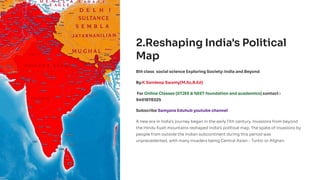
2.Reshaping India's Political
Map
8thclass social science Exploring Society: India and Beyond
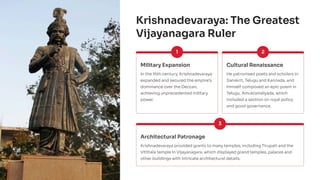
By:K Sandeep Swamy(M.Sc,B.Ed)
For Online Classes (IITJEE & NEET foundation and academics) contact :
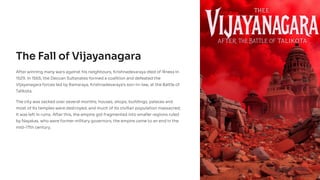
9491878325
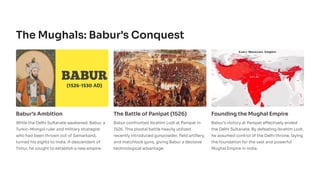
Subscribe Samyans Eduhub youtube channel
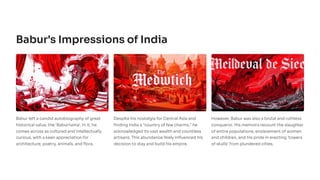
A new era in India's journey began in the early 11th century. Invasions from beyond
the Hindu Kush mountains reshaped India's political map. The spate of invasions by
people from outside the Indian subcontinent during this period was
unprecedented, with many invaders being Central Asian - Turkic or Afghan.
2.
The Medieval Periodin Indian Context
Defining the Medieval Era
The period from the 11th to the 17th centuries is often called the
'medieval period' of Indian history. The term 'medieval' (meaning
'between two ages') was originally applied to European history, from
the fall of the Roman Empire to the Renaissance.
A Transformative Indian Period
While Europe and India's histories differ significantly, making the term
'medieval' not ideal for both, historians use it to refer to this
transformative period in Indian history when foreign invasions and the
rise of new dynasties dramatically reshaped political boundaries.
3.
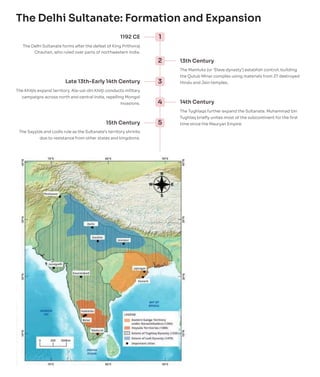
The Delhi Sultanate:Formation and Expansion
1
1192 CE
The Delhi Sultanate forms after the defeat of King Prithviraj
Chauhan, who ruled over parts of northwestern India.
2 13th Century
The Mamluks (or 'Slave dynasty') establish control, building
the Qutub Minar complex using materials from 27 destroyed
Hindu and Jain temples.
3
Late 13th-Early 14th Century
The Khiljis expand territory. Ala-ud-din Khilji conducts military
campaigns across north and central India, repelling Mongol
invasions. 4 14th Century
The Tughlaqs further expand the Sultanate. Muhammad bin
Tughlaq briefly unites most of the subcontinent for the first
time since the Mauryan Empire.
5
15th Century
The Sayyids and Lodis rule as the Sultanate's territory shrinks
due to resistance from other states and kingdoms.
4.
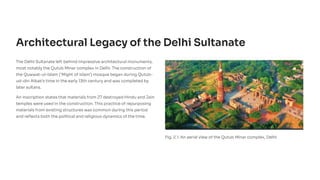
Architectural Legacy ofthe Delhi Sultanate
The Delhi Sultanate left behind impressive architectural monuments,
most notably the Qutub Minar complex in Delhi. The construction of
the Quwwat-ul-Islam ('Might of Islam') mosque began during Qutub-
ud-din Aibak's time in the early 13th century and was completed by
later sultans.
An inscription states that materials from 27 destroyed Hindu and Jain
temples were used in the construction. This practice of repurposing
materials from existing structures was common during this period
and reflects both the political and religious dynamics of the time.
Fig. 2.1. An aerial view of the Qutub Minar complex, Delhi
5.
Political Instability andExpansion Under the
Sultanate
Violent Successions
Frequent changes in power marked the
Sultanate, with nearly two out of three sultans
gaining power by eliminating their
predecessor, resulting in an average reign of
barely nine years.
Military Campaigns
Under leaders like Ala-ud-din Khilji's general,
Malik Kafur, the Sultanate expanded
southward through military expeditions,
acquiring vast wealth and supporting its large
military.
Failed Policies
Ambitious plans by rulers such as Muhammad
bin Tughlaq, including relocating the capital
and introducing 'token currency,' were poorly
executed and contributed to economic
decline.
6.
Religious Policies andSocial Impact
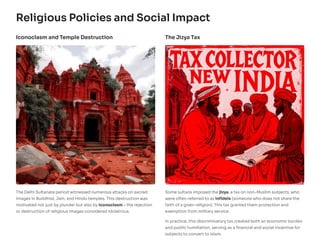
Iconoclasm and Temple Destruction
The Delhi Sultanate period witnessed numerous attacks on sacred
images in Buddhist, Jain, and Hindu temples. This destruction was
motivated not just by plunder but also by iconoclasm – the rejection
or destruction of religious images considered idolatrous.
The Jizya Tax
Some sultans imposed the jizya, a tax on non-Muslim subjects, who
were often referred to as infidels (someone who does not share the
faith of a given religion). This tax granted them protection and
exemption from military service.
In practice, this discriminatory tax created both an economic burden
and public humiliation, serving as a financial and social incentive for
subjects to convert to Islam.
7.
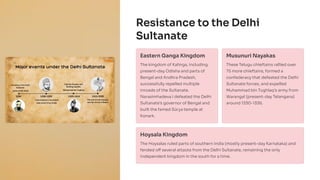
Resistance to theDelhi
Sultanate
Eastern Ganga Kingdom
The kingdom of Kalinga, including
present-day Odisha and parts of
Bengal and Andhra Pradesh,
successfully repelled multiple
inroads of the Sultanate.
Narasimhadeva I defeated the Delhi
Sultanate's governor of Bengal and
built the famed Sūrya temple at
Konark.
Musunuri Nayakas
These Telugu chieftains rallied over
75 more chieftains, formed a
confederacy that defeated the Delhi
Sultanate forces, and expelled
Muhammad bin Tughlaq's army from
Warangal (present-day Telangana)
around 1330-1336.
Hoysala Kingdom
The Hoysalas ruled parts of southern India (mostly present-day Karnataka) and
fended off several attacks from the Delhi Sultanate, remaining the only
independent kingdom in the south for a time.
8.
The Vijayanagara Empire:Rise and Glory
In the 14th century, two brothers, Harihara and Bukka, who had initially
served as governors under Muhammad bin Tughlaq, rejected Delhi's
authority and established an independent kingdom that grew into the
Vijayanagara Empire.
According to folklore, they witnessed a hare turning around and
chasing a pack of hounds at Hampi, symbolising unexpected strength
and courage. Their guru, Vidyaranya, interpreted this as a sign of
resilience and advised them to establish their capital at that very
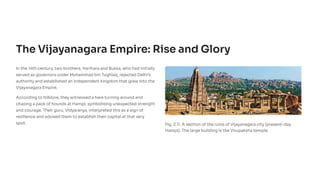
spot. Fig. 2.11. A section of the ruins of Vijayanagara city (present-day
Hampi). The large building is the Virupaksha temple.
9.
Krishnadevaraya: The Greatest
VijayanagaraRuler
1
Military Expansion
In the 16th century, Krishnadevaraya
expanded and secured the empire's
dominance over the Deccan,
achieving unprecedented military
power.
2
Cultural Renaissance
He patronised poets and scholars in
Sanskrit, Telugu and Kannada, and
himself composed an epic poem in
Telugu, Amuktamālyada, which
included a section on royal policy
and good governance.
3
Architectural Patronage
Krishnadevaraya provided grants to many temples, including Tirupati and the
Vitthala temple in Vijayanagara, which displayed grand temples, palaces and
other buildings with intricate architectural details.
10.
Vijayanagara: A Traveller'sPerspective
"This city ... seemed to me as large as Rome, and very beautiful to the sight; there are many groves of trees within it, in the gardens of the
houses, and many conduits of water which flow into the midst of it, and in places there are lakes... The people in this city are countless in
number... This is the best provided city in the world... The streets and markets are full of laden oxen ... you could find in great abundance
everything that you wanted."
- Domingo Paes, Portuguese traveller who visited Vijayanagara
A City of Grandeur and Beauty
The city was described by Paes as being "as
large as Rome" and "very beautiful," featuring
abundant groves, gardens, and flowing water
conduits and lakes that added to its splendor.
Abundance in Bustling Markets
Domingo Paes noted the city's countless
people and its markets overflowing with
goods and laden oxen, declaring it "the best
provided city in the world" where "everything
that you wanted" could be found.
Valuable Trade Relations
Foreign travellers like Domingo Paes visited
Vijayanagara for trade. Portuguese merchants
were particularly well-treated, as they came to
sell precious horses, which the king did not
want to fall into the hands of enemy
kingdoms.
11.
The Fall ofVijayanagara
After winning many wars against his neighbours, Krishnadevaraya died of illness in
1529. In 1565, the Deccan Sultanates formed a coalition and defeated the
Vijayanagara forces led by Ramaraya, Krishnadevaraya's son-in-law, at the Battle of
Talikota.
The city was sacked over several months; houses, shops, buildings, palaces and
most of its temples were destroyed, and much of its civilian population massacred;
it was left in ruins. After this, the empire got fragmented into smaller regions ruled
by Nayakas, who were former military governors; the empire came to an end in the
mid-17th century.
12.
The Mughals: Babur'sConquest
Babur's Ambition
While the Delhi Sultanate weakened, Babur, a
Turkic-Mongol ruler and military strategist
who had been thrown out of Samarkand,
turned his sights to India. A descendant of
Timur, he sought to establish a new empire.
The Battle of Panipat (1526)
Babur confronted Ibrahim Lodi at Panipat in
1526. This pivotal battle heavily utilized
recently introduced gunpowder, field artillery,
and matchlock guns, giving Babur a decisive
technological advantage.
Founding the Mughal Empire
Babur's victory at Panipat effectively ended
the Delhi Sultanate. By defeating Ibrahim Lodi,
he assumed control of the Delhi throne, laying
the foundation for the vast and powerful
Mughal Empire in India.
13.
Babur's Impressions ofIndia
Babur left a candid autobiography of great
historical value, the 'Baburnama'. In it, he
comes across as cultured and intellectually
curious, with a keen appreciation for
architecture, poetry, animals, and flora.
Despite his nostalgia for Central Asia and
finding India a "country of few charms," he
acknowledged its vast wealth and countless
artisans. This abundance likely influenced his
decision to stay and build his empire.
However, Babur was also a brutal and ruthless
conqueror. His memoirs recount the slaughter
of entire populations, enslavement of women
and children, and his pride in erecting 'towers
of skulls' from plundered cities.
14.
The Struggle forSuccession
1530: Humayun's Struggle
After Babur's death, his son Humayun
struggled to hold the empire together, facing
internal and external challenges.
1540-1555: Rise of Sher Shah Suri
Sher Shah Suri, a powerful Afghan leader,
established the Sur Empire over large parts of
north India and introduced many lasting
reforms.
1555: Humayun's Reconquest
Humayun reconquered the lost ground and
restored Mughal rule after years in exile.
1556: Himu's Brief Reign
Himu (or Hemu), a skilled military commander
under one of the last Suri rulers, captured
Delhi and ruled it briefly as Hemchandra
Vikramaditya.
1556: Akbar's Victory at Panipat
At the Second Battle of Panipat, Himu was
defeated by Akbar, who reclaimed Delhi for
the Mughals.
15.
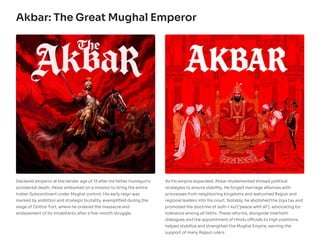
Akbar: The GreatMughal Emperor
Declared emperor at the tender age of 13 after his father Humayun's
accidental death, Akbar embarked on a mission to bring the entire
Indian Subcontinent under Mughal control. His early reign was
marked by ambition and strategic brutality, exemplified during the
siege of Chittor Fort, where he ordered the massacre and
enslavement of its inhabitants after a five-month struggle.
As his empire expanded, Akbar implemented shrewd political
strategies to ensure stability. He forged marriage alliances with
princesses from neighboring kingdoms and welcomed Rajput and
regional leaders into his court. Notably, he abolished the jizya tax and
promoted the doctrine of sulh-i-kul ('peace with all'), advocating for
tolerance among all faiths. These reforms, alongside interfaith
dialogues and the appointment of Hindu officials to high positions,
helped stabilize and strengthen the Mughal Empire, earning the
support of many Rajput rulers.
16.
Akbar's Cultural Contributions
TranslationProjects
Despite being illiterate, Akbar established a
'house of translation' at Fatehpur Sikri where
he had major Sanskrit texts translated into
Persian, including the Mahābhārata
(Razmnama), the Rāmāyaṇa, the Bhagavad
Gītā, and the Pañchatantra.
Architectural Legacy
Akbar built the magnificent city of Fatehpur
Sikri near Agra, featuring innovative
architectural elements that blended Persian,
Islamic, and Indian styles, including the five-
storied 'Panch Mahal'.
Religious Tolerance
He initiated interfaith dialogues and created a
new syncretic religion called Din-i-Ilahi, which
combined elements from various religions,
though it did not survive beyond his reign.
17.
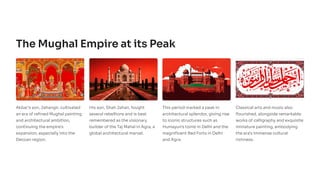
The Mughal Empireat its Peak
Akbar's son, Jahangir, cultivated
an era of refined Mughal painting
and architectural ambition,
continuing the empire's
expansion, especially into the
Deccan region.
His son, Shah Jahan, fought
several rebellions and is best
remembered as the visionary
builder of the Taj Mahal in Agra, a
global architectural marvel.
This period marked a peak in
architectural splendor, giving rise
to iconic structures such as
Humayun's tomb in Delhi and the
magnificent Red Forts in Delhi
and Agra.
Classical arts and music also
flourished, alongside remarkable
works of calligraphy and exquisite
miniature painting, embodying
the era's immense cultural
richness.
18.
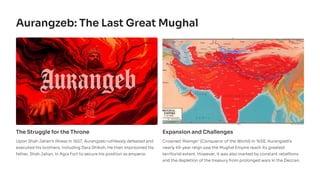
Aurangzeb: The LastGreat Mughal
The Struggle for the Throne
Upon Shah Jahan's illness in 1657, Aurangzeb ruthlessly defeated and
executed his brothers, including Dara Shikoh. He then imprisoned his
father, Shah Jahan, in Agra Fort to secure his position as emperor.
Expansion and Challenges
Crowned 'Alamgir' (Conqueror of the World) in 1658, Aurangzeb's
nearly 49-year reign saw the Mughal Empire reach its greatest
territorial extent. However, it was also marked by constant rebellions
and the depletion of the treasury from prolonged wars in the Deccan.
19.
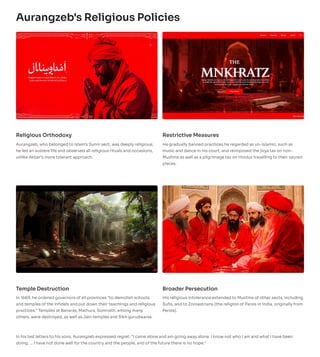
Aurangzeb's Religious Policies
ReligiousOrthodoxy
Aurangzeb, who belonged to Islam's Sunni sect, was deeply religious;
he led an austere life and observed all religious rituals and occasions,
unlike Akbar's more tolerant approach.
Restrictive Measures
He gradually banned practices he regarded as un-Islamic, such as
music and dance in his court, and reimposed the jizya tax on non-
Muslims as well as a pilgrimage tax on Hindus travelling to their sacred
places.
Temple Destruction
In 1669, he ordered governors of all provinces "to demolish schools
and temples of the infidels and put down their teachings and religious
practices." Temples at Banaras, Mathura, Somnath, among many
others, were destroyed, as well as Jain temples and Sikh gurudwaras.
Broader Persecution
His religious intolerance extended to Muslims of other sects, including
Sufis, and to Zoroastrians (the religion of Parsis in India, originally from
Persia).
In his last letters to his sons, Aurangzeb expressed regret: "I came alone and am going away alone. I know not who I am and what I have been
doing. ... I have not done well for the country and the people, and of the future there is no hope."
20.
Resistance to theMughals:
Peasant and Tribal Rebellions
Jat Peasant Uprising
In the 17th century, the Jat peasantry (in present-day western Uttar Pradesh,
Haryana and eastern Rajasthan) rebelled against harsh exploitation. In a
subsequent battle, 20,000 men confronted the Mughal army and fought
valiantly, but their Jat leader was killed and the rebellion suppressed.
Tribal Resistance
Many tribal groups - the Bhils, the Gonds, the Santhals, the Kochs - fought back
against attempts to annex their territory or impose taxes on them. While some
were subdued, others - especially those inhabiting forested, hilly, or remote
regions - maintained some degree of independence.
Rani Durgavati
Remembered as a valiant queen of the Garha kingdom (one of the Gond
kingdoms in central India), she ruled wisely and made her kingdom prosperous.
She kept an army of 20,000 soldiers and 1,000 elephants, with which she
repelled several attempted invasions.
When a general sent by Akbar attacked her kingdom in 1564, despite being
outnumbered and outmatched in weaponry, she led her troops and fought
bravely. Wounded, she took her own life on the battlefield to avoid capture. She
was only 40.
21.
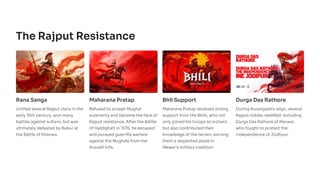
The Rajput Resistance
RanaSanga
Unified several Rajput clans in the
early 16th century, won many
battles against sultans, but was
ultimately defeated by Babur at
the Battle of Khanwa.
Maharana Pratap
Refused to accept Mughal
suzerainty and became the face of
Rajput resistance. After the Battle
of Haldighati in 1576, he escaped
and pursued guerrilla warfare
against the Mughals from the
Aravalli hills.
Bhil Support
Maharana Pratap received strong
support from the Bhils, who not
only joined his troops as archers
but also contributed their
knowledge of the terrain, earning
them a respected place in
Mewar's military tradition.
Durga Das Rathore
During Aurangzeb's reign, several
Rajput nobles rebelled, including
Durga Das Rathore of Marwar,
who fought to protect the
independence of Jodhpur.
22.
The Ahom Kingdom:Northeastern Resistance
Ahom Foundation & Paik System
In the 13th century, the Ahom ethnic group
migrated from present-day Myanmar to the
Brahmaputra Valley, establishing the Ahom
kingdom. Their unique 'paik system' required
every able-bodied man to provide service to
the state through labor or military duty in
exchange for land rights. This innovative
system enabled the rulers to build public
infrastructure and maintain a strong force
without a permanent army.
Strategic Resistance Tactics
When Aurangzeb dispatched Mughal forces to
capture the Ahom capital Garhgaon in the
17th century, the Ahoms leveraged their
profound knowledge of the terrain—dense
forests, hills, and rivers—and employed
persistent guerrilla tactics to repel the
attacks.
Victory at Saraighat
The Ahom kingdom's independence was
preserved in the decisive Battle of Saraighat
(1671), fought on the Brahmaputra River near
present-day Guwahati. The Ahom military
commander Lachit Borphukan led his 10,000
men to victory against a larger Mughal force of
30,000 soldiers in a historic naval
engagement.
23.
The Rise ofthe Sikhs
Spiritual Beginnings
In 15th century Punjab, Guru
Nanak spread the message of
equality, compassion, and the
oneness of God (Ik Onkār); his
followers came to be known as
Sikhs.
Martyrdom of Guru Arjan
Emperor Jahangir had Guru Arjan
tortured to death after he
supported his rebellious son. This
prompted Guru Arjan's son and
successor, Guru Hargobind, to
introduce martial training and
form a Sikh army.
Guru Tegh Bahadur's
Sacrifice
In 1675, Guru Tegh Bahadur stood
with Kashmiri Pandits seeking
protection from religious
persecution. Arrested by
Aurangzeb, he refused to convert
to Islam despite torture and was
publicly beheaded in Chandni
Chowk, Delhi.
Formation of the Khalsa
In response to his father's
martyrdom, Guru Gobind Singh -
the 10th and last Guru -
established the Khalsa, a martial
brotherhood committed to
justice, equality and defence of
the faith.
24.
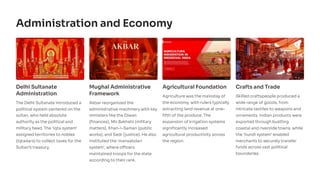
Administration and Economy
DelhiSultanate
Administration
The Delhi Sultanate introduced a
political system centered on the
sultan, who held absolute
authority as the political and
military head. The 'iqta system'
assigned territories to nobles
(iqtadars) to collect taxes for the
Sultan's treasury.
Mughal Administrative
Framework
Akbar reorganized the
administrative machinery with key
ministers like the Diwan
(finances), Mir Bakhshi (military
matters), Khan-i-Saman (public
works), and Sadr (justice). He also
instituted the 'mansabdari
system', where officers
maintained troops for the state
according to their rank.
Agricultural Foundation
Agriculture was the mainstay of
the economy, with rulers typically
extracting land revenue at one-
fifth of the produce. The
expansion of irrigation systems
significantly increased
agricultural productivity across
the region.
Crafts and Trade
Skilled craftspeople produced a
wide range of goods, from
intricate textiles to weapons and
ornaments. Indian products were
exported through bustling
coastal and riverside towns, while
the 'hundi system' enabled
merchants to securely transfer
funds across vast political
boundaries.
25.
Legacy of theMedieval Period
Political Reshaping
This period witnessed many
foreign invasions led by Turkic,
Afghan, and Mughal forces,
causing widespread destruction,
the fall of old dynasties, and the
rise and fall of kingdoms and
empires. Continuous warfare,
alliances and conquests reshaped
India's political boundaries.
Religious Dynamics
The period had many instances of
religious intolerance. Buddhists,
Jains, Hindus, Sikhs, Zoroastrians,
and tribals suffered severe
persecution at times, though
some rulers were more broad-
minded than others.
Economic Development
Agriculture and trade expanded,
enhancing India's wealth and
connectivity with the wider world.
Yet the economic condition of
the common subjects generally
remained harsh.
Cultural Resilience
Indian society showed
adaptability and resilience in
rebuilding towns, cities, temples,
and other aspects of the
economy. It found ways to
preserve cultural traditions and
blend indigenous and foreign
elements to create new cultural
expressions. Many forms of art
and culture, including
architecture, music and painting,
flourished.
 Most read
 Most read