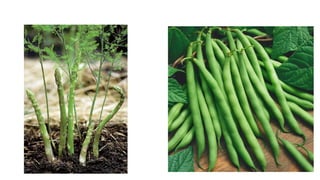
2 Post harvest Physiology of Horticulture produce.pptx
Explore the physiological stages of fruit and vegetable development, factors affecting perishability, and the impact of transpiration, respiration, and ethylene on post-harvest quality and shelf life.
2 Post harvest Physiology of Horticulture produce.pptx
1.
Lecture 2: Post-HarvestPhysiology of Horticulture
produce (Fruits, Vegetables and Flowers)- Water loss,
Ripening, Respiration and Role of Ethylene)
Prepared by
Umesh Timilsina
Assistant Professor
CNRM, Bardibas
Agriculture and Forestry University
2.
PHYSIOLOGY OF FRUITAND VEGETABLES
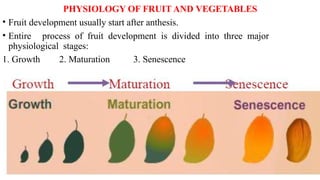
• Fruit development usually start after anthesis.
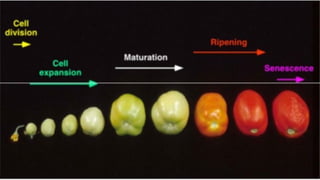
• Entire process of fruit development is divided into three major
physiological stages:
1. Growth 2. Maturation 3. Senescence
5.
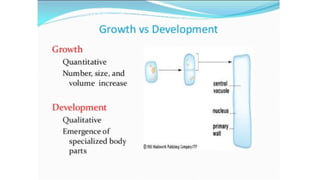
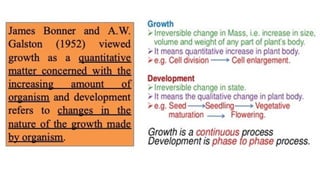
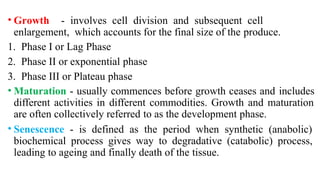
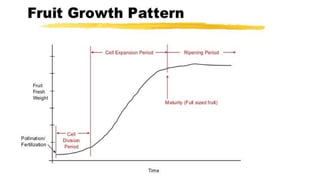
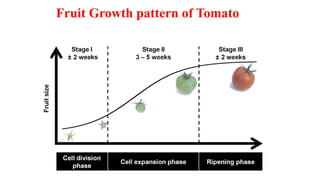
• Growth -involves cell division and subsequent cell
enlargement, which accounts for the final size of the produce.
1. Phase I or Lag Phase
2. Phase II or exponential phase
3. Phase III or Plateau phase
• Maturation - usually commences before growth ceases and includes
different activities in different commodities. Growth and maturation
are often collectively referred to as the development phase.
• Senescence - is defined as the period when synthetic (anabolic)
biochemical process gives way to degradative (catabolic) process,
leading to ageing and finally death of the tissue.
7.
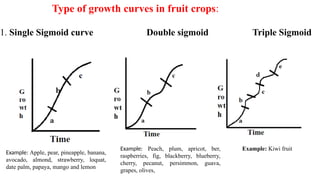
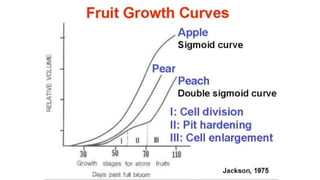
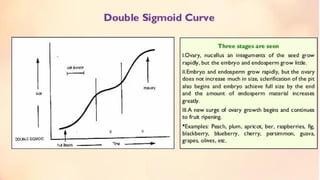
Type of growthcurves in fruit crops:
1. Single Sigmoid curve Double sigmoid Triple Sigmoid
Example: Apple, pear, pineapple, banana,
avocado, almond, strawberry, loquat,
date palm, papaya, mango and lemon
Example: Peach, plum, apricot, ber,
raspberries, fig, blackberry, blueberry,
cherry, pecanut, persimmon, guava,
grapes, olives,
Example: Kiwi fruit
Morpho-Anatomical Basis forPerishability of fruits and vegetables
1. Plant parts or Organ utilized
The response of a commodity to its
surroundings and to the method of handling
depends on what organ it is.
Leaves and flower wilt easily.
Climacteric fruits deteriorate at a faster
rate
Bulbs, tubers and storage roots have generally
long shelf life.
13.
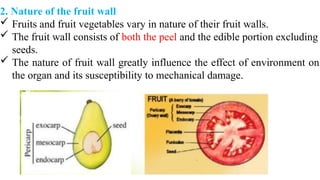
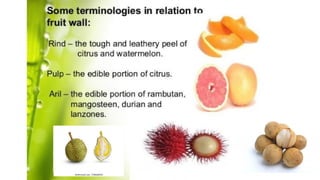
2. Nature ofthe fruit wall
Fruits and fruit vegetables vary in nature of their fruit walls.
The fruit wall consists of both the peel and the edible portion excluding
seeds.
The nature of fruit wall greatly influence the effect of environment on
the organ and its susceptibility to mechanical damage.
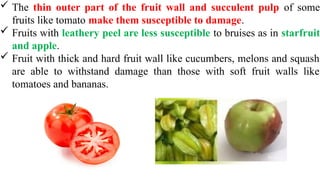
15.
The thinouter part of the fruit wall and succulent pulp of some
fruits like tomato make them susceptible to damage.
Fruits with leathery peel are less susceptible to bruises as in starfruit
and apple.
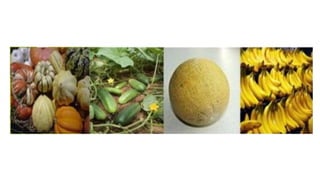
Fruit with thick and hard fruit wall like cucumbers, melons and squash
are able to withstand damage than those with soft fruit walls like
tomatoes and bananas.
17.
3. Surface-area-to-volume ratio(SA:V)
• It is a measure that describes how much surface area an object has
relative to its volume.
• It determines the reactive area for respiration, transpiration,
penetration of chemicals and micro organisms.
• The ratio between surface area and volume determines the rate of water
loss.
• The greater the surface to volume ratio, the faster the diffusion of
gases involved in respiration, exit of water through transpiration
and entry of micro organisms and chemicals.
• These result to shorter post harvest life.
• A leaf which has too large surfaces with little volume losses moisture
faster than a fruit.
• Large fruits lose more water than small fruits.
18.
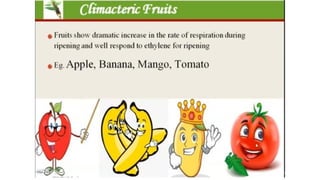
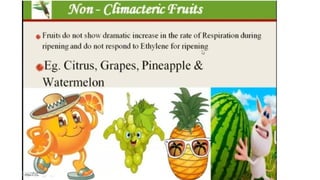
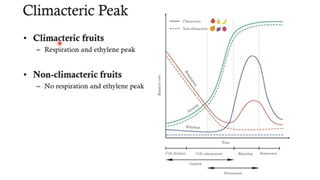
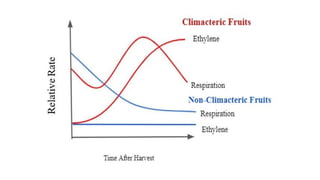
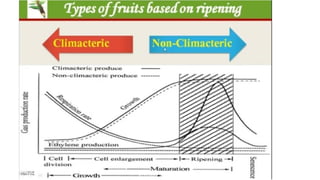
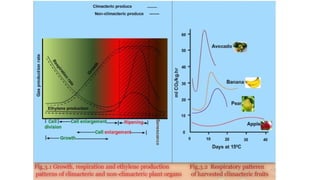
***How surface tovolume ratio affect the transpiration??***
1. Higher SA:V Ratio Increases Transpiration
Larger leaves or thin structures (Emergence or Trichomes) have a
higher SA:V ratio, meaning more surface area is exposed per unit of
volume.
This allows more stomata to be exposed to air, leading to higher water
loss through transpiration.
2. Lower SA:V Ratio Reduces Transpiration
Larger, thicker leaves have a lower SA:V ratio, meaning less surface
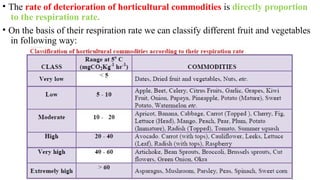
area per unit volume is exposed.
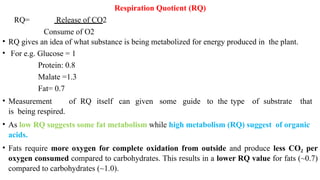
This reduces the rate of water loss, which is beneficial for plants in dry
environments.
19.
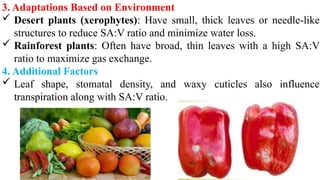
3. Adaptations Basedon Environment
Desert plants (xerophytes): Have small, thick leaves or needle-like
structures to reduce SA:V ratio and minimize water loss.
Rainforest plants: Often have broad, thin leaves with a high SA:V
ratio to maximize gas exchange.
4. Additional Factors
Leaf shape, stomatal density, and waxy cuticles also influence
transpiration along with SA:V ratio.
20.
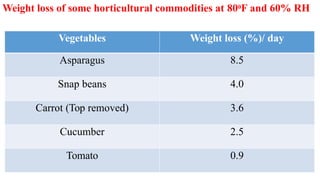
Weight loss ofsome horticultural commodities at 800F and 60% RH
Vegetables Weight loss (%)/ day
Asparagus 8.5
Snap beans 4.0
Carrot (Top removed) 3.6
Cucumber 2.5
Tomato 0.9
22.
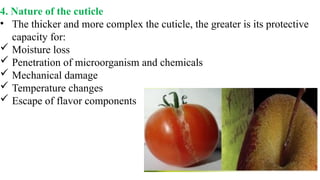
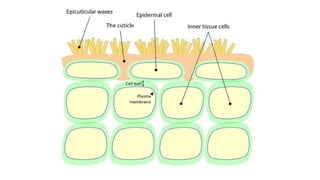
4. Nature ofthe cuticle
• The thicker and more complex the cuticle, the greater is its protective
capacity for:
Moisture loss
Penetration of microorganism and chemicals
Mechanical damage
Temperature changes
Escape of flavor components
23.
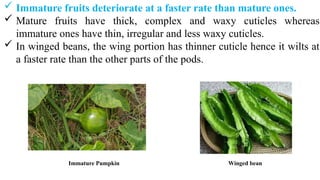
Immature fruitsdeteriorate at a faster rate than mature ones.
Mature fruits have thick, complex and waxy cuticles whereas
immature ones have thin, irregular and less waxy cuticles.
In winged beans, the wing portion has thinner cuticle hence it wilts at
a faster rate than the other parts of the pods.
Winged bean
Immature Pumpkin
24.
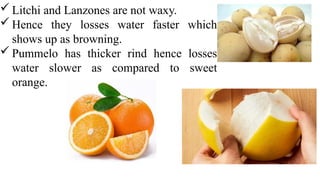
Litchi andLanzones are not waxy.
Hence they losses water faster which
shows up as browning.
Pummelo has thicker rind hence losses
water slower as compared to sweet
orange.
25.
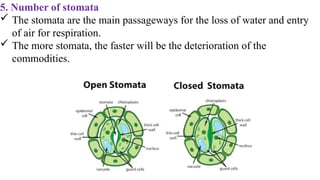
5. Number ofstomata
The stomata are the main passageways for the loss of water and entry
of air for respiration.
The more stomata, the faster will be the deterioration of the
commodities.
26.
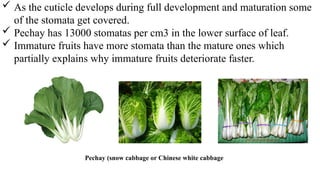
As thecuticle develops during full development and maturation some
of the stomata get covered.
Pechay has 13000 stomatas per cm3 in the lower surface of leaf.
Immature fruits have more stomata than the mature ones which
partially explains why immature fruits deteriorate faster.
Pechay (snow cabbage or Chinese white cabbage
27.
6. Amount ofhairs and / or spines
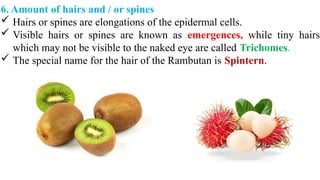
Hairs or spines are elongations of the epidermal cells.
Visible hairs or spines are known as emergences, while tiny hairs
which may not be visible to the naked eye are called Trichomes.
The special name for the hair of the Rambutan is Spintern.
28.
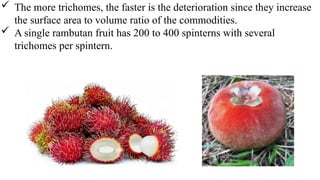
The moretrichomes, the faster is the deterioration since they increase
the surface area to volume ratio of the commodities.
A single rambutan fruit has 200 to 400 spinterns with several
trichomes per spintern.
29.
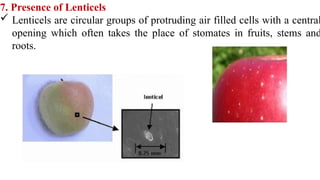
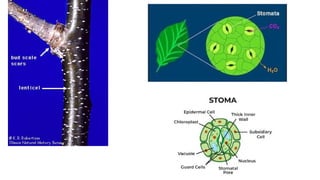
7. Presence ofLenticels
Lenticels are circular groups of protruding air filled cells with a central
opening which often takes the place of stomates in fruits, stems and
roots.
30.
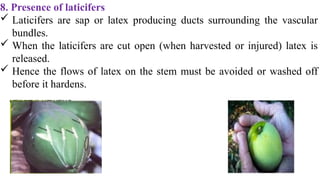
8. Presence oflaticifers
Laticifers are sap or latex producing ducts surrounding the vascular
bundles.
When the laticifers are cut open (when harvested or injured) latex is
released.
Hence the flows of latex on the stem must be avoided or washed off
before it hardens.
32.
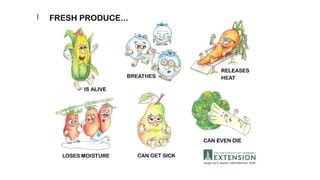
FRUIT AND VEGETABLESARE ALIVE AFTER HARVEST
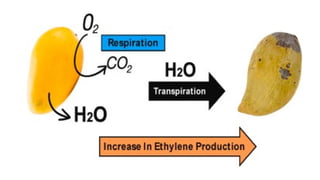
• Horticultural Produce respire by taking up O2, giving off CO2 and
heat and also transpire.
• While attached to plants, losses due to transpiration and respiration
are replaced by flow of sap, which contain water, photosynthates and
minerals.
• These functions continue even after harvest, and since the produce is
now removed from the its normal source of H2O, photosynthates
and minerals, the produce entirely depend on their own food reserves
and moisture content.
• Therefore, losses of repairable substrates and moisture are not made
up and deterioration has commenced hence, produce are perishable.
33.
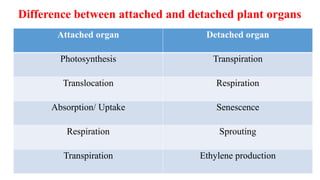
Difference between attachedand detached plant organs
Attached organ Detached organ
Photosynthesis Transpiration
Translocation Respiration
Absorption/ Uptake Senescence
Respiration Sprouting
Transpiration Ethylene production
34.
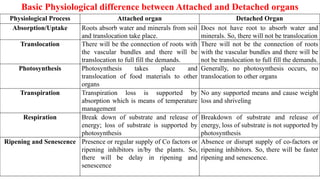
Basic Physiological differencebetween Attached and Detached organs
Physiological Process Attached organ Detached Organ
Absorption/Uptake Roots absorb water and minerals from soil
and translocation take place.
Does not have root to absorb water and
minerals. So, there will not be translocation
Translocation There will be the connection of roots with
the vascular bundles and there will be
translocation to full fill the demands.
There will not be the connection of roots
with the vascular bundles and there will be
not be translocation to full fill the demands.
Photosynthesis Photosynthesis takes place and
translocation of food materials to other
organs
Generally, no photosynthesis occurs, no
translocation to other organs
Transpiration Transpiration loss is supported by
absorption which is means of temperature
management
No any supported means and cause weight
loss and shriveling
Respiration Break down of substrate and release of
energy; loss of substrate is supported by
photosynthesis
Breakdown of substrate and release of
energy, loss of substrate is not supported by
photosynthesis
Ripening and Senescence Presence or regular supply of Co factors or
ripening inhibitors in/by the plants. So,
there will be delay in ripening and
senescence
Absence or disrupt supply of co-factors or
ripening inhibitors. So, there will be faster
ripening and senescence.
38.
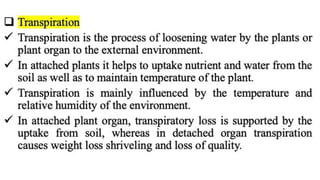
1. Transpiration
• Mostfresh produce contain 80-90 % of water when harvested.
• Transpiration is a physical process in which high amount of water is
lost from the produce, which is the main cause of deterioration.
• This exchange of water vapour in produce is carried through the cuticle,
epidermis cells, stomata and hairs of the produce.
• Produce stored at high temperature will have high transpiration
rate.
• When the harvested produce loses 5 % or more of its fresh weight, it
begins to wilt and soon becomes unusable.
• Water loss also causes loss in quality, such as reduced crispness and
other undesirable changes in colour, weight loss, shrinkage, changes in
the flavor, texture, palatability and also loss of nutritional quality.
41.
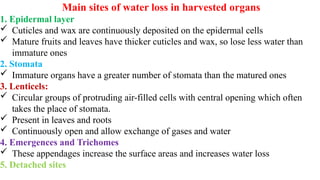
Main sites ofwater loss in harvested organs
1. Epidermal layer
Cuticles and wax are continuously deposited on the epidermal cells
Mature fruits and leaves have thicker cuticles and wax, so lose less water than
immature ones
2. Stomata
Immature organs have a greater number of stomata than the matured ones
3. Lenticels:
Circular groups of protruding air-filled cells with central opening which often
takes the place of stomata.
Present in leaves and roots
Continuously open and allow exchange of gases and water
4. Emergences and Trichomes
These appendages increase the surface areas and increases water loss
5. Detached sites
44.
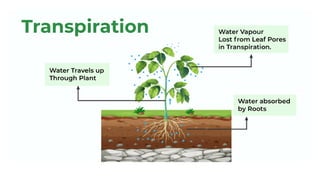
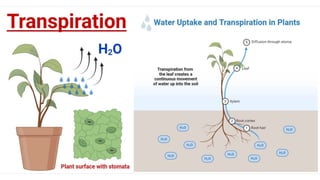
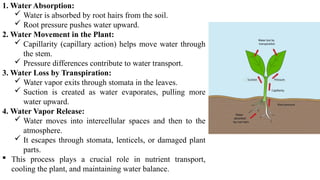
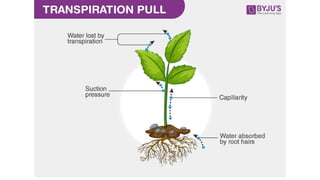
1. Water Absorption:
Water is absorbed by root hairs from the soil.
Root pressure pushes water upward.
2. Water Movement in the Plant:
Capillarity (capillary action) helps move water through
the stem.
Pressure differences contribute to water transport.
3. Water Loss by Transpiration:
Water vapor exits through stomata in the leaves.
Suction is created as water evaporates, pulling more
water upward.
4. Water Vapor Release:
Water moves into intercellular spaces and then to the
atmosphere.
It escapes through stomata, lenticels, or damaged plant
parts.
This process plays a crucial role in nutrient transport,
cooling the plant, and maintaining water balance.
46.
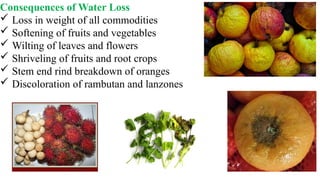
Consequences of WaterLoss
Loss in weight of all commodities
Softening of fruits and vegetables
Wilting of leaves and flowers
Shriveling of fruits and root crops
Stem end rind breakdown of oranges
Discoloration of rambutan and lanzones
47.
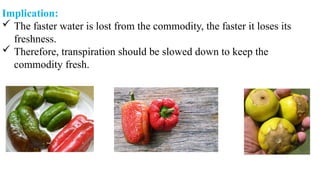
Implication:
The fasterwater is lost from the commodity, the faster it loses its
freshness.
Therefore, transpiration should be slowed down to keep the
commodity fresh.
48.
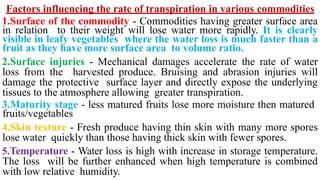
Factors influencing therate of transpiration in various commodities
1.Surface of the commodity - Commodities having greater surface area
in relation to their weight will lose water more rapidly. It is clearly
visible in leafy vegetables where the water loss is much faster than a
fruit as they have more surface area to volume ratio.
2.Surface injuries - Mechanical damages accelerate the rate of water
loss from the harvested produce. Bruising and abrasion injuries will
damage the protective surface layer and directly expose the underlying
tissues to the atmosphere allowing greater transpiration.
3.Maturity stage - less matured fruits lose more moisture then matured
fruits/vegetables
4.Skin texture - Fresh produce having thin skin with many more spores
lose water quickly than those having thick skin with fewer spores.
5.Temperature - Water loss is high with increase in storage temperature.
The loss will be further enhanced when high temperature is combined
with low relative humidity.
49.
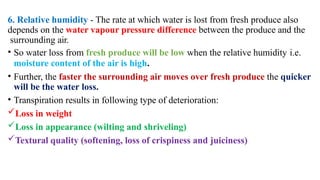
6. Relative humidity- The rate at which water is lost from fresh produce also
depends on the water vapour pressure difference between the produce and the
surrounding air.
• So water loss from fresh produce will be low when the relative humidity i.e.
moisture content of the air is high.
• Further, the faster the surrounding air moves over fresh produce the quicker
will be the water loss.
• Transpiration results in following type of deterioration:
Loss in weight
Loss in appearance (wilting and shriveling)
Textural quality (softening, loss of crispiness and juiciness)
50.
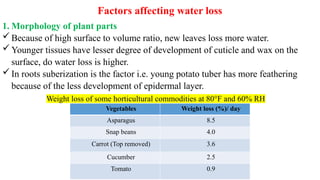
Factors affecting waterloss
1. Morphology of plant parts
Because of high surface to volume ratio, new leaves loss more water.
Younger tissues have lesser degree of development of cuticle and wax on the
surface, do water loss is higher.
In roots suberization is the factor i.e. young potato tuber has more feathering
because of the less development of epidermal layer.
Vegetables Weight loss (%)/ day
Asparagus 8.5
Snap beans 4.0
Carrot (Top removed) 3.6
Cucumber 2.5
Tomato 0.9
Weight loss of some horticultural commodities at 80°F and 60% RH
51.
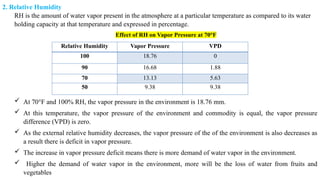
2. Relative Humidity
RHis the amount of water vapor present in the atmosphere at a particular temperature as compared to its water
holding capacity at that temperature and expressed in percentage.
Effect of RH on Vapor Pressure at 70°F
At 70°F and 100% RH, the vapor pressure in the environment is 18.76 mm.
At this temperature, the vapor pressure of the environment and commodity is equal, the vapor pressure
difference (VPD) is zero.
As the external relative humidity decreases, the vapor pressure of the of the environment is also decreases as
a result there is deficit in vapor pressure.
The increase in vapor pressure deficit means there is more demand of water vapor in the environment.
Higher the demand of water vapor in the environment, more will be the loss of water from fruits and
vegetables
Relative Humidity Vapor Pressure VPD
100 18.76 0
90 16.68 1.88
70 13.13 5.63
50 9.38 9.38
52.
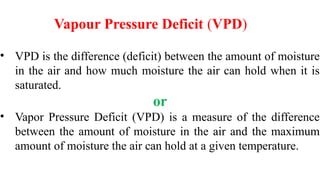
Vapour Pressure Deficit(VPD)
• VPD is the difference (deficit) between the amount of moisture
in the air and how much moisture the air can hold when it is
saturated.
or
• Vapor Pressure Deficit (VPD) is a measure of the difference
between the amount of moisture in the air and the maximum
amount of moisture the air can hold at a given temperature.
53.
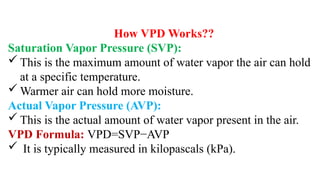
How VPD Works??
SaturationVapor Pressure (SVP):
This is the maximum amount of water vapor the air can hold
at a specific temperature.
Warmer air can hold more moisture.
Actual Vapor Pressure (AVP):
This is the actual amount of water vapor present in the air.
VPD Formula: VPD=SVP−AVP
It is typically measured in kilopascals (kPa).
54.
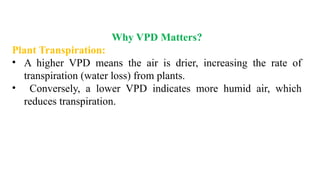
Why VPD Matters?
PlantTranspiration:
• A higher VPD means the air is drier, increasing the rate of
transpiration (water loss) from plants.
• Conversely, a lower VPD indicates more humid air, which
reduces transpiration.
55.
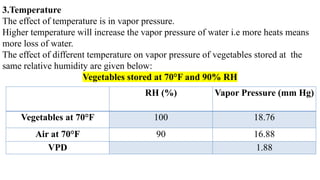
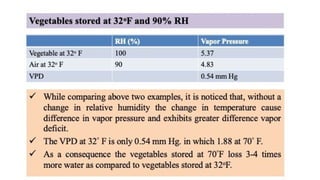
3.Temperature
The effect oftemperature is in vapor pressure.
Higher temperature will increase the vapor pressure of water i.e more heats means
more loss of water.
The effect of different temperature on vapor pressure of vegetables stored at the
same relative humidity are given below:
Vegetables stored at 70°F and 90% RH
RH (%) Vapor Pressure (mm Hg)
Vegetables at 70°F 100 18.76
Air at 70°F 90 16.88
VPD 1.88
62.
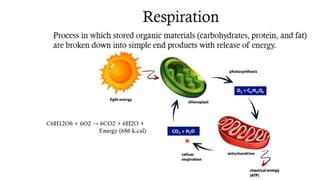
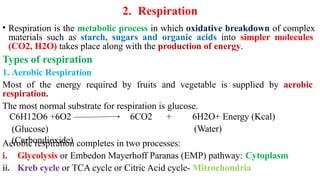
2. Respiration
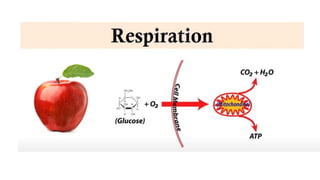
• Respirationis the metabolic process in which oxidative breakdown of complex
materials such as starch, sugars and organic acids into simpler molecules
(CO2, H2O) takes place along with the production of energy.
Types of respiration
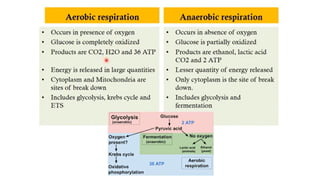
1. Aerobic Respiration
Most of the energy required by fruits and vegetable is supplied by aerobic
respiration.
The most normal substrate for respiration is glucose.
C6H12O6 +6O2 6CO2 +
(Glucose)
(Carbondioxide)
6H2O+ Energy (Kcal)
(Water)
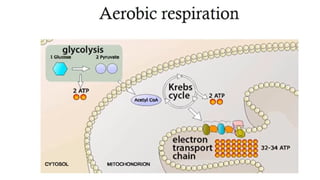
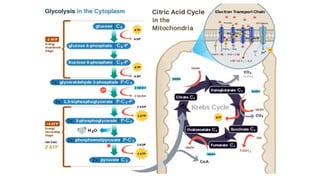
Aerobic respiration completes in two processes:
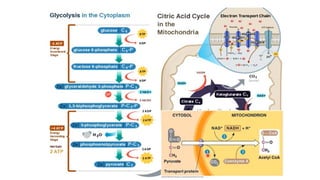
i. Glycolysis or Embedon Mayerhoff Paranas (EMP) pathway: Cytoplasm
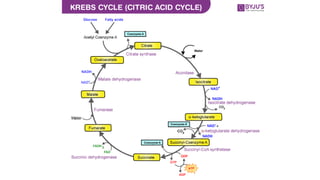
ii. Kreb cycle or TCA cycle or Citric Acid cycle- Mitrochondria
67.
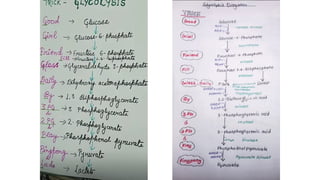
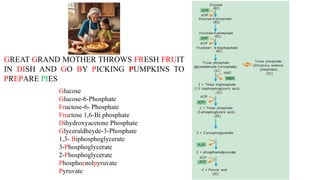
GREAT GRAND MOTHERTHROWS FRESH FRUIT
IN DISH AND GO BY PICKING PUMPKINS TO
PREPARE PIES
Glucose
Glucose-6-Phosphate
Fructose-6- Phosphate
Fructose 1,6-Bi phosphate
Dihydroxyacetone Phosphate
Glyceraldheyde-3-Phosphate
1,3- Biphosphoglycerate
3-Phosphoglycerate
2-Phosphoglycerate
Phosphoenolpyruvate
Pyruvate
68.
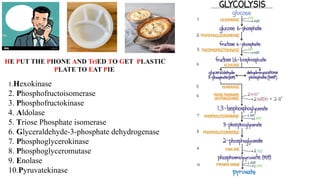
1.Hexokinase
2. Phosphofructoisomerase
3. Phosphofructokinase
4.Aldolase
5. Triose Phosphate isomerase
6. Glyceraldehyde-3-phosphate dehydrogenase
7. Phosphoglycerokinase
8. Phosphoglyceromutase
9. Enolase
10.Pyruvatekinase
HE PUT THE PHONE AND TriED TO GET PLASTIC
PLATE TO EAT PIE
70.
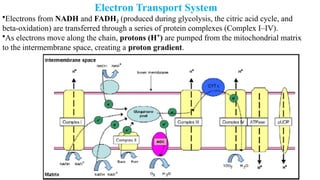
Electron Transport System
•Electronsfrom NADH and FADH₂ (produced during glycolysis, the citric acid cycle, and
beta-oxidation) are transferred through a series of protein complexes (Complex I–IV).
•As electrons move along the chain, protons (H )
⁺ are pumped from the mitochondrial matrix
to the intermembrane space, creating a proton gradient.
72.
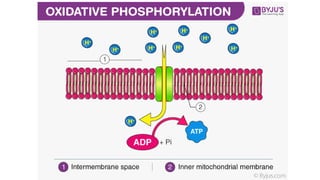
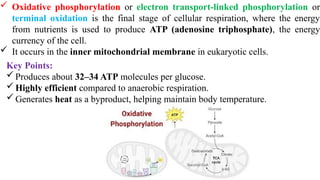
Oxidative phosphorylationor electron transport-linked phosphorylation or
terminal oxidation is the final stage of cellular respiration, where the energy
from nutrients is used to produce ATP (adenosine triphosphate), the energy
currency of the cell.
It occurs in the inner mitochondrial membrane in eukaryotic cells.
Key Points:
Produces about 32–34 ATP molecules per glucose.
Highly efficient compared to anaerobic respiration.
Generates heat as a byproduct, helping maintain body temperature.
73.
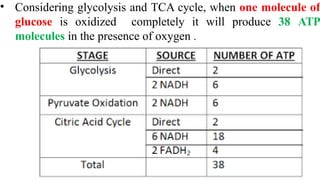
• Considering glycolysisand TCA cycle, when one molecule of
glucose is oxidized completely it will produce 38 ATP
molecules in the presence of oxygen .
74.
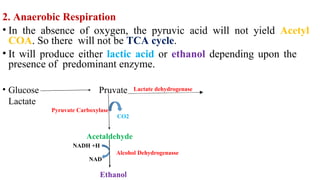
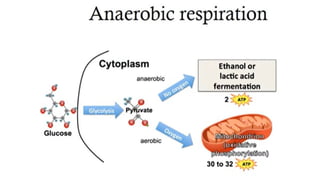
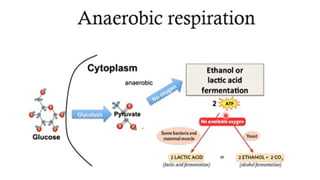
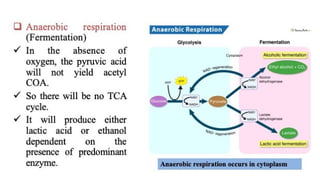
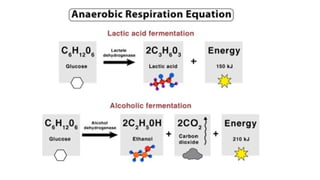
2. Anaerobic Respiration
•In the absence of oxygen, the pyruvic acid will not yield Acetyl
COA. So there will not be TCA cycle.
• It will produce either lactic acid or ethanol depending upon the
presence of predominant enzyme.
• Glucose Pruvate
Lactate
Lactate dehydrogenase
Pyruvate Carboxylase
CO2
Acetaldehyde
NADH +H
Alcohol Dehydrogenasse
NAD
Ethanol
80.
What is Q10??
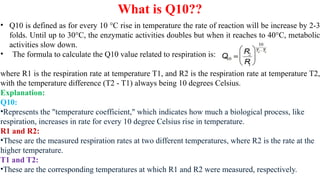
•Q10 is defined as for every 10 °C rise in temperature the rate of reaction will be increase by 2-3
folds. Until up to 30°C, the enzymatic activities doubles but when it reaches to 40°C, metabolic
activities slow down.
• The formula to calculate the Q10 value related to respiration is:
where R1 is the respiration rate at temperature T1, and R2 is the respiration rate at temperature T2,
with the temperature difference (T2 - T1) always being 10 degrees Celsius.
Explanation:
Q10:
•Represents the "temperature coefficient," which indicates how much a biological process, like
respiration, increases in rate for every 10 degree Celsius rise in temperature.
R1 and R2:
•These are the measured respiration rates at two different temperatures, where R2 is the rate at the
higher temperature.
T1 and T2:
•These are the corresponding temperatures at which R1 and R2 were measured, respectively.
81.
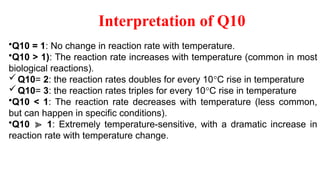
Interpretation of Q10
•Q10= 1: No change in reaction rate with temperature.
•Q10 > 1): The reaction rate increases with temperature (common in most
biological reactions).
Q10= 2: the reaction rates doubles for every 10°C rise in temperature
Q10= 3: the reaction rates triples for every 10°C rise in temperature
•Q10 < 1: The reaction rate decreases with temperature (less common,
but can happen in specific conditions).
•Q10 1
≫ : Extremely temperature-sensitive, with a dramatic increase in
reaction rate with temperature change.
82.
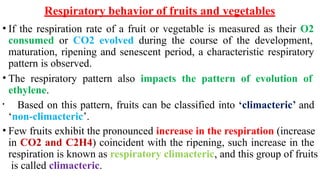
Respiratory behavior offruits and vegetables
• If the respiration rate of a fruit or vegetable is measured as their O2
consumed or CO2 evolved during the course of the development,
maturation, ripening and senescent period, a characteristic respiratory
pattern is observed.
• The respiratory pattern also impacts the pattern of evolution of
ethylene.
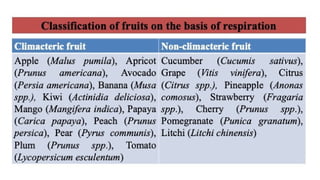
• Based on this pattern, fruits can be classified into ‘climacteric’ and
‘non-climacteric’.
• Few fruits exhibit the pronounced increase in the respiration (increase
in CO2 and C2H4) coincident with the ripening, such increase in the
respiration is known as respiratory climacteric, and this group of fruits
is called climacteric.
83.
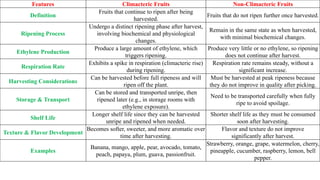
Features Climacteric FruitsNon-Climacteric Fruits
Definition
Fruits that continue to ripen after being
harvested.
Fruits that do not ripen further once harvested.
Ripening Process
Undergo a distinct ripening phase after harvest,
involving biochemical and physiological
changes.
Remain in the same state as when harvested,
with minimal biochemical changes.
Ethylene Production
Produce a large amount of ethylene, which
triggers ripening.
Produce very little or no ethylene, so ripening
does not continue after harvest.
Respiration Rate
Exhibits a spike in respiration (climacteric rise)
during ripening.
Respiration rate remains steady, without a
significant increase.
Harvesting Considerations
Can be harvested before full ripeness and will
ripen off the plant.
Must be harvested at peak ripeness because
they do not improve in quality after picking.
Storage & Transport
Can be stored and transported unripe, then
ripened later (e.g., in storage rooms with
ethylene exposure).
Need to be transported carefully when fully
ripe to avoid spoilage.
Shelf Life
Longer shelf life since they can be harvested
unripe and ripened when needed.
Shorter shelf life as they must be consumed
soon after harvesting.
Texture & Flavor Development
Becomes softer, sweeter, and more aromatic over
time after harvesting.
Flavor and texture do not improve
significantly after harvest.
Examples
Banana, mango, apple, pear, avocado, tomato,
peach, papaya, plum, guava, passionfruit.
Strawberry, orange, grape, watermelon, cherry,
pineapple, cucumber, raspberry, lemon, bell
pepper.
91.
• The rateof deterioration of horticultural commodities is directly proportion
to the respiration rate.
• On the basis of their respiration rate we can classify different fruit and vegetables
in following way:
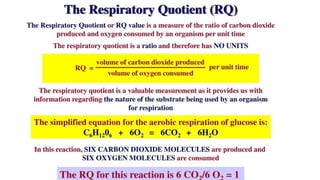
92.
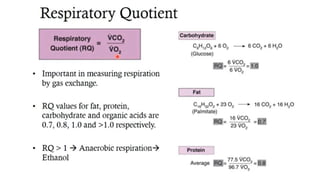
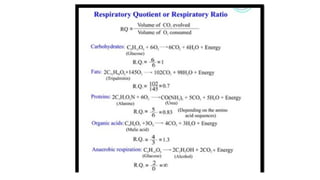
Respiration Quotient (RQ)
RQ=Release of CO2
Consume of O2
• RQ gives an idea of what substance is being metabolized for energy produced in the plant.
• For e.g. Glucose = 1
Protein: 0.8
Malate =1.3
Fat= 0.7
• Measurement of RQ itself can given some guide to the type of substrate that
is being respired.
• As low RQ suggests some fat metabolism while high metabolism (RQ) suggest of organic
acids.
• Fats require more oxygen for complete oxidation from outside and produce less CO per
₂
oxygen consumed compared to carbohydrates. This results in a lower RQ value for fats (~0.7)
compared to carbohydrates (~1.0).
96.
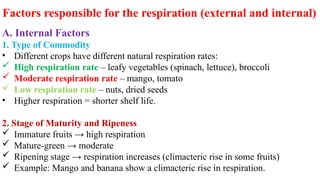
Factors responsible forthe respiration (external and internal)
A. Internal Factors
1. Type of Commodity
• Different crops have different natural respiration rates:
High respiration rate – leafy vegetables (spinach, lettuce), broccoli
Moderate respiration rate – mango, tomato
Low respiration rate – nuts, dried seeds
• Higher respiration = shorter shelf life.
2. Stage of Maturity and Ripeness
Immature fruits → high respiration
Mature-green → moderate
Ripening stage → respiration increases (climacteric rise in some fruits)
Example: Mango and banana show a climacteric rise in respiration.
97.
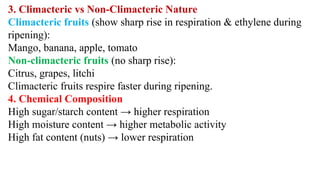
3. Climacteric vsNon-Climacteric Nature
Climacteric fruits (show sharp rise in respiration & ethylene during
ripening):
Mango, banana, apple, tomato
Non-climacteric fruits (no sharp rise):
Citrus, grapes, litchi
Climacteric fruits respire faster during ripening.
4. Chemical Composition
High sugar/starch content → higher respiration
High moisture content → higher metabolic activity
High fat content (nuts) → lower respiration
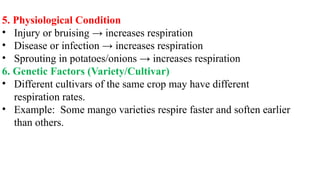
98.
5. Physiological Condition
•Injury or bruising → increases respiration
• Disease or infection → increases respiration
• Sprouting in potatoes/onions → increases respiration
6. Genetic Factors (Variety/Cultivar)
• Different cultivars of the same crop may have different
respiration rates.
• Example: Some mango varieties respire faster and soften earlier
than others.
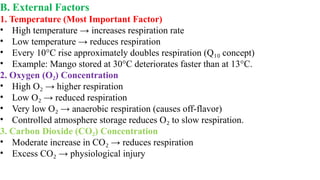
99.
B. External Factors
1.Temperature (Most Important Factor)
• High temperature → increases respiration rate
• Low temperature → reduces respiration
• Every 10°C rise approximately doubles respiration (Q concept)
₁₀
• Example: Mango stored at 30°C deteriorates faster than at 13°C.
2. Oxygen (O ) Concentration
₂
• High O → higher respiration
₂
• Low O → reduced respiration
₂
• Very low O → anaerobic respiration (causes off-flavor)
₂
• Controlled atmosphere storage reduces O to slow respiration.
₂
3. Carbon Dioxide (CO ) Concentration
₂
• Moderate increase in CO → reduces respiration
₂
• Excess CO → physiological injury
₂
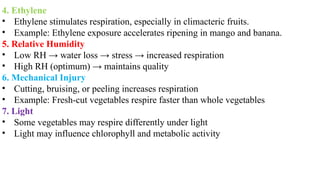
100.
4. Ethylene
• Ethylenestimulates respiration, especially in climacteric fruits.
• Example: Ethylene exposure accelerates ripening in mango and banana.
5. Relative Humidity
• Low RH → water loss → stress → increased respiration
• High RH (optimum) → maintains quality
6. Mechanical Injury
• Cutting, bruising, or peeling increases respiration
• Example: Fresh-cut vegetables respire faster than whole vegetables
7. Light
• Some vegetables may respire differently under light
• Light may influence chlorophyll and metabolic activity