Disciplines and Ideas in Applied Social Sciences
Unit 1: Introduction to the Applied Social Sciences
Pre-test: True or False
Write your answer in ¼ sheet of paper.
1. The social sciences the study of man, society, and politics.
2. Demograhy is the study of population changes and trends,
including migration from rural to urban areas.
3.Social work and counselling are both considered helping
professions.
4. A politician is also a political scientist.
5. The applied social sciences draw heavily from the theories of
the biological sciences.
6.Counselling draws heavily from the field of political science.
7. Social work and counselling are both considered helping
professions.
8. History studies the past to better understand the present.
9. The social sciences help us understand and analyze how
society works.
10. An interesting issue in the field of development studies is
whether the Philippines is a develop or an underdeveloped
society.
Lesson Objectives:
1. Identify the disciplines under the social sciences in
general and the applied social sciences in particular;
2. Understand the value of the applied social
sciences; and
3. Examine the importance of the social sciences.
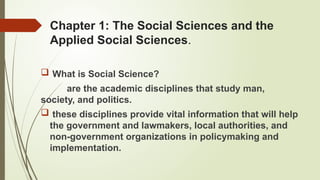
Chapter 1: The Social Sciences and the
Applied Social Sciences.
 What is Social Science?
are the academic disciplines that study man,
society, and politics.
 these disciplines provide vital information that will help
the government and lawmakers, local authorities, and
non-government organizations in policymaking and
implementation.
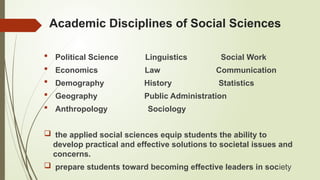
Academic Disciplines of Social Sciences
 Political Science Linguistics Social Work
 Economics Law Communication
 Demography History Statistics
 Geography Public Administration
 Anthropology Sociology
 the applied social sciences equip students the ability to
develop practical and effective solutions to societal issues and
concerns.
 prepare students toward becoming effective leaders in society
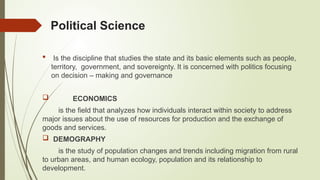
Political Science
 Is the discipline that studies the state and its basic elements such as people,
territory, government, and sovereignty. It is concerned with politics focusing
on decision – making and governance
 ECONOMICS
is the field that analyzes how individuals interact within society to address
major issues about the use of resources for production and the exchange of
goods and services.
 DEMOGRAPHY
is the study of population changes and trends including migration from rural
to urban areas, and human ecology, population and its relationship to
development.
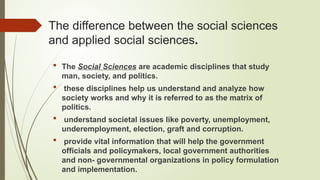
The difference between the social sciences
and applied social sciences.
 The Social Sciences are academic disciplines that study
man, society, and politics.
 these disciplines help us understand and analyze how
society works and why it is referred to as the matrix of
politics.
 understand societal issues like poverty, unemployment,
underemployment, election, graft and corruption.
 provide vital information that will help the government
officials and policymakers, local government authorities
and non- governmental organizations in policy formulation
and implementation.
 The Applied Social Sciences draw heavily from theories of
the various social science disciplines to critically study
society and the relationships among people.
 these disciplines equip students with ability to develop
practical and effective solutions to social issues and
concerns.
 the applied social sciences prepare the students to tackle
some of the most crucial and pressing social, economic,
political, and ecological issues of our times.
 prepare students toward becoming effective leaders in
society.
 Counselling- draws heavily from the theories of psychology and
other behavioral sciences. It seeks to improve the client’s mental
health and well-being by discussing his or her emotional
problems to help him or her cope with them.
 Social Work – is a practice – based profession that seeks to
improve the welfare of communities, individuals, families, and
other groups in society
 Communication – involves the sharing of symbols to create
meaning. The discipline covers a number of topics, including
face- to- face conversation and mass media such as television,
radio, newspapers, the internet, social media and electronic mail.
 The social science help us understand social
issues – specifically those in political,
economics, sociology, demography, social work
and communication – so we are able to conduct
research on these issues and come up with
policy recommendations for policymakers and
the general public.
Activity:
 In pairs, select a significant social issue and brainstorm on
how the social sciences and applied social sciences can
address it. Create a mind map showing your ideas and
insights. Present and discuss the output in class.
 Examples of social issues: Informal settlers, extrajudicial
killings, contractualization, traffic areas, free tuition, OFWs,
and the Marawi crisis.
 I will give 10 minutes to prepare and discuss.