Презентація з англійськоїмови за
темою
НЕПРЯМА МОВА
INDIRECT (REPORTED) SPEECH
Вчитель-методист
Одеської Маріїнської гімназії
Корш Н.В.
2.
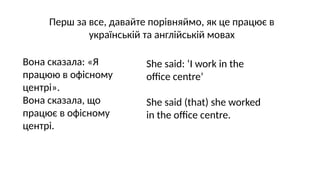
Перш за все,давайте порівняймо, як це працює в
українській та англійській мовах
Вона сказала: «Я
працюю в офісному
центрі».
Вона сказала, що
працює в офісному
центрі.
She said: ‘I work in the
office centre’
She said (that) she worked
in the office centre.
3.
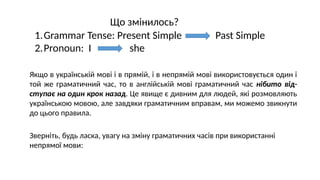
Що змінилось?
1.Grammar Tense:Present Simple Past Simple
2.Pronoun: I she
Якщо в українській мові і в прямій, і в непрямій мові використовується один і
той же граматичний час, то в англійській мові граматичний час нібито від-
ступає на один крок назад. Це явище є дивним для людей, які розмовляють
українською мовою, але завдяки граматичним вправам, ми можемо звикнути
до цього правила.
Зверніть, будь ласка, увагу на зміну граматичних часів при використанні
непрямої мови:
4.
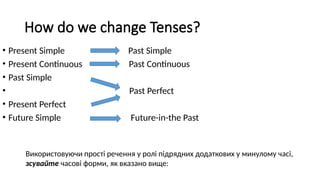
How do wechange Tenses?
• Present Simple Past Simple
• Present Continuous Past Continuous
• Past Simple
• Past Perfect
• Present Perfect
• Future Simple Future-in-the Past
Використовуючи прості речення у ролі підрядних додаткових у минулому часі,
зсувайте часові форми, як вказано вище:
5.
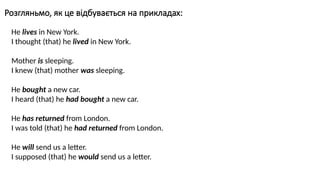
Розгляньмо, як цевідбувається на прикладах:
He lives in New York.
I thought (that) he lived in New York.
Mother is sleeping.
I knew (that) mother was sleeping.
He bought a new car.
I heard (that) he had bought a new car.
He has returned from London.
I was told (that) he had returned from London.
He will send us a letter.
I supposed (that) he would send us a letter.
6.
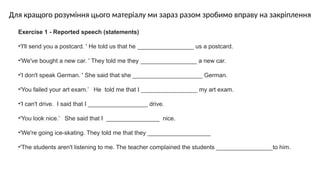
Exercise 1 -Reported speech (statements)
•'I'll send you a postcard. ' He told us that he _________________ us a postcard.
•'We've bought a new car. ' They told me they _________________ a new car.
•'I don't speak German. ' She said that she _____________________ German.
•'You failed your art exam.’ He told me that I _________________ my art exam.
•'I can't drive. I said that I __________________ drive.
•'You look nice.’ She said that I ________________ nice.
•'We're going ice-skating. They told me that they ___________________
•'The students aren't listening to me. The teacher complained the students _________________to him.
Для кращого розуміння цього матеріалу ми зараз разом зробимо вправу на закріплення
7.
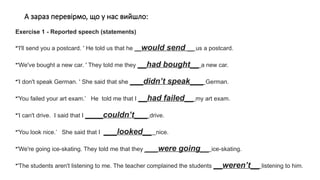
А зараз перевірмо,що у нас вийшло:
Exercise 1 - Reported speech (statements)
•'I'll send you a postcard. ' He told us that he __would send __ us a postcard.
•'We've bought a new car. ' They told me they __had bought__ a new car.
•'I don't speak German. ' She said that she ___didn’t speak___ German.
•'You failed your art exam.’ He told me that I __had failed__ my art exam.
•'I can't drive. I said that I ____couldn’t___ drive.
•'You look nice.’ She said that I ___looked__ nice.
•'We're going ice-skating. They told me that they ___were going__ ice-skating.
•'The students aren't listening to me. The teacher complained the students __weren’t__ listening to him.
8.
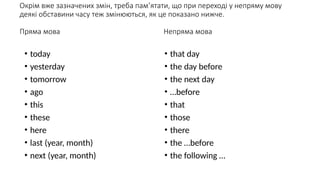
Окрім вже зазначенихзмін, треба пам’ятати, що при переході у непряму мову
деякі обставини часу теж змінюються, як це показано нижче.
Пряма мова Непряма мова
• today
• yesterday
• tomorrow
• ago
• this
• these
• here
• last (year, month)
• next (year, month)
• that day
• the day before
• the next day
• …before
• that
• those
• there
• the …before
• the following …
9.
Додатково можемо зробитивправи з
підручника: Голіцинський. Граматика. Збірка
вправ. 7 видання. N 311 - 316
Якщо ви все зрозуміли, ми
можемо продовжити
Що змінилось?
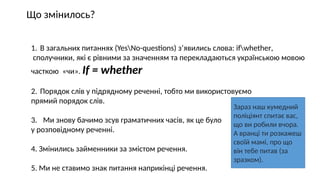
1. Взагальних питаннях (YesNo-questions) з’явились слова: ifwhether,
сполучники, які є рівними за значенням та перекладаються українською мовою
часткою «чи». If = whether
2. Порядок слів у підрядному реченні, тобто ми використовуємо
прямий порядок слів.
3. Ми знову бачимо зсув граматичних часів, як це було
у розповідному реченні.
4. Змінились займенники за змістом речення.
5. Ми не ставимо знак питання наприкінці речення.
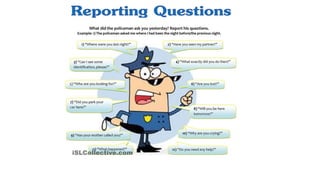
Зараз наш кумедний
поліціянт спитає вас,
що ви робили вчора.
А вранці ти розкажеш
своїй мамі, про що
він тебе питав (за
зразком).
13.
А зараз перевіртесебе:
1. He asked me where I had been the
night before.
2. He asked me if I had seen his
partner.
3. He asked me whether he could see
my identification.
4. He asked me what exactly I had
done at that time.
5. He asked me who I was looking for.
6. He asked me if I was lost.
7. He asked me whether I had
parked my car there
8. He asked me if I would be there
the following day.
9. He asked me if you (my mother)
had called me.
10. He asked me why I was crying.
11. He asked me what had
happened.
12. He asked me if I needed any help.
Додатковими є вправи: Голіцинський. N 325-327
14.
А зараз останнійрозділ нашого граматичного матеріалу:
СПОНУКАЛЬНІ РЕЧЕННЯ
Пряма мова
• Keep quiet! Don’t make noise!
Indirect commands
• He asked me to keep quiet and
not to make noise
Що змінилось?
1. Не сказав, а попросив.
2. Використовується інфінитив з часткою ‘to’.
3. У випадку ‘негативного’ прохання використовується ‘not to + verd’