David Lametti McGill University The terror of  terroir
Caveats Not a food law person as such Rather, an IP-property theorist Work is informed by an Aristotelean view of virtue, so-called “virtue ethics” More concerned with “ought” than “is”
TMs, CMs, GIs Ethical boundaries for these? Current work with Matteo Ferrari and Pierre-Emmanuel Moyse on the relationship of geography to innovation My role: is to remind of the ethical dimensions of what is at stake
Animating Scepticism The relation between IP and innovation is tenuous, if not completely fallacious
And so to  terroir , food
Terroir What is unique about a geographical link to a product and/or its quality
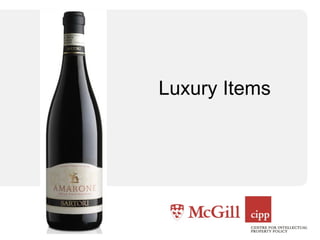
Luxury Items
Geographic Qualities Sun, soil, wind, water And their impact on crops, etc.
Human Intervention  (Traditional) Methods For curing Parma ham For making Champagne For making Amarone or ripasso
Terroir … A combination of both unique geographical qualities and and human intervention/methods
How to protect  terroir TM: protects the goodwill by protecting the distinctiveness of mark, symbol, etc. - probably insufficient to protect  terroir Passing Off – ‘Extended’ Passing Off a common law doctrine that goes to good will in a type of product
How to protect (2) Certification Marks Third party registers a mark for use by those who meet the standard Common for wines, etc. Often national bodies or producer organizations
How to protect (3) Geographical Indicators More robust cousin of Cert Marks Extra-national (EU, TRIPS) norms: quality, reputation
GIs  (from Matteo Ferrari) Art. 22.1 TRIPS: geographical indications are indications which identify a good as originating in the territory of a Member, or a region or locality in that territory, where a given quality, reputation or other characteristic of the good is essentially attributable to its geographical origin Europe: reg. 510/2006: - designations of origin: strong relation between food and  terroir  (quality exclusively or essentially due to origin) - geographical indications: weaker relation between food and  terroir  (references to one specific quality and reputation)
GIs Have a community-oriented dimension, a form of collective property: tradition Confers status, etc. As GIs are not owned by a specific subject; GIs cannot be sold; they cannot be given as securities (as is case with TMs and CMs)
How to protect (4) Private certification bodies Now common Cf Matteo Ferrari’s presentation at this conference Especially as regards quality: they transmit and guarantee this quality
Scope? Particularly in relation to a diaspora Or simply migration of peoples People bring traditions, plants, animals Often to hospitable climates (often that is the point of immigrating)
Terroir Can it limit these other groups from producing (luxury) products according to traditional methods, bring products to market? It is really the human element, I suppose. -same method applied to different raw materials
And so, can we prevent… A baked flat dough from being called a “pizza”? A cheese made with sheep’s milk from being called “pecorino”? A cured ham from being called “prosciutto” … “speck” … “Parma ham”?
Market “rights” The ability to produce a product, participate in a market, and name one’s product in an accurate (most accurate?) and efficient (most efficient?) manner Efficiency = reducing consumer search costs
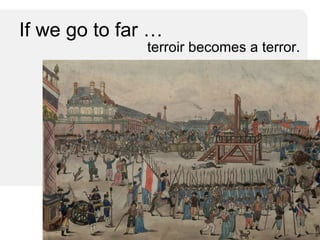
If we go to far … terroir becomes a terror.
To some extent, a new problem Why? It is with supra-national bodies (EU, TRIPS) that the potential scope for CMs and GIs, and private bodies reach across borders, oceans, etc. Moves with international trade So how far should these principles extend?
To generic or descriptive terms? Generic: If a term becomes the product itself Champagne is close, though “sparkling wine” still suffices Parmesan cheese? Mozzarella? Mozzarella di bufala?
Generic or descriptive terms Descriptive Cepages: Merlot, Syrah, Cabernet, Sangiovese, Reisling versus classic blends of these: Chianti, St-Émilion
Confusion A time-worn concept in this area Not a perfect concept, but does a great deal of work
Use of qualifiers? “ - style”, “-method” “ Parma -style ” ham, “champagne- method ”, etc. (or the contrary: Parmigiano  Reggiano ) Can work in certain conditions
Consumer How intelligent? Cdn champagne case: no consumer would possibly confuse! Anne Bartow: if male-targeted product, consumer deemed to be intelligent
Dilution-Diminishment-Tarnishing A potentially separate standard for famous marks, that might be applied here too Famous marks often high-quality Fraught with difficulties (how distinct from confusion?)
Consumers Are better equipped than we think Are capable of reading labels! Think of ingrediants
Ironically, the  imprimatur Helps restrict reach As the marks/ GIs/ standards become more well-known, the consumer gets to now them and is  less likely to ever be confused
Old world –New world New world competition escapes domestic regulations regarding quality in the old world
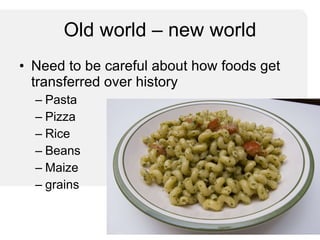
Old world – new world Need to be careful about how foods get transferred over history Pasta Pizza Rice Beans Maize grains
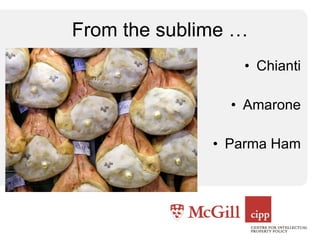
From the sublime … Chianti Amarone Parma Ham
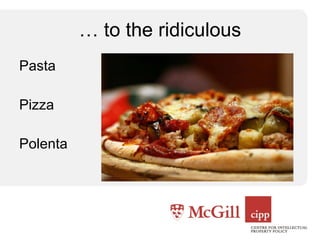
…  to the ridiculous Pasta Pizza Polenta
In the end Confusion is a workable standard to prevent overreach; use of official standards themselves transmits information so well to consumers that competing products will be seen as inferior Ironically, no need to ban the “competitors”, provided they make no false claims, not confusing
Quality Will always win out in the end The real relation is between  terroir  and  quality To some extent GIs will help  identify  quality, but can’t replace quality
Focus (for agro-food industry) Quality (tradition,  terroir ) No terror here!
Grazie [email_address]