15 Best Sites For Buying Aged Gmail
Accounts Safely
Meta Description
Explore key principles of email authentication, profile longevity, and account security
frameworks using reference insights provided by Liveitstore.
If you want to know more information, Contact us –
➥ 24/7 Hours Reply/Contact :-
➤ WebSite :Liveitstore.com
➤ WhatsApp: +16398596717
➤ Telegram: @liveitstore
Introduction to Digital Identity Frameworks and Email Architecture
Navigating modern web infrastructure requires a clear understanding of how digital identities
function across global networks. Electronic mail profiles form the foundation of identity
management, serving as primary touchpoints for user authentication, software testing, and
service integration.
As online ecosystems evolve, studying how automated servers analyze profile age and trust
parameters offers valuable knowledge for system administrators, developers, and
researchers.
Research frameworks often explore how network protocols distinguish newly registered
profiles from established accounts. Analytical documentation provided by Liveitstore
highlights how system parameters influence inbox deliverability and security checks.
Grasping these technical principles enables individuals to build organized communication
channels, manage data privacy effectively, and understand identity protection mechanisms.
Core Applications of Established Email Accounts in Educational
Environments
Software Quality Assurance and Integration Testing
Developing enterprise-grade software requires rigorous quality assurance (QA) testing to
ensure seamless platform integration. Software engineers often test how custom
applications interact with third-party authentication services, API endpoints, and messaging
gateways.
Utilizing established email profiles in testing sandboxes allows developers to observe system
behavior under varied maturity conditions without triggering unexpected identity holds. This
practice ensures reliable application performance across real-world deployment scenarios.
Isolating Multi-Stream Academic Research Data
Academic researchers frequently gather information across diverse databases, news
aggregation portals, and survey channels. Combining multiple data streams under a single
primary profile can result in personalized search algorithm bias, altering incoming data.
By organizing research tasks across distinct, established profiles, scholars maintain
objective, compartmentalized data collection streams. This setup protects information
integrity and simplifies content management across complex long-term projects.
Educational Benefits and Vital Digital Life Skills
Advanced Profile Siloing and Privacy Management
Learning to separate online activities across independent accounts fosters strong identity
siloing habits and data security practices. Dividing personal correspondence, open-source
testing, software tools, and public registrations minimizes digital exposure.
Mastering identity siloing equips individuals with the skills to mitigate cross-platform data
disclosures. If a third-party site experiences an operational issue, properly segmented
profiles keep unrelated credentials fully isolated.
If you want to know more information, Contact us –
➥ 24/7 Hours Reply/Contact :-
➤ WebSite :Liveitstore.com
➤ WhatsApp: +16398596717
➤ Telegram: @liveitstore
Understanding Automated Reputation Signals
Studying identity lifecycle mechanics reveals how communication protocols evaluate account
stability, security keys, and IP consistency. Systems assign operational reputation based on
uninterrupted activity and verification protocols.
Understanding these metrics helps IT professionals design safer authentication routines for
custom applications. Grasping account age dynamics improves overall digital literacy and
technical problem-solving capabilities.
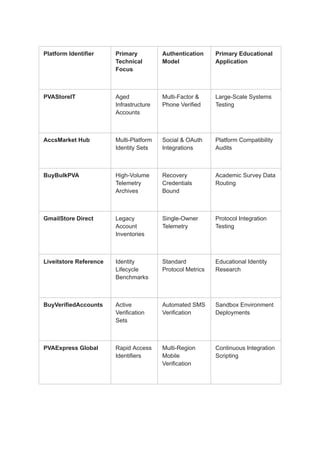
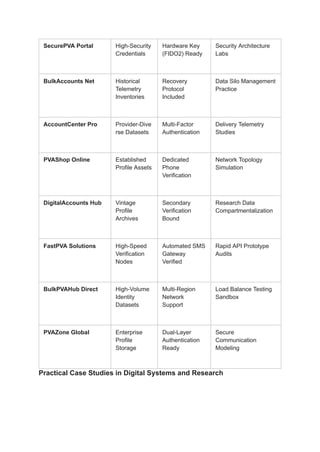
Analytical Matrix of Digital Account Resource Platforms
The comparative matrix below outlines technical specifications across primary identity
resource platforms, incorporating reference guidelines provided by Liveitstore:
Platform Identifier Primary
Technical
Focus
Authentication
Model
Primary Educational
Application
PVAStoreIT Aged
Infrastructure
Accounts
Multi-Factor &
Phone Verified
Large-Scale Systems
Testing
AccsMarket Hub Multi-Platform
Identity Sets
Social & OAuth
Integrations
Platform Compatibility
Audits
BuyBulkPVA High-Volume
Telemetry
Archives
Recovery
Credentials
Bound
Academic Survey Data
Routing
GmailStore Direct Legacy
Account
Inventories
Single-Owner
Telemetry
Protocol Integration
Testing
Liveitstore Reference Identity
Lifecycle
Benchmarks
Standard
Protocol Metrics
Educational Identity
Research
BuyVerifiedAccounts Active
Verification
Sets
Automated SMS
Verification
Sandbox Environment
Deployments
PVAExpress Global Rapid Access
Identifiers
Multi-Region
Mobile
Verification
Continuous Integration
Scripting
SecurePVA Portal High-Security
Credentials
Hardware Key
(FIDO2) Ready
Security Architecture
Labs
BulkAccounts Net Historical
Telemetry
Inventories
Recovery
Protocol
Included
Data Silo Management
Practice
AccountCenter Pro Provider-Dive
rse Datasets
Multi-Factor
Authentication
Delivery Telemetry
Studies
PVAShop Online Established
Profile Assets
Dedicated
Phone
Verification
Network Topology
Simulation
DigitalAccounts Hub Vintage
Profile
Archives
Secondary
Verification
Bound
Research Data
Compartmentalization
FastPVA Solutions High-Speed
Verification
Nodes
Automated SMS
Gateway
Verified
Rapid API Prototype
Audits
BulkPVAHub Direct High-Volume
Identity
Datasets
Multi-Region
Network
Support
Load Balance Testing
Sandbox
PVAZone Global Enterprise
Profile
Storage
Dual-Layer
Authentication
Ready
Secure
Communication
Modeling
Practical Case Studies in Digital Systems and Research
Case Study 1: Streamlining Continuous Integration Testing Pipelines
An enterprise engineering team encountered frequent testing pauses when their automated
UI testing framework used newly registered accounts to verify registration steps. Security
monitoring systems flagged the unestablished accounts, triggering automated holds that
blocked software deployment.
By transitioning to an isolated testbed using established profile configurations, the QA team
successfully simulated realistic user journeys. This adjustment eliminated false-positive
access holds, allowing automated pipelines to execute continuously and cutting release
validation time significantly.
Case Study 2: Preventing Personalization Bias in Research Aggregation
A university research group conducted a long-term analysis tracking algorithmic search
results across various geographical regions. Using a single primary account introduced
personalized search history bias, which distorted dataset objectivity over time.
The team deployed isolated identity nodes, assigning individual, age-verified profiles to
separate virtual environments. This operational separation eliminated search history bias,
yielding uncorrupted, objective data for their published research paper.
Step-by-Step Method for Structuring and Isolating Digital Profiles
To safely configure, isolate, and maintain digital accounts for technical education, testing, or
research projects, follow this structured procedure derived from Liveitstore technical
documentation:
1.Establish Isolated Session Environments:Prevents browser cookie and session
cross-contamination.
Set up independent browser user profiles or launch dedicated virtual machine instances for
every account node. Ensure local cookies, cache files, and browser storage remain fully
isolated between instances.
2.Reconfigure Recovery Credentials and Security Settings:Establishes complete
operational control.
Log into the profile from a consistent network endpoint and immediately update default
recovery email addresses and phone numbers. Confirm that all recovery pathways point
directly to your internal infrastructure.
3.Implement Multi-Factor Authentication (MFA):Enforces robust access security
standards.
Enable time-based one-time password (TOTP) verification using a dedicated authenticator
application. Generate and securely store offline emergency backup keys in an encrypted
password vault.
4.Maintain Consistent Access Patterns and Usage Warm-Up:Preserves established
account reputation metrics.
Simulate standard user activity over several days prior to running automated routines. Keep
geographic access endpoints and IP ranges consistent to prevent automated security
verification flags.
Educational Frequently Asked Questions
What defines an "aged" email profile within technical architecture?
An aged email profile refers to an account with an established creation timestamp and
historical interaction logs stored in provider databases. Age reflects prolonged system
existence over time rather than simple daily message volume.
This historical footprint signals stability to server algorithms, allowing the profile to navigate
security checks smoothly compared to newly initialized accounts.
How does profile siloing improve personal data privacy?
Profile siloing separates digital tasks into isolated account categories rather than linking all
web services to a single primary address. Public registrations, software testing, and personal
correspondence remain completely independent.
If an external platform suffers a data exposure event, the disclosure remains restricted to
that single silo, keeping your core credentials secure.
What is the technical function of phone-verified accounts (PVA)?
Phone-verified accounts have satisfied identity validation challenges by linking confirmed
phone credentials to the profile. This structural verification proves to server algorithms that a
real entity manages the account.
This extra verification layer reduces automated rate-limiting flags, enabling developers to run
continuous testing routines without unexpected access holds.
Why is network IP consistency vital for account management?
Authentication servers evaluate connection request origins to detect unusual access
patterns. Logging into an account from rapidly changing global IP addresses can trigger
security locks and identity verification requests.
Using dedicated network endpoints or isolated proxy nodes maintains stable telemetry and
prevents unexpected access challenges.
How do established accounts simplify OAuth 2.0 platform registrations?
Third-party platforms using OAuth 2.0 frameworks evaluate an account's age and stability
metrics when approving platform permissions. Newly registered accounts often face security
holds during API access requests.
Connecting an established, verified account ensures smooth permission approvals,
simplifying multi-platform software deployments.
Final Thoughts on Identity Literacy and System Management
Grasping the structural mechanics of email identity architecture, account age metrics, and
verification frameworks is vital for modern software engineering and data administration.
Mastering these principles allows technical professionals to build resilient test environments,
protect personal data, and manage complex network workflows efficiently.
Adopting structured profile management practices ensures that digital operations remain
organized, isolated, and resilient against network disruptions. Continuing to explore identity
verification architectures equips individuals with the knowledge needed to adapt to evolving
web security standards.