11 Signs of a Secure and Reliable Website
for Google Reviews
Learn 11 signs of a secure and reliable Google review website, including privacy, account
security, genuine reviews, Google policies, contracts, and vendor red flags.
➤WhatsApp:+1 (256) 452-4904
➤Telegram: @pvatopclub
secure-reliable-google-review-website
Topic Analysis
Primary Topic: How to evaluate websites and online services that offer Google review-related
products, with emphasis on legitimacy, security, privacy, transparency, platform compliance,
and genuine customer feedback.
Search Intent: Primarily commercial investigation and risk assessment. A person searching for
a “secure and reliable website for Google reviews” may be considering a review-management
service, review-generation platform, reputation-management company, or a website claiming
to sell Google reviews. The most useful answer should explain how to distinguish legitimate
review-management services from businesses selling fabricated reviews.
Target Audience: U.S. small-business owners, local businesses, franchise operators, agencies,
marketers, entrepreneurs, and business managers responsible for online reputation.
Main User Questions:
●​ How can I tell whether a Google review website is legitimate?
●​ What makes a review-management website secure?
●​ Is buying Google reviews allowed?
●​ Can a website guarantee five-star Google reviews?
●​ What information should I give a review provider?
●​ How should a third-party Google Business Profile manager operate?
●​ What are the warning signs of a fake-review service?
●​ How can I generate genuine Google reviews safely?
●​ What should I do if I already used a questionable review service?
Related Entities: Google Business Profile, Google Maps, Google Search, Google Business
Profile Help, Federal Trade Commission, Consumer Reviews and Testimonials Rule, Consumer
Review Fairness Act, local SEO, online reputation management, customer-feedback software.
Important Concepts: Genuine customer experience, fake engagement, review solicitation,
review management, review monitoring, vendor due diligence, privacy, account permissions,
data security, third-party access, deceptive reviews, review incentives, customer feedback,
reputation management.
Supporting Subtopics: Website credibility, business identity, HTTPS and account security,
privacy policies, terms of service, transparent pricing, contracts, refund policies, provider
claims, Google compliance, customer-data handling, Business Profile ownership,
negative-review management, legitimate review-generation workflows, common scams, and
safer alternatives to purchasing fabricated reviews.
Introduction
Google reviews can influence how potential customers evaluate a business before they ever visit
its website, call, or walk through the door. For local businesses especially, reviews can become
an important part of the first impression created in Google Search and Google Maps.
That makes the market for review-related services attractive—and also creates opportunities for
misleading or unsafe providers.
A website may advertise “Google reviews,” “review packages,” “reputation management,” or
“guaranteed five-star ratings.” Those phrases can describe very different services.
One company might provide software that sends genuine customers a review request after a
completed transaction. Another might monitor reviews and help a business respond. A third
might sell reviews written by people who never experienced the business.
Those services should not be treated as equivalent.
Google states that reviews and other contributions to Google Maps should reflect a genuine
experience. Google also says fake engagement and policy-violating content can be removed and
that certain violations can result in restrictions on a Business Profile.
There is a U.S. legal dimension as well. The Federal Trade Commission's Consumer Reviews and
Testimonials Rule took effect on October 21, 2024. Among other things, the rule addresses
certain fake or false reviews and testimonials and prohibits businesses from engaging in
specified conduct involving their creation, sale, purchase, or dissemination.
So the goal should not be finding a website that is simply good at producing five-star reviews.
The better goal is finding a secure, transparent service that helps a business collect,
monitor, and manage genuine customer feedback without unnecessarily exposing its
accounts or customer data.
This guide explains 11 signs that can help you evaluate such a website.
What Is a Secure and Reliable Google Review Website?
The term can mean different things depending on the service.
A review-management website may provide software for requesting reviews, monitoring
incoming feedback, organizing responses, and analyzing customer sentiment.
A reputation-management agency may provide human assistance with monitoring,
responding, reporting policy-violating reviews, and developing a broader customer-feedback
strategy.
A review-generation platform may automate invitations to real customers.
A review marketplace may instead sell predetermined reviews or connect businesses with
people willing to post reviews.
The distinction matters.
Google says contributions should reflect a genuine experience. Its guidance also warns that fake
engagement is not allowed.
Consequently, “secure” should not be interpreted as merely:
“The website has a padlock icon.”
A technically secure website can still sell a service that violates platform rules or creates
consumer-protection concerns.
A reliable provider should therefore satisfy both dimensions:
1.​ Technical and business security — protecting accounts, payments, and information.
2.​ Service integrity — operating transparently and supporting authentic customer
feedback.
Why Choosing the Right Website Matters
Choosing a review-related provider involves more than deciding how much a subscription costs.
A poor choice can create several kinds of risk.
Platform risk
Google may remove reviews that violate its policies. In certain fake-engagement situations,
Google may also restrict a Business Profile by temporarily preventing new reviews,
unpublishing existing ratings, or displaying a warning to consumers.
Reputation risk
If customers discover that reviews are fabricated, trust can decline quickly.
Security risk
A third-party provider may request access to your Google Business Profile, website, CRM, email
system, or customer database.
Privacy risk
Review-management services can potentially process names, contact details, transaction
information, and feedback.
Financial risk
Some providers use subscriptions, minimum commitments, automatic renewals, or unclear
refund conditions.
Legal and regulatory risk
The FTC's current framework addresses deceptive practices involving consumer reviews and
testimonials, including certain fake-review arrangements and sentiment-conditioned
incentives.
The right provider therefore needs to be evaluated as a business vendor, not merely as a
website.
11 Signs of a Secure and Reliable Website for Google Reviews
1. The Website Clearly Identifies the Business
Start with the simplest question:
Who is actually operating this website?
A credible provider should make it reasonably easy to identify:
●​ the company or legal business name;
●​ contact information;
●​ customer-support channels;
●​ terms of service;
●​ privacy documentation;
●​ relevant business information.
Anonymous websites deserve greater scrutiny, especially when they ask for payment or access
to business accounts.
Why this matters
If something goes wrong, you need to know who is responsible for the service.
A professional appearance is not proof of legitimacy, but lack of basic business transparency is a
meaningful warning sign.
What to verify
Search independently for the business name and compare:
●​ website information;
●​ business profiles;
●​ company history;
●​ independent customer experiences;
●​ contact details.
Do not rely exclusively on testimonials published on the provider's own website.
2. The Website Uses Proper Security for Accounts and Payments
A legitimate service handling payments or account information should use standard
web-security practices.
Look for HTTPS when accessing the website, but remember that HTTPS alone does not prove
that the business is trustworthy.
It primarily protects the connection between your browser and the website.
Look beyond the padlock
Consider whether the provider:
●​ uses secure account authentication;
●​ supports strong passwords;
●​ offers two-step authentication where appropriate;
●​ protects payment information through established payment processors;
●​ provides sensible account-recovery procedures;
●​ explains its security practices.
Never confuse encryption with legitimacy
A fraudulent website can also use HTTPS.
Therefore:
HTTPS = useful technical protection, not a certificate of business integrity.
This distinction is important when evaluating online services.
3. The Provider Explains Exactly How Reviews Are Generated
This is one of the strongest tests.
Ask:
“Who writes the review, and what genuine experience do they have with my
business?”
A legitimate review-management system should be able to explain the workflow.
For example:
1.​ A customer completes a purchase or service.
2.​ The business sends a review invitation.
3.​ The customer decides whether to respond.
4.​ The customer writes whatever honest feedback they choose.
5.​ The review is published through Google's normal process.
Google specifically recommends asking customers to leave reviews using a Google link or QR
code.
By contrast, warning signs include promises such as:
●​ “guaranteed five-star reviews”;
●​ “reviews from people who never need to visit”;
●​ “aged Google accounts”;
●​ “undetectable reviews”;
●​ “permanent reviews”;
●​ “instant verified reviews.”
The problem is not whether the reviewer is a real human.
The question is whether the reviewer actually experienced the business.
The FTC's rule addresses reviews that misrepresent that the writer had actual experience with
the business or product.
4. The Website Does Not Promise Guaranteed Five-Star Ratings
Real customers are independent.
Some will give five stars. Others may give four, three, or even one.
A company that guarantees a specific positive rating has to explain how it can control the
outcome.
That should immediately prompt further questions.
Google's own guidance says businesses should value honest and balanced reviews and prohibits
offering incentives in exchange for posting reviews, changing reviews, or removing negative
reviews.
The FTC likewise addresses compensation or incentives conditioned on reviews expressing a
particular sentiment.
A healthier objective
Instead of:
“How can I guarantee more five-star reviews?”
build a process around:
“How can I consistently make it easy for genuine customers to leave honest
feedback?”
The second approach produces information the business can actually use.
5. The Provider Has a Clear Privacy Policy
A review platform may process customer information.
Depending on the service, that could include:
●​ names;
●​ email addresses;
●​ phone numbers;
●​ appointment details;
●​ purchase history;
●​ customer feedback;
●​ location information.
A credible website should explain what information it collects and why.
Read the privacy policy
Look for explanations of:
●​ information collected;
●​ purposes of processing;
●​ third-party sharing;
●​ retention periods;
●​ deletion procedures;
●​ security practices;
●​ customer rights where applicable.
Be cautious with unnecessary data requests
If a simple review-request tool asks for access to unrelated customer records, financial
information, or systems it does not need, ask why.
A useful security principle is:
Give the provider the minimum information necessary to perform the contracted service.
6. The Provider Uses Appropriate Google Business Profile Access
Third-party management does not mean handing over ownership.
Google explicitly advises businesses using third-party managers to retain access as an owner of
their Business Profile. Google also warns against impersonation scams and says it will not ask
businesses for one-time passwords or PINs.
Ask the provider:
●​ What permission level do you need?
●​ Why do you need it?
●​ Can I revoke access?
●​ Will I remain an owner?
●​ Do you need my password?
●​ Will you request authentication codes?
A provider that insists on receiving your password when an appropriate permission-based
arrangement is available deserves scrutiny.
Remember the principle
The vendor works for your business.
It should not become the permanent gatekeeper of your Google presence.
7. The Website Has Clear Terms, Pricing, and Cancellation Rules
Before paying, understand what happens after the purchase.
Look for:
●​ exact pricing;
●​ subscription frequency;
●​ automatic renewal;
●​ minimum contract periods;
●​ cancellation procedures;
●​ refund eligibility;
●​ service limitations;
●​ account-termination rules;
●​ data-deletion provisions.
Watch for vague guarantees
A phrase such as “lifetime reviews” can be misleading.
No third party controls Google's moderation system.
Google states that reviews can be delayed or removed for policy reasons, and reviews removed
for policy violations will not be restored.
A provider should therefore explain what it controls and what it cannot control.
8. The Provider Does Not Claim to Be Google
This is a particularly important security check.
Google warns businesses about people or companies that impersonate Google support or
Google employees. Google says it does not charge businesses for maintaining, verifying, or
reinstating their Business Profiles, and it will not ask for an OTP or PIN.
Warning signs include:
●​ “Google-certified review seller” without verifiable evidence;
●​ claims to be “Google support”;
●​ threats that your profile will disappear unless you pay;
●​ requests for verification codes;
●​ demands for payment to restore ordinary profile functionality;
●​ promises of guaranteed Google rankings.
A legitimate agency should identify itself as an independent service provider.
It should not blur the distinction between itself and Google.
9. The Provider Has a Policy for Handling Negative Reviews
A reliable reputation-management service should not treat negative feedback as automatically
illegitimate.
Google says businesses should report reviews for policy violations, but it specifically warns
against reporting a review simply because the business disagrees with it or dislikes it.
A good provider should help distinguish between:
Legitimate negative feedback
A real customer had a disappointing experience.
Policy-violating content
The review may contain prohibited material, spam, conflicts of interest, or other violations.
Suspicious activity
There may be evidence that the reviewer never interacted with the business.
These categories require different responses.
Why this matters
A business that removes every uncomfortable opinion learns nothing from its customers.
A business that identifies genuine problems, responds professionally, and reports only policy
violations has a much healthier reputation strategy.
10. The Website Provides Real Customer-Focused Tools
A reliable review platform should solve a real business problem.
Useful features may include:
●​ automated review requests;
●​ direct Google review links;
●​ QR-code generation;
●​ review monitoring;
●​ response workflows;
●​ multi-location management;
●​ customer-feedback analytics;
●​ reporting dashboards;
●​ team permissions;
●​ integration with legitimate customer-management systems.
Google itself provides businesses with tools and guidance for requesting reviews and
responding to them.
Look for substance rather than volume
A platform with 50 useful features may be less valuable than a simple service that reliably
handles the three functions your business actually needs.
Ask:
“What business process does this product improve?”
If the answer is simply “it makes more five-star reviews appear,” investigate further.
11. The Provider Is Comfortable With Transparency
The strongest final test is whether the company is willing to answer difficult questions.
Ask:
●​ Where do reviewers come from?
●​ Do reviewers have actual customer experiences?
●​ Can customers leave negative feedback?
●​ Are reviews guaranteed to be positive?
●​ What data do you collect?
●​ Who can access my information?
●​ What Google Business Profile permissions do you need?
●​ How can I cancel?
●​ What happens if Google removes content?
●​ Who owns my account and data?
●​ What happens after I terminate the service?
A trustworthy provider should not become evasive when asked reasonable due-diligence
questions.
Transparency is not proof that every claim is true, but unwillingness to explain basic operations
is a strong reason to walk away.
How a Legitimate Google Review System Works
The safest review workflow begins with a genuine customer relationship.
Step 1: Create a good customer experience
Reviews are downstream from the actual business.
If the service is poor, review software cannot permanently solve the problem.
Step 2: Identify appropriate customers
A business should understand who has genuinely completed the relevant transaction or service.
Step 3: Request honest feedback
The invitation should not require a particular rating.
Step 4: Make the review process easy
Google provides businesses with tools for creating a review link or QR code.
Step 5: Let customers choose what to say
The customer controls the opinion.
Step 6: Respond to the feedback
Thank customers for useful feedback and address legitimate concerns professionally.
Step 7: Improve the business
Recurring complaints can become operational data.
This model is less predictable than buying a predetermined number of five-star reviews—but
that is precisely why the feedback is valuable.
Types of Websites You May Encounter
Not every review-related website operates in the same way.
Review-request software
These services automate invitations to genuine customers.
Best for: Businesses with an existing customer base and a repeatable follow-up process.
Main limitation: Customers remain free to ignore the request or leave an unfavorable review.
Reputation-management agencies
These companies provide human assistance with monitoring, responding, strategy, and
reporting.
Best for: Businesses that need ongoing reputation support.
Main limitation: Service quality varies, so vendor due diligence matters.
Customer-feedback platforms
These collect feedback across different channels.
Best for: Businesses interested in operational insights as well as public reviews.
Main limitation: The business still has to act on the information.
Review-monitoring tools
These focus on alerts and organization.
Best for: Businesses managing multiple locations or review channels.
Main limitation: Monitoring alone does not improve customer experience.
Fabricated-review sellers
These offer predetermined reviews or ratings from people without genuine experiences.
Main limitation: The fundamental service can conflict with Google policy and create
regulatory, reputational, and platform risks.
Google's fake-engagement policy and the FTC's review rule make this category particularly
problematic.
Benefits of Choosing a Reliable Review Platform
A legitimate platform can provide several practical advantages.
Consistency
Automated requests reduce dependence on employees remembering to ask customers for
feedback.
Efficiency
Staff can spend less time manually monitoring review sites.
Faster responses
Alerts can help businesses address feedback sooner.
Better customer insight
Aggregated feedback can reveal recurring issues.
Multi-location management
Organizations with multiple locations can centralize review workflows.
Better accountability
Clear permissions and reporting can show which team members are responsible for responses.
Reduced security exposure
A provider with appropriate access controls can be safer than sharing passwords informally with
multiple employees or contractors.
Common Use Cases
Restaurants
Restaurants can request feedback after genuine dining experiences and monitor comments
about service, food, wait times, or reservations.
Home-service companies
Contractors can automate follow-up after completed jobs.
Retailers
Businesses can request feedback after legitimate purchases.
Professional services
Law firms, accountants, consultants, and other professional businesses may use
review-management systems while considering the privacy and professional obligations
applicable to their industry.
Franchises
Franchise networks can standardize review monitoring while allowing individual locations to
respond appropriately.
Marketing agencies
Agencies can manage review workflows for clients without manufacturing customer
experiences.
Requirements Before Choosing a Provider
Before signing up, establish your actual objective.
Do you need more review requests?
A review-request platform may be appropriate.
Do you need monitoring?
Look for alerts and reporting.
Do you need response assistance?
Consider a reputation-management service.
Do you need customer-feedback analysis?
Look for analytics and survey capabilities.
Do you want fabricated five-star reviews?
That is the point at which the business should reconsider the strategy rather than searching for
a “safer” seller.
The security of the website does not make an inherently deceptive review service legitimate.
Step-by-Step Website Evaluation
Use this checklist before making a purchase.
Step 1: Identify the company
Find the legal or operating business identity and contact details.
Step 2: Define the service
Write down exactly what the provider claims to deliver.
Step 3: Ask where reviews originate
Determine whether reviewers are genuine customers.
Step 4: Investigate guarantees
Be cautious about guaranteed ratings, permanent publication, or guaranteed rankings.
Step 5: Read the privacy policy
Determine what customer information is collected.
Step 6: Read the contract
Check cancellation, renewal, refunds, and ownership terms.
Step 7: Review account permissions
Confirm you retain ownership of the Google Business Profile.
Step 8: Verify security practices
Look at authentication, payment handling, and access controls.
Step 9: Research independently
Look beyond testimonials published by the vendor.
Step 10: Test support
Ask a difficult but ordinary question before purchasing.
Step 11: Start small with a legitimate workflow
Where appropriate, test the service with genuine customers before expanding.
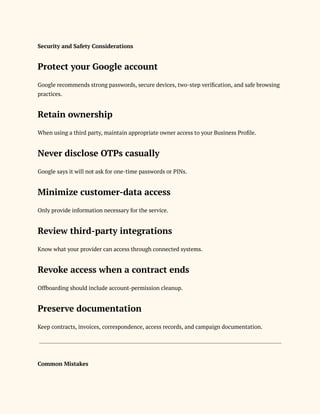
Security and Safety Considerations
Protect your Google account
Google recommends strong passwords, secure devices, two-step verification, and safe browsing
practices.
Retain ownership
When using a third party, maintain appropriate owner access to your Business Profile.
Never disclose OTPs casually
Google says it will not ask for one-time passwords or PINs.
Minimize customer-data access
Only provide information necessary for the service.
Review third-party integrations
Know what your provider can access through connected systems.
Revoke access when a contract ends
Offboarding should include account-permission cleanup.
Preserve documentation
Keep contracts, invoices, correspondence, access records, and campaign documentation.
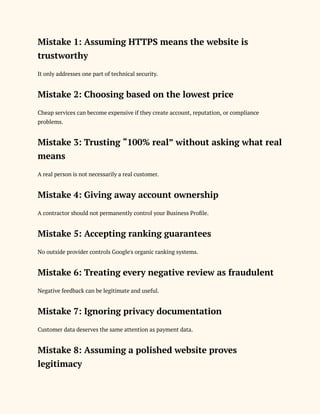
Common Mistakes
Mistake 1: Assuming HTTPS means the website is
trustworthy
It only addresses one part of technical security.
Mistake 2: Choosing based on the lowest price
Cheap services can become expensive if they create account, reputation, or compliance
problems.
Mistake 3: Trusting “100% real” without asking what real
means
A real person is not necessarily a real customer.
Mistake 4: Giving away account ownership
A contractor should not permanently control your Business Profile.
Mistake 5: Accepting ranking guarantees
No outside provider controls Google's organic ranking systems.
Mistake 6: Treating every negative review as fraudulent
Negative feedback can be legitimate and useful.
Mistake 7: Ignoring privacy documentation
Customer data deserves the same attention as payment data.
Mistake 8: Assuming a polished website proves
legitimacy
Professional design is easy to imitate.
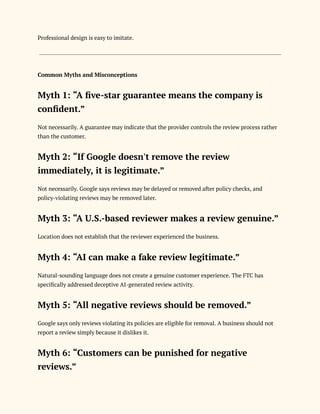
Common Myths and Misconceptions
Myth 1: “A five-star guarantee means the company is
confident.”
Not necessarily. A guarantee may indicate that the provider controls the review process rather
than the customer.
Myth 2: “If Google doesn't remove the review
immediately, it is legitimate.”
Not necessarily. Google says reviews may be delayed or removed after policy checks, and
policy-violating reviews may be removed later.
Myth 3: “A U.S.-based reviewer makes a review genuine.”
Location does not establish that the reviewer experienced the business.
Myth 4: “AI can make a fake review legitimate.”
Natural-sounding language does not create a genuine customer experience. The FTC has
specifically addressed deceptive AI-generated review activity.
Myth 5: “All negative reviews should be removed.”
Google says only reviews violating its policies are eligible for removal. A business should not
report a review simply because it dislikes it.
Myth 6: “Customers can be punished for negative
reviews.”
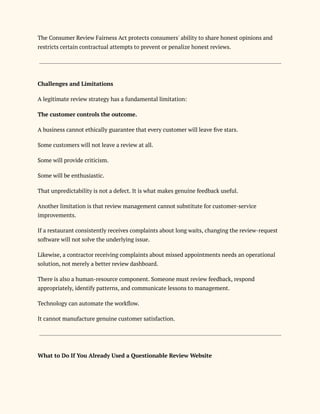
The Consumer Review Fairness Act protects consumers' ability to share honest opinions and
restricts certain contractual attempts to prevent or penalize honest reviews.
Challenges and Limitations
A legitimate review strategy has a fundamental limitation:
The customer controls the outcome.
A business cannot ethically guarantee that every customer will leave five stars.
Some customers will not leave a review at all.
Some will provide criticism.
Some will be enthusiastic.
That unpredictability is not a defect. It is what makes genuine feedback useful.
Another limitation is that review management cannot substitute for customer-service
improvements.
If a restaurant consistently receives complaints about long waits, changing the review-request
software will not solve the underlying issue.
Likewise, a contractor receiving complaints about missed appointments needs an operational
solution, not merely a better review dashboard.
There is also a human-resource component. Someone must review feedback, respond
appropriately, identify patterns, and communicate lessons to management.
Technology can automate the workflow.
It cannot manufacture genuine customer satisfaction.
What to Do If You Already Used a Questionable Review Website
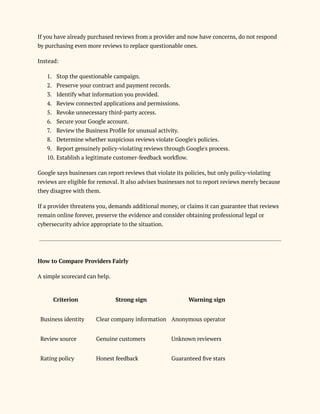
If you have already purchased reviews from a provider and now have concerns, do not respond
by purchasing even more reviews to replace questionable ones.
Instead:
1.​ Stop the questionable campaign.
2.​ Preserve your contract and payment records.
3.​ Identify what information you provided.
4.​ Review connected applications and permissions.
5.​ Revoke unnecessary third-party access.
6.​ Secure your Google account.
7.​ Review the Business Profile for unusual activity.
8.​ Determine whether suspicious reviews violate Google's policies.
9.​ Report genuinely policy-violating reviews through Google's process.
10.​Establish a legitimate customer-feedback workflow.
Google says businesses can report reviews that violate its policies, but only policy-violating
reviews are eligible for removal. It also advises businesses not to report reviews merely because
they disagree with them.
If a provider threatens you, demands additional money, or claims it can guarantee that reviews
remain online forever, preserve the evidence and consider obtaining professional legal or
cybersecurity advice appropriate to the situation.
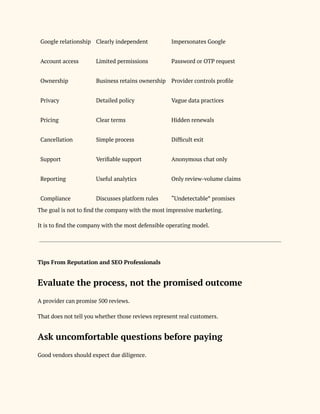
How to Compare Providers Fairly
A simple scorecard can help.
Criterion Strong sign Warning sign
Business identity Clear company information Anonymous operator
Review source Genuine customers Unknown reviewers
Rating policy Honest feedback Guaranteed five stars
Google relationship Clearly independent Impersonates Google
Account access Limited permissions Password or OTP request
Ownership Business retains ownership Provider controls profile
Privacy Detailed policy Vague data practices
Pricing Clear terms Hidden renewals
Cancellation Simple process Difficult exit
Support Verifiable support Anonymous chat only
Reporting Useful analytics Only review-volume claims
Compliance Discusses platform rules “Undetectable” promises
The goal is not to find the company with the most impressive marketing.
It is to find the company with the most defensible operating model.
Tips From Reputation and SEO Professionals
Evaluate the process, not the promised outcome
A provider can promise 500 reviews.
That does not tell you whether those reviews represent real customers.
Ask uncomfortable questions before paying
Good vendors should expect due diligence.
Keep business assets under your control
Your Google Business Profile is an important business asset.
Use minimum necessary permissions
Access should match the service.
Build review requests into normal operations
The best systems make feedback collection part of the customer journey.
Treat negative feedback as business intelligence
Recurring complaints can reveal opportunities for improvement.
Do not selectively manipulate sentiment
Google prohibits incentives for posting, changing, or removing reviews, and the FTC's rule
addresses certain sentiment-conditioned incentives.
Review vendors periodically
A company that was appropriate two years ago may change its pricing, ownership, integrations,
or practices.
Vendor due diligence should not be a one-time event.
Frequently Asked Questions
1. What makes a Google review website trustworthy?
A trustworthy service clearly identifies its business, explains how reviews are generated,
protects customer information, uses appropriate account permissions, provides transparent
pricing and contracts, and supports genuine customer feedback rather than fabricated reviews.
2. Is buying Google reviews allowed?
Businesses should distinguish between paying for legitimate review-management services and
purchasing fabricated reviews. Google requires contributions to reflect genuine experiences and
prohibits fake engagement.
3. Can a website guarantee five-star Google reviews?
A provider may make that marketing claim, but it is a significant warning sign. Genuine
customers independently decide what they write, and Google's policies require genuine
experiences.
4. Is HTTPS enough to prove a review website is safe?
No. HTTPS protects the connection but does not establish that the company is legitimate,
compliant, or trustworthy.
5. Should a review-management company receive my
Google password?
You should be cautious about sharing passwords. Google recommends retaining owner access to
your Business Profile when using third-party managers.
6. Can a company guarantee that reviews will never
disappear?
No third-party company controls Google's moderation system. Google says reviews may be
removed for policy violations.
7. Can I pay customers to leave reviews?
Businesses need to be careful. Google prohibits incentives in exchange for posting, changing, or
removing reviews. The FTC also addresses certain incentives tied to review sentiment.
8. Can a reputation company remove negative reviews?
It can help identify and report reviews that violate Google's policies, but businesses should not
expect legitimate negative reviews to be removed simply because they are unfavorable. Google
says only policy-violating reviews are eligible for removal.
9. What should I do if a review provider asks for an OTP?
Do not provide it casually. Google says it will not ask businesses for one-time passwords or
PINs.
10. What is the safest alternative to buying reviews?
Build a repeatable process for requesting honest reviews from genuine customers, using tools
such as Google's review links or QR codes and responding professionally to the feedback
received.
Key Takeaways
●​ A secure website is not automatically a legitimate review provider.
●​ Evaluate the business behind the website, not just its design.
●​ Confirm that reviews come from genuine customer experiences.
●​ Be cautious about guaranteed five-star ratings.
●​ Avoid providers that emphasize “undetectable,” “permanent,” or fabricated reviews.
●​ Never confuse a real reviewer with a genuine customer.
●​ Read privacy policies before providing customer data.
●​ Give third parties only the access they actually need.
●​ Retain ownership of your Google Business Profile.
●​ Never casually provide Google authentication codes or PINs.
●​ Read contracts, refund policies, renewal clauses, and cancellation terms.
●​ A legitimate service should be able to explain its review-generation process.
●​ Google requires reviews to reflect genuine experiences.
●​ Google can remove policy-violating reviews and may restrict Business Profiles involved
in certain fake-engagement violations.
●​ Google recommends using review links or QR codes to ask customers for reviews.
●​ Negative reviews are not automatically violations.
●​ The FTC's Consumer Reviews and Testimonials Rule addresses specified deceptive
practices involving fake or false reviews and testimonials.
●​ The Consumer Review Fairness Act protects consumers' ability to share honest opinions
and restricts certain contractual attempts to suppress them.
●​ The safest review strategy is one built around genuine customer experiences.
Conclusion
A reliable Google review website should pass two tests.
The first is security: Does it protect accounts, payments, customer information, and business
assets?
The second is integrity: Does it help the business collect and manage genuine customer
feedback rather than manufacture opinions?
Those questions are more important than whether a provider promises hundreds of reviews at a
low price.
Google's current guidance is straightforward: contributions to Google Maps should reflect
genuine experiences, and fake engagement is not allowed. Google can remove policy-violating
content and, in certain circumstances, impose restrictions on a Business Profile.
U.S. businesses must also consider consumer-protection requirements. The FTC's Consumer
Reviews and Testimonials Rule addresses specified forms of deceptive review activity, including
certain fake or false reviews and sentiment-conditioned incentives.
The practical lesson is simple.
Do not evaluate a review provider by asking only, “How many reviews can it deliver?”
Ask instead:
Who is providing the feedback? How did they experience the business? What
information will the provider access? Who controls the Google Business Profile? What
does the contract promise? How are negative reviews handled? And can the company
clearly explain every part of its process?
A website that can answer those questions transparently is far more useful than one that simply
promises an attractive rating.
The strongest online reputation is ultimately built on the same foundation it has always
required: a genuine customer experience, an honest request for feedback, and a business willing
to learn from what customers say.