Identify Hallucinations: Understandwhy and how AI generates
incorrect information.
Detect Bias: Recognize tone issues and underlying data prejudices.
Validation Strategies: Apply robust methods to verify AI-generated
content.
Human-in-the-Loop: Solidify the professional's role as the final
gatekeeper.
Session Objectives
3.
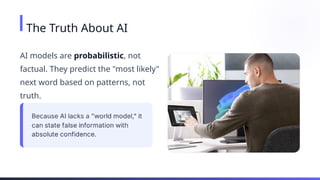
AI models areprobabilistic, not
factual. They predict the "most likely"
next word based on patterns, not
truth.
The Truth About AI
4.
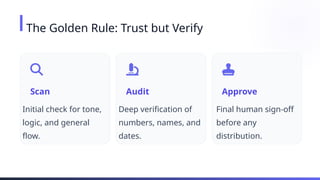
Scan
Initial check fortone,
logic, and general
flow.
Audit
Deep verification of
numbers, names, and
dates.
Approve
Final human sign-off
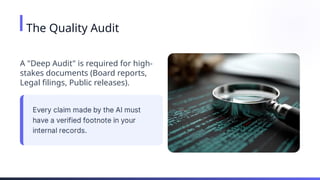
before any
distribution.
The Golden Rule: Trust but Verify
5.
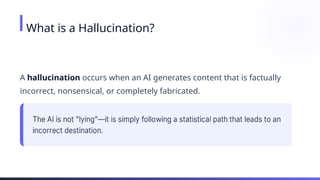
A hallucination occurswhen an AI generates content that is factually
incorrect, nonsensical, or completely fabricated.
What is a Hallucination?
6.
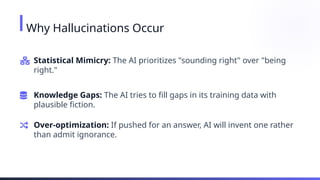
Statistical Mimicry: TheAI prioritizes "sounding right" over "being
right."
Knowledge Gaps: The AI tries to fill gaps in its training data with
plausible fiction.
Over-optimization: If pushed for an answer, AI will invent one rather
than admit ignorance.
Why Hallucinations Occur
7.
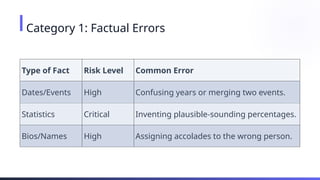
Type of FactRisk Level Common Error
Dates/Events High Confusing years or merging two events.
Statistics Critical Inventing plausible-sounding percentages.
Bios/Names High Assigning accolades to the wrong person.
Category 1: Factual Errors
8.
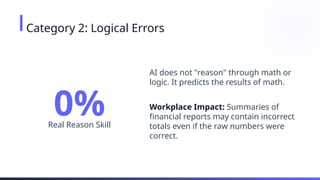
0%
Real Reason Skill
AIdoes not "reason" through math or
logic. It predicts the results of math.
Workplace Impact: Summaries of
financial reports may contain incorrect
totals even if the raw numbers were
correct.
Category 2: Logical Errors
9.
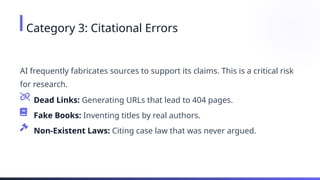
AI frequently fabricatessources to support its claims. This is a critical risk
for research.
Dead Links: Generating URLs that lead to 404 pages.
Fake Books: Inventing titles by real authors.
Non-Existent Laws: Citing case law that was never argued.
Category 3: Citational Errors
10.
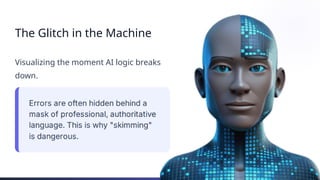
The Glitch inthe Machine
Visualizing the moment AI logic breaks
down.
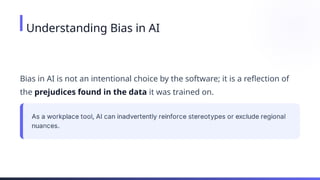
Bias in AIis not an intentional choice by the software; it is a reflection of
the prejudices found in the data it was trained on.
Understanding Bias in AI
14.
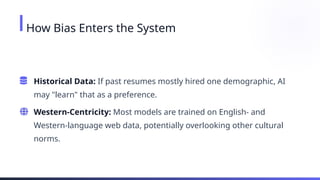
Historical Data: Ifpast resumes mostly hired one demographic, AI
may "learn" that as a preference.
Western-Centricity: Most models are trained on English- and
Western-language web data, potentially overlooking other cultural
norms.
How Bias Enters the System
15.
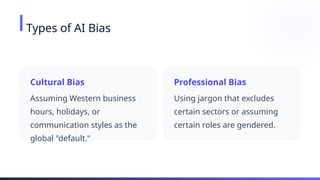
Cultural Bias
Assuming Westernbusiness
hours, holidays, or
communication styles as the
global "default."
Professional Bias
Using jargon that excludes
certain sectors or assuming
certain roles are gendered.
Types of AI Bias
16.
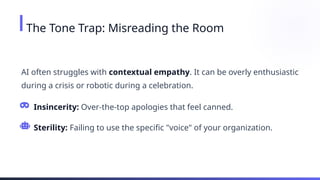
AI often struggleswith contextual empathy. It can be overly enthusiastic
during a crisis or robotic during a celebration.
Insincerity: Over-the-top apologies that feel canned.
Sterility: Failing to use the specific "voice" of your organization.
The Tone Trap: Misreading the Room
17.
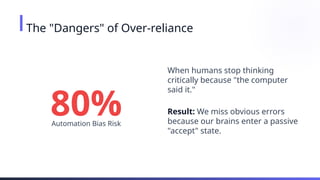
80%
Automation Bias Risk
Whenhumans stop thinking
critically because "the computer
said it."
Result: We miss obvious errors
because our brains enter a passive
"accept" state.
The "Dangers" of Over-reliance
18.
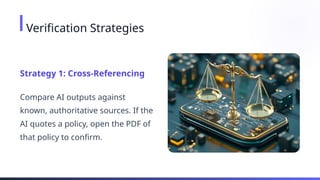
Strategy 1: Cross-Referencing
CompareAI outputs against
known, authoritative sources. If the
AI quotes a policy, open the PDF of
that policy to confirm.
Verification Strategies
19.
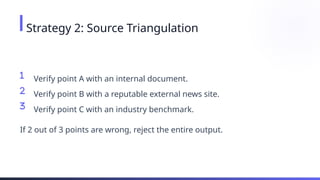
If 2 outof 3 points are wrong, reject the entire output.
Verify point A with an internal document.
Verify point B with a reputable external news site.
Verify point C with an industry benchmark.
Strategy 2: Source Triangulation
20.
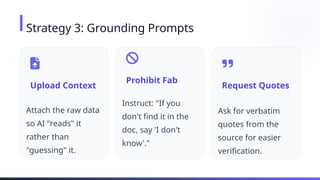
Upload Context
Attach theraw data
so AI "reads" it
rather than
"guessing" it.
Prohibit Fab
Instruct: "If you
don't find it in the
doc, say 'I don't
know'."
Request Quotes
Ask for verbatim
quotes from the
source for easier
verification.
Strategy 3: Grounding Prompts
21.
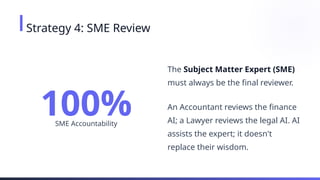
100%
SME Accountability
The SubjectMatter Expert (SME)
must always be the final reviewer.
An Accountant reviews the finance
AI; a Lawyer reviews the legal AI. AI
assists the expert; it doesn't
replace their wisdom.
Strategy 4: SME Review
22.
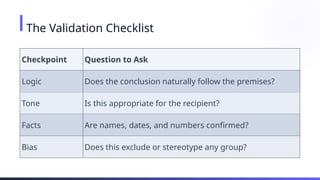
Checkpoint Question toAsk
Logic Does the conclusion naturally follow the premises?
Tone Is this appropriate for the recipient?
Facts Are names, dates, and numbers confirmed?
Bias Does this exclude or stereotype any group?
The Validation Checklist
23.
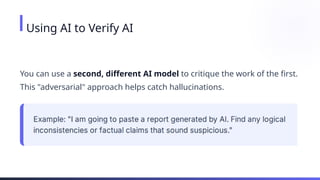
You can usea second, different AI model to critique the work of the first.
This "adversarial" approach helps catch hallucinations.
Using AI to Verify AI
24.
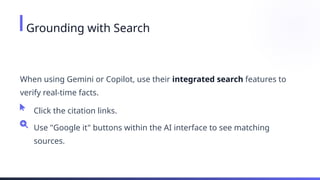
When using Geminior Copilot, use their integrated search features to
verify real-time facts.
Click the citation links.
Use "Google it" buttons within the AI interface to see matching
sources.
Grounding with Search
25.
A "Deep Audit"is required for high-
stakes documents (Board reports,
Legal filings, Public releases).
The Quality Audit
26.
A classic informationevaluation tool adapted for the age of Artificial
Intelligence.
Currency
Is the data up to
date?
Reliability
Does the AI cite its
work?
Authority
Is the AI the right
tool for this?
The C.R.A.P. Test for AI
27.
WHY?
Purpose: What isthe goal of this
output?
Is it meant to inform, persuade, or
entertain? AI often leans toward
"pleasing" the user, which can skew the
purpose of a neutral report.
Test: Purpose
28.
In the followingactivity, you will be given three "AI-generated"
paragraphs. Your mission is to find the hidden hallucinations and tone
issues.
Exercise Intro: Spot the Error
29.
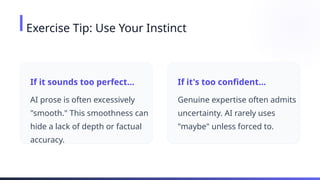
If it soundstoo perfect...
AI prose is often excessively
"smooth." This smoothness can
hide a lack of depth or factual
accuracy.
If it's too confident...
Genuine expertise often admits
uncertainty. AI rarely uses
"maybe" unless forced to.
Exercise Tip: Use Your Instinct
30.
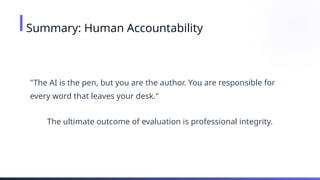
"The AI isthe pen, but you are the author. You are responsible for
every word that leaves your desk."
The ultimate outcome of evaluation is professional integrity.
Summary: Human Accountability
31.
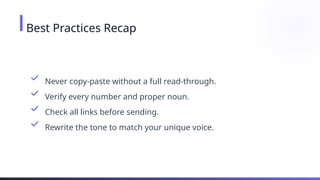
Never copy-paste withouta full read-through.
Verify every number and proper noun.
Check all links before sending.
Rewrite the tone to match your unique voice.
Best Practices Recap