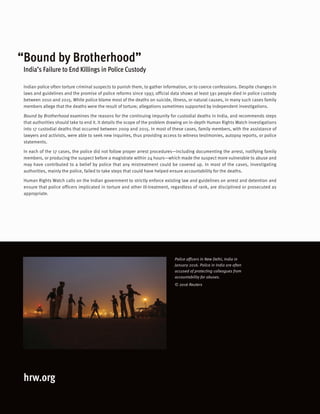
“Bound by Brotherhood”
India’s Failure to End Killings in Police Custody
H U M A N
R I G H T S
W A T C H
“Bound by Brotherhood”
India’s Failure to End Killings in Police Custody
Copyright © 2016 Human Rights Watch
All rights reserved.
Printed in the United States of America
ISBN: 978-1-6231-34334
Cover design by Rafael Jimenez
Human Rights Watch defends the rights of people worldwide. We scrupulously investigate
abuses, expose the facts widely, and pressure those with power to respect rights and
secure justice. Human Rights Watch is an independent, international organization that
works as part of a vibrant movement to uphold human dignity and advance the cause of
human rights for all.
Human Rights Watch is an international organization with staff in more than 40 countries,
and offices in Amsterdam, Beirut, Berlin, Brussels, Chicago, Geneva, Goma, Johannesburg,
London, Los Angeles, Moscow, Nairobi, New York, Paris, San Francisco, Sydney, Tokyo,
Toronto, Tunis, Washington DC, and Zurich.
For more information, please visit our website: http://www.hrw.org
DECEMBER 2016 ISBN: 978-1-6231-34334
“Bound by Brotherhood”
India’s Failure to End Killings in Police Custody
Summary ........................................................................................................................... 1
Police Failure to Follow Proper Arrest Procedures ......................................................................3
Failure to Hold Police Accountable for Custodial Deaths............................................................4
Intimidation of Victims’ Families and Witnesses....................................................................... 6
Key Recommendations.......................................................................................................8
Methodology......................................................................................................................9
I. Right to Life and Liberty in India .....................................................................................11
Persistence of Custodial Torture and Ill-Treatment...................................................................14
Legal Safeguards Against Custodial Violence.......................................................................... 15
National and State Human Rights Institutions.........................................................................18
Lack of Police Reformsp......................................................................................................... 20
A Law to Prevent Torture .........................................................................................................23
II. Unlawful Arrest and Detention......................................................................................24
Failure to Abide by Arrest Rules...............................................................................................24
Failure to Inform Family Members of Arrest and Enforced Disappearances ...............................38
Failure to Produce Suspects Before a Magistrate.....................................................................47
Failings by Magistrates ...........................................................................................................52
Lack of Adequate Medical Care...............................................................................................53
III. Lack of Accountability .................................................................................................62
Police Impunity...................................................................................................................... 62
Alleged Complicity of Medical Authorities in Cover-Ups.......................................................... 92
Intimidation of Victims’ Families and Witnesses Seeking Accountability................................. 96
The Role of the NHRC and State Human Rights Commissions in Pursuing Accountability........103
IV. Recommendations..................................................................................................... 106
To the Indian Parliament.......................................................................................................106
To the Union Home Ministry, Union Territory Police, State Home Ministries, and State Police. 107
To the National Human Rights Commission............................................................................111
To State Human Rights Commissions.................................................................................... 112
To Legal Service Authorities.................................................................................................. 112
To Foreign Governments and Donors......................................................................................113
Acknowledgments...........................................................................................................114
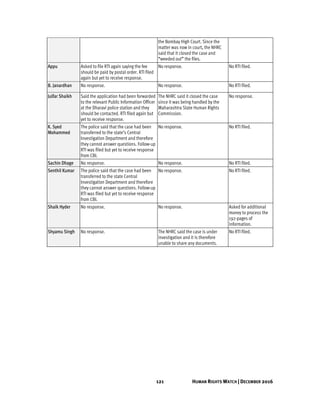
Appendix I: Sample Right to Information Letters.............................................................. 115
Appendix II: Table of Right to Information Responses ..................................................... 120
1 HUMAN RIGHTS WATCH | DECEMBER 2016
Summary
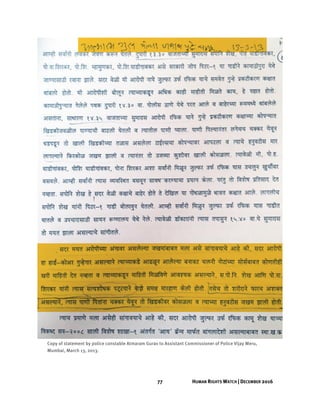
This is what I have to say about the wounds on the body of the said
accused. Since he was a hard core criminal, he refused to give any
information. It was essential to get that information from him, that’s why
[the police] used the “truth seeking” belt and beat him up in front of me. He
was so weak after the beating that when he got up to drink water, he was
dizzy with pain and collapsed against the window, breaking his lower jaw.
–Police constable testifying in Julfar Shaikh’s custodial death investigation, Mumbai, March 2013
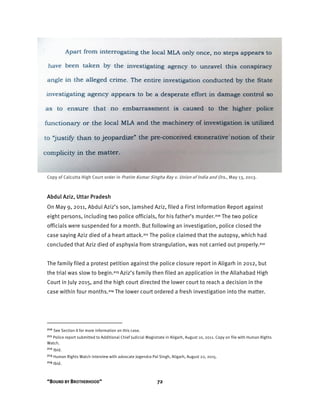
The entire investigation conducted by the state investigating agency
appears to be a desperate effort in damage control so as to ensure that no
embarrassment is caused to the higher police functionary.
–Pratim Kumar Singha Ray v. Union of India and Ors., Calcutta High Court on a case of death in
police custody, May 2013
Deaths of criminal suspects in custody occurs too often in India. In response to this
longstanding problem, Indian authorities including the courts and the National Human
Rights Commission have set out detailed procedures to prevent and punish police use of
torture and ill-treatment. However, Indian police still often torture suspects to punish
them, gather information, or coerce confessions.
According to the National Crime Records Bureau, between 2010 and 2015, 591 people died
in police custody. Police blame most of the deaths on suicide, illness, or natural causes.
For instance, of the 97 custody deaths reported by Indian authorities in 2015, police
records list only 6 as due to physical assault by police; 34 are listed as suicides, 11 as
deaths due to illness, 9 as natural deaths, and 12 as deaths during hospitalization or
treatment. However, in many such cases, family members allege that the deaths were the
result of torture.
While investigations were ordered by courts, human rights commissions, or other
authorities in some cases, Human Rights Watch is not aware of a single case in which a
police official was convicted for a custodial death between 2010 and 2015. Four policemen
in Mumbai were convicted in 2016 for the custodial death of a 20-year-old suspect in 2013.
“BOUND BY BROTHERHOOD” 2
This report examines the reasons for the continuing impunity for custodial deaths in India,
and recommends steps that authorities can and should take to end it. It details the scope
of the problem drawing on in-depth Human Rights Watch investigations into 17 custodial
deaths that occurred between 2009 and 2015, research by Indian organizations, and more
than 70 Human Rights Watch interviews with victims’ family members, witnesses, justice
experts, and police officials.
Ultimately, police abuse reflects a failure by India’s central government and state
governments to implement accountability mechanisms. Despite strict guidelines, the
authorities routinely fail to conduct rigorous investigations and prosecute police officials
implicated in torture and ill-treatment of arrested persons.
Police investigators often close cases relying solely on the accounts of the implicated
police officers. Maja Daruwala, executive director of the New Delhi-based rights
organization Commonwealth Human Rights Initiative, which has long campaigned for
police reform, said that even though police deny that they engage in cover-ups to protect
officers who commit abuse, there are serious gaps in both accountability and supervision:
“The police as an organization has to decide whether shielding bad policing, illegal
policing, and what amounts to murder is of value to their efficiency.”
Most cases detailed in this report involve family members who sought a judicial remedy with
assistance from lawyers or rights defenders, in which police records, medical records, and
other relevant documents are thus publicly available. Many of the cases are still pending in
courts. A number of independent investigations ordered by courts have uncovered serious
due process violations, in addition to compelling evidence of physical mistreatment.
In each of the 17 cases, the police did not follow proper arrest procedures—including
documenting the arrest, notifying family members, conducting medical examinations, or
producing the suspect before a magistrate within 24 hours—which made the suspect more
vulnerable to abuse and may have contributed to a belief by police that any mistreatment
could be covered up. In most cases, investigating authorities, mainly the police, failed to
take steps that could have helped ensure accountability for the deaths.
3 HUMAN RIGHTS WATCH | DECEMBER 2016
Police Failure to Follow Proper Arrest Procedures
Usually, torture is likely when suspects are first brought into custody, which is why proper
arresting procedures are crucial to prevent assault or death. For instance, police in
Hyderabad failed to register the arrest of B. Janardhan after they picked him up on August
2, 2009. Family members said they saw him in police custody on August 3, when four
policemen brought him briefly to his house. They said he was handcuffed and that the
officers repeatedly beat him. On August 4, Janardhan died while in police custody. The
police refused to admit to any wrongdoing, telling family members, “What could we do? He
died of a heart attack.” But Janardhan’s brother Sadanand said that the body had injuries
from apparent police beatings. The police initially denied that Janardhan was illegally
detained for two days, but following protests, the police chief admitted that his officers
were negligent and Janardhan should have been brought to the police station, with his
arrest duly noted, instead of being taken on a search operation.
As in Janardhan’s case, Indian police often bypass Supreme Court rules to prevent
custodial abuse set out in the case of D.K. Basu v. West Bengal nearly two decades ago in
1997. Since incorporated into the amended Code of Criminal Procedure, the rules call for
the police to identify themselves clearly when making an arrest; prepare a memo of arrest
with the date and time of arrest that is signed by an independent witness and
countersigned by the arrested person; and ensure that next of kin are informed of the
arrest and the place of detention.
The rules require arrested persons to be medically examined after being taken into
custody, with the doctor listing any pre-existing injuries—any new injuries will point to
police abuse in custody. Another important check on police abuse is the requirement that
every arrested person is produced before a magistrate within 24 hours. The magistrates
have a duty to prevent overreach of police powers by inspecting arrest-related documents
and ensuring the wellbeing of suspects by directly questioning them.
In practice, these protections have not prevented the worst custodial abuses. According to
government data, in 67 of 97 deaths in custody in 2015, the police either failed to produce
the suspects before a magistrate within 24 hours as required by law, or the suspects died
within 24 hours of being arrested.
“BOUND BY BROTHERHOOD” 4
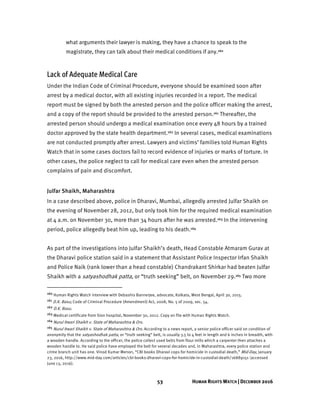
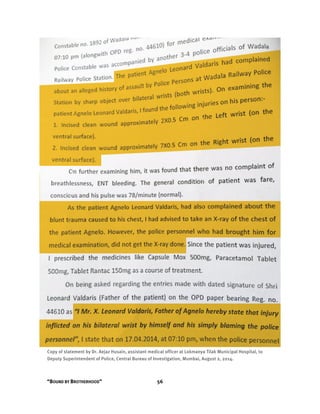
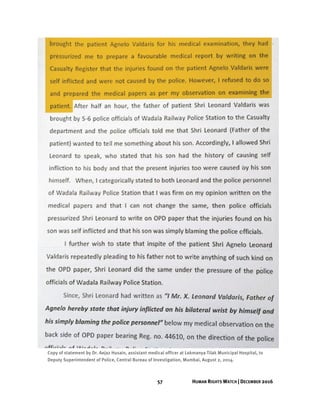
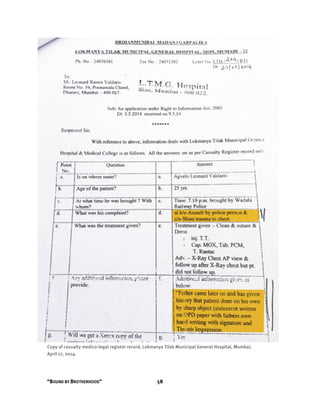
Agnelo Valdaris and three co-accused in April 2014 were beaten by police in Mumbai so
they would confess to stealing goods. While the suspects said they were warned from
saying anything during the mandatory medical check-up, the medical report includes a
record that Valdaris told the doctor his injuries were a result of police beatings. Before he
could be produced before a magistrate, the police said that Valdaris was hit and killed by a
train while trying to escape—a conclusion his co-accused found implausible given his
physical condition. “The police personnel killed my son because they were scared that he
was going to complain about the torture to the magistrate,” Valdaris’s father told Human
Rights Watch.
But the statistics also indicate that adhering to the rules on presenting people before
magistrates and conducting medical tests will not necessarily spare suspects from being
tortured. Suspects are afraid to say they have been mistreated or that medical staff did not
carry out their responsibilities in a professional or impartial manner. “The police often give
some explanations that the arrested person was trying to abscond or run away, and at that
time, got injured. Even the accused won’t say anything because he knows he might be sent
back in police custody,” a magistrate told Human Rights Watch.
The failure of police to abide by arrest and detention rules makes suspects more
vulnerable to mistreatment. The police have adopted many ways to get around the
custodial rules. Complained a magistrate in Tamil Nadu, “Police have their own code of
police procedure. They don’t follow the Code of Criminal Procedure.”
Failure to Hold Police Accountable for Custodial Deaths
Indian law requires a judicial magistrate to conduct an inquiry into every custodial death.
The police are expected to register a First Information Report (FIR) and the death
investigated by a police station or agency other than the one implicated. Every case of
custodial death is also supposed to be reported to the National Human Rights Commission
(NHRC). The police are also required to report the findings of the magistrate’s inquiry to the
NHRC along with the post-mortem report. NHRC rules call for the autopsy be filmed and the
autopsy report to be prepared according to a model form.
Human Rights Watch research, court decisions, and media accounts show that these steps
are frequently ignored. According to government data, a judicial inquiry was conducted in
5 HUMAN RIGHTS WATCH | DECEMBER 2016
only 31 of the 97 custodial deaths reported in 2015. In 26 cases, there was not even an
autopsy of the deceased. In some states, an executive magistrate—who belongs to the
executive branch of the government as do the police, and therefore is not independent and
is likely to face pressures not to act impartially—conducts the investigation rather than a
judicial magistrate.
Internal departmental inquiries to examine wrongdoing rarely find police culpable. The
police also may delay or resist filing complaints against implicated police officers. In 2015,
police registered cases against fellow police officers in only 33 of the 97 custodial deaths.
Said Satyabrata Pal, until 2014 a member of the National Human Rights Commission:
The entire intention in a police internal investigation is to whitewash so
they deliberately do not look at what you need to find the truth.… The police
investigation is not worth the paper it’s written on.
After Shyamu Singh died in police custody on April 15, 2012, in Uttar Pradesh state, police
said that Singh had committed suicide. But his brother who was arrested with him said
that after their arrest, both were stripped down to their underwear and tortured:
[The police officers] put us down on the floor. Four people held me down
and one man poured water down my nose continuously. I couldn’t breathe.
Once they stopped on me, they started on Shyamu. Shyamu fell
unconscious. So they started worrying and talking among themselves that
he is going to die. One of the men got a little packet and put the contents in
Shyamu’s mouth.
Shyamu Singh died in the hospital. The police dismissed allegations of death from torture
after holding a cursory internal investigation. The state Criminal Investigation Department
(CID) conducted an initial investigation and concluded in 2014 that seven police officers
were responsible for torturing Singh and poisoning him to death. However, a final inquiry
report submitted a year later cleared all seven.
One challenge for accountability in custodial deaths is the propensity of government
doctors to back police claims. Autopsy and forensic reports frequently support the police
version of events even where there is no apparent basis. Julfar Shaikh, 35, died at a
“BOUND BY BROTHERHOOD” 6
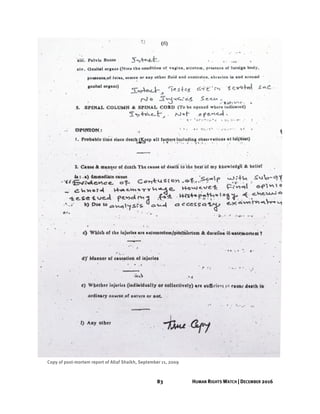
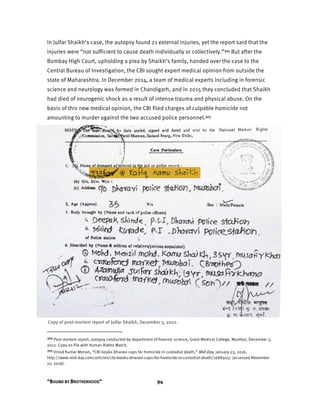
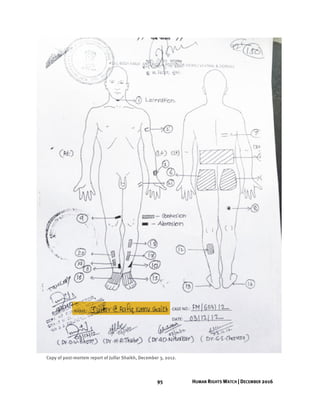
Mumbai police station on December 2, 2012. An autopsy found 21 external injuries, yet the
report said that the injuries were “not sufficient to cause death.” A panel of doctors
agreed, saying that Shaikh died of meningitis and “subarachnoid haemorrhage.” However,
expert medical opinion from outside the state of Maharashtra sought by the Central
Bureau of Investigation as part of a fresh inquiry found that Shaikh died of neurogenic
shock as a result of intense trauma and physical abuse. “The problem in the prosecution
of a custodial death case is that as soon as the medical [report] goes against you, the case
is finished,” Shaikh’s advocate Yug Mohit Chaudhry said. “Only when the medical
supports you, there is a chance.”
India’s Supreme Court has repeatedly noted that with custodial crimes, producing
evidence against the police is very difficult because the police feel “bound by their ties of
brotherhood.” The government and courts need to more rigorously address the willingness
of police to shield those responsible.
The national and state human rights commissions have largely failed in their oversight role
in cases of custodial killings. The National Human Rights Commission is empowered to
summon witnesses, order production of evidence, and recommend that the government
initiate prosecution of officials. However, in practice its recommendations have mostly
been limited to calling on the government to provide compensation or other immediate
interim relief. Between April 2012 and June 2015, of the 432 cases of deaths in police
custody reported to the NHRC, the commission recommended monetary relief totaling
about 22,910,000 rupees (US$343,400), but recommended disciplinary action in only
three cases and prosecution in none.
Intimidation of Victims’ Families and Witnesses
In custodial death cases, families of victims seeking justice often face intimidation and
threats. Many of these families are poor and socially marginalized, making them especially
vulnerable to such harassment. During the prosecution of policemen for the death of
Agnelo Valdaris, the Bombay High Court in September 2015 noted:
It is common knowledge that most of these people who have died in the
police custody belong to lower strata of society and belong to minority
community and these persons do not have knowledge about the State
7 HUMAN RIGHTS WATCH | DECEMBER 2016
policy to engage/appoint lawyer so that they can be properly represented in
Court matters.
Rajib Molla, a 21-year-old vegetable seller, was arrested on February 15, 2014, in West
Bengal state, and died the same day in police custody. The police said he committed
suicide but his wife alleged he died from torture. Molla’s wife said that ever since she
sought judicial intervention in the case, powerful men in the area threatened her to
withdraw her complaint. Banglar Manabadhikar Suraksha Mancha (MASUM), a
nongovernmental organization that was supporting her, also reported threats and the
detention and beating of one of its staff members.
***
India has ratified the International Covenant on Civil and Political Rights and signed the
Convention against Torture and Other Cruel, Inhuman or Degrading Treatment, both of
which prohibit torture and cruel, inhuman, and degrading treatment or punishment. They
also provide for the authorities to prosecute the officials responsible. These commitments
are reflected in Indian central and state laws that condemn torture, and provide some
procedural safeguards against it.
The Supreme Court has also interpreted the constitutional right to liberty and human dignity
as an “an inbuilt guarantee against torture or assault by the State or its functionaries.”
In many of the cases detailed in this report, deaths in custody could have been prevented
if police had followed the rules designed to deter mistreatment. And if police accused of
mistreating suspects were promptly and fairly brought to justice across India, perhaps
custodial deaths from torture would cease once and for all.
“BOUND BY BROTHERHOOD” 8
Key Recommendations
• Strictly enforce existing laws and guidelines on arrest and detention in the Code of
Criminal Procedure and the Supreme Court’s D.K. Basu decision, particularly with
respect to recording detentions, informing families, producing suspects before
magistrates, and providing medical examinations.
• Ensure that police officers implicated in torture and other ill-treatment, regardless
of rank, are disciplined or prosecuted as appropriate.
• Ratify the Convention against Torture and incorporate its provisions into
domestic law.
• Enact an adequately funded and effective victim and witness protection law.
9 HUMAN RIGHTS WATCH | DECEMBER 2016
Methodology
This report is based on Human Rights Watch field research and interviews conducted in
India from April 2015 to April 2016. Human Rights Watch interviewed more than 45
witnesses and family members of victims of custodial death. In addition, Human Rights
Watch spoke with more than 25 lawyers, civil society activists, and journalists who work on
police torture and abuse to understand the context and obstacles to justice for victims of
police abuse. Human Rights Watch also interviewed four serving and retired police officials
and magistrates, and a retired judge.
Interviews were conducted in several parts of India, including the states of West Bengal,
Tamil Nadu, Telangana, and Uttar Pradesh, and the cities of New Delhi and Mumbai.
The report follows a 2009 Human Rights Watch report, Broken System: Dysfunction, Abuse,
and Impunity in the Indian Police, that discussed some of the most common human rights
violations committed by police in India. The 2009 report examined abuses by the police
against individuals and the conditions that facilitated and encouraged police to commit
those abuses. Human Rights Watch found that police misbehavior is deeply rooted in
institutional practice and persists due to federal and state governments’ failure to hold
abusers accountable and overhaul the structure and practices that enable abusive
patterns of behavior.
This report documents recent cases to show that police abuses continue despite changes
in laws and guidelines and the promise of police reforms since 1997. While police are
known to commit human rights abuses against those accused in alleged terrorism cases,
and to commit extrajudicial killings with impunity in insurgency-affected areas, this report
focuses solely on cases of custodial death during routine police operations.
Most of the 17 cases detailed here are cases where family members, with the support of
lawyers or human rights advocates, have sought a judicial remedy. This gave us access to
police and medical records and other relevant documents that provide compelling evidence
of police abuse and negligence. Human Rights Watch, with the consent of the victim’s family,
witness, or their lawyer, received and has retained copies of such relevant documents.
“BOUND BY BROTHERHOOD” 10
Human Rights Watch provided no remuneration or other inducement to the
interviewees. In some cases, funds were provided to cover food and travel expenses
incurred by the witnesses for the interviews. Most interviews were conducted either in
Hindi or English. In Tamil Nadu state, some interviews were conducted in Tamil through
an independent interpreter. In West Bengal, some interviews were conducted in
Bengali through an interpreter.
Human Rights Watch drafted “right to information” letters for all pending cases documented
in the report to seek information from the police on whether they followed rules and
procedures during the victim’s arrest and detention, and the investigation into the death.
Human Rights Watch developed the model based on consultation and guidance from
Venkatesh Nayak, coordinator of the access to justice program at the Delhi-based
Commonwealth Human Rights Initiative. Local nongovernmental organizations filed the
applications under the Right to Information Act to seek information from the relevant district
and state police authorities and the national and state human rights commissions. Sample
right to information letters are included in the appendix. A complete table of the applications
filed and responses received at time of writing is also available in the appendix.
11 HUMAN RIGHTS WATCH | DECEMBER 2016
I. Right to Life and Liberty in India
Is it practical to follow the D.K. Basu rules of arrest and detention? Those
are only if society is ideal. It is not possible to follow these in the
environment we work.
–Sub-Inspector of Police, Uttar Pradesh, August 2015
Police in India routinely violate domestic and international laws governing due process for
arrest and detention. Many law enforcement officials view the use of force to obtain
confessions and information as an acceptable and necessary tool for investigating crime
and enforcing the law.
In our 2009 report, Broken System: Dysfunction, Abuse, and Impunity in the Indian Police,
Human Rights Watch found that police abuse of criminal suspects is deeply rooted, and it
persists due to lack of accountability and a failure to overhaul the structure and practices
that enable rights violations.1 At the same time, poor work conditions and a lack of proper
training in modern evidence-based investigation leads the police to rely on torture and
coercion. One policeman told Human Rights Watch:
No one has the right to torture but it mostly happens when we are trying to
get information to solve crime. Police are under tremendous pressure and
that is why we use shortcuts. Because if you ask the accused they will only
say they are not guilty.2
In addition to physically abusing suspects to gain information in investigations, police
also beat and torture suspects as retribution, choosing to punish crimes themselves
instead of doing the necessary work to gather evidence that will bring convictions in court.
1 Human Rights Watch, Broken System: Dysfunction, Abuse, and Impunity in the Indian Police, August 2008,
https://www.hrw.org/report/2009/08/04/broken-system/dysfunction-abuse-and-impunity-indian-police.
2 Human Rights Watch interview with sub-inspector of police, Varanasi district, Uttar Pradesh, August 20, 2015.
“BOUND BY BROTHERHOOD” 12
According to the National Crime Records Bureau, 591 people died in police custody between
2010 and 2015.3 They reflect all causes of death, including from torture. However, the figures
do not reflect the actual scale of torture because they do not include the numerous cases of
torture and ill-treatment in police custody not resulting in death.
The prohibition against torture is well-grounded in Indian law. India’s constitution
guarantees fundamental human rights to all, including right to life and liberty. The
Supreme Court has over the years sought to ensure adherence to these fundamental
rights by requiring that all state action be just, fair, and reasonable.4 In a 1981 decision,
the court stated:
No law which authorises and no procedure which leads to such torture or
cruelty, inhuman or degrading treatment can ever stand the test of
reasonableness and non-arbitrariness: it would plainly be unconstitutional
and void as being violative of Article 14 and 21.5
In its various judgments, the Supreme Court has laid down directives for law enforcement
that deal with various aspects of police work, including registering cases, treatment of
arrested persons, and conducting interrogations.6 Most of these guidelines have since
been incorporated into the Code of Criminal Procedure, which provides the statutory basis
of criminal due process.7 The courts have also provided directives for police on issues such
as protection of the rights of women, the poor, and the disadvantaged.8
3 “Crime in India, 2015,” National Crime Records Bureau, Ministry of Home Affairs, Government of India, http://ncrb.gov.in/
(accessed September 10, 2016); “Crime in India, 2014,” http://ncrb.nic.in/StatPublications/CII/CII2014/cii2014.asp
(accessed April 23, 2016); “Crime in India, 2013,” http://ncrb.nic.in/StatPublications/CII/CII2013/compendium%
202013_NEW.pdf (accessed April 23, 2016); “Crime in India, 2010,”
http://ncrb.nic.in/StatPublications/CII/cii2010/Compendium2010.pdf (accessed April 23, 2016).
4 Nitya Ramakrishnan, In Custody: Law, Impunity and Prisoner Abuse in South Asia (New Delhi: Sage Publications and South
Asians for Human Rights, 2013).
5 Francis Coralie Mullin v. Union Territory of Delhi, Supreme Court of India, AIR 746, SCR (2) 516, 1981,
http://indiankanoon.org/doc/78536/ (accessed August 12, 2015).
6 One such landmark judgment is the 1997 D.K. Basu v. State of West Bengal decision, in which the Supreme Court
recognized the prevalence of custodial torture: “Experience show that worst violations of human rights take place during the
course of investigation, when the police with a view to secure evidence or confession often resorts to third-degree methods
including torture.” D.K. Basu v. State of West Bengal, 1 SCC 416, 1997.
7 Code of Criminal Procedure, 1973, section 41, dealing with warrantless arrests, was amended by Act 5 of 2009; sections 41A
on notice of appearance before police officer, 41B dealing with procedure of arrest and duties of police officers making
arrests, 41C on district control rooms, and 41D on right of arrested person to meet an advocate of their choice during
interrogation were added by Act 5 of 2009; section 46 on how arrests were made was amended first by Act 25 of 2005 and
then by Act 5 of 2009; section 50A on obligation of person making arrest to inform about the arrests, etc. to a nominated
13 HUMAN RIGHTS WATCH | DECEMBER 2016
India has also ratified the International Covenant on Civil and Political Rights and signed
the Convention against Torture, both of which prohibit torture and cruel, inhuman, and
degrading treatment.9 India has also signed but is yet to ratify the International Convention
against Enforced Disappearance, which seeks to deter torture and other grave abuses.10
Despite this body of law, torture in custody remains a serious problem in India. Indian
human rights organizations have documented widespread police torture.11 On several
occasions in the last two decades, Indian courts have observed that “dehumanizing
torture, assault and death in custody” are so “widespread” as to “raise serious questions
about credibility of rule of law and administration of criminal justice.”12
person was added by Act 25 of 2007; section 53 on examination of accused by medical practitioner at the request of police
officer was amended by Act 25 of 2005; section 53A on examination of person accused of rape by medical practitioner was
added by Act 25 of 2005; section 54 on examination of arrested person by medical officer was amended by Act 5 of 2009;
section 55A on health and safety of arrested person was added by Act 5 of 2009; section 60 on arrest should be made strictly
according to the provisions of the Code of Criminal Procedure was added by Act 5 of 2009; section 164A on medical
examination of the victim of rape added by Act 25 of 2005; and section 176(1A) on inquiry by a magistrate into custodial
death was amended by Act 25 of 2005.
8 Mandeep Tiwana, Human Rights and Policing: Landmark Supreme Court Directives and National Human Rights Commission
Guidelines (New Delhi: Commonwealth Human Rights Initiative, April 2005),
http://www.humanrightsinitiative.org/publications/hrc/humanrights_policing.pdf (accessed February 2, 2016).
9 International Covenant on Civil and Political Rights (ICCPR), G.A. res. 2200A (XXI), 21 U.N. GAOR Supp. (No. 16) at 52, U.N.
Doc. A/6316 (1966), 999 U.N.T.S. 171, entered into force Mar. 23, 1976, arts. 3 and 7. Convention against Torture and Other
Cruel, Inhuman or Degrading Treatment or Punishment (Convention against Torture), adopted December 10, 1984, G.A. res.
39/46, annex, 39 U.N. GAOR Supp. (No. 51) at 197, U.N. Doc. A/39/51 (1984), entered into force June 26, 1987, art. 1. As a
signatory that has not ratified the Convention against Torture, India is not legally bound to implement the provisions of the
treaty but cannot act to defeat its object and purpose. Vienna Convention on the Law of Treaties, concluded May 23, 1969,
1155 U.N.T.S. 331, entered into force January 27, 1980, art. 18.
10 International Convention for the Protection of All Persons from Enforced Disappearance, E/CN.4/2005/WG.22/WP.1/Rev.4
(2005). India signed the convention in 2007. International human rights law defines arbitrary arrest and detention as those
deprivations of liberty that are not “in accordance with procedures as are established by law,” or that include elements of
inappropriateness, injustice, and lack of predictability. Arbitrary deprivations of liberty are broader than “unlawful”
deprivations, and include the arrest and detention of individuals for exercising their rights to freedom of expression,
association, and peaceful assembly. See ICCPR, art. 9(1); S. Joseph and M. Castan, The International Covenant on Civil and
Political Rights (Oxford: Oxford Univ. Press, 3d ed. 2013), secs. 11.11 to 11.15.
11 Between January 2006 and August 2008, the National Project on Preventing Torture in India documented 6,063 cases of
police torture in 47 districts across nine states. People’s Watch, “Torture and Impunity in India,” November 2008,
http://www.pwtn.org/tortureandimpunitybook.htm (accessed July 15, 2009). In several reports, the Asian Centre for Human
Rights has examined patterns of torture by police, discussing cases it has documented and analyzing media reports of
torture. See ACHR, Torture in India 2009 (New Delhi: ACHR, June 2009); Torture in India 2008 (New Delhi: ACHR, June 2008);
India Human Rights Report 2009 (New Delhi: ACHR, May 2009); India Human Rights Report 2008 (New Delhi: ACHR, May
2008); ACHR’s Actions Against Torture and Other Forms of Human Rights Violations in India (New Delhi: ACHR, 2009),
http://www.achrweb.org/ (accessed July 15, 2009).
12 Dalbir Singh v. State of U.P. and Ors., Supreme Court of India, W.P.(Crl.) No. 193 of 2006, decided March 2, 2009, paras. 8-
9. The court noted that procedural safeguards for arrest and detention established in D.K. Basu v. State of West Bengal,
“Seem to have caused not even any softening attitude to the inhuman approach in dealing with persons in custody.”
“BOUND BY BROTHERHOOD” 14
Persistence of Custodial Torture and Ill-Treatment
Lack of training and resources for scientific methods of forensic investigation contribute to
the use of torture during interrogations. Forensic laboratories are often understaffed and
have a significant backlog of cases.13
N. Ramachandran, a former director-general of police and current president of the Indian
Police Foundation, an independent nongovernmental organization, told Human Rights Watch
that the culture of investigation has to change in order to end torture in police custody:
Even today in India, we do not depend on forensics to the level we need to.
It is sub-optimally used and instead police, especially junior level police
officials, resort to extracting confessions using third-degree methods.
Incidents have come down but are still happening. Police are not trained or
equipped in the use of forensics. Most forensic labs in the country are
understaffed. Tens of thousands of cases will be pending for want of
forensic results.14
In 2000, the government-sponsored Padmanabhaiah Committee on Police Reforms stated:
A large section of people strongly believe that the police cannot deliver and
cannot be effective if it does not use strong-arm methods against the
criminals and anti-social elements of society. And these people include
India’s political class, the bureaucracy, and large sections of the upper and
middle class.… In their own perception, the policemen feel that they are
doing a job. They resort to torture for “professional objectives”—to extract
information or confession in order to solve a case.15
13 See, for example, Sana Shakil, “8,500 samples pending, forensic labs test cops' patience,” Times of India, February 3,
2016, http://timesofindia.indiatimes.com/city/delhi/8500-samples-pending-forensic-labs-test-cops-
patience/articleshow/50827632.cms (accessed February 6, 2016).
14 Human Rights Watch interview with N. Ramachandran, president of the Indian Police Foundation, New Delhi, December 16,
2015.
15 Padmanabhaiah, Committee on Police Reforms, October 2000. More recently, the Asian Centre for Human Rights has
documented several cases of police torture to extract confessions from criminal suspects. See ACHR, Torture in India 2009,
pp. 29-32; Torture in India 2008, pp. 12-16.
15 HUMAN RIGHTS WATCH | DECEMBER 2016
Legal Safeguards Against Custodial Violence
The Indian Penal Code has several provisions prohibiting custodial violence. For instance,
under section 330 of the code, voluntarily causing hurt for the purpose of extorting a
confession or to compel restoration of property carries a punishment of up to seven years
in prison and a fine.16 This also applies to police officials who use torture to obtain a
confession or information about stolen property. If the harm inflicted is grievous, the
punishment can extend up to 10 years in prison.17 Public servants disobeying the law, with
intent to cause injury to any person, can go to prison for one year.18 However, charges are
rarely brought against police officers violating these provisions.19
In 1985, the Law Commission of India had recommended that the Indian Evidence Act,
1872, be amended to stipulate that if a person suffers any bodily injury while in police
custody, the courts may presume that the injury was caused by the police officer who had
the custody of that person.20
Recognizing the inadequacy of the laws, the Supreme Court’s judgment in D.K. Basu lays
down certain guidelines to establish mandatory procedures for police detention, including
interrogation.21 The Supreme Court has said that police personnel failing to comply with
D.K. Basu guidelines can be tried for contempt of court and also punished through
departmental action. Because the Code of Criminal Procedure covers most of these
guidelines, a failure to comply is also punishable under several provisions of the Indian
Penal Code.22 Lawyer Trideep Pais says these guidelines are very important to check
custodial abuse: “D.K. Basu is not just for ensuring the health of the accused, but also to
ensure there is no tampering or falsification of evidence, timelines are not dodged, and
torture does not happen.”23
16 Indian Penal Code (IPC), 1860, sec. 330, http://indiankanoon.org/doc/2858386/.
17 IPC sec. 331, http://indiankanoon.org/doc/1135572/.
18 IPC sec. 166, http://indiankanoon.org/doc/570574/.
19 See National Crime Records Bureau, Crime in India: 2014; Crime in India: 2013; Crime in India: 2010.
20 Law Commission of India, 113th Report on Injuries in Police Custody, July 29, 1985,
http://lawcommissionofindia.nic.in/101-169/report113.pdf (accessed June 25, 2016).
21 D.K. Basu v. State of West Bengal, p. 14-15.
22 Indian Penal Code, secs. 217-219. Punishment varies from two to seven years of imprisonment.
23 Human Rights Watch interview with Trideep Pais, New Delhi, April 1, 2015.
“BOUND BY BROTHERHOOD” 16
Under the Code of Criminal Procedure, in addition to police investigation, an inquiry by a
judicial magistrate is mandatory in cases of death, enforced disappearance, or alleged rape
in police custody.24 However, the NHRC has interpreted the law to mean that an inquiry by a
judicial magistrate is not in fact mandatory in all such cases. In April 2010, the NHRC sent a
notification to all states saying a judicial inquiry is mandatory only in those cases of
custodial deaths “where there is reasonable suspicion of foul play or well founded allegation
of commission of an offense. All other cases of custodial death where the death is natural or
caused by disease may be enquired into by an executive magistrate.”25
The NHRC has issued guidelines requiring that police report every case of custodial death
to the commission within 24 hours and that a magistrate should inquire into every case of
death, preferably within three months.26 To ensure fair and impartial investigation, police
should register a First Information Report (FIR) whenever a culpable act of homicide is
alleged, and the case must be investigated by a police station or agency other than the
one implicated. Further, the NHRC asks that post-mortems in custodial deaths should be
filmed and the autopsy report should be prepared as per the commission’s model form.27
24 Code of Criminal Procedure (CrPC), section 176. (“Inquiry by Magistrate into cause of death. (1) when the case is of the
nature referred to in clause (i) or clause (ii) of sub-section (3) of section 174, the nearest Magistrate empowered to hold
inquests shall, and in any other case mentioned in sub- section (1) of section 174, any Magistrate so empowered may hold an
inquiry into the cause of death either instead of, or in addition to, the investigation held by the police officer; and if he does
so, he shall have all the powers in conducting it which he would have in holding an inquiry into an offence. (1A) Where, (a)
any person dies or disappears, or (b) rape is alleged to have been committed on any woman, while such person or woman is
in the custody of the police or in any other custody authorized by the Magistrate or the Court, under this Code in addition to
the inquiry or investigation held by the police, an inquiry shall be held by the Judicial Magistrate or the Metropolitan
Magistrate, as the case may be, within whose local jurisdiction the offence has been committed. (2) The Magistrate holding
such an inquiry shall record the evidence taken by him in connection therewith in any manner hereinafter prescribed
according to the circumstances of the case. (3) Whenever such Magistrate considers it expedient to make an examination of
the dead body of any person who has been already interred, in order to discover the cause of his death, the Magistrate may
cause the body to be disinterred and examined. (4) Where an inquiry is to be held under this section, the Magistrate shall,
wherever practicable, inform the relatives of the deceased whose names and addresses are known, and shall allow them to
remain present at the inquiry. (5) The Judicial Magistrate or the Metropolitan Magistrate or Executive Magistrate or police
officer holding an inquiry or investigation, as the case may be, under sub-section (1A) shall, within twenty-four hours of the
death of a person, forward the body with a view to its being examined to the nearest Civil Surgeon or other qualified medical
man appointed in this behalf by the State Government, unless it is not possible to do so for reasons to be recorded in
writing.”)
25 Guidelines/Clarification issued by the National Human Rights Commission in respect of the interpretation of section
176(1A) of CrPC, April 5, 2010, http://police.puducherry.gov.in/Guidelines%20clarification%20section%20176%20
CrPC%20by%20the%20NHRC.pdf (accessed July 23, 2016).
26 National Human Rights Commission, Revised Guidelines/Procedures to be followed in cases of deaths caused in police
action, May 12, 2010, http://nhrc.nic.in/documents/Death%20During%20the%20course%20of%20Police%20Action.pdf
(accessed July 23, 2016).
27 Letter from National Human Rights Commission to all Home Secretaries regarding the revised instructions to be followed
while sending post-mortem reports in cases of custodial deaths, January 3, 2011, http://nhrc.nic.in/Documents/
PostMortemReportInstructions.pdf (accessed August 13, 2015).
17 HUMAN RIGHTS WATCH | DECEMBER 2016
Police are also required to submit a second report to the NHRC in all these cases that
should include a post-mortem report and findings of a magisterial or departmental inquiry
into the death.
Based on these findings, the NHRC can recommend compensation, but accountability
remains a challenge. Section 197 of the Code of Criminal Procedure provides immunity
from prosecution to all public officials unless the government approves the
prosecution.28 The central and state governments often use this provision to deny
prosecution of police officials.29
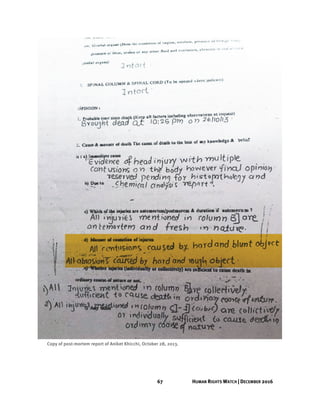
In a rare and important ruling in January 2016, the sessions court in Mumbai convicted four
police constables of culpable homicide for beating to death in custody a 20-year-old
suspect, Aniket Khicchi, in 2013.30 The constables now face up to seven years in prison.
Crucially, while delivering the ruling, Judge S.M. Bhosale noted that police failed to
conduct an effective investigation into the death. The judge said the investigating officer
did not have an expert examine the closed-circuit television footage, did not record the
statement of the station house officer present on duty, did not examine the body
immediately after death, and did not immediately order a post-mortem examination.31
In August 2014, a two-judge bench of the Bombay High Court laid down some guidelines
for the Maharashtra state government and the police to prevent custodial death, including
28 CrPC, sec. 197 (“When any person who is or was a Judge or Magistrate or a public servant not removable from his office
save by or with the sanction of the Government is accused of any offence alleged to have been committed by him while
acting or purporting to act in the discharge of his official duty, no Court shall take cognizance of such offence except with the
previous sanction.”).
29 In September 2014, the Supreme Court issued further requirements to be followed when investigating deaths in police
encounters. The guidelines include a provision that the police should record any intelligence or tip-offs received in
connection with criminal offences. If police officers use firearms when following up on such a tip-off, and kill someone, they
should immediately file a First Information Report and forward it to the court without any delay. There should be an
independent investigation into the matter by the state criminal investigation department or a police team from another
police station. The Supreme Court also called for a magisterial inquiry under sec. 176 of the Code of Criminal Procedure in all
cases of death that occur in the course of police shootings, and for the inquiry report to be sent to a judicial magistrate.
Finally, it reiterated some of the guidelines laid down by the National Human Rights Commission, including that police
officers who are accused in such cases should not receive out-of-turn promotions or gallantry awards for their actions. See
People’s Union for Civil Liberties and Anr. v. State of Maharashtra and Ors., Supreme Court of India, Criminal Appeal No. 1255
of 1999, September 23, 2014, http://supremecourtofindia.nic.in/outtoday/ar12551999.pdf (accessed August 15, 2015).
30 See Sections II and III for more information on this case.
31 Rebecca Samervel, “Police probe in custody death not done with care,” Times of India, February 7, 2016,
http://timesofindia.indiatimes.com/city/mumbai/Police-probe-in-custody-death-not-done-with-
care/articleshow/50884004.cms (accessed February 11, 2016).
“BOUND BY BROTHERHOOD” 18
mandatory use of closed-circuit cameras.32 In October 2015, the same two-judge bench
asked the Maharashtra state government to form a three-member committee and suggest
a long-term plan for preventing custodial deaths.33 The committee submitted a report to
the High Court in April 2016. While the report is yet to be made public, news reports
suggest that it lists over 40 recommendations, including wider use of closed-circuit
television and measures to assess the medical needs and health of the arrested person.34
National and State Human Rights Institutions
The National Human Rights Commission (NHRC) was established in 1993 based on the
provisions of the Protection of Human Rights Act, 1993.35 The NHRC does not have
prosecutorial powers, but it may recommend that the government initiate prosecution of
officials, or approach the Supreme Court or High Court to issue directions or orders. It also
has authority to review and recommend measures to effectively implement human rights
safeguards and to recommend that the government provide immediate interim relief to
victims in the form of monetary compensation.
The National Human Rights Commission has established guidelines for arrest
and detention.36
In December 1993, the NHRC instructed that all cases of custodial death and rape be
reported to it within 24 hours of occurrence, failing which the NHRC would draw an
32 Leonard Xavier Valdaris & Ors. v. Officer-in-charge Wadala Railway Police Station, Mumbai & Ors, Bombay High Court, Crl.
W.P. 2110 of 2014, August 13, 2014. The court directed the police to scrupulously follow all existing laws and guidelines on
arrest and detention. It also directed the state government to immediately install and maintain closed-circuit television
(CCTV) with rotating cameras in every corridor, room, and lock-up of each police station, CCTV tapes be preserved for a year,
and the responsibility of ensuring that CCTV is kept operational be on the senior officer-in-charge of the police station. The
court said that if the arrested person in police custody suffers any injury, he should be immediately taken to the nearest
hospital where he is given the best possible medical attention that can save his life and restore him to health. If any injuries
are found on the person who is in police custody, photographs should be taken, the court ordered. Also, courts should deal
with custodial death cases on high priority and the state government should appoint a special public prosecutor assisted by
a woman public prosecutor in such cases.
33 Leonard Xavier Valdaris & Ors. v. Officer-in-charge Wadala Railway Police Station, Mumbai & Ors.
34 Mustafa Plumber, “Panel suggests 43 steps to prevent custodial deaths,” DNA, April 20, 2016
http://www.dnaindia.com/mumbai/report-panel-suggests-43-steps-to-prevent-custodial-deaths-2203954 (accessed June 10,
2016).
35 Protection of Human Rights Act, 1993, as amended by the Protection of Human Rights (Amendment) Act, 2006, No. 43 of
2006, http://nhrc.nic.in/Documents/Publications/TheProtectionofHumanRightsAct1993_Eng.pdf (accessed November 30,
2015).
36 National Human Rights Commission guidelines regarding arrest, November 22, 1999, http://nhrc.nic.in/Documents/sec-
3.pdf (accessed August 13, 2015).
19 HUMAN RIGHTS WATCH | DECEMBER 2016
“adverse inference.”37 In August 1995, the NHRC went a step further, and requested chief
ministers of every state ensure that all post-mortem examinations of deaths in custody be
filmed.38 In March 1997, chief ministers were additionally requested to adopt a model
autopsy form prepared by NHRC.39
The investigation division of the NHRC is tasked with reviewing cases of custodial deaths.
Human rights groups are largely skeptical because the division is composed of serving
police officials; they do not receive additional human rights training, and have in
practice tended to protect their colleagues. A current official at the NHRC said, “Most of
our staff come from police and paramilitary forces and don’t have the incentive to
investigate police abuses in custodial deaths. In many cases, police also want to help
their fellow policemen.”40
The NHRC instituted a high-level advisory committee and submitted a set of
recommendations to the central government in 2000 to amend the Protection of Human
Rights Act to strengthen the functioning of the commission.
The act was amended in 2006, but significant problems remain. The amendments permit
the NHRC to transfer complaints to state human rights commissions, undercutting the
discretion of complainants who want to pursue their claims with the NHRC in light of its
expertise and greater resources.41 It cannot independently make public its findings until
the government first places the report before parliament. The amendments do not include
lifting the one-year “statute of limitations” on NHRC investigations, a time limit that is
unrealistic given the difficulty many victims have in obtaining counsel and their limited
awareness of their rights under the act.
37 Letter from National Human Rights Commission to all chief secretaries on the reporting of custodial deaths within 24 hours,
December 14, 1993, http://nhrc.nic.in/Documents/sec-1.pdf (accessed November 30, 2015).
38 Letter from National Human Rights Commission to chief ministers of states on the video filming of post-mortem
examinations in cases of custodial deaths, August 10, 1995, http://nhrc.nic.in/Documents/sec-1.pdf (accessed November 30,
2015).
39 Letter from National Human Rights Commission to chief ministers/administrators of all states/union territories with a
request to adopt the Model Autopsy form and the additional procedure for inquest, March 27, 1997,
http://nhrc.nic.in/Documents/sec-1.pdf (accessed November 30, 2015).
40 Human Rights Watch interview with an official at the National Human Rights Commission, New Delhi, February 10, 2016.
41 Human Rights Watch, Broken System, pp. 105-106.
“BOUND BY BROTHERHOOD” 20
The NHRC is still not authorized to investigate complaints of human rights violations by the
armed forces, including the paramilitary Border Security Force and the Central Reserve
Police Force.42
A 2011 report by the All India Network of NGOs and Individuals working with the National
and State Human Rights Institutions (AiNNI) also raised concerns over the seeming lack of
independence of the NHRC. It noted that the NHRC was tightly controlled financially by the
government of India and reported to the Ministry of Home Affairs, the same governmental
department responsible for internal security, including police and other law and order
officials, therefore undermining its independence. The report stated:
Placing India’s overarching human rights institution, responsible for
holding accountable violators of human rights, in the same department
overseeing police and law enforcement officers, against whom a large
number of complaints are made, unsurprisingly weakens the Commission’s
independence and its ability to be effective.43
Lack of Police Reforms
In 2006, the Supreme Court in a landmark decision, Prakash Singh v. Union of India,
issued six binding directives to the central and state governments to kick-start police
reforms.44 The court’s decision came in the wake of the government’s failure to implement
recommendations from the National Police Commission, including a wide range of
measures to modernize the police, guidelines for reducing police harassment of the public,
and limits on the use of “third degree” interrogation methods.45
42 V. Venkatesan, “A Commission in Limbo,” Frontline, vo. 20, issue 03, February 1-14, 2003,
http://www.frontline.in/static/html/fl2003/stories/20030214005312100.htm (accessed December 1, 2015).
43 All India Network of NGOs and Individuals working with National and State Human Rights Institutions, “An NGO Report on
the Compliance with the Paris Principles by the National Human Rights Commission of India,” January 2011,
http://www.peopleswatch.org/dm-documents/HRD/NGO%20Report_Paris%20Principles_NHRC_India.pdf (accessed
December 1, 2015).
44 Prakash Singh v. Union of India, Supreme Court of India, 8 SCC 1, 2006, http://indiankanoon.org/doc/1090328/
(accessed August 13, 2015).
45 Between 1979 and 1981, the National Police Commission published eight reports. See Bureau of Research and
Development, National Police Commission Reports, http://www.bprd.gov.in/index1.asp?linkid=281 (accessed August 13,
2015).
21 HUMAN RIGHTS WATCH | DECEMBER 2016
The Supreme Court directives were aimed at improving the functional autonomy of the
police through security of tenure, streamlining appointment and transfer processes,
insulating the police from government’s interference and influence, and enhancing police
accountability.46 The directives called for state security commissions to ensure that state
governments do not exercise unwarranted influence or pressure on the police; separate
the investigation and law and order functions of the police; establish police establishment
boards to decide on transfers, postings, promotions, and other service-related matters;
and establish police complaints authorities to inquire into public complaints against
police officers in cases of serious misconduct, including custodial death, grievous hurt, or
rape in police custody.
Initially, the Supreme Court itself monitored compliance, but in 2008 it set up a three-
member monitoring committee under former Supreme Court justice K.T. Thomas with a
two-year mandate to examine compliance by states and report back periodically. In August
2010, the committee submitted its final report to the court expressing dismay over the total
indifference to police reforms exhibited by states:
Practically no State has fully complied with those Directives so far, in
letter and spirit, despite the lapse of almost four years since the date of
the original judgment. In the States, where new police legislations have
not been enacted, the directions are purported to have been complied
with by issuing executive orders but the contents of such executive orders
clearly reflect dilution, in varying degrees, of the spirit, if not the letter, of
the Court directives.47
Based on the monitoring committee report, the Supreme Court issued notices to four
states—Maharashtra, West Bengal, Uttar Pradesh, and Karnataka—for non-compliance in
November 2010.48 In March 2013, a different bench of the Supreme Court examining two
incidents of police brutality in Punjab and Bihar issued notices to all state governments to
46 Commonwealth Human Rights Initiative, “Seven steps to police reforms,” September 2010,
http://www.humanrightsinitiative.org/programs/aj/police/india/initiatives/seven_steps_to_police_reform.pdf (accessed
August 14, 2015).
47 Final Report of Justice K.T. Thomas Committee constituted by the Supreme Court, August 2010,
http://www.peoplepolicemovement.com/commitee.html (accessed August 14, 2015).
48 Prakash Singh v. Union of India.
“BOUND BY BROTHERHOOD” 22
submit affidavits on their implementation of the directives issued in the 2006 Prakash
Singh decision.49
Ten years after that decision, the level of compliance with the court’s directives remains
low. As Prakash Singh, the petitioner in the case, noted in 2015: “Police reforms during the
last eight years has been a story of defiance of the Supreme Court, enactment of laws
which mock at the court’s directions and, at best, fraudulent compliance.”50
Directives aimed at enhancing police accountability are also pending. A December 2012
report by the Commonwealth Human Rights Initiative found that only six states and four
union territories had police complaints authorities that were actually operational at the
ground level. Kerala is the only state that had one functioning at both the state and district
levels. The report found that such authorities, where they existed, were dominated by
bureaucrats and the police, serving and retired, with little representation from the
community and civil society. “This does not bode well for the growth of independent police
oversight in India,” the report said. “The presence of serving officers, in particular, as
adjudicating members reflects a troubling trend.”51
The report card on establishment of state security commissions to ensure autonomy, the
first directive of the court, has been no better. According to a 2014 study by the
Commonwealth Human Rights Initiative, 26 Indian states and three union territories had
established State Security Commissions on paper, but they were functioning in only 14
states. And not a single one complied with the court’s design.52
49 “What happened to police reforms? Supreme Court asks all govts to file report,” Press Trust of India, March 11, 2013,
http://www.telegraphindia.com/1130311/jsp/frontpage/story_16658709.jsp (accessed August 14, 2015).
50 Prakash Singh, “Will SC Watch Helplessly as States Trifle with its Police Reforms Ruling?” New Indian Express, March 14,
2015, http://www.newindianexpress.com/magazine/voices/Will-SC-Watch-Helplessly-as-States-Trifle-with-its-Police-
Reforms-Ruling/2015/03/14/article2710492.ece (accessed august 14, 2015).
51 Commonwealth Human Rights Initiative, “Police Complaints Authorities in India: A Rapid Study,” December 2012,
http://www.humanrightsinitiative.org/publications/police/PCA_Rapid_Study_December_2012_FINAL.pdf (accessed August
14, 2015).
52 Commonwealth Human Rights Initiative, “State Security Commissions: Bringing Little to the Table,” August 2014,
http://www.humanrightsinitiative.org/programs/Report2014/CHRI_Report2014%20.pdf (accessed August 14, 2015).
23 HUMAN RIGHTS WATCH | DECEMBER 2016
A Law to Prevent Torture
In May 2010, the lower house of the Indian parliament, the Lok Sabha, passed the
Prevention of Torture Bill, which defines torture and prescribes conditions under which
torture is punishable.53 The bill was introduced to enable India to ratify the UN Convention
against Torture, which India has only signed.
While the bill was a step in the right direction, it fell short on several counts and drew
much criticism from experts.54
In August 2010, the upper house of the parliament, the Rajya Sabha, referred the bill to a
select committee for comments and suggestions. The select committee report, submitted
in December 2010, addressed several shortcomings in the bill and made suggestions for
amendments.55 Indian rights groups and legal experts largely praised the select
committee’s suggestions. But there have been no further efforts by the government to
revise the bill and enact it. In May 2016, the Home Ministry informed the parliament that
the bill had lapsed in 2014 and that the government was examining a proposal to amend
Indian Penal Code sections 330 and 331, which deal with voluntarily causing hurt to extract
confessions or to compel restoration of property.56
53 Prevention of Torture Bill, No. 58 of 2010,
http://www.prsindia.org/uploads/media/Torture/prevention%20of%20torture%20bill%202010.pdf (accessed August 14,
2015).
54 For a complete analysis of the bill, see PRS Legislative Research, June 29, 2010, http://www.prsindia.org/uploads/
media/Torture/Corrected%20Brief%20-%20Prevention%20of%20Torture%20Bill%202010_ab_3[1].9.10.pdf (accessed
August 15, 2015).
55 Report of the Select Committee on the Prevention of Torture Bill, 2010, presented to the Rajya Sabha on December 6, 2010,
http://www.prsindia.org/uploads/media/Torture/Select%20Committee%20Report%20Prevention%20of%20Torture%20Bill
%202010.pdf (accessed August 15, 2015). See also, PRS’s summary of the committee’s recommendations,
http://www.prsindia.org/uploads/media/Prevention%20of%20Torture%20Bill%202010%20Standing%20Committee%20Su
mmary%20Report%20Summary.pdf (accessed august 15, 2015).
56 Ministry of Home Affairs, Government of India, Statement in reply to the Rajya Sabha starred question No. 185, May 11,
2016, http://mha1.nic.in/par2013/par2016-pdfs/rs-110516/185E.pdf (accessed September 22, 2016).
“BOUND BY BROTHERHOOD” 24
II. Unlawful Arrest and Detention
India has numerous procedures and regulations to protect against torture and deaths in
custody. The 17 custodial death cases documented in detail by Human Rights Watch—most
of which occurred within 24 hours of the suspect being taken into custody—show that the
police often flout Indian and international laws and guidelines governing arrest and
detention. In this section, we draw on our case investigations to illustrate shortcomings in
the following areas: police failures to abide by arrest rules, inform family members of
arrests, and produce suspects before magistrates; failures by magistrates to fulfill their
duties; and failures by police to ensure that detainees receive medical check-ups, as
required by Indian law, to identify possible abuse.
Failure to Abide by Arrest Rules
India’s rules for arrest provide that all police personnel carrying out arrests should bear
accurate, visible, and clear badges or other identification listing their names and titles.57
Police officers carrying out arrests should prepare a memo of arrest stating the time and date
of arrest, signed by an independent witness and countersigned by the person arrested.58
Also, police should immediately inform the arrested person of their right to have someone
informed of their arrest and place of detention.59 Police failure to abide by the custodial rules,
whether deliberate or not, makes detainees more vulnerable to grave abuse.
Uttam Mal, West Bengal
On September 1, 2010, Uttam Mal, 26, a migrant worker from Jharua village in
Murshidabad district in West Bengal, was allegedly arrested by police from a park in
Durgapur. In this case, the family members and witnesses accuse the police of violating
arrest rules by failing to identify themselves at time of arrest and failing to prepare an
arrest memo.60 Mal died within 48 hours from serious injuries while in custody.
57 National Human Rights Commission guidelines regarding arrest; CrPC sec. 41B(a),
http://policewb.gov.in/wbp/misc/act/Amendment-Act-2008.pdf (accessed August 15, 2015).
58 D.K. Basu; CrPC sec. 41B(b), http://policewb.gov.in/wbp/misc/act/Amendment-Act-2008.pdf (accessed August 15, 2015).
59 D.K. Basu; CrPC sec. 41B(c), http://policewb.gov.in/wbp/misc/act/Amendment-Act-2008.pdf (accessed August 15, 2015).
60 Human Rights Watch interview with Bhanu Mal, Murshidabad, West Bengal, April 28, 2015.
25 HUMAN RIGHTS WATCH | DECEMBER 2016
During the judicial inquiry, the police asserted that Mal died from injuries sustained when
he tried to escape by jumping off the motorcycle of the arresting official. However, in
response to a “right to information” (RTI) request in October 2016, the police said that Mal
did not die in custody as he was “neither arrested nor detained by any police personnel.”61
Mal was with two of his relatives, Bhanu Mal and Surjodhan Mal, when two officials from
the Civic Police Volunteer Force at a police outpost reporting to the Durgapur police station
approached and questioned them.62 Bhanu Mal said that when the police started abusing
and beating them, he and Surjodhan ran way, but Uttam was apprehended by the police.63
Rahul Kumar Barua of the Civic Police Volunteer Force, one of the two officials who took
Uttam Mal into custody, told the additional chief judicial magistrate at Durgapur during the
judicial inquiry proceedings in July 2013 that he had received a complaint that some youth
were drinking alcohol and were causing a nuisance.64 Barua said Uttam Mal denied he had
been drinking alcohol but had a bag of alcohol-filled bottles so Barua decided to take Mal
for a medical test to ascertain whether he had been drinking in a public place. Barua
added that he asked his colleague Lambodar Mahato to take Mal for the medical test on
his motorbike while Barua followed on his own bike. According to Barua’s statement to the
court, he saw Mal jump from the motorcycle and fall down on the side of the road.65
However, during cross-examination in court, Barua said, “I did not myself see the act of
jumping of the victim from the motorcycle.”66
The judicial inquiry was not completed at time of writing but an internal departmental
investigation conducted by the office of the Additional Deputy Commissioner of Police
61 Letter from the Office of Additional Deputy Commissioner of Police (East), Asansol-Durgapur Police Commissionerate,
Government of West Bengal in reply to a RTI request, October 12, 2016. Copy on file with Human Rights Watch.
62 The Civic Police Volunteer Force was created by the state government and is composed largely of youth who support
regular police in traffic management and general law and order policing.
63 Human Rights Watch interview with Bhanu Mal, April 28, 2015.
64 Judicial Enquiry Proceeding No. 1 of 2013, Court of Additional Chief Judicial Magistrate, Durgapur, July 2013. Copies of
proceedings on file with Human Rights Watch.
65 Ibid.
66 Cross examination of Rahul Kumar Barua by Advocate J.N.Sinha on behalf of victim’s family as held on July 3, 2013, in
connection with Judicial proceeding No. 1 of 2013, Court of Additional Chief Judicial Magistrate, Durgapur. Copies of
proceedings on file with Human Rights Watch.
“BOUND BY BROTHERHOOD” 26
(East) Asansol-Durgapur concluded that Mal did not die in police custody.67 The report did
not discuss procedural failures by the police.
There is no evidence that police prepared a memo of arrest: “In the court [judicial
magisterial inquiry], the police have not shown any memo of arrest,” said Dilip Dasgupta, a
member of the rights group Association for Protection of Democratic Rights, which has
been helping Mal’s family pursue justice.68
Bhanu Mal, one of the witnesses to the arrest, told Human Rights Watch that the police
officials had given them no information regarding their names or which police station
they were from. “They didn’t tell us why they wanted to detain us. All they said is that we
had some bad intention and started beating us. They did not give us any opportunity to
ask questions.”69
B. Janardhan, Telangana
B. Janardhan, 29, worked for a private security firm as a supervisor in Hyderabad city. On
August 4, 2009, Janardhan died while in police custody. His family alleges he was detained
illegally and died from police torture. According to his older brother, B. Sadanand, when
Janardhan was initially picked up on August 2, the family did not know that it was the police
since the men were in civilian clothes and did not identify themselves. Sadanand said:
I used to live next door. My sister came and woke me up saying they are
taking our brother away. By the time I came they had taken him away. No
one knows who came and picked him up. At that time, we didn’t know if
they were policemen. We just knew that some people kidnapped him.70
The next morning, on August 3, Sadanand went to the closest police station, Golconda, and
lodged a missing person complaint. The police told him that they had relayed the message
to all police stations on wireless but were unable to find his brother. According to Sadanand,
67 Investigation report into the death of Uttam Mal submitted by the Office of the Deputy Commissioner of police (east),
Asansol-Durgapur Police Commissionerate to the Deputy Commissioner of Police (HQ), December 7, 2012. Copy on file with
Human Rights Watch.
68 Human Rights Watch interview with Dilip Dasgupta, Murshidabad, West Bengal, April 28, 2015.
69 Human Rights Watch interview with Bhanu Mal, Murshidabad, West Bengal, April 28, 2015.
70 Human Rights Watch interview with B. Sadanand, Hyderabad, Telangana, June 12, 2015.
27 HUMAN RIGHTS WATCH | DECEMBER 2016
on the morning of August 4, a sub-inspector from Golconda police station told him that his
brother might be at the L.B. Nagar police station. Sadanand told Human Rights Watch that
when he went to L.B. Nagar police station, he did not find Janardhan there either.71
Family members said that while Sadanand was still at the L.B. Nagar police station, four
policemen in civilian clothes brought Janardhan briefly to his house. The family members
allege that Janardhan was handcuffed, and that the officers repeatedly beat him.
Sadanand alleged that police confiscated the family television set, a gold ring, and a gold
chain, but later returned the television. That evening, on August 4, his family learned from
a news broadcast that Janardhan had died. Sadanand told Human Rights Watch:
The news said that he died in L.B. Nagar police station due to heart attack.
So then we went to L.B. Nagar police station. Lots of people from media
were there. For three hours, the police officials kept telling us: “We will give
you justice. What could we do? He died of a heart attack.”72
Sadanand alleged that Janardhan’s body had injuries from an apparent police beating on
his legs, soles of the feet, and genitals, and that the severe beating by the police after his
arrest caused his death.
The police said Janardhan had been accused of theft and was picked up in the early hours
of August 4 to assist in the search for another accused in the same case. A senior police
official told the media that Janardhan might have felt nervous and collapsed due to chest
pain.73 Deputy Commissioner of Police B.V. Ramana Kumar admitted to the media that the
police inspector, Mahender, had not informed his seniors of the investigations and had
been negligent in his duty. Kumar said: “Mahender should have brought Janardhan to the
police station and recorded his confession. Another team of police should have gone out
in search of the other accused.”74
71 Ibid.
72 Ibid.
73 “5 cops suspended for custodial death,” New Indian Express, August 6, 2009,
http://www.newindianexpress.com/cities/hyderabad/article66436.ece (accessed June 15, 2015).
74 Ibid.
“BOUND BY BROTHERHOOD” 28
The police violated several rules for arrest in this case including the requirement, drawn
from the constitution, that when the police make an arrest without a warrant, they must
inform the accused of the grounds for the arrest and the right to bail.75 According to
Janardhan’s family, the police illegally detained him, failed to identify themselves, and did
not inform the family where they were taking him.
Senthil Kumar, Tamil Nadu
The family of Senthil Kumar, 33, alleges that he died from a severe beating by the police at
the Vadamadurai police station in Dindigul district in Tamil Nadu state. The police assert that
Kumar died of a heart attack a few hours after he was arrested on the night of April 5, 2010.
Police said they arrested Kumar after the son of the local ward councilor filed a complaint of
threats, criminal intimidation, and extortion. According to the First Information Report (FIR),
the police received the complaint on April 5, 2010, at 1 a.m., and arrested Senthil Kumar at
about 3:30 a.m.76 The police said that they followed all arrest procedures. Kumar’s relatives
disputed the police account, which was later supported during a judicial inquiry.
Kumar’s mother and brother told Human Rights Watch that they witnessed Kumar’s arrest
by six policemen—half of them in uniform—at about 11 p.m. on April 4 at the local temple
where a festival was underway, and not at 1 a.m. as the police asserted. His brother, Sasi
Kumar, said the police did not have an arrest warrant and did not show one when asked,
instead beating up his brother.77 The family members followed the police to Vadamadurai
police station but were not allowed to enter. His mother, Saraswathi, said she could hear
her son’s voice screaming in pain from inside.
“I asked the DSP [deputy superintendent of police] Maheswaran about the sounds,”
Saraswathi said. “And he replied through the window grill, ‘Don’t worry this is not your
son’s voice. You go, your son will reach home in the morning.’”78 Kumar’s family left the
station that night but were informed the next morning by a friend that the police had taken
Senthil Kumar to the government hospital, where he died.
75 Indian Constitution, art. 22; Code of Criminal Procedure, sec. 50.
76 First Information Report filed against Senthil Kumar, April 5, 2010. Copy on file with Human Rights Watch.
77 Human Rights Watch interview with Sasi Kumar, Vadamadurai, Dindigul district, Tamil Nadu, May 30, 2015.
78 ibid.
29 HUMAN RIGHTS WATCH | DECEMBER 2016
Police had failed to follow procedures and take Kumar for a medical check-up immediately
after arrest. The FIR regarding Kumar’s death stated that he was drunk at the time of arrest,
but the arrest record makes no mention of this.79 A report of inquiry submitted on April 24,
2010, by the revenue divisional officer performing the functions of an executive magistrate
noted that if the accused were drunk, the police should have taken him to the hospital,
instead of remanding him to judicial custody.80
Julfar Shaikh, Maharashtra
According to witnesses, Julfar Shaikh, 35, was illegally detained by the police on November
28, 2012.81 The police flouted rules and produced Shaikh before a magistrate only on
November 30, long after the mandatory 24-hour rule. Shaikh died on December 2, 2012.
His family alleges that he died from injuries sustained during alleged police torture at the
Dharavi police station in Mumbai. The police reported that Shaikh died of a heart attack.
Julfar Shaikh had hired the taxi of Inamul Shaikh (no relation) on November 28 to go to
Bandra railway station to pick up a delivery for his employer. According to Inamul Shaikh,
they were stopped by two people in plainclothes riding a motorcycle who “attacked and
abused them.”82 This led to a scuffle before the two men identified themselves as police
officers and brought Julfar and Inamul to the Dharavi police station. Inamul Shaikh said
police officers slapped and beat them at the station for misbehaving with the two policemen.
Julfar Shaikh’s family members said the police did not inform them of the arrest, but that
evening they heard from a relative that he had been taken to the police station. The next
morning they informed a lawyer, Abhay Bhoir.83 Bhoir said he went to the Bandra court
assuming Julfar Shaikh would be presented before a magistrate as provided by law. But
the court clerk had no record of the arrest.84 Bhoir said that he suspected Shaikh had been
illegally detained, and returned to court the next day, on November 30. That afternoon,
79 First Information Report, April 5, 2010. Copy on file with Human Rights Watch.
80 Inquiry report submitted by the Revenue Divisional Officer, April 24, 2010. Copy on file with Human Rights Watch.
81 Nurul Itwari Shaikh v. State of Maharashtra & Ors., Bombay High Court, Crl. W.P. No. 4476 of 2012.
82 Nurul Itwari Shaikh v. State of Maharashtra & Ors.
83 Ibid.
84 Affidavit submitted by advocate Abhay Bhoir in Crl. W. P. No. 4476 of 2012, Bombay High Court. Copy on file with Human
Rights Watch.
“BOUND BY BROTHERHOOD” 30
Shaikh was produced before the magistrate but Bhoir said he was surprised to see that
police had shown the arrest date as November 29.85
According to Dharavi police, they arrested Julfar Shaikh and Inamul Shaikh on November
29 in a trap set by them, and found counterfeit currency on the two men. However, in a
petition before the High Court, Julfar Shaikh’s cousin said that the police claims were false
and that the police searched Julfar Shaikh’s bag and confiscated 32,500 rupees (US$320).
In this case, the police allegedly illegally detained Shaikh, did not inform his family of his
arrest, did not prepare any official record of arrest until a day later, and did not produce
him before a magistrate within 24 hours as required by law.
Rajib Molla, West Bengal
Police in Raninagar arrested Rajib Molla, 21, on February 15, 2014, in Murshidabad district
in West Bengal state. He died the same day. The police assert that he committed suicide,
but his wife, Reba Bibi, alleges his death was due to police torture.
Reba Bibi said that on the morning of February 15, about five police officers in civilian
clothes came to their house. The police officials said they had an arrest warrant but did not
show it to the family. Reba Bibi added that the police did not prepare an arrest memo or
tell the family members why Molla was being arrested or where they were taking him. Reba
Bibi and her mother-in-law went to the Raninagar police station that evening to see Molla
but were not allowed to meet him. Reba Bibi said when she asked the policemen if they
had beaten him, one of them said to her, “Not enough. We will beat him a lot more in the
coming days.”86 She said they could see Molla being beaten by four policemen from a
window: “We could see that his hands were tied at the back and he was being beaten up.
They were beating him with boots and slapping him. They also beat him with sticks.”87
Reba Bibi and her mother-in-law first received news of Molla’s death that evening from
villagers who said they had seen it on local television news. They went to the police station
to inquire and were told that Molla had been admitted to Godhanpara primary hospital.
But when they went to the hospital, they did not find him there. Meanwhile, villagers
85 Ibid.
86 Human Rights Watch interview with Reba Bibi, Murshidabad, West Bengal, April 29, 2015.
87 Ibid.
31 HUMAN RIGHTS WATCH | DECEMBER 2016
gathered at the police station after hearing the news of Molla’s death, to demand his body.
The family was finally informed by the village headman that they should collect Molla’s
body from the district hospital at Berhampore. There, they found the body lying outside the
mortuary under a tree, covered by a tarpaulin sheet. His wife told Human Rights Watch that
her husband’s body had a bruise on his neck, and there were injury marks on his back and
on the soles of his feet. “His eye was swollen and there were stains on his clothes,” she
said.88 The post-mortem report concluded that he died due to “hanging,” and did not note
any external injuries on his body other than on his neck.89
Abdul Aziz, Uttar Pradesh
On May 8, 2011, at about 10:30 p.m., four policemen from the Civil Lines police station
came to 59-year-old Abdul Aziz’s house in Aligarh city in Uttar Pradesh state and took him
with them.
The family alleges that the police refused to show an arrest warrant or divulge details of
why Aziz was being arrested or where they were taking him.90 When Aziz’s family members
reached the police station, they were told that Aziz had taken ill and that they had taken
him to the J.N. Medical College. When his son Jamshed asked the chief medical officer at
the hospital what his father was being treated for, he was told Aziz had been declared
dead on arrival.91
The police reported that Aziz died of a heart attack, but his family believes he died from
mistreatment. The hospital’s medical report supported the police version and said it was a
case of “cardiac arrest in police custody,” but the autopsy report noted an abrasion on his
neck and concluded he died due to “asphyxia as a result of strangulation.”92
88 Ibid.
89 Post-mortem report, conducted at Murshidabad Medical College, February 16, 2014. Copy on file with Human Rights Watch.
90 Human Rights Watch interview with Jamshed, Abdul Aziz’s son, Aligarh, Uttar Pradesh, August 22, 2015.
91 Ibid.
92 Post-mortem report, May 9, 2011. Copy on file with Human Rights Watch.
“BOUND BY BROTHERHOOD” 32
Copy of medical record of Abdul Aziz, May 8, 2011.
Copy of post-mortem report of Abdul Aziz, May 9, 2011.
33 HUMAN RIGHTS WATCH | DECEMBER 2016
Agnelo Valdaris, Maharashtra
Agnelo Valdaris, 25, died on the morning of April 18, 2014, three days after the police
arrested him. Police officials at Wadala railway police station in Mumbai said that he was
struck by a train after he tried to escape from custody. His family and those in custody with
him allege that he died from police torture.
Valdaris, Sufiyan Mohammad Khan, 23, Irfan Hajam, 19, and a 15-year-old boy, were picked
up by police at different locations between 11 p.m. on April 15 and 2 a.m. on April 16 on
suspicion of robbery. Sufiyan and the boy are cousins and they all knew each other; the
police took the boy with them to identify Valdaris’s house. The police did not prepare any
arrest memos or record their arrests at the police station. In Valdaris’s case, the police also
searched his home without a search warrant.93 An investigation by the Central Bureau of
Investigation later found that the police had detained them illegally and then prepared
false records.
While arresting them, the policemen allegedly hit and handcuffed them. Sufiyan
Mohammad Khan told Human Rights Watch that when he asked police officers why they
were being handcuffed and what crime they had committed, one of the policemen slapped
him and Hajam.94
The police took all three to a cabin at the Reay Road railway station where they beat them
with sticks and belts. The police then picked up Valdaris from his grandparents’ home. He
and the three suspects picked up earlier were detained at the Wadala railway police
station. Under the Juvenile Justice Law, the child should have been placed under the
charge of a special juvenile police unit or the designated child welfare public officer—he
should not have been kept in police lock-up.95 But the police illegally detained him along
with the adults in the lock-up.96
93 Leonard Xavier Valdaris & Ors. v. Officer-in-Charge Wadala Railway Police Station & Ors., Bombay High Court, Crl. W.P. No.
2110 of 2014.
94 Human Rights Watch interview with Sufiyan Mohammad Khan, Mumbai, March 21, 2016. India’s Supreme Court has
directed that handcuffs should only be used if a person is involved in serious non-bailable offences, is a previous convict, a
desperate character, violent, disorderly or obstructive or a person who is likely to commit suicide or who may attempt to
escape. Prem Shankar Shukla v. Delhi Administration , SCC 526, 1980. Many lawyers report that the police use handcuffs in
violation of the Supreme Court directive.
95 The Juvenile Justice (Care and Protection of Children) Act, 2015, No. 2 of 2016.
96 ICCPR, art. 10(2)(b) (“accused juvenile persons shall be separated from adults”); Convention on the Rights of the Child, art.
37(c).
“BOUND BY BROTHERHOOD” 34
The police officers allegedly beat and sexually abused all four suspects to confess to
committing the robbery. Hajam alleged that he was stripped and forced to lie naked on a
table and then beaten so hard that he fell unconscious. Then another police official
entered the room, threw a bucket of water on him, and accused him of pretending to faint.
Hajam, in his statement to the Central Bureau of Investigation in July 2014, said:
Then the policemen brought Sufiyan, [child’s name withheld], and Richie
[Agnelo Valdaris’s nickname] out of the lock-up and made them pull down
their pants. They asked me to perform oral sex on them. I refused but they
threatened to beat me up further if I didn’t.97
Hajam says he was tied up and hung upside down with an iron rod inserted between his
legs and arms. He was then beaten with a wooden stick and belt. Then the police officials
allegedly attempted to insert the wooden stick into Hajam’s rectum but when they could
not because of the stick’s thickness, they threatened to put gasoline on his genitals.
Hajam said he was terrified and so confessed to committing the robbery.98
To escape torture, Sufiyan, Irfan, and the boy later told the police that Valdaris had hidden
the stolen property.99 The witnesses said that on April 16, police officials tied Valdaris’s
hands and legs, hung him upside down, and beat him with a stick and belt. They also
kicked him repeatedly in his chest.
Vadaris’s father, Leonard Valdaris, said that on April 18, when he called one of the police
officials, he was told to go to Sion hospital. When he reached the hospital, a police officer
told him that Agnelo had died after being hit by a train, trying to escape custody. “I saw
that there was a hole on the right side ribs. Flesh had come off on the left hand and the
upper body was blood stained,” Leonard said.100
97 Statement by Mohammad Irfan Hajam to the Central Bureau of Investigation, RC-BSI/S/2014/0005-CBI/SCB/Mumbai, July
5, 2014. Copy on file with Human Rights Watch.
98 Leonard Xavier Valdaris & Ors. v. Officer-in-Charge Wadala Railway Police Station & Ors.
99 Ibid.
100 Statement by Leonard Valdaris to the Central Bureau of Investigation, RC BS1/2014/S/0005-CBI/SCB/Mumbai, July 5,
2014. Copy on file with Human Rights Watch.
35 HUMAN RIGHTS WATCH | DECEMBER 2016
Copy of post-mortem report of Agnelo Valdaris, April 18, 2014.
“BOUND BY BROTHERHOOD” 36
Copy of post-mortem report of Agnelo Valdaris, April 18, 2014.
37 HUMAN RIGHTS WATCH | DECEMBER 2016
The post-mortem report determined Valdaris’s collective injuries were the cause of his
death. He had multiple fresh external injuries on his head and face, arms, left shoulder,
chest, abdomen, and both legs. He had fractured ribs and internal lung injuries. The report
also noted that several injuries on his back, legs, arms, and wrists were over a day old,
suggesting that he suffered some of his injuries while in police custody.101
Altaf Shaikh, Maharashtra
Altaf Kadir Shaikh, 22, died on September 11, 2009, while in custody at the Ghatkopar
police station. The police claim that he died from consuming “medicines of intoxication.”
According to the police, he was drunk when they arrested him and they let him sleep it off
at the police station. When he didn’t wake up in the morning, they took him to the hospital,
where he was declared dead on arrival.102 His mother, Mehrunisa Shaikh, alleges that he
died from police torture while in custody.
Mehrunisa Shaikh said that early in the morning on September 11, four policemen from
Ghatkopar police station came to her house in civilian clothes, wearing no identification tags,
and asked for her son Altaf. She said she recognized them as policemen because they had
come earlier to arrest her son. According to Mehrunisa, the police officials dragged her son
outside the house and beat and punched him, then dragged him to a nearby auto rickshaw
and left. They told Mehrunisa to come to the police station the next morning.103
An investigation by the Central Bureau of Investigation later confirmed that the police did
not prepare an arrest memo and had held Shaikh unlawfully.104 The following morning, two
police officials came to Mehrunisa’s house while she was at work and asked her daughter
to send her to Rajawadi hospital because Altaf had been injured and was admitted there.
Mehrunisa said when she reached the hospital, she was told her son was dead. According
to Mehrunisa, her son was only wearing a shirt and underwear, and had several injuries on
his body. She said the police put pressure on her and her family members to quickly take
the body and bury it.105
101 Post-mortem report, April 18, 2014. Copy on file with Human Rights Watch.
102 Statement by Police Sub-Inspector Sanjay Sudam Khedekar to Assistant Commissioner of Police, CID, September 13,
2009; Mehrunisa Kadir Shaikh v. Officer-in-charge, Ghatkopar Police Station & Ors., Crl. W.P. No. 2613 of 2009.
103 Ibid.
104 Charge sheet in CBI case No. BSI/2009/S/0004, CBI, SCB, Mumbai, December 30, 2010. Copy on file with Human Rights
Watch.
105 Mehrunisa Kadir Shaikh v. Officer-in-charge, Ghatkopar Police Station & Ors.
“BOUND BY BROTHERHOOD” 38
An inquest report by the police conducted in the presence of a magistrate showed no
external injuries on Shaikh’s body. However, an autopsy report found that Shaikh had
eight external injuries and scalp contusions. While the post-mortem reserved judgment on
the final cause of death, it stated that “evidence of contusion of scalp with subarachnoid
haemorrhage” could be a cause.106
In its ruling on the case, the Bombay High Court determined that the police were trying to
“hush up the matter,” and found prima facie evidence that Shaikh’s death was a result
of torture.107
Failure to Inform Family Members of Arrest and Enforced Disappearances
International human rights law obligates the government to notify family members that a
relative has been detained. A government’s failure to provide information on the fate or
whereabouts of any person in state custody is an enforced disappearance. Enforced
disappearances are grave crimes because they often result in other serious violations of
human rights, including torture and extrajudicial execution.108
At the place of detention, an entry must be made in the police diary regarding the arrest.
The name of the person who has been informed of the arrest and the names and
particulars of the police officials in whose custody the arrested person is should also be
entered into the diary.109 The magistrate before whom the arrested person is produced
should ensure that these requirements are complied with.110
A police control room should be provided at all district and state headquarters where
information regarding the names and addresses of the persons arrested and the name and
designation of the police officers who made the arrest should be prominently displayed.
The state police headquarters is also required to maintain a database of information
regarding all arrests made by the police so that this information is easy accessible to the
106 Post-mortem report, September 11, 2009. Copy on file with Human Rights Watch.
107 Mehrunisa Kadir Shaikh v. Officer-in-charge, Ghatkopar Police Station & Ors.
108 International Convention for the Protection of All Persons from Enforced Disappearance, E/CN.4/2005/WG.22/WP.1/Rev.4
(2005), http://www.ohchr.org/EN/HRBodies/CED/Pages/ConventionCED.aspx (accessed November 10, 2016).
109 D.K. Basu; CrPC sec. 50A.
110 CrPC sec. 50A(4).
39 HUMAN RIGHTS WATCH | DECEMBER 2016
public.111 In 2015, the Supreme Court ordered the central and state governments to install
closed-circuit television cameras in police stations and prisons across the country in a
further bid to prevent torture in custody.112
In several cases documented by Human Rights Watch, police did not inform family
members of the arrest or where they had detained their loved one. Some examples of
failure to inform family members were included in the case examples detailed above. In
Uttam Mal’s case, for instance, police allegedly informed a family member of the arrest
only after he was admitted to the hospital with injuries.113 Julfar Shaikh was allegedly
detained by police at Dharavi in Mumbai for nearly a full day before police recorded the
arrest, and the police did not inform the family of the arrest even after they had officially
recorded it.114 And in the case of B. Janardhan, while police claim they picked him up only
on August 4, 2009, the day he died, family members allege police picked him up on August
2, beating him in the interim and causing his death. Janardhan’s brother Sadanand told
Human Rights Watch that he even went to the police station to file a missing person
complaint but received no information.115
Kazi Nasiruddin, West Bengal
Kazi Nasiruddin, 35, a local leader with the Trinamool Congress Party, the ruling political
party in West Bengal state, was detained on January 18, 2013, in Hooghly district in West
Bengal state. His family alleges that the police did not inform them of the arrest or
where Nasiruddin was being held. His wife, Manaza Bibi, told Human Rights Watch that
she only learned of it when her neighbor Jamshed, who witnessed the arrest, told her
and her family.116
111 D.K. Basu; CrPC sec. 41C, http://policewb.gov.in/wbp/misc/act/Amendment-Act-2008.pdf (accessed August 16, 2015). A
2016 report by the Commonwealth Human Rights Initiative found that even five years after the 2009 amendments to the Code
of Criminal Procedure regarding the duty of the police to make information about arrests publicly available, 21 out of 24
states included in the study failed to comply. The report also found that police in most states lacked knowledge about the
provisions of this section and had not put systems in place to implement them. See Commonwealth Human Rights Initiative,
“Transparency of Information about Arrests and Detentions,” 2016.
112 “SC directs all police stations to be under CCTV watch,” Times of India, July 25, 2015, http://timesofindia.indiatimes.com/
india/SC-directs-all-police-stations-to-be-under-CCTV-watch/articleshow/48209843.cms (accessed August 15, 2015).
113 Human Rights Watch interview with Bhanu Mal, Murshidabad, West Bengal, April 28, 2015.
114 Nurul Itwari Shaikh v. State of Maharashtra & Ors., Crl. W.P. No. 4476 of 2012, Bombay High Court.
115 Human Rights Watch interview with B. Sadanand, Hyderabad, Telangana, June 12, 2015.
116 Human Rights Watch interview with Manaza Bibi, Dhaniakhali, Hooghly district, West Bengal, May 1, 2015.
“BOUND BY BROTHERHOOD” 40
At about 10:30 p.m. on the day police took Nasiruddin into custody, a man from the next
village informed his family that the police were beating him at the Dhaniakhali police station.
Manaza Bibi says that when his brother Shamshuddin went to the police station,
he was told that Nasiruddin had been taken to the hospital, and after reaching the hospital
he was told Nasiruddin was dead. Despite the family’s protests, the police took Nasiruddin’s
body for a post-mortem without informing the family where they were taking him.117
The next morning, villagers gathered and protested in front of the police station while
Nasiruddin’s wife filed a habeas corpus petition in Chuchura court. The police finally
handed over the body to the Chuchura morgue. According to Suman Chakrabarty, a lawyer
present at that time and assisting in the case, Nasiruddin’s face was swollen with bruises
and one of his hands was “mutilated.”118
In May 2013, when ruling on a petition to transfer Nasiruddin’s case to the Central Bureau
of Investigation for an independent investigation, the Calcutta High Court emphasized that
police had flouted the procedures governing arrests in this case. The judges noted that the
arrest memo was signed by a person who was neither a relation nor a friend of the arrested
person, and the police had failed to inform a friend or relative of the arrest, in violation of
D.K. Basu guidelines.119
Obaidur Rahman, West Bengal
Obaidur Rahman, 52, a farmer in Sonakul village in Malda district in West Bengal, was
wanted by the police in a criminal case arising out of a land dispute with his neighbor.
Rahman’s family alleges that police arrested him on January 21, 2015, and he died within
24 hours from police abuse. The police, however, deny taking him into custody, saying
that he fell ill while he was outside the police station and that they merely brought him
to the hospital.
According to Rahman’s family, the police arrested him on January 21 from his daughter’s
house in Balupur village at about 8:30 p.m. The family alleged the police beat him up while
117 Ibid.
118 Human Rights Watch phone interview, September 22, 2016.
119 Pratim Kumar Singha Ray v. Union of India and Ors., Calcutta High Court, W.P. No. 3800 (W) of 2013, May 13, 2013,
http://judis.nic.in/Kolkata_App/Judge_Result_Disp.asp?RecCnt=2643&MyChk=WP_3800W_2013_13052013_J_228_218.pdf
&submit=Submit (accessed November 6, 2016).
41 HUMAN RIGHTS WATCH | DECEMBER 2016
arresting him. The policemen did not have an arrest warrant with them, nor did they
provide any information regarding where and why they were taking him, his wife, Sanoara
Begum, told Human Rights Watch.120 She said that family members who were with him
recognized that the police were from Harishchandrapur police station so assumed he had
been taken there. His daughter received a call from the police around midnight that night
informing them that Rahman’s condition was serious and they should visit Malda hospital.
The police said that Rahman became unwell in front of the Harishchandrapur police station
at about 10:15 p.m., so they took him to Harishchandrapur hospital. There the doctors
referred him to the medical college hospital in Malda and the police transported him there.
A family member who went to the Malda hospital said:
We reached the hospital about 4:30 a.m. and saw that [Rahman’s] lungi
[sarong] was down to his knees and was stained by vomit, urine, and stool.
His shirt was unbuttoned and was also stained by vomit. His face had mud
on it, his forehead drenched with sweat. I saw clotted blood on the knee
and few drops of blood inside his nostrils. He was breathing through his
mouth and was unconscious.121
The family alleges that when his condition continued to deteriorate in the Malda hospital,
the doctors there suggested taking him to a hospital in Kolkata but the police refused. So
the family wrote to the superintendent of police requesting that he be taken to a hospital
in Kolkata for further care. Following the letter to the superintendent of police, police
personnel took Rahman to the Bangur Institute of Neurosciences, Kolkata, where he was
declared dead on arrival. The post-mortem determined that no internal or external injuries
could be detected and Rahman died because of brain stem hemorrhage due to a
cerebrovascular accident, the medical term for a stroke.122
120 Human Rights Watch interview with Obaidur Rahman’s wife, Murshidabad, West Bengal, April 28, 2015.
121 Human Rights Watch interview with a member of Obaidur Rahman’s family (name withheld), Murshidabad, West Bengal,
April 28, 2015.
122 Medical certificate from the Bangur Institute of Neurosciences, January 23, 2015. The medical certificate is signed by
Bikash Halder, sub-inspector of police at Harishchandrapur police station. Copy on file with Human Rights Watch. According
to the report, Rahman fell sick at 10:15 p.m. in front of the police station and was brought to the hospital at 2:45 a.m.
“BOUND BY BROTHERHOOD” 42
K. Syed Mohammed, Tamil Nadu
K. Syed Mohammed, 23, a resident of S.P. Pattinam in Ramanathapuram district, was
picked up by police on October 14, 2014, after he allegedly got into a dispute with the
owner of a bike repair workshop opposite the S.P. Pattinam police station. Sub-Inspector A.
Kalidoss fatally shot Mohammed inside the station between 3 p.m. and 5 p.m., within a
couple of hours after his arrest. The family says that police did not inform them of the
arrest and that they only came to know about the incident from a friend who called them to
say that he had seen Mohammed in an ambulance with police.123
Kalidoss claims the shooting was in self-defense, saying that Mohammed had attacked
him with a knife during interrogation.124 However, family members allege that the police
took Mohammed into custody, beat him, and then shot him several times to cover up the
cause of death.125 The post-mortem report noted four gunshot wounds—above the left
clavicle, in the chest, in the left upper arm, and in the right hand close to the wrist. In
addition, the report noted 10 other injuries, such as contusions (bruises) to the left and
right thighs, left and right knees, right shoulder, and back of the right thigh.126
Safikul Haque, West Bengal
On December 7, 2012, police in Murshidabad district in West Bengal state arrested 51-year-
old Safikul Haque on charges of murdering a former politician. Haque died a month later
on January 7, 2013, while in judicial custody. His wife, Sakena Bibi, alleged that the police
failed to inform her or any other family member where they were taking him.127 Sakena Bibi
told Human Rights Watch that the policemen beat her husband while arresting him near
the mosque in Bilbari village at 5 a.m.:
They beat him with a lathi [heavy stick] and their boots. He was kicked on
his hips with the boots. They beat up my nephews as well. There were a lot
of policemen. My husband asked for water … and a policeman said, “You
123 Ibid.
124 “Probe into custodial death case faults cops,” Times of India, October 30, 2014,
http://timesofindia.indiatimes.com/city/madurai/Probe-into-custodial-death-case-faults-cops/articleshow/44978205.cms
(accessed June 15, 2015).
125 Human Rights Watch interview with Syed Mohammed’s mother Syed Ali Fatima, and his maternal uncles Mohammed
Sultan and Abdul Rahman, S.P. Pattinam, Ramanathapuram district, Tamil Nadu, June 2, 2015.
126 Post-mortem report, October 15, 2015. Copy on file with Human Rights Watch.
127 Human Rights Watch interview with Sakena Bibi, Murshidabad, West Bengal, April 29, 2015.
43 HUMAN RIGHTS WATCH | DECEMBER 2016
want water, I will give you poison. We will put you in the air-conditioned
room [morgue].”128
Haque’s wife said she assumed that the police took him to Nabagram police station since
some policemen were from that station. But when she arrived there an hour later, they said
he was not there. She then went to the Berhampore police station an hour away, but was
told by the police he was not there either. So she went to the chief judicial magistrate’s court
in Berhampore in case Haque was produced there. But she did not find him there either.
The next morning, Sakena Bibi said she got an anonymous phone call informing her that
Haque would be at Lalbagh’s additional chief judicial magistrate’s court. Sakena and some
other family members went to Lalbagh court and found Haque in court lock-up. According
to Sakena, Haque told her that the police had taken him to Bhagwangola police station
where he had been beaten for five hours.129
Haque’s relatives believe he died from injuries sustained during his time in police custody
and from the subsequent lack of adequate medical care. The inquest report by an
executive magistrate found wound marks on his left wrist, left knee, and left leg.130 The
post-mortem report said there were no fresh injuries but noted old healed scars on the left
knee and forefinger, and a healing ulcer over the dorsum of the great toe on the left foot.131
Appu, Uttar Pradesh
Appu, 27, died in police custody in Meerut city in Uttar Pradesh state on December 9, 2013.
According to his mother, Sarla Devi, the police did not inform the family of Appu’s arrest,
and gave different explanations for his death at different times. On December 9 at about 3
a.m., police came to Sarla Devi’s home and told her that Appu had had a heart attack.
About an hour later, when some more policemen came to inform her of his death, they said
he had died of poisoning.132 The official police report, however, said he committed suicide
by hanging himself from a ceiling fixture.
128 Human Rights Watch interview with Sakena Bibi, April 29, 2015.
129 Ibid.
130 Inquest report by deputy magistrate, January 8, 2013. Copy on file with Human Rights Watch.
131 National Human Rights Commission’s action taken report in reply to a “right to information” request, citing the conclusion
of the post-mortem report. NHRC reply received on October 6, 2016. Copy on file with Human Rights Watch.
132 Human Rights Watch interview with Sarla Devi, Meerut, Uttar Pradesh, August 24, 2015.
“BOUND BY BROTHERHOOD” 44
The police initially arrested Appu on December 7, and detained him in the lock-up at
Daurala police station. His mother says she learned of his arrest not from the police but
from her landlord the same day, and went to visit him on December 8.133 She told Human
Rights Watch: “He was in police lock-up. There were three other men in there with him. He
waved at me. I went to him. He was healthy, even asked if I was taking my medicine.”134
On December 9 at about 3 a.m., two policemen came to Sarla Devi’s house and told her
that Appu was in the nearby Pyarelal hospital. She told Human Rights Watch that the
policemen blamed her for Appu’s ill-health. “What did you say to him?” one said to her.
“He has had a heart attack.”135 They asked her to go see him. Sarla Devi told them she
would go the next day since it was already late at night. But after about an hour, four other
policemen came to her door. Sarla Devi said they looked worried and told her he had been
shifted to the Sardar Vallabh Bhai Patel hospital nearby and had died.
In the morning, people in the neighborhood surrounded the policemen and protested
Appu’s death. Sarla Devi and her elder son, Chandan, went to the hospital along with a
local political leader. According to Chandan, the police then said Appu had hanged himself.
Chandan said he did not see any external injuries on the body except the marks of a rope
around the neck. “Police told us that he tore his blanket and hung from the ceiling and
committed suicide,” he said.136
Shyamu Singh, Uttar Pradesh
On April 15, 2012, Shyamu Singh died in police custody at Kwarsi police station in Aligarh
district in Uttar Pradesh state. The police failed to promptly notify the family of the reason
for his arrest and violated several other procedural safeguards in the case.
A team of seven policemen, part of the Special Operations Group—an elite
counterinsurgency group—arrested Ramu Singh, who was accused in a criminal case,
together with his brother Shyamu Singh, claiming the two were identical twins. Police say
that they initially detained both to ensure they had the right brother because the two
133 According to news reports, Appu had been caught by police and was in lock-up at Daurala police station from December 7,
2013. “Youth commits suicide in Meerut police’s custody; 5 cops suspended,” Zee News, December 10, 2013,
http://zeenews.india.com/news/uttar-pradesh/youth-commits-suicide-in-meerut-polices-custody-5-cops-
suspended_895622.html (accessed June 5, 2016).
134 Human Rights Watch interview with Sarla Devi, August 24, 2015.
135 Ibid.
136 Human Rights Watch interview with Chandan, Meerut, Uttar Pradesh, August 24, 2015.
45 HUMAN RIGHTS WATCH | DECEMBER 2016
refused to confirm their identities. Police further claim that they identified Ramu before
reaching Kwarsi police station and released Shyamu, but that Shyamu decided to follow
them to the police station on his own initiative.
Ramu disputes virtually every aspect of the police account: he says the brothers were born
a year apart and did not look identical, and that both were taken directly to Talanagari
police station, not to Kwarsi station where the case against him was registered.137
According to Ramu and his family members, at the time of arrest the police did not
disclose to the family where they were taking the brothers.
Talanagari station is said to be secluded with no homes close by. According to Ramu and
other villagers, it has a reputation as a place where police take accused persons to beat
them up. Ramu told Human Rights Watch that he and his brother were stripped down to
their underwear at the station and then searched. He said:
[The police officers] put us down on the floor. Four people held me down
and one man poured water down my nose continuously. I couldn’t breathe.
Once they stopped on me, they started on Shyamu. Shyamu fell
unconscious. So they started worrying and talking among themselves that
he is going to die. One of the men got a little packet and put the contents in
Shyamu’s mouth. At that time, members of our family were standing
outside the station and protesting.138
After Shyamu’s condition deteriorated, Ramu says, the police took both brothers to Kwarsi
police station. While Ramu was locked up at the station, Shyamu was taken to a hospital
where he died. Police told the family that Shyamu committed suicide by consuming poison.
Sachin Dhage, Maharashtra
Trombay police said they arrested Sachin Dhage, 27, on February 14, 2014, at 3:55 p.m.
under the Maharashtra Prohibition Act for being in possession of six bottles of liquor. He
died in police custody on February 20.
137 Human Rights Watch interview with Ramu, Panihavar, Aligarh, Uttar Pradesh, August 22, 2015. Register and transfer
certificate forms from Shri Lakshmiraj Intercollege, Aligarh, show Ramu Singh’s birthdate as December 15, 1978, and Shyamu
Singh’s as December 14, 1979, almost exactly a year apart.
138 Human Rights Watch interview with Ramu, August 22, 2015.
“BOUND BY BROTHERHOOD” 46
The police asserted that Dhage died a natural death due to excessive alcohol consumption. They
said they took Dhage for a medical check-up at 11:45 p.m., and then to police lock-up at the R.C.F.
police station at 1 a.m. on February 15 because Trombay station did not have a lock-up facility.139
His family, however, alleges that Dhage died from police beatings.140 They say Dhage had gone
to meet a local man Sachin Shrisath who sold illegal liquor in the area and had consumed some
alcohol with him. Then Shrisath took him to the police station, saying he needed to talk to an
officer and would be out in a few minutes. Instead, his family says, the police detained Dhage,
letting Shrisath go home. They say that police did not inform them of Dhage’s arrest.141
Dhage’s mother, Sharda Dhage, says she was finally informed of her son’s whereabouts on the
evening of the next day, February 15, by Shrisath, who told her that her son was in Sion
hospital.142 The police claim that they informed Sharda Dhage of the arrest, submitting Dhage’s
arrest record as proof. While the document lists Sharda Dhage as the relative informed of arrest,
it does not include the date or time when she was informed and does not include Dhage’s
signature or any mark indicating that she was indeed informed.143
Police said they took Sachin Dhage to the hospital on February 15 because he had convulsions
and had fallen unconscious. After his condition worsened, his relatives transferred him to a
private hospital on February 19. Dhage died the next morning.
The final cause of death certificate states, “Lobar pneumonia with pulmonary hemorrhages with
extensive fatty liver with hepatosplenomegaly with focal subarachnoid haemorrhage with cerebral
and pulmonary edema.”144 While there could be many factors for subarachnoid hemorrhage or
fatty liver, according to some doctors, hemorrhaging contusion with pulmonary edema shows that
there might have been some form of trauma or bruising on the lungs. Additionally, the autopsy
report lists five injuries that were caused by a hard and rough or blunt object.145
139 Ibid.
140 Sharda Ramesh Dhage v. State of Maharashtra & Ors., Affidavit by Senior Inspector of Police Prasad Manohar Dharia of
Trombay Police station submitted to Bombay High Court, August 12, 2014.
141 Sharda Ramesh Dhage v. Senior Inspector of Police, Trombay Police Station & Ors., Bombay High Court, W.P. No. 1207 of
2014.
142 Ibid.
143 Arrest record of Sachin Dhage, February 14, 2014. Copy on file with Human Rights Watch.
144 Final Cause of Death Certificate, June 9, 2014. Copy on file with Human Rights Watch.
145 Post-mortem report, February 21, 2014. Copy on file with Human Rights Watch.
47 HUMAN RIGHTS WATCH | DECEMBER 2016
Copy of post-mortem report of Sachin Dhage, February 21, 2014.
“BOUND BY BROTHERHOOD” 48
Copy of post-mortem report of Sachin Dhage, February 21, 2014.
49 HUMAN RIGHTS WATCH | DECEMBER 2016
Failure to Produce Suspects Before a Magistrate
India’s Code of Criminal Procedure prohibits the police from keeping a person in custody
for more than 24 hours without an order from a magistrate.146 The law also lays down
duties and responsibilities for the magistrate, who is supposed to act as an important
check on police powers. Copies of all documents related to arrest, including the memo of
arrest, should be sent to the magistrate in the area.147 International human rights law
requires that anyone arrested or detained on a criminal charge be “brought promptly”
before a judge or other judicial officer.148
In practice, police sometimes detain suspects for longer periods before obtaining such
orders so that they can interrogate them at length before having to produce them before a
magistrate. Some examples of failure to produce were already included in the case
examples detailed above. For instance, B. Janardhan’s family members in Telangana allege
that the police detained him for two days without bringing him before a magistrate and
that he died on the third day before any magistrate even knew of his arrest.
No magistrate learned of the arrest of Agnelo Valdaris either. According to Agnelo’s father,
Leonard Valdaris, Agnelo was arrested at 2 a.m. on April 16, 2014, but police officially
recorded his arrest only on April 17 at 3:45 p.m., more than 36 hours later.149 When police did
not produce his son before a magistrate all day on April 16, Leonard Valdaris wrote a letter to
the Mumbai commissioner of police that evening informing him of his son’s detention. “Till
now they have not produced him in any court in Mumbai. I do not know about his
whereabouts,” he wrote.150 The next day, on April 17, Leonard Valdaris filed an application in
the metropolitan magistrate central railway court asking the court to direct the Wadala
railway police to produce his son in court.151 The court ordered Agnelo Valdaris
146 Code of Criminal Procedure, secs 56, 57, and 167(2).
147 Ibid.
148 ICCPR, art. 9(3); UN Human Rights Committee, General Comment 8 on Article 9 (Sixteenth session, 1982), Compilation of
General Comments and General Recommendations Adopted by Human Rights Treaty Bodies, U.N. Doc. HRI/GEN/1/Rev.6 at
130 (2003), para. 2 (“More precise time-limits are fixed by law in most States parties”).
149 First Information Report C.R. No. 49/2014.
150 Letter to Commissioner of Police, Mumbai, by Leonard Valdaris, April 16, 2014. Copy on file with Human Rights Watch.
151 Application by Leonard Valdaris in the Metropolitan Magistrate, Central Railway Court, on April 17, 2014. Copy on file with
Human Rights Watch.
“BOUND BY BROTHERHOOD” 50
to be immediately presented in court.152 However, the police were unable to comply with the
orders, reporting that Valdaris had died on April 18 while trying to escape custody.
In most of the custodial death cases documented by Human Rights Watch, the persons
arrested died within hours of their detention and therefore were never produced before a
magistrate. National Crime Records Bureau data from 2010 to 2015 shows that 416 of 591
people who died in police custody died before police obtained an order from a magistrate
authorizing their custody.153
Rules are set out to ensure interrogation is just and is free of coercion. Details of all police
personnel handling interrogation of the arrested persons should be recorded in a register.154
The arrested person is entitled to meet an advocate of their choice during interrogation,
though is not entitled to have counsel present throughout the interrogation.155
A chief judicial magistrate, however, told Human Rights Watch: “Usually the police uses
torture before bringing the arrested people to court.” He believed it was rare for police to
use torture after the court remands an accused person to police custody because the
suspect then receives regular mandatory medical check-ups. He added, however, that it is
difficult for magistrates to determine whether the person arrested was tortured by the
police before being produced in court. “The police often give some explanations that the
arrested person was trying to abscond or run away, and at that time got injured,” the
magistrate said. “Even the accused won’t say anything because he knows he might be sent
back in police custody.”156
Human Rights Watch also documented cases in which the police denied taking victims into
custody at all, thereby eliminating any need to produce the victim before a magistrate. For
instance, Obaidur Rahman’s family alleges that the police forcibly took him from his
daughter’s house without a warrant, but the police assert that Rahman just happened to
become sick in front of the police station so they took him to the hospital.
152 Court order on Leonard Valdaris’s application, April 17, 2014. Copy on file with Human Rights Watch.
153 National Crime Records Bureau, Ministry of Home Affairs, Government of India, Crime in India: 2015; Crime in India: 2014;
Crime in India: 2013; Crime in India: 2010.
154 D.K. Basu.
155 D.K. Basu; CrPC sec. 41D.
156 Human Rights Watch phone interview with an additional chief judicial magistrate (name withheld), February 4, 2016.
51 HUMAN RIGHTS WATCH | DECEMBER 2016
Copy of Leonard Valdaris’s application to the metropolitan magistrate at central railway court and the court’s
order, April 17, 2014.
“BOUND BY BROTHERHOOD” 52
Failings by Magistrates
The D.K. Basu guidelines require judicial magistrates in India to inspect arrest memos and
all other documents forwarded by the police, ensuring that they are proper. Magistrates
should note whether all D.K. Basu requirements have been followed.157
Magistrates too often fail to fully carry out these duties, including in cases that have
resulted in detainee deaths. “The magistracy has failed to check the abuses of the police,”
a magistrate who has handled deaths in police custody told Human Rights Watch.158
One step that some magistrates fail to take is insisting that police produce suspects in
court. Rights groups and lawyers say that detainees are often kept in court lock-ups while
the lawyer presents documents to the magistrate. If the magistrate does not insist on
meeting the detainee, the latter has no direct opportunity to make complaints about
torture or other mistreatment, and the magistrate is not able to see for himself any
physical evidence of mistreatment.
Safikul Haque of West Bengal, for example, was allegedly tortured and denied medical
care after being arrested. His wife alleges that the court did not find out soon enough
because he was kept in court lock-up and not physically produced before the Lalbagh’s
additional chief judicial magistrate’s court.159 Debashis Banerjee, a lawyer associated with
the Human Rights Law Network and representing Haque in a petition filed before the
Calcutta High Court in June 2013, told Human Rights Watch:
Unless the lawyer insists on physical production, the magistrate does not ask
for it. If the right to physical production is taken away from the arrested, then
all their rights are taken away right from the beginning. Without this, the
arrested have no idea about their case, often they do not know who their
lawyer is, nor have they seen their own lawyer. If an arrested person’s name
is called [when they are physically presented in court], they can at least hear
157 Code of Criminal Procedure, sec. 50A(4); Law Commission of India, 117th report on Law Relating to Arrest, Annexure III,
December 2001, http://lawcommissionofindia.nic.in/reports/177rptp2.pdf (accessed September 20, 2016).
158 Human Rights Watch interview with a judicial magistrate, June 2, 2015.
159 Human Rights Watch interview with Sakena Bibi, Murshidabad, West Bengal, April 29, 2015.
53 HUMAN RIGHTS WATCH | DECEMBER 2016
what arguments their lawyer is making, they have a chance to speak to the
magistrate, they can talk about their medical conditions if any.160
Lack of Adequate Medical Care
Under the Indian Code of Criminal Procedure, everyone should be examined soon after
arrest by a medical doctor, with all existing injuries recorded in a report. The medical
report must be signed by both the arrested person and the police officer making the arrest,
and a copy of the report should be provided to the arrested person.161 Thereafter, the
arrested person should undergo a medical examination once every 48 hours by a trained
doctor approved by the state health department.162 In several cases, medical examinations
are not conducted promptly after arrest. Lawyers and victims’ families told Human Rights
Watch that in some cases doctors fail to record evidence of injuries or marks of torture. In
other cases, the police neglect to call for medical care even when the arrested person
complains of pain and discomfort.
Julfar Shaikh, Maharashtra
In a case described above, police in Dharavi, Mumbai, allegedly arrested Julfar Shaikh on
the evening of November 28, 2012, but only took him for the required medical examination
at 4 a.m. on November 30, more than 34 hours after he was arrested.163 In the intervening
period, police allegedly beat him up, leading to his death.164
As part of the investigations into Julfar Shaikh’s death, Head Constable Atmaram Gurav at
the Dharavi police station said in a statement that Assistant Police Inspector Irfan Shaikh
and Police Naik (rank lower than a head constable) Chandrakant Shirkar had beaten Julfar
Shaikh with a satyashodhak patta, or “truth seeking” belt, on November 29.165 Two more
160 Human Rights Watch interview with Debashis Bannerjee, advocate, Kolkata, West Bengal, April 30, 2015.
161 D.K. Basu; Code of Criminal Procedure (Amendment) Act, 2008, No. 5 of 2009, sec. 54.
162 D.K. Basu.
163 Medical certificate from Sion hospital, November 30, 2012. Copy on file with Human Rights Watch.
164 Nurul Itwari Shaikh v. State of Maharashtra & Ors.
165 Nurul Itwari Shaikh v. State of Maharashtra & Ors. According to a news report, a senior police officer said on condition of
anonymity that the satyashodhak patta, or “truth seeking” belt, is usually 3.5 to 4 feet in length and 6 inches in breadth, with
a wooden handle. According to the officer, the police collect used belts from flour mills which a carpenter then attaches a
wooden handle to. He said police have employed the belt for several decades and, in Maharashtra, every police station and
crime branch unit has one. Vinod Kumar Menon, “CBI books Dharavi cops for homicide in custodial death,” Mid-Day, January
23, 2016, http://www.mid-day.com/articles/cbi-books-dharavi-cops-for-homicide-in-custodial-death/16889151 (accessed
June 13, 2016).
“BOUND BY BROTHERHOOD” 54
police constables said that Assistant Police Inspector Shaikh and Constable Shirkar had
beaten Julfar Shaikh and co-accused Inamul Shaikh using the belt and their fists because
Julfar did not give them the information they were seeking.166
In his statement, Inamul Shaikh said that on the way to the hospital a constable had
warned them not to mention the beatings to the doctor.167 The medical report did not note
any injuries or signs of beating.168 However, Julfar’s uncle said that when he went to meet
him on November 30 at the Bandra court where Julfar was presented before a magistrate
for the remand hearing, Julfar’s hands and legs were visibly swollen.169
Agnelo Valdaris, Maharashtra
In a case described above, police officials from the Wadala railway police station arrested
Agnelo Valdaris, Sufiyan Mohammad Khan, Irfan Hajam, and a 15-year-old on the night of
April 15-16, 2014. They were not taken for a mandatory medical check-up until over 24
hours later.170
According to the three others arrested, Valdaris complained of chest pain after being
repeatedly kicked by policemen on his chest and being beaten with a belt and stick.171 They
said that they begged the police officers to give Valdaris some medicine or take him to a
hospital but the police refused. Instead, when Valdaris began to froth at his mouth, one of
the officers put an onion and a slipper next to his mouth and told him to lick them.172
The three other suspects said the police threatened them not to say anything regarding the
beatings during medical examination or else they would be beaten even more severely, so
they kept quiet.173
166 Statement by Prakash Ghadigaonkar to investigating officer Assistant Police Commissioner Vijay Meru, March 14, 2013.
Copy on file with Human Rights Watch. Statement by Arjun Ghadigaonkar to investigating officer Assistant Police
Commissioner Vijay Meru, March 14, 2013. Copy on file with Human Rights Watch.
167 Statement made to the police by Inamul Shaikh, March 26, 2013. Copy on file with Human Rights Watch.
168 Medical certificate issued after Julfar Shaikh’s check-up, November 30, 2012. The certificate noted that there were “no
complaints” and all “vitals stable.” Copy on file with Human Rights Watch.
169 Nurul Itwari Shaikh v. State of Maharashtra & Ors.
170 Leonard Xavier Valdaris & Ors. v. Officer-in-Charge Wadala Railway Police Station & Ors.
171 Ibid.
172 Ibid.
173 Ibid.
55 HUMAN RIGHTS WATCH | DECEMBER 2016
However, Valdaris, who was taken for a check-up later, after the other three, complained to
the doctor that he was assaulted by police officials while in custody. The attending doctor
noted this in the medical report and also wrote that the patient complained of “blunt trauma
to chest.”174 As part of the investigations into Valdaris’s death, the doctor Aejaz Husain later
told the Central Bureau of Investigation (CBI) that he had found injuries and advised a chest
x-ray. But he said the police did not heed his advice. Dr. Husain added that the police who
had accompanied Valdaris to the hospital put pressure on him to prepare a medical report
favorable to them by writing that Valdaris’s injuries were self-inflicted. He said when he
refused, the police personnel brought Valdaris’s father to the hospital.175
Valdaris’s father, Leonard Valdaris, gave a written statement to the hospital that his son’s
injuries were self-inflicted using a blunt object.176 Leonard Valdaris later said that he made
the statement under threat from the police who had taken him to the hospital and told him
that if his son’s statement regarding torture was not withdrawn, they would not produce him
in court. Fearing for his son’s safety, who was begging to be saved from the police, Leonard
Valdaris said he decided to produce the exculpatory statement, against his son’s wishes.177
Dr. Husain’s statement to the CBI corroborated this: “In spite of the patient Shri Agnelo
Leonard Valdaris repeatedly pleading to his father not to write anything of such kind on the
OPD [Out-Patient Department] paper, Shri Leonard did the same under pressure of the police
officials of Wadala railway police station.”178
Agnelo later died of serious injuries, but police claim the injuries resulted not from police
abuse but from Agnelo being hit by a train while trying to escape police custody.
174 Casualty medico-legal register record notebook no. 16, p. 15, Lokmanya Tilak Municipal General Hospital, Sion, Mumbai,
April 17, 2014. Copy on file with Human Rights Watch.
175 Statement by Dr. Aejaz Husain, assistant medical officer at Lokmanya Tilak Municipal Hospital, to Deputy Superintendent
of Police, Central Bureau of Investigation, Mumbai, August 2, 2014. Copy on file with Human Rights Watch.
176 Casualty medico-legal register record notebook no. 16, p. 015, Lokmanya Tilak Municipal General Hospital, Sion, Mumbai,
April 17, 2014. Copy on file with Human Rights Watch.
177 Leonard Xavier Valdaris & Ors. v. Officer-in-Charge Wadala Railway Police Station & Ors.
178 Statement by Dr. Aejaz Husain, assistant medical officer at Lokmanya Tilak Municipal Hospital, to Deputy Superintendent
of Police, Central Bureau of Investigation, Mumbai, August 2, 2014. Copy on file with Human Rights Watch.
“BOUND BY BROTHERHOOD” 56
Copy of statement by Dr. Aejaz Husain, assistant medical officer at Lokmanya Tilak Municipal Hospital, to
Deputy Superintendent of Police, Central Bureau of Investigation, Mumbai, August 2, 2014.
57 HUMAN RIGHTS WATCH | DECEMBER 2016
Copy of statement by Dr. Aejaz Husain, assistant medical officer at Lokmanya Tilak Municipal Hospital, to
Deputy Superintendent of Police, Central Bureau of Investigation, Mumbai, August 2, 2014.
“BOUND BY BROTHERHOOD” 58
Copy of casualty medico-legal register record, Lokmanya Tilak Municipal General Hospital, Mumbai,
April 17, 2014.
59 HUMAN RIGHTS WATCH | DECEMBER 2016
Safikul Haque, West Bengal
In a third case described above, Safikul Haque, arrested by West Bengal police in
December 2012 and allegedly beaten with a stick and kicked, complained while in police
custody of pain in his spine and chest, and of breathlessness. According to his wife,
Haque was denied medical care for five days. She said:
He was unable to stand. He used to talk to me [in police lock-up] while
sitting on the floor. He had to swallow the food with water. He said he was
unable to eat. He had headaches, stomach pain, but they didn’t allow me to
give him any medicines.179
When Haque was remanded to judicial custody on December 12, 2012, the judge directed
that he receive medical assistance at the prison hospital. However, his health continued to
deteriorate, his wife said.180 On January 7, 2013, Haque was taken to the Berhampore
hospital for a checkup and treatment, where he died the same evening. His wife told
Human Rights Watch that when she saw him at the hospital he was in considerable pain:
When I went to him, he told me to say prayers for him and at the same time
cursed the superintendent of police. He told me he had congestion and
couldn’t breathe. He was badly bruised. When he removed his shirt, I found
dark bruises from a lathi [heavy stick]. His chest was full of dark bruises
and I also saw marks on his thighs and legs. I asked him about the bruises
on his chest and he said they were from police boots.181
A judicial inquiry found that Haque died of cardiogenic shock arising from a respiratory
problem, and noted that there was a delay by the prison authorities in taking him to a
hospital, albeit unintentional. The National Human Rights Commission noted that the
magistrate’s inquiry showed that the prison authorities had been negligent in not ensuring
medical help for Haque in time.182
179 Human Rights Watch interview with Sakena Bibi, Murshidabad, West Bengal, April 29, 2015.
180 Ibid.
181 Ibid.
182 National Human Rights Commission’s action taken report in reply to a “right to information” request. The report cited the
conclusion of the magistrate inquiry submitted to the NHRC on May 6, 2013. NHRC reply received on October 6, 2016. Copy
on file with Human Rights Watch.
“BOUND BY BROTHERHOOD” 60
Shaik Hyder’s brother, father, and sister at their home in Nizamabad, Telangana, June 2015. © 2015 Human
Rights Watch
Shaik Hyder, Telangana
Shaik Hyder, 25, of Nagaram village, Nizamabad district in Telangana state, was arrested by
the police on March 21, 2015, for alleged bicycle theft. He died the same day in police
custody, according to the police as a result of injuries sustained when he tried to escape.
Hyder’s family alleges that he died because of brutal beatings by the police.183 They say
police failed to get him timely medical treatment, and that he lay injured within police
premises for hours before the police gave them permission to take him to a hospital.
According to the First Information Report (FIR) filed by the police against Hyder, he was
booked under penal code sections 379 and 511 following a complaint for theft at 1:30 p.m.
on March 21.184 Police at Nizamabad Town One police station filed a second FIR against
183 Human Rights Watch interview with Ajmeri Begum, Shaik Hyder’s sister, Nizamabad, Telangana, June 11, 2015.
184 First Information Report, March 21, 2015. Copy on file with Human Rights Watch. See also, Indian Penal Code, sec. 379,
http://indiankanoon.org/doc/1101188/; sec. 511, http://indiankanoon.org/doc/1185693/.
61 HUMAN RIGHTS WATCH | DECEMBER 2016
Hyder at 3 p.m. under penal code section 224, alleging resistance to lawful apprehension.
According to the second FIR, this incident took place at 1:45 p.m.185
Hyder’s relatives dispute the police timeline. They said the police called them at about 1
p.m. to inform them of the arrest. When Hyder’s sister and younger brother reached the
police station at about 2 p.m., they said they were kept waiting for an hour before being
taken behind the station where Hyder lay unconscious on the ground, covered with a
tarpaulin sheet. They believe that the second FIR was filed to cover up Hyder’s death from
police abuse.186 His sister, Ajmeri Begum, told Human Rights Watch:
We went there and asked where he was. [The policemen] kept us standing
outside for one hour. They were busy playing games on their mobile phones
and laughing.… They pushed me out of the police station. They took my
younger brother behind the police station. There, [Hyder] was lying under the
tree almost unconscious.187
Despite Hyder’s serious injuries, the police did not take him to a hospital. Instead, the
police put Hyder in an auto-rickshaw and asked his sister and brother to take him to a
nearby hospital. After two hours at the hospital, the doctors there asked the family to take
Hyder to a hospital in Hyderabad city for better care. The police arranged for an ambulance
to take Hyder to Hyderabad, where he was declared dead on arrival. According to the post-
mortem report, Hyder’s death was caused by a deep and sharp cut on the sole of his left
foot and the ensuing complications. The report concluded that the cut was caused by a
“jump on the sharp edged broken ceramic lavatory basin material.”188 This supported the
police version of events, according to which Hyder sustained injuries while trying to
escape by climbing the police station compound wall.
185 First Information Report, March 21, 2015. Copy on file with Human Rights Watch. See also, Indian Penal Code, sec. 224,
http://indiankanoon.org/doc/1522870/.
186 Human Rights Watch interview with Ajmeri Begum, June 11, 2015.
187 Ibid.
188 Post-mortem report, March 22, 2015. Copy on file with Human Rights Watch.
“BOUND BY BROTHERHOOD” 62
III. Lack of Accountability
Bound as they are by the ties of brotherhood, it is not unknown that police
personnel prefer to remain silent and more often than not even pervert the
truth to save their colleagues.
–Munshi Singh Gautam (D) & Ors. v. State of M.P., Supreme Court of India, November 16, 2004
In most of the cases documented by Human Rights Watch, police failed to follow
procedures governing investigation of custodial deaths. In this section, we draw on our
case investigations to illustrate the central reasons for continued police impunity,
including weak or biased police investigations, resistance to filing FIRs against police,
evidence-tampering, and the occasional failure by magistrates to insist on seeing suspects
in person at the start of their detention. The section also examines failures by medical
authorities to conduct rigorous independent post-mortem examinations, police
intimidation of victims’ families and witnesses, and the role of the National Human Rights
Commission in pursuing accountability.
Police Impunity
Section 197 of the Code of Criminal Procedure provides immunity from prosecution to all
public officials for actions they undertake in carrying out their official duties, unless the
government approves the prosecution. This provision is intended to ensure government
officials are able to perform their duties without fear of malicious prosecution. Courts have
held, however, that prior approval is required only if police commit an act as part of their
official duties, pointing out that illegal detention or assaulting or killing someone in lock-
up is not part of their duties.
For instance, in P.P. Unnikrishnan v. Puttiyottil Alikutty, a case where two police officers
were accused of illegally detaining the complainant for several days and torturing him, the
Supreme Court held that:
There must be a reasonable connection between the act and the discharge
of official duty; the act must bear such relation to the duty that the accused
63 HUMAN RIGHTS WATCH | DECEMBER 2016
could lay a reasonable, but not a pretended or fanciful claim, that he did it
in the course of the performance of his duty.189
However, authorities often ignore limits set out by courts and instead use the section 197
immunity provision to resist filing complaints against police officers and to deny or delay
prosecutions. “The state relies on section 197 heavily to protect the police officials,”
lawyer Trideep Pais told Human Rights Watch. “They are on the same side.”190
State authorities also back police accused of wrongdoing in other ways. For instance,
public prosecutors, who are officers of the court and are supposed to represent the state,
often show a bias in favor of police accused of wrongdoing. This is despite court rulings
that have clarified that the role of the public prosecutor is independent of the police, and
is to “ensure that full and material facts are brought on record so that there might not be
miscarriage of justice.”191
Rajib Molla, West Bengal
The case of Rajib Molla, described above, is illustrative in this regard. Police filed a case of
unnatural death due to suicide on February 15, 2014. Molla’s wife, Reba Bibi, filed a written
complaint with the superintendent of police in Murshidabad district alleging Molla was
murdered in police custody, but no action was taken.
Reba Bibi then filed a petition in April 2014 at the magistrate’s court in Lalbagh,
Murshidabad district, accusing four police officials at the Raninagar police station of
killing her husband in custody. The court, after recording witness statements, found prima
facie evidence to proceed against the accused police personnel for culpable homicide not
amounting to murder, and issued summons to them.192 But the accused police officials
filed a criminal revision challenging the order in the sessions court at Lalbagh.193 At a
189 P.P. Unnikrishnan v. Puttiyottil Alikutty, AIR 2000 SC 2952, http://indiankanoon.org/doc/82632/ (accessed February 9,
2016).
190 Human Rights Watch phone interview with Trideep Pais, February 8, 2016.
191 Shakila Abdul Gafar Khan v. Vasant Raghunath Dhoble, 7 SCC 749, 2003; Shiv Kumar v. Hukam Chand, 7 SCC 467, 1999;
Hitendra Vishnu Thakur v. State of Maharashtra, 4 SCC 602, 1994, para. 23; Jai Pal Singh Naresh v. State of U.P., Allahabad
High Court, Crl. LJ 32, 1976.
192 Reba Bibi v. Biplab Karmakar & Ors., C.R. Case No. 801/14, Additional Chief Judicial Magistrate, Lalbagh, Murshidabad,
order issued on April 21, 2014. Copy on file with Human Rights Watch.
193 Criminal Revision No. 131/2015; Criminal Revision No. 5/2016.
“BOUND BY BROTHERHOOD” 64
January 2016 hearing of the criminal revision application, the state’s public prosecutor,
Shaukat Ali, pointed to section 197 of the Code of Criminal Procedure and argued that
government sanction was required to prosecute the police.
Reba Bibi’s lawyer argued that the public prosecutor should not have appeared for the
accused because doing so was a violation of legal ethics. According to Kirity Roy, the
secretary of the rights group Banglar Manabadhikar Suraksha Mancha (MASUM), the
actions of the public prosecutor in this case “shows that the accused police personnel are
backed by their official powers and supported by the government machinery.”194 On
February 1, 2016, the sessions court allowed the criminal revision application and set
aside the April 2014 order, asking the magistrate’s court to hold a further inquiry relying on
materials relevant to Molla’s death.195 The inquiry was pending at time of writing.
Aniket Khicchi, Maharashtra
The case of Aniket Khicchi, a 20-year-old who died in police custody in Mumbai,
exemplifies a rare prosecution resulting in guilty verdicts for police officers, a result in part
due to the court’s willingness to bypass the regular public prosecutor. In January 2016, a
court in Mumbai convicted four police constables of culpable homicide not amounting to
murder and of voluntarily causing hurt to extract a confession. Each was sentenced to
seven years in prison.196 Khicchi’s lawyer, Mihir Desai, said the conviction was a result of
several factors. Critical was the court’s appointment of a special public prosecutor after
Desai argued that he could not trust public prosecutors. “If we didn’t get a special public
prosecutor, I am doubtful whether a conviction would have happened,” Desai said. “Half
the time as a public prosecutor, you are taking instructions from the persons who are now
the accused,” he said, referring to the police.197
Khicchi and Ratan Vani were detained on October 26, 2013, for alleged theft, and taken to
the Vanrai police station in Mumbai. Khicchi died the night of his arrest. The police did not
inform Khicchi’s family either of the arrest or of his death. The police said that Khicchi had
194 Letter from Kirity Roy, secretary of Banglar Manabadhikar Suraksha Mancha (MASUM), to the chief justice of the Supreme
Court of India, February 1, 2016. Copy on file with Human Rights Watch.
195 Biplab Karmakar & Ors. v. Reba Bibi @ Bewa & Ors., Criminal Revision No. 5/2015, Additional District and Sessions Judge,
Lalbagh, Murshidbad, order issued on February 1, 2016. Copy on file with Human Rights Watch.
196 State of Maharashtra v. Chandrakant Rajaram Kamble & Ors., Court of Sessions, Greater Bombay, at Mumbai, SC 309,
2014.
197 Ibid.
65 HUMAN RIGHTS WATCH | DECEMBER 2016
tried to run away and fallen, and that an angry mob beat him up, resulting in severe
injuries that led to his death.198 His family alleged he died because of police beatings.199
Khicchi’s post-mortem report noted 56 injuries and final cause of death as “head injury
with multiple injuries.”200 According to the report, all contusions were caused by a hard
and blunt object.
Initially, the police filed a case of accidental death, but following protests by family
members and pressure from the media, the police filed a case of murder and voluntarily
causing hurt against unknown persons in the crowd that allegedly assaulted Khicchi.
Khicchi’s family members urged the police commissioner to transfer the investigation of
the case to an independent agency and in October 2013, the crime branch of the state
Criminal Investigation Department took over the case. A month later, the crime branch filed
charges and arrested four police officers on murder charges. The case was tried by the
sessions court, where Khicchi’s lawyer succeeded in getting the court to appoint a special
public prosecutor.
The court noted several procedural violations at time of arrest. The arrest record was drawn
up at 2:40 p.m. on October 26, but the policemen who took the two men into custody did
not register a First Information Report or make an entry into the police station diary as
required by law until after 8 p.m. Until that time, Khicchi and Vani were illegally detained
and interrogated inside the police station. The court also said that even though the
accused police officials claimed that Khicchi was assaulted by a mob and that they had
rescued him from about 60 to 70 people, the policemen did not take him for any medical
check-up.201
198 Ibid.
199 Sudhir Khicchi v. State of Maharashtra and Ors., Crl. W. P. No. 4167 of 2015.
200 The post-mortem report was prepared on October 28, 2013. It notes that Khicchi was dead on arrival when brought to
Cooper Memorial General Hospital at 10:25 p.m. on October 26. Copy on file with Human Rights Watch.
201 State of Maharashtra v. Chandrakant Rajaram Kamble & Ors., Court of Sessions, Greater Bombay, at Mumbai, SC 309,
2014.
“BOUND BY BROTHERHOOD” 66
Copy of post-mortem report of Aniket Khicchi, October 28, 2013.
67 HUMAN RIGHTS WATCH | DECEMBER 2016
Copy of post-mortem report of Aniket Khicchi, October 28, 2013.
“BOUND BY BROTHERHOOD” 68
Special public prosecutor Rati Amrolia told Human Rights Watch she faced significant
challenges because the police failed to investigate the case in a fair manner. “The biggest
road block we came across was that the investigation was very badly handled by the crime
branch,” she said. “The investigation is conducted by the same [crime branch] unit under
which that police station falls. In one sense, they are going to make an all-out effort to help
out their colleagues rather than conduct a fair investigation.”202 Amrolia said it is difficult
to get witnesses of torture in police stations to testify:
The fact that most key witnesses are policemen themselves, they are never
supportive of any aspect of prosecution’s case. All police witnesses that were
material to us turned hostile. Only one or two will support you partly. Even
independent witnesses turn hostile because of the intimidation by police.203
Amrolia said they were fortunate because they had an eyewitness in the case, Vani, who
was arrested along with Khicchi.204 Vani’s testimony played a critical role in ensuring the
conviction of the accused police officials.
Biased and Weak Investigations
Often, police investigators close cases relying entirely on the account of the accused
police officers. In cases discussed below, family members, with the support of lawyers or
activists, pursued their cases in the courts.
Kazi Nasiruddin, West Bengal
The case of Kazi Nasiruddin, described above, provides a good illustration of how deeply
flawed police investigations contribute to impunity. While police say that Nasiruddin died
from injuries he suffered when he fell in a toilet at the Dhaniakhali police station,
Nasiruddin’s wife, Manaza Bibi, alleges her husband was beaten to death at the station.
Manaza Bibi filed a complaint with the officer-in-charge of the Dhaniakhali police station
alleging that police brutality led to her husband’s death. However, rather than registering a
202 Human Rights Watch interview with advocate Rati Amrolia, Mumbai, March 14, 2016.
203 Ibid.
204 Ibid.
69 HUMAN RIGHTS WATCH | DECEMBER 2016
case of murder, the police registered a case of culpable homicide not amounting to murder
under section 304.205
Manaza Bibi wrote to the governor seeking an independent investigation, and the case
was handed over to the Criminal Investigation Department (CID) of West Bengal state.
However, the CID officials, also part of the state police, failed to examine the violation of
arrest rules by the policemen who informed Nasiruddin’s family of his arrest only after he
died in custody. They also relied on the police version of how Nasiruddin died despite the
fact that the post-mortem report showed marks of injury on his body that were not noted in
the arrest memo prepared at the time of his arrest.206
Lawyer Pratima Singha Ray filed a public interest litigation in Calcutta High Court seeking
an independent investigation by the federal Central Bureau of Investigation (CBI). On May
13, 2013, the High Court ruled that the state investigation agency, the CID, had failed to
conduct its investigation in a fair and impartial manner, and ordered that the investigation
be transferred to the CBI “to ensure credibility and public confidence.” It also noted “a
wanton and blatant abuse of power to arrest.”207
The judges found that the CID had failed to examine a possible conspiracy that might
involve a local member of the legislative assembly who had a previous run-in with
Nasiruddin. The judgment stated:
The entire investigation conducted by the state investigating agency
appears to be a desperate effort in damage control so as to ensure that no
embarrassment is caused to the higher police functionary or the local MLA
205 IPC, sec. 300. The text of the provision reads in relevant part: “Culpable homicide is not murder – if the offender, whilst
deprived of the power of self-control by grave and sudden provocation, causes the death of the person who gave the
provocation or causes the death of any other person by mistake or accident; if the offender, in the exercise in good faith of
the right of private defence of person or property, exceeds the power given to him by law and causes the death of the person
against whom he is exercising such right of defence without premeditation, and without any intention of doing more harm
than is necessary for the purpose of such defence; if the offender, being a public servant or aiding a public servant acting for
the advancement of public justice, exceeds the powers given to him by law, and causes death by doing an act which he, in
good faith, believes to be lawful and necessary for the due discharge of his duty as such public servant and without ill-will
towards the person whose death is caused; if it is committed without premeditation in a sudden fight in the heat of passion
upon a sudden quarrel and without the offender having taken undue advantage or acted in a cruel or unusual manner; when
the person whose death is caused, being above the age of eighteen years, suffers death or takes the risk of death with his
own consent.”
206 Pratim Kumar Singha Ray v. Union of India and Ors.
207 Ibid.
“BOUND BY BROTHERHOOD” 70
[Member of Legislative Assembly] and the machinery of investigation is
utilized [more] to “justify than to jeopardize” the pre-conceived exonerative
notion of their complicity in the matter.208
The CBI conducted its investigation and in September 2014 filed charges against seven
police officials under penal code section 304(a), which in effect outlaws causing death by
negligence, and carries a maximum punishment of two years in prison.209 At time of writing,
all accused officials were out on bail and the trial was ongoing at a court in Chuchura.
208 Ibid. Order issued on May 13, 2013.
209 “CBI names seven cops in Bengal custodial death case,” IANS, September 29, 2014, http://www.business-
standard.com/article/news-ians/cbi-names-seven-cops-in-bengal-custodial-death-case-114092901162_1.html (accessed
September 11, 2016).
71 HUMAN RIGHTS WATCH | DECEMBER 2016
Copy of Calcutta High Court order in Pratim Kumar Singha Ray v. Union of India and Ors., May 13, 2013.
“BOUND BY BROTHERHOOD” 72
Copy of Calcutta High Court order in Pratim Kumar Singha Ray v. Union of India and Ors., May 13, 2013.
Abdul Aziz, Uttar Pradesh
On May 9, 2011, Abdul Aziz’s son, Jamshed Aziz, filed a First Information Report against
eight persons, including two police officials, for his father’s murder.210 The two police
officials were suspended for a month. But following an investigation, police closed the
case saying Aziz died of a heart attack.211 The police claimed that the autopsy, which had
concluded that Aziz died of asphyxia from strangulation, was not carried out properly.212
The family filed a protest petition against the police closure report in Aligarh in 2012, but
the trial was slow to begin.213 Aziz’s family then filed an application in the Allahabad High
Court in July 2015, and the high court directed the lower court to reach a decision in the
case within four months.214 The lower court ordered a fresh investigation into the matter.
210 See Section II for more information on this case.
211 Police report submitted to Additional Chief Judicial Magistrate in Aligarh, August 10, 2011. Copy on file with Human Rights
Watch.
212 Ibid.
213 Human Rights Watch interview with advocate Jogendra Pal Singh, Aligarh, August 22, 2015.
214 Ibid.
73 HUMAN RIGHTS WATCH | DECEMBER 2016
Shyamu Singh, Uttar Pradesh
Shyamu Singh died in custody at the Kwarsi police station in Uttar Pradesh state on April
15, 2012, which police claimed was suicide. Singh’s brother Manveer Singh filed an FIR
against seven members of the Special Operations Group (SOG), an elite police team, on
the day of his death, alleging death due to torture.215 Since that time the police have
repeatedly stalled efforts to ensure accountability.
Responding to the FIR, the police filed a closure report in August 2012 dismissing the
allegations.216 The family then filed a protest petition in the chief judicial magistrate’s court.
On November 29, 2013, the court dismissed the police closure report, found prima facie
evidence against six accused police officials, and told them to appear before the court on
December 20, 2013.217 Four of the accused police officials then filed a revision petition, but
the additional district and sessions judge dismissed it on May 20, 2015. The accused then
appealed in Allahabad High Court but the court dismissed it in January 2016.218 In March
2016, the Supreme Court also dismissed the appeal from the accused.219 However, at time
of writing the accused police officials had yet to appear before the court.
The police and other authorities have repeatedly undermined efforts to ensure accountability.
The initial inquiry into Singh’s death was conducted by an executive magistrate instead of a
judicial magistrate, in violation of section 176(1A) of the Code of Criminal Procedure. The
executive magistrate concluded that Singh consumed poison of his own will and that none
of the members of the SOG team had any involvement in his death.220
Then, on the recommendation of the National Human Rights Commission, on February 12,
2014, state authorities ordered an investigation by the crime branch of the Criminal
215 FIR filed at Kwarsi police station by Manveer Singh, April 15, 2012. Copy on file with Human Rights Watch.
216 Police report, August 28, 2012. Copy on file with Human Rights Watch.
217 Manveer Singh v. S.I. Anand Prakash & Ors., Chief Judicial Magistrate Court, Aligarh, No. 115.12.2013, November 29, 2013.
218 Durvijay Singh & Ors. v. State of U.P. & Ors., 16899 of 2015, Allahabad High Court, order issued on January 14, 2016. Copy
on file with Human Rights Watch.
219 Anand Prakash v. State of U.P. & Ors., 4406 of 2016, Supreme Court of India, order issued on March 11, 2016. Copy on file
with Human Rights Watch.
220 Report filed by the Crime Branch of the state Criminal Investigation Department, May 2014, citing conclusion of the
inquiry report of the sub-divisional magistrate, Vijay Kumar, submitted to the district magistrate of Aligarh on January 3, 2013.
Copy on file with Human Rights Watch.
“BOUND BY BROTHERHOOD” 74
Investigation Department.221 The CID investigation, which concluded on May 15, 2014,
found the SOG members guilty of illegal arrest; of torture, including forcing water down
Singh’s nose causing unconsciousness; and of feeding him poison that led to his death.222
Before the agency could submit the charges in court, the wife of one of the accused,
Constable Digvijay Singh, submitted a complaint to the head of the investigating agency
alleging that the inquiry was flawed and should be conducted again, this time by a crime
branch other than the Agra branch.223 The Agra branch’s commissioner agreed to order a
reinvestigation but did not transfer the case to a different branch. On August 16 the second
inquiry was concluded and new charges were brought.
However, on August 20, another accused sub-inspector, Pramod Kumar, submitted an
application to the head of the investigating agency saying the second inquiry had not been
conducted properly and the investigation should be transferred from the Agra branch to a
different crime branch.224 The commissioner of the Agra crime branch acquiesced again,
and an inquiry was ordered for a third time. In September 2014, an investigation was
ordered by the Lucknow branch of the Criminal Investigation Department.
The final inquiry report, submitted on May 2, 2015, fully exonerated all seven accused
members of the Special Operations Group.225
Julfar Shaikh, Maharashtra
Julfar Shaikh, 35, died in police custody at Dharavi police station on December 2, 2012.226
The police offered several contradictory explanations for Shaikh’s death. Following his
death, police registered a case of accidental death and said Shaikh began to suffer from
221 Letter from the National Human Rights Commission to the director general of police, Uttar Pradesh, January 21, 2014;
letter from Uttar Pradesh government to the Crime Branch of the state Criminal Investigation Department, February 14, 2014.
Copies on file with Human Rights Watch.
222 Final report of the Criminal Investigation Department, Crime Branch 29/2014, Case No. 12170/24/3/2012–AD, May 15,
2014. Copy on file with Human Rights Watch.
223 Letter from Anju Yadav, wife of Digvijay Yadav, to the head of the Crime Branch-Criminal Investigation Department,
Lucknow, July 21, 2014. Copy on file with Human Rights Watch.
224 Letter from Pramod Kumar to the head of Crime Branch-Criminal Investigation Department, Lucknow, August 20, 2014.
Copy on file with Human Rights Watch.
225 Final report of the Criminal Investigation Department, crime Branch 29/2014, Case No. 12170/24/3/2012–AD, May 2, 2015.
Copy on file with Human Rights Watch.
226 See Section II for more information on this case.
75 HUMAN RIGHTS WATCH | DECEMBER 2016
chest pains during the inquiry and became breathless, and when they took him to the
hospital he was declared dead on arrival.227 The police told the media that Shaikh had died
of a heart attack.228 A day later, police from the crime branch investigating the death said
Shaikh may have died of jaundice.229
The police did not file a First Information Report against the police officials who might have
been responsible for Shaikh’s death. On December 11, Julfar Shaikh’s cousin Nurul Shaikh
wrote to the commissioner of police requesting the police file an FIR, but received no
response.230 On December 20, Nurul Shaikh filed a petition in Bombay High Court.231
Three months later, in March 2013, an assistant commissioner in the state police’s
Detection Crime Branch of the Criminal Investigation Department (CID), Praful Bhosale,
filed an FIR following court orders. Instead of a murder investigation, the FIR called for
Assistant Police Inspector Irfan Shaikh and his associates to be investigated on charges of
causing voluntary hurt to extort confession.232 In April, Bhosale said in his affidavit to the
court that he had conducted an investigation into the accidental death report initially filed
by the Dharavi police and concluded that Shaikh’s death was “natural.” He added that
neither co-accused Inamul Shaikh nor any other witnesses had alleged mistreatment of
Julfar Shaikh in custody.233 This contradicted statements that Inamul, witnesses in lock-up,
and several low-ranking police officials present in the station made to assistant
commissioner of police Vijay Meru from the crime branch of the CID, to whom the
investigation was handed over in April. Meru submitted his report on May 20, 2013.234
However, Meru also called for Assistant Police Inspector Shaikh and his associates to be
charged only for causing voluntary hurt. This was despite numerous testimonies by
227 Accidental death report filed by police at Dharavi police station, December 2, 2012. Copy on file with Human Rights Watch.
228 Ahmed Ali, “Youth found dead in police lock-up,” Times of India, December 2, 2012,
http://timesofindia.indiatimes.com/city/mumbai/Youth-found-dead-in-police-lock-up/articleshow/17455427.cms (accessed
April 28, 2016).
229 “Jaundice may have killed man: cops,” Mumbai Mirror, December 4, 2012,
http://www.mumbaimirror.com/mumbai/others/Jaundice-may-have-killed-man-Cops/articleshow/17860796.cms (accessed
April 28, 2016).
230 Letter from Nurul Shaikh to the commissioner of police, Mumbai, on December 11, 2012. Copy on file with Human Rights
Watch.
231 Nurul Itwari Shaikh v. State of Maharashtra & Ors.
232 First Information Report, March 11, 2013. Copy on file with Human Rights Watch.
233 Affidavit of Assistant Commissioner of Police Praful Bhosale to Bombay High Court, April 1, 2013. Copy on file with Human
Rights Watch.
234 Final investigation report submitted by Vijay Meru, assistant commissioner of police, Crime Branch, Criminal
Investigation Department, May 20, 2013. Copy of report, including statement of witnesses, on file with Human Rights Watch.
“BOUND BY BROTHERHOOD” 76
witnesses and police officials present at the police station who said that the police beat
Julfar Shaikh with their fists and the “truth seeking” belt. Witness statements also noted
that both Julfar and co-accused Inamul Shaikh were hung by rope and assaulted.
According to Constable Atmaram Gurav’s testimony:
This is what I have to say about the wounds on the body of the said
accused. Since he was a hard-core criminal, he refused to give any
information on the source of those fake currency notes seized from him. But
it was essential to get that information from him, that’s why Assistant
Police Inspector Shaikh and Police Naik Shirkar used the “truth seeking”
belt and beat him up in front of me. He was so weak after the beating that
when he got up to drink water, he was dizzy with pain and collapsed
against the window, breaking his lower jaw.235
The charges filed by Meru mentioned efforts made by police officials to destroy evidence,
create a false record, and practice extortion.236 Yet Meru did not file charges against the
accused officials for these crimes.237 Several police officials stated that they had witnessed
the torture but did not report it even though they are bound by law to do so. Despite that,
they were not charged under section 202 of the penal code, which prescribes a maximum
punishment of six months for anyone who is legally bound to provide information
regarding the commitment of an offense and yet intentionally fails to do so.
Following the submission of the report by Meru, petitioners requested a reinvestigation,
and in August 2013 the court asked the deputy commissioner of police to conduct a fresh
inquiry. However, the deputy commissioner of police failed to submit a report and in June
2014 the court asked the Central Bureau of Investigation to investigate the death.238
235 Statement by Police Constable Atmaram Gurav to Assistant Commissioner of Police Vijay Meru, March 13, 2013. Copy of
testimony on file with Human Rights Watch.
236 Final investigation report submitted by Vijay Meru, assistant commissioner of police, Crime Branch, Criminal
Investigation Department, May 20, 2013. Copy of report, including statement of witnesses, on file with Human Rights Watch.
237 Ibid.
238 Nurul Itwari Shaikh v. State of Maharashtra & Ors., June 30, 2014.
77 HUMAN RIGHTS WATCH | DECEMBER 2016
Copy of statement by police constable Atmaram Gurav to Assistant Commissioner of Police Vijay Meru,
Mumbai, March 13, 2013.
“BOUND BY BROTHERHOOD” 78
According to news reports, the CBI filed charges against Assistant Police Inspector Shaikh
and Police Naik Shirkar for culpable homicide not amounting to murder in July 2015.239
Agnelo Valdaris, Maharashtra
Following Agnelo Valdaris’s death in police custody, his father, Leonard Valdaris, filed a
complaint with the police on April 30, 2014.240 In May, the police transferred the
investigation to S.D. Khedekar, deputy superintendent of police, the state CID. On May 12,
Sufiyan Mohammad Khan and Irfan Hajam, who had been arrested and allegedly tortured
along with Valdaris, also filed individual complaints against 10 police officials at the
Wadala railway police station. Their complaints were also transferred to the CID, which was
investigating allegations that Valdaris was tortured and killed in police custody.
Sufiyan, Irfan, the 15-year old who was arrested with them, and Leonard Valdaris each
wrote to senior police officials stating that the investigation officer was threatening and
intimidating them, not recording their statements accurately, and protecting the accused
police officials.241 Hajam wrote, “He treats me as if I am an accused in the case and
constantly abuses and insults me.” He requested that the investigation officer be removed
and that another police officer record his complaint.242
When the police failed to take any action on the complaints, the four filed a petition in
Bombay High Court asking that the investigation be handed over to the Central Bureau of
Investigation. On June 17, 2014, the High Court found that the CID had “bungled” the
investigation, failing to seize closed-circuit television (CCTV) footage which was crucial
evidence to prove police claims that Valdaris had escaped from police custody and been
struck by a train. The court expressed doubts over the “transparency and fairness of the
investigation carried out by the State-CID or by local police,” and ordered that a fresh
investigation be conducted by the CBI.243
239 Vinod Kumar Menon, “CBI books Dharavi cops for homicide in custodial death,” Mid-Day, January 23, 2016,
http://www.mid-day.com/articles/cbi-books-dharavi-cops-for-homicide-in-custodial-death/16889151 (accessed November 9,
2016).
240 See Section II for more information on this case.
241 Letters from the victims to the director general of police, Maharashtra, May 30, 2014; letter from Irfan Hajam to
superintendent of police, state CID, May 26, 2014. Copies on file with Human Rights Watch.
242 Ibid.
243 Leonard Xavier Valdaris & Ors. v. Officer-in-Charge Wadala Railway Police Station & Ors., June 17, 2014.
79 HUMAN RIGHTS WATCH | DECEMBER 2016
In June 2014, the CBI began investigations against 10 accused police officials after
registering complaints by the four petitioners on charges of murder, criminal conspiracy,
fabricating and concealing evidence, committing deliberate and malicious acts to outrage
religious feelings, voluntarily causing grievous hurt, wrongful confinement, kidnapping,
sodomy, and criminal intimidation under the Indian Penal Code; sexual assault of a minor
under the Protection of Children from Sexual Offences Act; and cruelty to a juvenile under
the Juvenile Justice (Care and Protection of Children) Act.244
The CBI filed charges in January 2016, and in February the government gave sanction to
prosecute eight accused police officials. (The CBI had found that two of the names in the
First Information Report were actually aliases of officials already named as accused).245 The
final report of the CBI found that the police officials at the Wadala railway police station
had illegally detained and assaulted Agnelo Valdaris and the other co-accused, prepared
false arrest memos to show their arrest as legal, and made false entries in police and
general diaries to save themselves.246
The report also said that police officials threatened the suspects before taking them for
medical check-ups after their arrest and told them to explain their injuries as stemming
from a motorcycle accident. The report found that the police put pressure on the doctor
who had examined Valdaris to give them a favorable report by saying that the injuries on
his body were self-inflicted, and, when that did not work, the police threatened Agnelo’s
father, Leonard Valdaris, into backing their claims.247
The report nonetheless concluded that Valdaris died because he was hit by a train. The CBI
filed charges of criminal conspiracy, fabricating evidence, negligence, voluntarily causing
hurt, and wrongful confinement under the penal code, and neglect of duty under the Police
Act. In July 2016, the CBI also filed charges under section 6 for aggravated penetrative
sexual assault and section 12 for sexual harassment of the Protection of Children from
Sexual Offences Act, and section 23 of the Juvenile Justice (Care and Protection of Children)
Act, which outlaws joint proceedings of children who are suspected of a crime with adults.
244 First Information Report under CrPC sec. 154, filed by CBI, Mumbai, June 25, 2014. Copy on file with Human Rights Watch.
245 Sanction Orders from Department of Home, Government of Maharashtra, February 15, 2015. Copies on file with Human
Rights Watch.
246 Charge sheet in CBI case RC No. 5/S/2014, CBI, SCB, Mumbai. December 31, 2015. Copy on file with Human Rights Watch.
247 Ibid.
“BOUND BY BROTHERHOOD” 80
Altaf Shaikh, Maharashtra
In October 2009, the Bombay High Court directed the Central Bureau of Investigation to
register a criminal case in the death of Altaf Shaikh for murder, causing disappearance of
evidence, and voluntarily causing hurt to extort a confession.248 The accused police
officials filed a special leave petition in the Supreme Court. On November 23, the Supreme
Court directed the CBI to register a First Information Report in Shaikh’s death and
investigate it without being influenced by observations made by the Bombay High Court.249
The High Court directed the CBI to investigate because it observed that the police were
trying to cover up wrongdoing, and both the magisterial inquiry and the investigation by
the state Criminal Investigation Department could not be trusted.250 The court found that
the inquest report was “manufactured to help the police officers.” The High Court also
expressed concern that the assistant commissioner of police from the crime branch of the
CID, who was investigating the accused police officials, had filed a reply affidavit in the
court even though he was not a respondent. “From his affidavit it appears that he has
already made his mind and has given a clean chit to the police officers. Therefore, the
inquiry being conducted by DCB [crime branch], CID, would be meaningless,” the court
said. The court further found that the magisterial inquiry was being conducted by the same
magistrate who conducted the inquest, “which manifestly is false.”251
The CBI submitted its report in September 2010, filing charges of criminal conspiracy,
voluntarily causing hurt, and wrongful confinement.252 The CBI investigation found that three
police officials from the Ghatkopar police station in Mumbai illegally detained Altaf Shaikh
in the early hours of September 11, 2009.253 According to the CBI, they picked Shaikh up from
his home, “beat, slapped and kicked him,” and that the repeated beating and punching
resulted in several injuries. The CBI also found that the police officials did not prepare an
arrest memo or make any entry in the station diary regarding Shaikh’s detention.
248 Mehrunisa Kadir Shaikh v. Officer-in-charge, Ghatkopar Police Station & Ors., October 16, 2009.
249 Sanjay Sudam Khedekar & Ors. v. Mehrunissa Kadir Shaikh & Ors., Supreme Court of India, Crl. S.L.P. 7952 of 2009,
November 23, 2009.
250 Bombay High Court, Mehrunisa Kadir Shaikh v. Officer-in-charge, Ghatkopar Police Station & Ors., Crl. W.P. No. 2613 of
2009, October 16, 2009.
251 Ibid.
252 Charge sheet in CBI case No. BSI/2009/S/0004, CBI, SCB, Mumbai, December 30, 2010. Copy on file with Human Rights
Watch.
253 See Section II for more information on this case.
81 HUMAN RIGHTS WATCH | DECEMBER 2016
Copy of post-mortem report of Altaf Shaikh, September 11, 2009
“BOUND BY BROTHERHOOD” 82
Copy of post-mortem report of Altaf Shaikh, September 11, 2009
83 HUMAN RIGHTS WATCH | DECEMBER 2016
Copy of post-mortem report of Altaf Shaikh, September 11, 2009
“BOUND BY BROTHERHOOD” 84
However, while the CBI noted that the autopsy showed several external injuries, it ruled
out murder charges against the accused policemen, saying that doctors at the All India
Institute of Medical Sciences had concluded that cause of death “could be respiratory
failure due to combined additive effect of toxicity of Alprazolam and ethyl alcohol and lung
pneumonia.”254 This overlooked opinions from several doctors from Maharashtra,
including experts in forensic science who testified to the CBI that scalp contusions with
subarachnoid hemorrhage due to external injuries could have caused Shaikh’s death.255
On September 16, Mehrunisa Shaikh, Altaf’s mother, filed a protest petition requesting
that charges of murder and voluntarily causing hurt to extort confession be added against
the accused police officials. On November 3, 2014, the additional chief metropolitan
magistrate allowed the protest petition and committed the case to the Human Rights Court
in Mumbai to try the accused for charges of murder, wrongful confinement, and voluntarily
causing hurt to extort confession.256 At time of writing, the trial had yet to begin.
Resistance or Delay in Filing FIRs Against Accused Police
Under the National Human Rights Commission guidelines, police should register a First
Information Report whenever an act of culpable homicide is alleged, and the case must be
investigated by a police station or agency other than the one implicated.257 But in several
cases of custodial deaths documented by Human Rights Watch, police either resisted filing
FIRs against other police or unnecessarily delayed doing so. Often, it took the intervention
of courts for a proper investigation into alleged custodial deaths.
254 Charge sheet in CBI case No. BSI/2009/S/0004, CBI, SCB, Mumbai, December 30, 2010. Copy on file with Human Rights
Watch.
255 Statements from doctors and experts in forensic medicine in Maharashtra to the CBI, Mumbai, January and February 2010.
Copies on file with Human Rights Watch.
256 Mehrunisa Kadir Shaikh v. Sanjay S. Khedekar & Ors., additional chief metropolitan magistrate court, Mumbai, C.C. No.
1170 PW 2010, November 3, 2014. The Human Rights Court is a sessions court, specified under section 30 of the Protection of
Human Rights Act, 1993, for speedy trial of offenses that arise out of violation of human rights. See
http://nhrc.nic.in/documents/Publications/TheProtectionofHumanRightsAct1993_Eng.pdf (accessed September 20, 2016).
257 “Whenever a specific complaint is made against the police alleging commission of a criminal act on their part, which
makes out a cognizable case of culpable homicide, an FIR to this effect must be registered under appropriate sections of the
I.P.C.” Revised Guidelines/Procedures to be followed in cases of deaths caused in police action, National Human Rights
Commission, May 12, 2010.
85 HUMAN RIGHTS WATCH | DECEMBER 2016
Shaik Hyder, Telangana
Shaik Hyder died on March 21, 2015, in police custody in Nizamabad in Telangana state.258
His family alleged police abuse but the police did not file an FIR against the police officials
implicated in arresting and torturing Hyder. In apparent response to protests, the
authorities temporarily suspended two policemen. Hyder’s father told Human Rights Watch:
The suspension only took place because of the hungama [noise] we made.
The police would have buried the body in Hyderabad but then members of
the Muslim political organization Majlis Bachao Tehreek came to the
hospital in Hyderabad, took photos of Hyder’s body, called the media, and
raised their voices against this.259
Both the state human rights commission and the minority commission investigated the
death and recommended that the state government pay compensation to the family.260
However, the family had not received any compensation at time of writing.
K. Syed Mohammed, Tamil Nadu
Sub-Inspector A. Kalidoss said that he shot and killed K. Syed Mohammed inside the S.P.
Pattinam police station in self-defense on October 14, 2014, after Mohammed had
attacked him with a knife during interrogation.261 Kalidoss was suspended and six police
personnel who were present on duty at the time of the shooting were transferred.262
However, the police did not file a case or attempt to prosecute Sub-Inspector Kalidoss.
Mohammed’s maternal uncle S. Sabukar Ali filed a petition in court to request a proper
investigation. The petition argued that the officers at S.P. Pattinam police station were
helping Kalidoss destroy important evidence and fabricate witnesses.263 In October 2014,
the Madurai bench of the Madras High Court ruled in favor of the petitioner and directed
258 See Section II for more information on this case.
259 Human Rights Watch Interview with Shaikh Babu, Nizamabad, Telangana, June 11, 2015.
260 Amit Kumar, “Two commissions, one custodial death, zero justice: The case of Shaikh Hyder,” TwoCircles.net, January 1,
2016, http://twocircles.net/2016jan01/1451661077.html#.WCWVpS197IU (accessed November 10, 2016).
261 See Section II for more information on this case.
262 “Ramnad custodial death case: six police personnel transferred,” Times of India, October 18, 2014,
http://timesofindia.indiatimes.com/city/madurai/Ramnad-custodial-death-case-six-police-personnel-
transferred/articleshow/44864437.cms (accessed June 15, 2015).
263 S. Sakubar v. Home Secretary, Crl. O.P. (MD), 19158 of 2014. Copy on file with Human Rights Watch.
“BOUND BY BROTHERHOOD” 86
the crime branch of the state Criminal Investigation Department to conduct a speedy
investigation into Mohammed’s death.264 The court also directed the Tamil Nadu
government to increase compensation for the victim’s family.265 However, the victim’s
family said the authorities ignored the court’s order on compensation.
In June 2015, a magisterial inquiry rejected Kalidoss’s claim that he shot Mohammed in
self-defense.266 In July 2015, the CID’s crime branch filed a case of murder, voluntarily
causing hurt, and wrongful confinement against Kalidoss at the principal district court in
Ramanathapuram.267 Kalidoss filed a discharge petition but it was dismissed by the court.
The case against Kalidoss was pending at time of writing.
Sachin Dhage, Maharashtra
Nearly three years after Sachin Dhage’s death in custody, Trombay police had not filed an
FIR against accused police officials. Dhage was arrested on February 14, 2014, under the
Maharashtra Prohibition Act, and died in police custody on February 20.268 Police claimed
he died because of consuming too much alcohol, but his family says his death was due to
police beatings.
Sachin’s mother Sharda Dhage filed a petition in Bombay High Court in March 2014
seeking an FIR against police officials involved in her son’s arrest and alleged torture, and
an investigation by the Central Bureau of Investigation.269 In August 2014, the court asked
the state government to produce all medical papers from the time of arrest to post-
mortem.270 However, at time of writing, the FIR had still not been filed.
264 Ibid. Order issued on October 16, 2014.
265 L. Saravanan, “Ramanathapuram custodial death: Madras HC directs Tamil Nadu govt to give job to victim’s kin,” Times
of India, October 16, 2014, http://timesofindia.indiatimes.com/india/Ramanathapuram-custodial-death-Madras-HC-directs-
Tamil-Nadu-govt-to-give-job-to-victims-kin/articleshow/44839342.cms (accessed June 15, 2015).
266 “SI Remanded in Custodial Death Case,” New Indian Express, June 20, 2015,
http://www.newindianexpress.com/states/tamil_nadu/SI-Remanded-in-Custodial-Death-
Case/2015/06/20/article2876007.ece (accessed June 25, 2015).
267 CBCID v. Kalithas, SC 1000086, Principal District Court, Ramanathapuram, Tamil Nadu, filed on July 28, 2015.
268 See Section II for more information on this case.
269 Sharda Ramesh Daghe v. Sr. Inspector of Police, Trombay Police Station & Ors., W.P. No. 1207 of 2014.
270 Ibid. Order issued on August 13, 2014. Copy on file with Human Rights Watch.
87 HUMAN RIGHTS WATCH | DECEMBER 2016
No Inquiries by Judicial Magistrates
An inquiry by a judicial magistrate is mandatory in all cases of custodial deaths under
section 176(1A) of the Code of Criminal Procedure.271 The code also says that, wherever
practicable, the magistrate should “inform the relatives of the deceased whose names
and addresses are known, and shall allow them to remain present at the inquiry.”272 In
some of the cases Human Rights Watch examined, however, the inquiry was conducted
by an executive magistrate instead of a judicial magistrate. An executive magistrate is
part of the executive branch of government, as are the police, and thus faces pressures
not to act impartially.
In the Shyamu Singh case discussed above, for instance, the inquiry was conducted by
an executive magistrate instead of a judicial magistrate. The executive magistrate
concluded that Singh consumed poison of his own will and exonerated the police,
findings later disputed by other investigators.273 A May 2015 report by the Criminal
Investigation Department noted that the magisterial inquiry was conducted in a
“careless and lazy” manner, and the sub-divisional magistrate failed to question the
police account of the incident.274
A proper judicial inquiry is an important step in ensuring accountability for custody deaths.
For instance, although the authorities have yet to hold perpetrators to account, the inquiry
into Senthil Kumar’s death in police custody in April 2010 exemplifies how an impartial
and thorough inquiry can reveal not only police failure to follow procedures but also police
efforts to fabricate evidence to cover up their crime.275
In the Kumar case, the magistrate’s inquiry report found that the arrest memo did not give
the right time of arrest,a finding consistent with witness accounts, and that Senthil
Kumar’s signature on the judicial remand report looked suspicious, raising doubts that the
police had produced Kumar before a magistrate as they claimed.276 The magistrate said an
271 CrPC sec. 176(1A).
272 CrPC sec. 176(4).
273 Report filed by the Crime Branch of the state Criminal Investigation Department, May 2014, citing conclusion of the
inquiry report of the sub-divisional magistrate, Vijay Kumar, submitted to the district magistrate of Aligarh on January 3, 2013.
Copy on file with Human Rights Watch.
274 Ibid.
275 See Section II for more information on this case.
276 Judicial magisterial inquiry report, May 2, 2011. Copy on file with Human Rights Watch.
“BOUND BY BROTHERHOOD” 88
expert’s opinion should be sought to find out if the signature belonged to Kumar or not,
and if found otherwise, the attempt to deceive the court should be properly investigated.277
In another apparent violation of procedure, the police filed a First Information Report in the
case under section 174 of the Code of Criminal Procedure, which deals with investigation
into suicide or unnatural death rather than into murder as alleged by the family. Records
showed further discrepancies. The FIR regarding Kumar’s death stated that Kumar was
drunk at the time of arrest, but the arrest record prepared by the police made no mention
of this.278 A separate report of inquiry submitted on April 24, 2010, by the revenue
divisional officer, performing the function of an executive magistrate, concluded that
police officials had tampered with the records and called for departmental action against
police personnel present at the station at the time of the incident.279
Similarly, as discussed above, family members had to approach the court to ensure that
Sub-Inspector A. Kalidoss, who faced only suspension for shooting K. Syed Mohammed in
custody, was eventually prosecuted.280 A magisterial inquiry was held under section 176(1A)
of the Code of Criminal Procedure, according to Ramanathapuram district collector K.
Nandakumar, who said a preliminary inquiry report prepared by the superintendent of
police had been submitted before the chief judicial magistrate for further investigation.281
In July 2015, following the magisterial inquiry, the crime branch registered a case of murder
against Kalidoss.282 The case was still pending at time of writing.
B. Janardhan, Telangana
B. Janardhan died on August 4, 2009, in police custody. The police in Hyderabad city said
Janardhan was detained for theft, forced to join a police search for another accused, and
died after collapsing from chest pain. Police acknowledged that the arresting officer
277 Ibid.
278 First Information Report, April 5, 2010. Copy on file with Human Rights Watch.
279 Inquiry report submitted by the Revenue Divisional Officer, April 24, 2010. Copy on file with Human Rights Watch.
280 “Ramnad custodial death case: six police personnel transferred,” Times of India, October 18, 2014,
http://timesofindia.indiatimes.com/city/madurai/Ramnad-custodial-death-case-six-police-personnel-
transferred/articleshow/44864437.cms (accessed June 15, 2015).
281 Arun Janardhanan, “Man shot during interrogation; Tamil Nadu Police SI suspended, probe on,” Indian Express, October
15, 2014, http://indianexpress.com/article/india/india-others/man-shot-during-interrogation-tamil-nadu-police-si-
suspended-probe-on/ (accessed June 16, 2015).
282 “Murder case booked against SI,” The Hindu, April 18, 2015, http://www.thehindu.com/news/national/tamil-
nadu/murder-case-booked-against-si/article7115490.ece (accessed June 15, 2015).
89 HUMAN RIGHTS WATCH | DECEMBER 2016
should have brought Janardhan to the police station and recorded his confession instead
of taking him out on a search operation.
Uttam Mal, West Bengal
Witnesses disputed police assertions that Uttam Mal had died from injuries incurred while
trying to escape police custody by jumping from a moving police motorcycle. After the
police failed to bring a case against police officials implicated in Uttam Mal’s death, Mal’s
employer, Sanaur SK, filed a murder complaint at the Durgapur police station against
unknown police personnel of B-Zone outpost on September 4, 2010. The police filed an FIR
based on it under section 304 for culpable homicide not amounting to murder.283
“We had no idea which police officials arrested Uttam Mal and whose jurisdiction the case
came under,” said Mal’s brother-in-law, Dulal Mal. “The police officials who came to
inform at our residence were not Civic Police Volunteer Force [those who arrested Mal], but
from the police station.”284
The additional deputy commissioner of police conducted an internal inquiry into the case,
concluding in a report submitted on December 7, 2012, that Uttam Mal’s death was an
accident.285 There was no judicial magistrate’s inquiry after his death. The police justified
this in the internal inquiry report by saying they had not called for an inquiry because the
death did not take place in police custody.286 It took an intervention by the rights group
Banglar Manabadhikar Suraksha Mancha (MASUM) to get a judicial inquiry launched.
MASUM filed a complaint with the National Human Rights Commission, which wrote to the
Calcutta High Court regarding the judicial magisterial inquiry. The High Court directed the
additional chief judicial magistrate of Durgapur to initiate a judicial inquiry, which began
on May 13, 2013, and was still ongoing more than three years later.
Obaidur Rahman, West Bengal
Hasnara Begum, Obaidur Rahman’s daughter, filed a complaint with the Malda district
superintendent of police alleging that Sub-Inspector Bikash Haldar, accompanied by two
283 First Information Report, September 4, 2012. Copy on file with Human Rights Watch.
284 Human Rights Watch interview with Dulal Mal, Murshidabad, West Bengal, April 28, 2015.
285 Police inquiry report, December 7, 2012. Copy on file with Human Rights Watch.
286 Ibid.
“BOUND BY BROTHERHOOD” 90
policemen and four people who had filed a criminal case against Rahman, forcibly entered
their house without a warrant on January 21, 2015, at about 8:30 p.m.287 In the complaint,
Hasnara said Haldar “brutally assaulted Obaidur with sticks and torch lights [flashlights]
on head and other parts of the body,” which rendered him unconscious. He was then taken
to a nearby hospital.288
The police refused to file a complaint against the police officials, and only filed a case of
unnatural death. They denied taking Rahman into custody, saying he had become sick in
front of the police station so they had taken him directly to the hospital. No judicial
magisterial inquiry was held. An executive magistrate initiated an inquiry and filed his
report in January 2015.289
Tampering with Evidence
Police tampering with records such as police diaries, arrest memos, and police log books
is another serious issue in custodial death cases. The police have direct access to such
records, making it relatively easy for them to change entries after the fact either to show
they followed proper procedures or to provide themselves with an alibi.
Agnelo Valdaris, Maharashtra
In the case of Agnelo Valdaris discussed above, the Central Bureau of Investigation filed
charges of criminal conspiracy and fabricating evidence in addition to other charges
against 10 accused police officials in January 2016. The CBI’s final report found that the
police officials at the Wadala railway police station prepared false arrest memos to portray
their arrest as legal, and made false entries in police and general diaries.290
Assistant Sub-Inspector of Police Vakil Pathan, who was on duty at the Wadala railway
police station the night Valdaris and three others were illegally detained, told the CBI that
he deliberately made incorrect entries in the police general diary on the directions of his
senior officer. He admitted that he also made false entries in the police station records
regarding the movements of the station police staff, to cover up the actual date and time of
287 See Section II for more information on this case.
288 Complaint letter by Hasnara Begum, January 22, 2015. Copy on file with Human Rights Watch.
289 Inquest report by executive magistrate on January 23, 2015. Copy on file with Human Rights Watch.
290 Charge sheet in CBI case RC No. 5/S/2014, CBI, SCB, Mumbai. December 31, 2015. Copy on file with Human Rights Watch.
91 HUMAN RIGHTS WATCH | DECEMBER 2016
arrest.291 Agnelo Valdaris was allegedly picked up at 2 a.m. on April 16, 2014, but police
officially recorded his arrest only on April 17 at 3:45 p.m., more than 36 hours later.
Senthil Kumar, Tamil Nadu
A judicial inquiry into Senthil Kumar’s death in custody on April 5, 2010, concluded that
the police had made false claims about the incident and tampered with evidence to cover
up the crime. However, the authorities only temporarily suspended the responsible sub-
inspector and took no further action against accused police officials.292
Senthil Kumar’s mother filed a writ petition before the Madurai bench of the Madras High
Court seeking an independent inquiry by the crime branch of the Criminal Investigation
Department, as well as a First Information Report filed by police against officials
suspected in her son’s death.293 The High Court granted the request. In November 2015,
the crime branch completed its inquiry and filed charges against three police officials for
wrongful confinement, tampering with official records with intent to cause injury, and
culpable homicide not amounting to murder, which carries a maximum punishment of 10
years in prison.294
Julfar Shaikh, Maharashtra
An investigation into the death of Julfar Shaikh, who died on December 2, 2012, while in
custody of the Dharavi police in Mumbai, found that police had tampered with evidence.
The charge sheet filed by the assistant commissioner of police, though it appeared to
shield the officers responsible, nonetheless mentioned efforts by police officials to
destroy evidence and create a false record of Shaikh’s arrest. The police had illegally
detained Shaikh on November 28, 2012, but fabricated arrest-related documents to show
that they arrested him on November 29.295
291 Statement by assistant sub-inspector of police Vakil Pathan to P.N. Arin C Bose, deputy superintendent of police, CBI,
Mumbai, August 6, 2015. Copy of testimony on file with Human Rights Watch.
292 Judicial magisterial inquiry report, May 2, 2011. Copy on file with Human Rights Watch.
293 Human Rights Watch interview with Saraswathi, Vadamadurai, Dindigul district, Tamil Nadu, May 30, 2015.
294 CBCID Dindigul v. Thirumalai Muthusamy & Ors., PRC 800013, filed on November 11, 2015, Chief Judicial Magistrate Court,
Dindigul, Tamil Nadu. Copy on file with Human Rights Watch.
295 Nurul Itwari Shaikh v. State of Maharashtra & Ors.
“BOUND BY BROTHERHOOD” 92
Alleged Complicity of Medical Authorities in Cover-Ups
Civil society groups and lawyers working on custodial death cases say medical
professionals often write post-mortem reports that wrongly support the police version of
events. The National Human Rights Commission has also flagged this as a serious concern
and a hurdle to justice for victims’ families.296
In a 1995 letter to chief ministers, the chair of the NHRC wrote:
The post-mortem report was intended to be the most valuable record and
considerable importance was being placed on this document in drawing
conclusions about the death. The Commission is of a prima-facie view that
the local doctor succumbs to police pressure which leads to distortion of
the facts. The Commission would like that all post-mortem examinations
done in respect of deaths in police custody and in jails should be video-
filmed and cassettes be sent to the Commission along with the post-
mortem report.297
Although the National Human Rights Commission guidelines now call for a video recording
of the post-mortem to be submitted alongside the report itself, not all states adhere to the
guidelines. Satyabrata Pal, a former member of the National Human Rights Commission,
said that the quality of post-mortem reports was a concern: “Post-mortem reports often tell
you the police version of the story.”298 Although the quality of the reports varies from state
to state and even among districts, Pal said that in many cases post-mortem examinations
are conducted not by doctors but by so-called cleaners, the men who help with dead
bodies in the morgue. “It’s now getting a bit more difficult because of the [NHRC’s]
insistence on the video,” he said. “The video is a great help because we sometimes realize
296 National Human Rights Commission, Guidelines on Custodial Deaths/Rapes, http://nhrc.nic.in/Documents/sec-1.pdf.
297 Letter from Justice Ranganath Misra, chair of the National Human Rights Commission, to chief ministers of states on the
video filming of post-mortem examinations in cases of custodial deaths, August 10, 1995, http://nhrc.nic.in/Documents/sec-
1.pdf (accessed August 20, 2016).
298 Human Rights Watch interview with Satyabrata Pal, Noida, Uttar Pradesh, December 10, 2015.
93 HUMAN RIGHTS WATCH | DECEMBER 2016
that what the doctor is putting in the autopsy report is a figment of their imagination, or
sometimes what he is being asked to put in.”299
Due to the unreliability of the autopsy report, the NHRC often has to fall back on forensic
experts, which causes delays in the investigation. Because the commission does not have
access to the body of the deceased, its forensic experts cannot conduct a fresh autopsy
and instead have to rely on photos and secondary evidence.
In Senthil Kumar’s case, the post-mortem report supported the police version, saying he
died of “myocardial infarction,” a heart attack.300 But an inquiry by the revenue divisional
officer concluded that Kumar’s body bore injuries that appeared to be caused by a baton,
which pointed to police torture.301
Properly conducted autopsies and post-mortem reports can be powerful evidence to prove
police abuse in custody. For instance, even though the report from J.N. Medical College,
where police took Abdul Aziz when his condition deteriorated, supported the police
version that he had died of a heart attack, the post-mortem report said that he “died due
to asphyxia as a result of strangulation.”302 The police claimed the post-mortem was not
conducted properly and closed the case, but Aziz’s family is using the report to pursue
justice in court.
The Calcutta High Court judgment in Kazi Nasiruddin’s case pointed out that the post-
mortem report revealed marks of injury on his body, and that the cause of death was due
to “head injury and ante mortem [before death] in nature.” Comparing it with the arrest
memo that showed there were no visible marks on Nasiruddin’s body at the time of arrest,
the judges said it appeared that Nasiruddin had suffered the injuries in police custody and,
therefore, police had to explain how Nasiruddin got them.303
299 Ibid.
300 Post-mortem report, April 5, 2010; forensic report, April 21, 2010. Copies on file with Human Rights Watch.
301 Inquiry report submitted by the Revenue Divisional Officer, June 24, 2010. Copy on file with Human Rights Watch.
302 Post-mortem report, May 9, 2011. Copy on file with Human Rights Watch.
303 Pratim Kumar Singha Ray v. Union of India and Ors.
“BOUND BY BROTHERHOOD” 94
In Julfar Shaikh's case, the autopsy found 21 external injuries, yet the report said that the
injuries were “not sufficient to cause death individually or collectively.”304 But after the
Bombay High Court, upholding a plea by Shaikh’s family, handed over the case to the
Central Bureau of Investigation, the CBI sought expert medical opinion from outside the
state of Maharashtra. In December 2014, a team of medical experts including in forensic
science and neurology was formed in Chandigarh, and in 2015 they concluded that Shaikh
had died of neurogenic shock as a result of intense trauma and physical abuse. On the
basis of this new medical opinion, the CBI filed charges of culpable homicide not
amounting to murder against the two accused police personnel.305
Copy of post-mortem report of Julfar Shaikh, December 3, 2012.
304 Post-mortem report, autopsy conducted by department of forensic science, Grant Medical College, Mumbai, December 3,
2012. Copy on file with Human Rights Watch.
305 Vinod Kumar Menon, “CBI books Dharavi cops for homicide in custodial death,” Mid-Day, January 23, 2016,
http://www.mid-day.com/articles/cbi-books-dharavi-cops-for-homicide-in-custodial-death/16889151 (accessed November
10, 2016).
95 HUMAN RIGHTS WATCH | DECEMBER 2016
Copy of post-mortem report of Julfar Shaikh, December 3, 2012.
“BOUND BY BROTHERHOOD” 96
Intimidation of Victims’ Families and Witnesses Seeking Accountability
India lacks a witness and victim protection law. Many cases have been reported in which
witnesses withdraw their statements or turn hostile because of threats and intimidation
from the perpetrators, especially when the perpetrators are powerful.306 In custodial death
cases, if the victim’s relatives are poor or marginalized, they are even more vulnerable.
Family members frequently allege that the police charge them with fake and trumped-up
criminal charges to scare them off pursuing justice. The state authorities typically fail to
provide needed protection.
Rajib Molla, West Bengal
Reba Bibi, Rajib Molla’s wife, wrote several letters to the authorities, including the
superintendent of police, alleging that she had been threatened for pursuing Molla’s case
and asking for protection. On July 13, 2015, the West Bengal-based rights group MASUM
also filed a complaint with the National Human Rights Commission regarding the threats
and intimidation Reba Bibi faced, but received no response.307
After Reba Bibi and MASUM refused to back down despite the threats, MASUM alleged that
its district human rights monitor, Ajimuddin Sarkar, was also threatened by politically
306 Leading lawyers and rights activists have long argued that victims and witnesses are pressured to change their testimony
during criminal proceedings. This leads to acquittals, including in trials for murder, rape, caste-based atrocities, and
sectarian crimes. For instance, in a case that dragged on for nearly two decades, teenager Ruchika Girhotra accused a
powerful police officer in Haryana state of sexually abusing her in 1990. When Ruchika pressed the case, her entire family
was harassed, and she committed suicide in 1993. See Ajay Surai, “19 years after death, Ruchika’s friend cries for justice,”
Times of India, December 26, 2012, http://timesofindia.indiatimes.com/india/19-years-after-death-Ruchikas-friend-cries-for-
justice/articleshow/17761608.cms (accessed September 22, 2016). Human Rights Watch has reported on how several legal
cases collapsed in connection to the 1984 anti-Sikh violence in Delhi after powerful suspects allegedly threatened or
intimidated witnesses. See “India: No Justice for 1984 Anti-Sikh Bloodshed,” Human Rights Watch news release, October 29,
2014, https://www.hrw.org/news/2014/10/29/india-no-justice-1984-anti-sikh-bloodshed. Similarly, Human Rights Watch
documented how Hindu extremists threatened and intimidated victims, witnesses, and rights defenders fighting for the
prosecution of those responsible for the killing and injury of Muslims during the 2002 Gujarat riots. See Human Rights Watch,
Discouraging Dissent: Intimidation and Harassment of Witnesses, Human Rights Activists, and Lawyers Pursuing
Accountability for the 2002 Communal Violence in Gujarat, September 2004,
https://www.hrw.org/legacy/backgrounder/asia/india/gujarat/. In 2005, the Standing Committee on Home
Affairs raised concerns about the lack of witness protection and recommended law reform. See Standing Committee on
Home Affairs, 111th report on Criminal Law (Amendment) Bill, 2003, February 2005,
http://164.100.47.5/newcommittee/reports/EnglishCommittees/Committee%20on%20Home%20Affairs/111threport.htm
(accessed September 21, 2016). In 2006, the Law Commission of India produced a 500-page report on witness protection,
recommending procedural changes to protect witnesses inside and outside courtrooms. See Law Commission of India, 198th
report on Witness Identity Protection, August 2006, http://lawcommissionofindia.nic.in/reports/rep198.pdf (accessed
September 21, 2016).
307 Letter from Kirity Roy, secretary of MASUM, to the National Human Rights Commission, July 13, 2015. Copy on file with
Human Rights Watch.
97 HUMAN RIGHTS WATCH | DECEMBER 2016
powerful men in the area.308 MASUM wrote several times to the National Human Rights
Commission seeking the commission’s intervention, but received no reply. According to
MASUM, in September 2015 police went beyond intimidation and mere threats and
detained Sarkar.309
Senthil Kumar, Tamil Nadu
Senthil Kumar’s brother, Sasi Kumar, told Human Rights Watch that he was detained at the
Dindigul Taluk police station on April 5, 2010, to stop him from participating in protests
demanding justice for his brother’s death. Kumar said the police beat him up and broke
his arm before taking him to the government hospital to see his brother’s dead body.310 A
medical report from that day confirmed that Sasi Kumar had suffered an “undisplaced
fracture” in his arm that was “grievous in nature.”311
Senthil Kumar’s family says that they faced threats from police soon after they began to
push for an independent inquiry into his death. Senthil Kumar’s wife, Sivagami, wrote a
letter to the revenue divisional officer on April 22, 2010, saying that she and her mother-in-
law were threatened by the deputy superintendent of police.”312
Safikul Haque, West Bengal
Safikul Haque’s wife, Sakena Bibi, alleged that police officials attempted to intimidate,
threaten, and harass their family through random searches and fake criminal complaints.
During searches that continued for 25 days after Haque’s death, according to Sakena Bibi,
the police never showed any search warrant and no female officers were present in the
search teams. She told Human Rights Watch:
There were days when there would be searches twice a day. Each search
lasted about an hour and comprised of about four to ten people. Every time
308 MASUM has sent several complaints regarding the harassment faced by Ajimuddin Sarkar to the National Human Rights
Commission. The NHRC has registered several cases in this regard. See NHRC cases nos. 1231/25/13/2013, 1142/25/13/2013,
and 657/25/13/2013.
309 Letter from Human Rights Defender Alert to the National Human Rights Commission, November 22, 2015,
http://hrdaindia.org/wp-content/uploads/2015/11/2015-11-22-HRDA-UA-WEST-BENGAL-Case-of-Mr.-Azimuddin-Sarkar.pdf
(accessed June 5, 2016).
310 Human Rights Watch interview with Sasi Kumar, Vadamadurai, Dindigul district, Tamil Nadu, May 30, 2015.
311 Medical report of Sasi Kumar, April 14, 2010. Copy on file with Human Rights Watch.
312 Copy of letter on file with Human Rights Watch.
“BOUND BY BROTHERHOOD” 98
the police came, the men [in the family] left the house because of fear that
they would be implicated in false charges. At night, none of the men slept
inside the house. So every time the police came, only women were in the
house. They would ask me, “Where are the men?” They even asked me
“Where is your husband?” I would say the police killed him. “Oh,” [the police]
would add: “So where are your sons?” They ransacked our household items,
they littered sand in the house that we kept for construction, opened up
cupboards, bags, briefcases. They even tore pillowcases and checked inside
them. We used to feel scared. We were terrorized.313
Four months after Haque’s death, on May 11, 2013, Nabagram police arrested his son
Rafikul Haque, 25, saying there was a case of arson against him. Sakena Bibi said when
she went to the police station and told them the case was false, the officer-in-charge
taunted her: “Would it be better if we bring a major charge against him like murder or
something else?” The case against Rafikul Haque was pending in court at time of writing.
Sakena Bibi said such harassment had taken a toll on her family: “We don’t feel safe
because of the fear that the police will implicate my sons in false cases. They can’t go out
and move freely, get jobs.”314
Abdul Aziz, Uttar Pradesh
The authorities in Uttar Pradesh also filed allegedly fake criminal charges against Jamshed,
the son of Abdul Aziz, soon after he filed a case against the police in court. Police booked
him under Indian Penal Code sections 323 and 504 for causing hurt and intentionally
insulting in order to provoke a breach of the peace, and later under the Uttar Pradesh
Control of Goondas Act. Jamshed said the court dismissed the cases but he believed the
charges were clearly intended to “put pressure on me to stop pursuing my father’s case, so
that I get tied down by all of this to prevent me from following up on his case.”315
Obaidur Rahman, West Bengal
Obaidur Rahman’s family in West Bengal said they faced intimidation and harassment
after his death. The family believed that because they were pursuing justice for Rahman,
313 Human Rights Watch interview with Sakena Bibi, Murshidabad, West Bengal, April 29, 2015.
314 Ibid.
315 Human Rights Watch interview with Jamshed Aziz, Aligarh, Uttar Pradesh, August 22, 2015.
99 HUMAN RIGHTS WATCH | DECEMBER 2016
the police pursued the case in which Obaidur Rahman was accused along with 13 of his
family members. His son and brother were arrested in March 2015.316
Shyamu Singh, Uttar Pradesh
Shyamu Singh’s brother Ramu told Human Rights Watch that the police had threatened
him on the phone:
The police used to tell me I have become a sore wound for them that
needs to be cut out. “You have become that for us. Beware or the same
thing that happened to Shyamu will happen to you.” The police also
threatened my sister.317
Ramu filed a writ petition in 2013 regarding the threats the family was receiving and sought
protection. The Allahabad High Court wrote to the senior superintendent of police saying
that nothing untoward should happen to the family. Ramu and his family were offered
police protection during court appearances, but no further action to provide them security
had been taken by the authorities at time of writing.318
Ramu also alleged that his sister’s son, in whose house Ramu and Shyamu were arrested,
was booked on false charges. “The police are just trying to harass us so that we withdraw
our case,” Ramu said. He alleged that the police offered the family bribes to withdraw
the case.319
316 Human Rights Watch Interview with Obaidur Rahman’s daughter, Murshidabad, West Bengal, April 28, 2015.
317 Human Rights Watch interview with Ramu, Aligarh, Uttar Pradesh, August 22, 2015.
318 Ibid.
319 Human Rights Watch interview with Ramu, August 22, 2015.
“BOUND BY BROTHERHOOD” 100
Karuppi
The struggle for justice following the custodial death of Karuppi (no last name) illustrates how the process can
take many years, with witnesses repeatedly threatened or coerced by perpetrators. It also illustrates how
decisions to pursue justice can depend on whether the victim’s family receives support from a nongovernmental
organization willing to bear the expenses, engage a lawyer, and spend the time necessary to see a case through
to completion. This becomes even more important when the victim’s family, as in this case, is poor and illiterate.
Finally, it shows that even with such support, justice can be elusive.
Karuppi, 50, was found hanging from a telephone pole 10 meters behind the Paramakudi police station in
Ramanathapuram district, Tamil Nadu state, on December 1, 2002. Karuppi, a domestic worker, was
allegedly illegally detained and tortured by the police on suspicion of theft after her employer, D. Prema,
filed a complaint.320
A preliminary inquiry by the sub-divisional magistrate concluded that there was a possibility of police abuse
and recommended a more detailed inquiry.321 An inquest into the death also suggested a criminal offense
and recommended a detailed inquiry.322 The post-mortem report noted several injuries on her arms and
legs.323 However, the medical report on final cause of death concluded that Karuppi had died of asphyxia due
to hanging.324
The final inquiry report by the collector, submitted in January 2003, found procedural lapses committed by
the police. Karuppi was illegally detained and repeatedly summoned to the police station for inquiry for “long
continuous hours” without any record kept of it, and Karuppi, her daughter, and her sister-in-law were called
for questioning in the absence of female police officers.325 Thiru Ravi, who often accompanied Karuppi to the
police station for questioning, testified that he left the police station at 9 p.m. on November 30, 2002, with
Karuppi still present inside the station. The next morning Karuppi was found hanging from the telephone pole
behind the station.326
Based on a newspaper article, the Tamil Nadu State Human Rights Commission undertook an independent
320 First Information Report, November 25, 2002. Copy on file with Human Rights Watch.
321 Letter from Thiru Ashish Chatterjee, sub-collector and sub-divisional magistrate of Paramakudi, to the collector at
Ramanathapuram district, December 1, 2002. Copy on file with Human Rights Watch.
322 Inquest report, December 1, 2002. Copy on file with Human Rights Watch.
323 Post-mortem report, December 1, 2002. Copy on file with Human Rights Watch.
324 Medical report submitted to the executive sub-divisional magistrate. Copy on file with Human Rights Watch.
325 Inquiry report on the death of Karuppi by Ashish Chatterjee, executive sub-divisional magistrate and sub-collector,
Paramakudi, January 9, 2003. Copy on file with Human Rights Watch.
326 Ibid.
101 HUMAN RIGHTS WATCH | DECEMBER 2016
investigation. While the commission noted some procedural violations by the police, it failed to recommend any
action against the officers implicated.327 The Tamil Nadu State Commission for Women held a public hearing on
the case. At the hearing, Karuppi’s sister-in-law Arumugam and brother-in-law Christudas, who claimed to have
witnessed Karuppi’s torture in the police station, alleged that they had not admitted this to the sub-divisional
magistrate during the inquiry because they had been threatened. They claimed that their children had been
kidnapped by a man called Raja Hussain who they said was a relative of Police Inspector Shahul Hameed, one of
the main accused in the case.328 The hearing concluded that there were sufficient grounds to believe that the
police kept Karuppi in the station for six days and tortured her. It also found that witnesses were “subjected to
threats, coercion, and undue influence by the policemen.”329
Arumugam and Christudas alleged that they had been detained, harassed, and beaten by police on several
occasions.330 Karuppi’s lawyer, S.J. Sheik Ibrahim, told Human Rights Watch he was also threatened. “About
seven to eight times, we got phone calls on the office landline where the callers said, ‘Don’t take this case. If you
want money, we will give you money.’”331
In 2006, based on the recommendations of the district collector, the government took departmental action
against four accused police officials for wrongful confinement and torture, and initiated criminal prosecution
against two of them.332 A case was filed at the chief judicial magistrate’s court in the district.
However, the Madurai-based NGO People’s Watch, which had been supporting the family, filed a petition in
Madras High Court to transfer the investigation to the Central Bureau of Investigation.333 In September 2008, the
High Court directed the Madurai Crime Branch of the Criminal Investigation Department to investigate the case,
and asked the state government to pay compensation of 300,000 rupees (US$4,500) to Karuppi’s family.334 The
crime branch filed charges against eight police officials for wrongful confinement, voluntarily causing hurt,
abetting suicide, intentionally giving false evidence, and hiding evidence to protect an offender.335
327 Report by State Human Rights Commission, Tamil Nadu, Case No. 7074/2002/SS, February 24, 2003. Copy on file with
Human Rights Watch.
328 Report of the public hearing on violence against women organized by the National Commission for Women and the Tamil
Nadu State Commission for Women, October 28, 2003. Copy on file with Human Rights Watch.
329 Ibid.
330 State of Tamil Nadu v. Shahul Hameed & Ors., Additional District Sessions Court, Ramanathapuram SC No. 105/2007.
331 Human Rights Watch interview with S.J. Sheik Ibrahim, lawyer, Ramanathapuram, Tamil Nadu, June 2, 2015.
332 Order issued by the collector, Ramanathapuram, Tamil Nadu, January 12, 2006. Copy on file with Human Rights Watch.
333 Henri Tiphagne v. State of Tamil Nadu & Ors., Crl. O.P. 3715 of 2004.
334 Ibid.
335 An order from the deputy inspector general of police, Ramanathapuram, Tamil Nadu, citing charges filed by CB-CID,
September 25, 2009. Copy on file with Human Rights Watch.
“BOUND BY BROTHERHOOD” 102
Karuppi’s husband, Sonai, works as a cobbler in Paramakudi, Tamil Nadu, June 2015. © 2015 Human Rights Watch.
In 2013, eleven years after Karuppi’s death, the additional district session court in Ramanathapuram convicted
the policemen for illegal confinement, abetment of suicide, and giving false evidence to protect an offender, and
gave them varying sentences, up to a maximum punishment of 10 years in prison.336
However, in February 2014 the Madras High Court reversed the trial court order and acquitted all eight policemen
on the grounds that there was no oral or ocular evidence supporting the prosecution’s case beyond doubt, and
that the case was void for non-grant of sanction under section 197 of the Code of Criminal Procedure.337 In 2014,
People’s Watch filed a petition in the Supreme Court against the High Court order.338 The case was pending at time
of writing.
336 State of Tamil Nadu v. Shahul Hameed & Ors., Additional District Sessions Court, Ramanathapuram SC No. 105/2007,
February 14, 2013.
337 Shahul Hameed v. State of Tamil Nadu, High Court of Madras, Bench at Madurai, Crl. A. (MD) Nos. 58 to 62 of 2013,
February 27, 2014.
338 Henri Tiphagne v. Shahul Hameed & Ors., Special Leave Petition (Crl). No. of 2015
103 HUMAN RIGHTS WATCH | DECEMBER 2016
The Role of the NHRC and State Human Rights Commissions in Pursuing
Accountability
The National Human Rights Commission has an important role to play in custodial death
cases. Police are required to report every such death to the NHRC within 24 hours, and the
commission is tasked with inquiring into all complaints that deal with violations of human
rights or negligence in the prevention of such violation by a public servant.339 While the
NHRC at times has played a positive role in pressing for more rigorous investigations of
custodial deaths, at other times it has failed to ensure accountability in custodial deaths.
A major weakness of the NHRC has been its unwillingness to recommend prosecution of
police officers, even when there is prima facie evidence that officers have committed a
criminal offense. The NHRC typically recommends only interim relief or compensation for
victims. Delays in investigations, transfer of cases to ill-equipped state human rights
commissions, and lack of updates to complainants are other concerns.
An NHRC official told Human Rights Watch that the investigation department rarely
conducted “spot inquiries,” or their own independent investigations, relying instead on
reviews of documents sent by the police or administrative authorities.340 Activists are
concerned about NHRC’s April 2010 notification to state governments that in cases of
custodial deaths where no foul play was alleged, it was not mandatory for the inquiry to be
conducted by a judicial magistrate because victims’ families are often unable to challenge
police accounts of deaths in custody.341
339 Letter to all chief secretaries on the reporting of custodial deaths within 24 hours, December 14, 1993,
http://nhrc.nic.in/Documents/sec-1.pdf (accessed November 30, 2015); The Protection of Human Rights Act, 1993, chapter
III, “Functions and Powers of the Commission,”
http://nhrc.nic.in/documents/Publications/TheProtectionofHumanRightsAct1993_Eng.pdf (accessed November 9, 2016).
340 Human Rights Watch interview with a National Human Rights Commission official (name withheld), New Delhi, February
10, 2016.
341 Guidelines/Clarification issued by the National Human Rights Commission in respect of the interpretation of section
176(1A) of CrPC, April 5, 2010,
http://police.puducherry.gov.in/Guidelines%20clarification%20section%20176%20CrPC%20by%20the%20NHRC.pdf
(accessed July 23, 2016).
“BOUND BY BROTHERHOOD” 104
Delays in Investigating Cases
Nongovernmental organizations report that it typically takes constant follow-up and
pressure to induce the National Human Rights Commission to take concrete steps in
specific cases. Lack of adequate staffing means there are significant delays in addressing
complaints. Complainants often wait months or even years before they receive any
updates on their cases.
In the case of Agnelo Valdaris, who died in April 2014, the NHRC successfully pressured
Maharashtra state authorities to send documents related to his death; yet at time of
writing, over two years after his death and a year after the commission received the
documents, it had yet to pass a final order in the case.342
In the 2014 case of Syed Mohammed, the NHRC directed the director general of
investigations to collect facts and reports within eight weeks, but over two years later, no
updates were available.343
Similarly, in the January 2015 case of Obaidur Rahman, after receiving a complaint from the
rights group MASUM, the NHRC asked its investigation department to look into the matter
but nearly two years later, there was no further update.344
In June 2015, two years after Uttam Mal’s death, the NHRC noted that considerable time
had lapsed since it had asked the authorities to submit the magisterial inquiry report, and
asked for the report within six weeks.345 But at time of writing, 17 months after the lapse of
the deadline, there had been no update.
Failure to Recommend Prosecution
The NHRC recommended that the government of Andhra Pradesh state pay 5oo,000
rupees (US$8,300) to B. Janardhan’s next of kin, but did not recommend the perpetrators
342 Letter from NHRC in response to RTI application, August 24, 2016. Copy on file with Human Rights Watch.
343 Case details from the website of the National Human Rights Commission, File Number: 1661/22/30/2014-PCD
http://nhrc.nic.in/display.asp?fno=1661/22/30/2014-PCD (accessed November 12, 2016).
344 Case details from the website of the National Human Rights Commission, File Number: 612/25/11/2015-AD,
http://nhrc.nic.in/display.asp?fno=612/25/11/2015-AD (accessed November 12, 2016).
345 Case details from the website of the National Human Rights Commission, File Number: 1628/25/4/2012-AD,
http://nhrc.nic.in/display.asp?fno=1628/25/4/2012-AD (accessed November 12, 2016).
105 HUMAN RIGHTS WATCH | DECEMBER 2016
be prosecuted.346 Similarly, it recommended 300,000 rupees (US$4,500) as
compensation to the widow of Safikul Haque and asked the chief secretary of West
Bengal to take corrective steps in light of the judicial inquiry findings, but then closed
the case in January 2015 without making any specific recommendations regarding
prosecution of accused police officials.347
Former NHRC member Satyabrata Pal told Human Rights Watch that the decision to
recommend compensation and not prosecution reflected a difficult moral quandary for the
commission. While the NHRC has a responsibility to seek both justice and relief for victims’
families by recommending prosecution of those who committed the crime and
compensation for the victims, Pal said seeking prosecution often jeopardized the
possibility of relief. “The two sadly should have gone together but they tended to clash,”
Pal said. “Most states would simply not accept the recommendation and therefore, since
NHRC can only recommend and not compel, we would then fail in our duty to get both
justice and relief.”348
In some cases, the NHRC closes valid cases without even recommending compensation
and leaving the matter to the authorities. In the case of Appu in Uttar Pradesh, for example,
the NHRC disposed of the case in February 2015 after merely directing the concerned
authority to take appropriate action within eight weeks.349
While state human rights commissions could be taking a more active role in addressing
human rights violations, their lack of capacity, typically inadequate human rights training,
and greater exposure to local pressure means that they are less likely to question the
police version of events and provide real assistance to the victims.
346 Case details from the website of the National Human Rights Commission, File Number: 328/1/7/09-10-AD
http://nhrc.nic.in/display.asp?fno=328/1/7/09-10-AD (accessed November 30, 2015).
347 Case details from the website of the National Human Rights Commission, File Number: 31/25/13/2013-JCD,
http://nhrc.nic.in/display.asp?fno=31/25/13/2013-JCD (accessed November 30, 2015).
348 Human Rights Watch interview with Satyabrata Pal, December 10, 2015.
349 Case details from the website of the National Human Rights Commission, File Number: 20256/24/54/2014,
http://nhrc.nic.in/display.asp?fno=20256/24/54/2014 (accessed November 30, 2015).
“BOUND BY BROTHERHOOD” 106
IV. Recommendations
During his first year in office, Prime Minister Narendra Modi publicly committed to a
sensitive, accountable, responsive, and better trained police force.350 Improved police
response to deaths in custody should be an important benchmark of his success.
To better address deaths in police custody, the central government should work with state
governments, police, civil society organizations, foreign donors, and the general public to
implement the recommendations detailed below. (For an extended list of
recommendations for police reform, see the 2009 Human Rights Watch report, Broken
System: Dysfunction, Abuse, and Impunity in the Indian Police.351)
To the Indian Parliament
• Ratify the Convention against Torture and Other Cruel, Inhuman or Degrading
Treatment or Punishment, and incorporate its provisions into domestic law.
• Ratify the International Convention for the Protection of All Persons from
Enforced Disappearance.
• Revise the Indian Penal Code to include the criminal offenses of torture and
enforced disappearance in line with the Convention against Torture and other
international treaties and standards.
• Enact an adequately funded and effective victim and witness protection law.
• Reform section 197 of the Code of Criminal Procedure to make clear that
prosecutors do not need to obtain government approval before pursuing charges
against police in cases alleging arbitrary detention, torture, extrajudicial killings,
and other criminal acts. Prior to the reform of section 197, define “official duty” in
line with Supreme Court rulings to exclude conduct such as arbitrary detention,
custodial torture and ill-treatment, and extrajudicial killings.
• Support increases in the investigative staff of the National Human Rights Commission.
350 “PM calls for 'smart' police reforms and honour for force's martyrs,” Daily Mail, December 1, 2014,
http://www.dailymail.co.uk/indiahome/indianews/article-2855247/PM-calls-smart-police-reforms-honour-force-s-
martyrs.html (accessed February 10, 2016).
351 Human Rights Watch, Broken System, pp. 107-117.
107 HUMAN RIGHTS WATCH | DECEMBER 2016
• Amend section 36 of the Protection of Human Rights (Amendment) Act, 2006, to
permit the National Human Rights Commission to inquire into violations pending
before other commissions or that occurred more than one year before the
complaint was filed to allow more victims access to the commission.
To the Union Home Ministry, Union Territory Police, State Home Ministries,
and State Police
Enforce Existing Law on Arrest and Detention
• Strictly enforce laws and guidelines on arrest and detention as set forth in the Code
of Criminal Procedure and the Supreme Court’s D.K. Basu decision. In training and
practice, emphasize the requirement that police record all arrests and detentions,
promptly inform a relative of arrested persons, produce suspects before a
magistrate within 24 hours, and provide required medical examinations of
suspects in custody.
• Ensure that police officers implicated in torture and other ill-treatment, regardless
of rank, are disciplined or prosecuted as appropriate.
• Clearly and unequivocally signal, through statements and measures by state
officials and high-ranking police officials, that the use of torture or other ill-
treatment in police custody is unacceptable, unlawful, and will not be tolerated.
Explicitly define acceptable interrogation techniques consistent with international
standards in police rules and manuals.
• Require police, upon arrest or any informal detention of a suspect, to recite the
suspect’s basic rights under the D.K. Basu decision and the Code of Criminal
Procedure. The Basu recitation should include a clear statement of the charge and
the suspect’s rights to consult with an attorney, inform others of detention, and
receive a medical examination.
• Allow independent monitoring of detention facilities including station lock-ups
by human rights commissions and civil society groups. Detainees should be
permitted to meet privately with representatives of independent organizations
conducting monitoring.
• Consider requiring police in cities to videotape interrogations, particularly in
cases involving murder and other serious crimes, to prevent the use of torture
and ill-treatment.
“BOUND BY BROTHERHOOD” 108
• Work with civil society groups to train police on proper conduct toward women,
sexual minorities, and children in custody.
• Amend police laws and manuals regarding use of force during arrests to reflect
international legal standards, including the UN Code of Conduct for Law
Enforcement Officials and the UN Basic Principles on the Use of Force and Firearms
by Law Enforcement Officials. In particular, require that police apply, as far as
possible, nonviolent means before resorting to the use of force, use force only in
proportion to the seriousness of the offense, and use lethal force only when strictly
unavoidable to protect life.
• Promptly install and maintain closed-circuit television (CCTV) with rotating cameras
in every corridor, room, and lock-up of each police station. CCTV tapes should be
preserved for a year, and the senior officer-in-charge of the police station should
ensure that the CCTV is kept operational at all times.
• In custodial death cases, the state government should appoint a special
public prosecutor.
• Ensure that the right to counsel is available to suspects as soon as possible by
providing legal aid at the police station level.
Implement Procedures on Custodial Deaths
• Codify the NHRC’s revised guidelines regarding custodial deaths in police rules and
manuals, implement the prescribed procedures, and train police accordingly. In
particular, immediately notify the NHRC and relevant state human rights
commission of any custodial death.
• In all custodial death cases, immediately and without exception send the
deceased’s body for post-mortem examination. Provide a written copy of the post-
mortem examination to the deceased’s family within 24 hours of the examination.
109 HUMAN RIGHTS WATCH | DECEMBER 2016
Ensure Accountability for Police Misconduct
• Ensure that Police Complaints Authorities (PCAs) are set up in line with Supreme
Court directives and are functional at both state and district levels. PCAs should
include civil society representatives and should have the necessary capacity to
effectively manage their caseloads. If a PCA sustains a complaint against an officer
and the officer is not internally disciplined, police should publicly provide a
detailed justification. All complaints taken up by the PCA should automatically be
forwarded to a local prosecutor for review.
• Provide complainants with clear instructions, simple forms, and a telephone
contact to check on the status of investigations. Consider creating an anonymous
complaints line for victims and witnesses, including other police present during
abuses, to report police misconduct.
• Establish a unit at the state level to address the legal, social, medical, and
psychological needs of victims of police abuse and killings during the
investigative process.
Bolster External Accountability Mechanisms
• Establish that under no circumstances should investigations ordered by external
agencies such as state human rights commissions be referred to police from the
same police station implicated in the complaint.
• End the practice of transferring police alleged to have committed abuses, which
only endangers other residents. Establish that when police officers are identified in
any First Information Report regarding custodial abuse, they are suspended until
the incident is investigated and resolved.
Establish Robust Internal Accountability Mechanisms
• Establish an independent internal affairs or “professional responsibility” unit at
the state level to promptly and impartially investigate, within a one-year mandatory
time limit, all cases of custodial torture and death and all police shootings that
result in death. Internal investigations should be triggered by allegations made to
external government agencies such as the NHRC.
• Monitor compliance with the D.K. Basu guidelines and similar provisions in the
Code of Criminal Procedure. Authorize an independent internal affairs or
“BOUND BY BROTHERHOOD” 110
“professional responsibility” unit at the state level to conduct random checks on
police lock-ups and respond to allegations of ongoing or recurrent violations of the
D.K. Basu guidelines by police.
Establish Responsibility of Supervising Police
• Issue directives to police superintendents advising that they are responsible for
identifying, preventing, and ensuring accountability for abuses committed by
officers under their supervision, and for monitoring their compliance with the D.K.
Basu guidelines.
• Discipline or prosecute as appropriate superior officers who knew or should have
known of acts of torture or killings, and failed to take steps to prevent them.
Bolster Internal Discipline
• Establish a detailed scheme defining police misconduct and prescribing penalties,
such as a disciplinary matrix or table describing the range of penalties officers
should expect for various offenses, in order to minimize disparities in how officers
in different stations are disciplined. Regularly issue public reports regarding
ongoing disciplinary proceedings or investigations.
• Establish a policy making clear that under no circumstances should any review
agency or officer attempt to dissuade or intimidate a complainant, and that those
who do so will face disciplinary or criminal sanctions.
• Increase the number of investigating officer (sub-inspector) positions, as
recommended by the 2000 Padmanabhaiah Committee on Police Reforms.
Implement the Supreme Court’s directive in Prakash Singh to separate
investigation and law order functions of policing by assigning a significant
proportion of trained officers exclusively to investigation duties.
Provide Training in Scientific Methods of Investigation
• Implement an investigating officer curriculum at police academies. Take steps to
attract instructors qualified to teach forensic science.
• Train investigating officers on modern, non-coercive techniques for suspect and
witness interviewing and questioning.
111 HUMAN RIGHTS WATCH | DECEMBER 2016
• Revise constables’ police academy curriculum by increasing instruction on
applicable laws and the legal duties of police. Training should include an
introduction to forensic science to ensure they can assist investigating officers in
the collection and preservation of physical evidence.
Protect Families of Victims of Custodial Killings and Witnesses
• The government should make arrangements to protect the families of victims of
custodial killings and witnesses against any kind of intimidation, coercion,
inducement, violence, or threats of violence.
• The investigating officer and the officer-in-charge of each police station should
ensure that they record all complaints by the families of victims and witnesses on
any kind of alleged intimidation, coercion, inducement, violence, or threats of
violence, whether given orally or in writing. The complainant should be
immediately given a photocopy of the First Information Report free of cost.
To the National Human Rights Commission
• Issue guidelines on prevention of torture in police custody based on minimum
interrogation standards developed by the Asia-Pacific Forum of National Human
Rights Institutions.
• Monitor the implementation of guidelines on custodial torture and
encounter deaths.
• Clarify that all deaths in police custody should be investigated by a judicial
magistrate as provided by section 176(1A) of the Code of Criminal Procedure.
• Ensure that the National Legal Services Authority or State Legal Services Authority
assists in every case of custodial violence. District and block level legal service
authorities should address each case of custodial death and conduct a fact-finding
investigation on behalf of the deceased person’s family. A report of the
investigation should be submitted to the NHRC and the district police complaint
authority, where it exists.
• End the practice of transferring cases filed with the NHRC to state human rights
commissions unless given express consent to do so by complainants, whose
complaints may receive a more fair hearing by the NHRC.
“BOUND BY BROTHERHOOD” 112
• End the practice of filing multiple complaints for the same case. All complaints
related to a case of custodial violence and death should be tied together and have
the same number so that they can easily be tracked for updates.
• End the practice of closing investigations upon ordering interim compensation for
victims of rights violations.
• Address the legal, social, medical, and psychological needs of victims of police
violence and their families while an investigation is ongoing.
• Consider establishing field offices or placing NHRC staff at or near state
human rights commission offices to make the NHRC more accessible to
affected communities.
• Train staff in relevant criminal procedure law and human rights legal standards.
• Conduct more independent investigations into custodial deaths rather than relying
heavily on magisterial and police inquiry reports.
• Make public annual reports produced since 2011. Make future reports public within
a year following their production.
To State Human Rights Commissions
• Create a unit devoted to oversight of the police that is authorized to respond to
complaints of ongoing violations by visiting police stations.
• Make public information annually on number of received and pending complaints,
and steps taken in response, including in reports.
• Provide complainants with a copy of the police response to their complaints and
give them an opportunity to respond.
• Train staff in relevant criminal procedure law and human rights legal standards.
To Legal Service Authorities
• Appoint a criminal lawyer to assist defendants and their families in all cases in
which the defendant alleges custodial abuse. The legal advisor appointed by the
National Legal Services Authority or State Legal Services Authority can act as
liaison with the NHRC to provide updates on ongoing cases.
113 HUMAN RIGHTS WATCH | DECEMBER 2016
• Issue guidelines to ensure prompt provision of legal services to persons in
police custody.
To Foreign Governments and Donors
• Urge the Indian government to ensure that police treatment of all individuals
conforms to international human rights standards.
• Support specialized police training in human rights alongside existing programs for
counterterrorism training and assistance.
• Provide increased support for Indian civil society organizations engaged in
effective human rights monitoring and delivery of direct assistance to victims of
police abuse.
• Raise concerns regarding continuing use of torture and lack of police reform at
India’s upcoming Universal Periodic Review in 2017.
• Encourage India to invite the UN Special Rapporteur on torture and other cruel,
inhuman or degrading treatment or punishment on a fact-finding visit.
“BOUND BY BROTHERHOOD” 114
Acknowledgments
This report was researched and written by Jayshree Bajoria, a research consultant in the
Asia division at Human Rights Watch. It was edited by Meenakshi Ganguly, South Asia
director; James Ross, legal and policy director; and Joseph Saunders, deputy program
director. Production assistance was provided by Shayna Bauchner, Asia division
associate; Olivia Hunter, publications and photography associate; Fitzroy Hepkins,
administrative manager; and Jose Martinez, senior publications coordinator.
Human Rights Watch acknowledges the valuable assistance of several Indian rights
activists and organizations, including Maja Daruwala, Venkatesh Prasad, and the team at
Commonwealth Human Rights Initiative, New Delhi; Kirity Roy, Biplab Mukherjee, Subhasis
Dutta, and the team at Banglar Manabadhikar Suraksha Mancha (MASUM), West Bengal;
Henri Tiphagne, Mathew Jacob, Palaniammal, Rajavelu, and the team at People’s Watch,
Madurai; Lenin Raghuvanshi, Shruti Raghuvanshi, Anup Srivastava, and the team at
People’s Vigilance Committee on Human Rights, Varanasi; and Lateef Mohammed Khan
and Kaneez Fathima at Civil Liberties Monitoring Committee, Hyderabad. We would also
like to thank lawyers Trideep Pais, Mihir Desai, Yug Mohit Chaudhry, Jawahar Raja, M.A.
Shakeel, and Satyabrata Pal, former member of the National Human Rights Commission,
for their valuable insights.
Above all, we thank the families and friends of all the victims who shared their stories
with us.
115 HUMAN RIGHTS WATCH | DECEMBER 2016
Appendix I: Sample Right to Information Letters
Application to Seek Information on Whether Police Followed Rules of Arrest
To the Superintendent of Police:
Apropos of news item attached to this Right to Information application, I would like to
obtain the following information under the proviso to section 7(1) of the Right to
Information Act within 48 hours:
1. A certified copy of the First Information Report relating to which [XX] was
apprehended by the police.
2. A certified copy of any warrant of arrest that might have been issued in the name of
[XX] by a competent magistrate.
3. If there was no arrest warrant issued by a magistrate, a certified copy of any notice
of appearance issued to [XX] under section 41(a) of the Code of Criminal Procedure.
4. A certified copy of the arrest memo containing the details of the circumstances of
arrest of [XX].
5. A certified copy of report recording reasons of arrest if maximum punishment for
the crime that [XX] was arrested for is seven years or less as provided under section
41(1)(b)(ii) of the Code of Criminal Procedure.
6. A certified copy of any report submitted to the district police control room under
section 41(c) relating to the circumstances of arrest.
7. A certified copy of report submitted by the officer-in-charge of the police station to
the district magistrate regarding the facts of arrest under section 58 of the Code of
Criminal Procedure.
8. The name and contact details of the person who was informed about the arrest
under section 41(b)(c) of the Code of Criminal Procedure.
9. A certified copy of the extract from the station diary/general diary/daily diary
relating to the apprehension of [XX] and his holding in police custody.
10. A certified copy of all documents prepared under section 51 of the Code of Criminal
Procedure for [XX].
“BOUND BY BROTHERHOOD” 116
11. A certified copy of the medical report prepared under section 54 of Code of Criminal
Procedure for [XX].
12. A certified copy of any document indicating that [XX] was informed of his right to
meet an advocate of his choice as per the requirement of section 41(d) of the Code
of Criminal Procedure.
13. A certified copy of any document indicating the date and time on which [XX] was
produced before a magistrate under section 167 or 56 of the Code of Criminal
Procedure, along with the name and designation of police personnel who escorted
him to the magistrate’s court.
14. A certified copy of any document that contains a record of magistrate’s satisfaction
regarding compliance with sections 50A(2) and (3) of the Code of Criminal
Procedure. This is required under section 50A(4) of the CrPC.
15. A certified copy of the order of the magistrate authorizing detention of [XX] in
police custody.
16. A certified copy of police vehicle log books regarding the transportation of [XX] in
relation of the case in which he was accused.
I am a citizen of India and have enclosed the application fee. The information specified
above directly relates to life and liberty of [XX]. I am entitled to receive all information
specified above within 48 hours of submitting this Right to Information application. Please
inform me of any additional fee payable for obtaining this information.
Application to Seek Information on Whether Police Followed Rules of Detention
To the Superintendent of Police:
Apropos of news item attached to this Right to Information application, I would like to
obtain the following information under the proviso to section 7(1) of the Right to
Information Act within 48 hours:
1. A certified copy of all documents indicating details of the action taken by the police
personnel of [insert name] police station to ensure reasonable care of the health
and safety of [XX] under section 55(a) of the Code of Criminal Procedure.
2. A certified copy of the daily diary entry recording the fact of the death of [XX].
117 HUMAN RIGHTS WATCH | DECEMBER 2016
3. A certified copy of any document that indicates the name and designation of the
police officers who interacted with [XX] for any purpose between the date and time
of his arrest and the date and time of his death, along with details of the purpose
of such interaction.
4. A certified copy of dispatches issued by the police station to senior police officers
relating to the death of [XX] and the responses received from such police officers.
5. A certified copy of any document indicating the date and time at which the
deceased body was sent for post-mortem examination.
6. A certified copy of the extract from daily diary indicating the date and time on
which the relatives of the deceased were informed about the death of [XX].
7. A certified copy of the admission card issued by the hospital to which [XX]
was taken.
8. A certified copy of the discharge card issued by the hospital to which [XX]
was taken.
9. A certified copy of the report of the post-mortem examination of the body of [XX].
10. A clear and legible copy of the videograph of the post-mortem examination
conducted on the body of [XX] pursuant of National Human Rights Commission
guidelines circulated vide NHRC/ID/PM/96/57 on March 27, 1997.
11. A copy of all documents in hard copy or electronic form sent to the National Human
Rights Commission as per its guidelines circulated vide D.O. No. 40/1/1999-2000-
CD (NRR) on January 3, 2001, in relation to the death of [XX] in police custody.
I am a citizen of India and have enclosed the application fee. The information specified
above directly relates to life and liberty of [XX]. I am entitled to receive all information
specified above within 48 hours of submitting this Right to Information application. Please
inform me of any additional fee payable for obtaining this information.
“BOUND BY BROTHERHOOD” 118
Application to Seek Information on Whether Police Followed Guidelines on Investigation
into Custodial Deaths
To the Superintendent of Police:
Apropos of news item attached to this Right to Information application, I would like to
obtain the following information under the proviso to section 7(1) of the Right to
Information Act within 48 hours:
1. A certified copy of any document prepared by the police to initiate a magisterial
inquiry into the cause of death of [XX] under section 176(1A) of the Code of
Criminal Procedure.
2. A certified copy of the report of the inquiry conducted by the magistrate under
section 176(1A) along with annexures if any.
3. A certified copy of the report of any inquiry held by the police regarding the
circumstances of death of [XX] in police custody.
4. A certified copy of any report relating to the death of [XX] in police custody
submitted by the police to senior police officers having jurisdiction over said police
station and their remarks if any.
5. A certified copy of any document relating to the initiation of departmental action
against any police personnel in relation to the death of [XX] in police custody.
6. A certified copy of all interim and final reports relating to the findings of the
departmental inquiry initiated into the actions of police personnel in relation to the
death of [XX] in police custody, along with annexures, file notings, if any.
I am a citizen of India and have enclosed the application fee. The information specified
above directly relates to life and liberty of [XX]. I am entitled to receive all information
specified above within 48 hours of submitting this Right to Information application. Please
inform me of any additional fee payable for obtaining this information.
Application to Seek Information from the National Human Rights Commission
To the National Human Rights Commission:
I would like to obtain under the Right to Information Act certified copies of all
documents contained in the file/files relating to the complaint cases regarding [insert
119 HUMAN RIGHTS WATCH | DECEMBER 2016
name of deceased] mentioned below including file notings, interim orders, and final
orders of the commission.
[Name of deceased, file number, date.]
I am a citizen of India and have enclosed the application fee. I would like to obtain the
information specified above within 48 hours of receipt of this application, as it relates to
life and liberty of the victims of police action. I am entitled to receive this information
within 48 hours under the proviso of section 7(1) of the Right to Information Act.
“BOUND BY BROTHERHOOD” 120
Appendix II: Table of Right to Information Responses
Name of
Deceased
Response from RTI Filed to Police Response from RTI Filed to National
Human Rights Commission
Response from RTI
Filed to State Human
Rights Commission
Kazi Nasiruddin The matter has been transferred to the
Central Bureau of Investigation
headquarters in New Delhi.
Case closed because the State
Human Rights Commission had taken
prior cognizance.
The SHRC said it closed
the case after receiving
a report from the
police, but said it
couldn’t share the
police report.
Obaidur
Rahman
The police responded that the case is
under investigation, but did not share
any further information.
No response. No RTI filed.
Rajib Molla No response. No response. The SHRC said the case
is still pending but did
not share any further
information.
Safikul Haque No response. Case closed on January 1, 2015, after
the state government submitted a
compliance report and submitted
proof that it had paid 300,000 rupees
(US$4,530) to Haque’s wife, Sakena
Bibi, as per the NHRC’s
recommendation.
No RTI filed.
Uttam Mal The police said that Mal did not die in
police custody and he was neither
detained nor arrested by any police
personnel. However, they said that an
investigation was underway and near
completion on the basis of a complaint
filed regarding his death. They did not
share any details of the investigation.
No response. No RTI filed.
Abdul Aziz No response. The NHRC said it had recommended
that the Uttar Pradesh government
pay a compensation of 500,000
rupees (US$7,500) to Aziz’s family,
but the government refused to accept
the recommendation. Following this,
the NHRC closed the case on
November 19, 2015, and the files
were “weeded out.”
No RTI filed.
Agnelo Valdaris Asked to file RTI again with additional
fee. Follow-up RTI filed but yet to receive
response.
Final order is pending in the case.
The commission sent copies of
interim orders passed by it primarily
to seek further information from state
authorities.
No RTI filed.
Altaf Shaikh No response. The NHRC said it was informed by the
government of Maharashtra that the
victim’s family had sought
compensation in a petition filed in
No RTI filed.
121 HUMAN RIGHTS WATCH | DECEMBER 2016
the Bombay High Court. Since the
matter was now in court, the NHRC
said that it closed the case and
“weeded out” the files.
Appu Asked to file RTI again saying the fee
should be paid by postal order. RTI filed
again but yet to receive response.
No response. No RTI filed.
B. Janardhan No response. No response. No RTI filed.
Julfar Shaikh Said the application had been forwarded
to the relevant Public Information Officer
at the Dharavi police station and they
should be contacted. RTI filed again but
yet to receive response.
The NHRC said it closed the case
since it was being handled by the
Maharashtra State Human Rights
Commission.
No response.
K. Syed
Mohammed
The police said that the case had been
transferred to the state’s Central
Investigation Department and therefore
they cannot answer questions. Follow-up
RTI was filed but yet to receive response
from CBI.
No response. No RTI filed.
Sachin Dhage No response. No response. No RTI filed.
Senthil Kumar The police said that the case had been
transferred to the state Central
Investigation Department and therefore
they cannot answer questions. Follow-up
RTI was filed but yet to receive response
from CBI.
No response. No RTI filed.
Shaik Hyder No response. No response. Asked for additional
money to process the
192-pages of
information.
Shyamu Singh No response. The NHRC said the case is under
investigation and it is therefore
unable to share any documents.
No RTI filed.
hrw.org
Police officers in New Delhi, India in
January 2016. Police in India are often
accused of protecting colleagues from
accountability for abuses.
© 2016 Reuters
Indian police often torture criminal suspects to punish them, to gather information, or to coerce confessions. Despite changes in
laws and guidelines and the promise of police reforms since 1997, official data shows at least 591 people died in police custody
between 2010 and 2015. While police blame most of the deaths on suicide, illness, or natural causes, in many such cases family
members allege that the deaths were the result of torture; allegations sometimes supported by independent investigations.
Bound by Brotherhood examines the reasons for the continuing impunity for custodial deaths in India, and recommends steps
that authorities should take to end it. It details the scope of the problem drawing on in-depth Human Rights Watch investigations
into 17 custodial deaths that occurred between 2009 and 2015. In most of these cases, family members, with the assistance of
lawyers and activists, were able to seek new inquiries, thus providing access to witness testimonies, autopsy reports, or police
statements.
In each of the 17 cases, the police did not follow proper arrest procedures—including documenting the arrest, notifying family
members, or producing the suspect before a magistrate within 24 hours—which made the suspect more vulnerable to abuse and
may have contributed to a belief by police that any mistreatment could be covered up. In most of the cases, investigating
authorities, mainly the police, failed to take steps that could have helped ensure accountability for the deaths.
Human Rights Watch calls on the Indian government to strictly enforce existing law and guidelines on arrest and detention and
ensure that police officers implicated in torture and other ill-treatment, regardless of rank, are disciplined or prosecuted as
appropriate.
“Bound by Brotherhood”
India’s Failure to End Killings in Police Custody

“Bound by Brotherhood”

  • 1.
    “Bound by Brotherhood” India’sFailure to End Killings in Police Custody H U M A N R I G H T S W A T C H
  • 3.
    “Bound by Brotherhood” India’sFailure to End Killings in Police Custody
  • 4.
    Copyright © 2016Human Rights Watch All rights reserved. Printed in the United States of America ISBN: 978-1-6231-34334 Cover design by Rafael Jimenez Human Rights Watch defends the rights of people worldwide. We scrupulously investigate abuses, expose the facts widely, and pressure those with power to respect rights and secure justice. Human Rights Watch is an independent, international organization that works as part of a vibrant movement to uphold human dignity and advance the cause of human rights for all. Human Rights Watch is an international organization with staff in more than 40 countries, and offices in Amsterdam, Beirut, Berlin, Brussels, Chicago, Geneva, Goma, Johannesburg, London, Los Angeles, Moscow, Nairobi, New York, Paris, San Francisco, Sydney, Tokyo, Toronto, Tunis, Washington DC, and Zurich. For more information, please visit our website: http://www.hrw.org
  • 5.
    DECEMBER 2016 ISBN:978-1-6231-34334 “Bound by Brotherhood” India’s Failure to End Killings in Police Custody Summary ........................................................................................................................... 1 Police Failure to Follow Proper Arrest Procedures ......................................................................3 Failure to Hold Police Accountable for Custodial Deaths............................................................4 Intimidation of Victims’ Families and Witnesses....................................................................... 6 Key Recommendations.......................................................................................................8 Methodology......................................................................................................................9 I. Right to Life and Liberty in India .....................................................................................11 Persistence of Custodial Torture and Ill-Treatment...................................................................14 Legal Safeguards Against Custodial Violence.......................................................................... 15 National and State Human Rights Institutions.........................................................................18 Lack of Police Reformsp......................................................................................................... 20 A Law to Prevent Torture .........................................................................................................23 II. Unlawful Arrest and Detention......................................................................................24 Failure to Abide by Arrest Rules...............................................................................................24 Failure to Inform Family Members of Arrest and Enforced Disappearances ...............................38 Failure to Produce Suspects Before a Magistrate.....................................................................47 Failings by Magistrates ...........................................................................................................52 Lack of Adequate Medical Care...............................................................................................53 III. Lack of Accountability .................................................................................................62 Police Impunity...................................................................................................................... 62 Alleged Complicity of Medical Authorities in Cover-Ups.......................................................... 92 Intimidation of Victims’ Families and Witnesses Seeking Accountability................................. 96 The Role of the NHRC and State Human Rights Commissions in Pursuing Accountability........103 IV. Recommendations..................................................................................................... 106 To the Indian Parliament.......................................................................................................106 To the Union Home Ministry, Union Territory Police, State Home Ministries, and State Police. 107
  • 6.
    To the NationalHuman Rights Commission............................................................................111 To State Human Rights Commissions.................................................................................... 112 To Legal Service Authorities.................................................................................................. 112 To Foreign Governments and Donors......................................................................................113 Acknowledgments...........................................................................................................114 Appendix I: Sample Right to Information Letters.............................................................. 115 Appendix II: Table of Right to Information Responses ..................................................... 120
  • 7.
    1 HUMAN RIGHTSWATCH | DECEMBER 2016 Summary This is what I have to say about the wounds on the body of the said accused. Since he was a hard core criminal, he refused to give any information. It was essential to get that information from him, that’s why [the police] used the “truth seeking” belt and beat him up in front of me. He was so weak after the beating that when he got up to drink water, he was dizzy with pain and collapsed against the window, breaking his lower jaw. –Police constable testifying in Julfar Shaikh’s custodial death investigation, Mumbai, March 2013 The entire investigation conducted by the state investigating agency appears to be a desperate effort in damage control so as to ensure that no embarrassment is caused to the higher police functionary. –Pratim Kumar Singha Ray v. Union of India and Ors., Calcutta High Court on a case of death in police custody, May 2013 Deaths of criminal suspects in custody occurs too often in India. In response to this longstanding problem, Indian authorities including the courts and the National Human Rights Commission have set out detailed procedures to prevent and punish police use of torture and ill-treatment. However, Indian police still often torture suspects to punish them, gather information, or coerce confessions. According to the National Crime Records Bureau, between 2010 and 2015, 591 people died in police custody. Police blame most of the deaths on suicide, illness, or natural causes. For instance, of the 97 custody deaths reported by Indian authorities in 2015, police records list only 6 as due to physical assault by police; 34 are listed as suicides, 11 as deaths due to illness, 9 as natural deaths, and 12 as deaths during hospitalization or treatment. However, in many such cases, family members allege that the deaths were the result of torture. While investigations were ordered by courts, human rights commissions, or other authorities in some cases, Human Rights Watch is not aware of a single case in which a police official was convicted for a custodial death between 2010 and 2015. Four policemen in Mumbai were convicted in 2016 for the custodial death of a 20-year-old suspect in 2013.
  • 8.
    “BOUND BY BROTHERHOOD”2 This report examines the reasons for the continuing impunity for custodial deaths in India, and recommends steps that authorities can and should take to end it. It details the scope of the problem drawing on in-depth Human Rights Watch investigations into 17 custodial deaths that occurred between 2009 and 2015, research by Indian organizations, and more than 70 Human Rights Watch interviews with victims’ family members, witnesses, justice experts, and police officials. Ultimately, police abuse reflects a failure by India’s central government and state governments to implement accountability mechanisms. Despite strict guidelines, the authorities routinely fail to conduct rigorous investigations and prosecute police officials implicated in torture and ill-treatment of arrested persons. Police investigators often close cases relying solely on the accounts of the implicated police officers. Maja Daruwala, executive director of the New Delhi-based rights organization Commonwealth Human Rights Initiative, which has long campaigned for police reform, said that even though police deny that they engage in cover-ups to protect officers who commit abuse, there are serious gaps in both accountability and supervision: “The police as an organization has to decide whether shielding bad policing, illegal policing, and what amounts to murder is of value to their efficiency.” Most cases detailed in this report involve family members who sought a judicial remedy with assistance from lawyers or rights defenders, in which police records, medical records, and other relevant documents are thus publicly available. Many of the cases are still pending in courts. A number of independent investigations ordered by courts have uncovered serious due process violations, in addition to compelling evidence of physical mistreatment. In each of the 17 cases, the police did not follow proper arrest procedures—including documenting the arrest, notifying family members, conducting medical examinations, or producing the suspect before a magistrate within 24 hours—which made the suspect more vulnerable to abuse and may have contributed to a belief by police that any mistreatment could be covered up. In most cases, investigating authorities, mainly the police, failed to take steps that could have helped ensure accountability for the deaths.
  • 9.
    3 HUMAN RIGHTSWATCH | DECEMBER 2016 Police Failure to Follow Proper Arrest Procedures Usually, torture is likely when suspects are first brought into custody, which is why proper arresting procedures are crucial to prevent assault or death. For instance, police in Hyderabad failed to register the arrest of B. Janardhan after they picked him up on August 2, 2009. Family members said they saw him in police custody on August 3, when four policemen brought him briefly to his house. They said he was handcuffed and that the officers repeatedly beat him. On August 4, Janardhan died while in police custody. The police refused to admit to any wrongdoing, telling family members, “What could we do? He died of a heart attack.” But Janardhan’s brother Sadanand said that the body had injuries from apparent police beatings. The police initially denied that Janardhan was illegally detained for two days, but following protests, the police chief admitted that his officers were negligent and Janardhan should have been brought to the police station, with his arrest duly noted, instead of being taken on a search operation. As in Janardhan’s case, Indian police often bypass Supreme Court rules to prevent custodial abuse set out in the case of D.K. Basu v. West Bengal nearly two decades ago in 1997. Since incorporated into the amended Code of Criminal Procedure, the rules call for the police to identify themselves clearly when making an arrest; prepare a memo of arrest with the date and time of arrest that is signed by an independent witness and countersigned by the arrested person; and ensure that next of kin are informed of the arrest and the place of detention. The rules require arrested persons to be medically examined after being taken into custody, with the doctor listing any pre-existing injuries—any new injuries will point to police abuse in custody. Another important check on police abuse is the requirement that every arrested person is produced before a magistrate within 24 hours. The magistrates have a duty to prevent overreach of police powers by inspecting arrest-related documents and ensuring the wellbeing of suspects by directly questioning them. In practice, these protections have not prevented the worst custodial abuses. According to government data, in 67 of 97 deaths in custody in 2015, the police either failed to produce the suspects before a magistrate within 24 hours as required by law, or the suspects died within 24 hours of being arrested.
  • 10.
    “BOUND BY BROTHERHOOD”4 Agnelo Valdaris and three co-accused in April 2014 were beaten by police in Mumbai so they would confess to stealing goods. While the suspects said they were warned from saying anything during the mandatory medical check-up, the medical report includes a record that Valdaris told the doctor his injuries were a result of police beatings. Before he could be produced before a magistrate, the police said that Valdaris was hit and killed by a train while trying to escape—a conclusion his co-accused found implausible given his physical condition. “The police personnel killed my son because they were scared that he was going to complain about the torture to the magistrate,” Valdaris’s father told Human Rights Watch. But the statistics also indicate that adhering to the rules on presenting people before magistrates and conducting medical tests will not necessarily spare suspects from being tortured. Suspects are afraid to say they have been mistreated or that medical staff did not carry out their responsibilities in a professional or impartial manner. “The police often give some explanations that the arrested person was trying to abscond or run away, and at that time, got injured. Even the accused won’t say anything because he knows he might be sent back in police custody,” a magistrate told Human Rights Watch. The failure of police to abide by arrest and detention rules makes suspects more vulnerable to mistreatment. The police have adopted many ways to get around the custodial rules. Complained a magistrate in Tamil Nadu, “Police have their own code of police procedure. They don’t follow the Code of Criminal Procedure.” Failure to Hold Police Accountable for Custodial Deaths Indian law requires a judicial magistrate to conduct an inquiry into every custodial death. The police are expected to register a First Information Report (FIR) and the death investigated by a police station or agency other than the one implicated. Every case of custodial death is also supposed to be reported to the National Human Rights Commission (NHRC). The police are also required to report the findings of the magistrate’s inquiry to the NHRC along with the post-mortem report. NHRC rules call for the autopsy be filmed and the autopsy report to be prepared according to a model form. Human Rights Watch research, court decisions, and media accounts show that these steps are frequently ignored. According to government data, a judicial inquiry was conducted in
  • 11.
    5 HUMAN RIGHTSWATCH | DECEMBER 2016 only 31 of the 97 custodial deaths reported in 2015. In 26 cases, there was not even an autopsy of the deceased. In some states, an executive magistrate—who belongs to the executive branch of the government as do the police, and therefore is not independent and is likely to face pressures not to act impartially—conducts the investigation rather than a judicial magistrate. Internal departmental inquiries to examine wrongdoing rarely find police culpable. The police also may delay or resist filing complaints against implicated police officers. In 2015, police registered cases against fellow police officers in only 33 of the 97 custodial deaths. Said Satyabrata Pal, until 2014 a member of the National Human Rights Commission: The entire intention in a police internal investigation is to whitewash so they deliberately do not look at what you need to find the truth.… The police investigation is not worth the paper it’s written on. After Shyamu Singh died in police custody on April 15, 2012, in Uttar Pradesh state, police said that Singh had committed suicide. But his brother who was arrested with him said that after their arrest, both were stripped down to their underwear and tortured: [The police officers] put us down on the floor. Four people held me down and one man poured water down my nose continuously. I couldn’t breathe. Once they stopped on me, they started on Shyamu. Shyamu fell unconscious. So they started worrying and talking among themselves that he is going to die. One of the men got a little packet and put the contents in Shyamu’s mouth. Shyamu Singh died in the hospital. The police dismissed allegations of death from torture after holding a cursory internal investigation. The state Criminal Investigation Department (CID) conducted an initial investigation and concluded in 2014 that seven police officers were responsible for torturing Singh and poisoning him to death. However, a final inquiry report submitted a year later cleared all seven. One challenge for accountability in custodial deaths is the propensity of government doctors to back police claims. Autopsy and forensic reports frequently support the police version of events even where there is no apparent basis. Julfar Shaikh, 35, died at a
  • 12.
    “BOUND BY BROTHERHOOD”6 Mumbai police station on December 2, 2012. An autopsy found 21 external injuries, yet the report said that the injuries were “not sufficient to cause death.” A panel of doctors agreed, saying that Shaikh died of meningitis and “subarachnoid haemorrhage.” However, expert medical opinion from outside the state of Maharashtra sought by the Central Bureau of Investigation as part of a fresh inquiry found that Shaikh died of neurogenic shock as a result of intense trauma and physical abuse. “The problem in the prosecution of a custodial death case is that as soon as the medical [report] goes against you, the case is finished,” Shaikh’s advocate Yug Mohit Chaudhry said. “Only when the medical supports you, there is a chance.” India’s Supreme Court has repeatedly noted that with custodial crimes, producing evidence against the police is very difficult because the police feel “bound by their ties of brotherhood.” The government and courts need to more rigorously address the willingness of police to shield those responsible. The national and state human rights commissions have largely failed in their oversight role in cases of custodial killings. The National Human Rights Commission is empowered to summon witnesses, order production of evidence, and recommend that the government initiate prosecution of officials. However, in practice its recommendations have mostly been limited to calling on the government to provide compensation or other immediate interim relief. Between April 2012 and June 2015, of the 432 cases of deaths in police custody reported to the NHRC, the commission recommended monetary relief totaling about 22,910,000 rupees (US$343,400), but recommended disciplinary action in only three cases and prosecution in none. Intimidation of Victims’ Families and Witnesses In custodial death cases, families of victims seeking justice often face intimidation and threats. Many of these families are poor and socially marginalized, making them especially vulnerable to such harassment. During the prosecution of policemen for the death of Agnelo Valdaris, the Bombay High Court in September 2015 noted: It is common knowledge that most of these people who have died in the police custody belong to lower strata of society and belong to minority community and these persons do not have knowledge about the State
  • 13.
    7 HUMAN RIGHTSWATCH | DECEMBER 2016 policy to engage/appoint lawyer so that they can be properly represented in Court matters. Rajib Molla, a 21-year-old vegetable seller, was arrested on February 15, 2014, in West Bengal state, and died the same day in police custody. The police said he committed suicide but his wife alleged he died from torture. Molla’s wife said that ever since she sought judicial intervention in the case, powerful men in the area threatened her to withdraw her complaint. Banglar Manabadhikar Suraksha Mancha (MASUM), a nongovernmental organization that was supporting her, also reported threats and the detention and beating of one of its staff members. *** India has ratified the International Covenant on Civil and Political Rights and signed the Convention against Torture and Other Cruel, Inhuman or Degrading Treatment, both of which prohibit torture and cruel, inhuman, and degrading treatment or punishment. They also provide for the authorities to prosecute the officials responsible. These commitments are reflected in Indian central and state laws that condemn torture, and provide some procedural safeguards against it. The Supreme Court has also interpreted the constitutional right to liberty and human dignity as an “an inbuilt guarantee against torture or assault by the State or its functionaries.” In many of the cases detailed in this report, deaths in custody could have been prevented if police had followed the rules designed to deter mistreatment. And if police accused of mistreating suspects were promptly and fairly brought to justice across India, perhaps custodial deaths from torture would cease once and for all.
  • 14.
    “BOUND BY BROTHERHOOD”8 Key Recommendations • Strictly enforce existing laws and guidelines on arrest and detention in the Code of Criminal Procedure and the Supreme Court’s D.K. Basu decision, particularly with respect to recording detentions, informing families, producing suspects before magistrates, and providing medical examinations. • Ensure that police officers implicated in torture and other ill-treatment, regardless of rank, are disciplined or prosecuted as appropriate. • Ratify the Convention against Torture and incorporate its provisions into domestic law. • Enact an adequately funded and effective victim and witness protection law.
  • 15.
    9 HUMAN RIGHTSWATCH | DECEMBER 2016 Methodology This report is based on Human Rights Watch field research and interviews conducted in India from April 2015 to April 2016. Human Rights Watch interviewed more than 45 witnesses and family members of victims of custodial death. In addition, Human Rights Watch spoke with more than 25 lawyers, civil society activists, and journalists who work on police torture and abuse to understand the context and obstacles to justice for victims of police abuse. Human Rights Watch also interviewed four serving and retired police officials and magistrates, and a retired judge. Interviews were conducted in several parts of India, including the states of West Bengal, Tamil Nadu, Telangana, and Uttar Pradesh, and the cities of New Delhi and Mumbai. The report follows a 2009 Human Rights Watch report, Broken System: Dysfunction, Abuse, and Impunity in the Indian Police, that discussed some of the most common human rights violations committed by police in India. The 2009 report examined abuses by the police against individuals and the conditions that facilitated and encouraged police to commit those abuses. Human Rights Watch found that police misbehavior is deeply rooted in institutional practice and persists due to federal and state governments’ failure to hold abusers accountable and overhaul the structure and practices that enable abusive patterns of behavior. This report documents recent cases to show that police abuses continue despite changes in laws and guidelines and the promise of police reforms since 1997. While police are known to commit human rights abuses against those accused in alleged terrorism cases, and to commit extrajudicial killings with impunity in insurgency-affected areas, this report focuses solely on cases of custodial death during routine police operations. Most of the 17 cases detailed here are cases where family members, with the support of lawyers or human rights advocates, have sought a judicial remedy. This gave us access to police and medical records and other relevant documents that provide compelling evidence of police abuse and negligence. Human Rights Watch, with the consent of the victim’s family, witness, or their lawyer, received and has retained copies of such relevant documents.
  • 16.
    “BOUND BY BROTHERHOOD”10 Human Rights Watch provided no remuneration or other inducement to the interviewees. In some cases, funds were provided to cover food and travel expenses incurred by the witnesses for the interviews. Most interviews were conducted either in Hindi or English. In Tamil Nadu state, some interviews were conducted in Tamil through an independent interpreter. In West Bengal, some interviews were conducted in Bengali through an interpreter. Human Rights Watch drafted “right to information” letters for all pending cases documented in the report to seek information from the police on whether they followed rules and procedures during the victim’s arrest and detention, and the investigation into the death. Human Rights Watch developed the model based on consultation and guidance from Venkatesh Nayak, coordinator of the access to justice program at the Delhi-based Commonwealth Human Rights Initiative. Local nongovernmental organizations filed the applications under the Right to Information Act to seek information from the relevant district and state police authorities and the national and state human rights commissions. Sample right to information letters are included in the appendix. A complete table of the applications filed and responses received at time of writing is also available in the appendix.
  • 17.
    11 HUMAN RIGHTSWATCH | DECEMBER 2016 I. Right to Life and Liberty in India Is it practical to follow the D.K. Basu rules of arrest and detention? Those are only if society is ideal. It is not possible to follow these in the environment we work. –Sub-Inspector of Police, Uttar Pradesh, August 2015 Police in India routinely violate domestic and international laws governing due process for arrest and detention. Many law enforcement officials view the use of force to obtain confessions and information as an acceptable and necessary tool for investigating crime and enforcing the law. In our 2009 report, Broken System: Dysfunction, Abuse, and Impunity in the Indian Police, Human Rights Watch found that police abuse of criminal suspects is deeply rooted, and it persists due to lack of accountability and a failure to overhaul the structure and practices that enable rights violations.1 At the same time, poor work conditions and a lack of proper training in modern evidence-based investigation leads the police to rely on torture and coercion. One policeman told Human Rights Watch: No one has the right to torture but it mostly happens when we are trying to get information to solve crime. Police are under tremendous pressure and that is why we use shortcuts. Because if you ask the accused they will only say they are not guilty.2 In addition to physically abusing suspects to gain information in investigations, police also beat and torture suspects as retribution, choosing to punish crimes themselves instead of doing the necessary work to gather evidence that will bring convictions in court. 1 Human Rights Watch, Broken System: Dysfunction, Abuse, and Impunity in the Indian Police, August 2008, https://www.hrw.org/report/2009/08/04/broken-system/dysfunction-abuse-and-impunity-indian-police. 2 Human Rights Watch interview with sub-inspector of police, Varanasi district, Uttar Pradesh, August 20, 2015.
  • 18.
    “BOUND BY BROTHERHOOD”12 According to the National Crime Records Bureau, 591 people died in police custody between 2010 and 2015.3 They reflect all causes of death, including from torture. However, the figures do not reflect the actual scale of torture because they do not include the numerous cases of torture and ill-treatment in police custody not resulting in death. The prohibition against torture is well-grounded in Indian law. India’s constitution guarantees fundamental human rights to all, including right to life and liberty. The Supreme Court has over the years sought to ensure adherence to these fundamental rights by requiring that all state action be just, fair, and reasonable.4 In a 1981 decision, the court stated: No law which authorises and no procedure which leads to such torture or cruelty, inhuman or degrading treatment can ever stand the test of reasonableness and non-arbitrariness: it would plainly be unconstitutional and void as being violative of Article 14 and 21.5 In its various judgments, the Supreme Court has laid down directives for law enforcement that deal with various aspects of police work, including registering cases, treatment of arrested persons, and conducting interrogations.6 Most of these guidelines have since been incorporated into the Code of Criminal Procedure, which provides the statutory basis of criminal due process.7 The courts have also provided directives for police on issues such as protection of the rights of women, the poor, and the disadvantaged.8 3 “Crime in India, 2015,” National Crime Records Bureau, Ministry of Home Affairs, Government of India, http://ncrb.gov.in/ (accessed September 10, 2016); “Crime in India, 2014,” http://ncrb.nic.in/StatPublications/CII/CII2014/cii2014.asp (accessed April 23, 2016); “Crime in India, 2013,” http://ncrb.nic.in/StatPublications/CII/CII2013/compendium% 202013_NEW.pdf (accessed April 23, 2016); “Crime in India, 2010,” http://ncrb.nic.in/StatPublications/CII/cii2010/Compendium2010.pdf (accessed April 23, 2016). 4 Nitya Ramakrishnan, In Custody: Law, Impunity and Prisoner Abuse in South Asia (New Delhi: Sage Publications and South Asians for Human Rights, 2013). 5 Francis Coralie Mullin v. Union Territory of Delhi, Supreme Court of India, AIR 746, SCR (2) 516, 1981, http://indiankanoon.org/doc/78536/ (accessed August 12, 2015). 6 One such landmark judgment is the 1997 D.K. Basu v. State of West Bengal decision, in which the Supreme Court recognized the prevalence of custodial torture: “Experience show that worst violations of human rights take place during the course of investigation, when the police with a view to secure evidence or confession often resorts to third-degree methods including torture.” D.K. Basu v. State of West Bengal, 1 SCC 416, 1997. 7 Code of Criminal Procedure, 1973, section 41, dealing with warrantless arrests, was amended by Act 5 of 2009; sections 41A on notice of appearance before police officer, 41B dealing with procedure of arrest and duties of police officers making arrests, 41C on district control rooms, and 41D on right of arrested person to meet an advocate of their choice during interrogation were added by Act 5 of 2009; section 46 on how arrests were made was amended first by Act 25 of 2005 and then by Act 5 of 2009; section 50A on obligation of person making arrest to inform about the arrests, etc. to a nominated
  • 19.
    13 HUMAN RIGHTSWATCH | DECEMBER 2016 India has also ratified the International Covenant on Civil and Political Rights and signed the Convention against Torture, both of which prohibit torture and cruel, inhuman, and degrading treatment.9 India has also signed but is yet to ratify the International Convention against Enforced Disappearance, which seeks to deter torture and other grave abuses.10 Despite this body of law, torture in custody remains a serious problem in India. Indian human rights organizations have documented widespread police torture.11 On several occasions in the last two decades, Indian courts have observed that “dehumanizing torture, assault and death in custody” are so “widespread” as to “raise serious questions about credibility of rule of law and administration of criminal justice.”12 person was added by Act 25 of 2007; section 53 on examination of accused by medical practitioner at the request of police officer was amended by Act 25 of 2005; section 53A on examination of person accused of rape by medical practitioner was added by Act 25 of 2005; section 54 on examination of arrested person by medical officer was amended by Act 5 of 2009; section 55A on health and safety of arrested person was added by Act 5 of 2009; section 60 on arrest should be made strictly according to the provisions of the Code of Criminal Procedure was added by Act 5 of 2009; section 164A on medical examination of the victim of rape added by Act 25 of 2005; and section 176(1A) on inquiry by a magistrate into custodial death was amended by Act 25 of 2005. 8 Mandeep Tiwana, Human Rights and Policing: Landmark Supreme Court Directives and National Human Rights Commission Guidelines (New Delhi: Commonwealth Human Rights Initiative, April 2005), http://www.humanrightsinitiative.org/publications/hrc/humanrights_policing.pdf (accessed February 2, 2016). 9 International Covenant on Civil and Political Rights (ICCPR), G.A. res. 2200A (XXI), 21 U.N. GAOR Supp. (No. 16) at 52, U.N. Doc. A/6316 (1966), 999 U.N.T.S. 171, entered into force Mar. 23, 1976, arts. 3 and 7. Convention against Torture and Other Cruel, Inhuman or Degrading Treatment or Punishment (Convention against Torture), adopted December 10, 1984, G.A. res. 39/46, annex, 39 U.N. GAOR Supp. (No. 51) at 197, U.N. Doc. A/39/51 (1984), entered into force June 26, 1987, art. 1. As a signatory that has not ratified the Convention against Torture, India is not legally bound to implement the provisions of the treaty but cannot act to defeat its object and purpose. Vienna Convention on the Law of Treaties, concluded May 23, 1969, 1155 U.N.T.S. 331, entered into force January 27, 1980, art. 18. 10 International Convention for the Protection of All Persons from Enforced Disappearance, E/CN.4/2005/WG.22/WP.1/Rev.4 (2005). India signed the convention in 2007. International human rights law defines arbitrary arrest and detention as those deprivations of liberty that are not “in accordance with procedures as are established by law,” or that include elements of inappropriateness, injustice, and lack of predictability. Arbitrary deprivations of liberty are broader than “unlawful” deprivations, and include the arrest and detention of individuals for exercising their rights to freedom of expression, association, and peaceful assembly. See ICCPR, art. 9(1); S. Joseph and M. Castan, The International Covenant on Civil and Political Rights (Oxford: Oxford Univ. Press, 3d ed. 2013), secs. 11.11 to 11.15. 11 Between January 2006 and August 2008, the National Project on Preventing Torture in India documented 6,063 cases of police torture in 47 districts across nine states. People’s Watch, “Torture and Impunity in India,” November 2008, http://www.pwtn.org/tortureandimpunitybook.htm (accessed July 15, 2009). In several reports, the Asian Centre for Human Rights has examined patterns of torture by police, discussing cases it has documented and analyzing media reports of torture. See ACHR, Torture in India 2009 (New Delhi: ACHR, June 2009); Torture in India 2008 (New Delhi: ACHR, June 2008); India Human Rights Report 2009 (New Delhi: ACHR, May 2009); India Human Rights Report 2008 (New Delhi: ACHR, May 2008); ACHR’s Actions Against Torture and Other Forms of Human Rights Violations in India (New Delhi: ACHR, 2009), http://www.achrweb.org/ (accessed July 15, 2009). 12 Dalbir Singh v. State of U.P. and Ors., Supreme Court of India, W.P.(Crl.) No. 193 of 2006, decided March 2, 2009, paras. 8- 9. The court noted that procedural safeguards for arrest and detention established in D.K. Basu v. State of West Bengal, “Seem to have caused not even any softening attitude to the inhuman approach in dealing with persons in custody.”
  • 20.
    “BOUND BY BROTHERHOOD”14 Persistence of Custodial Torture and Ill-Treatment Lack of training and resources for scientific methods of forensic investigation contribute to the use of torture during interrogations. Forensic laboratories are often understaffed and have a significant backlog of cases.13 N. Ramachandran, a former director-general of police and current president of the Indian Police Foundation, an independent nongovernmental organization, told Human Rights Watch that the culture of investigation has to change in order to end torture in police custody: Even today in India, we do not depend on forensics to the level we need to. It is sub-optimally used and instead police, especially junior level police officials, resort to extracting confessions using third-degree methods. Incidents have come down but are still happening. Police are not trained or equipped in the use of forensics. Most forensic labs in the country are understaffed. Tens of thousands of cases will be pending for want of forensic results.14 In 2000, the government-sponsored Padmanabhaiah Committee on Police Reforms stated: A large section of people strongly believe that the police cannot deliver and cannot be effective if it does not use strong-arm methods against the criminals and anti-social elements of society. And these people include India’s political class, the bureaucracy, and large sections of the upper and middle class.… In their own perception, the policemen feel that they are doing a job. They resort to torture for “professional objectives”—to extract information or confession in order to solve a case.15 13 See, for example, Sana Shakil, “8,500 samples pending, forensic labs test cops' patience,” Times of India, February 3, 2016, http://timesofindia.indiatimes.com/city/delhi/8500-samples-pending-forensic-labs-test-cops- patience/articleshow/50827632.cms (accessed February 6, 2016). 14 Human Rights Watch interview with N. Ramachandran, president of the Indian Police Foundation, New Delhi, December 16, 2015. 15 Padmanabhaiah, Committee on Police Reforms, October 2000. More recently, the Asian Centre for Human Rights has documented several cases of police torture to extract confessions from criminal suspects. See ACHR, Torture in India 2009, pp. 29-32; Torture in India 2008, pp. 12-16.
  • 21.
    15 HUMAN RIGHTSWATCH | DECEMBER 2016 Legal Safeguards Against Custodial Violence The Indian Penal Code has several provisions prohibiting custodial violence. For instance, under section 330 of the code, voluntarily causing hurt for the purpose of extorting a confession or to compel restoration of property carries a punishment of up to seven years in prison and a fine.16 This also applies to police officials who use torture to obtain a confession or information about stolen property. If the harm inflicted is grievous, the punishment can extend up to 10 years in prison.17 Public servants disobeying the law, with intent to cause injury to any person, can go to prison for one year.18 However, charges are rarely brought against police officers violating these provisions.19 In 1985, the Law Commission of India had recommended that the Indian Evidence Act, 1872, be amended to stipulate that if a person suffers any bodily injury while in police custody, the courts may presume that the injury was caused by the police officer who had the custody of that person.20 Recognizing the inadequacy of the laws, the Supreme Court’s judgment in D.K. Basu lays down certain guidelines to establish mandatory procedures for police detention, including interrogation.21 The Supreme Court has said that police personnel failing to comply with D.K. Basu guidelines can be tried for contempt of court and also punished through departmental action. Because the Code of Criminal Procedure covers most of these guidelines, a failure to comply is also punishable under several provisions of the Indian Penal Code.22 Lawyer Trideep Pais says these guidelines are very important to check custodial abuse: “D.K. Basu is not just for ensuring the health of the accused, but also to ensure there is no tampering or falsification of evidence, timelines are not dodged, and torture does not happen.”23 16 Indian Penal Code (IPC), 1860, sec. 330, http://indiankanoon.org/doc/2858386/. 17 IPC sec. 331, http://indiankanoon.org/doc/1135572/. 18 IPC sec. 166, http://indiankanoon.org/doc/570574/. 19 See National Crime Records Bureau, Crime in India: 2014; Crime in India: 2013; Crime in India: 2010. 20 Law Commission of India, 113th Report on Injuries in Police Custody, July 29, 1985, http://lawcommissionofindia.nic.in/101-169/report113.pdf (accessed June 25, 2016). 21 D.K. Basu v. State of West Bengal, p. 14-15. 22 Indian Penal Code, secs. 217-219. Punishment varies from two to seven years of imprisonment. 23 Human Rights Watch interview with Trideep Pais, New Delhi, April 1, 2015.
  • 22.
    “BOUND BY BROTHERHOOD”16 Under the Code of Criminal Procedure, in addition to police investigation, an inquiry by a judicial magistrate is mandatory in cases of death, enforced disappearance, or alleged rape in police custody.24 However, the NHRC has interpreted the law to mean that an inquiry by a judicial magistrate is not in fact mandatory in all such cases. In April 2010, the NHRC sent a notification to all states saying a judicial inquiry is mandatory only in those cases of custodial deaths “where there is reasonable suspicion of foul play or well founded allegation of commission of an offense. All other cases of custodial death where the death is natural or caused by disease may be enquired into by an executive magistrate.”25 The NHRC has issued guidelines requiring that police report every case of custodial death to the commission within 24 hours and that a magistrate should inquire into every case of death, preferably within three months.26 To ensure fair and impartial investigation, police should register a First Information Report (FIR) whenever a culpable act of homicide is alleged, and the case must be investigated by a police station or agency other than the one implicated. Further, the NHRC asks that post-mortems in custodial deaths should be filmed and the autopsy report should be prepared as per the commission’s model form.27 24 Code of Criminal Procedure (CrPC), section 176. (“Inquiry by Magistrate into cause of death. (1) when the case is of the nature referred to in clause (i) or clause (ii) of sub-section (3) of section 174, the nearest Magistrate empowered to hold inquests shall, and in any other case mentioned in sub- section (1) of section 174, any Magistrate so empowered may hold an inquiry into the cause of death either instead of, or in addition to, the investigation held by the police officer; and if he does so, he shall have all the powers in conducting it which he would have in holding an inquiry into an offence. (1A) Where, (a) any person dies or disappears, or (b) rape is alleged to have been committed on any woman, while such person or woman is in the custody of the police or in any other custody authorized by the Magistrate or the Court, under this Code in addition to the inquiry or investigation held by the police, an inquiry shall be held by the Judicial Magistrate or the Metropolitan Magistrate, as the case may be, within whose local jurisdiction the offence has been committed. (2) The Magistrate holding such an inquiry shall record the evidence taken by him in connection therewith in any manner hereinafter prescribed according to the circumstances of the case. (3) Whenever such Magistrate considers it expedient to make an examination of the dead body of any person who has been already interred, in order to discover the cause of his death, the Magistrate may cause the body to be disinterred and examined. (4) Where an inquiry is to be held under this section, the Magistrate shall, wherever practicable, inform the relatives of the deceased whose names and addresses are known, and shall allow them to remain present at the inquiry. (5) The Judicial Magistrate or the Metropolitan Magistrate or Executive Magistrate or police officer holding an inquiry or investigation, as the case may be, under sub-section (1A) shall, within twenty-four hours of the death of a person, forward the body with a view to its being examined to the nearest Civil Surgeon or other qualified medical man appointed in this behalf by the State Government, unless it is not possible to do so for reasons to be recorded in writing.”) 25 Guidelines/Clarification issued by the National Human Rights Commission in respect of the interpretation of section 176(1A) of CrPC, April 5, 2010, http://police.puducherry.gov.in/Guidelines%20clarification%20section%20176%20 CrPC%20by%20the%20NHRC.pdf (accessed July 23, 2016). 26 National Human Rights Commission, Revised Guidelines/Procedures to be followed in cases of deaths caused in police action, May 12, 2010, http://nhrc.nic.in/documents/Death%20During%20the%20course%20of%20Police%20Action.pdf (accessed July 23, 2016). 27 Letter from National Human Rights Commission to all Home Secretaries regarding the revised instructions to be followed while sending post-mortem reports in cases of custodial deaths, January 3, 2011, http://nhrc.nic.in/Documents/ PostMortemReportInstructions.pdf (accessed August 13, 2015).
  • 23.
    17 HUMAN RIGHTSWATCH | DECEMBER 2016 Police are also required to submit a second report to the NHRC in all these cases that should include a post-mortem report and findings of a magisterial or departmental inquiry into the death. Based on these findings, the NHRC can recommend compensation, but accountability remains a challenge. Section 197 of the Code of Criminal Procedure provides immunity from prosecution to all public officials unless the government approves the prosecution.28 The central and state governments often use this provision to deny prosecution of police officials.29 In a rare and important ruling in January 2016, the sessions court in Mumbai convicted four police constables of culpable homicide for beating to death in custody a 20-year-old suspect, Aniket Khicchi, in 2013.30 The constables now face up to seven years in prison. Crucially, while delivering the ruling, Judge S.M. Bhosale noted that police failed to conduct an effective investigation into the death. The judge said the investigating officer did not have an expert examine the closed-circuit television footage, did not record the statement of the station house officer present on duty, did not examine the body immediately after death, and did not immediately order a post-mortem examination.31 In August 2014, a two-judge bench of the Bombay High Court laid down some guidelines for the Maharashtra state government and the police to prevent custodial death, including 28 CrPC, sec. 197 (“When any person who is or was a Judge or Magistrate or a public servant not removable from his office save by or with the sanction of the Government is accused of any offence alleged to have been committed by him while acting or purporting to act in the discharge of his official duty, no Court shall take cognizance of such offence except with the previous sanction.”). 29 In September 2014, the Supreme Court issued further requirements to be followed when investigating deaths in police encounters. The guidelines include a provision that the police should record any intelligence or tip-offs received in connection with criminal offences. If police officers use firearms when following up on such a tip-off, and kill someone, they should immediately file a First Information Report and forward it to the court without any delay. There should be an independent investigation into the matter by the state criminal investigation department or a police team from another police station. The Supreme Court also called for a magisterial inquiry under sec. 176 of the Code of Criminal Procedure in all cases of death that occur in the course of police shootings, and for the inquiry report to be sent to a judicial magistrate. Finally, it reiterated some of the guidelines laid down by the National Human Rights Commission, including that police officers who are accused in such cases should not receive out-of-turn promotions or gallantry awards for their actions. See People’s Union for Civil Liberties and Anr. v. State of Maharashtra and Ors., Supreme Court of India, Criminal Appeal No. 1255 of 1999, September 23, 2014, http://supremecourtofindia.nic.in/outtoday/ar12551999.pdf (accessed August 15, 2015). 30 See Sections II and III for more information on this case. 31 Rebecca Samervel, “Police probe in custody death not done with care,” Times of India, February 7, 2016, http://timesofindia.indiatimes.com/city/mumbai/Police-probe-in-custody-death-not-done-with- care/articleshow/50884004.cms (accessed February 11, 2016).
  • 24.
    “BOUND BY BROTHERHOOD”18 mandatory use of closed-circuit cameras.32 In October 2015, the same two-judge bench asked the Maharashtra state government to form a three-member committee and suggest a long-term plan for preventing custodial deaths.33 The committee submitted a report to the High Court in April 2016. While the report is yet to be made public, news reports suggest that it lists over 40 recommendations, including wider use of closed-circuit television and measures to assess the medical needs and health of the arrested person.34 National and State Human Rights Institutions The National Human Rights Commission (NHRC) was established in 1993 based on the provisions of the Protection of Human Rights Act, 1993.35 The NHRC does not have prosecutorial powers, but it may recommend that the government initiate prosecution of officials, or approach the Supreme Court or High Court to issue directions or orders. It also has authority to review and recommend measures to effectively implement human rights safeguards and to recommend that the government provide immediate interim relief to victims in the form of monetary compensation. The National Human Rights Commission has established guidelines for arrest and detention.36 In December 1993, the NHRC instructed that all cases of custodial death and rape be reported to it within 24 hours of occurrence, failing which the NHRC would draw an 32 Leonard Xavier Valdaris & Ors. v. Officer-in-charge Wadala Railway Police Station, Mumbai & Ors, Bombay High Court, Crl. W.P. 2110 of 2014, August 13, 2014. The court directed the police to scrupulously follow all existing laws and guidelines on arrest and detention. It also directed the state government to immediately install and maintain closed-circuit television (CCTV) with rotating cameras in every corridor, room, and lock-up of each police station, CCTV tapes be preserved for a year, and the responsibility of ensuring that CCTV is kept operational be on the senior officer-in-charge of the police station. The court said that if the arrested person in police custody suffers any injury, he should be immediately taken to the nearest hospital where he is given the best possible medical attention that can save his life and restore him to health. If any injuries are found on the person who is in police custody, photographs should be taken, the court ordered. Also, courts should deal with custodial death cases on high priority and the state government should appoint a special public prosecutor assisted by a woman public prosecutor in such cases. 33 Leonard Xavier Valdaris & Ors. v. Officer-in-charge Wadala Railway Police Station, Mumbai & Ors. 34 Mustafa Plumber, “Panel suggests 43 steps to prevent custodial deaths,” DNA, April 20, 2016 http://www.dnaindia.com/mumbai/report-panel-suggests-43-steps-to-prevent-custodial-deaths-2203954 (accessed June 10, 2016). 35 Protection of Human Rights Act, 1993, as amended by the Protection of Human Rights (Amendment) Act, 2006, No. 43 of 2006, http://nhrc.nic.in/Documents/Publications/TheProtectionofHumanRightsAct1993_Eng.pdf (accessed November 30, 2015). 36 National Human Rights Commission guidelines regarding arrest, November 22, 1999, http://nhrc.nic.in/Documents/sec- 3.pdf (accessed August 13, 2015).
  • 25.
    19 HUMAN RIGHTSWATCH | DECEMBER 2016 “adverse inference.”37 In August 1995, the NHRC went a step further, and requested chief ministers of every state ensure that all post-mortem examinations of deaths in custody be filmed.38 In March 1997, chief ministers were additionally requested to adopt a model autopsy form prepared by NHRC.39 The investigation division of the NHRC is tasked with reviewing cases of custodial deaths. Human rights groups are largely skeptical because the division is composed of serving police officials; they do not receive additional human rights training, and have in practice tended to protect their colleagues. A current official at the NHRC said, “Most of our staff come from police and paramilitary forces and don’t have the incentive to investigate police abuses in custodial deaths. In many cases, police also want to help their fellow policemen.”40 The NHRC instituted a high-level advisory committee and submitted a set of recommendations to the central government in 2000 to amend the Protection of Human Rights Act to strengthen the functioning of the commission. The act was amended in 2006, but significant problems remain. The amendments permit the NHRC to transfer complaints to state human rights commissions, undercutting the discretion of complainants who want to pursue their claims with the NHRC in light of its expertise and greater resources.41 It cannot independently make public its findings until the government first places the report before parliament. The amendments do not include lifting the one-year “statute of limitations” on NHRC investigations, a time limit that is unrealistic given the difficulty many victims have in obtaining counsel and their limited awareness of their rights under the act. 37 Letter from National Human Rights Commission to all chief secretaries on the reporting of custodial deaths within 24 hours, December 14, 1993, http://nhrc.nic.in/Documents/sec-1.pdf (accessed November 30, 2015). 38 Letter from National Human Rights Commission to chief ministers of states on the video filming of post-mortem examinations in cases of custodial deaths, August 10, 1995, http://nhrc.nic.in/Documents/sec-1.pdf (accessed November 30, 2015). 39 Letter from National Human Rights Commission to chief ministers/administrators of all states/union territories with a request to adopt the Model Autopsy form and the additional procedure for inquest, March 27, 1997, http://nhrc.nic.in/Documents/sec-1.pdf (accessed November 30, 2015). 40 Human Rights Watch interview with an official at the National Human Rights Commission, New Delhi, February 10, 2016. 41 Human Rights Watch, Broken System, pp. 105-106.
  • 26.
    “BOUND BY BROTHERHOOD”20 The NHRC is still not authorized to investigate complaints of human rights violations by the armed forces, including the paramilitary Border Security Force and the Central Reserve Police Force.42 A 2011 report by the All India Network of NGOs and Individuals working with the National and State Human Rights Institutions (AiNNI) also raised concerns over the seeming lack of independence of the NHRC. It noted that the NHRC was tightly controlled financially by the government of India and reported to the Ministry of Home Affairs, the same governmental department responsible for internal security, including police and other law and order officials, therefore undermining its independence. The report stated: Placing India’s overarching human rights institution, responsible for holding accountable violators of human rights, in the same department overseeing police and law enforcement officers, against whom a large number of complaints are made, unsurprisingly weakens the Commission’s independence and its ability to be effective.43 Lack of Police Reforms In 2006, the Supreme Court in a landmark decision, Prakash Singh v. Union of India, issued six binding directives to the central and state governments to kick-start police reforms.44 The court’s decision came in the wake of the government’s failure to implement recommendations from the National Police Commission, including a wide range of measures to modernize the police, guidelines for reducing police harassment of the public, and limits on the use of “third degree” interrogation methods.45 42 V. Venkatesan, “A Commission in Limbo,” Frontline, vo. 20, issue 03, February 1-14, 2003, http://www.frontline.in/static/html/fl2003/stories/20030214005312100.htm (accessed December 1, 2015). 43 All India Network of NGOs and Individuals working with National and State Human Rights Institutions, “An NGO Report on the Compliance with the Paris Principles by the National Human Rights Commission of India,” January 2011, http://www.peopleswatch.org/dm-documents/HRD/NGO%20Report_Paris%20Principles_NHRC_India.pdf (accessed December 1, 2015). 44 Prakash Singh v. Union of India, Supreme Court of India, 8 SCC 1, 2006, http://indiankanoon.org/doc/1090328/ (accessed August 13, 2015). 45 Between 1979 and 1981, the National Police Commission published eight reports. See Bureau of Research and Development, National Police Commission Reports, http://www.bprd.gov.in/index1.asp?linkid=281 (accessed August 13, 2015).
  • 27.
    21 HUMAN RIGHTSWATCH | DECEMBER 2016 The Supreme Court directives were aimed at improving the functional autonomy of the police through security of tenure, streamlining appointment and transfer processes, insulating the police from government’s interference and influence, and enhancing police accountability.46 The directives called for state security commissions to ensure that state governments do not exercise unwarranted influence or pressure on the police; separate the investigation and law and order functions of the police; establish police establishment boards to decide on transfers, postings, promotions, and other service-related matters; and establish police complaints authorities to inquire into public complaints against police officers in cases of serious misconduct, including custodial death, grievous hurt, or rape in police custody. Initially, the Supreme Court itself monitored compliance, but in 2008 it set up a three- member monitoring committee under former Supreme Court justice K.T. Thomas with a two-year mandate to examine compliance by states and report back periodically. In August 2010, the committee submitted its final report to the court expressing dismay over the total indifference to police reforms exhibited by states: Practically no State has fully complied with those Directives so far, in letter and spirit, despite the lapse of almost four years since the date of the original judgment. In the States, where new police legislations have not been enacted, the directions are purported to have been complied with by issuing executive orders but the contents of such executive orders clearly reflect dilution, in varying degrees, of the spirit, if not the letter, of the Court directives.47 Based on the monitoring committee report, the Supreme Court issued notices to four states—Maharashtra, West Bengal, Uttar Pradesh, and Karnataka—for non-compliance in November 2010.48 In March 2013, a different bench of the Supreme Court examining two incidents of police brutality in Punjab and Bihar issued notices to all state governments to 46 Commonwealth Human Rights Initiative, “Seven steps to police reforms,” September 2010, http://www.humanrightsinitiative.org/programs/aj/police/india/initiatives/seven_steps_to_police_reform.pdf (accessed August 14, 2015). 47 Final Report of Justice K.T. Thomas Committee constituted by the Supreme Court, August 2010, http://www.peoplepolicemovement.com/commitee.html (accessed August 14, 2015). 48 Prakash Singh v. Union of India.
  • 28.
    “BOUND BY BROTHERHOOD”22 submit affidavits on their implementation of the directives issued in the 2006 Prakash Singh decision.49 Ten years after that decision, the level of compliance with the court’s directives remains low. As Prakash Singh, the petitioner in the case, noted in 2015: “Police reforms during the last eight years has been a story of defiance of the Supreme Court, enactment of laws which mock at the court’s directions and, at best, fraudulent compliance.”50 Directives aimed at enhancing police accountability are also pending. A December 2012 report by the Commonwealth Human Rights Initiative found that only six states and four union territories had police complaints authorities that were actually operational at the ground level. Kerala is the only state that had one functioning at both the state and district levels. The report found that such authorities, where they existed, were dominated by bureaucrats and the police, serving and retired, with little representation from the community and civil society. “This does not bode well for the growth of independent police oversight in India,” the report said. “The presence of serving officers, in particular, as adjudicating members reflects a troubling trend.”51 The report card on establishment of state security commissions to ensure autonomy, the first directive of the court, has been no better. According to a 2014 study by the Commonwealth Human Rights Initiative, 26 Indian states and three union territories had established State Security Commissions on paper, but they were functioning in only 14 states. And not a single one complied with the court’s design.52 49 “What happened to police reforms? Supreme Court asks all govts to file report,” Press Trust of India, March 11, 2013, http://www.telegraphindia.com/1130311/jsp/frontpage/story_16658709.jsp (accessed August 14, 2015). 50 Prakash Singh, “Will SC Watch Helplessly as States Trifle with its Police Reforms Ruling?” New Indian Express, March 14, 2015, http://www.newindianexpress.com/magazine/voices/Will-SC-Watch-Helplessly-as-States-Trifle-with-its-Police- Reforms-Ruling/2015/03/14/article2710492.ece (accessed august 14, 2015). 51 Commonwealth Human Rights Initiative, “Police Complaints Authorities in India: A Rapid Study,” December 2012, http://www.humanrightsinitiative.org/publications/police/PCA_Rapid_Study_December_2012_FINAL.pdf (accessed August 14, 2015). 52 Commonwealth Human Rights Initiative, “State Security Commissions: Bringing Little to the Table,” August 2014, http://www.humanrightsinitiative.org/programs/Report2014/CHRI_Report2014%20.pdf (accessed August 14, 2015).
  • 29.
    23 HUMAN RIGHTSWATCH | DECEMBER 2016 A Law to Prevent Torture In May 2010, the lower house of the Indian parliament, the Lok Sabha, passed the Prevention of Torture Bill, which defines torture and prescribes conditions under which torture is punishable.53 The bill was introduced to enable India to ratify the UN Convention against Torture, which India has only signed. While the bill was a step in the right direction, it fell short on several counts and drew much criticism from experts.54 In August 2010, the upper house of the parliament, the Rajya Sabha, referred the bill to a select committee for comments and suggestions. The select committee report, submitted in December 2010, addressed several shortcomings in the bill and made suggestions for amendments.55 Indian rights groups and legal experts largely praised the select committee’s suggestions. But there have been no further efforts by the government to revise the bill and enact it. In May 2016, the Home Ministry informed the parliament that the bill had lapsed in 2014 and that the government was examining a proposal to amend Indian Penal Code sections 330 and 331, which deal with voluntarily causing hurt to extract confessions or to compel restoration of property.56 53 Prevention of Torture Bill, No. 58 of 2010, http://www.prsindia.org/uploads/media/Torture/prevention%20of%20torture%20bill%202010.pdf (accessed August 14, 2015). 54 For a complete analysis of the bill, see PRS Legislative Research, June 29, 2010, http://www.prsindia.org/uploads/ media/Torture/Corrected%20Brief%20-%20Prevention%20of%20Torture%20Bill%202010_ab_3[1].9.10.pdf (accessed August 15, 2015). 55 Report of the Select Committee on the Prevention of Torture Bill, 2010, presented to the Rajya Sabha on December 6, 2010, http://www.prsindia.org/uploads/media/Torture/Select%20Committee%20Report%20Prevention%20of%20Torture%20Bill %202010.pdf (accessed August 15, 2015). See also, PRS’s summary of the committee’s recommendations, http://www.prsindia.org/uploads/media/Prevention%20of%20Torture%20Bill%202010%20Standing%20Committee%20Su mmary%20Report%20Summary.pdf (accessed august 15, 2015). 56 Ministry of Home Affairs, Government of India, Statement in reply to the Rajya Sabha starred question No. 185, May 11, 2016, http://mha1.nic.in/par2013/par2016-pdfs/rs-110516/185E.pdf (accessed September 22, 2016).
  • 30.
    “BOUND BY BROTHERHOOD”24 II. Unlawful Arrest and Detention India has numerous procedures and regulations to protect against torture and deaths in custody. The 17 custodial death cases documented in detail by Human Rights Watch—most of which occurred within 24 hours of the suspect being taken into custody—show that the police often flout Indian and international laws and guidelines governing arrest and detention. In this section, we draw on our case investigations to illustrate shortcomings in the following areas: police failures to abide by arrest rules, inform family members of arrests, and produce suspects before magistrates; failures by magistrates to fulfill their duties; and failures by police to ensure that detainees receive medical check-ups, as required by Indian law, to identify possible abuse. Failure to Abide by Arrest Rules India’s rules for arrest provide that all police personnel carrying out arrests should bear accurate, visible, and clear badges or other identification listing their names and titles.57 Police officers carrying out arrests should prepare a memo of arrest stating the time and date of arrest, signed by an independent witness and countersigned by the person arrested.58 Also, police should immediately inform the arrested person of their right to have someone informed of their arrest and place of detention.59 Police failure to abide by the custodial rules, whether deliberate or not, makes detainees more vulnerable to grave abuse. Uttam Mal, West Bengal On September 1, 2010, Uttam Mal, 26, a migrant worker from Jharua village in Murshidabad district in West Bengal, was allegedly arrested by police from a park in Durgapur. In this case, the family members and witnesses accuse the police of violating arrest rules by failing to identify themselves at time of arrest and failing to prepare an arrest memo.60 Mal died within 48 hours from serious injuries while in custody. 57 National Human Rights Commission guidelines regarding arrest; CrPC sec. 41B(a), http://policewb.gov.in/wbp/misc/act/Amendment-Act-2008.pdf (accessed August 15, 2015). 58 D.K. Basu; CrPC sec. 41B(b), http://policewb.gov.in/wbp/misc/act/Amendment-Act-2008.pdf (accessed August 15, 2015). 59 D.K. Basu; CrPC sec. 41B(c), http://policewb.gov.in/wbp/misc/act/Amendment-Act-2008.pdf (accessed August 15, 2015). 60 Human Rights Watch interview with Bhanu Mal, Murshidabad, West Bengal, April 28, 2015.
  • 31.
    25 HUMAN RIGHTSWATCH | DECEMBER 2016 During the judicial inquiry, the police asserted that Mal died from injuries sustained when he tried to escape by jumping off the motorcycle of the arresting official. However, in response to a “right to information” (RTI) request in October 2016, the police said that Mal did not die in custody as he was “neither arrested nor detained by any police personnel.”61 Mal was with two of his relatives, Bhanu Mal and Surjodhan Mal, when two officials from the Civic Police Volunteer Force at a police outpost reporting to the Durgapur police station approached and questioned them.62 Bhanu Mal said that when the police started abusing and beating them, he and Surjodhan ran way, but Uttam was apprehended by the police.63 Rahul Kumar Barua of the Civic Police Volunteer Force, one of the two officials who took Uttam Mal into custody, told the additional chief judicial magistrate at Durgapur during the judicial inquiry proceedings in July 2013 that he had received a complaint that some youth were drinking alcohol and were causing a nuisance.64 Barua said Uttam Mal denied he had been drinking alcohol but had a bag of alcohol-filled bottles so Barua decided to take Mal for a medical test to ascertain whether he had been drinking in a public place. Barua added that he asked his colleague Lambodar Mahato to take Mal for the medical test on his motorbike while Barua followed on his own bike. According to Barua’s statement to the court, he saw Mal jump from the motorcycle and fall down on the side of the road.65 However, during cross-examination in court, Barua said, “I did not myself see the act of jumping of the victim from the motorcycle.”66 The judicial inquiry was not completed at time of writing but an internal departmental investigation conducted by the office of the Additional Deputy Commissioner of Police 61 Letter from the Office of Additional Deputy Commissioner of Police (East), Asansol-Durgapur Police Commissionerate, Government of West Bengal in reply to a RTI request, October 12, 2016. Copy on file with Human Rights Watch. 62 The Civic Police Volunteer Force was created by the state government and is composed largely of youth who support regular police in traffic management and general law and order policing. 63 Human Rights Watch interview with Bhanu Mal, April 28, 2015. 64 Judicial Enquiry Proceeding No. 1 of 2013, Court of Additional Chief Judicial Magistrate, Durgapur, July 2013. Copies of proceedings on file with Human Rights Watch. 65 Ibid. 66 Cross examination of Rahul Kumar Barua by Advocate J.N.Sinha on behalf of victim’s family as held on July 3, 2013, in connection with Judicial proceeding No. 1 of 2013, Court of Additional Chief Judicial Magistrate, Durgapur. Copies of proceedings on file with Human Rights Watch.
  • 32.
    “BOUND BY BROTHERHOOD”26 (East) Asansol-Durgapur concluded that Mal did not die in police custody.67 The report did not discuss procedural failures by the police. There is no evidence that police prepared a memo of arrest: “In the court [judicial magisterial inquiry], the police have not shown any memo of arrest,” said Dilip Dasgupta, a member of the rights group Association for Protection of Democratic Rights, which has been helping Mal’s family pursue justice.68 Bhanu Mal, one of the witnesses to the arrest, told Human Rights Watch that the police officials had given them no information regarding their names or which police station they were from. “They didn’t tell us why they wanted to detain us. All they said is that we had some bad intention and started beating us. They did not give us any opportunity to ask questions.”69 B. Janardhan, Telangana B. Janardhan, 29, worked for a private security firm as a supervisor in Hyderabad city. On August 4, 2009, Janardhan died while in police custody. His family alleges he was detained illegally and died from police torture. According to his older brother, B. Sadanand, when Janardhan was initially picked up on August 2, the family did not know that it was the police since the men were in civilian clothes and did not identify themselves. Sadanand said: I used to live next door. My sister came and woke me up saying they are taking our brother away. By the time I came they had taken him away. No one knows who came and picked him up. At that time, we didn’t know if they were policemen. We just knew that some people kidnapped him.70 The next morning, on August 3, Sadanand went to the closest police station, Golconda, and lodged a missing person complaint. The police told him that they had relayed the message to all police stations on wireless but were unable to find his brother. According to Sadanand, 67 Investigation report into the death of Uttam Mal submitted by the Office of the Deputy Commissioner of police (east), Asansol-Durgapur Police Commissionerate to the Deputy Commissioner of Police (HQ), December 7, 2012. Copy on file with Human Rights Watch. 68 Human Rights Watch interview with Dilip Dasgupta, Murshidabad, West Bengal, April 28, 2015. 69 Human Rights Watch interview with Bhanu Mal, Murshidabad, West Bengal, April 28, 2015. 70 Human Rights Watch interview with B. Sadanand, Hyderabad, Telangana, June 12, 2015.
  • 33.
    27 HUMAN RIGHTSWATCH | DECEMBER 2016 on the morning of August 4, a sub-inspector from Golconda police station told him that his brother might be at the L.B. Nagar police station. Sadanand told Human Rights Watch that when he went to L.B. Nagar police station, he did not find Janardhan there either.71 Family members said that while Sadanand was still at the L.B. Nagar police station, four policemen in civilian clothes brought Janardhan briefly to his house. The family members allege that Janardhan was handcuffed, and that the officers repeatedly beat him. Sadanand alleged that police confiscated the family television set, a gold ring, and a gold chain, but later returned the television. That evening, on August 4, his family learned from a news broadcast that Janardhan had died. Sadanand told Human Rights Watch: The news said that he died in L.B. Nagar police station due to heart attack. So then we went to L.B. Nagar police station. Lots of people from media were there. For three hours, the police officials kept telling us: “We will give you justice. What could we do? He died of a heart attack.”72 Sadanand alleged that Janardhan’s body had injuries from an apparent police beating on his legs, soles of the feet, and genitals, and that the severe beating by the police after his arrest caused his death. The police said Janardhan had been accused of theft and was picked up in the early hours of August 4 to assist in the search for another accused in the same case. A senior police official told the media that Janardhan might have felt nervous and collapsed due to chest pain.73 Deputy Commissioner of Police B.V. Ramana Kumar admitted to the media that the police inspector, Mahender, had not informed his seniors of the investigations and had been negligent in his duty. Kumar said: “Mahender should have brought Janardhan to the police station and recorded his confession. Another team of police should have gone out in search of the other accused.”74 71 Ibid. 72 Ibid. 73 “5 cops suspended for custodial death,” New Indian Express, August 6, 2009, http://www.newindianexpress.com/cities/hyderabad/article66436.ece (accessed June 15, 2015). 74 Ibid.
  • 34.
    “BOUND BY BROTHERHOOD”28 The police violated several rules for arrest in this case including the requirement, drawn from the constitution, that when the police make an arrest without a warrant, they must inform the accused of the grounds for the arrest and the right to bail.75 According to Janardhan’s family, the police illegally detained him, failed to identify themselves, and did not inform the family where they were taking him. Senthil Kumar, Tamil Nadu The family of Senthil Kumar, 33, alleges that he died from a severe beating by the police at the Vadamadurai police station in Dindigul district in Tamil Nadu state. The police assert that Kumar died of a heart attack a few hours after he was arrested on the night of April 5, 2010. Police said they arrested Kumar after the son of the local ward councilor filed a complaint of threats, criminal intimidation, and extortion. According to the First Information Report (FIR), the police received the complaint on April 5, 2010, at 1 a.m., and arrested Senthil Kumar at about 3:30 a.m.76 The police said that they followed all arrest procedures. Kumar’s relatives disputed the police account, which was later supported during a judicial inquiry. Kumar’s mother and brother told Human Rights Watch that they witnessed Kumar’s arrest by six policemen—half of them in uniform—at about 11 p.m. on April 4 at the local temple where a festival was underway, and not at 1 a.m. as the police asserted. His brother, Sasi Kumar, said the police did not have an arrest warrant and did not show one when asked, instead beating up his brother.77 The family members followed the police to Vadamadurai police station but were not allowed to enter. His mother, Saraswathi, said she could hear her son’s voice screaming in pain from inside. “I asked the DSP [deputy superintendent of police] Maheswaran about the sounds,” Saraswathi said. “And he replied through the window grill, ‘Don’t worry this is not your son’s voice. You go, your son will reach home in the morning.’”78 Kumar’s family left the station that night but were informed the next morning by a friend that the police had taken Senthil Kumar to the government hospital, where he died. 75 Indian Constitution, art. 22; Code of Criminal Procedure, sec. 50. 76 First Information Report filed against Senthil Kumar, April 5, 2010. Copy on file with Human Rights Watch. 77 Human Rights Watch interview with Sasi Kumar, Vadamadurai, Dindigul district, Tamil Nadu, May 30, 2015. 78 ibid.
  • 35.
    29 HUMAN RIGHTSWATCH | DECEMBER 2016 Police had failed to follow procedures and take Kumar for a medical check-up immediately after arrest. The FIR regarding Kumar’s death stated that he was drunk at the time of arrest, but the arrest record makes no mention of this.79 A report of inquiry submitted on April 24, 2010, by the revenue divisional officer performing the functions of an executive magistrate noted that if the accused were drunk, the police should have taken him to the hospital, instead of remanding him to judicial custody.80 Julfar Shaikh, Maharashtra According to witnesses, Julfar Shaikh, 35, was illegally detained by the police on November 28, 2012.81 The police flouted rules and produced Shaikh before a magistrate only on November 30, long after the mandatory 24-hour rule. Shaikh died on December 2, 2012. His family alleges that he died from injuries sustained during alleged police torture at the Dharavi police station in Mumbai. The police reported that Shaikh died of a heart attack. Julfar Shaikh had hired the taxi of Inamul Shaikh (no relation) on November 28 to go to Bandra railway station to pick up a delivery for his employer. According to Inamul Shaikh, they were stopped by two people in plainclothes riding a motorcycle who “attacked and abused them.”82 This led to a scuffle before the two men identified themselves as police officers and brought Julfar and Inamul to the Dharavi police station. Inamul Shaikh said police officers slapped and beat them at the station for misbehaving with the two policemen. Julfar Shaikh’s family members said the police did not inform them of the arrest, but that evening they heard from a relative that he had been taken to the police station. The next morning they informed a lawyer, Abhay Bhoir.83 Bhoir said he went to the Bandra court assuming Julfar Shaikh would be presented before a magistrate as provided by law. But the court clerk had no record of the arrest.84 Bhoir said that he suspected Shaikh had been illegally detained, and returned to court the next day, on November 30. That afternoon, 79 First Information Report, April 5, 2010. Copy on file with Human Rights Watch. 80 Inquiry report submitted by the Revenue Divisional Officer, April 24, 2010. Copy on file with Human Rights Watch. 81 Nurul Itwari Shaikh v. State of Maharashtra & Ors., Bombay High Court, Crl. W.P. No. 4476 of 2012. 82 Nurul Itwari Shaikh v. State of Maharashtra & Ors. 83 Ibid. 84 Affidavit submitted by advocate Abhay Bhoir in Crl. W. P. No. 4476 of 2012, Bombay High Court. Copy on file with Human Rights Watch.
  • 36.
    “BOUND BY BROTHERHOOD”30 Shaikh was produced before the magistrate but Bhoir said he was surprised to see that police had shown the arrest date as November 29.85 According to Dharavi police, they arrested Julfar Shaikh and Inamul Shaikh on November 29 in a trap set by them, and found counterfeit currency on the two men. However, in a petition before the High Court, Julfar Shaikh’s cousin said that the police claims were false and that the police searched Julfar Shaikh’s bag and confiscated 32,500 rupees (US$320). In this case, the police allegedly illegally detained Shaikh, did not inform his family of his arrest, did not prepare any official record of arrest until a day later, and did not produce him before a magistrate within 24 hours as required by law. Rajib Molla, West Bengal Police in Raninagar arrested Rajib Molla, 21, on February 15, 2014, in Murshidabad district in West Bengal state. He died the same day. The police assert that he committed suicide, but his wife, Reba Bibi, alleges his death was due to police torture. Reba Bibi said that on the morning of February 15, about five police officers in civilian clothes came to their house. The police officials said they had an arrest warrant but did not show it to the family. Reba Bibi added that the police did not prepare an arrest memo or tell the family members why Molla was being arrested or where they were taking him. Reba Bibi and her mother-in-law went to the Raninagar police station that evening to see Molla but were not allowed to meet him. Reba Bibi said when she asked the policemen if they had beaten him, one of them said to her, “Not enough. We will beat him a lot more in the coming days.”86 She said they could see Molla being beaten by four policemen from a window: “We could see that his hands were tied at the back and he was being beaten up. They were beating him with boots and slapping him. They also beat him with sticks.”87 Reba Bibi and her mother-in-law first received news of Molla’s death that evening from villagers who said they had seen it on local television news. They went to the police station to inquire and were told that Molla had been admitted to Godhanpara primary hospital. But when they went to the hospital, they did not find him there. Meanwhile, villagers 85 Ibid. 86 Human Rights Watch interview with Reba Bibi, Murshidabad, West Bengal, April 29, 2015. 87 Ibid.
  • 37.
    31 HUMAN RIGHTSWATCH | DECEMBER 2016 gathered at the police station after hearing the news of Molla’s death, to demand his body. The family was finally informed by the village headman that they should collect Molla’s body from the district hospital at Berhampore. There, they found the body lying outside the mortuary under a tree, covered by a tarpaulin sheet. His wife told Human Rights Watch that her husband’s body had a bruise on his neck, and there were injury marks on his back and on the soles of his feet. “His eye was swollen and there were stains on his clothes,” she said.88 The post-mortem report concluded that he died due to “hanging,” and did not note any external injuries on his body other than on his neck.89 Abdul Aziz, Uttar Pradesh On May 8, 2011, at about 10:30 p.m., four policemen from the Civil Lines police station came to 59-year-old Abdul Aziz’s house in Aligarh city in Uttar Pradesh state and took him with them. The family alleges that the police refused to show an arrest warrant or divulge details of why Aziz was being arrested or where they were taking him.90 When Aziz’s family members reached the police station, they were told that Aziz had taken ill and that they had taken him to the J.N. Medical College. When his son Jamshed asked the chief medical officer at the hospital what his father was being treated for, he was told Aziz had been declared dead on arrival.91 The police reported that Aziz died of a heart attack, but his family believes he died from mistreatment. The hospital’s medical report supported the police version and said it was a case of “cardiac arrest in police custody,” but the autopsy report noted an abrasion on his neck and concluded he died due to “asphyxia as a result of strangulation.”92 88 Ibid. 89 Post-mortem report, conducted at Murshidabad Medical College, February 16, 2014. Copy on file with Human Rights Watch. 90 Human Rights Watch interview with Jamshed, Abdul Aziz’s son, Aligarh, Uttar Pradesh, August 22, 2015. 91 Ibid. 92 Post-mortem report, May 9, 2011. Copy on file with Human Rights Watch.
  • 38.
    “BOUND BY BROTHERHOOD”32 Copy of medical record of Abdul Aziz, May 8, 2011. Copy of post-mortem report of Abdul Aziz, May 9, 2011.
  • 39.
    33 HUMAN RIGHTSWATCH | DECEMBER 2016 Agnelo Valdaris, Maharashtra Agnelo Valdaris, 25, died on the morning of April 18, 2014, three days after the police arrested him. Police officials at Wadala railway police station in Mumbai said that he was struck by a train after he tried to escape from custody. His family and those in custody with him allege that he died from police torture. Valdaris, Sufiyan Mohammad Khan, 23, Irfan Hajam, 19, and a 15-year-old boy, were picked up by police at different locations between 11 p.m. on April 15 and 2 a.m. on April 16 on suspicion of robbery. Sufiyan and the boy are cousins and they all knew each other; the police took the boy with them to identify Valdaris’s house. The police did not prepare any arrest memos or record their arrests at the police station. In Valdaris’s case, the police also searched his home without a search warrant.93 An investigation by the Central Bureau of Investigation later found that the police had detained them illegally and then prepared false records. While arresting them, the policemen allegedly hit and handcuffed them. Sufiyan Mohammad Khan told Human Rights Watch that when he asked police officers why they were being handcuffed and what crime they had committed, one of the policemen slapped him and Hajam.94 The police took all three to a cabin at the Reay Road railway station where they beat them with sticks and belts. The police then picked up Valdaris from his grandparents’ home. He and the three suspects picked up earlier were detained at the Wadala railway police station. Under the Juvenile Justice Law, the child should have been placed under the charge of a special juvenile police unit or the designated child welfare public officer—he should not have been kept in police lock-up.95 But the police illegally detained him along with the adults in the lock-up.96 93 Leonard Xavier Valdaris & Ors. v. Officer-in-Charge Wadala Railway Police Station & Ors., Bombay High Court, Crl. W.P. No. 2110 of 2014. 94 Human Rights Watch interview with Sufiyan Mohammad Khan, Mumbai, March 21, 2016. India’s Supreme Court has directed that handcuffs should only be used if a person is involved in serious non-bailable offences, is a previous convict, a desperate character, violent, disorderly or obstructive or a person who is likely to commit suicide or who may attempt to escape. Prem Shankar Shukla v. Delhi Administration , SCC 526, 1980. Many lawyers report that the police use handcuffs in violation of the Supreme Court directive. 95 The Juvenile Justice (Care and Protection of Children) Act, 2015, No. 2 of 2016. 96 ICCPR, art. 10(2)(b) (“accused juvenile persons shall be separated from adults”); Convention on the Rights of the Child, art. 37(c).
  • 40.
    “BOUND BY BROTHERHOOD”34 The police officers allegedly beat and sexually abused all four suspects to confess to committing the robbery. Hajam alleged that he was stripped and forced to lie naked on a table and then beaten so hard that he fell unconscious. Then another police official entered the room, threw a bucket of water on him, and accused him of pretending to faint. Hajam, in his statement to the Central Bureau of Investigation in July 2014, said: Then the policemen brought Sufiyan, [child’s name withheld], and Richie [Agnelo Valdaris’s nickname] out of the lock-up and made them pull down their pants. They asked me to perform oral sex on them. I refused but they threatened to beat me up further if I didn’t.97 Hajam says he was tied up and hung upside down with an iron rod inserted between his legs and arms. He was then beaten with a wooden stick and belt. Then the police officials allegedly attempted to insert the wooden stick into Hajam’s rectum but when they could not because of the stick’s thickness, they threatened to put gasoline on his genitals. Hajam said he was terrified and so confessed to committing the robbery.98 To escape torture, Sufiyan, Irfan, and the boy later told the police that Valdaris had hidden the stolen property.99 The witnesses said that on April 16, police officials tied Valdaris’s hands and legs, hung him upside down, and beat him with a stick and belt. They also kicked him repeatedly in his chest. Vadaris’s father, Leonard Valdaris, said that on April 18, when he called one of the police officials, he was told to go to Sion hospital. When he reached the hospital, a police officer told him that Agnelo had died after being hit by a train, trying to escape custody. “I saw that there was a hole on the right side ribs. Flesh had come off on the left hand and the upper body was blood stained,” Leonard said.100 97 Statement by Mohammad Irfan Hajam to the Central Bureau of Investigation, RC-BSI/S/2014/0005-CBI/SCB/Mumbai, July 5, 2014. Copy on file with Human Rights Watch. 98 Leonard Xavier Valdaris & Ors. v. Officer-in-Charge Wadala Railway Police Station & Ors. 99 Ibid. 100 Statement by Leonard Valdaris to the Central Bureau of Investigation, RC BS1/2014/S/0005-CBI/SCB/Mumbai, July 5, 2014. Copy on file with Human Rights Watch.
  • 41.
    35 HUMAN RIGHTSWATCH | DECEMBER 2016 Copy of post-mortem report of Agnelo Valdaris, April 18, 2014.
  • 42.
    “BOUND BY BROTHERHOOD”36 Copy of post-mortem report of Agnelo Valdaris, April 18, 2014.
  • 43.
    37 HUMAN RIGHTSWATCH | DECEMBER 2016 The post-mortem report determined Valdaris’s collective injuries were the cause of his death. He had multiple fresh external injuries on his head and face, arms, left shoulder, chest, abdomen, and both legs. He had fractured ribs and internal lung injuries. The report also noted that several injuries on his back, legs, arms, and wrists were over a day old, suggesting that he suffered some of his injuries while in police custody.101 Altaf Shaikh, Maharashtra Altaf Kadir Shaikh, 22, died on September 11, 2009, while in custody at the Ghatkopar police station. The police claim that he died from consuming “medicines of intoxication.” According to the police, he was drunk when they arrested him and they let him sleep it off at the police station. When he didn’t wake up in the morning, they took him to the hospital, where he was declared dead on arrival.102 His mother, Mehrunisa Shaikh, alleges that he died from police torture while in custody. Mehrunisa Shaikh said that early in the morning on September 11, four policemen from Ghatkopar police station came to her house in civilian clothes, wearing no identification tags, and asked for her son Altaf. She said she recognized them as policemen because they had come earlier to arrest her son. According to Mehrunisa, the police officials dragged her son outside the house and beat and punched him, then dragged him to a nearby auto rickshaw and left. They told Mehrunisa to come to the police station the next morning.103 An investigation by the Central Bureau of Investigation later confirmed that the police did not prepare an arrest memo and had held Shaikh unlawfully.104 The following morning, two police officials came to Mehrunisa’s house while she was at work and asked her daughter to send her to Rajawadi hospital because Altaf had been injured and was admitted there. Mehrunisa said when she reached the hospital, she was told her son was dead. According to Mehrunisa, her son was only wearing a shirt and underwear, and had several injuries on his body. She said the police put pressure on her and her family members to quickly take the body and bury it.105 101 Post-mortem report, April 18, 2014. Copy on file with Human Rights Watch. 102 Statement by Police Sub-Inspector Sanjay Sudam Khedekar to Assistant Commissioner of Police, CID, September 13, 2009; Mehrunisa Kadir Shaikh v. Officer-in-charge, Ghatkopar Police Station & Ors., Crl. W.P. No. 2613 of 2009. 103 Ibid. 104 Charge sheet in CBI case No. BSI/2009/S/0004, CBI, SCB, Mumbai, December 30, 2010. Copy on file with Human Rights Watch. 105 Mehrunisa Kadir Shaikh v. Officer-in-charge, Ghatkopar Police Station & Ors.
  • 44.
    “BOUND BY BROTHERHOOD”38 An inquest report by the police conducted in the presence of a magistrate showed no external injuries on Shaikh’s body. However, an autopsy report found that Shaikh had eight external injuries and scalp contusions. While the post-mortem reserved judgment on the final cause of death, it stated that “evidence of contusion of scalp with subarachnoid haemorrhage” could be a cause.106 In its ruling on the case, the Bombay High Court determined that the police were trying to “hush up the matter,” and found prima facie evidence that Shaikh’s death was a result of torture.107 Failure to Inform Family Members of Arrest and Enforced Disappearances International human rights law obligates the government to notify family members that a relative has been detained. A government’s failure to provide information on the fate or whereabouts of any person in state custody is an enforced disappearance. Enforced disappearances are grave crimes because they often result in other serious violations of human rights, including torture and extrajudicial execution.108 At the place of detention, an entry must be made in the police diary regarding the arrest. The name of the person who has been informed of the arrest and the names and particulars of the police officials in whose custody the arrested person is should also be entered into the diary.109 The magistrate before whom the arrested person is produced should ensure that these requirements are complied with.110 A police control room should be provided at all district and state headquarters where information regarding the names and addresses of the persons arrested and the name and designation of the police officers who made the arrest should be prominently displayed. The state police headquarters is also required to maintain a database of information regarding all arrests made by the police so that this information is easy accessible to the 106 Post-mortem report, September 11, 2009. Copy on file with Human Rights Watch. 107 Mehrunisa Kadir Shaikh v. Officer-in-charge, Ghatkopar Police Station & Ors. 108 International Convention for the Protection of All Persons from Enforced Disappearance, E/CN.4/2005/WG.22/WP.1/Rev.4 (2005), http://www.ohchr.org/EN/HRBodies/CED/Pages/ConventionCED.aspx (accessed November 10, 2016). 109 D.K. Basu; CrPC sec. 50A. 110 CrPC sec. 50A(4).
  • 45.
    39 HUMAN RIGHTSWATCH | DECEMBER 2016 public.111 In 2015, the Supreme Court ordered the central and state governments to install closed-circuit television cameras in police stations and prisons across the country in a further bid to prevent torture in custody.112 In several cases documented by Human Rights Watch, police did not inform family members of the arrest or where they had detained their loved one. Some examples of failure to inform family members were included in the case examples detailed above. In Uttam Mal’s case, for instance, police allegedly informed a family member of the arrest only after he was admitted to the hospital with injuries.113 Julfar Shaikh was allegedly detained by police at Dharavi in Mumbai for nearly a full day before police recorded the arrest, and the police did not inform the family of the arrest even after they had officially recorded it.114 And in the case of B. Janardhan, while police claim they picked him up only on August 4, 2009, the day he died, family members allege police picked him up on August 2, beating him in the interim and causing his death. Janardhan’s brother Sadanand told Human Rights Watch that he even went to the police station to file a missing person complaint but received no information.115 Kazi Nasiruddin, West Bengal Kazi Nasiruddin, 35, a local leader with the Trinamool Congress Party, the ruling political party in West Bengal state, was detained on January 18, 2013, in Hooghly district in West Bengal state. His family alleges that the police did not inform them of the arrest or where Nasiruddin was being held. His wife, Manaza Bibi, told Human Rights Watch that she only learned of it when her neighbor Jamshed, who witnessed the arrest, told her and her family.116 111 D.K. Basu; CrPC sec. 41C, http://policewb.gov.in/wbp/misc/act/Amendment-Act-2008.pdf (accessed August 16, 2015). A 2016 report by the Commonwealth Human Rights Initiative found that even five years after the 2009 amendments to the Code of Criminal Procedure regarding the duty of the police to make information about arrests publicly available, 21 out of 24 states included in the study failed to comply. The report also found that police in most states lacked knowledge about the provisions of this section and had not put systems in place to implement them. See Commonwealth Human Rights Initiative, “Transparency of Information about Arrests and Detentions,” 2016. 112 “SC directs all police stations to be under CCTV watch,” Times of India, July 25, 2015, http://timesofindia.indiatimes.com/ india/SC-directs-all-police-stations-to-be-under-CCTV-watch/articleshow/48209843.cms (accessed August 15, 2015). 113 Human Rights Watch interview with Bhanu Mal, Murshidabad, West Bengal, April 28, 2015. 114 Nurul Itwari Shaikh v. State of Maharashtra & Ors., Crl. W.P. No. 4476 of 2012, Bombay High Court. 115 Human Rights Watch interview with B. Sadanand, Hyderabad, Telangana, June 12, 2015. 116 Human Rights Watch interview with Manaza Bibi, Dhaniakhali, Hooghly district, West Bengal, May 1, 2015.
  • 46.
    “BOUND BY BROTHERHOOD”40 At about 10:30 p.m. on the day police took Nasiruddin into custody, a man from the next village informed his family that the police were beating him at the Dhaniakhali police station. Manaza Bibi says that when his brother Shamshuddin went to the police station, he was told that Nasiruddin had been taken to the hospital, and after reaching the hospital he was told Nasiruddin was dead. Despite the family’s protests, the police took Nasiruddin’s body for a post-mortem without informing the family where they were taking him.117 The next morning, villagers gathered and protested in front of the police station while Nasiruddin’s wife filed a habeas corpus petition in Chuchura court. The police finally handed over the body to the Chuchura morgue. According to Suman Chakrabarty, a lawyer present at that time and assisting in the case, Nasiruddin’s face was swollen with bruises and one of his hands was “mutilated.”118 In May 2013, when ruling on a petition to transfer Nasiruddin’s case to the Central Bureau of Investigation for an independent investigation, the Calcutta High Court emphasized that police had flouted the procedures governing arrests in this case. The judges noted that the arrest memo was signed by a person who was neither a relation nor a friend of the arrested person, and the police had failed to inform a friend or relative of the arrest, in violation of D.K. Basu guidelines.119 Obaidur Rahman, West Bengal Obaidur Rahman, 52, a farmer in Sonakul village in Malda district in West Bengal, was wanted by the police in a criminal case arising out of a land dispute with his neighbor. Rahman’s family alleges that police arrested him on January 21, 2015, and he died within 24 hours from police abuse. The police, however, deny taking him into custody, saying that he fell ill while he was outside the police station and that they merely brought him to the hospital. According to Rahman’s family, the police arrested him on January 21 from his daughter’s house in Balupur village at about 8:30 p.m. The family alleged the police beat him up while 117 Ibid. 118 Human Rights Watch phone interview, September 22, 2016. 119 Pratim Kumar Singha Ray v. Union of India and Ors., Calcutta High Court, W.P. No. 3800 (W) of 2013, May 13, 2013, http://judis.nic.in/Kolkata_App/Judge_Result_Disp.asp?RecCnt=2643&MyChk=WP_3800W_2013_13052013_J_228_218.pdf &submit=Submit (accessed November 6, 2016).
  • 47.
    41 HUMAN RIGHTSWATCH | DECEMBER 2016 arresting him. The policemen did not have an arrest warrant with them, nor did they provide any information regarding where and why they were taking him, his wife, Sanoara Begum, told Human Rights Watch.120 She said that family members who were with him recognized that the police were from Harishchandrapur police station so assumed he had been taken there. His daughter received a call from the police around midnight that night informing them that Rahman’s condition was serious and they should visit Malda hospital. The police said that Rahman became unwell in front of the Harishchandrapur police station at about 10:15 p.m., so they took him to Harishchandrapur hospital. There the doctors referred him to the medical college hospital in Malda and the police transported him there. A family member who went to the Malda hospital said: We reached the hospital about 4:30 a.m. and saw that [Rahman’s] lungi [sarong] was down to his knees and was stained by vomit, urine, and stool. His shirt was unbuttoned and was also stained by vomit. His face had mud on it, his forehead drenched with sweat. I saw clotted blood on the knee and few drops of blood inside his nostrils. He was breathing through his mouth and was unconscious.121 The family alleges that when his condition continued to deteriorate in the Malda hospital, the doctors there suggested taking him to a hospital in Kolkata but the police refused. So the family wrote to the superintendent of police requesting that he be taken to a hospital in Kolkata for further care. Following the letter to the superintendent of police, police personnel took Rahman to the Bangur Institute of Neurosciences, Kolkata, where he was declared dead on arrival. The post-mortem determined that no internal or external injuries could be detected and Rahman died because of brain stem hemorrhage due to a cerebrovascular accident, the medical term for a stroke.122 120 Human Rights Watch interview with Obaidur Rahman’s wife, Murshidabad, West Bengal, April 28, 2015. 121 Human Rights Watch interview with a member of Obaidur Rahman’s family (name withheld), Murshidabad, West Bengal, April 28, 2015. 122 Medical certificate from the Bangur Institute of Neurosciences, January 23, 2015. The medical certificate is signed by Bikash Halder, sub-inspector of police at Harishchandrapur police station. Copy on file with Human Rights Watch. According to the report, Rahman fell sick at 10:15 p.m. in front of the police station and was brought to the hospital at 2:45 a.m.
  • 48.
    “BOUND BY BROTHERHOOD”42 K. Syed Mohammed, Tamil Nadu K. Syed Mohammed, 23, a resident of S.P. Pattinam in Ramanathapuram district, was picked up by police on October 14, 2014, after he allegedly got into a dispute with the owner of a bike repair workshop opposite the S.P. Pattinam police station. Sub-Inspector A. Kalidoss fatally shot Mohammed inside the station between 3 p.m. and 5 p.m., within a couple of hours after his arrest. The family says that police did not inform them of the arrest and that they only came to know about the incident from a friend who called them to say that he had seen Mohammed in an ambulance with police.123 Kalidoss claims the shooting was in self-defense, saying that Mohammed had attacked him with a knife during interrogation.124 However, family members allege that the police took Mohammed into custody, beat him, and then shot him several times to cover up the cause of death.125 The post-mortem report noted four gunshot wounds—above the left clavicle, in the chest, in the left upper arm, and in the right hand close to the wrist. In addition, the report noted 10 other injuries, such as contusions (bruises) to the left and right thighs, left and right knees, right shoulder, and back of the right thigh.126 Safikul Haque, West Bengal On December 7, 2012, police in Murshidabad district in West Bengal state arrested 51-year- old Safikul Haque on charges of murdering a former politician. Haque died a month later on January 7, 2013, while in judicial custody. His wife, Sakena Bibi, alleged that the police failed to inform her or any other family member where they were taking him.127 Sakena Bibi told Human Rights Watch that the policemen beat her husband while arresting him near the mosque in Bilbari village at 5 a.m.: They beat him with a lathi [heavy stick] and their boots. He was kicked on his hips with the boots. They beat up my nephews as well. There were a lot of policemen. My husband asked for water … and a policeman said, “You 123 Ibid. 124 “Probe into custodial death case faults cops,” Times of India, October 30, 2014, http://timesofindia.indiatimes.com/city/madurai/Probe-into-custodial-death-case-faults-cops/articleshow/44978205.cms (accessed June 15, 2015). 125 Human Rights Watch interview with Syed Mohammed’s mother Syed Ali Fatima, and his maternal uncles Mohammed Sultan and Abdul Rahman, S.P. Pattinam, Ramanathapuram district, Tamil Nadu, June 2, 2015. 126 Post-mortem report, October 15, 2015. Copy on file with Human Rights Watch. 127 Human Rights Watch interview with Sakena Bibi, Murshidabad, West Bengal, April 29, 2015.
  • 49.
    43 HUMAN RIGHTSWATCH | DECEMBER 2016 want water, I will give you poison. We will put you in the air-conditioned room [morgue].”128 Haque’s wife said she assumed that the police took him to Nabagram police station since some policemen were from that station. But when she arrived there an hour later, they said he was not there. She then went to the Berhampore police station an hour away, but was told by the police he was not there either. So she went to the chief judicial magistrate’s court in Berhampore in case Haque was produced there. But she did not find him there either. The next morning, Sakena Bibi said she got an anonymous phone call informing her that Haque would be at Lalbagh’s additional chief judicial magistrate’s court. Sakena and some other family members went to Lalbagh court and found Haque in court lock-up. According to Sakena, Haque told her that the police had taken him to Bhagwangola police station where he had been beaten for five hours.129 Haque’s relatives believe he died from injuries sustained during his time in police custody and from the subsequent lack of adequate medical care. The inquest report by an executive magistrate found wound marks on his left wrist, left knee, and left leg.130 The post-mortem report said there were no fresh injuries but noted old healed scars on the left knee and forefinger, and a healing ulcer over the dorsum of the great toe on the left foot.131 Appu, Uttar Pradesh Appu, 27, died in police custody in Meerut city in Uttar Pradesh state on December 9, 2013. According to his mother, Sarla Devi, the police did not inform the family of Appu’s arrest, and gave different explanations for his death at different times. On December 9 at about 3 a.m., police came to Sarla Devi’s home and told her that Appu had had a heart attack. About an hour later, when some more policemen came to inform her of his death, they said he had died of poisoning.132 The official police report, however, said he committed suicide by hanging himself from a ceiling fixture. 128 Human Rights Watch interview with Sakena Bibi, April 29, 2015. 129 Ibid. 130 Inquest report by deputy magistrate, January 8, 2013. Copy on file with Human Rights Watch. 131 National Human Rights Commission’s action taken report in reply to a “right to information” request, citing the conclusion of the post-mortem report. NHRC reply received on October 6, 2016. Copy on file with Human Rights Watch. 132 Human Rights Watch interview with Sarla Devi, Meerut, Uttar Pradesh, August 24, 2015.
  • 50.
    “BOUND BY BROTHERHOOD”44 The police initially arrested Appu on December 7, and detained him in the lock-up at Daurala police station. His mother says she learned of his arrest not from the police but from her landlord the same day, and went to visit him on December 8.133 She told Human Rights Watch: “He was in police lock-up. There were three other men in there with him. He waved at me. I went to him. He was healthy, even asked if I was taking my medicine.”134 On December 9 at about 3 a.m., two policemen came to Sarla Devi’s house and told her that Appu was in the nearby Pyarelal hospital. She told Human Rights Watch that the policemen blamed her for Appu’s ill-health. “What did you say to him?” one said to her. “He has had a heart attack.”135 They asked her to go see him. Sarla Devi told them she would go the next day since it was already late at night. But after about an hour, four other policemen came to her door. Sarla Devi said they looked worried and told her he had been shifted to the Sardar Vallabh Bhai Patel hospital nearby and had died. In the morning, people in the neighborhood surrounded the policemen and protested Appu’s death. Sarla Devi and her elder son, Chandan, went to the hospital along with a local political leader. According to Chandan, the police then said Appu had hanged himself. Chandan said he did not see any external injuries on the body except the marks of a rope around the neck. “Police told us that he tore his blanket and hung from the ceiling and committed suicide,” he said.136 Shyamu Singh, Uttar Pradesh On April 15, 2012, Shyamu Singh died in police custody at Kwarsi police station in Aligarh district in Uttar Pradesh state. The police failed to promptly notify the family of the reason for his arrest and violated several other procedural safeguards in the case. A team of seven policemen, part of the Special Operations Group—an elite counterinsurgency group—arrested Ramu Singh, who was accused in a criminal case, together with his brother Shyamu Singh, claiming the two were identical twins. Police say that they initially detained both to ensure they had the right brother because the two 133 According to news reports, Appu had been caught by police and was in lock-up at Daurala police station from December 7, 2013. “Youth commits suicide in Meerut police’s custody; 5 cops suspended,” Zee News, December 10, 2013, http://zeenews.india.com/news/uttar-pradesh/youth-commits-suicide-in-meerut-polices-custody-5-cops- suspended_895622.html (accessed June 5, 2016). 134 Human Rights Watch interview with Sarla Devi, August 24, 2015. 135 Ibid. 136 Human Rights Watch interview with Chandan, Meerut, Uttar Pradesh, August 24, 2015.
  • 51.
    45 HUMAN RIGHTSWATCH | DECEMBER 2016 refused to confirm their identities. Police further claim that they identified Ramu before reaching Kwarsi police station and released Shyamu, but that Shyamu decided to follow them to the police station on his own initiative. Ramu disputes virtually every aspect of the police account: he says the brothers were born a year apart and did not look identical, and that both were taken directly to Talanagari police station, not to Kwarsi station where the case against him was registered.137 According to Ramu and his family members, at the time of arrest the police did not disclose to the family where they were taking the brothers. Talanagari station is said to be secluded with no homes close by. According to Ramu and other villagers, it has a reputation as a place where police take accused persons to beat them up. Ramu told Human Rights Watch that he and his brother were stripped down to their underwear at the station and then searched. He said: [The police officers] put us down on the floor. Four people held me down and one man poured water down my nose continuously. I couldn’t breathe. Once they stopped on me, they started on Shyamu. Shyamu fell unconscious. So they started worrying and talking among themselves that he is going to die. One of the men got a little packet and put the contents in Shyamu’s mouth. At that time, members of our family were standing outside the station and protesting.138 After Shyamu’s condition deteriorated, Ramu says, the police took both brothers to Kwarsi police station. While Ramu was locked up at the station, Shyamu was taken to a hospital where he died. Police told the family that Shyamu committed suicide by consuming poison. Sachin Dhage, Maharashtra Trombay police said they arrested Sachin Dhage, 27, on February 14, 2014, at 3:55 p.m. under the Maharashtra Prohibition Act for being in possession of six bottles of liquor. He died in police custody on February 20. 137 Human Rights Watch interview with Ramu, Panihavar, Aligarh, Uttar Pradesh, August 22, 2015. Register and transfer certificate forms from Shri Lakshmiraj Intercollege, Aligarh, show Ramu Singh’s birthdate as December 15, 1978, and Shyamu Singh’s as December 14, 1979, almost exactly a year apart. 138 Human Rights Watch interview with Ramu, August 22, 2015.
  • 52.
    “BOUND BY BROTHERHOOD”46 The police asserted that Dhage died a natural death due to excessive alcohol consumption. They said they took Dhage for a medical check-up at 11:45 p.m., and then to police lock-up at the R.C.F. police station at 1 a.m. on February 15 because Trombay station did not have a lock-up facility.139 His family, however, alleges that Dhage died from police beatings.140 They say Dhage had gone to meet a local man Sachin Shrisath who sold illegal liquor in the area and had consumed some alcohol with him. Then Shrisath took him to the police station, saying he needed to talk to an officer and would be out in a few minutes. Instead, his family says, the police detained Dhage, letting Shrisath go home. They say that police did not inform them of Dhage’s arrest.141 Dhage’s mother, Sharda Dhage, says she was finally informed of her son’s whereabouts on the evening of the next day, February 15, by Shrisath, who told her that her son was in Sion hospital.142 The police claim that they informed Sharda Dhage of the arrest, submitting Dhage’s arrest record as proof. While the document lists Sharda Dhage as the relative informed of arrest, it does not include the date or time when she was informed and does not include Dhage’s signature or any mark indicating that she was indeed informed.143 Police said they took Sachin Dhage to the hospital on February 15 because he had convulsions and had fallen unconscious. After his condition worsened, his relatives transferred him to a private hospital on February 19. Dhage died the next morning. The final cause of death certificate states, “Lobar pneumonia with pulmonary hemorrhages with extensive fatty liver with hepatosplenomegaly with focal subarachnoid haemorrhage with cerebral and pulmonary edema.”144 While there could be many factors for subarachnoid hemorrhage or fatty liver, according to some doctors, hemorrhaging contusion with pulmonary edema shows that there might have been some form of trauma or bruising on the lungs. Additionally, the autopsy report lists five injuries that were caused by a hard and rough or blunt object.145 139 Ibid. 140 Sharda Ramesh Dhage v. State of Maharashtra & Ors., Affidavit by Senior Inspector of Police Prasad Manohar Dharia of Trombay Police station submitted to Bombay High Court, August 12, 2014. 141 Sharda Ramesh Dhage v. Senior Inspector of Police, Trombay Police Station & Ors., Bombay High Court, W.P. No. 1207 of 2014. 142 Ibid. 143 Arrest record of Sachin Dhage, February 14, 2014. Copy on file with Human Rights Watch. 144 Final Cause of Death Certificate, June 9, 2014. Copy on file with Human Rights Watch. 145 Post-mortem report, February 21, 2014. Copy on file with Human Rights Watch.
  • 53.
    47 HUMAN RIGHTSWATCH | DECEMBER 2016 Copy of post-mortem report of Sachin Dhage, February 21, 2014.
  • 54.
    “BOUND BY BROTHERHOOD”48 Copy of post-mortem report of Sachin Dhage, February 21, 2014.
  • 55.
    49 HUMAN RIGHTSWATCH | DECEMBER 2016 Failure to Produce Suspects Before a Magistrate India’s Code of Criminal Procedure prohibits the police from keeping a person in custody for more than 24 hours without an order from a magistrate.146 The law also lays down duties and responsibilities for the magistrate, who is supposed to act as an important check on police powers. Copies of all documents related to arrest, including the memo of arrest, should be sent to the magistrate in the area.147 International human rights law requires that anyone arrested or detained on a criminal charge be “brought promptly” before a judge or other judicial officer.148 In practice, police sometimes detain suspects for longer periods before obtaining such orders so that they can interrogate them at length before having to produce them before a magistrate. Some examples of failure to produce were already included in the case examples detailed above. For instance, B. Janardhan’s family members in Telangana allege that the police detained him for two days without bringing him before a magistrate and that he died on the third day before any magistrate even knew of his arrest. No magistrate learned of the arrest of Agnelo Valdaris either. According to Agnelo’s father, Leonard Valdaris, Agnelo was arrested at 2 a.m. on April 16, 2014, but police officially recorded his arrest only on April 17 at 3:45 p.m., more than 36 hours later.149 When police did not produce his son before a magistrate all day on April 16, Leonard Valdaris wrote a letter to the Mumbai commissioner of police that evening informing him of his son’s detention. “Till now they have not produced him in any court in Mumbai. I do not know about his whereabouts,” he wrote.150 The next day, on April 17, Leonard Valdaris filed an application in the metropolitan magistrate central railway court asking the court to direct the Wadala railway police to produce his son in court.151 The court ordered Agnelo Valdaris 146 Code of Criminal Procedure, secs 56, 57, and 167(2). 147 Ibid. 148 ICCPR, art. 9(3); UN Human Rights Committee, General Comment 8 on Article 9 (Sixteenth session, 1982), Compilation of General Comments and General Recommendations Adopted by Human Rights Treaty Bodies, U.N. Doc. HRI/GEN/1/Rev.6 at 130 (2003), para. 2 (“More precise time-limits are fixed by law in most States parties”). 149 First Information Report C.R. No. 49/2014. 150 Letter to Commissioner of Police, Mumbai, by Leonard Valdaris, April 16, 2014. Copy on file with Human Rights Watch. 151 Application by Leonard Valdaris in the Metropolitan Magistrate, Central Railway Court, on April 17, 2014. Copy on file with Human Rights Watch.
  • 56.
    “BOUND BY BROTHERHOOD”50 to be immediately presented in court.152 However, the police were unable to comply with the orders, reporting that Valdaris had died on April 18 while trying to escape custody. In most of the custodial death cases documented by Human Rights Watch, the persons arrested died within hours of their detention and therefore were never produced before a magistrate. National Crime Records Bureau data from 2010 to 2015 shows that 416 of 591 people who died in police custody died before police obtained an order from a magistrate authorizing their custody.153 Rules are set out to ensure interrogation is just and is free of coercion. Details of all police personnel handling interrogation of the arrested persons should be recorded in a register.154 The arrested person is entitled to meet an advocate of their choice during interrogation, though is not entitled to have counsel present throughout the interrogation.155 A chief judicial magistrate, however, told Human Rights Watch: “Usually the police uses torture before bringing the arrested people to court.” He believed it was rare for police to use torture after the court remands an accused person to police custody because the suspect then receives regular mandatory medical check-ups. He added, however, that it is difficult for magistrates to determine whether the person arrested was tortured by the police before being produced in court. “The police often give some explanations that the arrested person was trying to abscond or run away, and at that time got injured,” the magistrate said. “Even the accused won’t say anything because he knows he might be sent back in police custody.”156 Human Rights Watch also documented cases in which the police denied taking victims into custody at all, thereby eliminating any need to produce the victim before a magistrate. For instance, Obaidur Rahman’s family alleges that the police forcibly took him from his daughter’s house without a warrant, but the police assert that Rahman just happened to become sick in front of the police station so they took him to the hospital. 152 Court order on Leonard Valdaris’s application, April 17, 2014. Copy on file with Human Rights Watch. 153 National Crime Records Bureau, Ministry of Home Affairs, Government of India, Crime in India: 2015; Crime in India: 2014; Crime in India: 2013; Crime in India: 2010. 154 D.K. Basu. 155 D.K. Basu; CrPC sec. 41D. 156 Human Rights Watch phone interview with an additional chief judicial magistrate (name withheld), February 4, 2016.
  • 57.
    51 HUMAN RIGHTSWATCH | DECEMBER 2016 Copy of Leonard Valdaris’s application to the metropolitan magistrate at central railway court and the court’s order, April 17, 2014.
  • 58.
    “BOUND BY BROTHERHOOD”52 Failings by Magistrates The D.K. Basu guidelines require judicial magistrates in India to inspect arrest memos and all other documents forwarded by the police, ensuring that they are proper. Magistrates should note whether all D.K. Basu requirements have been followed.157 Magistrates too often fail to fully carry out these duties, including in cases that have resulted in detainee deaths. “The magistracy has failed to check the abuses of the police,” a magistrate who has handled deaths in police custody told Human Rights Watch.158 One step that some magistrates fail to take is insisting that police produce suspects in court. Rights groups and lawyers say that detainees are often kept in court lock-ups while the lawyer presents documents to the magistrate. If the magistrate does not insist on meeting the detainee, the latter has no direct opportunity to make complaints about torture or other mistreatment, and the magistrate is not able to see for himself any physical evidence of mistreatment. Safikul Haque of West Bengal, for example, was allegedly tortured and denied medical care after being arrested. His wife alleges that the court did not find out soon enough because he was kept in court lock-up and not physically produced before the Lalbagh’s additional chief judicial magistrate’s court.159 Debashis Banerjee, a lawyer associated with the Human Rights Law Network and representing Haque in a petition filed before the Calcutta High Court in June 2013, told Human Rights Watch: Unless the lawyer insists on physical production, the magistrate does not ask for it. If the right to physical production is taken away from the arrested, then all their rights are taken away right from the beginning. Without this, the arrested have no idea about their case, often they do not know who their lawyer is, nor have they seen their own lawyer. If an arrested person’s name is called [when they are physically presented in court], they can at least hear 157 Code of Criminal Procedure, sec. 50A(4); Law Commission of India, 117th report on Law Relating to Arrest, Annexure III, December 2001, http://lawcommissionofindia.nic.in/reports/177rptp2.pdf (accessed September 20, 2016). 158 Human Rights Watch interview with a judicial magistrate, June 2, 2015. 159 Human Rights Watch interview with Sakena Bibi, Murshidabad, West Bengal, April 29, 2015.
  • 59.
    53 HUMAN RIGHTSWATCH | DECEMBER 2016 what arguments their lawyer is making, they have a chance to speak to the magistrate, they can talk about their medical conditions if any.160 Lack of Adequate Medical Care Under the Indian Code of Criminal Procedure, everyone should be examined soon after arrest by a medical doctor, with all existing injuries recorded in a report. The medical report must be signed by both the arrested person and the police officer making the arrest, and a copy of the report should be provided to the arrested person.161 Thereafter, the arrested person should undergo a medical examination once every 48 hours by a trained doctor approved by the state health department.162 In several cases, medical examinations are not conducted promptly after arrest. Lawyers and victims’ families told Human Rights Watch that in some cases doctors fail to record evidence of injuries or marks of torture. In other cases, the police neglect to call for medical care even when the arrested person complains of pain and discomfort. Julfar Shaikh, Maharashtra In a case described above, police in Dharavi, Mumbai, allegedly arrested Julfar Shaikh on the evening of November 28, 2012, but only took him for the required medical examination at 4 a.m. on November 30, more than 34 hours after he was arrested.163 In the intervening period, police allegedly beat him up, leading to his death.164 As part of the investigations into Julfar Shaikh’s death, Head Constable Atmaram Gurav at the Dharavi police station said in a statement that Assistant Police Inspector Irfan Shaikh and Police Naik (rank lower than a head constable) Chandrakant Shirkar had beaten Julfar Shaikh with a satyashodhak patta, or “truth seeking” belt, on November 29.165 Two more 160 Human Rights Watch interview with Debashis Bannerjee, advocate, Kolkata, West Bengal, April 30, 2015. 161 D.K. Basu; Code of Criminal Procedure (Amendment) Act, 2008, No. 5 of 2009, sec. 54. 162 D.K. Basu. 163 Medical certificate from Sion hospital, November 30, 2012. Copy on file with Human Rights Watch. 164 Nurul Itwari Shaikh v. State of Maharashtra & Ors. 165 Nurul Itwari Shaikh v. State of Maharashtra & Ors. According to a news report, a senior police officer said on condition of anonymity that the satyashodhak patta, or “truth seeking” belt, is usually 3.5 to 4 feet in length and 6 inches in breadth, with a wooden handle. According to the officer, the police collect used belts from flour mills which a carpenter then attaches a wooden handle to. He said police have employed the belt for several decades and, in Maharashtra, every police station and crime branch unit has one. Vinod Kumar Menon, “CBI books Dharavi cops for homicide in custodial death,” Mid-Day, January 23, 2016, http://www.mid-day.com/articles/cbi-books-dharavi-cops-for-homicide-in-custodial-death/16889151 (accessed June 13, 2016).
  • 60.
    “BOUND BY BROTHERHOOD”54 police constables said that Assistant Police Inspector Shaikh and Constable Shirkar had beaten Julfar Shaikh and co-accused Inamul Shaikh using the belt and their fists because Julfar did not give them the information they were seeking.166 In his statement, Inamul Shaikh said that on the way to the hospital a constable had warned them not to mention the beatings to the doctor.167 The medical report did not note any injuries or signs of beating.168 However, Julfar’s uncle said that when he went to meet him on November 30 at the Bandra court where Julfar was presented before a magistrate for the remand hearing, Julfar’s hands and legs were visibly swollen.169 Agnelo Valdaris, Maharashtra In a case described above, police officials from the Wadala railway police station arrested Agnelo Valdaris, Sufiyan Mohammad Khan, Irfan Hajam, and a 15-year-old on the night of April 15-16, 2014. They were not taken for a mandatory medical check-up until over 24 hours later.170 According to the three others arrested, Valdaris complained of chest pain after being repeatedly kicked by policemen on his chest and being beaten with a belt and stick.171 They said that they begged the police officers to give Valdaris some medicine or take him to a hospital but the police refused. Instead, when Valdaris began to froth at his mouth, one of the officers put an onion and a slipper next to his mouth and told him to lick them.172 The three other suspects said the police threatened them not to say anything regarding the beatings during medical examination or else they would be beaten even more severely, so they kept quiet.173 166 Statement by Prakash Ghadigaonkar to investigating officer Assistant Police Commissioner Vijay Meru, March 14, 2013. Copy on file with Human Rights Watch. Statement by Arjun Ghadigaonkar to investigating officer Assistant Police Commissioner Vijay Meru, March 14, 2013. Copy on file with Human Rights Watch. 167 Statement made to the police by Inamul Shaikh, March 26, 2013. Copy on file with Human Rights Watch. 168 Medical certificate issued after Julfar Shaikh’s check-up, November 30, 2012. The certificate noted that there were “no complaints” and all “vitals stable.” Copy on file with Human Rights Watch. 169 Nurul Itwari Shaikh v. State of Maharashtra & Ors. 170 Leonard Xavier Valdaris & Ors. v. Officer-in-Charge Wadala Railway Police Station & Ors. 171 Ibid. 172 Ibid. 173 Ibid.
  • 61.
    55 HUMAN RIGHTSWATCH | DECEMBER 2016 However, Valdaris, who was taken for a check-up later, after the other three, complained to the doctor that he was assaulted by police officials while in custody. The attending doctor noted this in the medical report and also wrote that the patient complained of “blunt trauma to chest.”174 As part of the investigations into Valdaris’s death, the doctor Aejaz Husain later told the Central Bureau of Investigation (CBI) that he had found injuries and advised a chest x-ray. But he said the police did not heed his advice. Dr. Husain added that the police who had accompanied Valdaris to the hospital put pressure on him to prepare a medical report favorable to them by writing that Valdaris’s injuries were self-inflicted. He said when he refused, the police personnel brought Valdaris’s father to the hospital.175 Valdaris’s father, Leonard Valdaris, gave a written statement to the hospital that his son’s injuries were self-inflicted using a blunt object.176 Leonard Valdaris later said that he made the statement under threat from the police who had taken him to the hospital and told him that if his son’s statement regarding torture was not withdrawn, they would not produce him in court. Fearing for his son’s safety, who was begging to be saved from the police, Leonard Valdaris said he decided to produce the exculpatory statement, against his son’s wishes.177 Dr. Husain’s statement to the CBI corroborated this: “In spite of the patient Shri Agnelo Leonard Valdaris repeatedly pleading to his father not to write anything of such kind on the OPD [Out-Patient Department] paper, Shri Leonard did the same under pressure of the police officials of Wadala railway police station.”178 Agnelo later died of serious injuries, but police claim the injuries resulted not from police abuse but from Agnelo being hit by a train while trying to escape police custody. 174 Casualty medico-legal register record notebook no. 16, p. 15, Lokmanya Tilak Municipal General Hospital, Sion, Mumbai, April 17, 2014. Copy on file with Human Rights Watch. 175 Statement by Dr. Aejaz Husain, assistant medical officer at Lokmanya Tilak Municipal Hospital, to Deputy Superintendent of Police, Central Bureau of Investigation, Mumbai, August 2, 2014. Copy on file with Human Rights Watch. 176 Casualty medico-legal register record notebook no. 16, p. 015, Lokmanya Tilak Municipal General Hospital, Sion, Mumbai, April 17, 2014. Copy on file with Human Rights Watch. 177 Leonard Xavier Valdaris & Ors. v. Officer-in-Charge Wadala Railway Police Station & Ors. 178 Statement by Dr. Aejaz Husain, assistant medical officer at Lokmanya Tilak Municipal Hospital, to Deputy Superintendent of Police, Central Bureau of Investigation, Mumbai, August 2, 2014. Copy on file with Human Rights Watch.
  • 62.
    “BOUND BY BROTHERHOOD”56 Copy of statement by Dr. Aejaz Husain, assistant medical officer at Lokmanya Tilak Municipal Hospital, to Deputy Superintendent of Police, Central Bureau of Investigation, Mumbai, August 2, 2014.
  • 63.
    57 HUMAN RIGHTSWATCH | DECEMBER 2016 Copy of statement by Dr. Aejaz Husain, assistant medical officer at Lokmanya Tilak Municipal Hospital, to Deputy Superintendent of Police, Central Bureau of Investigation, Mumbai, August 2, 2014.
  • 64.
    “BOUND BY BROTHERHOOD”58 Copy of casualty medico-legal register record, Lokmanya Tilak Municipal General Hospital, Mumbai, April 17, 2014.
  • 65.
    59 HUMAN RIGHTSWATCH | DECEMBER 2016 Safikul Haque, West Bengal In a third case described above, Safikul Haque, arrested by West Bengal police in December 2012 and allegedly beaten with a stick and kicked, complained while in police custody of pain in his spine and chest, and of breathlessness. According to his wife, Haque was denied medical care for five days. She said: He was unable to stand. He used to talk to me [in police lock-up] while sitting on the floor. He had to swallow the food with water. He said he was unable to eat. He had headaches, stomach pain, but they didn’t allow me to give him any medicines.179 When Haque was remanded to judicial custody on December 12, 2012, the judge directed that he receive medical assistance at the prison hospital. However, his health continued to deteriorate, his wife said.180 On January 7, 2013, Haque was taken to the Berhampore hospital for a checkup and treatment, where he died the same evening. His wife told Human Rights Watch that when she saw him at the hospital he was in considerable pain: When I went to him, he told me to say prayers for him and at the same time cursed the superintendent of police. He told me he had congestion and couldn’t breathe. He was badly bruised. When he removed his shirt, I found dark bruises from a lathi [heavy stick]. His chest was full of dark bruises and I also saw marks on his thighs and legs. I asked him about the bruises on his chest and he said they were from police boots.181 A judicial inquiry found that Haque died of cardiogenic shock arising from a respiratory problem, and noted that there was a delay by the prison authorities in taking him to a hospital, albeit unintentional. The National Human Rights Commission noted that the magistrate’s inquiry showed that the prison authorities had been negligent in not ensuring medical help for Haque in time.182 179 Human Rights Watch interview with Sakena Bibi, Murshidabad, West Bengal, April 29, 2015. 180 Ibid. 181 Ibid. 182 National Human Rights Commission’s action taken report in reply to a “right to information” request. The report cited the conclusion of the magistrate inquiry submitted to the NHRC on May 6, 2013. NHRC reply received on October 6, 2016. Copy on file with Human Rights Watch.
  • 66.
    “BOUND BY BROTHERHOOD”60 Shaik Hyder’s brother, father, and sister at their home in Nizamabad, Telangana, June 2015. © 2015 Human Rights Watch Shaik Hyder, Telangana Shaik Hyder, 25, of Nagaram village, Nizamabad district in Telangana state, was arrested by the police on March 21, 2015, for alleged bicycle theft. He died the same day in police custody, according to the police as a result of injuries sustained when he tried to escape. Hyder’s family alleges that he died because of brutal beatings by the police.183 They say police failed to get him timely medical treatment, and that he lay injured within police premises for hours before the police gave them permission to take him to a hospital. According to the First Information Report (FIR) filed by the police against Hyder, he was booked under penal code sections 379 and 511 following a complaint for theft at 1:30 p.m. on March 21.184 Police at Nizamabad Town One police station filed a second FIR against 183 Human Rights Watch interview with Ajmeri Begum, Shaik Hyder’s sister, Nizamabad, Telangana, June 11, 2015. 184 First Information Report, March 21, 2015. Copy on file with Human Rights Watch. See also, Indian Penal Code, sec. 379, http://indiankanoon.org/doc/1101188/; sec. 511, http://indiankanoon.org/doc/1185693/.
  • 67.
    61 HUMAN RIGHTSWATCH | DECEMBER 2016 Hyder at 3 p.m. under penal code section 224, alleging resistance to lawful apprehension. According to the second FIR, this incident took place at 1:45 p.m.185 Hyder’s relatives dispute the police timeline. They said the police called them at about 1 p.m. to inform them of the arrest. When Hyder’s sister and younger brother reached the police station at about 2 p.m., they said they were kept waiting for an hour before being taken behind the station where Hyder lay unconscious on the ground, covered with a tarpaulin sheet. They believe that the second FIR was filed to cover up Hyder’s death from police abuse.186 His sister, Ajmeri Begum, told Human Rights Watch: We went there and asked where he was. [The policemen] kept us standing outside for one hour. They were busy playing games on their mobile phones and laughing.… They pushed me out of the police station. They took my younger brother behind the police station. There, [Hyder] was lying under the tree almost unconscious.187 Despite Hyder’s serious injuries, the police did not take him to a hospital. Instead, the police put Hyder in an auto-rickshaw and asked his sister and brother to take him to a nearby hospital. After two hours at the hospital, the doctors there asked the family to take Hyder to a hospital in Hyderabad city for better care. The police arranged for an ambulance to take Hyder to Hyderabad, where he was declared dead on arrival. According to the post- mortem report, Hyder’s death was caused by a deep and sharp cut on the sole of his left foot and the ensuing complications. The report concluded that the cut was caused by a “jump on the sharp edged broken ceramic lavatory basin material.”188 This supported the police version of events, according to which Hyder sustained injuries while trying to escape by climbing the police station compound wall. 185 First Information Report, March 21, 2015. Copy on file with Human Rights Watch. See also, Indian Penal Code, sec. 224, http://indiankanoon.org/doc/1522870/. 186 Human Rights Watch interview with Ajmeri Begum, June 11, 2015. 187 Ibid. 188 Post-mortem report, March 22, 2015. Copy on file with Human Rights Watch.
  • 68.
    “BOUND BY BROTHERHOOD”62 III. Lack of Accountability Bound as they are by the ties of brotherhood, it is not unknown that police personnel prefer to remain silent and more often than not even pervert the truth to save their colleagues. –Munshi Singh Gautam (D) & Ors. v. State of M.P., Supreme Court of India, November 16, 2004 In most of the cases documented by Human Rights Watch, police failed to follow procedures governing investigation of custodial deaths. In this section, we draw on our case investigations to illustrate the central reasons for continued police impunity, including weak or biased police investigations, resistance to filing FIRs against police, evidence-tampering, and the occasional failure by magistrates to insist on seeing suspects in person at the start of their detention. The section also examines failures by medical authorities to conduct rigorous independent post-mortem examinations, police intimidation of victims’ families and witnesses, and the role of the National Human Rights Commission in pursuing accountability. Police Impunity Section 197 of the Code of Criminal Procedure provides immunity from prosecution to all public officials for actions they undertake in carrying out their official duties, unless the government approves the prosecution. This provision is intended to ensure government officials are able to perform their duties without fear of malicious prosecution. Courts have held, however, that prior approval is required only if police commit an act as part of their official duties, pointing out that illegal detention or assaulting or killing someone in lock- up is not part of their duties. For instance, in P.P. Unnikrishnan v. Puttiyottil Alikutty, a case where two police officers were accused of illegally detaining the complainant for several days and torturing him, the Supreme Court held that: There must be a reasonable connection between the act and the discharge of official duty; the act must bear such relation to the duty that the accused
  • 69.
    63 HUMAN RIGHTSWATCH | DECEMBER 2016 could lay a reasonable, but not a pretended or fanciful claim, that he did it in the course of the performance of his duty.189 However, authorities often ignore limits set out by courts and instead use the section 197 immunity provision to resist filing complaints against police officers and to deny or delay prosecutions. “The state relies on section 197 heavily to protect the police officials,” lawyer Trideep Pais told Human Rights Watch. “They are on the same side.”190 State authorities also back police accused of wrongdoing in other ways. For instance, public prosecutors, who are officers of the court and are supposed to represent the state, often show a bias in favor of police accused of wrongdoing. This is despite court rulings that have clarified that the role of the public prosecutor is independent of the police, and is to “ensure that full and material facts are brought on record so that there might not be miscarriage of justice.”191 Rajib Molla, West Bengal The case of Rajib Molla, described above, is illustrative in this regard. Police filed a case of unnatural death due to suicide on February 15, 2014. Molla’s wife, Reba Bibi, filed a written complaint with the superintendent of police in Murshidabad district alleging Molla was murdered in police custody, but no action was taken. Reba Bibi then filed a petition in April 2014 at the magistrate’s court in Lalbagh, Murshidabad district, accusing four police officials at the Raninagar police station of killing her husband in custody. The court, after recording witness statements, found prima facie evidence to proceed against the accused police personnel for culpable homicide not amounting to murder, and issued summons to them.192 But the accused police officials filed a criminal revision challenging the order in the sessions court at Lalbagh.193 At a 189 P.P. Unnikrishnan v. Puttiyottil Alikutty, AIR 2000 SC 2952, http://indiankanoon.org/doc/82632/ (accessed February 9, 2016). 190 Human Rights Watch phone interview with Trideep Pais, February 8, 2016. 191 Shakila Abdul Gafar Khan v. Vasant Raghunath Dhoble, 7 SCC 749, 2003; Shiv Kumar v. Hukam Chand, 7 SCC 467, 1999; Hitendra Vishnu Thakur v. State of Maharashtra, 4 SCC 602, 1994, para. 23; Jai Pal Singh Naresh v. State of U.P., Allahabad High Court, Crl. LJ 32, 1976. 192 Reba Bibi v. Biplab Karmakar & Ors., C.R. Case No. 801/14, Additional Chief Judicial Magistrate, Lalbagh, Murshidabad, order issued on April 21, 2014. Copy on file with Human Rights Watch. 193 Criminal Revision No. 131/2015; Criminal Revision No. 5/2016.
  • 70.
    “BOUND BY BROTHERHOOD”64 January 2016 hearing of the criminal revision application, the state’s public prosecutor, Shaukat Ali, pointed to section 197 of the Code of Criminal Procedure and argued that government sanction was required to prosecute the police. Reba Bibi’s lawyer argued that the public prosecutor should not have appeared for the accused because doing so was a violation of legal ethics. According to Kirity Roy, the secretary of the rights group Banglar Manabadhikar Suraksha Mancha (MASUM), the actions of the public prosecutor in this case “shows that the accused police personnel are backed by their official powers and supported by the government machinery.”194 On February 1, 2016, the sessions court allowed the criminal revision application and set aside the April 2014 order, asking the magistrate’s court to hold a further inquiry relying on materials relevant to Molla’s death.195 The inquiry was pending at time of writing. Aniket Khicchi, Maharashtra The case of Aniket Khicchi, a 20-year-old who died in police custody in Mumbai, exemplifies a rare prosecution resulting in guilty verdicts for police officers, a result in part due to the court’s willingness to bypass the regular public prosecutor. In January 2016, a court in Mumbai convicted four police constables of culpable homicide not amounting to murder and of voluntarily causing hurt to extract a confession. Each was sentenced to seven years in prison.196 Khicchi’s lawyer, Mihir Desai, said the conviction was a result of several factors. Critical was the court’s appointment of a special public prosecutor after Desai argued that he could not trust public prosecutors. “If we didn’t get a special public prosecutor, I am doubtful whether a conviction would have happened,” Desai said. “Half the time as a public prosecutor, you are taking instructions from the persons who are now the accused,” he said, referring to the police.197 Khicchi and Ratan Vani were detained on October 26, 2013, for alleged theft, and taken to the Vanrai police station in Mumbai. Khicchi died the night of his arrest. The police did not inform Khicchi’s family either of the arrest or of his death. The police said that Khicchi had 194 Letter from Kirity Roy, secretary of Banglar Manabadhikar Suraksha Mancha (MASUM), to the chief justice of the Supreme Court of India, February 1, 2016. Copy on file with Human Rights Watch. 195 Biplab Karmakar & Ors. v. Reba Bibi @ Bewa & Ors., Criminal Revision No. 5/2015, Additional District and Sessions Judge, Lalbagh, Murshidbad, order issued on February 1, 2016. Copy on file with Human Rights Watch. 196 State of Maharashtra v. Chandrakant Rajaram Kamble & Ors., Court of Sessions, Greater Bombay, at Mumbai, SC 309, 2014. 197 Ibid.
  • 71.
    65 HUMAN RIGHTSWATCH | DECEMBER 2016 tried to run away and fallen, and that an angry mob beat him up, resulting in severe injuries that led to his death.198 His family alleged he died because of police beatings.199 Khicchi’s post-mortem report noted 56 injuries and final cause of death as “head injury with multiple injuries.”200 According to the report, all contusions were caused by a hard and blunt object. Initially, the police filed a case of accidental death, but following protests by family members and pressure from the media, the police filed a case of murder and voluntarily causing hurt against unknown persons in the crowd that allegedly assaulted Khicchi. Khicchi’s family members urged the police commissioner to transfer the investigation of the case to an independent agency and in October 2013, the crime branch of the state Criminal Investigation Department took over the case. A month later, the crime branch filed charges and arrested four police officers on murder charges. The case was tried by the sessions court, where Khicchi’s lawyer succeeded in getting the court to appoint a special public prosecutor. The court noted several procedural violations at time of arrest. The arrest record was drawn up at 2:40 p.m. on October 26, but the policemen who took the two men into custody did not register a First Information Report or make an entry into the police station diary as required by law until after 8 p.m. Until that time, Khicchi and Vani were illegally detained and interrogated inside the police station. The court also said that even though the accused police officials claimed that Khicchi was assaulted by a mob and that they had rescued him from about 60 to 70 people, the policemen did not take him for any medical check-up.201 198 Ibid. 199 Sudhir Khicchi v. State of Maharashtra and Ors., Crl. W. P. No. 4167 of 2015. 200 The post-mortem report was prepared on October 28, 2013. It notes that Khicchi was dead on arrival when brought to Cooper Memorial General Hospital at 10:25 p.m. on October 26. Copy on file with Human Rights Watch. 201 State of Maharashtra v. Chandrakant Rajaram Kamble & Ors., Court of Sessions, Greater Bombay, at Mumbai, SC 309, 2014.
  • 72.
    “BOUND BY BROTHERHOOD”66 Copy of post-mortem report of Aniket Khicchi, October 28, 2013.
  • 73.
    67 HUMAN RIGHTSWATCH | DECEMBER 2016 Copy of post-mortem report of Aniket Khicchi, October 28, 2013.
  • 74.
    “BOUND BY BROTHERHOOD”68 Special public prosecutor Rati Amrolia told Human Rights Watch she faced significant challenges because the police failed to investigate the case in a fair manner. “The biggest road block we came across was that the investigation was very badly handled by the crime branch,” she said. “The investigation is conducted by the same [crime branch] unit under which that police station falls. In one sense, they are going to make an all-out effort to help out their colleagues rather than conduct a fair investigation.”202 Amrolia said it is difficult to get witnesses of torture in police stations to testify: The fact that most key witnesses are policemen themselves, they are never supportive of any aspect of prosecution’s case. All police witnesses that were material to us turned hostile. Only one or two will support you partly. Even independent witnesses turn hostile because of the intimidation by police.203 Amrolia said they were fortunate because they had an eyewitness in the case, Vani, who was arrested along with Khicchi.204 Vani’s testimony played a critical role in ensuring the conviction of the accused police officials. Biased and Weak Investigations Often, police investigators close cases relying entirely on the account of the accused police officers. In cases discussed below, family members, with the support of lawyers or activists, pursued their cases in the courts. Kazi Nasiruddin, West Bengal The case of Kazi Nasiruddin, described above, provides a good illustration of how deeply flawed police investigations contribute to impunity. While police say that Nasiruddin died from injuries he suffered when he fell in a toilet at the Dhaniakhali police station, Nasiruddin’s wife, Manaza Bibi, alleges her husband was beaten to death at the station. Manaza Bibi filed a complaint with the officer-in-charge of the Dhaniakhali police station alleging that police brutality led to her husband’s death. However, rather than registering a 202 Human Rights Watch interview with advocate Rati Amrolia, Mumbai, March 14, 2016. 203 Ibid. 204 Ibid.
  • 75.
    69 HUMAN RIGHTSWATCH | DECEMBER 2016 case of murder, the police registered a case of culpable homicide not amounting to murder under section 304.205 Manaza Bibi wrote to the governor seeking an independent investigation, and the case was handed over to the Criminal Investigation Department (CID) of West Bengal state. However, the CID officials, also part of the state police, failed to examine the violation of arrest rules by the policemen who informed Nasiruddin’s family of his arrest only after he died in custody. They also relied on the police version of how Nasiruddin died despite the fact that the post-mortem report showed marks of injury on his body that were not noted in the arrest memo prepared at the time of his arrest.206 Lawyer Pratima Singha Ray filed a public interest litigation in Calcutta High Court seeking an independent investigation by the federal Central Bureau of Investigation (CBI). On May 13, 2013, the High Court ruled that the state investigation agency, the CID, had failed to conduct its investigation in a fair and impartial manner, and ordered that the investigation be transferred to the CBI “to ensure credibility and public confidence.” It also noted “a wanton and blatant abuse of power to arrest.”207 The judges found that the CID had failed to examine a possible conspiracy that might involve a local member of the legislative assembly who had a previous run-in with Nasiruddin. The judgment stated: The entire investigation conducted by the state investigating agency appears to be a desperate effort in damage control so as to ensure that no embarrassment is caused to the higher police functionary or the local MLA 205 IPC, sec. 300. The text of the provision reads in relevant part: “Culpable homicide is not murder – if the offender, whilst deprived of the power of self-control by grave and sudden provocation, causes the death of the person who gave the provocation or causes the death of any other person by mistake or accident; if the offender, in the exercise in good faith of the right of private defence of person or property, exceeds the power given to him by law and causes the death of the person against whom he is exercising such right of defence without premeditation, and without any intention of doing more harm than is necessary for the purpose of such defence; if the offender, being a public servant or aiding a public servant acting for the advancement of public justice, exceeds the powers given to him by law, and causes death by doing an act which he, in good faith, believes to be lawful and necessary for the due discharge of his duty as such public servant and without ill-will towards the person whose death is caused; if it is committed without premeditation in a sudden fight in the heat of passion upon a sudden quarrel and without the offender having taken undue advantage or acted in a cruel or unusual manner; when the person whose death is caused, being above the age of eighteen years, suffers death or takes the risk of death with his own consent.” 206 Pratim Kumar Singha Ray v. Union of India and Ors. 207 Ibid.
  • 76.
    “BOUND BY BROTHERHOOD”70 [Member of Legislative Assembly] and the machinery of investigation is utilized [more] to “justify than to jeopardize” the pre-conceived exonerative notion of their complicity in the matter.208 The CBI conducted its investigation and in September 2014 filed charges against seven police officials under penal code section 304(a), which in effect outlaws causing death by negligence, and carries a maximum punishment of two years in prison.209 At time of writing, all accused officials were out on bail and the trial was ongoing at a court in Chuchura. 208 Ibid. Order issued on May 13, 2013. 209 “CBI names seven cops in Bengal custodial death case,” IANS, September 29, 2014, http://www.business- standard.com/article/news-ians/cbi-names-seven-cops-in-bengal-custodial-death-case-114092901162_1.html (accessed September 11, 2016).
  • 77.
    71 HUMAN RIGHTSWATCH | DECEMBER 2016 Copy of Calcutta High Court order in Pratim Kumar Singha Ray v. Union of India and Ors., May 13, 2013.
  • 78.
    “BOUND BY BROTHERHOOD”72 Copy of Calcutta High Court order in Pratim Kumar Singha Ray v. Union of India and Ors., May 13, 2013. Abdul Aziz, Uttar Pradesh On May 9, 2011, Abdul Aziz’s son, Jamshed Aziz, filed a First Information Report against eight persons, including two police officials, for his father’s murder.210 The two police officials were suspended for a month. But following an investigation, police closed the case saying Aziz died of a heart attack.211 The police claimed that the autopsy, which had concluded that Aziz died of asphyxia from strangulation, was not carried out properly.212 The family filed a protest petition against the police closure report in Aligarh in 2012, but the trial was slow to begin.213 Aziz’s family then filed an application in the Allahabad High Court in July 2015, and the high court directed the lower court to reach a decision in the case within four months.214 The lower court ordered a fresh investigation into the matter. 210 See Section II for more information on this case. 211 Police report submitted to Additional Chief Judicial Magistrate in Aligarh, August 10, 2011. Copy on file with Human Rights Watch. 212 Ibid. 213 Human Rights Watch interview with advocate Jogendra Pal Singh, Aligarh, August 22, 2015. 214 Ibid.
  • 79.
    73 HUMAN RIGHTSWATCH | DECEMBER 2016 Shyamu Singh, Uttar Pradesh Shyamu Singh died in custody at the Kwarsi police station in Uttar Pradesh state on April 15, 2012, which police claimed was suicide. Singh’s brother Manveer Singh filed an FIR against seven members of the Special Operations Group (SOG), an elite police team, on the day of his death, alleging death due to torture.215 Since that time the police have repeatedly stalled efforts to ensure accountability. Responding to the FIR, the police filed a closure report in August 2012 dismissing the allegations.216 The family then filed a protest petition in the chief judicial magistrate’s court. On November 29, 2013, the court dismissed the police closure report, found prima facie evidence against six accused police officials, and told them to appear before the court on December 20, 2013.217 Four of the accused police officials then filed a revision petition, but the additional district and sessions judge dismissed it on May 20, 2015. The accused then appealed in Allahabad High Court but the court dismissed it in January 2016.218 In March 2016, the Supreme Court also dismissed the appeal from the accused.219 However, at time of writing the accused police officials had yet to appear before the court. The police and other authorities have repeatedly undermined efforts to ensure accountability. The initial inquiry into Singh’s death was conducted by an executive magistrate instead of a judicial magistrate, in violation of section 176(1A) of the Code of Criminal Procedure. The executive magistrate concluded that Singh consumed poison of his own will and that none of the members of the SOG team had any involvement in his death.220 Then, on the recommendation of the National Human Rights Commission, on February 12, 2014, state authorities ordered an investigation by the crime branch of the Criminal 215 FIR filed at Kwarsi police station by Manveer Singh, April 15, 2012. Copy on file with Human Rights Watch. 216 Police report, August 28, 2012. Copy on file with Human Rights Watch. 217 Manveer Singh v. S.I. Anand Prakash & Ors., Chief Judicial Magistrate Court, Aligarh, No. 115.12.2013, November 29, 2013. 218 Durvijay Singh & Ors. v. State of U.P. & Ors., 16899 of 2015, Allahabad High Court, order issued on January 14, 2016. Copy on file with Human Rights Watch. 219 Anand Prakash v. State of U.P. & Ors., 4406 of 2016, Supreme Court of India, order issued on March 11, 2016. Copy on file with Human Rights Watch. 220 Report filed by the Crime Branch of the state Criminal Investigation Department, May 2014, citing conclusion of the inquiry report of the sub-divisional magistrate, Vijay Kumar, submitted to the district magistrate of Aligarh on January 3, 2013. Copy on file with Human Rights Watch.
  • 80.
    “BOUND BY BROTHERHOOD”74 Investigation Department.221 The CID investigation, which concluded on May 15, 2014, found the SOG members guilty of illegal arrest; of torture, including forcing water down Singh’s nose causing unconsciousness; and of feeding him poison that led to his death.222 Before the agency could submit the charges in court, the wife of one of the accused, Constable Digvijay Singh, submitted a complaint to the head of the investigating agency alleging that the inquiry was flawed and should be conducted again, this time by a crime branch other than the Agra branch.223 The Agra branch’s commissioner agreed to order a reinvestigation but did not transfer the case to a different branch. On August 16 the second inquiry was concluded and new charges were brought. However, on August 20, another accused sub-inspector, Pramod Kumar, submitted an application to the head of the investigating agency saying the second inquiry had not been conducted properly and the investigation should be transferred from the Agra branch to a different crime branch.224 The commissioner of the Agra crime branch acquiesced again, and an inquiry was ordered for a third time. In September 2014, an investigation was ordered by the Lucknow branch of the Criminal Investigation Department. The final inquiry report, submitted on May 2, 2015, fully exonerated all seven accused members of the Special Operations Group.225 Julfar Shaikh, Maharashtra Julfar Shaikh, 35, died in police custody at Dharavi police station on December 2, 2012.226 The police offered several contradictory explanations for Shaikh’s death. Following his death, police registered a case of accidental death and said Shaikh began to suffer from 221 Letter from the National Human Rights Commission to the director general of police, Uttar Pradesh, January 21, 2014; letter from Uttar Pradesh government to the Crime Branch of the state Criminal Investigation Department, February 14, 2014. Copies on file with Human Rights Watch. 222 Final report of the Criminal Investigation Department, Crime Branch 29/2014, Case No. 12170/24/3/2012–AD, May 15, 2014. Copy on file with Human Rights Watch. 223 Letter from Anju Yadav, wife of Digvijay Yadav, to the head of the Crime Branch-Criminal Investigation Department, Lucknow, July 21, 2014. Copy on file with Human Rights Watch. 224 Letter from Pramod Kumar to the head of Crime Branch-Criminal Investigation Department, Lucknow, August 20, 2014. Copy on file with Human Rights Watch. 225 Final report of the Criminal Investigation Department, crime Branch 29/2014, Case No. 12170/24/3/2012–AD, May 2, 2015. Copy on file with Human Rights Watch. 226 See Section II for more information on this case.
  • 81.
    75 HUMAN RIGHTSWATCH | DECEMBER 2016 chest pains during the inquiry and became breathless, and when they took him to the hospital he was declared dead on arrival.227 The police told the media that Shaikh had died of a heart attack.228 A day later, police from the crime branch investigating the death said Shaikh may have died of jaundice.229 The police did not file a First Information Report against the police officials who might have been responsible for Shaikh’s death. On December 11, Julfar Shaikh’s cousin Nurul Shaikh wrote to the commissioner of police requesting the police file an FIR, but received no response.230 On December 20, Nurul Shaikh filed a petition in Bombay High Court.231 Three months later, in March 2013, an assistant commissioner in the state police’s Detection Crime Branch of the Criminal Investigation Department (CID), Praful Bhosale, filed an FIR following court orders. Instead of a murder investigation, the FIR called for Assistant Police Inspector Irfan Shaikh and his associates to be investigated on charges of causing voluntary hurt to extort confession.232 In April, Bhosale said in his affidavit to the court that he had conducted an investigation into the accidental death report initially filed by the Dharavi police and concluded that Shaikh’s death was “natural.” He added that neither co-accused Inamul Shaikh nor any other witnesses had alleged mistreatment of Julfar Shaikh in custody.233 This contradicted statements that Inamul, witnesses in lock-up, and several low-ranking police officials present in the station made to assistant commissioner of police Vijay Meru from the crime branch of the CID, to whom the investigation was handed over in April. Meru submitted his report on May 20, 2013.234 However, Meru also called for Assistant Police Inspector Shaikh and his associates to be charged only for causing voluntary hurt. This was despite numerous testimonies by 227 Accidental death report filed by police at Dharavi police station, December 2, 2012. Copy on file with Human Rights Watch. 228 Ahmed Ali, “Youth found dead in police lock-up,” Times of India, December 2, 2012, http://timesofindia.indiatimes.com/city/mumbai/Youth-found-dead-in-police-lock-up/articleshow/17455427.cms (accessed April 28, 2016). 229 “Jaundice may have killed man: cops,” Mumbai Mirror, December 4, 2012, http://www.mumbaimirror.com/mumbai/others/Jaundice-may-have-killed-man-Cops/articleshow/17860796.cms (accessed April 28, 2016). 230 Letter from Nurul Shaikh to the commissioner of police, Mumbai, on December 11, 2012. Copy on file with Human Rights Watch. 231 Nurul Itwari Shaikh v. State of Maharashtra & Ors. 232 First Information Report, March 11, 2013. Copy on file with Human Rights Watch. 233 Affidavit of Assistant Commissioner of Police Praful Bhosale to Bombay High Court, April 1, 2013. Copy on file with Human Rights Watch. 234 Final investigation report submitted by Vijay Meru, assistant commissioner of police, Crime Branch, Criminal Investigation Department, May 20, 2013. Copy of report, including statement of witnesses, on file with Human Rights Watch.
  • 82.
    “BOUND BY BROTHERHOOD”76 witnesses and police officials present at the police station who said that the police beat Julfar Shaikh with their fists and the “truth seeking” belt. Witness statements also noted that both Julfar and co-accused Inamul Shaikh were hung by rope and assaulted. According to Constable Atmaram Gurav’s testimony: This is what I have to say about the wounds on the body of the said accused. Since he was a hard-core criminal, he refused to give any information on the source of those fake currency notes seized from him. But it was essential to get that information from him, that’s why Assistant Police Inspector Shaikh and Police Naik Shirkar used the “truth seeking” belt and beat him up in front of me. He was so weak after the beating that when he got up to drink water, he was dizzy with pain and collapsed against the window, breaking his lower jaw.235 The charges filed by Meru mentioned efforts made by police officials to destroy evidence, create a false record, and practice extortion.236 Yet Meru did not file charges against the accused officials for these crimes.237 Several police officials stated that they had witnessed the torture but did not report it even though they are bound by law to do so. Despite that, they were not charged under section 202 of the penal code, which prescribes a maximum punishment of six months for anyone who is legally bound to provide information regarding the commitment of an offense and yet intentionally fails to do so. Following the submission of the report by Meru, petitioners requested a reinvestigation, and in August 2013 the court asked the deputy commissioner of police to conduct a fresh inquiry. However, the deputy commissioner of police failed to submit a report and in June 2014 the court asked the Central Bureau of Investigation to investigate the death.238 235 Statement by Police Constable Atmaram Gurav to Assistant Commissioner of Police Vijay Meru, March 13, 2013. Copy of testimony on file with Human Rights Watch. 236 Final investigation report submitted by Vijay Meru, assistant commissioner of police, Crime Branch, Criminal Investigation Department, May 20, 2013. Copy of report, including statement of witnesses, on file with Human Rights Watch. 237 Ibid. 238 Nurul Itwari Shaikh v. State of Maharashtra & Ors., June 30, 2014.
  • 83.
    77 HUMAN RIGHTSWATCH | DECEMBER 2016 Copy of statement by police constable Atmaram Gurav to Assistant Commissioner of Police Vijay Meru, Mumbai, March 13, 2013.
  • 84.
    “BOUND BY BROTHERHOOD”78 According to news reports, the CBI filed charges against Assistant Police Inspector Shaikh and Police Naik Shirkar for culpable homicide not amounting to murder in July 2015.239 Agnelo Valdaris, Maharashtra Following Agnelo Valdaris’s death in police custody, his father, Leonard Valdaris, filed a complaint with the police on April 30, 2014.240 In May, the police transferred the investigation to S.D. Khedekar, deputy superintendent of police, the state CID. On May 12, Sufiyan Mohammad Khan and Irfan Hajam, who had been arrested and allegedly tortured along with Valdaris, also filed individual complaints against 10 police officials at the Wadala railway police station. Their complaints were also transferred to the CID, which was investigating allegations that Valdaris was tortured and killed in police custody. Sufiyan, Irfan, the 15-year old who was arrested with them, and Leonard Valdaris each wrote to senior police officials stating that the investigation officer was threatening and intimidating them, not recording their statements accurately, and protecting the accused police officials.241 Hajam wrote, “He treats me as if I am an accused in the case and constantly abuses and insults me.” He requested that the investigation officer be removed and that another police officer record his complaint.242 When the police failed to take any action on the complaints, the four filed a petition in Bombay High Court asking that the investigation be handed over to the Central Bureau of Investigation. On June 17, 2014, the High Court found that the CID had “bungled” the investigation, failing to seize closed-circuit television (CCTV) footage which was crucial evidence to prove police claims that Valdaris had escaped from police custody and been struck by a train. The court expressed doubts over the “transparency and fairness of the investigation carried out by the State-CID or by local police,” and ordered that a fresh investigation be conducted by the CBI.243 239 Vinod Kumar Menon, “CBI books Dharavi cops for homicide in custodial death,” Mid-Day, January 23, 2016, http://www.mid-day.com/articles/cbi-books-dharavi-cops-for-homicide-in-custodial-death/16889151 (accessed November 9, 2016). 240 See Section II for more information on this case. 241 Letters from the victims to the director general of police, Maharashtra, May 30, 2014; letter from Irfan Hajam to superintendent of police, state CID, May 26, 2014. Copies on file with Human Rights Watch. 242 Ibid. 243 Leonard Xavier Valdaris & Ors. v. Officer-in-Charge Wadala Railway Police Station & Ors., June 17, 2014.
  • 85.
    79 HUMAN RIGHTSWATCH | DECEMBER 2016 In June 2014, the CBI began investigations against 10 accused police officials after registering complaints by the four petitioners on charges of murder, criminal conspiracy, fabricating and concealing evidence, committing deliberate and malicious acts to outrage religious feelings, voluntarily causing grievous hurt, wrongful confinement, kidnapping, sodomy, and criminal intimidation under the Indian Penal Code; sexual assault of a minor under the Protection of Children from Sexual Offences Act; and cruelty to a juvenile under the Juvenile Justice (Care and Protection of Children) Act.244 The CBI filed charges in January 2016, and in February the government gave sanction to prosecute eight accused police officials. (The CBI had found that two of the names in the First Information Report were actually aliases of officials already named as accused).245 The final report of the CBI found that the police officials at the Wadala railway police station had illegally detained and assaulted Agnelo Valdaris and the other co-accused, prepared false arrest memos to show their arrest as legal, and made false entries in police and general diaries to save themselves.246 The report also said that police officials threatened the suspects before taking them for medical check-ups after their arrest and told them to explain their injuries as stemming from a motorcycle accident. The report found that the police put pressure on the doctor who had examined Valdaris to give them a favorable report by saying that the injuries on his body were self-inflicted, and, when that did not work, the police threatened Agnelo’s father, Leonard Valdaris, into backing their claims.247 The report nonetheless concluded that Valdaris died because he was hit by a train. The CBI filed charges of criminal conspiracy, fabricating evidence, negligence, voluntarily causing hurt, and wrongful confinement under the penal code, and neglect of duty under the Police Act. In July 2016, the CBI also filed charges under section 6 for aggravated penetrative sexual assault and section 12 for sexual harassment of the Protection of Children from Sexual Offences Act, and section 23 of the Juvenile Justice (Care and Protection of Children) Act, which outlaws joint proceedings of children who are suspected of a crime with adults. 244 First Information Report under CrPC sec. 154, filed by CBI, Mumbai, June 25, 2014. Copy on file with Human Rights Watch. 245 Sanction Orders from Department of Home, Government of Maharashtra, February 15, 2015. Copies on file with Human Rights Watch. 246 Charge sheet in CBI case RC No. 5/S/2014, CBI, SCB, Mumbai. December 31, 2015. Copy on file with Human Rights Watch. 247 Ibid.
  • 86.
    “BOUND BY BROTHERHOOD”80 Altaf Shaikh, Maharashtra In October 2009, the Bombay High Court directed the Central Bureau of Investigation to register a criminal case in the death of Altaf Shaikh for murder, causing disappearance of evidence, and voluntarily causing hurt to extort a confession.248 The accused police officials filed a special leave petition in the Supreme Court. On November 23, the Supreme Court directed the CBI to register a First Information Report in Shaikh’s death and investigate it without being influenced by observations made by the Bombay High Court.249 The High Court directed the CBI to investigate because it observed that the police were trying to cover up wrongdoing, and both the magisterial inquiry and the investigation by the state Criminal Investigation Department could not be trusted.250 The court found that the inquest report was “manufactured to help the police officers.” The High Court also expressed concern that the assistant commissioner of police from the crime branch of the CID, who was investigating the accused police officials, had filed a reply affidavit in the court even though he was not a respondent. “From his affidavit it appears that he has already made his mind and has given a clean chit to the police officers. Therefore, the inquiry being conducted by DCB [crime branch], CID, would be meaningless,” the court said. The court further found that the magisterial inquiry was being conducted by the same magistrate who conducted the inquest, “which manifestly is false.”251 The CBI submitted its report in September 2010, filing charges of criminal conspiracy, voluntarily causing hurt, and wrongful confinement.252 The CBI investigation found that three police officials from the Ghatkopar police station in Mumbai illegally detained Altaf Shaikh in the early hours of September 11, 2009.253 According to the CBI, they picked Shaikh up from his home, “beat, slapped and kicked him,” and that the repeated beating and punching resulted in several injuries. The CBI also found that the police officials did not prepare an arrest memo or make any entry in the station diary regarding Shaikh’s detention. 248 Mehrunisa Kadir Shaikh v. Officer-in-charge, Ghatkopar Police Station & Ors., October 16, 2009. 249 Sanjay Sudam Khedekar & Ors. v. Mehrunissa Kadir Shaikh & Ors., Supreme Court of India, Crl. S.L.P. 7952 of 2009, November 23, 2009. 250 Bombay High Court, Mehrunisa Kadir Shaikh v. Officer-in-charge, Ghatkopar Police Station & Ors., Crl. W.P. No. 2613 of 2009, October 16, 2009. 251 Ibid. 252 Charge sheet in CBI case No. BSI/2009/S/0004, CBI, SCB, Mumbai, December 30, 2010. Copy on file with Human Rights Watch. 253 See Section II for more information on this case.
  • 87.
    81 HUMAN RIGHTSWATCH | DECEMBER 2016 Copy of post-mortem report of Altaf Shaikh, September 11, 2009
  • 88.
    “BOUND BY BROTHERHOOD”82 Copy of post-mortem report of Altaf Shaikh, September 11, 2009
  • 89.
    83 HUMAN RIGHTSWATCH | DECEMBER 2016 Copy of post-mortem report of Altaf Shaikh, September 11, 2009
  • 90.
    “BOUND BY BROTHERHOOD”84 However, while the CBI noted that the autopsy showed several external injuries, it ruled out murder charges against the accused policemen, saying that doctors at the All India Institute of Medical Sciences had concluded that cause of death “could be respiratory failure due to combined additive effect of toxicity of Alprazolam and ethyl alcohol and lung pneumonia.”254 This overlooked opinions from several doctors from Maharashtra, including experts in forensic science who testified to the CBI that scalp contusions with subarachnoid hemorrhage due to external injuries could have caused Shaikh’s death.255 On September 16, Mehrunisa Shaikh, Altaf’s mother, filed a protest petition requesting that charges of murder and voluntarily causing hurt to extort confession be added against the accused police officials. On November 3, 2014, the additional chief metropolitan magistrate allowed the protest petition and committed the case to the Human Rights Court in Mumbai to try the accused for charges of murder, wrongful confinement, and voluntarily causing hurt to extort confession.256 At time of writing, the trial had yet to begin. Resistance or Delay in Filing FIRs Against Accused Police Under the National Human Rights Commission guidelines, police should register a First Information Report whenever an act of culpable homicide is alleged, and the case must be investigated by a police station or agency other than the one implicated.257 But in several cases of custodial deaths documented by Human Rights Watch, police either resisted filing FIRs against other police or unnecessarily delayed doing so. Often, it took the intervention of courts for a proper investigation into alleged custodial deaths. 254 Charge sheet in CBI case No. BSI/2009/S/0004, CBI, SCB, Mumbai, December 30, 2010. Copy on file with Human Rights Watch. 255 Statements from doctors and experts in forensic medicine in Maharashtra to the CBI, Mumbai, January and February 2010. Copies on file with Human Rights Watch. 256 Mehrunisa Kadir Shaikh v. Sanjay S. Khedekar & Ors., additional chief metropolitan magistrate court, Mumbai, C.C. No. 1170 PW 2010, November 3, 2014. The Human Rights Court is a sessions court, specified under section 30 of the Protection of Human Rights Act, 1993, for speedy trial of offenses that arise out of violation of human rights. See http://nhrc.nic.in/documents/Publications/TheProtectionofHumanRightsAct1993_Eng.pdf (accessed September 20, 2016). 257 “Whenever a specific complaint is made against the police alleging commission of a criminal act on their part, which makes out a cognizable case of culpable homicide, an FIR to this effect must be registered under appropriate sections of the I.P.C.” Revised Guidelines/Procedures to be followed in cases of deaths caused in police action, National Human Rights Commission, May 12, 2010.
  • 91.
    85 HUMAN RIGHTSWATCH | DECEMBER 2016 Shaik Hyder, Telangana Shaik Hyder died on March 21, 2015, in police custody in Nizamabad in Telangana state.258 His family alleged police abuse but the police did not file an FIR against the police officials implicated in arresting and torturing Hyder. In apparent response to protests, the authorities temporarily suspended two policemen. Hyder’s father told Human Rights Watch: The suspension only took place because of the hungama [noise] we made. The police would have buried the body in Hyderabad but then members of the Muslim political organization Majlis Bachao Tehreek came to the hospital in Hyderabad, took photos of Hyder’s body, called the media, and raised their voices against this.259 Both the state human rights commission and the minority commission investigated the death and recommended that the state government pay compensation to the family.260 However, the family had not received any compensation at time of writing. K. Syed Mohammed, Tamil Nadu Sub-Inspector A. Kalidoss said that he shot and killed K. Syed Mohammed inside the S.P. Pattinam police station in self-defense on October 14, 2014, after Mohammed had attacked him with a knife during interrogation.261 Kalidoss was suspended and six police personnel who were present on duty at the time of the shooting were transferred.262 However, the police did not file a case or attempt to prosecute Sub-Inspector Kalidoss. Mohammed’s maternal uncle S. Sabukar Ali filed a petition in court to request a proper investigation. The petition argued that the officers at S.P. Pattinam police station were helping Kalidoss destroy important evidence and fabricate witnesses.263 In October 2014, the Madurai bench of the Madras High Court ruled in favor of the petitioner and directed 258 See Section II for more information on this case. 259 Human Rights Watch Interview with Shaikh Babu, Nizamabad, Telangana, June 11, 2015. 260 Amit Kumar, “Two commissions, one custodial death, zero justice: The case of Shaikh Hyder,” TwoCircles.net, January 1, 2016, http://twocircles.net/2016jan01/1451661077.html#.WCWVpS197IU (accessed November 10, 2016). 261 See Section II for more information on this case. 262 “Ramnad custodial death case: six police personnel transferred,” Times of India, October 18, 2014, http://timesofindia.indiatimes.com/city/madurai/Ramnad-custodial-death-case-six-police-personnel- transferred/articleshow/44864437.cms (accessed June 15, 2015). 263 S. Sakubar v. Home Secretary, Crl. O.P. (MD), 19158 of 2014. Copy on file with Human Rights Watch.
  • 92.
    “BOUND BY BROTHERHOOD”86 the crime branch of the state Criminal Investigation Department to conduct a speedy investigation into Mohammed’s death.264 The court also directed the Tamil Nadu government to increase compensation for the victim’s family.265 However, the victim’s family said the authorities ignored the court’s order on compensation. In June 2015, a magisterial inquiry rejected Kalidoss’s claim that he shot Mohammed in self-defense.266 In July 2015, the CID’s crime branch filed a case of murder, voluntarily causing hurt, and wrongful confinement against Kalidoss at the principal district court in Ramanathapuram.267 Kalidoss filed a discharge petition but it was dismissed by the court. The case against Kalidoss was pending at time of writing. Sachin Dhage, Maharashtra Nearly three years after Sachin Dhage’s death in custody, Trombay police had not filed an FIR against accused police officials. Dhage was arrested on February 14, 2014, under the Maharashtra Prohibition Act, and died in police custody on February 20.268 Police claimed he died because of consuming too much alcohol, but his family says his death was due to police beatings. Sachin’s mother Sharda Dhage filed a petition in Bombay High Court in March 2014 seeking an FIR against police officials involved in her son’s arrest and alleged torture, and an investigation by the Central Bureau of Investigation.269 In August 2014, the court asked the state government to produce all medical papers from the time of arrest to post- mortem.270 However, at time of writing, the FIR had still not been filed. 264 Ibid. Order issued on October 16, 2014. 265 L. Saravanan, “Ramanathapuram custodial death: Madras HC directs Tamil Nadu govt to give job to victim’s kin,” Times of India, October 16, 2014, http://timesofindia.indiatimes.com/india/Ramanathapuram-custodial-death-Madras-HC-directs- Tamil-Nadu-govt-to-give-job-to-victims-kin/articleshow/44839342.cms (accessed June 15, 2015). 266 “SI Remanded in Custodial Death Case,” New Indian Express, June 20, 2015, http://www.newindianexpress.com/states/tamil_nadu/SI-Remanded-in-Custodial-Death- Case/2015/06/20/article2876007.ece (accessed June 25, 2015). 267 CBCID v. Kalithas, SC 1000086, Principal District Court, Ramanathapuram, Tamil Nadu, filed on July 28, 2015. 268 See Section II for more information on this case. 269 Sharda Ramesh Daghe v. Sr. Inspector of Police, Trombay Police Station & Ors., W.P. No. 1207 of 2014. 270 Ibid. Order issued on August 13, 2014. Copy on file with Human Rights Watch.
  • 93.
    87 HUMAN RIGHTSWATCH | DECEMBER 2016 No Inquiries by Judicial Magistrates An inquiry by a judicial magistrate is mandatory in all cases of custodial deaths under section 176(1A) of the Code of Criminal Procedure.271 The code also says that, wherever practicable, the magistrate should “inform the relatives of the deceased whose names and addresses are known, and shall allow them to remain present at the inquiry.”272 In some of the cases Human Rights Watch examined, however, the inquiry was conducted by an executive magistrate instead of a judicial magistrate. An executive magistrate is part of the executive branch of government, as are the police, and thus faces pressures not to act impartially. In the Shyamu Singh case discussed above, for instance, the inquiry was conducted by an executive magistrate instead of a judicial magistrate. The executive magistrate concluded that Singh consumed poison of his own will and exonerated the police, findings later disputed by other investigators.273 A May 2015 report by the Criminal Investigation Department noted that the magisterial inquiry was conducted in a “careless and lazy” manner, and the sub-divisional magistrate failed to question the police account of the incident.274 A proper judicial inquiry is an important step in ensuring accountability for custody deaths. For instance, although the authorities have yet to hold perpetrators to account, the inquiry into Senthil Kumar’s death in police custody in April 2010 exemplifies how an impartial and thorough inquiry can reveal not only police failure to follow procedures but also police efforts to fabricate evidence to cover up their crime.275 In the Kumar case, the magistrate’s inquiry report found that the arrest memo did not give the right time of arrest,a finding consistent with witness accounts, and that Senthil Kumar’s signature on the judicial remand report looked suspicious, raising doubts that the police had produced Kumar before a magistrate as they claimed.276 The magistrate said an 271 CrPC sec. 176(1A). 272 CrPC sec. 176(4). 273 Report filed by the Crime Branch of the state Criminal Investigation Department, May 2014, citing conclusion of the inquiry report of the sub-divisional magistrate, Vijay Kumar, submitted to the district magistrate of Aligarh on January 3, 2013. Copy on file with Human Rights Watch. 274 Ibid. 275 See Section II for more information on this case. 276 Judicial magisterial inquiry report, May 2, 2011. Copy on file with Human Rights Watch.
  • 94.
    “BOUND BY BROTHERHOOD”88 expert’s opinion should be sought to find out if the signature belonged to Kumar or not, and if found otherwise, the attempt to deceive the court should be properly investigated.277 In another apparent violation of procedure, the police filed a First Information Report in the case under section 174 of the Code of Criminal Procedure, which deals with investigation into suicide or unnatural death rather than into murder as alleged by the family. Records showed further discrepancies. The FIR regarding Kumar’s death stated that Kumar was drunk at the time of arrest, but the arrest record prepared by the police made no mention of this.278 A separate report of inquiry submitted on April 24, 2010, by the revenue divisional officer, performing the function of an executive magistrate, concluded that police officials had tampered with the records and called for departmental action against police personnel present at the station at the time of the incident.279 Similarly, as discussed above, family members had to approach the court to ensure that Sub-Inspector A. Kalidoss, who faced only suspension for shooting K. Syed Mohammed in custody, was eventually prosecuted.280 A magisterial inquiry was held under section 176(1A) of the Code of Criminal Procedure, according to Ramanathapuram district collector K. Nandakumar, who said a preliminary inquiry report prepared by the superintendent of police had been submitted before the chief judicial magistrate for further investigation.281 In July 2015, following the magisterial inquiry, the crime branch registered a case of murder against Kalidoss.282 The case was still pending at time of writing. B. Janardhan, Telangana B. Janardhan died on August 4, 2009, in police custody. The police in Hyderabad city said Janardhan was detained for theft, forced to join a police search for another accused, and died after collapsing from chest pain. Police acknowledged that the arresting officer 277 Ibid. 278 First Information Report, April 5, 2010. Copy on file with Human Rights Watch. 279 Inquiry report submitted by the Revenue Divisional Officer, April 24, 2010. Copy on file with Human Rights Watch. 280 “Ramnad custodial death case: six police personnel transferred,” Times of India, October 18, 2014, http://timesofindia.indiatimes.com/city/madurai/Ramnad-custodial-death-case-six-police-personnel- transferred/articleshow/44864437.cms (accessed June 15, 2015). 281 Arun Janardhanan, “Man shot during interrogation; Tamil Nadu Police SI suspended, probe on,” Indian Express, October 15, 2014, http://indianexpress.com/article/india/india-others/man-shot-during-interrogation-tamil-nadu-police-si- suspended-probe-on/ (accessed June 16, 2015). 282 “Murder case booked against SI,” The Hindu, April 18, 2015, http://www.thehindu.com/news/national/tamil- nadu/murder-case-booked-against-si/article7115490.ece (accessed June 15, 2015).
  • 95.
    89 HUMAN RIGHTSWATCH | DECEMBER 2016 should have brought Janardhan to the police station and recorded his confession instead of taking him out on a search operation. Uttam Mal, West Bengal Witnesses disputed police assertions that Uttam Mal had died from injuries incurred while trying to escape police custody by jumping from a moving police motorcycle. After the police failed to bring a case against police officials implicated in Uttam Mal’s death, Mal’s employer, Sanaur SK, filed a murder complaint at the Durgapur police station against unknown police personnel of B-Zone outpost on September 4, 2010. The police filed an FIR based on it under section 304 for culpable homicide not amounting to murder.283 “We had no idea which police officials arrested Uttam Mal and whose jurisdiction the case came under,” said Mal’s brother-in-law, Dulal Mal. “The police officials who came to inform at our residence were not Civic Police Volunteer Force [those who arrested Mal], but from the police station.”284 The additional deputy commissioner of police conducted an internal inquiry into the case, concluding in a report submitted on December 7, 2012, that Uttam Mal’s death was an accident.285 There was no judicial magistrate’s inquiry after his death. The police justified this in the internal inquiry report by saying they had not called for an inquiry because the death did not take place in police custody.286 It took an intervention by the rights group Banglar Manabadhikar Suraksha Mancha (MASUM) to get a judicial inquiry launched. MASUM filed a complaint with the National Human Rights Commission, which wrote to the Calcutta High Court regarding the judicial magisterial inquiry. The High Court directed the additional chief judicial magistrate of Durgapur to initiate a judicial inquiry, which began on May 13, 2013, and was still ongoing more than three years later. Obaidur Rahman, West Bengal Hasnara Begum, Obaidur Rahman’s daughter, filed a complaint with the Malda district superintendent of police alleging that Sub-Inspector Bikash Haldar, accompanied by two 283 First Information Report, September 4, 2012. Copy on file with Human Rights Watch. 284 Human Rights Watch interview with Dulal Mal, Murshidabad, West Bengal, April 28, 2015. 285 Police inquiry report, December 7, 2012. Copy on file with Human Rights Watch. 286 Ibid.
  • 96.
    “BOUND BY BROTHERHOOD”90 policemen and four people who had filed a criminal case against Rahman, forcibly entered their house without a warrant on January 21, 2015, at about 8:30 p.m.287 In the complaint, Hasnara said Haldar “brutally assaulted Obaidur with sticks and torch lights [flashlights] on head and other parts of the body,” which rendered him unconscious. He was then taken to a nearby hospital.288 The police refused to file a complaint against the police officials, and only filed a case of unnatural death. They denied taking Rahman into custody, saying he had become sick in front of the police station so they had taken him directly to the hospital. No judicial magisterial inquiry was held. An executive magistrate initiated an inquiry and filed his report in January 2015.289 Tampering with Evidence Police tampering with records such as police diaries, arrest memos, and police log books is another serious issue in custodial death cases. The police have direct access to such records, making it relatively easy for them to change entries after the fact either to show they followed proper procedures or to provide themselves with an alibi. Agnelo Valdaris, Maharashtra In the case of Agnelo Valdaris discussed above, the Central Bureau of Investigation filed charges of criminal conspiracy and fabricating evidence in addition to other charges against 10 accused police officials in January 2016. The CBI’s final report found that the police officials at the Wadala railway police station prepared false arrest memos to portray their arrest as legal, and made false entries in police and general diaries.290 Assistant Sub-Inspector of Police Vakil Pathan, who was on duty at the Wadala railway police station the night Valdaris and three others were illegally detained, told the CBI that he deliberately made incorrect entries in the police general diary on the directions of his senior officer. He admitted that he also made false entries in the police station records regarding the movements of the station police staff, to cover up the actual date and time of 287 See Section II for more information on this case. 288 Complaint letter by Hasnara Begum, January 22, 2015. Copy on file with Human Rights Watch. 289 Inquest report by executive magistrate on January 23, 2015. Copy on file with Human Rights Watch. 290 Charge sheet in CBI case RC No. 5/S/2014, CBI, SCB, Mumbai. December 31, 2015. Copy on file with Human Rights Watch.
  • 97.
    91 HUMAN RIGHTSWATCH | DECEMBER 2016 arrest.291 Agnelo Valdaris was allegedly picked up at 2 a.m. on April 16, 2014, but police officially recorded his arrest only on April 17 at 3:45 p.m., more than 36 hours later. Senthil Kumar, Tamil Nadu A judicial inquiry into Senthil Kumar’s death in custody on April 5, 2010, concluded that the police had made false claims about the incident and tampered with evidence to cover up the crime. However, the authorities only temporarily suspended the responsible sub- inspector and took no further action against accused police officials.292 Senthil Kumar’s mother filed a writ petition before the Madurai bench of the Madras High Court seeking an independent inquiry by the crime branch of the Criminal Investigation Department, as well as a First Information Report filed by police against officials suspected in her son’s death.293 The High Court granted the request. In November 2015, the crime branch completed its inquiry and filed charges against three police officials for wrongful confinement, tampering with official records with intent to cause injury, and culpable homicide not amounting to murder, which carries a maximum punishment of 10 years in prison.294 Julfar Shaikh, Maharashtra An investigation into the death of Julfar Shaikh, who died on December 2, 2012, while in custody of the Dharavi police in Mumbai, found that police had tampered with evidence. The charge sheet filed by the assistant commissioner of police, though it appeared to shield the officers responsible, nonetheless mentioned efforts by police officials to destroy evidence and create a false record of Shaikh’s arrest. The police had illegally detained Shaikh on November 28, 2012, but fabricated arrest-related documents to show that they arrested him on November 29.295 291 Statement by assistant sub-inspector of police Vakil Pathan to P.N. Arin C Bose, deputy superintendent of police, CBI, Mumbai, August 6, 2015. Copy of testimony on file with Human Rights Watch. 292 Judicial magisterial inquiry report, May 2, 2011. Copy on file with Human Rights Watch. 293 Human Rights Watch interview with Saraswathi, Vadamadurai, Dindigul district, Tamil Nadu, May 30, 2015. 294 CBCID Dindigul v. Thirumalai Muthusamy & Ors., PRC 800013, filed on November 11, 2015, Chief Judicial Magistrate Court, Dindigul, Tamil Nadu. Copy on file with Human Rights Watch. 295 Nurul Itwari Shaikh v. State of Maharashtra & Ors.
  • 98.
    “BOUND BY BROTHERHOOD”92 Alleged Complicity of Medical Authorities in Cover-Ups Civil society groups and lawyers working on custodial death cases say medical professionals often write post-mortem reports that wrongly support the police version of events. The National Human Rights Commission has also flagged this as a serious concern and a hurdle to justice for victims’ families.296 In a 1995 letter to chief ministers, the chair of the NHRC wrote: The post-mortem report was intended to be the most valuable record and considerable importance was being placed on this document in drawing conclusions about the death. The Commission is of a prima-facie view that the local doctor succumbs to police pressure which leads to distortion of the facts. The Commission would like that all post-mortem examinations done in respect of deaths in police custody and in jails should be video- filmed and cassettes be sent to the Commission along with the post- mortem report.297 Although the National Human Rights Commission guidelines now call for a video recording of the post-mortem to be submitted alongside the report itself, not all states adhere to the guidelines. Satyabrata Pal, a former member of the National Human Rights Commission, said that the quality of post-mortem reports was a concern: “Post-mortem reports often tell you the police version of the story.”298 Although the quality of the reports varies from state to state and even among districts, Pal said that in many cases post-mortem examinations are conducted not by doctors but by so-called cleaners, the men who help with dead bodies in the morgue. “It’s now getting a bit more difficult because of the [NHRC’s] insistence on the video,” he said. “The video is a great help because we sometimes realize 296 National Human Rights Commission, Guidelines on Custodial Deaths/Rapes, http://nhrc.nic.in/Documents/sec-1.pdf. 297 Letter from Justice Ranganath Misra, chair of the National Human Rights Commission, to chief ministers of states on the video filming of post-mortem examinations in cases of custodial deaths, August 10, 1995, http://nhrc.nic.in/Documents/sec- 1.pdf (accessed August 20, 2016). 298 Human Rights Watch interview with Satyabrata Pal, Noida, Uttar Pradesh, December 10, 2015.
  • 99.
    93 HUMAN RIGHTSWATCH | DECEMBER 2016 that what the doctor is putting in the autopsy report is a figment of their imagination, or sometimes what he is being asked to put in.”299 Due to the unreliability of the autopsy report, the NHRC often has to fall back on forensic experts, which causes delays in the investigation. Because the commission does not have access to the body of the deceased, its forensic experts cannot conduct a fresh autopsy and instead have to rely on photos and secondary evidence. In Senthil Kumar’s case, the post-mortem report supported the police version, saying he died of “myocardial infarction,” a heart attack.300 But an inquiry by the revenue divisional officer concluded that Kumar’s body bore injuries that appeared to be caused by a baton, which pointed to police torture.301 Properly conducted autopsies and post-mortem reports can be powerful evidence to prove police abuse in custody. For instance, even though the report from J.N. Medical College, where police took Abdul Aziz when his condition deteriorated, supported the police version that he had died of a heart attack, the post-mortem report said that he “died due to asphyxia as a result of strangulation.”302 The police claimed the post-mortem was not conducted properly and closed the case, but Aziz’s family is using the report to pursue justice in court. The Calcutta High Court judgment in Kazi Nasiruddin’s case pointed out that the post- mortem report revealed marks of injury on his body, and that the cause of death was due to “head injury and ante mortem [before death] in nature.” Comparing it with the arrest memo that showed there were no visible marks on Nasiruddin’s body at the time of arrest, the judges said it appeared that Nasiruddin had suffered the injuries in police custody and, therefore, police had to explain how Nasiruddin got them.303 299 Ibid. 300 Post-mortem report, April 5, 2010; forensic report, April 21, 2010. Copies on file with Human Rights Watch. 301 Inquiry report submitted by the Revenue Divisional Officer, June 24, 2010. Copy on file with Human Rights Watch. 302 Post-mortem report, May 9, 2011. Copy on file with Human Rights Watch. 303 Pratim Kumar Singha Ray v. Union of India and Ors.
  • 100.
    “BOUND BY BROTHERHOOD”94 In Julfar Shaikh's case, the autopsy found 21 external injuries, yet the report said that the injuries were “not sufficient to cause death individually or collectively.”304 But after the Bombay High Court, upholding a plea by Shaikh’s family, handed over the case to the Central Bureau of Investigation, the CBI sought expert medical opinion from outside the state of Maharashtra. In December 2014, a team of medical experts including in forensic science and neurology was formed in Chandigarh, and in 2015 they concluded that Shaikh had died of neurogenic shock as a result of intense trauma and physical abuse. On the basis of this new medical opinion, the CBI filed charges of culpable homicide not amounting to murder against the two accused police personnel.305 Copy of post-mortem report of Julfar Shaikh, December 3, 2012. 304 Post-mortem report, autopsy conducted by department of forensic science, Grant Medical College, Mumbai, December 3, 2012. Copy on file with Human Rights Watch. 305 Vinod Kumar Menon, “CBI books Dharavi cops for homicide in custodial death,” Mid-Day, January 23, 2016, http://www.mid-day.com/articles/cbi-books-dharavi-cops-for-homicide-in-custodial-death/16889151 (accessed November 10, 2016).
  • 101.
    95 HUMAN RIGHTSWATCH | DECEMBER 2016 Copy of post-mortem report of Julfar Shaikh, December 3, 2012.
  • 102.
    “BOUND BY BROTHERHOOD”96 Intimidation of Victims’ Families and Witnesses Seeking Accountability India lacks a witness and victim protection law. Many cases have been reported in which witnesses withdraw their statements or turn hostile because of threats and intimidation from the perpetrators, especially when the perpetrators are powerful.306 In custodial death cases, if the victim’s relatives are poor or marginalized, they are even more vulnerable. Family members frequently allege that the police charge them with fake and trumped-up criminal charges to scare them off pursuing justice. The state authorities typically fail to provide needed protection. Rajib Molla, West Bengal Reba Bibi, Rajib Molla’s wife, wrote several letters to the authorities, including the superintendent of police, alleging that she had been threatened for pursuing Molla’s case and asking for protection. On July 13, 2015, the West Bengal-based rights group MASUM also filed a complaint with the National Human Rights Commission regarding the threats and intimidation Reba Bibi faced, but received no response.307 After Reba Bibi and MASUM refused to back down despite the threats, MASUM alleged that its district human rights monitor, Ajimuddin Sarkar, was also threatened by politically 306 Leading lawyers and rights activists have long argued that victims and witnesses are pressured to change their testimony during criminal proceedings. This leads to acquittals, including in trials for murder, rape, caste-based atrocities, and sectarian crimes. For instance, in a case that dragged on for nearly two decades, teenager Ruchika Girhotra accused a powerful police officer in Haryana state of sexually abusing her in 1990. When Ruchika pressed the case, her entire family was harassed, and she committed suicide in 1993. See Ajay Surai, “19 years after death, Ruchika’s friend cries for justice,” Times of India, December 26, 2012, http://timesofindia.indiatimes.com/india/19-years-after-death-Ruchikas-friend-cries-for- justice/articleshow/17761608.cms (accessed September 22, 2016). Human Rights Watch has reported on how several legal cases collapsed in connection to the 1984 anti-Sikh violence in Delhi after powerful suspects allegedly threatened or intimidated witnesses. See “India: No Justice for 1984 Anti-Sikh Bloodshed,” Human Rights Watch news release, October 29, 2014, https://www.hrw.org/news/2014/10/29/india-no-justice-1984-anti-sikh-bloodshed. Similarly, Human Rights Watch documented how Hindu extremists threatened and intimidated victims, witnesses, and rights defenders fighting for the prosecution of those responsible for the killing and injury of Muslims during the 2002 Gujarat riots. See Human Rights Watch, Discouraging Dissent: Intimidation and Harassment of Witnesses, Human Rights Activists, and Lawyers Pursuing Accountability for the 2002 Communal Violence in Gujarat, September 2004, https://www.hrw.org/legacy/backgrounder/asia/india/gujarat/. In 2005, the Standing Committee on Home Affairs raised concerns about the lack of witness protection and recommended law reform. See Standing Committee on Home Affairs, 111th report on Criminal Law (Amendment) Bill, 2003, February 2005, http://164.100.47.5/newcommittee/reports/EnglishCommittees/Committee%20on%20Home%20Affairs/111threport.htm (accessed September 21, 2016). In 2006, the Law Commission of India produced a 500-page report on witness protection, recommending procedural changes to protect witnesses inside and outside courtrooms. See Law Commission of India, 198th report on Witness Identity Protection, August 2006, http://lawcommissionofindia.nic.in/reports/rep198.pdf (accessed September 21, 2016). 307 Letter from Kirity Roy, secretary of MASUM, to the National Human Rights Commission, July 13, 2015. Copy on file with Human Rights Watch.
  • 103.
    97 HUMAN RIGHTSWATCH | DECEMBER 2016 powerful men in the area.308 MASUM wrote several times to the National Human Rights Commission seeking the commission’s intervention, but received no reply. According to MASUM, in September 2015 police went beyond intimidation and mere threats and detained Sarkar.309 Senthil Kumar, Tamil Nadu Senthil Kumar’s brother, Sasi Kumar, told Human Rights Watch that he was detained at the Dindigul Taluk police station on April 5, 2010, to stop him from participating in protests demanding justice for his brother’s death. Kumar said the police beat him up and broke his arm before taking him to the government hospital to see his brother’s dead body.310 A medical report from that day confirmed that Sasi Kumar had suffered an “undisplaced fracture” in his arm that was “grievous in nature.”311 Senthil Kumar’s family says that they faced threats from police soon after they began to push for an independent inquiry into his death. Senthil Kumar’s wife, Sivagami, wrote a letter to the revenue divisional officer on April 22, 2010, saying that she and her mother-in- law were threatened by the deputy superintendent of police.”312 Safikul Haque, West Bengal Safikul Haque’s wife, Sakena Bibi, alleged that police officials attempted to intimidate, threaten, and harass their family through random searches and fake criminal complaints. During searches that continued for 25 days after Haque’s death, according to Sakena Bibi, the police never showed any search warrant and no female officers were present in the search teams. She told Human Rights Watch: There were days when there would be searches twice a day. Each search lasted about an hour and comprised of about four to ten people. Every time 308 MASUM has sent several complaints regarding the harassment faced by Ajimuddin Sarkar to the National Human Rights Commission. The NHRC has registered several cases in this regard. See NHRC cases nos. 1231/25/13/2013, 1142/25/13/2013, and 657/25/13/2013. 309 Letter from Human Rights Defender Alert to the National Human Rights Commission, November 22, 2015, http://hrdaindia.org/wp-content/uploads/2015/11/2015-11-22-HRDA-UA-WEST-BENGAL-Case-of-Mr.-Azimuddin-Sarkar.pdf (accessed June 5, 2016). 310 Human Rights Watch interview with Sasi Kumar, Vadamadurai, Dindigul district, Tamil Nadu, May 30, 2015. 311 Medical report of Sasi Kumar, April 14, 2010. Copy on file with Human Rights Watch. 312 Copy of letter on file with Human Rights Watch.
  • 104.
    “BOUND BY BROTHERHOOD”98 the police came, the men [in the family] left the house because of fear that they would be implicated in false charges. At night, none of the men slept inside the house. So every time the police came, only women were in the house. They would ask me, “Where are the men?” They even asked me “Where is your husband?” I would say the police killed him. “Oh,” [the police] would add: “So where are your sons?” They ransacked our household items, they littered sand in the house that we kept for construction, opened up cupboards, bags, briefcases. They even tore pillowcases and checked inside them. We used to feel scared. We were terrorized.313 Four months after Haque’s death, on May 11, 2013, Nabagram police arrested his son Rafikul Haque, 25, saying there was a case of arson against him. Sakena Bibi said when she went to the police station and told them the case was false, the officer-in-charge taunted her: “Would it be better if we bring a major charge against him like murder or something else?” The case against Rafikul Haque was pending in court at time of writing. Sakena Bibi said such harassment had taken a toll on her family: “We don’t feel safe because of the fear that the police will implicate my sons in false cases. They can’t go out and move freely, get jobs.”314 Abdul Aziz, Uttar Pradesh The authorities in Uttar Pradesh also filed allegedly fake criminal charges against Jamshed, the son of Abdul Aziz, soon after he filed a case against the police in court. Police booked him under Indian Penal Code sections 323 and 504 for causing hurt and intentionally insulting in order to provoke a breach of the peace, and later under the Uttar Pradesh Control of Goondas Act. Jamshed said the court dismissed the cases but he believed the charges were clearly intended to “put pressure on me to stop pursuing my father’s case, so that I get tied down by all of this to prevent me from following up on his case.”315 Obaidur Rahman, West Bengal Obaidur Rahman’s family in West Bengal said they faced intimidation and harassment after his death. The family believed that because they were pursuing justice for Rahman, 313 Human Rights Watch interview with Sakena Bibi, Murshidabad, West Bengal, April 29, 2015. 314 Ibid. 315 Human Rights Watch interview with Jamshed Aziz, Aligarh, Uttar Pradesh, August 22, 2015.
  • 105.
    99 HUMAN RIGHTSWATCH | DECEMBER 2016 the police pursued the case in which Obaidur Rahman was accused along with 13 of his family members. His son and brother were arrested in March 2015.316 Shyamu Singh, Uttar Pradesh Shyamu Singh’s brother Ramu told Human Rights Watch that the police had threatened him on the phone: The police used to tell me I have become a sore wound for them that needs to be cut out. “You have become that for us. Beware or the same thing that happened to Shyamu will happen to you.” The police also threatened my sister.317 Ramu filed a writ petition in 2013 regarding the threats the family was receiving and sought protection. The Allahabad High Court wrote to the senior superintendent of police saying that nothing untoward should happen to the family. Ramu and his family were offered police protection during court appearances, but no further action to provide them security had been taken by the authorities at time of writing.318 Ramu also alleged that his sister’s son, in whose house Ramu and Shyamu were arrested, was booked on false charges. “The police are just trying to harass us so that we withdraw our case,” Ramu said. He alleged that the police offered the family bribes to withdraw the case.319 316 Human Rights Watch Interview with Obaidur Rahman’s daughter, Murshidabad, West Bengal, April 28, 2015. 317 Human Rights Watch interview with Ramu, Aligarh, Uttar Pradesh, August 22, 2015. 318 Ibid. 319 Human Rights Watch interview with Ramu, August 22, 2015.
  • 106.
    “BOUND BY BROTHERHOOD”100 Karuppi The struggle for justice following the custodial death of Karuppi (no last name) illustrates how the process can take many years, with witnesses repeatedly threatened or coerced by perpetrators. It also illustrates how decisions to pursue justice can depend on whether the victim’s family receives support from a nongovernmental organization willing to bear the expenses, engage a lawyer, and spend the time necessary to see a case through to completion. This becomes even more important when the victim’s family, as in this case, is poor and illiterate. Finally, it shows that even with such support, justice can be elusive. Karuppi, 50, was found hanging from a telephone pole 10 meters behind the Paramakudi police station in Ramanathapuram district, Tamil Nadu state, on December 1, 2002. Karuppi, a domestic worker, was allegedly illegally detained and tortured by the police on suspicion of theft after her employer, D. Prema, filed a complaint.320 A preliminary inquiry by the sub-divisional magistrate concluded that there was a possibility of police abuse and recommended a more detailed inquiry.321 An inquest into the death also suggested a criminal offense and recommended a detailed inquiry.322 The post-mortem report noted several injuries on her arms and legs.323 However, the medical report on final cause of death concluded that Karuppi had died of asphyxia due to hanging.324 The final inquiry report by the collector, submitted in January 2003, found procedural lapses committed by the police. Karuppi was illegally detained and repeatedly summoned to the police station for inquiry for “long continuous hours” without any record kept of it, and Karuppi, her daughter, and her sister-in-law were called for questioning in the absence of female police officers.325 Thiru Ravi, who often accompanied Karuppi to the police station for questioning, testified that he left the police station at 9 p.m. on November 30, 2002, with Karuppi still present inside the station. The next morning Karuppi was found hanging from the telephone pole behind the station.326 Based on a newspaper article, the Tamil Nadu State Human Rights Commission undertook an independent 320 First Information Report, November 25, 2002. Copy on file with Human Rights Watch. 321 Letter from Thiru Ashish Chatterjee, sub-collector and sub-divisional magistrate of Paramakudi, to the collector at Ramanathapuram district, December 1, 2002. Copy on file with Human Rights Watch. 322 Inquest report, December 1, 2002. Copy on file with Human Rights Watch. 323 Post-mortem report, December 1, 2002. Copy on file with Human Rights Watch. 324 Medical report submitted to the executive sub-divisional magistrate. Copy on file with Human Rights Watch. 325 Inquiry report on the death of Karuppi by Ashish Chatterjee, executive sub-divisional magistrate and sub-collector, Paramakudi, January 9, 2003. Copy on file with Human Rights Watch. 326 Ibid.
  • 107.
    101 HUMAN RIGHTSWATCH | DECEMBER 2016 investigation. While the commission noted some procedural violations by the police, it failed to recommend any action against the officers implicated.327 The Tamil Nadu State Commission for Women held a public hearing on the case. At the hearing, Karuppi’s sister-in-law Arumugam and brother-in-law Christudas, who claimed to have witnessed Karuppi’s torture in the police station, alleged that they had not admitted this to the sub-divisional magistrate during the inquiry because they had been threatened. They claimed that their children had been kidnapped by a man called Raja Hussain who they said was a relative of Police Inspector Shahul Hameed, one of the main accused in the case.328 The hearing concluded that there were sufficient grounds to believe that the police kept Karuppi in the station for six days and tortured her. It also found that witnesses were “subjected to threats, coercion, and undue influence by the policemen.”329 Arumugam and Christudas alleged that they had been detained, harassed, and beaten by police on several occasions.330 Karuppi’s lawyer, S.J. Sheik Ibrahim, told Human Rights Watch he was also threatened. “About seven to eight times, we got phone calls on the office landline where the callers said, ‘Don’t take this case. If you want money, we will give you money.’”331 In 2006, based on the recommendations of the district collector, the government took departmental action against four accused police officials for wrongful confinement and torture, and initiated criminal prosecution against two of them.332 A case was filed at the chief judicial magistrate’s court in the district. However, the Madurai-based NGO People’s Watch, which had been supporting the family, filed a petition in Madras High Court to transfer the investigation to the Central Bureau of Investigation.333 In September 2008, the High Court directed the Madurai Crime Branch of the Criminal Investigation Department to investigate the case, and asked the state government to pay compensation of 300,000 rupees (US$4,500) to Karuppi’s family.334 The crime branch filed charges against eight police officials for wrongful confinement, voluntarily causing hurt, abetting suicide, intentionally giving false evidence, and hiding evidence to protect an offender.335 327 Report by State Human Rights Commission, Tamil Nadu, Case No. 7074/2002/SS, February 24, 2003. Copy on file with Human Rights Watch. 328 Report of the public hearing on violence against women organized by the National Commission for Women and the Tamil Nadu State Commission for Women, October 28, 2003. Copy on file with Human Rights Watch. 329 Ibid. 330 State of Tamil Nadu v. Shahul Hameed & Ors., Additional District Sessions Court, Ramanathapuram SC No. 105/2007. 331 Human Rights Watch interview with S.J. Sheik Ibrahim, lawyer, Ramanathapuram, Tamil Nadu, June 2, 2015. 332 Order issued by the collector, Ramanathapuram, Tamil Nadu, January 12, 2006. Copy on file with Human Rights Watch. 333 Henri Tiphagne v. State of Tamil Nadu & Ors., Crl. O.P. 3715 of 2004. 334 Ibid. 335 An order from the deputy inspector general of police, Ramanathapuram, Tamil Nadu, citing charges filed by CB-CID, September 25, 2009. Copy on file with Human Rights Watch.
  • 108.
    “BOUND BY BROTHERHOOD”102 Karuppi’s husband, Sonai, works as a cobbler in Paramakudi, Tamil Nadu, June 2015. © 2015 Human Rights Watch. In 2013, eleven years after Karuppi’s death, the additional district session court in Ramanathapuram convicted the policemen for illegal confinement, abetment of suicide, and giving false evidence to protect an offender, and gave them varying sentences, up to a maximum punishment of 10 years in prison.336 However, in February 2014 the Madras High Court reversed the trial court order and acquitted all eight policemen on the grounds that there was no oral or ocular evidence supporting the prosecution’s case beyond doubt, and that the case was void for non-grant of sanction under section 197 of the Code of Criminal Procedure.337 In 2014, People’s Watch filed a petition in the Supreme Court against the High Court order.338 The case was pending at time of writing. 336 State of Tamil Nadu v. Shahul Hameed & Ors., Additional District Sessions Court, Ramanathapuram SC No. 105/2007, February 14, 2013. 337 Shahul Hameed v. State of Tamil Nadu, High Court of Madras, Bench at Madurai, Crl. A. (MD) Nos. 58 to 62 of 2013, February 27, 2014. 338 Henri Tiphagne v. Shahul Hameed & Ors., Special Leave Petition (Crl). No. of 2015
  • 109.
    103 HUMAN RIGHTSWATCH | DECEMBER 2016 The Role of the NHRC and State Human Rights Commissions in Pursuing Accountability The National Human Rights Commission has an important role to play in custodial death cases. Police are required to report every such death to the NHRC within 24 hours, and the commission is tasked with inquiring into all complaints that deal with violations of human rights or negligence in the prevention of such violation by a public servant.339 While the NHRC at times has played a positive role in pressing for more rigorous investigations of custodial deaths, at other times it has failed to ensure accountability in custodial deaths. A major weakness of the NHRC has been its unwillingness to recommend prosecution of police officers, even when there is prima facie evidence that officers have committed a criminal offense. The NHRC typically recommends only interim relief or compensation for victims. Delays in investigations, transfer of cases to ill-equipped state human rights commissions, and lack of updates to complainants are other concerns. An NHRC official told Human Rights Watch that the investigation department rarely conducted “spot inquiries,” or their own independent investigations, relying instead on reviews of documents sent by the police or administrative authorities.340 Activists are concerned about NHRC’s April 2010 notification to state governments that in cases of custodial deaths where no foul play was alleged, it was not mandatory for the inquiry to be conducted by a judicial magistrate because victims’ families are often unable to challenge police accounts of deaths in custody.341 339 Letter to all chief secretaries on the reporting of custodial deaths within 24 hours, December 14, 1993, http://nhrc.nic.in/Documents/sec-1.pdf (accessed November 30, 2015); The Protection of Human Rights Act, 1993, chapter III, “Functions and Powers of the Commission,” http://nhrc.nic.in/documents/Publications/TheProtectionofHumanRightsAct1993_Eng.pdf (accessed November 9, 2016). 340 Human Rights Watch interview with a National Human Rights Commission official (name withheld), New Delhi, February 10, 2016. 341 Guidelines/Clarification issued by the National Human Rights Commission in respect of the interpretation of section 176(1A) of CrPC, April 5, 2010, http://police.puducherry.gov.in/Guidelines%20clarification%20section%20176%20CrPC%20by%20the%20NHRC.pdf (accessed July 23, 2016).
  • 110.
    “BOUND BY BROTHERHOOD”104 Delays in Investigating Cases Nongovernmental organizations report that it typically takes constant follow-up and pressure to induce the National Human Rights Commission to take concrete steps in specific cases. Lack of adequate staffing means there are significant delays in addressing complaints. Complainants often wait months or even years before they receive any updates on their cases. In the case of Agnelo Valdaris, who died in April 2014, the NHRC successfully pressured Maharashtra state authorities to send documents related to his death; yet at time of writing, over two years after his death and a year after the commission received the documents, it had yet to pass a final order in the case.342 In the 2014 case of Syed Mohammed, the NHRC directed the director general of investigations to collect facts and reports within eight weeks, but over two years later, no updates were available.343 Similarly, in the January 2015 case of Obaidur Rahman, after receiving a complaint from the rights group MASUM, the NHRC asked its investigation department to look into the matter but nearly two years later, there was no further update.344 In June 2015, two years after Uttam Mal’s death, the NHRC noted that considerable time had lapsed since it had asked the authorities to submit the magisterial inquiry report, and asked for the report within six weeks.345 But at time of writing, 17 months after the lapse of the deadline, there had been no update. Failure to Recommend Prosecution The NHRC recommended that the government of Andhra Pradesh state pay 5oo,000 rupees (US$8,300) to B. Janardhan’s next of kin, but did not recommend the perpetrators 342 Letter from NHRC in response to RTI application, August 24, 2016. Copy on file with Human Rights Watch. 343 Case details from the website of the National Human Rights Commission, File Number: 1661/22/30/2014-PCD http://nhrc.nic.in/display.asp?fno=1661/22/30/2014-PCD (accessed November 12, 2016). 344 Case details from the website of the National Human Rights Commission, File Number: 612/25/11/2015-AD, http://nhrc.nic.in/display.asp?fno=612/25/11/2015-AD (accessed November 12, 2016). 345 Case details from the website of the National Human Rights Commission, File Number: 1628/25/4/2012-AD, http://nhrc.nic.in/display.asp?fno=1628/25/4/2012-AD (accessed November 12, 2016).
  • 111.
    105 HUMAN RIGHTSWATCH | DECEMBER 2016 be prosecuted.346 Similarly, it recommended 300,000 rupees (US$4,500) as compensation to the widow of Safikul Haque and asked the chief secretary of West Bengal to take corrective steps in light of the judicial inquiry findings, but then closed the case in January 2015 without making any specific recommendations regarding prosecution of accused police officials.347 Former NHRC member Satyabrata Pal told Human Rights Watch that the decision to recommend compensation and not prosecution reflected a difficult moral quandary for the commission. While the NHRC has a responsibility to seek both justice and relief for victims’ families by recommending prosecution of those who committed the crime and compensation for the victims, Pal said seeking prosecution often jeopardized the possibility of relief. “The two sadly should have gone together but they tended to clash,” Pal said. “Most states would simply not accept the recommendation and therefore, since NHRC can only recommend and not compel, we would then fail in our duty to get both justice and relief.”348 In some cases, the NHRC closes valid cases without even recommending compensation and leaving the matter to the authorities. In the case of Appu in Uttar Pradesh, for example, the NHRC disposed of the case in February 2015 after merely directing the concerned authority to take appropriate action within eight weeks.349 While state human rights commissions could be taking a more active role in addressing human rights violations, their lack of capacity, typically inadequate human rights training, and greater exposure to local pressure means that they are less likely to question the police version of events and provide real assistance to the victims. 346 Case details from the website of the National Human Rights Commission, File Number: 328/1/7/09-10-AD http://nhrc.nic.in/display.asp?fno=328/1/7/09-10-AD (accessed November 30, 2015). 347 Case details from the website of the National Human Rights Commission, File Number: 31/25/13/2013-JCD, http://nhrc.nic.in/display.asp?fno=31/25/13/2013-JCD (accessed November 30, 2015). 348 Human Rights Watch interview with Satyabrata Pal, December 10, 2015. 349 Case details from the website of the National Human Rights Commission, File Number: 20256/24/54/2014, http://nhrc.nic.in/display.asp?fno=20256/24/54/2014 (accessed November 30, 2015).
  • 112.
    “BOUND BY BROTHERHOOD”106 IV. Recommendations During his first year in office, Prime Minister Narendra Modi publicly committed to a sensitive, accountable, responsive, and better trained police force.350 Improved police response to deaths in custody should be an important benchmark of his success. To better address deaths in police custody, the central government should work with state governments, police, civil society organizations, foreign donors, and the general public to implement the recommendations detailed below. (For an extended list of recommendations for police reform, see the 2009 Human Rights Watch report, Broken System: Dysfunction, Abuse, and Impunity in the Indian Police.351) To the Indian Parliament • Ratify the Convention against Torture and Other Cruel, Inhuman or Degrading Treatment or Punishment, and incorporate its provisions into domestic law. • Ratify the International Convention for the Protection of All Persons from Enforced Disappearance. • Revise the Indian Penal Code to include the criminal offenses of torture and enforced disappearance in line with the Convention against Torture and other international treaties and standards. • Enact an adequately funded and effective victim and witness protection law. • Reform section 197 of the Code of Criminal Procedure to make clear that prosecutors do not need to obtain government approval before pursuing charges against police in cases alleging arbitrary detention, torture, extrajudicial killings, and other criminal acts. Prior to the reform of section 197, define “official duty” in line with Supreme Court rulings to exclude conduct such as arbitrary detention, custodial torture and ill-treatment, and extrajudicial killings. • Support increases in the investigative staff of the National Human Rights Commission. 350 “PM calls for 'smart' police reforms and honour for force's martyrs,” Daily Mail, December 1, 2014, http://www.dailymail.co.uk/indiahome/indianews/article-2855247/PM-calls-smart-police-reforms-honour-force-s- martyrs.html (accessed February 10, 2016). 351 Human Rights Watch, Broken System, pp. 107-117.
  • 113.
    107 HUMAN RIGHTSWATCH | DECEMBER 2016 • Amend section 36 of the Protection of Human Rights (Amendment) Act, 2006, to permit the National Human Rights Commission to inquire into violations pending before other commissions or that occurred more than one year before the complaint was filed to allow more victims access to the commission. To the Union Home Ministry, Union Territory Police, State Home Ministries, and State Police Enforce Existing Law on Arrest and Detention • Strictly enforce laws and guidelines on arrest and detention as set forth in the Code of Criminal Procedure and the Supreme Court’s D.K. Basu decision. In training and practice, emphasize the requirement that police record all arrests and detentions, promptly inform a relative of arrested persons, produce suspects before a magistrate within 24 hours, and provide required medical examinations of suspects in custody. • Ensure that police officers implicated in torture and other ill-treatment, regardless of rank, are disciplined or prosecuted as appropriate. • Clearly and unequivocally signal, through statements and measures by state officials and high-ranking police officials, that the use of torture or other ill- treatment in police custody is unacceptable, unlawful, and will not be tolerated. Explicitly define acceptable interrogation techniques consistent with international standards in police rules and manuals. • Require police, upon arrest or any informal detention of a suspect, to recite the suspect’s basic rights under the D.K. Basu decision and the Code of Criminal Procedure. The Basu recitation should include a clear statement of the charge and the suspect’s rights to consult with an attorney, inform others of detention, and receive a medical examination. • Allow independent monitoring of detention facilities including station lock-ups by human rights commissions and civil society groups. Detainees should be permitted to meet privately with representatives of independent organizations conducting monitoring. • Consider requiring police in cities to videotape interrogations, particularly in cases involving murder and other serious crimes, to prevent the use of torture and ill-treatment.
  • 114.
    “BOUND BY BROTHERHOOD”108 • Work with civil society groups to train police on proper conduct toward women, sexual minorities, and children in custody. • Amend police laws and manuals regarding use of force during arrests to reflect international legal standards, including the UN Code of Conduct for Law Enforcement Officials and the UN Basic Principles on the Use of Force and Firearms by Law Enforcement Officials. In particular, require that police apply, as far as possible, nonviolent means before resorting to the use of force, use force only in proportion to the seriousness of the offense, and use lethal force only when strictly unavoidable to protect life. • Promptly install and maintain closed-circuit television (CCTV) with rotating cameras in every corridor, room, and lock-up of each police station. CCTV tapes should be preserved for a year, and the senior officer-in-charge of the police station should ensure that the CCTV is kept operational at all times. • In custodial death cases, the state government should appoint a special public prosecutor. • Ensure that the right to counsel is available to suspects as soon as possible by providing legal aid at the police station level. Implement Procedures on Custodial Deaths • Codify the NHRC’s revised guidelines regarding custodial deaths in police rules and manuals, implement the prescribed procedures, and train police accordingly. In particular, immediately notify the NHRC and relevant state human rights commission of any custodial death. • In all custodial death cases, immediately and without exception send the deceased’s body for post-mortem examination. Provide a written copy of the post- mortem examination to the deceased’s family within 24 hours of the examination.
  • 115.
    109 HUMAN RIGHTSWATCH | DECEMBER 2016 Ensure Accountability for Police Misconduct • Ensure that Police Complaints Authorities (PCAs) are set up in line with Supreme Court directives and are functional at both state and district levels. PCAs should include civil society representatives and should have the necessary capacity to effectively manage their caseloads. If a PCA sustains a complaint against an officer and the officer is not internally disciplined, police should publicly provide a detailed justification. All complaints taken up by the PCA should automatically be forwarded to a local prosecutor for review. • Provide complainants with clear instructions, simple forms, and a telephone contact to check on the status of investigations. Consider creating an anonymous complaints line for victims and witnesses, including other police present during abuses, to report police misconduct. • Establish a unit at the state level to address the legal, social, medical, and psychological needs of victims of police abuse and killings during the investigative process. Bolster External Accountability Mechanisms • Establish that under no circumstances should investigations ordered by external agencies such as state human rights commissions be referred to police from the same police station implicated in the complaint. • End the practice of transferring police alleged to have committed abuses, which only endangers other residents. Establish that when police officers are identified in any First Information Report regarding custodial abuse, they are suspended until the incident is investigated and resolved. Establish Robust Internal Accountability Mechanisms • Establish an independent internal affairs or “professional responsibility” unit at the state level to promptly and impartially investigate, within a one-year mandatory time limit, all cases of custodial torture and death and all police shootings that result in death. Internal investigations should be triggered by allegations made to external government agencies such as the NHRC. • Monitor compliance with the D.K. Basu guidelines and similar provisions in the Code of Criminal Procedure. Authorize an independent internal affairs or
  • 116.
    “BOUND BY BROTHERHOOD”110 “professional responsibility” unit at the state level to conduct random checks on police lock-ups and respond to allegations of ongoing or recurrent violations of the D.K. Basu guidelines by police. Establish Responsibility of Supervising Police • Issue directives to police superintendents advising that they are responsible for identifying, preventing, and ensuring accountability for abuses committed by officers under their supervision, and for monitoring their compliance with the D.K. Basu guidelines. • Discipline or prosecute as appropriate superior officers who knew or should have known of acts of torture or killings, and failed to take steps to prevent them. Bolster Internal Discipline • Establish a detailed scheme defining police misconduct and prescribing penalties, such as a disciplinary matrix or table describing the range of penalties officers should expect for various offenses, in order to minimize disparities in how officers in different stations are disciplined. Regularly issue public reports regarding ongoing disciplinary proceedings or investigations. • Establish a policy making clear that under no circumstances should any review agency or officer attempt to dissuade or intimidate a complainant, and that those who do so will face disciplinary or criminal sanctions. • Increase the number of investigating officer (sub-inspector) positions, as recommended by the 2000 Padmanabhaiah Committee on Police Reforms. Implement the Supreme Court’s directive in Prakash Singh to separate investigation and law order functions of policing by assigning a significant proportion of trained officers exclusively to investigation duties. Provide Training in Scientific Methods of Investigation • Implement an investigating officer curriculum at police academies. Take steps to attract instructors qualified to teach forensic science. • Train investigating officers on modern, non-coercive techniques for suspect and witness interviewing and questioning.
  • 117.
    111 HUMAN RIGHTSWATCH | DECEMBER 2016 • Revise constables’ police academy curriculum by increasing instruction on applicable laws and the legal duties of police. Training should include an introduction to forensic science to ensure they can assist investigating officers in the collection and preservation of physical evidence. Protect Families of Victims of Custodial Killings and Witnesses • The government should make arrangements to protect the families of victims of custodial killings and witnesses against any kind of intimidation, coercion, inducement, violence, or threats of violence. • The investigating officer and the officer-in-charge of each police station should ensure that they record all complaints by the families of victims and witnesses on any kind of alleged intimidation, coercion, inducement, violence, or threats of violence, whether given orally or in writing. The complainant should be immediately given a photocopy of the First Information Report free of cost. To the National Human Rights Commission • Issue guidelines on prevention of torture in police custody based on minimum interrogation standards developed by the Asia-Pacific Forum of National Human Rights Institutions. • Monitor the implementation of guidelines on custodial torture and encounter deaths. • Clarify that all deaths in police custody should be investigated by a judicial magistrate as provided by section 176(1A) of the Code of Criminal Procedure. • Ensure that the National Legal Services Authority or State Legal Services Authority assists in every case of custodial violence. District and block level legal service authorities should address each case of custodial death and conduct a fact-finding investigation on behalf of the deceased person’s family. A report of the investigation should be submitted to the NHRC and the district police complaint authority, where it exists. • End the practice of transferring cases filed with the NHRC to state human rights commissions unless given express consent to do so by complainants, whose complaints may receive a more fair hearing by the NHRC.
  • 118.
    “BOUND BY BROTHERHOOD”112 • End the practice of filing multiple complaints for the same case. All complaints related to a case of custodial violence and death should be tied together and have the same number so that they can easily be tracked for updates. • End the practice of closing investigations upon ordering interim compensation for victims of rights violations. • Address the legal, social, medical, and psychological needs of victims of police violence and their families while an investigation is ongoing. • Consider establishing field offices or placing NHRC staff at or near state human rights commission offices to make the NHRC more accessible to affected communities. • Train staff in relevant criminal procedure law and human rights legal standards. • Conduct more independent investigations into custodial deaths rather than relying heavily on magisterial and police inquiry reports. • Make public annual reports produced since 2011. Make future reports public within a year following their production. To State Human Rights Commissions • Create a unit devoted to oversight of the police that is authorized to respond to complaints of ongoing violations by visiting police stations. • Make public information annually on number of received and pending complaints, and steps taken in response, including in reports. • Provide complainants with a copy of the police response to their complaints and give them an opportunity to respond. • Train staff in relevant criminal procedure law and human rights legal standards. To Legal Service Authorities • Appoint a criminal lawyer to assist defendants and their families in all cases in which the defendant alleges custodial abuse. The legal advisor appointed by the National Legal Services Authority or State Legal Services Authority can act as liaison with the NHRC to provide updates on ongoing cases.
  • 119.
    113 HUMAN RIGHTSWATCH | DECEMBER 2016 • Issue guidelines to ensure prompt provision of legal services to persons in police custody. To Foreign Governments and Donors • Urge the Indian government to ensure that police treatment of all individuals conforms to international human rights standards. • Support specialized police training in human rights alongside existing programs for counterterrorism training and assistance. • Provide increased support for Indian civil society organizations engaged in effective human rights monitoring and delivery of direct assistance to victims of police abuse. • Raise concerns regarding continuing use of torture and lack of police reform at India’s upcoming Universal Periodic Review in 2017. • Encourage India to invite the UN Special Rapporteur on torture and other cruel, inhuman or degrading treatment or punishment on a fact-finding visit.
  • 120.
    “BOUND BY BROTHERHOOD”114 Acknowledgments This report was researched and written by Jayshree Bajoria, a research consultant in the Asia division at Human Rights Watch. It was edited by Meenakshi Ganguly, South Asia director; James Ross, legal and policy director; and Joseph Saunders, deputy program director. Production assistance was provided by Shayna Bauchner, Asia division associate; Olivia Hunter, publications and photography associate; Fitzroy Hepkins, administrative manager; and Jose Martinez, senior publications coordinator. Human Rights Watch acknowledges the valuable assistance of several Indian rights activists and organizations, including Maja Daruwala, Venkatesh Prasad, and the team at Commonwealth Human Rights Initiative, New Delhi; Kirity Roy, Biplab Mukherjee, Subhasis Dutta, and the team at Banglar Manabadhikar Suraksha Mancha (MASUM), West Bengal; Henri Tiphagne, Mathew Jacob, Palaniammal, Rajavelu, and the team at People’s Watch, Madurai; Lenin Raghuvanshi, Shruti Raghuvanshi, Anup Srivastava, and the team at People’s Vigilance Committee on Human Rights, Varanasi; and Lateef Mohammed Khan and Kaneez Fathima at Civil Liberties Monitoring Committee, Hyderabad. We would also like to thank lawyers Trideep Pais, Mihir Desai, Yug Mohit Chaudhry, Jawahar Raja, M.A. Shakeel, and Satyabrata Pal, former member of the National Human Rights Commission, for their valuable insights. Above all, we thank the families and friends of all the victims who shared their stories with us.
  • 121.
    115 HUMAN RIGHTSWATCH | DECEMBER 2016 Appendix I: Sample Right to Information Letters Application to Seek Information on Whether Police Followed Rules of Arrest To the Superintendent of Police: Apropos of news item attached to this Right to Information application, I would like to obtain the following information under the proviso to section 7(1) of the Right to Information Act within 48 hours: 1. A certified copy of the First Information Report relating to which [XX] was apprehended by the police. 2. A certified copy of any warrant of arrest that might have been issued in the name of [XX] by a competent magistrate. 3. If there was no arrest warrant issued by a magistrate, a certified copy of any notice of appearance issued to [XX] under section 41(a) of the Code of Criminal Procedure. 4. A certified copy of the arrest memo containing the details of the circumstances of arrest of [XX]. 5. A certified copy of report recording reasons of arrest if maximum punishment for the crime that [XX] was arrested for is seven years or less as provided under section 41(1)(b)(ii) of the Code of Criminal Procedure. 6. A certified copy of any report submitted to the district police control room under section 41(c) relating to the circumstances of arrest. 7. A certified copy of report submitted by the officer-in-charge of the police station to the district magistrate regarding the facts of arrest under section 58 of the Code of Criminal Procedure. 8. The name and contact details of the person who was informed about the arrest under section 41(b)(c) of the Code of Criminal Procedure. 9. A certified copy of the extract from the station diary/general diary/daily diary relating to the apprehension of [XX] and his holding in police custody. 10. A certified copy of all documents prepared under section 51 of the Code of Criminal Procedure for [XX].
  • 122.
    “BOUND BY BROTHERHOOD”116 11. A certified copy of the medical report prepared under section 54 of Code of Criminal Procedure for [XX]. 12. A certified copy of any document indicating that [XX] was informed of his right to meet an advocate of his choice as per the requirement of section 41(d) of the Code of Criminal Procedure. 13. A certified copy of any document indicating the date and time on which [XX] was produced before a magistrate under section 167 or 56 of the Code of Criminal Procedure, along with the name and designation of police personnel who escorted him to the magistrate’s court. 14. A certified copy of any document that contains a record of magistrate’s satisfaction regarding compliance with sections 50A(2) and (3) of the Code of Criminal Procedure. This is required under section 50A(4) of the CrPC. 15. A certified copy of the order of the magistrate authorizing detention of [XX] in police custody. 16. A certified copy of police vehicle log books regarding the transportation of [XX] in relation of the case in which he was accused. I am a citizen of India and have enclosed the application fee. The information specified above directly relates to life and liberty of [XX]. I am entitled to receive all information specified above within 48 hours of submitting this Right to Information application. Please inform me of any additional fee payable for obtaining this information. Application to Seek Information on Whether Police Followed Rules of Detention To the Superintendent of Police: Apropos of news item attached to this Right to Information application, I would like to obtain the following information under the proviso to section 7(1) of the Right to Information Act within 48 hours: 1. A certified copy of all documents indicating details of the action taken by the police personnel of [insert name] police station to ensure reasonable care of the health and safety of [XX] under section 55(a) of the Code of Criminal Procedure. 2. A certified copy of the daily diary entry recording the fact of the death of [XX].
  • 123.
    117 HUMAN RIGHTSWATCH | DECEMBER 2016 3. A certified copy of any document that indicates the name and designation of the police officers who interacted with [XX] for any purpose between the date and time of his arrest and the date and time of his death, along with details of the purpose of such interaction. 4. A certified copy of dispatches issued by the police station to senior police officers relating to the death of [XX] and the responses received from such police officers. 5. A certified copy of any document indicating the date and time at which the deceased body was sent for post-mortem examination. 6. A certified copy of the extract from daily diary indicating the date and time on which the relatives of the deceased were informed about the death of [XX]. 7. A certified copy of the admission card issued by the hospital to which [XX] was taken. 8. A certified copy of the discharge card issued by the hospital to which [XX] was taken. 9. A certified copy of the report of the post-mortem examination of the body of [XX]. 10. A clear and legible copy of the videograph of the post-mortem examination conducted on the body of [XX] pursuant of National Human Rights Commission guidelines circulated vide NHRC/ID/PM/96/57 on March 27, 1997. 11. A copy of all documents in hard copy or electronic form sent to the National Human Rights Commission as per its guidelines circulated vide D.O. No. 40/1/1999-2000- CD (NRR) on January 3, 2001, in relation to the death of [XX] in police custody. I am a citizen of India and have enclosed the application fee. The information specified above directly relates to life and liberty of [XX]. I am entitled to receive all information specified above within 48 hours of submitting this Right to Information application. Please inform me of any additional fee payable for obtaining this information.
  • 124.
    “BOUND BY BROTHERHOOD”118 Application to Seek Information on Whether Police Followed Guidelines on Investigation into Custodial Deaths To the Superintendent of Police: Apropos of news item attached to this Right to Information application, I would like to obtain the following information under the proviso to section 7(1) of the Right to Information Act within 48 hours: 1. A certified copy of any document prepared by the police to initiate a magisterial inquiry into the cause of death of [XX] under section 176(1A) of the Code of Criminal Procedure. 2. A certified copy of the report of the inquiry conducted by the magistrate under section 176(1A) along with annexures if any. 3. A certified copy of the report of any inquiry held by the police regarding the circumstances of death of [XX] in police custody. 4. A certified copy of any report relating to the death of [XX] in police custody submitted by the police to senior police officers having jurisdiction over said police station and their remarks if any. 5. A certified copy of any document relating to the initiation of departmental action against any police personnel in relation to the death of [XX] in police custody. 6. A certified copy of all interim and final reports relating to the findings of the departmental inquiry initiated into the actions of police personnel in relation to the death of [XX] in police custody, along with annexures, file notings, if any. I am a citizen of India and have enclosed the application fee. The information specified above directly relates to life and liberty of [XX]. I am entitled to receive all information specified above within 48 hours of submitting this Right to Information application. Please inform me of any additional fee payable for obtaining this information. Application to Seek Information from the National Human Rights Commission To the National Human Rights Commission: I would like to obtain under the Right to Information Act certified copies of all documents contained in the file/files relating to the complaint cases regarding [insert
  • 125.
    119 HUMAN RIGHTSWATCH | DECEMBER 2016 name of deceased] mentioned below including file notings, interim orders, and final orders of the commission. [Name of deceased, file number, date.] I am a citizen of India and have enclosed the application fee. I would like to obtain the information specified above within 48 hours of receipt of this application, as it relates to life and liberty of the victims of police action. I am entitled to receive this information within 48 hours under the proviso of section 7(1) of the Right to Information Act.
  • 126.
    “BOUND BY BROTHERHOOD”120 Appendix II: Table of Right to Information Responses Name of Deceased Response from RTI Filed to Police Response from RTI Filed to National Human Rights Commission Response from RTI Filed to State Human Rights Commission Kazi Nasiruddin The matter has been transferred to the Central Bureau of Investigation headquarters in New Delhi. Case closed because the State Human Rights Commission had taken prior cognizance. The SHRC said it closed the case after receiving a report from the police, but said it couldn’t share the police report. Obaidur Rahman The police responded that the case is under investigation, but did not share any further information. No response. No RTI filed. Rajib Molla No response. No response. The SHRC said the case is still pending but did not share any further information. Safikul Haque No response. Case closed on January 1, 2015, after the state government submitted a compliance report and submitted proof that it had paid 300,000 rupees (US$4,530) to Haque’s wife, Sakena Bibi, as per the NHRC’s recommendation. No RTI filed. Uttam Mal The police said that Mal did not die in police custody and he was neither detained nor arrested by any police personnel. However, they said that an investigation was underway and near completion on the basis of a complaint filed regarding his death. They did not share any details of the investigation. No response. No RTI filed. Abdul Aziz No response. The NHRC said it had recommended that the Uttar Pradesh government pay a compensation of 500,000 rupees (US$7,500) to Aziz’s family, but the government refused to accept the recommendation. Following this, the NHRC closed the case on November 19, 2015, and the files were “weeded out.” No RTI filed. Agnelo Valdaris Asked to file RTI again with additional fee. Follow-up RTI filed but yet to receive response. Final order is pending in the case. The commission sent copies of interim orders passed by it primarily to seek further information from state authorities. No RTI filed. Altaf Shaikh No response. The NHRC said it was informed by the government of Maharashtra that the victim’s family had sought compensation in a petition filed in No RTI filed.
  • 127.
    121 HUMAN RIGHTSWATCH | DECEMBER 2016 the Bombay High Court. Since the matter was now in court, the NHRC said that it closed the case and “weeded out” the files. Appu Asked to file RTI again saying the fee should be paid by postal order. RTI filed again but yet to receive response. No response. No RTI filed. B. Janardhan No response. No response. No RTI filed. Julfar Shaikh Said the application had been forwarded to the relevant Public Information Officer at the Dharavi police station and they should be contacted. RTI filed again but yet to receive response. The NHRC said it closed the case since it was being handled by the Maharashtra State Human Rights Commission. No response. K. Syed Mohammed The police said that the case had been transferred to the state’s Central Investigation Department and therefore they cannot answer questions. Follow-up RTI was filed but yet to receive response from CBI. No response. No RTI filed. Sachin Dhage No response. No response. No RTI filed. Senthil Kumar The police said that the case had been transferred to the state Central Investigation Department and therefore they cannot answer questions. Follow-up RTI was filed but yet to receive response from CBI. No response. No RTI filed. Shaik Hyder No response. No response. Asked for additional money to process the 192-pages of information. Shyamu Singh No response. The NHRC said the case is under investigation and it is therefore unable to share any documents. No RTI filed.
  • 128.
    hrw.org Police officers inNew Delhi, India in January 2016. Police in India are often accused of protecting colleagues from accountability for abuses. © 2016 Reuters Indian police often torture criminal suspects to punish them, to gather information, or to coerce confessions. Despite changes in laws and guidelines and the promise of police reforms since 1997, official data shows at least 591 people died in police custody between 2010 and 2015. While police blame most of the deaths on suicide, illness, or natural causes, in many such cases family members allege that the deaths were the result of torture; allegations sometimes supported by independent investigations. Bound by Brotherhood examines the reasons for the continuing impunity for custodial deaths in India, and recommends steps that authorities should take to end it. It details the scope of the problem drawing on in-depth Human Rights Watch investigations into 17 custodial deaths that occurred between 2009 and 2015. In most of these cases, family members, with the assistance of lawyers and activists, were able to seek new inquiries, thus providing access to witness testimonies, autopsy reports, or police statements. In each of the 17 cases, the police did not follow proper arrest procedures—including documenting the arrest, notifying family members, or producing the suspect before a magistrate within 24 hours—which made the suspect more vulnerable to abuse and may have contributed to a belief by police that any mistreatment could be covered up. In most of the cases, investigating authorities, mainly the police, failed to take steps that could have helped ensure accountability for the deaths. Human Rights Watch calls on the Indian government to strictly enforce existing law and guidelines on arrest and detention and ensure that police officers implicated in torture and other ill-treatment, regardless of rank, are disciplined or prosecuted as appropriate. “Bound by Brotherhood” India’s Failure to End Killings in Police Custody